ISSN(Online): 2319-8753 ISSN (Print): 2347-6710
I
nternational
J
ournal of
I
nnovative
R
esearch in
S
cience,
E
ngineering and
T
echnology
(A High Impact Factor, Monthly, Peer Reviewed Journal)
Visit: www.ijirset.com Vol. 8, Issue 8, August 2019
A Brief Study on Machine Learning
Jagjot Singh Saini
1,Aksaht Harlalka
2, Parag Jain
3The Emerald Heights International School, Indore, Madhya Pradesh, India1
Vedanta The Global School, Indore, Madhya Pradesh, India 2
Choithram school Manik bagh, Indore, Madhya Pradesh, India3
ABSTRACT: In the era full of specialization and technological development, computer development or development of machines are at hike for not just in performance but even making the computers or the machine respond intelligently. Machine Learning is the field of study that gives computers the capability to learn without being explicitly programmed [1]. Machine learning is one of the most exciting technologies that one can experience and see the wonders of this never ending field. It gives a clear description from its name; it gives the computer the ability thatmakes it more similar to humans. The ability to learn and react accordingly, Machine learning is actively being used today, in many more places than one would expect.
KEYWORDS: Need of ML, Advantages, Data Recognition, Neural Networks, Analysis
I. INTRODUCTION
What is Machine Learning?
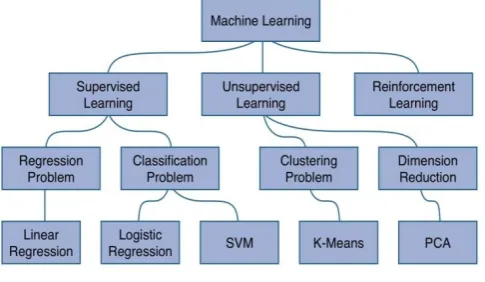
In today’s era we can define machine learning from its own meaning and can give a simpler definition which might work as, the ability of the machine to develop or write code itself without any human intervention and work according to user choices. These days automated or self-driving cars are at hike, Google uses your recommended choices of products and display them to you as advertisement , use in robotics for understanding our feeling and responding to us in appropriate manner etc. there is a huge amount of research work and infinite development in this field.It is further categorised into two parts that is supervised learning and unsupervised learning according to the given input and output produced.
Supervised learning
In supervised learning there are algorithms to build data using mathematical model which consists input and output. The known data is called training data which consists of training example which has one or more input and desired output. Training example is represented by feature vector and training data by matrix.
With use of Iterative optimization, supervised learning learn functions which can be used to predict output of new inputs .The inputs that were not the part of training data will also be correctly determined using algorithm that will be allowed by optimal function. Algorithm whose accuracy or predictions improves over time has learned from the performed task. Classification and regression problem are included under supervised learning algorithm. When output is restricted to a limited set of values then classification problem is used and when the output have numerical value within a range then a regression algorithm is used.The area closely related to regression and classification in supervised learning is Similarity learning, similarity function measures how two objects are similar or related are by learning from examples. Speaker verification, face verification, visual identity tracking etc. are its application.
Unsupervised learning
ISSN(Online): 2319-8753 ISSN (Print): 2347-6710
I
nternational
J
ournal of
I
nnovative
R
esearch in
S
cience,
E
ngineering and
T
echnology
(A High Impact Factor, Monthly, Peer Reviewed Journal)
Visit: www.ijirset.com Vol. 8, Issue 8, August 2019
such commonalities Instead of responding to feedback. Summarizing and explaining data features are encompassed in unsupervised learning.
Cluster analysis is the assignment of a set of observations into subsets so that observations within the same cluster are similar assumptions are made on structure of data using different clustering techniques, which are often defined by some similarity metric and evaluated. Methods are also based on estimated density and graph connectivity
Fig 1: Flow Chart
Reinforcement learning
To maximise the notion of cumulative reward, reinforcement machine learning is concerned with how software take actions in an environment so as to maximize a part of cumulative reward. The field is studied in many other disciplines because of its generality example game theory,control theory operation research, information theory, simulation-based optimization, swarm intelligence and genetic algorithm. Markov Decision Process (MDP) is used for representing environment in machine learning. Many reinforcement learning algorithm use dynamic programme techniques .Reinforcement learning algorithms do not assume knowledge of an exact mathematical model of the MDP, and are used when exact models are infeasible. Reinforcement learning algorithms are used in autonomous vehicles or in learning to play a game against a human opponent [1].
Feature learning
During training several learning algorithms aim at discovering better representations of the inputs provided. Classic examples include principal component analysis and cluster analysis. Feature learning algorithms which are oftenknown as representation learning algorithms, usually attempt to preserve the information in their input but also transform the information in such a way that makes it useful, as a pre-processing step which can be used before performing classification or predictions. This technique allows reconstruction of the inputs coming from the unknown data-generating distribution, while not being necessarily faithful to configurations that are implausible under that distribution[2].Allows machine to learn and perform a specific task using manual learning.
Feature learning can be either supervised or unsupervised.Using labelled input data features are learned In supervised feature learning,. Examples are artificial neural networks, multilayer perceptions, and supervised dictionary learning. Features are learned with unlabelled input data. Features are learned with unlabelled input data in unsupervised feature learning. Examples whichincludedictionary learning,analysis of independent component, auto encoders, matrix factorization and various forms of clustering fall under the category of unsupervised learning
ISSN(Online): 2319-8753 ISSN (Print): 2347-6710
I
nternational
J
ournal of
I
nnovative
R
esearch in
S
cience,
E
ngineering and
T
echnology
(A High Impact Factor, Monthly, Peer Reviewed Journal)
Visit: www.ijirset.com Vol. 8, Issue 8, August 2019
tasks such as classification require input that are mathematically and computational and which can be easily processed in Feature learning .Though data such as images, video, and sensory data are not yet capable of producing algorithmically which can be used to define specific features. An alternative is to discover such features or representations through examination, without relying on explicit algorithms [3].
Anomaly detection
Outlier detection also known data mining anomaly detection which is used the identification of rare items, events or observations which are raising suspicions by differing significantly from the majority data , some issues such as bank fraud, a structural defect, medical problems or errors in a text are anomalous items which are detected .
Unexpected bursts in activity, interesting objects are often not rare objects in the context of abuse and network intrusion detection. This pattern does not follow common statistical definition of an outlier being a rare object, on such data many outlier detection methods will, till it has been aggregated in an appropriate way.
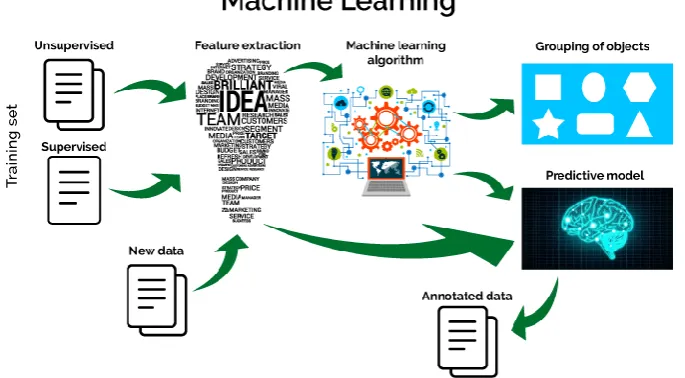
There are three broad categories in which anomaly detection techniques exist in unsupervised anomaly detection techniques, it detects anomalies in an unlabelled test data set having assumption that the majority have normal data set. To detect techniques and testing instance which are generated by a model having normal behaviour in Semi-supervised anomaly detection.
Fig 2: Identification of Data and Predicting Result
II. ARTIFICIAL NEURAL NETWORKS
To solve problems in the same way as that of human brain is the original goal of the ANN with time, attention is moving on for performing specific tasks, leading to deviations from biology.
Artificial neurons,According to the different kinds of transformations on the basis of their inputs, different layers may perform different transformations. Signals travel from the first layer which is the input layer, to the last layer being the output layer, possibly after traversing through multiple layers multiple number of times.
ISSN(Online): 2319-8753 ISSN (Print): 2347-6710
I
nternational
J
ournal of
I
nnovative
R
esearch in
S
cience,
E
ngineering and
T
echnology
(A High Impact Factor, Monthly, Peer Reviewed Journal)
Visit: www.ijirset.com Vol. 8, Issue 8, August 2019
Decision trees
In conclusions about the item's targeted valueDecision in tree learning uses a decision tree as a predictive model to go from observations about an item. This can be seen as one of the predictive modelling approaches used in statistics, data mining and machine learning. Where the targeted variable can take a discrete set of values in tree model, are called classification trees. Regression trees are those where a targeted variable can take continuous values in decision trees. A decision tree describes a data in data mining.
Support vector machines
Support vector networks which are commonly known as Support vector machines (SVM), for classification and regressionthere are set of methods which are related in supervised learning. A set of training example where each of them I marked as belonging to one of two categories, a model is built that predicts a SVM training falls into one category or the other .An efficient performance can be given by a SVM foe non-linear classification using tricks such as Kernel trick.Searches not being send to the website rather handled midway. Inference and learning efficient algorithms can be used. Devices which are Surfing on some website and the searches are not being send to the main website directly.
Pattern Recognising
Pattern is one of the most important key for a programme and even essential for systems towork in a systematic manner so to fulfil the needs and wants of a user. We can observe a pattern physically or it can even be observed mathematically by applying various algorithms. Is the process recognizing of patterns by using machine learning algorithm. The knowledge which is already gained or information through statistical data is used in Pattern recognising for classification of data. Continuous or discrete binary variables are features that may be represented. Features may be represented as continuous, discrete or discrete binary variables. Pattern recognition is being used to give human recognition intelligence to machine which plays a major role required inprocessing of image.
Bayesian networks
Belief network or directed acyclic graphical are none other than graphical model of Bayesian network, which are used for representing a set of random variables and even used for representing their directed acyclic graph with conditional independence.
It can even be used for identifying diseases and their symptoms. Now easily identifying and solving problems such as, text of a data images and files containing data, one can refer to influence diagram which can be used in Bayesian network.
For providing inference and learning efficient algorithms can be used.
Training model
In most of the cases machine learning programme require a lot of data and storage so to that it can operate leniently, and when training a machine, it requires a lot of data so that the machine could perform well.
The data collected can vary from the main data such as text, images or some data file, so that the machine could perform well. The data collected can vary from the main data such as text, images or some data file.
Federated learning
This is a new way of training machine learning models as many of them get decentralize in the training process , so that the user privacy or data is not send to centralize servers , due to this the efficiency of training process increases in many
devices .
Surfing on some website and the searches not being send to the website rather handled midway. Inference and learning
ISSN(Online): 2319-8753 ISSN (Print): 2347-6710
I
nternational
J
ournal of
I
nnovative
R
esearch in
S
cience,
E
ngineering and
T
echnology
(A High Impact Factor, Monthly, Peer Reviewed Journal)
Visit: www.ijirset.com Vol. 8, Issue 8, August 2019
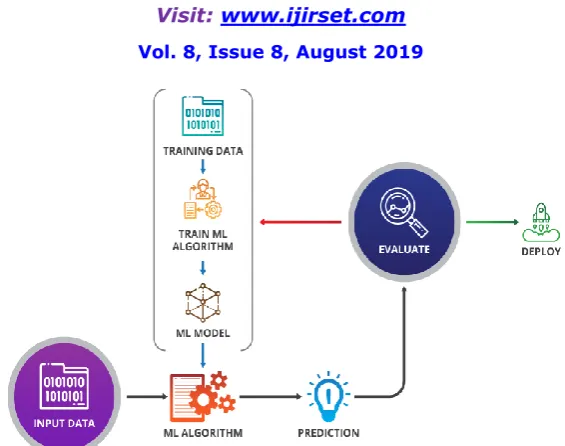
Fig 3: Evaluation of Input Data
III. CONCLUSION
Machine learning is one of the most advanced way to develop any machine, which can probably act as a human and support the living for a better, and could lead us at points that lack human reach by communicating with the entire system so to provide a deeper context to information and improve the quality of technology present were a vast majority is connected safely.
REFERENCES
1. R. Kohavi and F. Provost, "Glossary of terms," Machine Learning, vol. 30, no. 2–3, pp. 271–274, 1998.
2. Mohri, Mehryar; Rostamizadeh, Afshin; Talwalkar, Ameet (2012). Foundations of Machine Learning. The MIT Press. 3. "The First Wave of Corporate AI Is Doomed to Fail". Harvard Business Review. 2017-04-18. Retrieved 2018-08-20. 4. "Why the A.I. euphoria is doomed to fail". VentureBeat. 2016-09-18. Retrieved 2018-08-20.
5. Dimitri P. Bertsekas and John N. Tsitsiklis. "Neuro-Dynamic Programming", Athena Scientific, 1996.
6. Hernandez, Daniela; Greenwald, Ted (11). "IBM Has a Watson Dilemma". Wall Street Journal. ISSN 0099-9660. Retrieved 2018-08-21.
7. "Opinion | When an Algorithm Helps Send You to Prison". New York Times. Retrieved 2018-08-20.
8. Daniel Jurafsky; James H. Martin (2009). Speech and Language Processing. Pearson Education International. pp. 145–146. 9. Metz, Rachel. "Why Microsoft's teen chatbot, Tay, said lots of awful things online". MIT Technology Review.
10. Hempel, Jessi (2018-11-13). "Fei-Fei Li's Quest to Make Machines Better for Humanity". Wired. ISSN 1059-1028. Retrieved 2019-02-17.
11. Coates, Adam; Lee, Honglak; Ng, Andrew Y. (2011). An analysis of single-layer networks in unsupervised feature learning (PDF). Int'l Conf.
on AI and Statistics (AISTATS).
12. Shapiro, Ehud Y. Inductive inference of theories from facts, Research Report 192, Yale University, Department of Computer Science, 1981. Reprinted in J.-L. Lassez, G. Plotkin (Eds.), Computational Logic, The MIT Press, Cambridge, MA, 1991, pp. 199–254.
13. Urbanowicz, Ryan J.; Moore, Jason H. (2009-09-22). "Learning Classifier Systems: A Complete Introduction, Review, and Roadmap". Journal of Artificial Evolution and Applications. 2009.
14. Ray Solomonoff, An Inductive Inference Machine, IRE Convention Record, Section on Information Theory, Part 2, pp., 56–62, 1957. 15. Van Otterlo, M.; Wiering, M. (2012). Reinforcement learning and markov decision processes. Reinforcement Learning. Adaptation, Learning,