Copyright to IJIRSET www.ijirset.com 5622
Removal of Two Azo and Two Anthra-
Quinone Dyes from the Textile Effluent
Using Tunic of
Allium Cepa
.
Sumalatha Mallipudi
1, N.T.Rajeeva Lakshmi
2and Meena Vangalapati
3Research. Scholar, Dept of Chemical Engineering, AUCE (A), Andhra University, A.P, India1
M.Tech. Student, Dept of Chemical Engineering, AUCE (A), Andhra University, A.P, India2
Associate professor, Dept of chemical Engineering, AUCE (A), Andhra University, A.P, India3
Abstract: Textile effluents are the one most calumnious threat to the environment, which have a lot of chronic effect towards the human beings. Color is the main experimental variable to recognize the water has contaminated. Out of many techniques, Adsorption is attaining a specific place of importance due to its scope choosing naturally available materials. Tunic of Allium cepa (TAC) had been chosen as an Adsorbent, as it is abundantly available. Powdered TAC (PTAC) was used for optimization studies for the removal of selected dyes from the textile effluents. The selected dyes are safranine, Indigoid, Alizarin Red S and Crystal violet belongs to the Azo and Anthraquinone family dyes respectively. These dyes are selected as they are not degradable easily and are very toxic in nature. The optimum percentage removal of selected dyes from the textile effluent was 70, 53, 40 and 68 respectively
.
Key words: Adsorption, Azo dyes, Anthraquinone dyes, Textile effluent, Optimization, Allium cepa.
I. INTRODUCTION
Most of the Industries releases the effluent with a load of color with it and is released in to the nearby water bodies. Especially, the textile industries discharge the effluent with a lot dyes and organic matter in it. Now days, treating the textile effluents are becoming an environmental concern due to scarcity of water, chronic effects. Treating the effluents can be done in so many conventional methods likely ion exchange, reverse osmosis, coagulation and flocculation, Ozonation, fungal decolorization, adsorption etc. Dyes exist in two forms one is True color and the other is Apparent color. Apparent color can be removed very easily where as True color is very hard to treat. Since Organic content reduces the Dissolved Oxygen content in the water and becomes a threat to the Aquatic life and dyes used in textile industries are very carcinogenic, mutagenic and toxic in nature leads to the chronic effects towards human beings.
Copyright to IJIRSET www.ijirset.com 5623 mainly sourced from agricultural waste such as rice husk [17, 11], Mango seeds [16], peanut husk [15], Moringaoliefera seeds [14], Coffee grounds [5], Neem dust [7], Mytilusedulis shells [12], Sagaun saw dust [10], eucalyptus [9], Pine apple leaves [8], Subabul seeds [4], Bahama grass[3] fledspar [6]. The natural adsorbents are chemically or magnetically treated to get high efficiencies for the removal of pollutants from the textile effluents [5, 15].
This part of a research work,a Tunic of Allium cepa (TAC) was used to remove the dye stuff from the Textile effluent. The dyes concentrated belong to the family of Azo and Anthroquinone namely Safranine, Indigo carmine, Alizarin Red S and Crystal Violet respectively. The below mentioned table1gives the details of the selected dye stuff.
S.no Product Chemical
formula
Chemical Name Type Molecular
weight
C.I.no λ (nm)
1. Safranine C20H19N4Cl Basic Red 2 Cationic /
Direct / Azo
350.84 50240 516
2. Alizarine Red S (ARS)
C14H7NaO7S Mordant Red 3 Anthra-
quinone
342.26 58005 518
3. Indigoid C16H8N2Na2O8
S4
Carmine indigo Anionic/ Azo
466.36 73015 612
4. Crystal Violet C25H30N3Cl Basic Violet 3 Anthra –
quinone / Basic
408.0 42555 591
Table.1: Details of Dyes selected Safranine, Alizarin Red S, Indigoid and Crystalviolet.
TAC is very abundantly available in the local market of Visakhapatnam. TAC was used to study the optimized conditions for the removal of selected dye stuff from the textile effluent. The optimized conditions which are studying in this paper are pH, contact time, dosage of adsorbent, particle size. The effects of the optimized parameters are discussed.
II. MATERIALS AND METHODS
Copyright to IJIRSET www.ijirset.com 5624
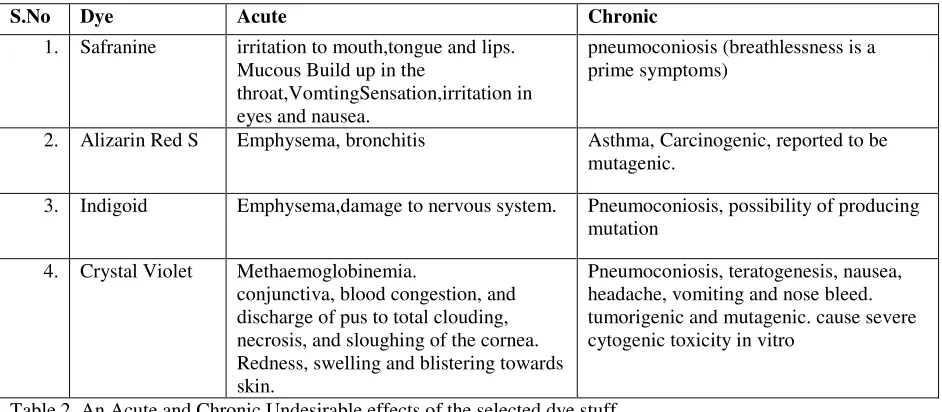
S.No Dye Acute Chronic
1. Safranine irritation to mouth,tongue and lips. Mucous Build up in the
throat,VomtingSensation,irritation in eyes and nausea.
pneumoconiosis (breathlessness is a prime symptoms)
2. Alizarin Red S Emphysema, bronchitis Asthma, Carcinogenic, reported to be mutagenic.
3. Indigoid Emphysema,damage to nervous system. Pneumoconiosis, possibility of producing mutation
4. Crystal Violet Methaemoglobinemia.
conjunctiva, blood congestion, and discharge of pus to total clouding, necrosis, and sloughing of the cornea. Redness, swelling and blistering towards skin.
Pneumoconiosis, teratogenesis, nausea, headache, vomiting and nose bleed. tumorigenic and mutagenic. cause severe cytogenic toxicity in vitro
Table 2. An Acute and Chronic Undesirable effects of the selected dye stuff.
2. Optimization studies: Parameters like pH, Contact time of the Adsorbent, Dosage of the Adsorbent, and size of the Adsorbent were studied to obtain highest removal percentage of selected dye stuff from the textile effluent and the procedures were as follows.
Optimization of Contact time of Adsorbent: Optimum Contact time was investigated by taking a 100 ml of effluent sample taken in four conical flasks (namely 1, 2, 3, and 4.). To the conical flasks 1gm of PTAC was added simultaneously to all the four conical flasks. The conical flasks were in shaker for four different time periods as 30, 60, 90, and 120. After the completion of contact time, supernatant of each individual sample was taken at their respective time and their concentrations of the selected dye stuff were noticed at their respective wavelength. Optimization of PTAC for Effluent: Optimum PTAC was investigated by taking 100 ml of effluent sample in four individual conical flasks (namely 1, 2, 3 and 4). Different amounts of adsorbent (0.5gm, 1gm, 2gm and 3gm) was added to the above four conical flasks simultaneously. Then after, the conical flasks were kept for shaking in a shaker for about a period of 2hrs. The supernatant was collected for each of individual sample and their concentrations of the selected dye stuff were noticed at their respective wavelength.
Optimization of pH: The value of optimum pH was determined by adjusting the pH in the five conical flasks (namely 1, 2, 3, 4 and 5) and pH was varied in the range of 2.5 to 4.5 by using HCL and NaOH. 100 ml of effluent was taken in above mentioned five conical flasks and then pH also adjusted. Five conical flasks were kept for shaking in shaker for 2hrs and concentrations were observed for the selected dye stuff at their respective wavelength for the collected supernatants of each individual sample.
Copyright to IJIRSET www.ijirset.com 5625
III. RESULTS AND DISCUSSIONS
Parameters like Contact time, Particle size, Amount of Adsorbent, pH, initial concentration of dye etc, play a crucial role in study of adsorption technique. With these parameters, Recovering of adsorption can be done, efficiency of adsorption and yield can be increased enormously.
Effect of Contact time:
Effect of contact time for the removal of selected dyes from the effluent was shown below mention figure. The parameters to be maintained were temperature and the Adsorbent dosage fixed at 30 oC and 1gm per 100ml respectively. With the increase in the time of contact, the removal of selected dye stuff increases till the removal reaches an equilibrium phase. Crystal violet was showing high removal right from the initial point. Whereas the other dyes, Indigoid and Alizarin Red S had lowness in the removal. Here in the optimization of the contact time, removal of dyes were getting stabilized after the completion of 120 min and the values for each dye after completion of 120 min were mentioned in the below table.
Fig.1 Influence of contact time on % of removal of dyes
Effect of pH:
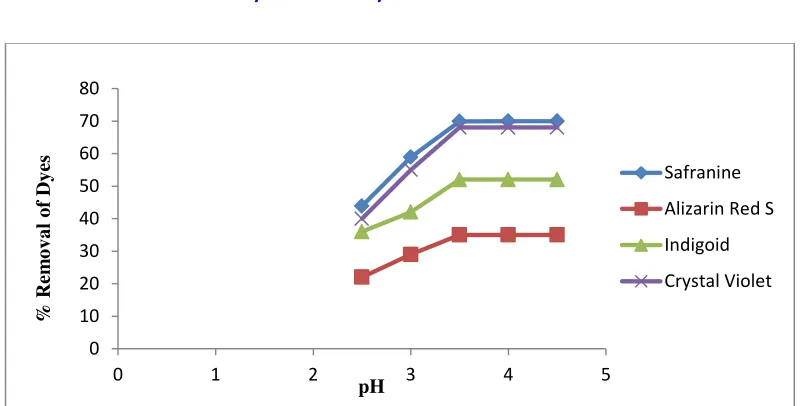
The effect of pH on the removal of selected dye stuff on the PTAC was studied where the temperature, contact time and amount of PTAC fixed at 30 oC, 120 min and 1 gm respectively. The influence of pH was studied from the range of 2.5 - 4.5. With the increase in pH, there was a change in removal can be noticed. Safranine was showing an equilibrium phase from pH 3 to 4 and shown high removal than other dyes. Alizarin Red S and Indigoid had shown quite less amounts of removal.
0 10 20 30 40 50 60 70 80
0 50 100 150 200
%
Rem
o
v
a
l
o
f
Dy
es
Contact Time (min)
Safranine
Alizarin Red S
Indigoid
Copyright to IJIRSET www.ijirset.com 5626
Fig. 2 Influence of the pH on % removal of Dyes.
Effect of Dosage of Adsorbent:
In this work, the effect of Dosage of Adsorbent for the removal of SN from the effluent was studied and is shown in below mentioned figure. While the parameters like contact time, temperature and pH fixed at 120 min, 30 oC, and 3.5 respectively. Due to the availability of high amt of PTAC, this increases the active sites for adsorption increases dye removal. Safranine was shown the highest removal and Alizarin Red S shown lowest removal.
Fig. 3 Influence of Dosage of PTAC on %removal of dyes.
0 10 20 30 40 50 60 70 80
0 1 2 3 4 5
%
Rem
o
v
a
l
o
f
Dy
es
pH
Safranine
Alizarin Red S
Indigoid
Crystal Violet
0 10 20 30 40 50 60 70 80
0 1 2 3 4
%Rem
o
v
a
l
o
f
Dy
es
Dosage
ofPTAC (gm)
Safranine
Alizarin Red S
Indigoid
Copyright to IJIRSET www.ijirset.com 5627 Effect of Particle size:
In this study, the parameters to be maintained were temperature, adsorbent dosage and the contact time fixed at 30
o
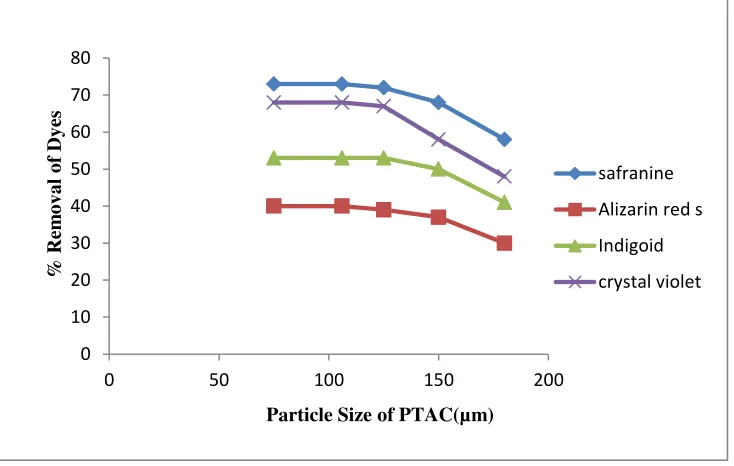
C, 1 gm and 120 min respectively, to find out the particle size which suits to further process. From the below mentioned figure, the removal of dye decreases with the increases in the size of adsorbent. This entails that the lesser size of PTAC gave the high removal of selected dye stuff from the effluent. The selected dye stuff showed similar type of effect while on the removal with the adsorption of PTAC.
Fig.4 Influence of Particle Size (µm) on % Removal of dyes.
After the completion of the optimization process. With the obtained optimum parameters, an experiment had conducted to know the optimum percentage removal of selected dye stuff from the Textile industry effluent and the values were shown in the table 3.
Dye /
Parameters.
Contact Time
(min).
pH Particle Size
(µm).
Dosage of
PTAC(gm).
% Removal of Dye.
Safranine 120 3 125 1.5 70
Alizarine Red S 120 3.5 125 1.5 40
Indigoid 120 3.5 125 2 53
Crystal violet 120 3.5 125 2 68
Table 3: Optimum conditions for the removal of selected dye stuff through Adsorption
0 10 20 30 40 50 60 70 80
0 50 100 150 200
%
Rem
o
v
a
l
o
f
Dy
es
Particle Size of PTAC(µm)
safranine
Alizarin red s
Indigoid
Copyright to IJIRSET www.ijirset.com 5628
IV. CONCLUSIONS:
This present part of research study reveals that the PTAC can use as an Adsorbent for the removal of selected dye stuff from the textile effluent. The removal of Dye adsorbed varies with the contact time and particle size. From this optimization process, PTAC shows an efficient way to replace the commercial activated carbon for the removal of dyes textile effluent. Overall, the results suggest that the PTAC can be an efficient adsorbent for the removal of dyes from the textile effluent. The optimum conditions for the removal of Safranine, Indigoid, Alizarin Red S and Crystal Violet from the textile effluent on to the PTAC were 70, 53, 40 and 68 respectively.
REFERENCES
[1] M. Ghaedi, A. Najibi, H. Hossainian, A. Shokrollahi and M. Soylak, “Kinetic and equilibrium study of Alizarin Red S removal by activated
carbon,” Toxicological & Environmental Chemistry. Vol. 94, 2012, pp 40–48.
[2] H. V. Jadhava, S. M. Khetre and S. R. Bamane, “Removal of Alizarin red-S from aqueous solution by adsorption on nanocrystalline Cu0.5Zn0.5Ce3O5,” Der ChemicaSinica. Vol. 2, 2011, pp 68-75.
[3] J. Samusolomon and P. Martin Devaprasath, “Removal of Alizarin Red S (Dye) from aqueous Media by using Cynodondactylon as an
Adsorbent,”J. Chem. Pharm. Res. Vol. 3, 2011, pp 478-490.
[4] A.K.Patil and S. VinodShrivastava, “Kinetic and Equilibrium Studies on the Adsorption of Crystal Violet Dye Using Leucaena Leucocephala
(Subabul) Seed Pods as an Adsorbent,” Journal of Applied Chemical Research. Vol. 6, 2012, pp 24-36.
[5] Ivo Safarik, Katerina Horska, BarboraSvobodova and MirkaSafarikova, “Magnetically modified spent coffee grounds for dyes removal,” Eur
Food Res Technol. Vol. 234, 2012, pp 345–350.
[6] NamalPriyanthaand SujeewaPerera, “Removal of Sulfate, Phosphate And Colored Substances In Wastewater Effluents Using Feldspar,”
Water Resources Management. Vol. 14, 2000, pp 417–433.
[7] S. D. Khattri and M. K. Singh, “Colour Removal from Synthetic Dye wastewater Using A Bioadsorbent,” Water, Air, And Soil Pollution.
Vol. 120, 2000, pp 283–294.
[8] SagnikChakraborty, Shamik Chowdhury and Papita Das Saha, “Insight into biosorption equilibrium, kinetics and thermodynamics of crystal
violet onto Ananascomosus (pineapple) leaf powder,” Appl Water Sci. Vol. 2, 2012, pp 135–141.
[9] Luis M. Cotoruelo, Marı´a D. Marque´ s, Francisco J. Dı´az, Jose´ Rodrı´guez-Mirasol, Juan J. Rodrı´guez, and Toma´ s Cordero, ”Lignin
-Based Activated Carbons as Adsorbents For Crystal Violet Removal from Aqueous Solutions,” Environmental Progress & Sustainable Energy.
Vol.31, 2012, pp 386-396.
[10] S. D. Khattri and M. K. Singh, “Use of Sagaun Sawdust as an Adsorbent for the Removal of Crystal Violet Dye from Simulated
Wastewater,” Environmental Progress & Sustainable Energy. Vol. 31, 2012, pp 435-442.
[11] Rajeev jain, meghamathur and shalinisikarwar, “Removal of indigo carmine from industrial effluents using low cost adsorbent,” Environmental Progress & Sustainable Energy. Vol.31, 2012, pp 258-263.
[12] Maghri, A. Kenz, M. Elkouali, O. Tanane and M. Talbi, “Textile Dyes removal from industrial waste water by mytilusedulis shells,”J. Mater. Environ. Sci. Vol. 3, 2012, pp121-136.
[13] Chang SookKeng, ZulkarnainZainal and Abdul Halim Abdullah, “Removal of Cationic and Anionic Dyes by Immobilised Titanium
Dioxide Loaded Activated Carbon,” The Malaysian Journal of Analytical Sciences. Vol. 12: pp 451 – 457 2008.
[14] Beltra´n-Heredia, J. Sa´nchez-Martı´n, and A. Delgado-Regalado, “Removal of Carmine Indigo Dye with MoringaoleiferaSeed Extract,”
Ind. Eng. Chem. Res.Vol.48, 2009, pp 6512–6520.
[15] Ivo Safarika and MirkaSafarikova, “Magnetic fluid modified peanut husks as an adsorbent for organic dyes removal,” Physics Procedia.Vol. 9, 2010, pp 274–278.
[16] Mohamad RasoolMalekbala, Salman MasoudiSoltani, Sara KazemiYazdi, and SorayaHosseini, “Equilibrium and Kinetic Studies of Safranine Adsorption on Alkali-Treated Mango Seed Integuments,” International Journal of Chemical Engineering and Applications. Vol. 3, 2012, pp 160-166.
[17] Papita Das Saha and Rahul Mishra, “Adsorption of safranin onto chemically modified rice husk in a upward flow packed bed reactor:
Copyright to IJIRSET www.ijirset.com 5629
BIOGRAPHY
Dr.MeenaVangalapatiM.Tech., Ph.D, Associate Professor, Department of Chemical Engineering, Andhra University College of Engineering (A), Andhra University, Visakhapatnam, Andhra Pradesh, India. She has 12 years of teaching experience and published 47 more Papers published in National and International Reputed Journals published 5 monographs/Books.
Mrs.M.SumalathaM.Tech., (Ph.D.) Department of Chemical Engineering, Andhra University College of Engineering (A), Andhra University, Visakhapatnam, Andhra Pradesh, India. She has attended 10 more National and International conferences. She possesses teaching Experience of More than three years.