Optimization of Material Removal Rate and
Surface Roughness in Laser Cutting Machine
by Taguchi Method
Sachin Srinivasan
1, Rajeshwar S Kadadevaramath
2, Vijay Kumar
3, Suresh Kumar P K
4Department of Industrial Engineering and Management, Siddaganga Institute of Technology, Tumakuru, Karnataka,
India1 2 3
SFO Technologies pvt ltd, Bommasandra Industrial area, Bangalore, Karnataka, India4
ABSTRACT: The main aim of the work shows the optimization of surface roughness in CO2 laser cutting of stainless
steel of 3mm thickness by using Taguchi method. The experiment is conducted on the basis of standard L25 Orthogonal
Array Taguchi method by five different levels by considering parameters such as cutting speed, laser power and assist gas pressure. Optimal solution is obtained by L25 Orthogonal array. Validation of process parameter is necessary to
achieve the objective so analysis is made by using ANOVA (Analysis of Variance). By the analysis of variance, laser cutting parameter are identified which affecting the machining process. The results shows that cutting parameters such as cutting speed and assist gas pressure majorly affects the surface roughness when compared to laser power, because laser power has less effect on surface roughness.
KEYWORDS: Taguchi method, ANOVA, CO2 laser, Surface roughness
I. INTRODUCTION
Laser cutting is a technology that uses a laser to cut materials, and is typically used for industrial manufacturing applications. . Laser cutting works by directing the output of a high-power laser most commonly through optics. The laser optics and CNC (computer numerical control) are used to direct the material. The focused laser beam directed at the material, which then either melts, burns, vaporizes away, or is blown away by a jet of gas, leaving an edge with a high-quality surface finish. Industrial laser cutters are used to cut flat-sheet material as well as structural and piping materials. The laser cutting process mainly depends on the cutting parameters to achieve maximum metal removal rate and to minimize the surface roughness.
II. LITERATURE REVIEW
Milos Madiac et.al (1) used Taguchi method for optimization of surface roughness in mild steel material and they considered three parameters and showed that speed of cut and gas pressure has more influence when compared to laser. P.J Pawar et.al (2) made multiobjective optimization using genetic algorithm (NSGA) to obtain optimum solution. They carried out their work on stainless steel to improve the quality performance in terms of kerf width, kerf taper and surface roughness by considering assist gas pressure, cutting speed and pulse of frequency.Venkatesan et.al (3) made an experimental investigation of Laser Assisted Machining (LAM) of Inconel 718 using turning process and they conducted Taguchi L9 orthogonal array of experimental design. To determine the effects on cutting temperature and cutting forces they considered control factors such as cutting speed, feed rate and laser power. Multilayered coated carbide insert is used as cutting tool for machining. Finally the cutting forces were compared between LAM and conventional machining a maximum of 60% of reduction was observed. From the literature review, the literature gap observed that there are many works carried out on the optimization of cutting parameters of CO2 laser on mild steel,
present work is carried out on stainless steel using Taguchi based orthogonal array approach. By considering laser power, assist gas pressure and cutting speed as major parameters which affecting the machining process.
III. PROBLEM DEFINITION
By undergoing machining process it is identified that the parameters play an important role in achieving maximum removal rate and improve surface roughness.While working on the specific material, burrs are created on the workpiece.In the on-going process, the metal removed will struck on the workpiece so that the nozzle head moves to the next process instead of doing the particular process and also improper cut in the workpiece occurs instead of cutting the proper dimension. Bow issues arises in the workpiece leads to improper machining.
1. OBJECTIVES:
The main objective of the present work is toInvestigate the effects of various Laser cutting machine input parameters i.e. cutting speed, cutting material thickness & its composition, assist gas pressure, laser power, mode of operation, cutting angle, nozzle gap, feed rate etc., on metal removal rate and surface finish on machining. Identifying the key parameters which are majorly affecting the machining process. Process parameter optimization by using Taguchi method. Validation of process parameter by using ANOVA.
2. METHODOLOGY
Based on the problem definition and objectives as explained in the previous chapter. Methodology is explained here to define the objectives. Based on the present machining process followed, some of the problems were identified such as Parameters like cutting speed, gas pressure, laser power, feed rate and nozzle velocity etc. play an important role in maximize the material removal rate and to enhance the surface finish, so as to overcome the existing problem, few optimization technique has to be incorporated. Based on the mentioned parameter the following study was conducted to achieve the objective. Once the root cause of the problems/parameter which impacted the material removal and surface finish was identified and objectives were set to overcome the problem .Cutting speed, Gas pressure and Laser power were identified as the main factor affecting the laser cutting process. Based on the observation, Taguchi method was followed to Design the experiment to study the major contributing factors. Minitab software was used to optimize the Design of Experiments using Taguchi techniques.Validation/Analysis of the contributing factors (process parameters) for laser cutting was done with the help of ANOVA tool (Analysis Of Variance). Contribution of Process parameters for laser cutting were hence identified. Finally, a confirmation test was carried out to compare the experimental results with the estimated results.
3. EXPERIMENTAL SETUP
The experimental setup was made by conducting the experiments using laser cutting machine
Machine Type LASER-TRUMPF TLF 3200
Machine power 3200 W
Material Stainless steel
Material Thickness 3mm
Type of Gas Nitrogen
Nozzle diameter 1.7mm
Lens focal length 7.5ʺ
Nozzle stand off 0.60mm
Table 1
Level
Cutting Speed (mm/min)
Laser Power(W)
Assist gas pressure(bar)
1 3000 1000 10
2 4000 1500 11
3 5000 2000 12
4 6000 2500 13
5 7000 3000 14
IV. RESULT AND DISCUSSION
Taguchi Method:
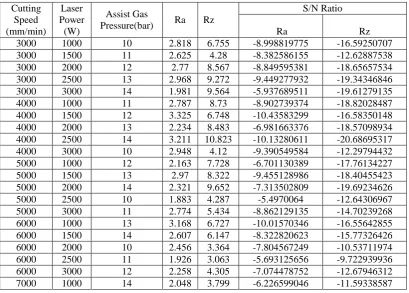
The Taguchi method is a well-known technique that provides a systematic and efficient methodology for process optimization. It has been widely used for product design and process optimization worldwide. This is due to the advantages of the design of experiment using Taguchi’s technique, which includes simplification of experimental plan and feasibility of study of interaction between different parameters.The design was constructed with L25 Taguchi orthogonal array and the experimental results, in terms of surface roughness were obtained after conducting the machining operation for the specimen were shown in the table.The instrument used to measure surface roughness was Surtronics 3+. For a probe movement of 4mm, surface roughness readings were recorded at three locations on the work piece and the average value was used for analysis.Specifications of Surtronics 3+: gauge range: ±150um, probe movement (max): 25.4mm, traverse speed: 1mm/s.Later, the results were analyzed by employing main effects, ANOVA and the signal-to-noise ratio (S/N) analysis.
Table 2
Cutting Speed (mm/min)
Laser Power
(W)
Assist Gas
Pressure(bar) Ra Rz
S/N Ratio
Ra Rz
3000 1000 10 2.818 6.755 -8.998819775 -16.59250707
3000 1500 11 2.625 4.28 -8.382586155 -12.62887538
3000 2000 12 2.77 8.567 -8.849595381 -18.65657534
3000 2500 13 2.968 9.272 -9.449277932 -19.34346846
3000 3000 14 1.981 9.564 -5.937689511 -19.61279135
4000 1000 11 2.787 8.73 -8.902739374 -18.82028487
4000 1500 12 3.325 6.748 -10.43583299 -16.58350148
4000 2000 13 2.234 8.483 -6.981663376 -18.57098934
4000 2500 14 3.211 10.823 -10.13280611 -20.68695317
4000 3000 10 2.948 4.12 -9.390549584 -12.29794432
5000 1000 12 2.163 7.728 -6.701130389 -17.76134227
5000 1500 13 2.97 8.322 -9.455128986 -18.40455423
5000 2000 14 2.321 9.652 -7.313502809 -19.69234626
5000 2500 10 1.883 4.287 -5.4970064 -12.64306967
5000 3000 11 2.774 5.434 -8.862129135 -14.70239268
6000 1000 13 3.168 6.727 -10.01570346 -16.55642855
6000 1500 14 2.607 6.147 -8.322820623 -15.77326426
6000 2000 10 2.456 3.364 -7.804567249 -10.53711974
6000 2500 11 1.926 3.063 -5.693125656 -9.722939936
6000 3000 12 2.258 4.305 -7.074478752 -12.67946312
7000 1500 10 2.236 3.57 -6.989435984 -11.05336432
7000 2000 11 2.863 4.225 -9.13642696 -12.51653427
7000 2500 12 1.996 2.87 -6.003210739 -9.157637935
7000 3000 13 2.299 4.627 -7.230779425 -13.30598999
Main Effects
The surface roughness for each factor i.e. Cutting speed, Laser Power and Assist gas pressure at each level i.e. level 1, level 2, level 3, level 4, level 5 was obtained and the result is summarized in Table 6.2. The quality characteristics investigated in this study was “smaller-the-better” owing to the fact that smaller roughness represents good surface quality with maximum material removal rate.
S/N ratio were calculated from the following equations (4):
Where, yiis the quality characteristic under consideration for ith experiment.
Figure 1 Figure 2
Figure 1 shows the combination of laser cutting parameters and their level A5B4C5 yields the optimum quality
characteristic i.e. cutting speed 7000 mm/min, Laser Power 2500W, Assist gas pressure 14 bar gives the optimal surface roughness.Figure 2 shows the combination of laser cutting parameters and their level A5B2C1 yields the
optimum quality characteristic i.e. cutting speed 7000 mm/min, Laser Power 2500W, Assist gas pressure 10 bar gives the optimal surface roughness.
Table 3
Source DF Seq SS Adj SS Adj
MS F P
Cutting Speed
(mm/min) 4 1.0957 1.0957 0.274 1.18 0.367
Laser Power
(W) 4 0.3833 0.3833 0.096 0.41 0.795
Assist Gas
Pressure (bar) 4 0.2802 0.2802 0.07 0.3 0.871
Error 12 2.7774 2.7774 0.232
Total 24 4.5366
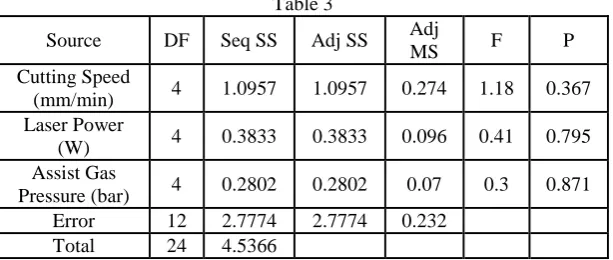
the value cutting speed, within the range investigated in this study, affect the surface roughness and thereby the chatter significantly since the F-ratio is higher than 1. It can also be seen from this table that the percentage contribution of parameter i.e. Cutting speed to the roughness is maximum (24.15%).The percentage contribution of other parameters in descending order is Laser power (8.45%) and assist gas pressure (6.20%).Thus based on the ANOVA analysis the optimal combination of laser cutting parameters and their levels for achieving minimum surface roughness is A5B4C5
i.e. Cutting speed is 7000 mm/min, Laser power is 2500 W and Assist gas pressure is 14 bar.
Table 4
Source DF Seq SS Adj SS
Adj
MS F P
Cutting Speed
(mm/min) 4 66.763 66.763 16.691 8.37 0.002
Laser Power (W) 4 6.24 6.24 1.56 0.78 0.558
Assist Gas Pressure
(bar) 4 45.938 45.938 11.484 5.76 0.008
Error 12 23.915 23.915 1.993
Total 24 142.855
Table 6.4 shows the results of ANOVA for the roughness test. The F-ratios were obtained for 99% level of confidence. In addition to this, percent contribution of each parameter was also calculated. It can be seen from Table 6.4 that change in the value cutting speed and assist gas pressure within the range investigated in this study, affect the surface roughness and thereby the chatter significantly since the F-ratio is higher than 1. It can also be seen from this table that the percentage contribution of parameter i.e. Cutting speed to the roughness is maximum (46.74%).The percentage contribution of other parameters in descending order is Laser power (4.63%) and assist gas pressure (32.15%).Thus based on the ANOVA analysis the optimal combination of laser cutting parameters and their levels for achieving minimum surface roughness is A5B4C1 i.e. cutting speed is 7000 mm/min, Laser power is 2500 W and Assist gas
pressure is 10 bar.
Confirmation test:
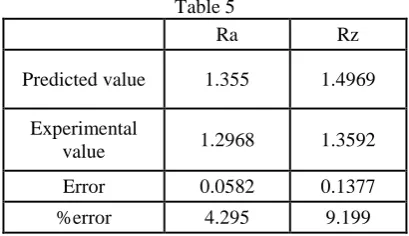
Once the optimal combination of process parameters and their levels was obtained, the final step was to verify the estimated result against experimental value. It may be noted that if the optimal combination of parameters and their levels coincidently match with one of the experiments in the OA, then no confirmation test is required.Confirmation test was required in the present work because the optimum combination of parameters and their levels i.e. A5B4C5 for
Raand A5B4C1 for Rz did not correspond to any experiment of the orthogonal array. The value of surface roughness Ra
and Rz obtained from the experiment was then compared with the predicted value as shown in the table 5.
Table 5
Ra Rz
Predicted value 1.355 1.4969
Experimental
value 1.2968 1.3592
Error 0.0582 0.1377
%error 4.295 9.199
experimental result is strongly correlated with the predicted result, as the error is only 4.295% for Ra and 9.199% for Rz respectively.
V. CONCLUSION
The combination of laser cutting parameters i.e. cutting speed, laser power and assist gas pressure were planned by L25 Orthogonal Array Taguchi method , based on the results obtained and derived analysis the following can be
concluded.
The optimal solution obtained for Ra and Rz based on the combination of laser cutting parameters and their levels is A5B4C5 (i.e. cutting speed 7000 mm/min, laser power 2500W and assist gas pressure 14 bar) and
A5B4C1 (i.e. cutting speed 7000mm/min, laser power 2500W and assist gas pressure 10 bar) respectively. ANOVA results indicate that cutting speed plays prominent role in determining the surface roughness. The
contribution of cutting speed, laser power and assist gas pressure to the quality characteristics surface roughness Ra is 24.15%, 8.45% and 6.20% respectively.
The contribution of cutting speed, laser power and assist gas pressure to the quality characteristics surface roughness Rz is 46.74%, 4.36% and 32.15% respectively.
Cutting speed and assist gas pressure are the most significant parameters majorly affecting the surface roughness whereas the laser power is much smaller.
The optimal cutting parameters are determined using Taguchi methods match with the experimental values by minimum errors i.e. 4.295% for Ra and 9.199% for Rz respectively.
REFERNCES
1. Milos Madic, Miroslav Radovanic, LaurentiuSlateanu “Surface Roughness Optimization in CO2 laser cutting by using Taguchi Method”
U.P.B. Sci. Bull., Series D, Vol. 75, Iss. 1, 2013.
2. P.J. Pawar and G.B. Rayate “Multi-objective Optimization of Laser Beam Machining Process Parameters” International Journal of Advanced
Mechanical Engineering.ISSN 2250-3234 Volume 4, Number 3 (2014), pp. 257-262.
3. K. Venkatesan, R. Ramanujam, P. Kuppan “Analysis of Cutting Forces and Temperature in Laser Assisted Machining of Inconel 718 using
Taguchi Method” 12th Global congress on manufacturing and management, GCMM 2014, published by Elsev, by 2014.
4. Phadke, M.S., 1989, “Quality Engineering Using Robust Design”. Prentice Hall International Inc., New York.