© 2017, IJCSMC All Rights Reserved 154
Available Online atwww.ijcsmc.com
International Journal of Computer Science and Mobile Computing
A Monthly Journal of Computer Science and Information Technology
ISSN 2320–088X
IMPACT FACTOR: 6.017
IJCSMC, Vol. 6, Issue. 5, May 2017, pg.154 – 159
Review: Routing Protocols and
Optimization Algorithms in MANET
Harshpreet Kaur
1, Sukhjeet Kaur
21
ECE Department, BBSBEC Fatehgarh Sahib, India 2
EE Department, BBSBEC Fatehgarh Sahib, India
[email protected], [email protected]
Abstract -Routing is basically used to find an efficient path to send packets from source to destination. There are several types of routing protocols especially intended to establish competent routes between sources and sink nodes. In the mobile ad hoc networks (MANET), there are various routing protocols such as AODV, DSDV, TORA, and DSR which are used to find excellent path. Moreover, MANETs has few topologies and infrastructure changes, which lead to various problems and constraints that affects network performance and resultant into inappropriate path selection. Considering the fact, this paper has focused on finding the optimal and best solution using various optimization techniques. This research has conducted to outline the work that has been done in this field which represents the basic concept of routing, protocols developed by different researchers and optimization algorithms used in MANETs.
Keywords - Genetic Algorithm, GRP, Optimization Algorithm, Swarm Intelligence, Routing Protocols, ZHLS.
I. INTRODUCTION
Wireless ad- hoc networks active without a permanent infrastructure. Designing routing protocols are a major challenge
© 2017, IJCSMC All Rights Reserved 155
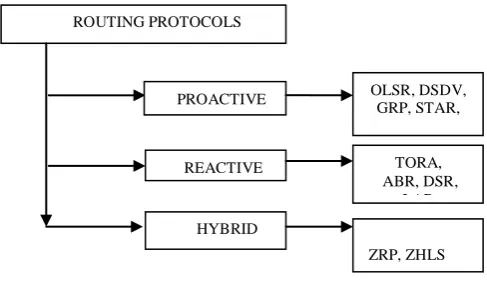
room to develop a wired network. MANETS's routing protocols fall into three categories: proactive (table driven), reactive (demand driven), and hybrid routing protocols described below.
Fig. 1 Classification of routing protocols
II. CLASSIFICATION of ROUTING PROTOCOLS
A. Proactive Routing Protocols
Proactive routing protocols are also called table driven protocols. In proactive routing, each node updates and maintains routing protocols every time the topology in the network changes. Therefore, storing and managing entries for each node is an ambiguous task. Therefore, this routing is not suitable for large networks. The most aggressive routing protocols proposed for mobile ad hoc networks have properties inherited from the algorithms used in wired networks.
1) Optimized Link State Routing (OLSR): OLSR is a table driven protocol. Normally, the route is saved and updated, so if the route is needed, the route is immediately presented without initial delay. In OLSR, several candidate nodes called Multipoint Relay (MPR) are selected and are responsible for forwarding the broadcast packets during the flooding process. This technique reduces packet transmission overhead compared to the flooding mechanism. OLSR performs hop-by-hop routing used by each node and routes packets using the latest routing information. MPR is designed to cover all nodes two hops away. A node senses and selects that MPR with a control message called a HELLO message. Hello messages are used to guarantee bidirectional links with neighbours. These messages are sent at specific intervals. The node broadcasts a "TC" or topology control message to determine its MPR.
2) Geographical Routing Protocol (GRP): Geographical routing is one of the most appropriate routing strategies in wireless mobile ad hoc networks primarily due to its scalability and there is no need to maintain an explicit route. The main approach in geographical routing is greedy transferred and fails if a packet encounters a void node. Geographical routing protocols attract much attention in the field of routing protocols for MANET. These geographical approaches allow routers to be nearly stateless because the forwarding decision is based on the destination location information and the location information of all one - hop neighbours.
3) Hierarchical State Routing (HSR): The hierarchical state routing feature is multi-level clustering and logical partitioning of mobile nodes. The network is divided into clusters and the selected cluster head is chosen like a cluster based algorithm. In HSR, the cluster head is organized again into clusters and so on. Nodes in the physical cluster broadcast link information to each other. The cluster head summarizes the information of the cluster and transmits it to the adjacent cluster head via the gateway.
4) Source Tree Adaptive Routing (STAR): An important feature of this protocol is to apply Least Overhead Routing Approach (LORA) and routing information updates are exchanged between nodes and the changes are reflected. In the STAR protocol, every node desires to send modernize messages to neighbouring nodes through initialization, and sends revise messages about latest destinations, path loop potential, path costs. All nodes broadcast the source tree information to the radio link used by the node with the preferred path to the destination. The STAR’s router promotes the constraints of the source routing tree consisting of every link the router needs to achieve all known destinations in
ROUTING PROTOCOLS
PROACTIVE
REACTIVE
HYBRID
OLSR, DSDV, GRP, STAR,
TORA, ABR, DSR,
LAR
© 2017, IJCSMC All Rights Reserved 156
the ad - hoc network, If the node does not have a path to a particular destination to which it wishes to send packets, the node will initiate a pass-away message to its neighbours.
5) Destination Sequenced Distance Vector Routing (DSDV): It adds a new attribute, sequence number, of each route table entry of the conventional RIP. Using the newly Added sequence number, the mobile nodes can distinguish stale route information from the new routes table for all possible destinations within the network and the number of hops to each destination node. Each entry has a sequence number and a number assigned by the destination node. Routing table updates are periodically sent across the network to maintain table consistency. A large amount of network traffic, route update, can adopt two kinds of packets, "full dump" first and "incremental routing" second. A full dump can send a complete routing table to the neighbour and cover many packets, but in incremental updates only entries in the routing table whose metric changed since the last update are sent, it must fit in the packet. The network is relatively stable, incremental updates are sent to avoid extra traffic, and full dump is relatively rare.
B. Reactive Routing Protocol
Reactive routing protocols acquire routing information only when it is required. In reactive routing, when a source node requests a route to a destination node, the route determination process is invoked on demand.
1) Temporally Ordered Routing Algorithm (TORA): This protocol uses a "flat" non-hierarchical routing algorithm that enables you to accomplish high scalability. TORA builds and maintains Directed Acyclic Graph (DAG). This is the on-demand routing protocol initiated by the source. It detects multiple routes from the source node to the destination node. The main feature of TORA is that the control message is localized to a very small set of nodes that are close to the occurrence of the phase change. To accomplish this, the node maintains routing information on the neighbouring nodes. The protocol has three basic functions: route creation, route maintenance, route removal.
2) Associability Based Routing (ABR): This protocol is a new approach for routing and it defines new metrics for routing known as relevance to stability. In these routing protocols, there is no loop, deadlock and packet duplication. In ABR, routes are selected based on the joint state of nodes. Every node generates a regular beacon to indicate its existence. When a neighbour node receives a beacon, it updates its associativity tables. Association stability means that a node is connected beyond time and space to another node. A high value of the association tick to the node indicates a low state of mobility of the node and a low value of connectivity tick can indicate a high mobility state of the node. The basic purpose of ABR is to find a longer-lived route for ad-hoc mobile networks. The three phases of ABR are Route discovery, Route reconstruction (RRC), Route deletion.
3) Location-Aided Routing (LAR): This protocol is an on-demand method. The prerequisite is that every host knows its own location and global time. This can be provided by Global Positioning System (GPS).LAR defines the concepts of “expected zone'' and “request zone”. For better understanding let’s consider an example, When node S wishes to send a message to node D, it broadcasts a route query message, which is forwarded only by the node in `` requested zone ''. When the node forwards the route query, the node ID is the beginning of the packet. After finally receiving the route inquiry, the node D returns the route in response to the transmission source node S using the reverse route recorded at the head of the route inquiry packet. The route from S to D is established when the source node S receives the route response packet. LAR can efficiently reduce the RREQ flooding cost. The main problem with this method is that it is difficult to obtain accurate location information in some environments.
4) Dynamic Source Routing (DSR): This protocol uses a source routing technique (all data packets carry all path information in the header) to forward packets. The source node must know the total path to the destination before sending the data packet. Otherwise, flood the Route Request (RREQ) message and start the route discovery phase. The RREQ message carries the sequence of hops passed in the message header. A node that receives the same RREQ message will not broadcast it again. When the RREQ message arrives at the destination node, the destination node responds with a route Reply (RREP) packet to the source. The RREP packet carries the path information obtained from the RREQ packet. When the RREP packet moves backwards to the source, the source node and all transit nodes know the route to the destination. Each node uses the route cache to record the complete route to intended destination.
C. Hybrid Routing Protocol
Hybrid protocol is associated of the advantage of the both proactive and reactive routing protocols.
© 2017, IJCSMC All Rights Reserved 157
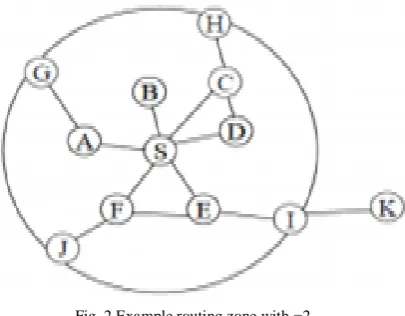
2) Zone based hierarchical protocol (ZHLS): As its name implies, is based on the concept of zones. The routing zones are defined separately for each node, and the zone is expressed in hops. Therefore, a zone contains a node whose distance from that node is at most hops. An exemplary routing zone is shown in Fig. 4, where the routing zone of S includes node A-1, but not K. In the figure, the radius is marked as a circle around the node in question. Note, however, that zone is defined by hops, not physical distances.
Fig. 2 Example routing zone with =2
III. DIFFERENTOPTIMIZATIONAPPROACHESFORMANETS
Various optimization techniques are used to find the optimal solutions. The optimization approach that falls into the category of these algorithms is as follows.
1) Genetic algorithms (GA): This technique was proposed by the Netherlands in 1975. The genetic algorithm is a branch of a computational model based on the principle of natural selection. This optimization method is the most powerful of the others. These algorithms are affected by humanism. Genetic algorithms work best with optimization and are called function optimizers. In this population solution, called chromosome, it is initialized for algorithm [1]. Fitness is evaluated for each chromosome using the appropriate fitness function. For this, the best chromosome is chosen and crossover and mutation occur for better offspring. GA is convenient and efficient in the following cases.
i. Search space is big, complicated, not well known. ii. Mathematical analysis is not available.
iii. In order to narrow the search area, domain knowledge is scarce to encode.
iv. For complicated problems and loosely defined problems, it works with its own internal rules. v. The conventional search method fails.
2) Particle Swarm Optimization (PSO): It is a population-based probabilistic optimization method, proposed by Kennedy and Eberhart in 1995. This technique is inspired by group behaviour of birds and fish swimming. In PSO, each member is represented by particles with their speed and position. The best position of the particle is estimated by the highest fitness value [2]. The various steps involved in the PSO algorithm are as follows.
i. Initialize the particle in a given search space. ii. Evaluate the performance of each particle.
iii. Compare the particle’s fitness value with pbest. If the value of particle is better than pbest set this value as pbest
iv. Update the position and velocity of particles.
3) Ant Colony Optimization (ACO): It is a meta-heuristic technique inspired by ant feeding behaviour. This optimization method was proposed by Dorgio and Dicario in 1999. These three main functions are structured:
i. Ant Solution Construct: In this non-natural ants move during adjacent states of predicament. ii. Pheromone Update: Once the clarification is built absolutely, pheromone trails is restructured. iii. Daemon actions: In this supplementary pheromone are applied to the superlative solution.
© 2017, IJCSMC All Rights Reserved 158 i. Spectator
ii. Utilize
5) Bacterial Foraging Optimization Algorithm (BFOA): This algorithm is a global optimization algorithm inspired by feeding behaviour of bacteria named Escherichia coli. BFOA is affected by the chemo taxis of bacteria. These bacteria obtain a direction to food based on the gradient of chemicals [3]. Information processing strategies are achieved through a series of processes.
i. Chemo taxis: Cells shift along the exterior one at a time.
ii. Reproduction: greatest set of bacteria of is chosen, so that it donates to the subsequent generation. iii. Elimination and Dispersal: Cells are unnecessary and new illustrations are interleaved.
6) Binary Particle Swarm Optimization (BPSO): In accumulation, there is a comprehensive description of PSO called BPSO. In binary PSO, each particle represents its position with a binary value of 0 or 1. The value of each particle can be changed from 1 to 0 or vice versa. In binary PSO, the velocity of a particle is defined as the probability that a particle will change its state to 1. Binary PSO is used in many applications such as iterative prisoner's dilemma, optimal input subset of SVM, dual-band dual polarization planar antenna design. Unlike PSO, since the BPSO algorithm was used in the binary discrete search space, it is possible to reduce the computational complexity compared with PSO and reduce the accuracy of the calculation. The main advantage of BPSO is that it has a finite state solution and can significantly shorten the calculation time required for particle convergence compared to PSO.Qualities of binary PSO over Particle Swarm Optimization:
i. Condense the computational complexity ii. Increase the accuracy of calculation iii. Restricted state resolution
iv. Easy accomplishment
v. Well-organized for worldwide investigate algorithm.
IV. CONCLUSIONANDFUTURESCOPE
This paper concludes various protocols i.e. proactive, reactive and hybrid which have been used in MANETs for transmission of information from source to destination. Each protocol have analyzed along with its classifications. Most of the protocols are not able to find the optimal path between the source and destination due to which an optimization approaches has also defined in this paper. Different optimization algorithm can be applied in different protocols to obtain the optimal path efficiently and effectively. As the main focus of the most of the techniques are to make the network reliable, efficient and optimized without losing the original link during data transmission. Thus in future, one of the optimization techniques on more than one routing protocols can be used to acquire optimal path and best solution from possible results. Based on the scenario of the network, different optimization techniques can be applied accordingly.
REFERENCES
[1] Al-Ghazal M, “Routing Optimization using Genetic Algorithm in Ad Hoc Networks” International Symposium on Signal Processing and Information Technology, IEEE, 2007.
[2] Alireza Sajedi Nasab, “Energy-aware multicast routing in MANET based on particle swarm optimization” Procedia Technology, ELSEVIER, 2011.
[3] Harpreet Kaur, “Optimization of Hello messaging scheme in MANET On-demand routing protocols using BFOA”
International Journal of Application or Innovation in Engineering & Management (IJAIEM), Vol- 3, Issue 7, July 2014.
[4] E. Hemalatha Jai Kumari, “Dynamic Shortest Path Routing In Mobile Adhoc Networks Using Modified Artificial Bee Colony Optimization Algorithm” (IJCSIT) International Journal of Computer Science and Information Technologies, Vol- 5 (6), Pp 7423-7426, 2014.
[5] Manish Y. Barange, “Review paper on implementation of multipath reactive routing protocol in manet”, IEEE, Pp 227-231 , 2016.
[6] Nessrine Chskchouk, “A Survey on Opportunistic Routing in Wireless Communication Networks”, IEEE, Vol- 17, Pp 2214-2241, 2015.
[7] Shabana Habib, “Review on MANET Routing Protocols and Challenges”, IEEE, Pp 529-533, 2015.
[8] Neetendra Singh Dhakad, “Review on Routing Protocols of Moblie Ad-hoc Network MANET”, IJAREEIE, Vol-5. Pp 2785-2790, 2016.
© 2017, IJCSMC All Rights Reserved 159 [10] Vikas Goyal, “Review Paper on AODV & DSR Routing protocol”, IRJAES, Vol-1, Pp 136-141, 2016.
[11] C. Jothikumar, “A Review of Hierarchical Routing Protocol for Wireless Sensor Network”, Indian Journal of Science and Technology”, Vol-9, Pp 1-10, 2016.
[12] Er. Mandeep Kaur, “Routing Protocols of Wireless Sensor Networks”, IRACST, Vol-3, Pp 50-55, 2013.
[13] Kamaldeep Kaur, “Review of Various Optimization techniques in MANET Routing Protocols”, IJSETR, Vol-4, Pp 2830-2833, 2015.
[14] Anuj K. Gupta et al, “Review of Routing Protocol for MANETs”, IJIEE, Vol 1, Issue 3, Pp 251-259, 2011.
[15] Jatin Gupta et al, “Relative Investigation of OLSR, TORA and GRP Routing Protocol Using OPNET”, IJCSMC, Vol 2, issue 7, Pp 280-287, 2013.
[16] Mohamed Elboukhari et al, “Performance Comparison of routing protocols in Mobile Ad hoc Networks”, IJU, Vol 6, Issue 2, Pp 1-11. 2015.
[17] Rajwinder Kaue et al, “A Review: Comparative Study of Wireless Sensor Network Protocols”, IJARCCE, Vol 5, Issue 6, Pp 205-213, 2016.
[18] Badr Chahidi et al, “Hybrid Routing Protocol For Wireless Sensor Nteworks”, IJCS, Vol 9, Issue 2, Pp 490-494, 2012. [19] Yong Liu et al, “ A Region based routing protocol for wireless sensor network”, IEEE, Vol 18, Issue 4, Pp 12-17, 2004. [20] M V Narayana et al, “Genetic-ZHLS Routing Protocol for fault tolerance and load balancing”, JATIT, Vol 83, Issue 1, Pp 72-80, 2016.
[21] Rajesh Yadav et al, “A Survey of various routing protocol in MANETS”, IJCSIT, Vol 6, Issue 5, Pp 4587-4592, 2015. [22] Puneet Mittal et al, “Performance Analysis of AODV, OLSR, GRP and DSR Routing Protocols with database load in MANETS”, IJRET, Vol 2, Issue 9, Pp 412-420, 2013.