Storing Secrets on Continually Leaky Devices
Yevgeniy Dodis∗ Allison Lewko † Brent Waters ‡ Daniel Wichs § July 6, 2011
Abstract
We consider the question of how to store a value secretly on devices that continually leak information about their internal state to an external attacker. If the secret value is stored on a single device from which it is efficiently retrievable, and the attacker can leak even a single predicate of the internal state of that device, then she may learn some information about the secret value itself. Therefore, we consider a setting where the secret value is shared between multiple devices (or multiple components of a single device),each of which continually leaks arbitrary adaptively chosen predicates its individual state. Since leakage is continual, each device must also continually update its state so that an attacker cannot just leak it entirely one bit at a time. In our model, the devices update their state individually and asynchronously, without any communication between them. The update process is necessarily randomized, and its randomness can leak as well.
As our main result, we construct a sharing scheme for two devices, where a constant fraction of the internal state of each device can leak in between and during updates. Our scheme has the structure of a public-key encryption, where one share is a secret key and the other is a ciphertext. As a contribution of independent interest, we also get public-key encryption in thecontinual leakage model, introduced by Brakerski et al. and Dodis et al. (FOCS ’10). This scheme tolerates continual leakage on the secret key and the updates, and simplifies the recent construction of Lewko, Lewko and Waters (STOC ’11). For our main result, we show how to update the ciphertexts of the encryption scheme so that the message remains hidden even if an attacker interleaves leakage on secret key and ciphertext shares. The security of our scheme is based on thelinear assumption in prime-order bilinear groups.
We also provide an extension to general access structures realizable by linear secret sharing schemes across many devices. The main advantage of this extension is that the state of some devices can be compromisedentirely, while that of the all remaining devices is susceptible to continual leakage.
Lastly, we show impossibility ofinformation theoretic sharing schemes in our model, where continu-ally leaky devices update their state individucontinu-ally.
∗
New York University. [email protected]
†
University of Texas, Austin. [email protected]
‡
University of Texas, Austin. [email protected]
§
Contents
1 Introduction 2
2 Notation and Preliminaries 5
3 Definitions 6
3.1 Continual-Leakage-Resilient Sharing (CLRS) . . . 6 3.2 CLRS-Friendly Encryption . . . 7
4 Scheme Description 8
5 Security Proof Overview 9
5.1 Alternate Distributions for Keys, Ciphertexts and Updates . . . 10 5.2 The Hybrid Proof Strategy . . . 11
6 Conclusions 13
A The Proof in Pictures 17
B Background Lemmas 18
B.1 Statistical Indistinguishability: Hiding Subspaces and Orthogonality . . . 19 B.2 Computational Indistinguishability: Extended Rank-Hiding Assumption . . . 20 B.3 (Re)Programming Updates . . . 21
C Proof of Security (Theorem 4.1) 24
C.1 Hybrid Game Definitions . . . 24 C.2 Hybrid Indistinguishability Arguments . . . 26 C.3 Putting It All Together . . . 35
D Generalization to k-Linear 35
D.1 Scheme Description . . . 35 D.2 The Generalized Proof (Sketch) . . . 37
E CLRS for General Access Structures 38
E.1 Definition . . . 39 E.2 Scheme Description . . . 41 E.3 Security . . . 42
1
Introduction
One of the central tenets of theoretical computer science is that computation can be analyzed abstractly and independently of the physical processes that ultimately implement it. This is the paradigm usually followed in cryptography, where we analyze cryptographic algorithms as abstract computations that get inputs and generate outputs with the help of some internal secret state. Unfortunately, this abstraction may fail to properly model the real world where various physical attributes of a computational device (e.g. timing, power-consumption, temperature, radiation, acoustics, etc.) can be measured and may leak useful information about the internal state of the device. Attacks that use such information to break security are calledside-channel leakage attacks, and they have been analyzed and exploited in many recent works (see e.g. [Koc96, KJJ99, QS01, AARR02, QK02, BE03, Rel, ECR] and the references therein). These attacks pose a major challenge to the applicability of cryptographic theory to practice.
Modeling Leakage. In recent years, cryptographic theory has taken on the challenge of formally model-ing leakage and constructmodel-ing cryptographic primitives that remain provably secure even in the presence of well defined classes of leakage attacks. Several different proposed models of leakage have emerged, with an emphasis on capturing large general classes of attacks. In this work, we will focus on thecontinual-leakage model, which came as an extension of the earlierbounded-leakage model, both of which are discussed below.1
The bounded-leakage model was introduced by Akavia, Goldwasser and Vaikuntanathan [AGV09] and it allows the attacker to learn arbitrary information about the internal secret state of a device, as long as the total amount of leaked information (measured in bits) is bounded by some parameter`, called the
leakage bound. In other words, the attacker can learn up to`arbitrary (efficiently computable) predicates of the internal state of a device, throughout its lifetime. Unfortunately, by bounding the overall amount of observable leakage, this model does not seem to adequately capture an attacker with prolonged access to a device and the ability to make many side-channel measurements over time.
The continual-leakage model, introduced concurrently by Brakerski et al. [BKKV10] and Dodis et al. [DHLW10], addresses exactly this issue and allows the attacker to continually leak information about the internal state of a device over time, as long as only the rate of leakage is bounded. More specifically, the device has some internal notion of time periods and, at the end of each period, it updates its internal state, using some fresh local randomness. The attacker is allowed to learn up to ` predicates of the internal state (including the random coins of the update process) in each time period, but can do so for as many time periods as desired, and there is no bound on the total amount of information learned. Prior work in the bounded leakage model [AGV09, NS09, ADW09a, KV09] and the continual-leakage model [BKKV10, DHLW10, LRW11, LLW11] construct encryption, signature and related primitives.
We also briefly mention an alternative model called the only computation leaks information model, which was introduced by Micali and Reyzin [MR04] and studied in [DP08, Pie09, FKPR10, JV10, GR10]. This model also considers continual leakage but, in each time period, the attacker is limited to only leaking information about the portion of the state accessed by the “computation” during that period (and never on the full state of a device). There are several variants of this model depending on how one breaks up a computation into distinct time periods.
Storing Secrets on Leaky Devices. In this work, we ask a basic question of how to store a secret value (message) on continually leaky devices while preserving its secrecy. Unfortunately, in the bounded and continual leakage models, it is impossible to store a message secretly on a single leaky device from which it is efficiently retrievable, because a single leaked predicate of the internal state of such device can reveal (say) the first bit of the message. There are two natural alternatives to overcoming this difficulty:
1
1. We can weaken the leakage model and restrict the attacker to only learning some limited class of predicates of the internal state of the device. This class should capture realistic attacks but cannot be powerful enough to recover the stored secret, even though there is an efficient method for doing so.
2. We can consider a model where the secret is shared between two or more devices, each of which leaks
individually in the continual leakage model. The attacker can continually learn arbitrary predicates of the internal state of each individual device (but not of the combined joint state of all the devices).
In the rest of the paper, we will frame our discussion in terms of thesecond approach. However, this can also be naturally viewed as a concrete instantiation of the first approach, where we think of the state of a single device as divided into multiplecomponents, and leakage is restricted to the limited class of predicates that each depend on only a single component. This may be a natural and realistic class of leakage attacks if the components of the state are e.g. stored in different areas of memory and accessed separately by the device. In particular, this can be seen as astrengthening of the “only computation leaks information” (OCLI) model. In the OCLI model, the various components leak individually but only when accessed by a computation, while here they leak individually but all the time. We note that this strengthening was explicitly considered by prior works in the OCLI model, starting with Dziembowski and Pietrzak [DP08] in the case of stream ciphers. Although prior results in various models of continual leakage construct many basic and advanced cryptographic primitives, they do not address the simple question of storing a consistent value secretly on leaky devices. Indeed, they rely on the fact that one does not need to store a consistent secret key over time to e.g. decrypt, sign, or generate a random stream.
Let us now describe our concrete model in more detail. We assume that each device has its own individ-ual notion oftime periods, but these notions can differ across devices and they need not be synchronized. At the end of each time period, a device updates its share using some local fresh randomness. This update is conducted individually, and the devices do not communicate during the update process. At any point in time, no matter how many updates occurred on each device, the shares of the devices can be efficiently combined toreconstruct the shared secret message.
For security, we allow the attacker to continually learn arbitrary (efficiently computable) predicates of the internal state of each device. The attacker can choose the predicatesadaptively and can alternate leakage between the devices. The internal state of each device in each time period consists of the current version of its share and the randomness of the update process used to derive the next share.2 This models
the state of the device evenduringthe update process, which we assume can leak as well. The attacker can arbitrarily schedule the updates on different devices. We only restrict it to leaking at most`predicates from each device during each time period. The shared message should remain semantically secure throughout the game.3 We call a scheme satisfying these criteria an `-continual-leakage-resilient sharing (`-CLRS).
We mention that a solution with just two continually leaky devices is optimal, and that adding more devices only makes the problem easier. However, we will also consider an extension where the state of some devices can befully compromised, in which case having more devices will be useful.
Our Results. Our main result is to construct an`-CLRS scheme between two devices, for any polynomial leakage-bound`. The size of the shares necessarily depends on and exceeds the leakage bound`. However, we guarantee that ` is a constant fraction of the share size (albeit a small constant), and hence we can interpret our results as saying that a constant fraction of each share can leak in each time period. The security of our scheme is based on the well-studiedlinear assumption in prime-order bilinear groups. We show that computational assumptions are necessary and that this primitive cannot be realizedinformation theoretically, even for`= 1 bit of leakage.
2
We implicitly assume that the devices can perfectly delete/overwrite past values during an update.
3
We also extend our result to general access structures realizable by linear secret sharing schemes over many devices. The main advantage is that the attacker can even fully corrupt some subset of the devices and continually leak from all others. We only require that the corrupted subset is unauthorized and remains unauthorized with the addition of any other single device.4 Our main scheme for two devices becomes a
special case, where we apply the above to atwo-out-of-two linear sharing scheme.
Lastly, our`-CLRS scheme has special structure where one share is asecret key and the other share is a ciphertext of a public key encryption scheme. This immediately gives continual-leakage-resilient public-key encryption (CLR-PKE) [BKKV10, LRW11, LLW11], where continual leakage on the secret key does not allow an attacker to decrypt future ciphertexts. Moreover, our scheme also allows for significant
leakage during the updates. This property was recently achieved by a scheme of Lewko, Lewko and Waters [LLW11] under a strong assumption called the generalized subgroup decisional assumption in composite-order bilinear groups. As a result of independent interest, we substantially simplify the scheme and the proof of [LLW11], converting it into a scheme over the more common prime-order bilinear groups, with a proof of security under the more common linear assumption. We get other benefits along the way, including shorter public keys and improved efficiency by directly encrypting group elements rather than bits.
Our Techniques. Our construction begins with the idea of using an encryption scheme, and making one share a secret key and the other share a ciphertext. Taking any of the recent results on CLR-PKE, we get a method for updating (just) the key share. We also get the guarantee that the message remains hidden even if the attacker continually leaks on the key share and later gets the ciphertext share in full. Unfortunately, this does not suffice for three reasons. Firstly,we need a method for updating the ciphertext, which is not a property of CLR-PKE.Secondly,we need a new security property to guarantee that, even if the ciphertext and secret-key shares are both continually leaking at the same time, the shared message stays hidden. This property is strictly stronger, and significantly harder to analyze, than the security of CLR-PKE. Thirdly,
the proof strategy of [BKKV10, LRW11] does not deal with leakage on key updates directly, but instead uses a generic “guessing” argument to allow for some small (logarithmic) leakage. Unfortunately, this argument does not apply to the case of sharing. In particular, security without leakage on updates does not seem to imply any guarantees if even 1 bit can leak during the update.
Therefore, our starting point will be the recent CLR-PKE scheme of [LLW11], which provides a new proof strategy to argue about leakage of key updates directly. Although we borrow many high level ideas from this proof strategy, our first result is to significantly simplify the construction and the proof of [LLW11], getting several other benefits along the way (mentioned above). Next, we show a natural method for updating the ciphertexts of the new scheme, analogously to the way that the secret keys are updated. Lastly, we carefully lay out a new proof strategy to argue that continual leakage on secret keys and ciphertexts keeps the message hidden. This proof strategy is significantly more involved then arguing CLR-PKE security alone, and involves moving from a game where every secret key correctly decrypts every ciphertext in every time period, to a game where this is never the case.
Relation to Other Primitives. It is useful to compare CLRS schemes to other primitives from the
literature. Most obviously, standard secret sharing schemes [Sha79] provide security when some subset of the shares are fully compromised while others are fully secure. In CLRS schemes, all shares leak and hence none are fully secure. The idea of updating shares to protect them against continual compromise was also considered in the context of proactive secret sharing [HJKY95]. However, the motivation there was to protect against a mobile adversary that corrupts different subsets of the shares in different time periods, while in our case all shares leak in all time periods. Another important connection is to the
leakage-resilient storage scheme of [DDV10]. This gives an information-theoretic solution for sharing a secret securely on two leaky devices/components in the bounded leakage model, where the overall amount
4
of leakage on each share is bounded. The work of [DF11] extends this information theoretic solution to the continual leakage model, but requires that devices have access to some correlated randomness generated in a leak-free way (e.g. using leak-free hardware) and update their shares interactively. In contrast, we do not assume any leak-free hardware. Also, our updates are performed individually and we show that this comes at the necessary expense of having computational assumptions.
Lastly, we mention the prior works [JV10, GR10], which consider general compilers for executing ar-bitrary computations privately on leaky devices. Both works provide solutions in variants of the “only computation leaks information model”, but require some additional leak-free hardware. Implicitly, these works also address the question of storing a value secretly on leaky devices, since the state of the com-putation must be somehow stored consistently. However, the use of leak-free hardware in these solutions greatly simplifies the problem of storage and avoids virtually all of the challenges that we address in the current work. We believe that our work provides an important first step in the direction of building general compilers without any leak-free hardware, since the question of (just) securing storage must be addressed as a part of any solution to the larger question of securing computation.
Organization. We define our notation and hardness assumptions in Section 2. In Section 3 we define CLRS schemes and in Section 4 we describe our (simplest) construction under a fairly strong assumption known as 1-linear or SXDH. In Section 5 we give an overview of the proof. The full proof is deferred to Appendix C. In Appendix D we present a generalized (but more complicated) construction under progressively weaker assumptions, known as thek-linear assumptions, for arbitraryk≥1. In Appendix E, we define and construct an extension to general access structures realizable by linear secret sharing schemes over many devices. Lastly, in Appendix F, we showimpossibility for information-theoretic CLRS schemes.
2
Notation and Preliminaries
Linear Algebra. LetFbe a field. We denoterow vectors with~v∈Fn. If~v1, . . . , ~vm ∈Fnarem vectors we letspan(~v1, . . . , ~vm)⊆Fn denote the linear space spanned by these vectors. We let h~v, ~wi def=~v·w~> be the dot product of ~v, ~w ∈ Fn
q. If A ∈ Fn×m is a n×m matrix of scalars, we let colspan(A),rowspan(A) denote the subspaces spanned by the columns and rows of A respectively. If V ⊆ Fn is a subspace, we let V⊥ denote the orthogonal space of V, defined by V⊥ def= { w~ ∈ Fnq | hw, ~~ vi = 0 ∀~v ∈ V }. We write (~v1, . . . , ~vm)⊥as shorthand forspan(~v1, . . . , ~vm)⊥. We writeV ⊥ W ifV ⊆ W⊥ and therefore alsoW ⊆ V⊥.
We define the kernel of a matrixA to beker(A)def=rowspan(A)⊥.
For integers d, n, m with 1 ≤ d≤ min(n, m), we use the notation Rkd(Fn×mq ) to denote the set of all rank dmatrices in Fn×mq . WhenW ⊆Fmq is a subspace, we also use the notationRkd(Fn×mq |row∈ W) to denote the set of rank dmatrices in Fn×mq whose rows come from the subspaceW.
Matrix-in-the-Exponent Notation. LetGbe a group of prime orderq generated by an elementg∈G and letA∈Fn×mq be a matrix. Then we use the notationgA∈Gn×mto denote the matrix gA
i,j def
=g(A)i,j
of group elements. Note that, given a matrix of group elements gA ∈Gn×m and a matrix B ∈
Fm×kq of “exponents”, one can efficiently compute gAB. However, given gA and gB it is (generally) not feasible to efficiently compute gAB. On the other hand, if
G1,G2,GT are three groups of prime order q and e : G1×G2 → GT is an efficient bilinear map, then, given gA and hB for generators g ∈ G1,h ∈ G2,
one can efficiently compute e(g,h)AB via (e(g,h)AB)i,j =
Qm
k=1e gAi,k,hBk,j
. We abuse notation and let e(gA,hB) =e(g,h)AB denote this operation.
Hardness Assumptions. Let G be a pairing generation algorithm (G1,G2,GT, q, e,g,h) ← G(1λ), where G1,G2,GT are descriptions of cyclic group of prime order q with generatorsg ∈G1,h∈G2 and e
assumption. This assumption was introduced by [NS09] and shown to be implied by the more common k-linear assumption [BBS04, HK07, Sha07]. The k-rank hiding assumption on the left group G1 states
that for anyk≤i < j ≤min{m, n} we cannot distinguish rankiand j matrices in the exponent of g:
prms,gX
prms← G(1λ) X ←$ Rki(Fn×mq )
!
comp
≈ prms,gX
prms← G(1λ)
X←$ Rkj(Fn×mq )
!
Similarly, we can make the k-rank hiding assumption on the right group G2, by replacing g with h in
the above. We say that the k-rank hiding assumption holds for G if it holds for both the left and right groups. It is easy to see that the k-rank hiding assumption gets weaker as k increases. Therefore, the k = 1 version of the assumption is the strongest. In fact, when k = 1, this assumption is equivalent to 1-linear which is just DDH. Unfortunately, it is known that DDHcannot hold in symmetric pairings where G1 = G2. However, it is often reasonable to assume that DDH holds in asymmetric pairings, and this is
also called theexternal Diffie-Hellman assumption SXDH [Sco02, BBS04, GR04, Ver04]. Since the SXDH assumption is fairly strong, it is sometimes preferable to use k≥2. The (k= 2)-linear assumption, also calleddecisional linear, is commonly believed to hold in many symmetric and asymmetric pairings.
3
Definitions
3.1 Continual-Leakage-Resilient Sharing (CLRS)
We now formally define the notion of a continual-leakage-resilient sharing (CLRS) scheme between two devices. The scheme has the following syntax:
ShareGen(1λ,msg)→(sh1,sh2) : The share generation algorithm takes as input the security parameter
λand a secret message msg. It outputs twoshares,sh1 and sh2 respectively.
Updateb(shb)→sh0b : Therandomized update algorithm takes the indexband the current version of the share shb and outputs an updated versionsh0b.
We use the notation Updateib(shb) to denote the operation of updating the share shb successively i times in a row so thatUpdate0b(shb) :=shb,Updateb(i+1)(shb) :=Updateb(Updateib(shb)).
Reconstruct(sh1,sh2)→msg : The reconstruction algorithm takes in some version of secret sharessh1,sh2
and it outputs the secret message msg.
Correctness. We say that the scheme is correct if for any shares (sh1,sh2) ← ShareGen(1λ,msg) and
any sequence of i ≥ 0, j ≥ 0 updates resulting in sh01 ← Updatei1(sh1), sh02 ← Update
j
2(sh2), we get
Reconstruct(sh01,sh02) =msg. Note that iand j are arbitrary, and are not required to be equal.
Security. We define`-CLR security as an interactive game between an attackerAand a challenger. The attacker chooses two messages: msg0,msg1 ∈ {0,1}∗ with |msg0| = |msg1|. The challenger chooses a bit b← {0,1} at random, runs (sh1,sh2) ←ShareGen(1λ,msgb). The challenger also chooses randomness rand1, rand2 for the next update of the shares 1,2 respectively and sets state1 := (sh1, rand1),state2 :=
(sh2, rand2). It also initializes the counters L1 := 0, L2 := 0. The attacker A can adaptively make any
number of the following types of queries to the challenger in any order of its choosing:
Update Queries: The attacker specifies an indexi ∈ {1,2}. The challenger parsesstatei = (shi, randi) and computes the updated sharesh0i:=Updatei(shi;randi) using randomnessrandi. It samples fresh randomnessrand0i and setsstatei:= (sh0i, rand0i), Li := 0.
At any point in the game, the attacker A can output a guess ˜b ∈ {0,1}. We say that A wins if its guess matches the choice of the challenger ˜b=b. We say that an`-CLRS scheme issecureif for any PPT attacker A running in the above game, we have|Pr[Awins ]−12| ≤negl(λ).
Remarks on the Definition. The inclusion of the update randomnessrandi in the state of the device models leakage during the update process itself when this randomness is used. Note that we do not need to explicitly include the next share sh0i = Updatei(shi;randi) in the state since it is already efficiently computable from shi and randi.
The given definition also already implies that the message remain hidden even if one of the shares is revealed fully at the end of the game (but no leakage on the other share is allowed afterwards). To see this, assume that at some point in the game, there is a distinguishing strategyDthat uses a fully revealed share shi to break security. Then we could also just leak the single predicate D(shi) to break security.
3.2 CLRS-Friendly Encryption
We consider an approach of instantiating CLRS via apublic key encryptionscheme (KeyGen,Encrypt,Decrypt) having the usual syntax. Given any such encryption scheme, we can define a sharing scheme where the two shares are the secret key sh1 =sk and the ciphertext sh2=ctrespectively. Formally, we define:
ShareGen(1λ;msg) : Sample (pk,sk)←KeyGen(1λ),ct←Encryptpk(msg). Output sh1 :=sk,sh2 :=ct.
Reconstruct(sh1,sh2) : Parsesh1 =sk,sh2 =ct. Outputmsg=Decryptsk(ct).
We say that an encryption scheme isupdatableif it comes with two additional (non-standard) procedures
sk0 ←SKUpdate(sk), ct0 ←CTUpdate(ct) for updating the secret keys and ciphertexts respectively. These
procedures can naturally be used to define updates for the corresponding sharing via Update1(sh1) :=
SKUpdate(sk), Update2(sh2) := CTUpdate(ct), where sh1 = sk,sh2 = ct. The above gives us a natural
syntactical transformation from an updatable encryption scheme to a corresponding CLRS scheme. We say that an updatable encryption scheme is an `-CLRS-Friendly Encryption if:
• The corresponding CLRS scheme satisfies correctness.
• The corresponding CLRS scheme satisfies a strengthening of`-CLRS security where the attacker is first given the public key pk and then adaptively chooses the messagesmsg1,msg2.
(i.e. The challenger first chooses (pk,sh1 =sk)←KeyGen(1λ) and givespk to the attacker, who chooses msg1,msg2. The challenger then generates sh2 ←Encryptpk(msgb) and the game continues as before.)
Remarks. We note that the additional functionality provided by CLRS-friendly encryption on top of a plain CLRS may be useful even in the context of sharing a secret between leaky devices. For example, we can imagine a system where one (continually leaky) master device stores a secret key share and we publish the corresponding public key. Then other devices can enter the system in an ad-hoc manner by just encrypting their data individually under the public key to establish a shared value with the master device (i.e. no communication is necessary to establish the sharing). The same secret-key share on the master device can be reused to share many different messages with many different devices.
4
Scheme Description
We now describe our construction of CLRS going through CLRS-Friendly Encryption. We give two encryp-tion algorithms – asimple one which is sufficient for CLR-PKE where we update keys but not ciphertexts, and an updatable one which is needed for CLRS and CLRS-Friendly Encryption.
Let m, n, dbe integer parameters with n≥d. The scheme is defined as follows.
KeyGen(1λ) →(pk,sk) : Sample (G1,G2,GT, e,g,h, q)← G(1λ) to be the description of a bilinear group of prime order q, with an efficient pairing e:G1×G2 →GT, and generatorsg∈G1,h∈G2.
Choose ~p, ~w ∈ Fmq at random subject to h~p, ~wi = 0 and set prms = ((G1,G2,GT, e,g,h, q),g~p,hw~) to be the public parameters of the system. These parameters can then be re-used to create the public/secret keys of all future users. For convenience, weimplicitly think of prmsas a part of each public key pkand as an input to all of the other algorithms.
Choose~t←$ Fm
q and setpk:=e(g~p, h ~ t>
) =e(g,h)αwhereα=h~p, ~ti. Choose~r= (r1, . . . , rn) $ ←Fn
q and setsk:=hS, whereS is the n×m matrix given by
S :=
r1w~ +~t
· · · rnw~ +~t
=
~r> ~ w +
~1>
~t
.
In other words, each row ofS is chosen at random from the 1-dimensional affine subspace~t+span(w~). (Note thathS can be computed from the components hw~,~t,~r without knowingw~.)
(Simple) SimplEncryptpk(msg)→ct : To encryptmsg∈GT under pk=f =e(g,h)α , choose u∈Fq and output: ct= (gu~p,fu·msg).
(Updatable) Encryptpk(msg)→ct : To encryptmsg∈GT underpk=f =e(g,h)α, choose ~u= (u1, . . . , un)
$
←Fnq and outputct= (ct(1),ct(2)) where:
ct(1)=
gu1~p . . .
gun~p
, ct(2) =
fu1·msg . . .
fun·msg
Each row is an independent encryption of the (same) message msg using the simple encryption
process. Equivalently, we can write the ciphertext asct(1) =gC, ct(2)=e(g,h)~z> for:
C =
~u>
~ p
, ~z> =
~u>
α+
~1> µ = C
t>
+
~1>
µ
whereµ is given bymsg=e(g,h)µ andα =h~p, ~ti.
Decryptsk(ct)→msg: To decrypt, we only need to look at the first rows of the secret key and the
ciphertext matrices. Given the first row h~s of the secret key sk = hS, the first row g~c of the ciphertext component ct(1) = gC, and the first scalar component e(g,h)z of ct(2) = e(g,h)~z>, the decryption algorithm outputs: msg=e(g,h)z/e(g~c , h~s> ).
CTUpdate(ct)→ct0 : Choose a random matrix B0 ←$ Rkd(Fn×nq ). Derive B by “rescaling” each row of B0 so that its components sum up to 1. That is, set (B)i,j := (B0)i,j/(Pnk=1(B0)i,k), soB~1>=~1>. If the current ciphertext isct= (gC, e(g,h)~z>), output the updated ciphertextct0 := (gBC, e(g,h)B~z>).
Theorem 4.1. For any integersm≥6, n≥3m−6, d:=n−m+ 3the above scheme is an`-CLRS-friendly encryption scheme under the SXDH assumption for `= min(m/6−1, n−3m+ 6) log(q)−ω(log(λ)).
In the above theorem, the absolute leakage (`) scales linearly as min(m, n−3m) or log(q) grow.
The ratio of leakage to share size is `/(nmlog(q)), and is maximized atm= 7, n= 16 to roughly 1/672.
Corollary 4.2. For any polynomial `=`(λ), there exist `-CLRS schemes under the SXDH assumption. Furthermore, `is a constant fraction of the share size.
Lastly, if we only care about encryption with continual leakage on the secret key and update randomness, then there is no need to update ciphertexts and we can use the “simple” encryption strategy.
Corollary 4.3. For any m, n, d as above, the scheme (KeyGen, SimplEncrypt, Decrypt, SKUpdate) is an
`-CLR-Encryption with leakage-of-updates, under the SXDH assumption and for the same` as above.
Correctness. Let (prms,pk,sk) ← KeyGen(1λ) and let ct = (ct(1),ct(2)) ← Encrypt
pk(msg). Then we
can write sk=gS,ct(1)=hC,ct(2) =e(g,h)~z for some values S, C, ~z andW, ~tsatisfying:
S =W +~1>~t , ~z>=C~t>+~1>µ : rowspan(W)⊥ rowspan(C) (1)
withµ given bymsg=e(g,h)µ.
First, we show that for any sk and ct satisfying equation (1), we get Decryptsk(ct) = msg. This is because decryption looks at the first row ofsk,ct(1),ct(2) respectively, which are of the formhs~,g~c, e(g,h)z where ~s = w~ +~t, z = h~c, ~ti+µ for some vectors w, ~~ c, ~twith h~c, ~wi = 0. Therefore decryption correctly recovers:
e(g,h)z/e(g~c , hs> ) =e(g,h)h~c,~ti+µ/e(g,h)h~c, ~w+~ti=e(g,h)µ=msg
Next we show, that updates preserve the key/ciphertext structure of equation (1). Assume that we update the secret key with the matricesA1, A2, . . . , Aiand the ciphertext with the matricesB1, B2, . . . , Bj.
Define ¯A = AiAi−1· · ·A1, ¯B = BjBj−1· · ·B1. Since the update matrices are “rescaled” we know that
¯
A~1> = ¯B~1>=~1>. Therefore we can write the updated values asski=g
¯
AS,ct(1)
j =h
¯
BC,ct(2)
j =e(g,h)
¯
B~z>
satisfying:
( ¯AS) = ( ¯AW) +~1>~t , ( ¯B~z>) = ( ¯BC)~t>+~1>µ : rowspan( ¯AW) ⊥rowspan( ¯BC).
So equation (1) is satisfied by the updated keys and ciphertexts and we get Decryptski(ctj) =msg.
5
Security Proof Overview
5.1 Alternate Distributions for Keys, Ciphertexts and Updates
Assume that the vectors ~p, ~w, ~tare fixed, defining the public values gp~,hw~,pk=e(g,h)h~p,~ti. Fix w~1 :=w~,
and let (w~1, . . . , ~wm−1) be somebasis of (~p)⊥ and (~c1, . . . , ~cm−1) be some basis of (w~)⊥. We define various
distributions of keys and ciphertexts relative to these bases.
Key Distributions. The secret key is always set tohS for somen×m matrixS of the form
S =
| |
~
r>1 · · · ~r>i
| |
− w~1 −
· · · − wi~ −
+
~1>
~t
(2)
where ~r1, . . . , ~ri ∈ Fnq are chosen randomly. Equivalently, each of the n rows of S is chosen randomly from the affine space: span(w~1, . . . , ~wi) +~t. The honest key generation algorithm uses i= 1 and we call these honest keys. In addition, we define mid keys which are chosen with i= 2 and high keys which are chosen with i = m−1. Notice that honest/mid/high keys all correctly decrypt honestly generated ciphertexts sincespan(w~1, . . . , ~wm−1) ⊥span(~p).
Ciphertext Distributions. The encryption of the message msg = e(g,h)µ ∈ GT is always set to
ct = (ct(1),ct(2)) where ct(1) = gC and ct(2) = e(g,h)~z> with ~z> = C~t>+~1>µ. The second component
ct(2) can always be efficiently and deterministically computed fromgC, given~tandmsg, without knowing the exponentsC, µ. The different ciphertext distributions only differ in how ct(1) =gC is chosen.
For thehonest ciphertexts, we set C=~u>p~ for a uniformly random~u∈Fnq. That is, every row ofC is chosen at random from the spacespan(p~). In addition to the honest way of choosingC, we define three
additional distributions onC given by:
C =
| |
~
u>1 · · · ~u>j
| |
− ~c1 −
· · · − ~cj −
(3)
where~u1, . . . , ~uj ∈Fnq are chosen randomly. Equivalently the rows of theC are chosen randomly from the subspace: span(~c1, . . . , ~cj). When j = 1, we call these low ciphertexts, when j = 2 we call these mid ciphertexts and whenj = (m−1), we call these high ciphertexts. Notice that honest/low/mid/high ciphertexts are all correctly decrypted by honest secret keys since span(w~) ⊥span(~c1, . . . , ~cm−1).
Bases Correlations. By default, we choose the basis (w~1, . . . , ~wm−1) of the space (~p)⊥ and the basis
(~c1, . . . , ~cm−1) of the space (w~)⊥ uniformly at random and independently subject to fixingw~1 :=w~. This
is statistically close to choosing w~2, . . . , ~wm−1
$
← (~p)⊥ and ~c1, . . . , ~cm−1
$
← (w~)⊥ (Lemma B.1, part II). We call this choice of bases uncorrelated. We will also consider two alternate distributions. We say that the bases are correlated if we instead choose ~c1
$
← (w~1, ~w2)⊥ and all other vectors as before. We
say that the bases are super-correlated if we instead choose~c1, ~c2
$
← (w~1, ~w2)⊥ and all other vectors as
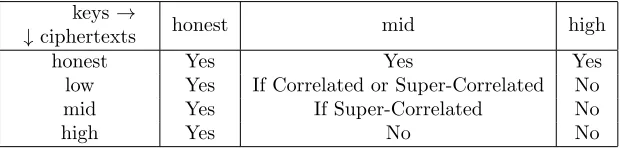
before. If the key and ciphertext bases are correlated then mid keys correctly decrypt low ciphertexts and if they are super-correlated then mid keys correctly decrypt low and mid ciphertexts. The table in Figure 1 summarizes which types of secret keys can correctly decrypt which types of ciphertexts.
Programmed Updates. Honest key updates in period i are performed by choosing A0i ←$ Rkd(Fn×nq ) and rescaling its rows to getAi. LetDi =AiAi−1· · ·A1 be the product of all key-update matrices up to
and including period i(as a corner case, defineD0 to be the identity matrix). We say that the update Ai is programmed to annihilate the vectors ~v1, . . . , ~vj ∈ Fnq if we instead choose A0i
$
keys→
↓ciphertexts honest mid high
honest Yes Yes Yes
low Yes If Correlated or Super-Correlated No
mid Yes If Super-Correlated No
high Yes No No
Figure 1: Do alternate keys correctly decrypt alternate ciphertexts?
whereV= (Di−1~v>1, . . . , Di−1~vj>)⊥. In other words, a programmed updateAihas the vectors{Di−1~vρ}jρ=1
in its kernel. We defineprogrammed ciphertext updates analogously.
By programming the update matrices, we can have updates which reduce the rank of the key/ciphertext matrices (e.g. reduce high keys to mid keys, or mid ciphetexts to low ciphertexts). Let us go through an example. Assume the initial key is high with sk1 = gS for S given by equation (2), and the updates
A1, . . . , Ai−1 are chosen honestly, Ai is programmed to annihilate the vectors r~3, . . . , ~rm−1 and Ai+1 is
programmed to annihilate~r2. Then the corresponding secret keyssk1, . . . ,ski in periods 1 toiwill be high keys, ski+1 will be a mid key and ski+2 will be an honest key. To see this, notice that the exponent of
(e.g.) the key ski+1 will follow equation (2) with~r>j replaced byAiAi−1· · ·A1~r>j . SinceAi is programmed to annihilate the vectors~rj forj≥3, these values will be replaced by~0 in periodi+ 1.
5.2 The Hybrid Proof Strategy
We use a series of hybrids, where each step either takes advantage of the fact that the adversary is
computationally bounded and cannot distinguish the rank of various matrices in the exponent, or of the fact that the adversary is leakage bounded and is only seing partial leakage on any key and ciphertext. When we use computational steps, we can even assume that the attacker getsfull leakage and so wecannot
modify any property of the game that could be efficiently tested given the keys and ciphertexts in full – in particular, we cannot modify whether any secret key correctly decrypts any ciphertext in any time period. When we use leakage steps, we can even assume that the attacker is computationally unbounded and hence we cannot modify the distribution of any individual key/ciphertext/update – but we can modify various
correlations between them, which may not be testable given just partial leakage on the individual values.5 The main strategy is to move from a game where all keys/ciphertexts/updates are honest to a game where the keys and ciphertexts no longer decrypt correctly. We can use computational steps to change the distribution of the initial key (honest/mid/high) or ciphertext (honest/low/mid/high) butonly if they still decrypt correctly. For example, we can make the initial key and ciphertext both be mid, but only if the bases are super-correlated. We then want to use a leakage step to argue that the attacker cannot notice the correlation between the bases vectors w~2 ⊥ ~c2. We rely on the fact (Lemma B.9) that given partial
independent leakage on two vectors, one cannot distinguish whether the vectors are orthogonal or not, which follows from inner-product being a good two-source extractor. Unfortunately, since leakage on keys and ciphertexts is continual, we cannot argue that leakage on the bases vectors w~2, ~c2 is partial. To get
around this, we carefully program our updates to reduce the rank of future keys/ciphertexts, so that the leakage on the vectorsw~2, ~c2 only occurs in a single key and ciphertext respectively. We carefully arrange
the hybrids so as to make this type of argument on each key/ciphertext pair, one at a time.
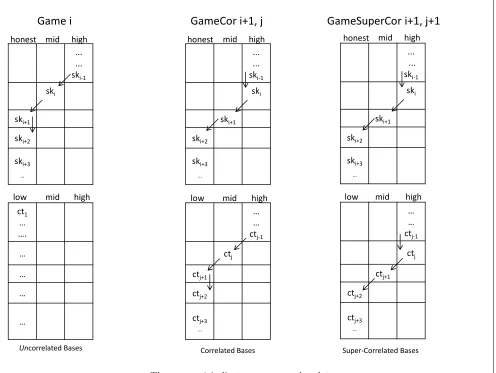
Hybrid Games. A helpful pictorial representation of the main hybrid games appears in Figure 2. Our hybrid games, called Game (i, j) are all of the following type. Fori≥2, the challenger chooses the initial key sk1 as a high key, the firsti−2 updates are honest (and hence the keys sk1, . . . ,ski−1 are high keys),
the updateAi−1 is programmed to reduce the key to a mid keyski, and the updateAi is programmed to 5
reduce the key to a honest keyski+1. The rest of the updates are honest and hence the keysski+1,ski+2, . . .
are honest. For the special case i = 1, the initial key sk1 already starts out as a mid key and the first
updateA1 reduces it to an honest key. For the special case i= 0, the initial keysk1 is already an honest
key. This description is mirrored by the ciphertexts. When j ≥ 2, the initial ciphertext ct1 is a high
ciphertext, the firstj−2 ciphertext updates are honest (and hence the ciphertextsct1, . . . ,ctj−1are high),
the updateBj−1 is programmed to reduce the ciphertext to a midctj, and the updateBj is programmed to reduce the ciphertext to alow ciphertext ctj+1. The rest of the updates are honest and hence the other
ciphertexts stay low. For the special case j = 1, the initial ciphertext ct1 is already mid and the first
updateB1 reduces it to low. For the special casej= 0, the initial ciphertext ct1 is already low.
We write Game i as short for Game (i, j = 0). In Game (i, j) the ciphertext and key bases are
uncorrelated. We also define analogous games: GameCor (i, j) where the bases arecorrelated and Game-SuperCor (i, j) where the bases are super-correlated.
Sequence of Steps. A helpful table describing the sequence of hybrid arguments appears in Figure 3. Our first step is to move from Real Game to Game 0 (i.e. i = 0, j = 0). The only difference in this step is that we change the initial ciphertext ct1 from an honest ciphertext to a low ciphertext. This is a
computational step and all secret keys still correctly decrypt all ciphertexts in the game.
Next, our goal is to keep moving from Game i to Game i+ 1. We call this the outer loop where we incrementi. Unfortunately, wecannot just increment iin a single step since each such move changesski+1
from an honest key to a mid key and hence changes it from decrypting all of the low ciphertexts in the game to decrypting none of them. A single computational or leakage step cannot suffice.
Instead, wecan move fromGameitoGameCori+ 1 in a single computational step. Even though the key ski+1 changes from an honest key in Game i to a mid key in GameCor i+ 1, by making the bases
correlated we ensure that it still correctly decrypts all of the low ciphertexts in the game. Therefore, these games cannot be distinguished even given full leakage.
(Now, we might be tempted to make an information theoretic step that moves us from GameCor i+ 1to
Gamei+1, by arguing that a leakage-bounded attacker cannot tell if the key/ciphertext bases are correlated. Indeed, the leakage on the secret-key basis vector w~2 is bounded overall, as this vector only occurs in the
single mid key ski+1. Unfortunately, the leakage on the ciphertext basis vector~c1 is notbounded overall as
it occurs in every single ciphertext, and so a computationally unbounded attacker can learnspan(~c1)in full
and test ifw~2 ⊥~c1. On the other hand, if we only cared about CLR encryption and notsecret sharing, then
the leakage on the secret key occurs before any information about the ciphertext is seen, and therefore the above argument would be legitimate. Indeed, this matches the high-level structure of the proof of security for the CLR Encryption scheme of [LLW11].)
To move from GameCor i+ 1 to Game i+ 1, we first introduce an inner loop in which we slowly increment j. Starting with j= 0, we move fromGameCor (i+ 1, j) to GameSuperCor (i+ 1, j+ 1). This is a single computational step. Even though we change ctj+1 from a low ciphertext to a mid ciphertext, it
is still correctly decrypted (only) by the mid and low keys in periods i+ 1 and later, since the bases are super-correlated. Therefore, these games cannot be distinguished even given full leakage. Finally, we use an information theoretic step to move from GameSuperCor (i+ 1, j+ 1) to GameCor (i+ 1, j+ 1). Here we are actually changing whether a single key ski+1 correctly decrypts a single ciphertext ctj+1 (it does
inGameSuperCor but not inGameCor). We use the fact that the adversary is leakage-bounded to argue that it cannot notice whether the bases arecorrelated orsuper-correlated. In particular, because the bases vectors w~2 and~c2 only occur in the single mid key ski+1 and the single mid ciphertextctj+1 respectively,
the leakage on these vectors is bounded overall. We argue that such partial leakagehides whetherw~2 ⊥~c2,
which determines if the bases are correlated or super-correlated.
Assume that the attacker makes at most qct update queries on the ciphertext and at most qsk update
queries on the secret key. By repeatedly increasing j in the inner loop, we move from GameCor (i+ 1,0) toGameCor (i+ 1, qct+ 1) where all of the ciphertexts that the attacker can leak on arehigh ciphertexts.
now apply another computational step to move fromGameCor (i+ 1, qct+ 1) toGame i+ 1 and therefore
(finally) incrementingiin the outer loop. This step preserves all interactions between keys and ciphertexts and therefore these games cannot be distinguished even given full leakage. Lastly, by repeatedly increasing iin the outer loop, we can move fromGame 0 toGame qsk+ 1 where all of the secret keys that the attacker
can leak on arehigh keys and all of the ciphertexts arelow ciphertexts. Therefore, in Game qsk+ 1 none
of the keys correctly decrypts any of the ciphertexts. Hence we can argue that even an attacker that has full leakage in Game qsk+ 1 cannot learn any information about the shared/encrypted message msg.
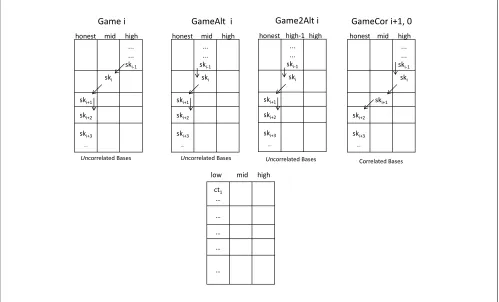
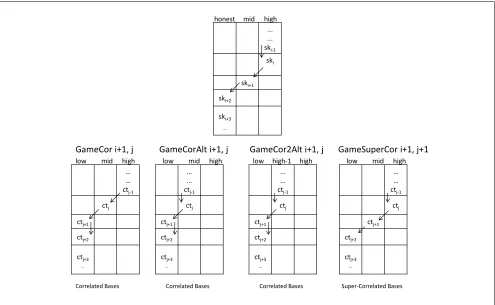
Under the Rug. The above discussion is slightly oversimplified. The main issue is that the compu-tational transitions, e.g. from Game i to GameCor i+ 1, are not computationally indistinguishable the way we defined the games. This is because in Game i the update matrix Ai+1 is unlikely to annihilate
any vectors (i.e. its kernel is unlikely to contain non-zero vectors from the span of the previous updates) while in GameCor i+ 1 it is programmed to annihilate vectors so as to reduce the dimension of the key. This can be efficiently tested given full leakage of the update matrices. Therefore, in the full proof, we define the gamesGame,GameCor andGameSuperCor slightly differently with some updates programmed to annihilate additional uniformly random vectors. With this modification, we can prove computational indistinguishability. We also need extra information theoretic steps to argue that the attacker cannot tell if updates are programmed to annihilate some random vectors, given limited leakage.
6
Conclusions
In this work, we show how to store secret values securely on device(s) that continually leak information about their internal state. We can view of our result as applying to either many devices, each of which is leaking individually in the continual leakage model, or to a single device which is continually leaking a restricted class of predicates that can only access a single memory component at a time.
One interesting question, under the latter view, is to consider different restricted classes of predicates. For example, we can look at predicates of the entire state that are computable in some fixed polynomial time, smaller than the complexity of reconstructing the secret. The work of [DDV10] considers several such classes in the bounded leakage model, where the overall number of leaked predicates is bounded.
Another interesting question is whether sharing schemes between two or more devices in the continual leakage model can be achieved information theoretically, if the devices are allowed to run an interactive protocol to update their shares. Our information-theoretic impossibility result only rules out the case where updates are performed by each device individually without any communication.
Yet another question would be to improve the fraction of the share that can leak from a small constant achieved in this work to larger constants, ideally approaching 1. At the very least, we would need to rely on better two-source extractors than the inner product to beat 12. This would seem to require fundamentally new techniques.
Lastly, an important open question is to design methods for not only storing secrets securely but also computing on secrets securely in the presence of continual leakage. This question was studied in [ISW03, FRR+10, GR10, JV10], but solutions only exist in restrictive models and/or using some secure
leak-free hardware. One elegant solution would be to design secure computation protocols where two (or more) continually leaky devices can securely compute functions of a secret value that is shared between them under our CLRS scheme.
References
[ADW09a] Jo¨el Alwen, Yevgeniy Dodis, and Daniel Wichs. Leakage-resilient public-key cryptography in the bounded-retrieval model. In Halevi [Hal09], pages 36–54.
[ADW09b] Jo¨el Alwen, Yevgeniy Dodis, and Daniel Wichs. Survey: Leakage resilience and the bounded retrieval model. InICITS, pages 1–18, 2009.
[AGV09] Adi Akavia, Shafi Goldwasser, and Vinod Vaikuntanathan. Simultaneous hardcore bits and cryptography against memory attacks. In Omer Reingold, editor,Sixth Theory of Cryptography Conference — TCC 2007, volume 5444 ofLecture Notes in Computer Science. Springer-Verlag, 2009.
[BBS04] Dan Boneh, Xavier Boyen, and Hovav Shacham. Short group signatures. In CRYPTO, pages 41–55, 2004.
[BE03] Hagai Bar-El. Known attacks against smartcards, 2003. last accessed: August 26, 2009. http://www.hbarel.com/publications/Known_Attacks_Against_Smartcards.pdf.
[Bei96] A. Beimel. PhD thesis, Israel Institute of Technology, Technion, Haifa, Israel, 1996.
[BKKV10] Zvika Brakerski, Jonathan Katz, Yael Kalai, and Vinod Vaikuntanathan. Overcomeing the hole in the bucket: Public-key cryptography against resilient to continual memory leakage. In
FOCS [IEE10], pages 501–510.
[CG88] Benny Chor and Oded Goldreich. Unbiased bits from sources of weak randomness and proba-bilistic communication complexity. SIAM Journal on Computing, 17(2):230–261, 1988.
[DDV10] Francesco Dav`ı, Stefan Dziembowski, and Daniele Venturi. Leakage-resilient storage. In Juan A. Garay and Roberto De Prisco, editors,SCN, volume 6280 ofLecture Notes in Computer Science, pages 121–137. Springer, 2010.
[DF11] Stefan Dziembowski and Sebastian Faust. Leakage-resilient cryptography from the inner-product extractor, 2011. Manuscript in submission.
[DHLW10] Yevgeniy Dodis, Kristiyan Haralambiev, Adriana L´opez-Alt, and Daniel Wichs. Cryptography against continuous memory attacks. InFOCS [IEE10], pages 511–520.
[DORS08] Yevgeniy Dodis, Rafail Ostrovsky, Leonid Reyzin, and Adam Smith. Fuzzy extractors: How to generate strong keys from biometrics and other noisy data. SIAM Journal on Computing, 38(1):97–139, 2008.
[DP08] Stefan Dziembowski and Krzysztof Pietrzak. Leakage-resilient cryptography. In 49th Sym-posium on Foundations of Computer Science, pages 293–302, Philadelphia, PA, USA, Octo-ber 25–28 2008. IEEE Computer Society.
[ECR] ECRYPT. Side channel cryptanalysis lounge. last accessed: August 26, 2009. http://www. emsec.rub.de/research/projects/sclounge/.
[FKPR10] Sebastian Faust, Eike Kiltz, Krzysztof Pietrzak, and Guy N. Rothblum. Leakage-resilient signatures. InTCC, pages 343–360, 2010.
[GR04] Steven D. Galbraith and Victor Rotger. Easy decision-diffie-hellman groups. LMS Journal of Computation and Mathematics, 7:2004, 2004.
[GR10] Shafi Goldwasser and Guy N. Rothblum. Securing computation against continuous leakage. In Rabin [Rab10], pages 59–79.
[Hal09] Shai Halevi, editor. Advances in Cryptology - CRYPTO 2009, volume 5677 of LNCS. Spring-er-Verlag, 2009.
[HJKY95] Amir Herzberg, Stanislaw Jarecki, Hugo Krawczyk, and Moti Yung. Proactive secret sharing or: How to cope with perpetual leakage. In Don Coppersmith, editor,CRYPTO, volume 963 ofLNCS, pages 339–352. Springer-Verlag, 27–31 August 1995.
[HK07] Dennis Hofheinz and Eike Kiltz. Secure hybrid encryption from weakened key encapsulation. InCRYPTO, pages 553–571, 2007.
[IEE10] IEEE. 51th Symposium on Foundations of Computer Science, Las Vegas, NV, USA, Octo-ber 23–26 2010.
[ISW03] Yuval Ishai, Amit Sahai, and David Wagner. Private circuits: Securing hardware against probing attacks. In Dan Boneh, editor,Advances in Cryptology—CRYPTO 2003, volume 2729 ofLNCS. Springer-Verlag, 2003.
[JV10] Ali Juma and Yevgeniy Vahlis. Protecting cryptographic keys against continual leakage. In Rabin [Rab10], pages 41–58.
[KJJ99] Paul Kocher, Joshua Jaffe, and Benjamin Jun. Differential power analysis. In Michael Wiener, editor,Advances in Cryptology—CRYPTO ’99, volume 1666 ofLNCS, pages 388–397. Spring-er-Verlag, 15–19 August 1999.
[Koc96] Paul Kocher. Timing attacks on implementations of Diffie-Hellman, RSA, DSS, and other systems. In Neal Koblitz, editor, Advances in Cryptology—CRYPTO ’96, volume 1109 of
LNCS, pages 104–113. Springer-Verlag, 18–22 August 1996.
[KV09] Jonathan Katz and Vinod Vaikuntanathan. Signature schemes with bounded leakage resilience. In Mitsuru Matsui, editor,Advances in Cryptology—ASIACRYPT 2009, LNCS. Springer-Ver-lag, 2009. To Appear.
[LLTT05] Chia-Jung Lee, Chi-Jen Lu, Shi-Chun Tsai, and Wen-Guey Tzeng. Extracting randomness from multiple independent sources. IEEE Transactions on Information Theory, 51(6):2224– 2227, 2005.
[LLW11] Allison B. Lewko, Mark Lewko, and Brent Waters. How to leak on key updates. In STOC, 2011. To Appear.
[LRW11] Allison B. Lewko, Yannis Rouselakis, and Brent Waters. Achieving leakage resilience through dual system encryption. InTCC, pages 70–88, 2011.
[MR04] Silvio Micali and Leonid Reyzin. Physically observable cryptography (extended abstract). In Moni Naor, editor, First Theory of Cryptography Conference — TCC 2004, volume 2951 of
LNCS, pages 278–296. Springer-Verlag, February 19–21 2004.
[NZ96] Noam Nisan and David Zuckerman. Randomness is linear in space. Journal of Computer and System Sciences, 52(1):43–53, 1996.
[Pie09] Krzysztof Pietrzak. A leakage-resilient mode of operation. In Antoine Joux, editor,Advances in Cryptology - EUROCRYPT 2009, volume 5479 of LNCS, pages 462–482. Springer-Verlag, 2009.
[QK02] Jean-Jaques Quisquater and Fran¸cois Koene. Side channel attacks: State of the art, Octo-ber 2002. http://www.ipa.go.jp/security/enc/CRYPTREC/fy15/doc/1047_Side_Channel_ report.pdf, last accessed: August 26, 2009.
[QS01] Jean-Jacques Quisquater and David Samyde. Electromagnetic analysis (ema): Measures and counter-measures for smart cards. In Isabelle Attali and Thomas P. Jensen, editors, E-smart, volume 2140 ofLNCS, pages 200–210. Springer-Verlag, September 19-21 2001.
[Rab10] Tal Rabin, editor. Advances in Cryptology - CRYPTO 2010, 30th Annual Cryptology Con-ference, Santa Barbara, CA, USA, August 15-19, 2010. Proceedings, volume 6223 of Lecture Notes in Computer Science. Springer, 2010.
[Rel] Reliable Computing Laboratory, Boston University. Side channel attacks database. http: //www.sidechannelattacks.com, last accessed: August 26, 2009.
[Sco02] Mike Scott. Authenticated id-based key exchange and remote log-in with simple token and pin number. Cryptology ePrint Archive, Report 2002/164, 2002. http://eprint.iacr.org/.
[Sha79] Adi Shamir. How to share a secret. Communications of the ACM, 22(11):612–613, 1979.
[Sha07] Hovav Shacham. A cramer-shoup encryption scheme from the linear assumption and from progressively weaker linear variants, 2007. Cryptology ePrint Archive, Report 2007/074.
A
The Proof in Pictures
... ... ski-1
ski
ski+1
ski+2
ski+3
…
ct1
… ….
…
…
…
…
... ... ski-1
ski
ski+1
ski+2
ski+3
…
… … ctj-1
ctj
ctj+1
ctj+2
ctj+3 …
Game i
GameCor i+1, j
... ... ski-1
ski
ski+1
ski+2
ski+3
…
… … ctj-1
ctj
ctj+1
ctj+2
ctj+3 …
GameSuperCor i+1, j+1
honest mid high honest mid high honest mid high
low mid high low mid high low mid high
Correlated Bases Super-Correlated Bases
Uncorrelated Bases
The arrows↓indicate programmed updates.
Figure 2: An Overview of the Main Hybrid Games
Real comp≈ Game 0.
For i∈ {0, . . . , qsk}:
Gameicomp≈ GameCor (i+ 1,0).
For j∈ {0, . . . , qct} : GameCor (i+ 1, j)
comp
≈ GameSuperCor (i+ 1, j+ 1)stat≈ GameCor (i+ 1, j+ 1).
GameCor (i+ 1, qct+ 1)
comp
≈ Game i+ 1.
Game qsk+ 1
comp
≈ GameFinal.
B
Background Lemmas
Random Matrices. We first prove two simple properties of random matrices.
Lemma B.1. Assume q is super-polynomial in the security parameter.
(I)For n≥m the uniform distributions over Rkm(Fn×mq ) and Fn×mq are statistically indistinguishable. (II)Forn≥dandW ⊆Fmq a subspace of dimensiond, the uniform distributions overRkd(Fn×mq |row ∈ W)
and Wn (seen asn rows) are statistically indistinguishable.
Proof. Notice that (II) implies (I) with d=m andW =Fmq . The statistical distance between the uniform distributions over Rkd(Fn×mq | row ∈ W) and Wn is just the probability that n samples from W span a sub-space of dimension< d. Think of choosing the rows fromWone-by-one. Then the probability that the ith sample falls into the subspace of the previous ones is at mostqi−1/qd. By union-bound, the probability of this happening in the firstdsamples is upper-bounded byPd
i=1q
i−1/qd≤2/q.
Lemma B.2. Let d, n, m be integers withmin(n, m)≥d≥1.
(I) The uniform distribution over Rkd(Fn×mq ) is equivalent to sampling C
$
← Rkd(Fn×dq ), R
$
← Rkd(Fd×mq )
and outputting A=CR. Notice colspan(A) =colspan(C),rowspan(A) =rowspan(R).
(II) IfW ⊆Fmq is a fixed subspaceof dimension≥d, the uniform distribution over Rkd(Fn×mq |row ∈ W)
is equivalent to sampling C←$ Rkd(Fn×dq ), R
$
←Rkd(Fd×mq |row ∈ W) and outputting A=CR. (III) If W ⊆Fm
q a uniformly random subspace of a fixed dimension≥d, the uniform distribution over
Rkd(Fn×mq |row∈ W) is equivalent to the uniform distribution over Rkd(Fn×mq ).
Proof. Notice that (II) implies (I) with W = Fmq . For (II), it suffices to show that number of ways of writing A = CR as a product of some C and R is the same for every A (for appropriate domains of A, C, R). In particular, it is equal the number of ways of choosing such R so that its rows form a basis
of rowspan(A), which is Qd−1
i=0(qd−qi). For (III), we notice that for every A∈Rkd(Fn×mq ) the number of spaces W (of any fixed dimension) such that A ∈Rkd(Fn×mq | row ∈ W) is just the number of spacesW
thatrowspan(A)⊆ W which is the same for every A.
Entropy, Statistical Distance, Leftover Hash. Thestatistical distancebetween two random variables X, Y is defined bySD(X, Y) = 12P
x|Pr[X =x]−Pr[Y =x]|.We writeX≈Y to denoteSD(X, Y)≤, and X stat≈ Y to denote that the statistical distance is negligible. The min-entropy of a random variable X isH∞(X)
def
= −log(maxxPr[X =x]). This is a standard notion of entropy used in cryptography, since it measures the worst-case predictability of X. We also review a generalization from [DORS08], called
average conditional min-entropy defined by
e
H∞(X|Z) def
=−log
E z←Z
h
max
x Pr[X=x|Z =z]
i
=−log
E z←Z
h
2−H∞(X|Z=z)i
.
This measures the worst-case predictability ofX by an adversary that may observe an average-case cor-related variableZ.
Lemma B.3([DORS08]). LetX, Y, Z be random variables whereY takes on values in a set of size at most
2`. ThenHe∞(X|(Y, Z))≥He∞((X, Y)|Z)−`≥He∞(X|Z)−`and, in particular,He∞(X|Y)≥H∞(X)−`.
We now define the notion of an (average case) randomness extractor.
Definition B.4(Extractor). ArandomizedfunctionExt:X → Y is an (k, )-extractor if for all r.v. X, Z
such that X is distributed over X andHe∞(X|Z)≥k, we get(Z, R,Ext(X;R))
stat
≈(Z, R, Y)where R is a random variable for the coins of Ext and Y is the uniform over Y.
Lemma B.5 (Leftover-Hash Lemma [NZ96, DORS08]). Assume that the family Hof functions h : X →
Y, is a universal hash family so that for any x6=x0∈ X we have Pr
h←H$ [h(x) =h(x
0)]≤1/|Y|. Then the
Two-Source Extractors. We crucially rely on the inner product being a good two-source extractor [CG88]. Here we use an average case version of two-source extractors (analogous to the average case version of seeded extractors defined by [DORS08])
Lemma B.6 (Inner Product Two-Source Extractor). Let X, Y, Z be correlated r.v. where X, Y have their support in Fmq and are independent conditioned on Z. Then (Z,hX, Yi)
stat
≈ (Z, U) where U is uniform
over Fq and ≤2−s fors= 1 +21(kX+kY −(m+ 1) log(q)) where kX :=He∞(X |Z), kY :=He∞(Y |Z).
The worst-case version of the lemma, where Z is empty or fixed, is proved in [CG88] (see [LLTT05] for a very simple proof giving the above parameters). We now prove the average-case version, whereZ is random. The proof follows that of [DORS08] showing that leftover-hash is a good average-case extractor.
Proof. Let (Xz, Yz) = (X, Y|Z =z). Then
SD( (Z,hX, Yi) , (Z, U) ) =E
z[SD(hXz, Yzi , U )] ≤ 1 2Ez
q
2−(H∞(Xz)+H∞(Yz))qm+1
≤ 1 2
q
E z
2−(H∞(Xz)+H∞(Yz))qm+1
≤ 1 2
q
2−(He∞(X|Z)+He∞(Y|Z))qm+1
where the first inequality follows from the worst-case version of the lemma and the second inequality is Jensen’s inequality. This gives us the average case version of the lemma.
B.1 Statistical Indistinguishability: Hiding Subspaces and Orthogonality
Hiding Subspaces. The following lemma says that, given some leakage on a random matrix A, it is hard to distinguish random vectors fromcolspan(A) from uniformly random vectors. A similar lemma was shown in [BKKV10]. Here we give a significantly simpler proof usingleftover-hash (Lemma B.5).
Lemma B.7 (Subspace Hiding with Leakage). Let the integers d, n, s, u be polynomial in the security parameter λ. Let S ∈ Fd×sq be an arbitrary (fixed and public) matrix and Leak : {0,1}∗ → {0,1}`
be an arbitrary function with `-bit output (possibly depending on S). For randomly sampled A ←$ Fn×d q , V ←$ Fd×uq , U
$
←Fn×uq , we have:
(Leak(A), AS, V, AV)stat≈ ( Leak(A), AS, V, U)
as long as (d−s−u) log(q)−`=ω(log(λ)).
Proof. The lemma follows by applying leftover-hash (see Lemma B.5) to each row of A independently. In particular, take any row ~ai of A and think of it as a random source (while all the other rows of A are arbitrarily fixed) whose conditional min-entropy is
e
H∞(~ai |AS,Leak(A))≥dlog(q)−(slog(q) +`).
Think of V as the seed of the universal hash function hV(~ai) =~ai·V whose output size is ulog(q) bits. The leftover-hash lemma tells us that the ith row of AV looks uniform. By using the hybrid argument over all nrows, the first part of the lemma follows.
Corollary B.8. Let the integers n, d, s, u be polynomial in the security parameter λ, withn≥d≥1. Let
S ∈Fn×sq be a fixed matrix,W ⊆Fn
q be some fixed subspace of dimension at leastd, andLeak : {0,1}∗ → {0,1}` be an arbitrary function (possibly depending onS,W). Then, for a random V $
←Fn×u q , U
$
←Fn×u q
and A←$ Rkd(Fn×nq |row∈ W) we have
(Leak(A), AS, V, AV)stat≈ ( Leak(A), AS, V, U)
as long as (d−s−u) log(q)−`=ω(log(λ))and q=ω(log(λ)).
Proof. SamplingA←$ Rkd(Fn×nq |row∈ W) is equivalent to samplingC $
←Rkd(Fn×dq ),R $
←Rkd(Fd×nq |row∈ W) and setting A = CR . The corollary then follows by applying Lemma B.7 to the matrix C while thinking of R as public. In particular, `-bit leakage Leak(A) on the matrix A = CR is equivalent to `-bit leakage Leak0(C) on the matrix C. Furthermore AS = CRS = CS0 for some S0 ∈ Fn×sq and AV = CRV = CV0 where V0 is uniformly random over the choice of V since R is full rank. We only use the fact that q is super-polynomial to switch from C ←$ Rkd(Fn×dq ) toC
$ ←Fn×d
q . So, by Lemma B.7, we have (Leak0(C), AS0, V0, AV0)stat≈ (Leak0(C), AS0, V0, U) which gives us our corollary.
Hiding Orthogonality. The following lemma can be interpreted as saying that if two random vectors X, Y leak individually, and the total amount of leakageZis sufficiently small, an attacker cannot distinguish whetherX, Y are random orthogonal vectors or uniformly random vectors. A slightly different but related lemma with a related proof strategy appears in [DDV10].
Lemma B.9 (Orthogonality Hiding). Let X, Y, Z = Leak(X, Y) be correlated r.v. where X, Y have their support in Fmq and are independent conditioned on Z. Let E be the event that hX, Yi = 0 and
let (X0, Y0, Z0=Leak(X0, Y0)) := (X, Y, Z |E) be the joint distribution conditioned on the event E. Then
Z stat≈ Z0 as long as He∞(X | Z) +He∞(Y |Z)−(m+ 3) log(q) =ω(log(λ)).
Proof. We rely on the fact that the inner product is a goodtwo source extractor(Lemma B.6). In particular, let0 be the bound from Lemma B.6 such that (Z,hX, Yi)stat≈0 (Z, U) whereU is uniform overFq. Assume there is a statistical test D such that Pr[D(Z0) = 1]−Pr[D(Z) = 1] = . Then we claim that there is a statistical test D0 that distinguishes (Z,hX, Yi) from (Z, U) with advantage /q−0. This implies that /q−0 ≤0 ⇒≤2q0 and, using the bound on0 from Lemma B.6, our lemma follows. Therefore we are left to describe and analyze the statistical testD0.
The testD0(·,·) just outputs 0 if the second component is non-zero and otherwise outputs the evaluation of Don the first component. This gives
Pr[D0(Z,hX, Yi) = 1] = Pr[D0(Z,hX, Yi) = 1 | hX, Yi= 0] Pr[hX, Yi= 0]≥Pr[D(Z0) = 1](1/q−0) Pr[D0(Z, U) = 1] = Pr[D0(Z, U) = 1 |U = 0] Pr[U = 0] = Pr[D(Z) = 1]/q
and so D0 has the claimed advantage/q−0.
B.2 Computational Indistinguishability: Extended Rank-Hiding Assumption
We define anextended rank hiding assumption which says that one cannot distinguish between matrices of different ranks in the exponent, even given some additional vectors in the kernel of the matrix.
Definition B.10 (Extended Rank Hiding Assumption). The k extended rank hiding assumption for a
satisfying k≤i < j≤min{n, m} and fort:=m−j, we get the indistinguishability property:
prms,gX, ~v1, . . . , ~vt
prms← G(1
λ), X $
←Rki(Fn×mq ),{~vρ}tρ=1 $
←ker(X)
comp
≈
prms,gX, ~v1, . . . , ~vt
prms← G(1
λ), X $
←Rkj(Fn×mq ),{~vρ}tρ=1 $
←ker(X)
for the left group G1 and also for the right group G2 by substituting the generator h instead of g above.
Lemma B.11. Thekextended rank hidingassumption is implied by the (regular)krank hidingassumption which is in-turn implied by the k-linear assumption.
Proof. The second part of the lemma (k-linear ⇒ k rank hiding) is shown in [NS09] and hence we skip it. For the first part of the lemma we show a reduction that converts a rank hiding challenge into an extended rank hiding challenge. In particular, the reduction is given the challenge (prms,gX0) where either (I)X0 ←$ Rki(Fn×jq ) or (II) X0
$
←Rkj(Fn×jq ) for somei, j, n satisfying i < j≤n. The reduction chooses a random matrixR ←$ Rkj(Fj×mq ) and setsgX =gX
0R
(which can be computed efficiently without knowing X0). It also chooses~v1, . . . , ~vt
$
←ker(R) and outputs the challenge (prms,gX, ~v1, . . . , ~vt).
Assume that the received challenge if of type (II). Then, by Lemma B.2, we see that the distribution of X=X0Ris the same as a random sample fromRkj(Fn×mq ). Furthermore sincerowspan(X) =rowspan(R), the vectors ~v1, . . . , ~vt are random over ker(R) = rowspan(R)⊥ = rowspan(X)⊥. Therefore the outputs of
the reduction is distributed the same as an extended rank-hiding assumption challenge with rank j. Assume that the received challenge is of type (I). Then, by Lemma B.2, we can sample X0 via X0 = X1X2 where X1
$
← Rki(Fn×iq ) and X2
$
← Rki(Fi×jq ). Applying Lemma B.2 once more, we get X2R is
uniformly random overRki(Fi×mq ) and applying it once again we see thatX =X0R=X1(X2R) is uniformly
random overRki(Fn×mq ). Furthermorerowspan(X) =rowspan(X2R)⊆rowspan(R) and soker(R)⊆ker(X).
Moreover,ker(R) is a randomt= (m−j) dimensional subspace of the (m−i) dimensional spaceker(X). Since samplingtrandom vectors fromker(X) is statistically close to first choosing a randomt-dimensional subspace ker(R) ⊆ ker(X) and then sampling t random vectors from that, we see the joint distribution ongX, ~v1, . . . , ~vtproduced by the reduction is (statistically close to) the extended rank hiding assumption
challenge with rank i.
B.3 (Re)Programming Updates
Here we show two useful results about the scenario where we continually update a key/ciphertext and the attacker is continually leaking on the process. The first lemma (Lemma B.12) shows that after continually updating a key/ciphertext of some rank (e.g. low, mid, high) honestly, we get a random key/ciphertext of the same rank at end. If we program updates to reduce the rank, we get a random key/ciphertext of the appropriate reduced rank at the end. This even holds if some of the updates are programmed to annihilate random vectors unrelated to the key/ciphertext. The second lemma (Lemma B.13) says that an attacker who is leaking sufficiently few bits of information on the update process cannot tell whether some updates are programmed to annihilate random vectors unrelated to the key/ciphertext.
We consider a randomized process called the Programming Experiment, defined as follows. First, we choose a random matrix R ←$ Fn×lq and label its columns R = [~r>1 | · · · | ~rl>]. Then we choose a series of (some polynomial number)t update matrices A1, . . . , At ∈Rkd(Fn×nq ) and iteratively set Ri+1 =AiRi
where R1 = R. The experiment is defined by an update regime R which specifies if/how the various