Secure Authentication Protocol for RFID
Systems
Mohammad Reza Sohizadeh Abyaneh Department of Informatics, University of Bergen
Abstract. Recently, Alomair et al. proposed the firstUnConditionally Securemutual authentication protocol for low-cost RFID systems(UCS-RFID). The security of the UCS-RFID relies on five dynamic secret keys which are updated at every protocol run using a fresh random number (nonce) secretly transmitted from a reader to tags.
Our results show that, at the highest security level of the protocol (secu-rity parameter= 256), inferring a nonce is feasible with the probability of 0.99 by eavesdropping(observing) about 90 runs of the protocol. Finding a nonce enables a passive attacker to recover all five secret keys of the protocol. To do so, we propose a three-phase probabilistic approach in this paper. Our attack recovers the secret keys with a probability that increases by accessing more protocol runs. We also show that tracing a tag using this protocol is also possible even with less runs of the protocol.
Key words: : RFID, Authentication Protocol, Passive Attack
1
Introduction
As of today, RFID (Radio Frequency Identification) is referred to as the next technological revolution after the Internet. A typical RFID system involves a
reader, a number of tags, which may range from the battery-powered, to the low-cost ones with even no internal power, and adatabase. RFID systems enable the identification of objects in various environments. They can potentially be applied almost everywhere from electronic passports[20,21], contactless credit cards[19], to supply chain management[22,23,24].
or simple arithmetic operations) instead of more expensive cryptographic prim-itives. The HB-family(HB+,HB++, HB*,etc.) [1,2,3,4,5,7,6,8] and the MAP-family(LMAP,EMAP,M2AP,etc)[9,10,11] authentication protocols, are some ex-amples of this kind. However, proposed lightweight protocols so far have been targeted to various successful attacks and therefore, the search for a concrete lightweight solution for authentication in low-cost RFID tags still continues. Recently, Alomair et al. embarked on the notion of UnConditionally Secure mu-tual authentication protocol for RFID systems (UCS-RFID)[17]. UCS-RFID’s security relies mainly on the freshness of five secret keys rather than the hard-ness of solving mathematical problems. Freshhard-ness in the keys is guaranteed with akey updating phase at every protocol run by means of a fresh random number (nonce). This nonce is generated at the reader side due to low-cost tags con-straints, and delivered to the tag secretly. This allows the tags to benefit from the functionalities of random numbers without the hardware to generate them.
Our Contribution.In this paper, we present a three-phase probabilistic pas-sive attack against the UCS-RFID protocol to recover all the secret keys in the protocol. Our attack is mainly based on a weakness observed in the proto-col(section 3). To put in a nutshell, the weakness implies that the more outputs we have from consecutive runs of the protocol, the more knowledge we will ob-tain on the nonces in these protocol runs. In other words, having more number of protocol run outputs observed, we are able to determine some of the nonces (victim nonces) with higher probability. It should be noted that this weakness has also been tackled by the authors in [17]. Nevertheless we will show that the security margin they expected from the protocol has been overestimated. Find-ing the victim nonce in the protocol paves the way toward adoptFind-ing an attackFind-ing scenario to achieve all of the five secret keys in the system.
Outline. The remainder of this paper is organized as follows. In section 2, we briefly describe the UCS-RFID protocol. In section 3 the weakness of the proto-col is investigated thoroughly. Section 4 and 5 describes our attacking scenario to recover the keys, and trace the tag in the protocol. Finally, section 6 concludes the paper.
2
Description of the UCS-RFID Protocol
The UCS-RFID authentication protocol consists of two phases: the mutual au-thentication phase and the key updating phase. The former phase mutually au-thenticates an RFID reader and a tag. In the latter phase both the reader and the tag update their dynamic secret keys for next protocol runs.
In this protocol, first the security parameter,N, is specified and a 2N-bit prime integer,p, is chosen. Then, each tag T is loaded with an N-bit long identifier, A(0), and five secret keys,k(0)
a , k(0)b , k(0)c , k(0)d andk(0)u chosen independently and
uniformly from Z2N,Zp,Zp\{0},Z2N andZp\{0}respectively.
Notation
-Ax, Bx, Cx, Dx: observable outputs ofxth protocol run
-n=nl||nr: random number inZ2N -nl, nr: left and righthalf-nonces
2.1 Mutual Authentication Phase
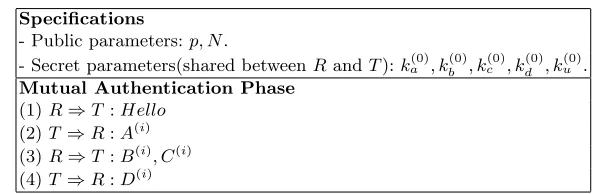
Figure 1 shows one instance run of the mutual authentication phase in the UCS-RFID protocol. The reader starts the interrogation with a “Hello” message which
Specifications
- Public parameters:p, N.
- Secret parameters(shared betweenR andT):ka(0), kb(0), k(0)c , kd(0), k(0)u .
Mutual Authentication Phase
(1)R⇒T :Hello (2)T ⇒R:A(i) (3)R⇒T :B(i), C(i) (4)T ⇒R:D(i)
Fig. 1.ithrun of the mutual authentication phase in the UCS-RFID protocol
is responded by tag’s dynamic identifier A(i). The reader then looks up in the database for a set of five keys(ka, kb, kc, kd, ku) which corresponds to A(i). If
this search is successful, it means that the tag is authentic. Having the tag authenticated, the reader generates a 2N-bit random noncen(i)uniformly drawn fromZ∗p, calculates messagesB
(i),C(i) by (2),(3) and sends them to the tag.
A(i)≡nl(i−1)+k(ai)mod 2N (1) B(i)≡n(i)+kb(i)mod p (2) C(i)≡n(i)×k(ci) mod p (3) The tag first checks the integrity of the received messages by (4):
(B(i)−kb(i))×k(ci)≡C(i) mod p (4) This check implies the authenticity of the reader as well. Then, the tag extracts the noncen(i)by (5.)
n(i)≡(B(i)−kb(i))mod p (5) To conclude the mutual authentication phase, the tag transmitsD(i)as a receipt of obtaining n(i).
2.2 Key Updating Phase
After a successful mutual authentication, both the reader and the tag update their keys and dynamic identifier (A(i)) for the next protocol run.
ka(i+1)=nr(i)⊕ka(i) (7) k(bi+1)≡k(ui)+ (n(i)⊕k(bi))mod p (8) k(ci+1)≡k(ui)×(n(i)⊕k(ci))mod p (9) k(di+1)=n(ri)⊕k
(i)
d (10)
ku(i+1)≡ku(i)×n(i) mod p (11) A(i+1)≡n(li)+ka(i+1) mod2N (12) It should be noted that the dynamic values have been proved to preserve their properties of independency and uniformity after updating[17].
3
Observation
In this section, we shed more light on a weakness in the UCS-RFID protocol which becomes the origin of our proposed attack presented in the subsequent section.
By xoring (7) and (10), we have:
kia+1⊕kdi+1=kia⊕kid (13) Equation (13) shows that the difference betweenka andkdremains the same for
two consecutive runs of the protocol. This statement can also be generalized for every rarbitrary run of the protocol the as following:
kar+1⊕krd+1=kra⊕krd=. . .=k0a⊕kd0=L (14) By using (14), for outputsA and D in m consecutive runs of the protocol, we have:
A(i)≡nl(i−1)+k(ai) mod2N (15) D(i)=nl(i)⊕(ka(i)⊕L) (16) A(i+1)≡n(li)+ (ka(i)⊕n(ri))mod2N (17) D(i+1)=n(li+1)⊕(ka(i)⊕L⊕n(ri)) (18)
.. .
A(i+m−1)≡nl(i+m−2)+ (k(ai)
i+m−2 M
j=i
n(rj))mod2N (19)
D(i+m−1)=nl(i+m−1)⊕(k(ai)⊕L
i+m−2 M
j=i
It is apparent that we have a set of 2mequations with 2m+ 2 variables. These variables can be divided into two groups:
1. 2mhalf-nonces:n(li−1), . . . , nl(i+m−1), n(ri), . . . , n(ri+m−2)
2.Landk(ai).
So, if we fix the value of variables L and ka(i), we end up with 2m equations
and 2m half-nonce variables. This implies that the 2m half-nonces can not be chosen independently and fulfil the above equations simultaneously. In other words, if we observe the outputs ofmconsecutive runs of the protocol, it is only necessary to search over all possible sequences of k(ai) andL, which is 22N, and
then it will be possible to find all 2mhalf-nonces uniquely. As we will see, this weakness is the result of introduction of a tighter bound for the half-nonces while we keep observing more runs of the protocol.
By the randomness nature of the generated half-nonces, the total number of pos-sible sequences for them(22N) is uniformly distributed over them. This implies
that each of the 2mhalf-nonces is expected to have a bound of 2m√22N possible
values (comparing to its previous bound which was N). Therefore, for m con-secutive protocol runs, the total number of possible values distributed over the 2mhalf-nonces is 2m2m√22N [17].
Now, if we exclude the value which half-nonces has taken already(2m2m√ 22N −
2m), we can calculate the probability that at least one half-nonce does not receive another possible value (remains constant). To do so, we utilize the well-known problem in probability theory(i.e. Givenrballs thrown uniformly at random at b bins, the probability that at least one bin remains empty which is calculated by (21))[18]:
Pr(at least one bin remains empty) = 1−
r−1
b−1
b+r−1
b−1
(21)
Now, it only requires to substituteb= 2mandr= 2m.2m√
22N−2min (21) and
then we will have (22). The result is plotted in Figure 2.
Ph= Pr(at least one half-nonce remains constant) = 1−
2m.2m√22N−2m−1 2m−1
2m.2m√22N−1 2m−1
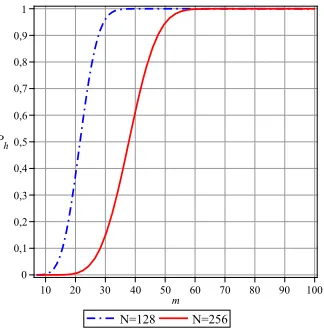
(22) Figure 2 shows the probability of inferring at least one half-nonce in terms of the number of consecutive runs of the protocol required to be observed to do so. For example, if we observe 35 runs of the protocol runs withN=256, we will be able to determine at least one of the 70 transmitted half-nonces with the probability of more than 0.99.
We will use the term ”victim half-nonce” for inferred half-nonce and notation mh instead ofmfor the number of consecutive runs of the protocol required to
Fig. 2.The number of consecutive protocol runs an adversary must observe(m) in order to infer at least one half-nonce forN = 128,256
4
Our Attack Scenario
In the previous section, we presented a probabilistic approach to find the number of consecutive runs of the protocol to infer one half-nonce. But in our attack, we need to have a complete nonce(left and right corresponding half-nonces) to recover all secret keys. To achieve this goal, we propose an attacking scenario which consists of the three following phases:
1. Finding the total number of necessary consecutive runs of the protocol to find a complete victim nonce (mt).
2. Finding the victim nonce. 3. Recovering the secret keys.
4.1 Phase I: Finding mt
In section 3, we proposed a probabilistic way to calculate the number of con-secutive runs that must be observed by an adversary to infer a half-nonce(mh).
It is obvious that if we keep observing more runs of the protocol(i.e. more than mh), after each extra observation, another half-nonce can be inferred. This is
simply possible by eliminating the two equations which contain the first victim half-nonce and adding two newly observed equations to the set of equations (15-20) and then, we again have 2mh equations and 2mh+ 2 variables which yield
another half-nonce inference.
As we know, after mh runs of the protocol, we accomplish to find one victim
half-nonce, afterme extra runs of the protocol, we have β = 2mh+ 2me
equa-tions andβ half-nonces whichme+ 1 of them can be inferred. The probability
that none of these me+ 1 half-nonces match is:
Pr(Having no pair aftermh+me runs) =
(β−1)
β ×
(β−2)
β ×. . .×
(β−me)
β
= Qme
i=1(β−i)
β(me) (23)
Consequently, the probability of having at least one pair after observingmeruns
is simply calculated by (24).
Pe= Pr(Having at least one pair of matching half-nonces aftermh+meruns)
= 1−
Qme
i=1(β−i)
β(me) (24)
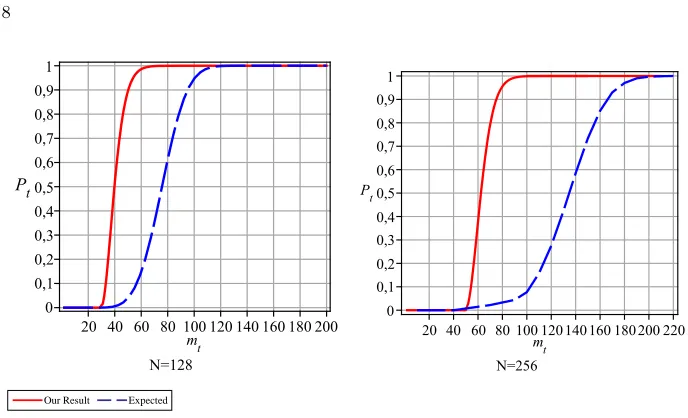
By using (22) and (24) the total number of protocol runs to have at least one complete victim nonce (mt=mh+me) can be calculated by (25) and is plotted
in Figure 3.
Pt= Pr(Having at least one complete nonce aftermt runs)
= (Pe|mh=h)×P r(mh=h) = (Pe|mh=h)×Ph(h) (25)
RemarkThe authors of [17] have also calculatedmtby using some other
pro-tocol outputs (B and C). Figure 3 compares our results with what the authors ”Expected”. This comparison has been conducted for two different security pa-rametersN=128,N=256 which are plotted on the left and right respectively. The results show that the security margin of the protocol in terms of the number of consecutive runs that must be observed to infer one nonce is less than what the designers of the protocol expected. In other words, we need less number of protocol runs to infer at least one nonce. For example a passive adversary is able to infer a complete nonce with high probability of 0.99 by eavesdropping less that 60 and 90 runs of the protocol for the key size of 128 and 256 bits respectively. These numbers were expected to be 110 and 200 respectively.
4.2 Phase II: Finding the constant nonce
Having mh consecutive runs of the protocol observed, we have one constant
half-nonce or one half-nonce with only one possible value. In order to find this half-nonce, we adopt the following algorithm.
Our Result Expected
Fig. 3.Comparison of expected security margin of the UCS-RFID protocol and our results in terms of the number of consecutive protocol runs an adversary must observe in order to infer at least one nonce.
2. Find the mh, mt related to the determined probability from Figures 1,2
respectively.
3. Calculateme=mt−mh
4. Choose two random numbers from Z2N and assign them to L,k (i)
a
respec-tively.
5. Find 2mnonces (n(li−1), . . . , n(i+mh−1)
l , n
(i)
r , . . . , n
(i+mh−2)
r ) as follows.
– Findn(li−1) from (15) i.e.nl(i−1)≡A(i)−k(i)
a mod2N.
– Findn(i)from (16) i.e.n(i)
l =D(i)⊕(k
(i)
a ⊕L).
– Findn(ri)from (17) i.e.nr(i)≡(A(i+1)−n(li)mod 2N)⊕ka(i).
.. .
– Findn(i+mh−2)
r from (19)i.e.nr(i+mh−2)≡(A(i+mh−1)−nl(i+mh−2)mod2N)⊕
(ka(i)Lij+=mih−2n
(j)
r ).
– Findn(i+mh−1)
l from (20) i.e.n
(i+mh−1)
l =D
(i+mh−1)⊕(ka(i)⊕L)Li+mh−2
j=i n
(j)
r .
6. Repeat 4 and 5 as many times as we observe that only one half-nonce keeps its value for all of the repetitions.
7. Save the constant(victim) half-nonce. 8. Observe another run of the protocol.
– A(i+mh)≡n(i+mh−1)
l + (k
(i)
a Lij+=mi h−1n
(j)
r )mod2N
– D(i+mh)=n(i+mh)
l ⊕(k
(i)
a ⊕LLij+=mih−1n(rj)).
10. Repeat 4,5,6,7,8 formetimes.
11. Match two corresponding victim half-nonces(e.g.n(lj), n(rj)).
12. Output the victim nonce (n(j)=nl(j)||n(rj)).
4.3 Phase III: Key Recovery
In the previous two phases of our attack, we accomplished to find a complete victim noncen(j) ,with a certain probability, by observingmtconsecutive runs
of the protocol. Now, we present how an adversary is able to recover all five se-cret keys of the protocol. To findka(j), k(bj), kc(j)andkd(j), we should follow(26-29).
ka(j)≡(A(j+1)−nl(j))⊕n(rj)mod2N (26) k(bj)≡B(j)−n(j)mod p (27) k(cj)≡( 1
n(j) mod p)×C
(j) mod p (28)
kd(j)=nl(j)⊕D(j) (29) To recover ku(j), we need to find the nonce in the next run (n(j+1)), thus we
should calculate the updated keys for the (j+ 1)thrun using (7) and (10).
ka(j+1)=ka(j)⊕n(rj) (30) kd(j+1)=kd(j)⊕n(rj) (31) Then we have:
n(lj+1)=D(j+1)⊕k(dj+1) (32) k(aj+2)=A(j+2)⊕n(lj+1) (33) Using (30) and (33), we can write:
nr(j+1)=ka(j+2)⊕ka(j+1) (34)
Finally, by using (27),(32) and,(34) we can findk(uj).
ku(j)≡B(j+1)−n(j+1)−(k(bj)⊕n(j+1))mod p (35) The procedure above provides us with our objective to recover all of the secret keys with a certain probability(Pt). This probability can be increased by paying
the price of having more protocol run outputs available.
5
On the Traceability of the UCS-RFID
In the previous section, we presented a probabilistic key recovery attack against the UCS-RFID protocol. We mentioned that according to Figure 3, we need to have about 90 runs of the protocol to be almost sure that our found keys are cor-rect. But with less number of protocol run outputs, we still can apply an attack against the traceability of the protocol. In this section, we formally investigate theuntraceability of the UCS-RFID based on the formal description in [12].
5.1 Adversarial Model
According to [12], the means that are accessible to an attacker are the following: We denote a tag and a reader inithrun of the protocol byT
iandRi, respectively.
– Query(Ti, m1, m3):This query models the attackerAsending a messagem1 to the tag and sending them3 after receiving the response.
– Send(Ri, m2): This query models the attacker Asending a message m2 to the Reader and being acknowledged.
– Execute(Ti,Ri):This query models the attackerAexecuting a run of protocol
between the Tag and Reader to obtain the exchanged messages.
– Reveal(Ti):This query models the attacker Aobtaining the information on
the Tag’s memory.
A Passive Adversary, AP, is capable of eavesdropping all communications
be-tween a tag and a reader and accesses only to theExecute(Ti,Ri):.
5.2 Attacking Untraceability
The result of application of an oracle for a passive attackOP ⊆ {Execute(.)}on
a tagT in the runiis denoted bywi(T). Thus, a set ofIprotocol run outputs,
ΩI(T), is:
ΩI(T) ={wi(T)|i∈I};I⊆N;(N denotes the total set of protocol runs).
The formal description of attacking scenario against untraceability of a protocol is as following:
1.AP requests theChallenger to give her a targetT.
2.AP choosesI and callsOracle(T, I,OP) where|I| ≤lref receivesΩI(T).
3.AP requests theChallenger thus receiving her challengeT1,T2 ,I1andI2 4.APcallsOracle(T1, I1,OP) ,Oracle(T2, I2,OP) then receivesΩI1(T1) ,ΩI2(T2).
5.AP decides which ofT1 orT2isT, then outputs her guessT´. For a security parameter,k, if AdvU N T
AP (k) = 2P r(T´ = T)−1 > then we
can say that the protocol is traceable.
For UCS-RFID case, as Figure 3 implies, an adversaryAP needs only to access
then according to section 4.3, she will be able to recover the keys of subsequent runs. After, key recovery, the adversary can easily distinguish a target tag with any other challenge tag given by the challenger. So we have:
∀lref ≥40,AdvAU N TP (128) = 2P r(T´=T)−1 = 0.1> .
∀lref ≥65,AdvAU N TP (256) = 2P r(T´=T)−1 = 0.1> .
6
Conclusions
The design of suitable lightweight security protocols for low-cost RFID tags is still a big challenge due to their severe constraints. Despite of interesting pro-posals in the literature, this field still lacks a concrete solution.
Recently, Alomairet al have proposed the first authentication protocol based on the notion of unconditional security. Regardless of some inefficiencies in UCS-RFID authentication protocol, such as: large key sizes, using modular multi-plication ,etc ,which makes this protocol an unsuitable nominate for low-cost RFID tag deployment, we presented a passive attack which showed that even the security margin which was expected to be yielded by UCS-RFID has also been overestimated.
In our attack, we showed that a passive adversary is able to achieve the all secret keys of the system with a high probability of 0.99 by eavesdropping less that 60 and 90 runs of the protocol for the key size of 128 and 256 bits respectively. Tracing the tag in the protocol is also feasible even by less number of runs of the protocol (e.g. 40, 65).
Our results suggest a major rethink in the design of the authentication protocols for RFID systems based on unconditional security notion. Drastic changes are necessary to fulfil both technological constraints and security concerns in RFID systems.
References
1. N.J. Hopper and M. Blum. : Secure Human Identifcation Protocols , in C. Boyd (ed.) Advances in Cryptology - ASIACRYPT 2001, Volume 2248, Lecture Notes in Computer Science, pp. 52-66, Springer-Verlag, (2001).
2. J. Bringer, H. Chabanne, and E. Dottax.: HB++: a Lightweight Authentication Protocol Secure Against Some Attacks, IEEE International Conference on Pervasive Services, Workshop on Security, Privacy and Trust in Pervasive and Ubiquitous Computing SecPerU, (2006).
3. Julien Bringer and Herve Chabanne.: Trusted-HB: a low-cost version of HB+ secure against man-in-the-middle attacks. CoRR, abs/0802.0603, (2008).
4. Julien Bringer, Herve Chabanne, and Emmanuelle Dottax.: HB++: a lightweight au-thentication protocol secure against some attacks, In Second International Workshop on Security, Privacy and Trust in Pervasive and Ubiquitous Computing (SecPerU 2006), pages 28-33. IEEE Computer Society, (2006).
6. Henri Gilbert, Matthew J. B. Robshaw, and Yannick Seurin: HB]: Increasing the security and effciency of HB+, Advances in Cryptology EUROCRYPT 2008, 27th Annual International Conference on the Theory and Applications of Cryptographic Techniques, Istanbul, Turkey, April 13-17, Proceedings, volume 4965 of Lecture Notes in Computer Science, pages 361-378.Springer, (2008).
7. J. Munilla and A. Peinado.: HB-MP: A further step in the HB-family of lightweight authentication protocols. Computer Networks, (2007).
8. Mukundan Madhavan,Andrew Thangaraj,Yogesh Sankarasubramaniam and Kapali Viswanathan: NLHB : A Non-Linear Hopper Blum Protocol,IEEE National Con-ference on Communications (NCC),2010, CoRR abs/1001.2140 (2010).
9. Peris-Lopez, Hernandez-Castro,Estevez Tapiador, and Ribagorda: LMAP: A Real Lightweight Mutual Authentication Protocol for Low-cost RFID tags , RFIDSec 06, (2006).
10. P. Peris-Lopez, J. C. Hernandez-Castro, J. Estevez-Tapiador, and A. Ribagorda: M2AP: A minimalist mutual-authentication protocol for low-cost RFID tags, in International Conference on Ubiquitous Intelligence and Computing (UIC06), vol. 4159 of LNCS, pp.912-923 (2006).
11. P. Peris-Lopez, J. C. Hernandez-Castro, J. Estevez-Tapiador, and A. Ribagorda: EMAP: An Efficient Mutual-Authentication Protocol for Low-cost RFID tags , in OTM Federated Conferences and Workshop: IS Workshop, (2006).
12. Avoine G. :Adversarial Model for Radio Frequency Identification. Cryptology ePrint Archive, Report 2005/049, (2005).
13. M. Ohkubo, K. Suzuki, and S. Kinoshita: Cryptographic Approach to Privacy-Friendly Tags, in RFID Privacy Workshop, (2003).
14. D. Henrici, and P. Muller: Hash-based Enhancement of Location Privacy for Ra-dio Frequency Identification Devices using Varying Identifiers, in Proceedings of PerSec04,IEEE PerCom, pp.149-153, (2004).
15. D. Henrici, and P. Muller: Providing Security and Privacy in RFID Systems Using Triggered Hash Chains, in PerCom’08, 50-59, (2008).
16. L.S. Kulseng: Lightweight Mutual Authentication, Owner Transfer, and Secure Search Protocols for RFID Systems , Master Thesis, Iowa State University,Ames, (2009).
17. B. Alomair, L. Lazos , R. Poovendran: Securing Low-cost RFID Systems: an Un-conditionally Secure Approach , RFIDsec’10 Asia, Singapore, (2010).
18. W. Feller: An Introduction to Probability Theory and its Applications, Wiley India Pvt. Ltd., (2008).
19. T.S. Heydt-Benjamin, D.V. Bailey, K. Fu, A. Juels, and T. O’Hare: Vulnerabilities in First-Generation RFID-Enabled Credit Cards, Proc. 11th Int’l Conf. Financial Cryptography and Data Security (FC ’07), pp. 2-14, (2007).
20. D.Carluccio, K.Lemke, C.Paar: E-passport: The Global Traceability or How to feel like a UPS package, Proceeding of WISA’06, LNCS 4298, Springer, pp.391-404, (2007).
21. J.-H. Hoepman, E. Hubbers, B. Jacobs, M. Oostdijk, and R.W. Schreur, Crossing Borders: Security and Privacy Issues of the European e-Passport, Proc. First Int’l Workshop Security (IWSEC ’06), pp.152-167 (2006).
22. CASPIAN, Boycott Benetton: http://www.boycottbenetton.com (2007). 23. Mitsubishi Electric Asia Switches on RFID:
www.rfidjournal.com/article/articleview/2644/ (2006).