© 2016, IJCSMC All Rights Reserved 296 Available Online at www.ijcsmc.com
International Journal of Computer Science and Mobile Computing
A Monthly Journal of Computer Science and Information Technology
ISSN 2320–088X
IMPACT FACTOR: 5.258
IJCSMC, Vol. 5, Issue. 6, June 2016, pg.296 – 312
A Study on Issues on Types of TCP
Protocol for Mobile Computing
RAMADEVI KOLLI
1, RAVINDER REDDY SEELAM
2,
P. NAGESWARA RAO
3, B. NAVEEN KUMAR
41
M.Tech Research Scholar Gandhi Academy Of Technical Education Ramapuram(V),Chilukur(M), INDIA -508206, [email protected] +91-8008266672
2
M.Tech Research Scholar Gandhi Academy Of Technical Education Ramapuram(V),Chilukur(M), INDIA -508206
3
Assistant Professor, Gandhi Academy Of Technical Education Ramapuram(V),Chilukur(M), INDIA -508206
4
Assistant Professor Gandhi Academy Of Technical Education Ramapuram(V),Chilukur(M), INDIA -508206_
Abstract: We examine the configuration standards of TCP inside the setting of heterogeneous wired/remote systems and versatile systems administration. We recognize three weaknesses in TCP's conduct: (i) the convention's mistake location system, which does not recognize diverse sorts of blunders and hence does not suffice for heterogeneous wired/remote situations, (ii) the mistake recuperation, which is not receptive to the particular qualities of remote systems, for example, transient or burst blunders because of handoffs and blurring channels, and (iii) the convention methodology, which does not control the exchange off between execution measures, for example, great put and vitality utilization, and regularly involves an inefficient exertion of retransmission and vitality consumption. We examine an answer system in light of chose exploration recommendations and the related assessment criteria for the proposed alterations. We highlight an essential edge that did not pull in the required consideration as such: the requirement for new execution measurements, fitting for assessing the effect of convention techniques on battery-fuelled gadgets.
Keywords: TCP, congestion control, wireless links, mobile computing, energy efficiency.
1 Introduction
© 2016, IJCSMC All Rights Reserved 297
circumstances of restricted data transfer capacity is not as a matter of course the ideal procedure to recoup from connection blunders. All the more exactly, it was understood that a productive TCP for wired/remote systems should be equipped with extra instruments that arrangement with: The identification of the nature (recurrence, term, and so forth.) of the mistakes that made parcels be dropped. This information can be utilized to decide the fitting mistake recuperation procedure. For instance, hand-offs, blurring channels, blockage and transient irregular mistakes call for particular recuperation procedures. The changes of the sender's level of information transmission, inside the bounds of reasonable conduct and relying upon the way of the blunders identified. This empowers recuperation methodologies that can change in accordance with the fundamental systems' mistake attributes, gadget requirements and execution tradeoffs. The convention's vitality and efficient capacities. This takes into account effective utilizations of the convention with versatile, battery-fuelled gadgets. The solid and exact recognition of blockage in both the forward and the converse way (subsequently, not in light of RTT estimations), and potentially not by method for encountering parcel drops as in standard TCP. Such extra components could sidestep the known issues of hitter kilter connects and lessen the effect of the timeout, which depends on estimations of the Round Trip Time (RTT), on convention execution. Prominently, a portion of the convention's inefficiencies won't not get to be clear when the convention is assessed with customary execution measurements. For instance, great put has customarily been utilized to gauge the rate at which information is conveyed to higher layers. Then again, the transmission exertion exhausted by the convention keeping in mind the end goal to accomplish its great put is in reality a critical metric. The fitting assessment for now's Internet, primarily because of the expanding nearness of battery-fueled gadgets, requires extra measurements, for example, vitality proficiency, overhead or transmission exertion. Conventional results and strategies that today constitute the guide of both decency and productivity are not as a matter of course ideal for wired/remote systems and the Internet.
In conjunction with the above contemplations a configuration issue has likewise been raised: "Where is the opportune spot to include the integrative usefulness of the wired and remote Internet?". We diagram a portion of the key instruments of TCP that require changes with a specific end goal to upgrade the convention execution in wired/remote systems. We talk about late results from the viewpoint of the convention usefulness and particular systems and we group late recommendations appropriately. We compose whatever remains of the paper as takes after: In Section 2 we survey the operations of standard TCP clog control. In Section 3 we talk about the issues of TCP with regards to wired and remote systems. In Section 4 we diagram the prerequisites of blunder discovery and we show the outline of a "testing" gadget that fulfils these necessities. We examine strategies for blunder recuperation and related recommendations for enhancing TCP execution from the point of view of heterogeneous wired/remote systems in Section 5. In Section 6 we shake TCP's procedure from the point of view of versatile blunder control and the related vitality/throughput tradeoffs. In Section 7 we introduce finishing up comments.
2 Transmission Control Protocol (TCP)
Today, the dominant part of use conventions utilize the Internet's solid Transmission Control Protocol (TCP). The usefulness of TCP [31] is intended to be satisfactory for Internet applications as well as for the assortment of fundamental systems. The convention goes for giving a dependable administration the accompanying elements:
Fairness to different streams that possibly share a station's transmission capacity
Dynamic disclosure of current accessibility of data transfer capacity
Mechanisms for blockage evasion and control and for streamlining of the mistake recuperation process Error control instruments are the focal part of solid conventions. They influence a convention's execution with appreciation to goodput, vitality consumption, and overhead. Mistake control is typically a two-stage process: blunder identification, trailed by blunder recuperation.
TCP recognizes blunders by checking the arrangement of information portions recognized (got). At the point when timeouts are accurately designed, a missing section is taken to demonstrate a blunder, in particular that the fragment is lost because of clog (i.e. support flood). Dependable conventions as a rule actualize a mistake recuperation system in view of two strategies: retransmission of lost fragments; and descending modification of the sender's window size and correction of the timeout period. In the standard TCP forms the beneficiary can acknowledge portions out of arrangement, yet conveys them keeping in mind the end goal to higher conventions. The collector promotes a window size and the sender guarantees that the quantity of unacknowledged bytes does not surpass this size. For every fragment effectively got, the collector sends back an affirmation1, which incorporates an arrangement number recognizing the following in-grouping byte anticipated. The transmitter actualizes a clog window that characterizes the Deferred Acknowledgments are examined in most extreme number of transmitted-however unacknowledged bytes allowed. This versatile window can increment and decline, however the real "sending window" never surpasses the base of the collector promoted and blockage window. Standard TCP applies graduated multiplicative and added substance conformity to the sender's blockage window keeping in mind the end goal to ensure dependability and decency to different streams that potentially endeavour to all the while use the transmission capacity of the channel. The Additive
1
© 2016, IJCSMC All Rights Reserved 298
Increase Multiplicative Decrease (AIMD) calculation is utilized to actualize TCP window conformities; in light of the examination of Chiu and Jain the calculation accomplishes security and merges to decency in circumstances where the interest (of contending streams) surpasses the channel's data transmission [15].
2.1 TCP Tahoe, Reno, Vegas
The blunder control system of TCP is essentially arranged toward blockage control. Blockage control can be helpful to the stream that encounters clog, subsequent to maintaining a strategic distance from pointless retransmission can prompt better goodput [22]. The fundamental thought is for every source to decide the amount of data transmission is accessible in the system, with the goal that it knows what number of sections it can securely have in travel. TCP uses affirmations to pace the transmission of portions and translates timeout occasions as demonstrating clog. In light of blockage, the TCP sender lessens the transmission rate by contracting its window. Tahoe and Reno are the two most regular reference usage of TCP. They depend on prompting lost sections to identify blockage so that a stream can conform its rate to its accessible offer. Subsequently, their methodology actualizes clog control. Or maybe, TCP Vegas [12] actualizes blockage shirking as it endeavours to identify clog before it happens (i.e. before fragments are lost). We talk about every rendition thusly.
TCP Tahoe: TCP Tahoe blockage control calculation incorporates Slow Start, Congestion Avoidance, and Fast
Retransmit [3]. It additionally executes a RTT-based estimation of the retransmission timeout. In the Fast retransmit system, various progressive (the edge is normally set at three), copy affirmations (dacks) conveying the same succession number triggers a retransmission without sitting tight for the related timeout occasion to happen. The window modification procedure for this "early timeout" is the same concerning the standard timeout: Slow Start is connected. The issue, in any case, is that Slow Start is not generally effective, particularly if the blunder was simply transient or arbitrary in nature, and not constant. In such a case the shrinkage of the clog window is, indeed, pointless, and renders the convention not able to completely use the accessible data transfer capacity of the correspondence channel amid the consequent period of window re-extension.
TCP Reno: TCP Reno presents Fast Recovery in conjunction with Fast Retransmit. The thought behind Fast Recovery
is that a dack means that accessible channel data transmission since a section has been effectively conveyed. This, thusly, infers the clog window (cwnd) ought to really be augmented upon a dack conveyance. Specifically, accepting the edge number of dacks triggers Fast Recovery: the sender retransmits one fragment, and sets the blockage edge to a large portion of the current cwnd. At that point, rather than entering Slow Start as in Tahoe, the sender builds its current cwnd by the dack edge number. From that point, and for whatever length of time that the sender stays in Fast Recovery, cwnd is expanded by one for each extra dack got. This methodology is called "blowing up" the window. The Fast Recovery stage is finished when an affirmation (ack) for new information is gotten. The sender then sets cwnd to the present blockage edge esteem ("flattening" the window), and resets the dack counter. In Fast Recovery, cwnd is accordingly adequately set to a large portion of its past quality within the sight of dacks, and develops with Additive Increase instead of Slow Start. TCP Reno's Fast Recovery can be compelling when there is one and only section drop from a window of information, given the way that Reno retransmits at most one dropped fragment for each RTT. The issue with the instrument is that it is not streamlined for numerous bundle drops from a solitary window, and this could contrarily affect execution.
TCP Vegas: TCP Vegas approaches the issue of clog from another viewpoint. In view of test RTT estimations, and the
span of the sending window, the sender ascertains the throughput rate each RTT. This rate is contrasted with a normal rate, which is computed in light of what is doing now known as best RTT (called base RTT). Two limits α and β trigger an added substance increment or decline, depending on whether the channel is under-or over-used, separately. Despite the fact that not self-evident, the convention is consistent to the principles of reasonableness: it applies multiplicative changes when blockage is recognized. In fact, it applies Slow Start in case of a period out. Vegas' methodology is fascinating: it endeavours to evaluate the level of blockage before it happens, and thusly keep away from it, in this manner maintaining a strategic distance from pointless bundle drops. One of the issues that it doesn't appear to overcome is the way asymmetry. The sender settles on choices in light of the RTT estimations, which, in any case, may not precisely demonstrate the clog level of the forward way. Besides, bundle drops created by transmission insufficiencies or blurring channels may trigger a Slow Start. Be that as it may, this issue is regular to all the above forms and is point by point beneath.
3 Research Issues
© 2016, IJCSMC All Rights Reserved 299
window extension, open doors for blunder free transmissions are squandered and correspondence time is expanded. As it were, within the sight of occasional and transient mistakes, TCP's back-off system maintains a strategic distance from just minor retransmission at the expense of essentially debased great put, which builds general association time. However, when a blunder happens and TCP backs off, it proceeds to mightily endeavour transmissions inside the limits of the diminished window size. Within the sight of blunders of a generally tenacious nature (blurring channel, drawn out and visit burst mistakes, blockage), this conduct does not support vitality sparing, since it may yield just minor great put change at high cost in transmission vitality. In synopsis, from the point of view of vitality use with regards to heterogeneous wired/remote systems, TCP appears to have an inalienable propensity to back off an excessive amount of when it ought not, and too little when it ought to [38]. The focal issue lies in the failure of TCP's instrument to accurately distinguish the way of the mistake, thus it is unequipped for reacting in a fitting way [16, 37, 8, 24]. Furthermore, the convention does not have the capacity to productively screen system conditions, quickly straighten out its window size in light of changes in these conditions2, and recognize clog without actuating parcel drops, in this way debasing general execution through extra retransmission and squandered open doors in keeping up the correspondence pipe full. The conventional composition of blockage control which consistently utilizes in reverse alteration of the clog window in case of retransmission, and which is exemplified by the TCP worldview, does not as a matter of course suffice for wired/remote systems. Note that a corresponding activity to the clog window modification is the timeout change. Augmentation of this timeout causes a corrupted capacity to quickly recognize mistake free conditions and recoup promptly. In this setting, a quick full-window recuperation after a transient connection mistake does not disregard the AIMD [15] guideline, which applies just when blockage exists. That is, AIMD does not support reasonableness, productivity or security when misfortunes are because of mistakes other than the deficient data transmission for the present interest of contending streams. Similarly, hand-offs or burst mistakes because of blurring don't as a matter of course legitimize an augmentation of the retransmission timeout or a graduated window modification (instead of full window recuperation) upon fruitful retransmission. Since TCP is not advanced for a particular system sort or application prerequisite, its instruments grant for a few application-and system particular changes. TCP's conduct over wired systems, where clog is a general reason for bundle misfortune, was at first examined by Jacobson [22]. As of late, TCP conduct over remote/wired and satellite systems has turned into a center of consideration. Late research results [2, 23, 38, 46, 16, 8, 43, 30, 25] have demonstrated that TCP throughput (i.e. sending rate) debases, within the sight of the sort of arbitrary/burst blunders and long engendering delays regular of remote and satellite situations, individually. Thus, a few scientists have tended to concentrate on the advancement of structures (e.g., remote intermediaries) that help the convention's operation over particular systems so as to acquaint minor changes with the convention itself. In this way, an extensive number of recommended recommendations going for enhancing TCP execution and stay away from or control system blockage manage the usefulness of system gadgets that can help the convention operations. For instance, the upgrades talked about in [8, 21, 32] require intercession at the switch or base-station level, to either furnish the sender with express data about the way of the mistake or endeavour to conceal inside and out the blunder from the sender. For instance, Ramakrishnan and Floyd in [32] propose an Explicit Congestion Notification (ECN) to be added to the IP convention keeping in mind the end goal to trigger TCP blockage control. A duality is presented with ECN: TCP execution can be upgraded by method for staying away from misfortunes of information windows because of restricted support space at the bottleneck switch, and congestive breakdown can be maintained a strategic distance from. Unmistakably, it could be valuable for the sender to know with accuracy that clog is going to happen. In any case, with regards to wired/remote systems ECN commitment may be constrained: by not getting an express notice the TCP sender won't have the capacity to securely expect that a distinguished drop was not brought about because of blockage. The craved accuracy of ECN-able TCP senders would be better drawn nearer if the level of blockage could likewise be shown with a specific end goal to permit TCP to actualize more refined recuperation. Accuracy however includes some significant pitfalls: the usefulness of the switches is more perplexing, changes are required to both switches and TCP itself, lastly, the arrival may be little because of heterogeneity, i.e. a few switches are not ECN-fit. Not at all like ECN, have RED Gateways [19] dropped, as opposed to check, parcels when clog is going to happen. The objective is to trigger TCP clog control, going for constraining the misfortune to one bundle. RED cans unction without requiring any change to the present transport level framework. Late work [28] presents a basic talk on the execution desires with RED. A fascinating perception about RED and ECN is that they could, by one means or another, limit future development. Envision a more advanced TCP which recognizes blockage and remote misfortunes. Since RED drops parcels in extent to sending rates, it is vague how reasonable RED would be to the modern TCP which simply happens not to superfluously back off if there should arise an occurrence of transient remote misfortunes.
The TCP-related work talked about above brings up a critical issue: "where is the perfect spot to include the required usefulness?". This inquiry does not have an unmistakable answer; mistake control is not solely an administration property of the switch or the base station, nor is it only doled out to the vehicle layer. A broadly acknowledged methodology, introduced by the end to end contention [35], states that we can just actualize a capacity at a lower layer, if that layer can play out the complete capacity. Since the lower level can't have enough data about the applications'
2
© 2016, IJCSMC All Rights Reserved 300
prerequisites, convention parameters, and gadget imperatives, it can't actualize the entire capacity of mistake control; it must be utilized to improve the capacity of the higher layer.
There are three notable focuses to make: First, TCP performs mistake control that is particularly customized toward blockage incited blunders; consequently it doesn't have the whole blunder control usefulness required for heterogeneous systems set up. Second, the proposed enhancements as often as possible display a clashing conduct with TCP's components; that is, a retransmission endeavour at a lower level may bring about developing the RTT assessments of TCP and thus its timeout. This broadened timeout may antagonistically influence the capacity of TCP to adequately recognize mistake free conditions. Moreover, we can't expect that all system gadgets or connection layer related modules would have the obliged usefulness to bolster a faulty TCP. Third, low-level alterations may oblige future TCP advancement. That is, the vehicle layer is by all accounts the normal spot for actualizing the centre usefulness for mistake control. This doesn't avoid potential advancements in light of the more exact or precise data that could be assembled from lower layers. For instance, having a TCP-mindful passage at the outskirt of the wired and remote systems empowers a more exact determination (i.e., restriction) of the wellspring of the mistake. All things considered, it creates the impression that there is no much strong hypothesis behind the above configuration issue; cost, pertinence and effect give off an impression of being the significant criteria for assessing distinctive methodologies. In synopsis, key issues of TCP that require consideration are:
Blunder Detection, that decides the locus of the drop and perhaps the way of the mistake,
Blunder Recovery that is receptive to the mistake design and,
Convention Strategy that favours one administration trademark over another (e.g., vitality over good put).
4 Blunder Detection
© 2016, IJCSMC All Rights Reserved 301
time). The purpose behind doing this is examined in the blink of an eye. The base station recognizes a fragment to the altered host simply after the portable host really gets and recognizes that section. Henceforth, TCP end-to-end semantics is kept up all through the lifetime of the association. Likewise, the round outing time seen by the source is the genuine round excursion time taken by a fragment to reach and come back from the versatile host, i.e. it does exclude living arrangement time at the base station required for nearby recuperation. In this way WTCP endeavours to reject the impact of the remote connection on the round outing time gauge and consequently timeout kept up by the sender. Not doing as such may superfluously expand the timeout esteem, which thusly may frustrate the capacity of the TCP sender to rapidly recognize clog over the wired segment of the system. In view of copy affirmation or timeout, the base station locally retransmits lost fragments. If there should arise an occurrence of timeout, WTCP accept a run of the mill burst misfortune on the remote connection is going to take after. Dissimilar to TCP Reno, WTCP translates the gathering of a copy affirmation as a sign that the remote connection is in great state. Area 5 talks about how the mistake recuperation of WTCP endeavours this remote blunder characterization.
4.1 Discussion
Testing instruments at the vehicle level were initially exhibited in [39] with regards to a test convention. In spite of the fact that the fancied properties (i.e., self-modifying capacity, throughput/delay checking) of testing gadgets have been unmistakably distinguished in [39, 37], the ideal configuration of such gadgets for TCP and with regards to wired/remote systems remains an open issue. For instance, a test cycle could comprise of one extensible test/ack trade as a bundle pair, where the level of clog could be measured in standout RTT. This is relied upon to positively affect throughput under occasional blunders of a transient nature. In any case, it might negatively affect the convention's self-modifying ability under situations of mistakes with certain thickness since the likelihood for a test or a test affirmation to be lost would be bound. Appearing to be identical thought from another point of view, we could outline a cycle to comprise of more than one organized trades of tests and their acks, subsequently improving further the capacity of distinguishing mistake examples of directed thickness at the expense of extra RTTs. Such a configuration would uphold a more moderate recuperation procedure. The effectiveness of various testing strategies for TCP has not been explored. Similarly, the effectiveness of identifying the level of blockage calls for further consideration. In [39, 44] Tsaoussidis l: propose the utilization of the wave design for identifying mistakes at the recipient. A wave is a settled 3 example of information trade amongst sender and collector that empowers the recipient to gauge the apparent level of clog taking into account the time required for a wave to be conveyed. All the more decisively, in TCP-Real [44], the beneficiary watches the system elements (blockage level) taking into account the proportion of the wave size to the wave conveyance time. The wave conveyance time is the time contrast between the gathering of the first and the last portion of the wave and it could be much littler than the RTT. The effectiveness of such estimations on the blockage level has two measurements: how to gauge clog, and where to quantify it (i.e., at the sender or the collector). In the following area we expand the talk on the last mentioned, since it critical for the mistake recuperation strategies of TCP. With respect to the previous, whether an estimation of clog ought to be founded on RTT estimations, on the bundle pair approach, on the wave design, or on single tests is an open issue of further research and experimentation. At long last, albeit remote intermediaries like WTCP might be compelling when the information and their acks finish the same way the intermediary, they get to be futile in circumstances where, for instance, information fragments complete a satellite connection the intermediary and acks take after a different physical way. Besides, some remote intermediary plans expect particular variants of TCP to be powerful. For instance, WTCP accept TCP forms which actualize timestamps for their RTT estimation. Snoop [9], then again, enhances the execution of TCP Reno by misusing its dupack instrument to distinguish the loss of cushioned fragments over remote connections.
5 Blunder Recovery
Once the convention can recognize the way of the mistake the recuperation methodology may should be more forceful when the blunders are not because of blockage. Blunder recuperation in TCP is not oversaw by a solitary segment. That is, the blockage window alteration, the affirmation methodology, the timeout component and different elements (e.g., recipient promoted window, moderate begin edge) all add to the effectiveness of the recuperation procedure. Thusly, inquire about endeavours were made to enhance particularly some of these segments under foreordained conditions and to upgrade usefulness at various layers. We next talk about some of these improvements.
5.1 The TCP sending window and timeout adjustments
TCP itself needs changes that arrangement with different sorts of mistake, not just lost fragments because of support flood. Since TCP expect just clog prompted misfortunes, Fast Recovery and Fast Retransmit are not sufficiently quick when the distinguished misfortunes are not due to network blockage. For instance, the sender needs to react to the mistake recognized utilizing the blockage window and the timeout system fittingly. The consistent game-plan of most methodologies is to shrivel the blockage window and extend the timeout period because of clog, or stop the window and timeout upon drops because of non-blockage mistakes. Thusly, Goff et al: [20] examine a change to abstain from debasing execution because of handoffs. Solidify TCP keeps away from timeouts at the sender amid handoffs since a timeout contracts the sending window to a base in all TCP adaptations. To this end, Freeze-TCP misuses the capacity of
3
© 2016, IJCSMC All Rights Reserved 302
the collector to promote a window of zero. Taking into account the sign's quality the recipient recognizes the handoff and advertizes a ZeroWindow Adjustment (ZWA). The sender then stops its transmission and its timeout esteem. Once the handoff is finished, the collector advertizes a non-zero window so that the sender resumes with its window and timeout values unaffected because of the handoff.
In TCP-Probing [37] Tsaoussidis and Badr present a recuperation technique that is receptive to the way of the mistake identified. Identification depends on the joined examining gadget laid out in Section 4 and is combined with an extra strategy, called Immediate Recovery. That is, neither the clog window nor the moderate begin limit are balanced downwards. Timeout values amid testing are additionally not balanced. The convention takes into account three particular strategies because of the way of the mistake distinguished: Slow Start (for clog identified by timeout), Fast Recovery (for directed blockage recognized by three dacks), and Immediate Recovery (for blockage free way). Note that a fourth strategy (i.e., traditionalist recuperation because of continuous connection mistakes) is excluded in the recuperation system. The thinking behind this choice is the steady property of the examining cycle to be expanded when a test or an affirmation is absent. This property supplements the recuperation procedure: when the mistake is thick, testing will be actually expanded and information transmission will be suspended, bringing about a more traditionalist transmission technique. Henceforth, a noteworthy commitment of the "Testing Device" is its capacity to normally adjust to mistake conditions and develop the "examining cycle". The consequence of this operation is generous amid handoffs or tenacious burst blunders: the sender suspends transmission and the timeout is not amplified, consequently keeping up the benefit of distinguishing the "great" stages over different variants. Suspending information transmission amid such decayed conditions results in vitality protection, which makes the convention especially material to portable, battery-fuelled gadgets. Quick Recovery is in checked refinement to Reno conduct toward the end of Fast Retransmit. The rationale here is that having sat out the mistake condition amid the test cycle and finding that system throughput is enhanced toward the end of the cycle, a forceful transmission is all the more plainly shown. Albeit two RTTs are squandered even by a solitary parcel misfortune, Probing can be more successful than Reno and Tahoe when the sending window is not very little. The Immediate Recovery instrument of TCP-Probing maintains a strategic distance from the Slow Start and/or the blockage evasion period of Tahoe and Reno. For this situation Probing promptly conforms the clog window to the recorded quality before the start of the test cycle. At the point when blockage is shown, the convention conforms to the clog control standards of standard TCP.
5.1.1 Decoupling the Sending Window from RTT
© 2016, IJCSMC All Rights Reserved 303
blockage identified, what number of levels are proper to empower a proficient use of the transmission capacity and food a straightforward and effective calculation for recuperation?
5.2 Acknowledgment Strategy
Note that the affirmation system adds to blunder discovery. It is introduced here for the most part since it doesn't contribute much to blunder arrangement and, furthermore, in light of the fact that it coordinates the conduct of the clog window. That is, TCP is an ack-timed convention and the affirmation procedure decides, as a result, the transmission rate. The standard convention's technique is to recognize every bundle got. It has been demonstrated that, sporadically, it can be helpful for the sender to speak with a beneficiary that defers the era of affirmations. The component is generally known as "Postponed Acks". Deferring Acks diminishes the preparing overhead furthermore the correspondence overhead. Numerous TCP usage recognize just every Kth portion out of a gathering of fragments that touch base inside a brief timeframe interim. The TCP sender must gauge the compelling RTT, including the extra time because of postponed ACKs, or else it will retransmit rashly [42]. The postponed affirmations methodology could be possibly a valuable component for controlling the sender's transmission rate at the beneficiary. Likewise, the pace of the TCP sender can likewise be balanced by a system gadget as per the present conditions distinguished. For instance, the quick retransmission approach [14] lessens the impact of versatile host hand-off. Amid a portable host hand-off starting with one base station then onto the next, TCP sections can be lost or postponed, and the source can timeout. In light of the common coarse granularity of the TCP clock, the timeout period is much higher than hand-off time, and the versatile host needs to superfluously sit tight for a long span to get a retransmission of a lost TCP section from the source. In the quick retransmit approach, promptly in the wake of finishing the hand-off, the IP in the versatile host triggers TCP to produce a specific number of copy affirmations. Since the greater part of TCP usage now have quick retransmit, these copy affirmations cause the source to retransmit the lost section without sitting tight for the timeout period to lapse. TCP makes utilization of copy affirmations essentially to demonstrate the following in-arrangement byte anticipated. Nonetheless, in a roundabout way, a DACK means that bundles are not stuck at some bottleneck gadget. Quick Recovery is planned taking into account this element. An inquiry emerges for the sender on the most proficient method to translate affirmations. New Reno for instance, sees certain affirmations as halfway [18]: A fractional affirmation is characterized as an affirmation for new information, which does not recognize all sections that were in flight right when Fast Recovery was started. It is in this manner a sign that not all information sent before entering Fast Recovery have been gotten. In Reno, the fractional ack triggers exit from Fast Recovery. In New Reno, it means that (no less than) one portion is missing and should be retransmitted. At the point when various parcels are lost from a window of information, New Reno can recoup without sitting tight for a retransmission timeout. Under rather particular conditions [38], this outcomes in some execution change. Albeit New Reno addresses the issue of different section drops inside the same window, and can along these lines maintain a strategic distance from a significant number of the retransmit timeouts of Reno, the calculation still retransmits at most one section for each RTT. Besides, the retransmission activated by a fractional ack may be for a postponed as opposed to lost section. Hence, the system dangers making various transmissions for the section, which can genuinely affect its vitality proficiency with no compensatory pick up in goodput. Results in [38] exhibit this wastefulness of New Reno.
Upgrades of the TCP affirmation methodology are likewise talked about in [27, 1, 5, 17]. TCP-SACK [27] utilizes specific affirmations to empower the beneficiary to advise the sender about the pieces of portions that have been effectively gotten. Particular affirmations are utilized as a part of conjunction with a Selective Repeat methodology: the missing sections can be retransmitted in one RTT. Essentially, the size impediment of the choices field of the TCP header constitutes a confinement on the quantity of obstructs that can be accounted for and thus, for the quantity of fragments that can be retransmitted. It is intriguing to note that Selective Acknowledgments give more data to the sender however don't uphold a more forceful retransmission. In spite of the fact that it is prescribed [17] that the Selective Repeat instrument be executed, it is fascinating to research at the point when precisely this is a decent practice; when mistake conditions don't require a forceful conduct, this technique may have negative effect on convention and/or system execution [38]. Be that as it may, this issue has not been examined for TCP-SACK and there are no outcomes that the creators know about to bolster this speculation. It ought to be noticed that SACK can be advantageous at any rate: the extra data can be utilized to trigger a preservationist conduct that stays away from additional overhead not just on the grounds that the sender can back-off amid weakened conditions, additionally on the grounds that retransmission can be more exact and particular. Obviously, the overhead that is added by SACK itself should be considered in the assessment of the convention execution. At long last, it is intriguing to note that TCP-SACK debilitates all the accessible space of the header's choices. That is, it doesn't permit space for future development of TCP or for mix of extra capacities that may should be all the while arranged between the two TCP closes.
5.3 Wired-Wireless Gateway
© 2016, IJCSMC All Rights Reserved 304
not trigerred. Unequivocal methodologies incorporate sending ECN-like notices, which require code adjustment (in any event) at the sender. We next talk about some intermediary based arrangements. The Indirect-TCP (I-TCP) [4] proposition parts the vehicle join at the wireline–wireless fringe to totally shield the sender from the impact of remote misfortunes. The base station keeps up two TCP associations, one over the altered system, and another over the remote connection. Along these lines, the low quality of the remote connection is escaped the altered system. By part the vehicle join, I-TCP does not keep up end-to-end TCP semantics, i.e. I-TCP depends on the application layer to guarantee dependability. It is contended that numerous applications give end-to-end unwavering quality, and one can pick I-TCP if the application gives dependability, and pick TCP generally. Accordingly, the portable host must know about an application's capacity to give dependability while picking an appropriate convention for the vehicle layer. Given the versatile host can pick the fitting transmission control convention, the base station ought to be educated about the portable host's determination as it is the place I-TCP executes.4 Since I-TCP utilizes TCP over the remote connection, it experiences poor execution in managing remote misfortunes. The MTCP proposition [13] is like I-TCP, aside from that the last TCP byte of the information is recognized to the source simply after it is gotten by the portable host. Despite the fact that the source erroneously trusts that each information byte with the exception of the last byte is gotten by the beneficiary, it can make medicinal move taking into account whether the last byte is gotten or not. Specifically, if the affirmation for the last byte is not got by the source, it needs to resend every one of the information including those that may have as of now been gotten by the versatile host. By clutching the last byte, the base station can send ZWA to solidify the source amid handoffs, so the window and timeout are not influenced. Like different methodologies, Explicit Bad State Notification (EBSN) [6] utilizes neighborhood retransmission from the base station to shield remote connection mistakes and enhance throughput. Be that as it may, if the remote connection is in mistake state for an amplified length, the source may timeout bringing about superfluous source retransmission. The EBSN approach maintains a strategic distance from source timeout by utilizing an express input system. In the event that the remote connection is in awful express, the base station sends an EBSN message to the hotspot for each retransmission of a portion to the versatile host. The EBSN message makes the source reinitialize the clock. On the off chance that the base station sends the EBSN messages before the source clock terminates, then there will be no timeouts at the source. In any case, the principle burden of this methodology is that it requires TCP code change at the source to have the capacity to decipher EBSN messages.
Ratnam and Matta [34, 33] proposed WTCP to shroud the time spent by a TCP fragment in the base station support (cf. Area 4). Subsequently, RTT gauges and timeout kept up at the sender (and thus the sender's capacity to distinguish 4Relying on the base station to settle on the vehicle convention is impossible as this requires the base station to know about the sort of utilization going through it. wired clog misfortunes) are not influenced by remote misfortunes. This is accomplished without express criticism messages, rather by changing the timestamp field in affirmations. In WTCP, the TCP association from the source is ended at the base station, and another dependable association is made from the base station to the portable host. In any case, the base station recognizes a TCP portion to the source simply after that section is recognized by the versatile host. Thusly, TCP's end-to-end semantics are totally saved. The solid association from the base station to the versatile host considers the extraordinary qualities of the nearby remote connection. If there should arise an occurrence of timeout, the transmission window for the remote association is decreased to only one section expecting a regular burst misfortune on the remote connection is going to take after. Accordingly, by quickly diminishing the transmission window possibly inefficient remote transmission is stayed away from and the obstruction with different channels is lessened. Dissimilar to normal TCP, every time an affirmation is gotten, WTCP opens the remote transmission window totally accepting that an affirmation shows that the remote connection is in great state. That is, the point at which an affirmation is gotten, the transmission window size is set to the window size promoted by the collector (i.e. versatile host). TCP Reno accept that a copy affirmation is brought about by a TCP section being lost because of blockage and the association is placed in the clog shirking stage. Nonetheless, for copy affirmation, WTCP does not adjust the remote transmission window accepting that the gathering of the copy affirmation means that the remote connection is in great state, and quickly retransmits the lost fragment. The base station keeps on transmitting the remaining sections that are inside the transmission window in the event that they have not as of now been transmitted. In any case, until the portable host gets the lost section, the gathering of each out-of-request fragment will create a copy affirmation. The quantity of these extra copy affirmations can be dictated by the base station, which stops to retransmit amid their gathering. By evading more than one copy affirmation based retransmission for a portion, WTCP endeavours to enhance the use of the remote channel. Snoop [9] is like WTCP, with the exception of that it is actualized at the connection layer of the base station. The base station sniffs the connection interface for any TCP sections bound for the versatile host, and supports them if cradle space is accessible. Source retransmitted portions that have as of now been recognized by the versatile host are not sent by the base station. The base station likewise sniffs into the affirmations from the portable host. On the off chance that the base station sees a copy affirmation, it distinguishes a portion misfortune and on the off chance that it is supported then Snoop recognizes a misfortune over the nearby remote
4
4Relying on the base station to decide on the transport protocol is out of the question as this requires the base station to b e aware of the type of
© 2016, IJCSMC All Rights Reserved 305
connection, retransmits the lost fragment and begins a clock. The copy affirmation is additionally dropped to maintain a strategic distance from superfluous quick retransmission at the sender.
5.3.1 Design Issues in Proxy-based Approaches
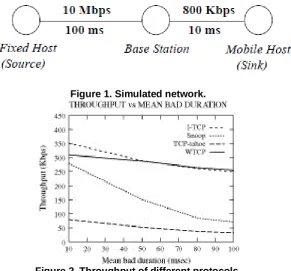
An essential outline choice in an intermediary based arrangement is whether it ought to be founded on unequivocal or verifiable criticism. A certain methodology accomplishes three relative resources: (i) instigates less overhead toward the end-has and organize, (ii) requires no code alteration to prepare any express messages, and (iii) keeps up the end-to-end semantics of TCP. At that point, an essential objective is to viably shield remote misfortunes from end-has. This is normally done by buffering information portions at the intermediary and retransmitting them over the nearby remote connection in the event that they get lost because of transmission mistakes. In these cases, window shrinkage at the TCP sender ought to be dodged, for instance by dropping related copy affirmations. A perfect intermediary based arrangement ought to likewise shield the impact of remote misfortunes on the retransmission timeout kept up at the sender. The timeout ought not lapse too early before the intermediary has the opportunity to locally repair remote misfortunes, additionally ought not be developed an excess of that it impedes TCP's capacity to rapidly respond to changes in blockage conditions. The most effective method to ideally conform the timeout of TCP over remote connections is still an open exploration question. Intermediary based arrangements ought to be intended to fulfill these outline objectives. Figure 2 demonstrates the throughput of I-TCP, Snoop, WTCP and TCP-tahoe 5. throughput is measured as the normal number of bits effectively transmitted to the portable host in one second. The reproduced system topology is appeared in Figure 1. We demonstrate the remote connection from the base station (intermediary) to the versatile host (customer) utilizing a two-state Markov channel [11], where the divert is in either great state or awful state. In the great express the bit mistake rate (BER) of the channel is low, and in the terrible state BER is high. We reproduced the remote connection with bit blunder rates of 10�6 and 10�2 in great and awful states, separately. The time spent in every state is displayed by an exponential circulation with mean great state term settled at 1 second. The mean awful state length is changed from 10 ms to 100 ms. we accept no misfortunes on the wired connection. For a decent quality remote connection, the throughput of I-TCP is better. At the point when the remote connection quality debases WTCP yields better throughput basically on account of its forceful retransmission approach over the remote connection. WTCP accomplishes throughput values 4-8 times higher than TCP-tahoe. Be that as it may, the previously stated approach debases (marginally) the usage of the remote connection [34, 33]. An open exploration inquiry is whether throughput picks up exceeds the little misfortune in connection usage (and related squandered vitality)
Figure 1. Simulated network.
Figure 2. Throughput of different protocols.
© 2016, IJCSMC All Rights Reserved 306
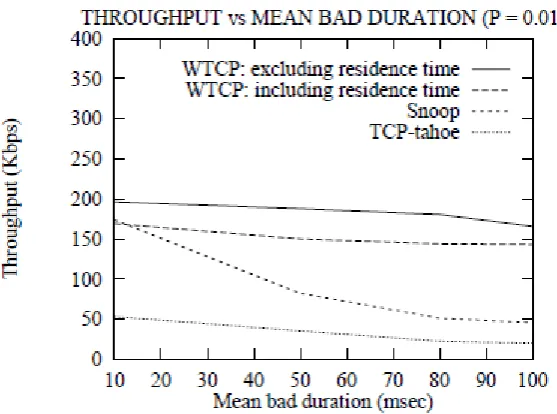
timeout esteem kept up at the source will be high. As pointed out before, this influences the TCP source's capacity to viably identify any clog misfortunes in the wired system bit of the association. To show this impact a lossy wired connection is demonstrated to arbitrarily lose information parcels with likelihood P. Figure 3 demonstrates the throughput for WTCP with and without altering the timestamp to bar the living arrangement time, and additionally the throughput for Snoop and TCP-tahoe. The remote connection is displayed by a two-state mistake channel as some time recently, and the mean great period is 1 second. The upside of concealing the habitation time at the base station turns out to be significantly more purported for higher wired (clog) misfortune probabilities. Be that as it may, when there are just few wired connection misfortunes (Figure 4), not surprisingly, the quantity of information portions lost is low, and henceforth barring the home time does not give noteworthy change in throughput. Though Snoop achieves throughput values comparable to I-TCP and WTCP at low loss situations, the throughput of Snoop is poor when the wireless link is very bursty (in bad error state) for long durations. The reason is that Snoop triggers retransmission only after the base station receives a duplicate acknowledgment. When the wireless link is in a bad state, acknowledgments might be lost. In this scenario, the base station fails to trigger DACK-based retransmission, and the throughput degrades.
Figure 3. WTCP throughput with wired (congestion) link loss probability ρ=0.011
Figure 4. WTCP throughput with wired (congestion) link loss probability ρ=0.001001
© 2016, IJCSMC All Rights Reserved 307
recuperation time if the section living arrangement time was really because of blockage on the remote part. The issue of vitality utilization, all around, has likewise not been concentrated on (see Section 6.1.1).
6 Protocol Strategy
6.1 Toward Adaptive Error Control
Clog Control envelops the qualities of versatile conduct: the sender alters the transmission rate as indicated by the present level of accessible data transfer capacity. Versatile blunder control presents another sort of conformity: the convention's technique. That is, the methodology of blockage control is dependably to back off. A mistake control that is receptive to different sorts of blunders requires a methodology that takes into account behavioural adaptability, from preservationist through forceful. Along these lines, a versatile methodology includes versatile conduct that is diverse for every mistake sort. Tsaoussidis et al: [38] analyze Tahoe, Reno and New Reno from the point of view of vitality and goodput effectiveness under changing mistake conditions. The previously stated conventions display a traditionalist, directed and more forceful conduct, individually and are fitting possibility for testing the effect of forcefulness of a recuperation procedure in light of the mistake attributes. The consequences of [38] demonstrate that a preservationist system yields better results when the mistake thickness over remote channel increments, while a forceful methodology seems more fitting at low blunder rates. Subsequently, a disentanglement of the sort "Traditionalist in wired/Aggressive in remote" couldn't direct an effective recuperation. In this setting, Reno's system, for instance, to constantly back off within the sight of mistakes can't show the rate-versatile example required to coordinate the states of the channel. Reno carries on every so often conservatively when the channel allows more forceful transmission, and generally forcefully when it strongly endeavours to transmit half window within the sight of a "terrible" channel. Reno tails this procedure because of all mistakes. It is imperative to note here that TCP's methodology is not plainly intended for a preservationist or forceful retransmission; the convention at times shows a conflicting6 conduct that may not comply with the key objectives of a convention for remote systems. The contention emerges from the two particular segments of TCP's blunder control, specifically the timeout and the blockage window. For instance, while the back-off technique amid burst mistakes or hand-offs might be proper, the timeout expansion does not add to proficient recuperation. This conflicting conduct emerges from the examination of Reno and Tahoe. In Fast Recovery, Reno parts the blockage window within the sight of three dacks. This conduct is more forceful than Slow Start. On the off chance that the channel conditions don't support such forceful procedure, the timeout of Reno may be expanded more remote than the one of Tahoe. Along these lines the endeavour to actualize a more forceful technique than Tahoe may create an unfavourable result. The "examining gadget" exhibited in Section 4 models precisely this craved property of versatile mistake control and keeps away from the contention between the timeout and the clog window. In case of steady blunder conditions (e.g. clog), the term of the test cycle will be actually stretched out and is prone to be comparable with that of the mistake condition, since test fragments will be lost. The information transmission procedure is in this manner "sitting out" these mistake conditions anticipating fruitful culmination of the test cycle. On account of transient arbitrary misfortune, notwithstanding, the test cycle will finish a great deal all the more rapidly, in extent to the common thickness of the event of the irregular blunders.
© 2016, IJCSMC All Rights Reserved 308
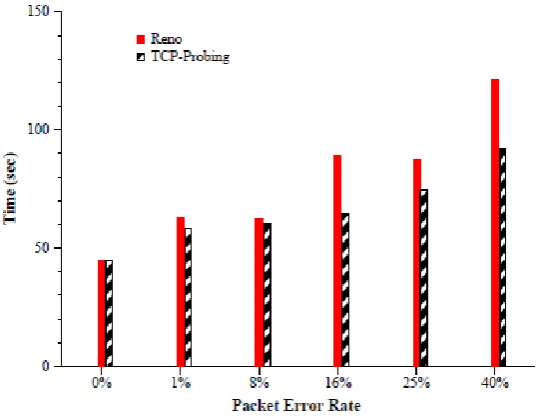
Figure 5. Task Completion Time of Reno and TCP-Probing.
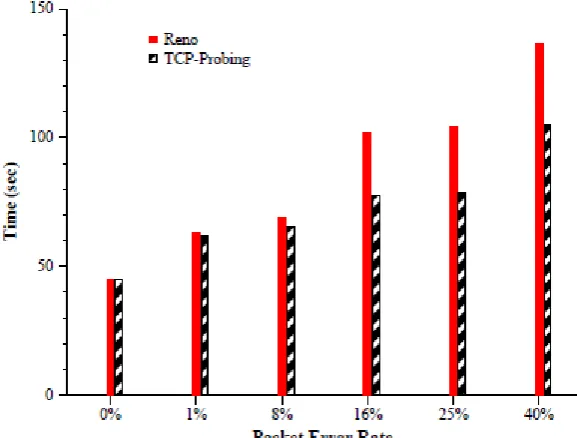
It is instructive to consider how the probing and Immediate Recovery mechanisms provide TCP-Probing with the behavioural flexibility underlying its superior performance in Figures 5 and 6. At relatively low error rates (1% to 8%), TCP-Probing is able to expand its window in the Good phase. During the Bad phase, its probing mechanism allows it to explore windows of opportunity for error-free transmissions, which are then exploited by Immediate Recovery. TCP-Probing is effectively backing off for the duration of the probe cycle, but is also capable of rapid window adjustments with Immediate Recovery where appropriate. In contrast, Reno’s mechanism is exclusively focused on congestion control. The idea is to alleviate congested routers and avoid flooding the network, so Reno’s mechanism does not allow for rapid window adjustments as a recovery strategy after backing off. It can be observed from Figure 6 that the impact of delay is even more significant on standard TCP. The cogitation that probing requires two RTTs (as opposed to several RTTs required by standard TCP’s graduated adjustments) and then
© 2016, IJCSMC All Rights Reserved 309
Figure 7. Task Completion Time performance with 50ms propagation delay and Congestion.
Prompt Recovery follows, alongside the thought that more extended deferral indicates an expansive Delay_Bandwidth item and henceforth window size, legitimizes the outcomes. Testing as a rule is not another idea and it has been proposed in the past as a component to quantify current system conditions (e.g. [45]). Examining here investigates an essential property that is surely novel: it is utilized as a gadget that executes the convention's versatile methodology by forming information transmission to fit in with the heap and blunder qualities of the system. All the more unequivocally, testing is self-balanced (reached out) in extent to the thickness of the blunder and thus transmission rate is molded appropriately. Unmistakably, versatile blunder control does not have one and only conceivable outline. Moreover, the sought properties of the examining gadget take into consideration distinctive outlines. The outcomes displayed above call for further research. For instance, there are circumstances where neither a forceful nor moderate procedure could be unmistakably demonstrated or actualized by testing. For instance, as the convention displays a more moderate technique (the blunder turns out to be more thick) the relative execution addition of TCP-Probing drops (see Figure 5 at the 25% mistake rate). An alternate outline of the examining gadget could execute an alternate technique. Alternately, the testing gadget itself could be intended to be versatile, for instance, to develop the required number of cycles as the mistake turns out to be more thick, bringing about a more moderate technique sooner than the point demonstrated by the present configuration.
6.1.1 Combining Goodput and Energy Efficiency
© 2016, IJCSMC All Rights Reserved 310
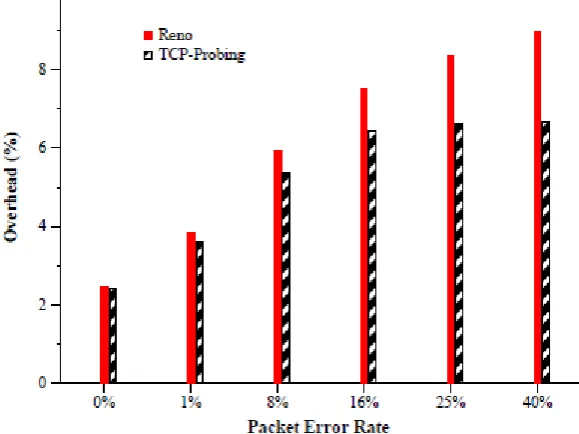
Figure 8. Overhead of Reno and Probing with wireless errors.
Figure 9. Overhead of Reno and Probing with additional 100ms propagation delay and wireless errors.
This goodput/overhead ratio is a particularly useful performance metric for applications on mobile, battery-powered devices since it reflects the energy efficiency of the protocol. That is, the overhead and time metrics combined can provide sufficient knowledge of a protocol’s energy-saving capabilities. Energy expenditure is device-, operation-, and application specific. It can only be measured with precision on a specific device, running each protocol version separately, and reporting the battery power consumed per version. Energy is consumed at different rates during various stages of communication, and the amount of expenditure depends on the current operation. For example, the transmitter/receiver expend different amounts of energy when they, respectively, are sending or receiving segments, are waiting for segments to arrive, or are idle. Hence, an estimation of additional energy expenditure cannot be based solely on the byte overhead due to retransmission, since overall connection time might have been extended while waiting or while attempting only a moderate rate of transmission. On the other hand, the estimation cannot be based solely on the overall connection time either, since the distinct operations performed during that time (e.g. transmission vs. idle) consume different levels of energy. Nevertheless, the potential for energy saving can be gauged from the combination of time and byte overhead savings achieved. Indeed, if we consider that several devices are not optimized to adjust the power of the transmitting/receiving module whenever the device does not actually transmit/receive data, and also that TCP’s operations do not involve any “idle” state by default7, communication time seems to be the most significant
© 2016, IJCSMC All Rights Reserved 311
7 Conclusion
We presented open issues and challenges in the design of reliable transport over heterogeneous wired/wireless networks. We discussed recent research results that expose these issues, provide preliminary solutions, and call for further investigation. A traditional approach to describe such reliable transport-over-wireless research is to classify the proposed solutions either in terms of where new functionality is placed or in terms of whether or not the solution is end-to-end. The first classification determines whether code modifications are done at the sender, receiver, intermediate node(s), or combinations thereof. The second classification determines the recovery actions that are taken either by the end-hosts only (i.e. sender and receiver) or by additional intermediate proxy/node(s). In this paper, we take a non-traditional approach to discuss design issues as they relate to the different protocol functions, namely, error detection and error correction. We argued for an error detection that is capable of classifying different kinds of error (e.g. congestion, transient wireless errors, persistent wireless errors). Based on this error classification, an error correction involves appropriate recovery actions that might differ from congestion-oriented mechanisms employed by TCP. We also argued for a protocol recovery strategy that flexibly adapts its behavior to accommodate various tradeoffs. An important tradeoff for battery-powered devices involve energy consumption and goodput performance. We highlighted the importance of defining new metrics that capture such tradeoffs and that could be used to evaluate aspects of stability and fairness in heterogeneous wired/wireless networks.
References
[1] M. Allman. On the Generation and Use of TCP Acknowledgments. ACM Computer Communication Review, October 1998.
[2] M. Allman, C. Hayes, H. Kruse, and S. Ostermann. TCP Performance over Satellite Links. In Proceedings of the 5th
International Conference on Telecommunication Systems, March 1997.
[3] M. Allman, V. Paxson, and W. Stevens. TCP Congestion Control. RFC 2581, April 1999.
[4] A. Bakre and B. Badrinath. I-TCP: Indirect TCP for Mobile Hosts. In Proceedings of the IEEE ICDCS ’95, pages 136–143, 1995.
[5] B. Bakshi, P. Krishna, N. Vaidya, and D. Pradhan. Improving Performance of TCP over Wireless Networks. In
Proceedings of the IEEE 17th ICDCS’97, pages 365–373, 1997.
[6] Bikram S. Bakshi, P. Krishna, N. H. Vaidya, and D. K. Pradhan. Improving Performance of TCP over Wireless Networks. Technical Report 96-014, Texas A & M University, 1996.
[7] H. Balakrishnan, V. Padmanabhan, and R. Katz. The Effects of Asymmetry in TCP Performance. In Proceedings of
the 3rd ACM/IEEE Mobicom Conference, September 1997.
[8] H. Balakrishnan, V. Padmanabhan, S. Seshan, and R. Katz. A Comparison of Mechanisms for Improving TCP Performance over Wireless Links. ACM/IEEE Transactions on Networking, December 1997.
[9] H. Balakrishnan, S. Seshan, E. Amir, and R. Katz. Improving TCP/IP Performance over Wireless Networks. In
Proceedings of the 1st ACM Int’l Conf. On Mobile Computing and Networking (Mobicom), November 1995.
[10] I. Batsiolas and I. Nikolaidis. Selective Idling: An Experiment in Transport-Layer Power-Efficient Protocol Implementation. In Proceedings of the International Conference on Internet Computing, June 2000.
[11] Pravin Bhagwat, Partha Bhattacharya, Arvind Krishna, and Satish K. Tripathi. Enchancing Throughput over Wireless LANs using Channel State Dependent Packet Scheduling. In IEEE INFOCOM’96, pages 1133–40, March 1996.
[12] L. Brakmo and L. Peterson. TCP Vegas: End to End Congestion Avoidance on a Global Internet. IEEE Journal on
Selected Areas of Communications, October 1995.
[13] Kevin Brown and Suresh Singh. M-TCP: TCP for Mobile Cellular Networks. In Proceedings of the ACM
SIGCOMM Computer Communication Review, pages 19–43, 1997.
[14] Ramon Caceres and Liviu Iftode. Improving the Performance of Reliable Transport Protocol in Mobile Computing Environment. IEEE Journal of Selected Areas in Communications, 13(5), June 1995.
[15] D. Chiu and R. Jain. Analysis of the Increase/Decrease Algorithms for Congestion Avoidance in Computer Networks. Journal of Computer Networks, 17(1), June 1989.
[16] A. Chockalingam, M. Zorzi, and R. Rao. Performance of TCP onWireless Fading Links with Memory. In
Proceedings of the IEEE ICC’98, Atlanta, GA, June 1998.
[17] K. Fall and S. Floyd. Simulation-based Comparisons of Tahoe, Reno, and SACK TCP. Computer Communication
Review, 26(3):5–21, July 1996.
[18] S. Floyd and T. Henderson. The New-Reno Modification to TCP’s Fast Recovery Algorithm. RFC 2582, April 1999.
[19] S. Floyd and V. Jacobson. Random Early Detection Gateways for Congestion Avoidance. IEEE/ACM Transactions
on Networking, August 1993.
© 2016, IJCSMC All Rights Reserved 312
[21] Z. Haas and P. Agrawal. Mobile-TCP: An Asymmetric Transport Protocol Design for Mobile Systems. In
Proceedings of the IEEE International Conference on Communications (ICC’97), 1997.
[22] V. Jacobson. Congestion Avoidance and Control. In Proceedings of the ACM SIGCOMM ’88, August 1988. [23] A. Kumar. Comparative Performance Analysis of Versions of TCP in a Local Network with a Lossy Link. In
ACM/IEEE Transactions on Networking, August 1998.
[24] T. Lakshman and U. Madhow. The Performance of TCP/IP for Networks with High Bandwidth-Delay Products and Random Loss. IEEE/ACM Transactions on Networking, pages 336–350, June 1997.
[25] T. Lakshman and U. Madhow. TCP/IP Performance with Random Loss and Bidirectional Congestion. IEEE/ACM
Transactions on Networking, 8(5):541–555, October 2000.
[26] T.V. Lakshman and Upamanyu Madhow. The Performance of TCP/IP for Networks with High Bandwidth-Delay Product and Random Loss. IEEE/ACM Transactions on Networking, 5(3), June 1997.
[27] M. Mathis, J. Mahdavi, S. Floyd, and A. Romanow. TCP Selective Acknowledgement Options. RFC 2018, April 1996.
[28] M. May, T. Bonald, and J. Bolot. Analytic Evaluation of RED Performance. In INFOCOM 2000, August 2000. [29] C. Parsa and G. Aceves. Improving TCP Congestion Control over Internets with Heterogeneous Transmission Media. IEEE International Conference on Network Protocols (ICNP ’99), 1999.
[30] C. Partridge and T. Shepard. TCP Performance over Satellite Links. IEEE Network, 11(5):44–99, September 1997. [31] J. Postel. Transmission Control Protocol. RFC 793, September 1981.
[32] K. Ramakrishnan and S. Floyd. A Proposal to Add Explicit Congestion Notification (ECN) to IP. RFC 2481, January 1999.
[33] Karu Ratnam and Ibrahim Matta. Effect of Local Retransmission at Wireless Access Points on the Round Trip Time Estimation of TCP. In Proceedings of IEEE 31st Annual Simulation Symposium ’98, April 1998.
[34] Karu Ratnam and Ibrahim Matta. WTCP: An Efficient Mechanism for Improving TCP Performance over Wireless Links. In Proceedings of the Third IEEE Symposium on Computer and Communications (ISCC ’98), June 1998. Code available from http://www.cs.bu.edu/faculty/matta/software.html.
[35] J. H. Saltzer, D. Reed, and D. Clark. End-to-End Arguments in System Design. ACM Transactions on Computer
Systems, November 1984.
[36] The x-kernel Protocol Framework. www.cs.princeton.edu/xkernel.
[37] V. Tsaoussidis and H. Badr. TCP-Probing: Towards an Error Control Schema with Energy and Throughput Performance Gains. In Proceedings of the 8th IEEE International Conference on Network Protocols, 2000.
[38] V. Tsaoussidis, H. Badr, X. Ge, and K. Pentikousis. Energy / Throughput Tradeoffs of TCP Error Control Strategies. In Proceedings of the 5th IEEE Symposium on Computers and Communications (ISCC), 2000.
[39] V. Tsaoussidis, H. Badr, and R. Verma. Wave & Wait Protocol (WWP) An Energy-Saving Transport Protocol for Mobile IP-Devices. In Proceedings of the 7th International Conference on Network Protocols, 1999.
[40] V. Tsaoussidis, A. Lahanas, and H. Badr. TheWave andWait Protocol: High Throughput and Low Energy Expenditure for Mobile-IP Devices. In Proceedings of the 8th IEEE Conference on Networks (ICON 2000), Singapore, 2000.
[41] V. Tsaoussidis, A. Lahanas, and C. Zhang. The Wave and Probe Communication Mechanisms. The Journal of
Supercomputing, 20(2), September 2001.
[42] D. Borman V. Jacobson, R. Braden. TCP Extensions for High Performance. RFC 1323, May 1992.
[43] G. Xylomenos and G. Polyzos. TCP and UDP Performance over a Wireless LAN. In Proceedings of the IEEE
INFOCOM, 1999.
[44] C. Zhang and V. Tsaoussidis. TCP Real: Improving Real-time Capabilities of TCP over Heterogeneous Networks.
In Proceedings of the 11th IEEE/ACM NOSSDAV 2001, New York, 2001.
[45] M. Zorzi and R. Rao. Error Control and Energy Consumption in Communications for Nomadic Computing. In
IEEE Transactions on Computers (Special Issue on Mobile Computing), March 1997.