Available Online atwww.ijcsmc.com
International Journal of Computer Science and Mobile Computing
A Monthly Journal of Computer Science and Information TechnologyISSN 2320–088X
IMPACT FACTOR: 6.017
IJCSMC, Vol. 6, Issue. 4, April 2017, pg.467 – 471
Survey on Security Issues in
Platform-as-a-Service Model
P Buddha Reddy,
IT Department, Vardhaman College of EngineeringVinod Bhupathi,
IT Department, Vardhaman College of EngineeringCh Sravan,
CSE Department, Vardhaman College of EngineeringAbstract: Cloud computing is making a big revolution in the field of information technology thereby
reducing capital expenditures spent. Computing is delivered as a service enabling effective utilization
of computational resources. Certain security issues exist which prevents individuals and industries
from using clouds despite its advantages. Resolving such problems may increase the usage of cloud
thereby reducing the amount spent for resources. Platform-as-a-Service (PaaS). PaaS model, security
issues encountered in PaaS clouds. The issues along with solutions discussed provide an insight into
PaaS security for both providers and users which may help in future PaaS design and implementation.
Keywords: encryption, interoperability, multi-tenancy, trusted computing base, virtualization.
1
Introduction
Outsourcing of computational resources is possible with the advent of cloud computing. Sharing of resources
reduces capital expenditure making it foreseen and can be observed as rising trend. Such sharing of resources
may cause certain security issues despite of vast advantages of cloud like better utilization of resources, least time
taken in deploying new services and so on. Three ways to deliver cloud computing capabilities (Figure 1) are
Fig 1 : Service model in Cloud Environment
Characteristics of cloud are on-demand self-service, broad network access, resource pooling, rapid elasticity
and measured service. The various deployment models include private, public, hybrid and community cloud.
The paper focuses on basic PaaS model and also in identifying the security in PaaS
environment along with the solutions. Section 2 gives a deep insight into PaaS mode. Section 3 discusses
the security issues along with appropriate solutions. The paper is concluded in Section5.
2
PaaS Model
2.1 PaaS basic model
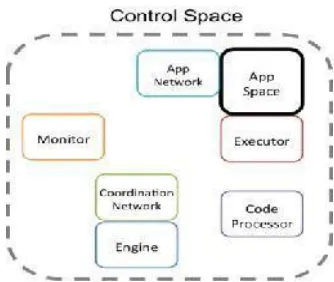
The two different constructs of PaaS model are Control space and App space (Figure2) serve different
purposes. App space is fully wrapped within the Control space. Since control space operates on same
infrastructure like the app space, control space shares some characteristics of app space. Control Space
components are definitives built from primitives and sophisticates to provide the prescriptive approach to the App
2.1.1. Control Space
The functions of control space include automation, management and provisioning. It interacts to lo-level
components with the help of API abstractions. The Control space determines what elements are exposed to
App Space thereby maintaining coherency and dependencies of App Space. Several separate functions of
control space can be combined in various manners based on PaaS implementation.
2.1.2. App Space
The applications of end-user/customer are deployed, updated and run in App Space which is being
controlled by Control Space. Exposure of PaaS Element types by Control Space to App Space is one of the
key differentiating factors between different PaaS implementations.
a) App network b) Executor c) Code Processor d) Coordination Network e) Engine f) Monitor
3
PaaS Security
3.1. PaaS Security Elements
Elements that characterize PaaS security platform are as follows:
a) Information processing: This is the stage where one is creating data and rest of the web uses it.
Creation of data may happen live on remote server. So the document can be intercepted. PaaS
provides security when this data is in stored format, which clearly states that the problem is during
processing stage.
b) Information interactivity: This is the process of sharing data across the board. Interaction can go with
personal computers, networks, devices like phones and so on. This interaction connects confidential data in
local network with the web where most of them can access and hence security issue comes in.
c) Data Storage: This specifies the hosting aspect of Cloud. Several mechanisms in PaaS allow multiple
applications to be encrypted to prevent data leakage. Verification is hard as data is in shared servers.
3.2. PaaS Security Issues 3.2.1. Interoperability
Interoperability is the ability for different cloud to talk to each other at three different levels
simultaneously, regardless of the differences between the providers [15]. Application written to use specific
services from a vendor's PaaS will require changes to use similar services from another vendor's PaaS.
Efforts are taken on development of open and proprietary standard API's to enable cloud management,
security, and interoperability. Common container formats like DMTF’S Open Virtualization Format (OVF) can
be used. Application written to those standards is far more likely to be interoperable and portable.
Interoperability can be maintained by providing common interfaces to objects for resource access.
3.2.2. Host Vulnerability
Vulnerability may be described in terms of resistance to a certain type of attack. Multi-tenancy allows user objects
to be spread over interconnected multi-user hosts. Hosts have to be protected from attacks in such an
environment. If this protection fails, an attacker can easily access the resources of host and also tenant objects.
Provider has to take necessary security measures. TCB serves as solution for host vulnerability also.
3.2.3. Object Vulnerability
Service providers can access and modify user objects. Three ways by which security of an
object can be breached in PaaS clouds are: a) Provider may access any user object that resides on its hosts.
A fully homomorphic encryption can be employed as a cryptographic defense for user objects during
execution, but it is computationally expensive. Hence, this type of attack is unavoidable and can be avoided
to some extent by trust relations between user and provider. b) Users may mutually attack each other's
objects that are tenants of same host because tenant objects synchronously share the same resources. c)
Third party may directly attack a user object. Secure coding enables objects to defend themselves.
3.2.4. Access Control
Network communications must be confidential and access of remote entities should be controlled.
Three major concepts of access control are: authentication, authorization and traceability. Some of the attacks in
such cloud-based environments are impersonation, phishing attacks, brute force attacks and password reset
attacks. Two-factor authentication like smart cards and biometric mechanisms can protect from such attacks.
Solutions to access control problems are as follows: a) Encapsulation b) Policy enforcement points (PEPs)
3.2.5. Privacy-Aware Authentication
For authentication, user reveals most of the details regarding him. Proxy certificates help to reduce
aware authentication with proxy certificates are: a) Based on access control policies defined by both service
providers and users, hosts and objects should not request more attributes than the required amount. If more
attributes are requested, then the service is negotiated. b) With the help of trusted third party, easily
configurable credentials which reveal data that the identity owners permit can be achieved.
4. Conclusion
Secure PaaS cloud can be achieved by understanding the PaaS model, its types and the issues related to
security as described in the paper. The various features of PaaS can be utilized in an efficient manner based
on the deeper understanding of PaaS environment in cloud. The characteristics of PaaS along with the
evaluation criteria in choosing a provider for PaaS has also been identified along with PaaS security
elements. Finally, security issues in PaaS with their appropriate solutions have been discussed to provide a
clear insight in data security issues and other challenges while running application on PaaS platform. With
the solutions and also by knowing these issues, customers can be precautionary while using PaaS.
References
1. Devi T, Ganesan R. Platform-as-a-Service (PaaS): Model and Security Issues. TELKOMNIKA Vol. 15, No. 1, July 2015 : 151 – 161
2. LM Kaufman. Data security in the world of cloud computing. IEEE Security & Privacy. 2009; 7(4): 61-64.
3. D Catteddu, G Hogben. Cloud computing: Benefits, risks and recommendations for information security. Technical report, ENISA. 2009.
4. S Subashini, V Kavitha. A survey on security issues in service delivery models of cloud computing. Journal of Network and Computer Applications. 2011; 34(1): 1-11.
5. VJR Winkler. Securing the Cloud: Cloud Computer Security Techniques and Tactics. Waltham: Syngress. 2011. 6. National Institute of Standards and Technology (NIST). http://www.nist.gov.
7. Google app engine. 2012. https://developers.google.com/ appengine/. 8. Windows azure platform. 2012. http://www.windowsazure.com/ en-us/.
9. D Zissis, D Lekkas. Addressing cloud computing security issues. Future Generation Computer Systems. 2012; 28(3): 583-592.
10. M Almorsy, J Grundy, AS Ibrahim. Collaboration-Based Cloud Computing Security Management Framework. IEEE 4th International Conference on Cloud Computing. 2011: 364-371.