Western University Western University
Scholarship@Western
Scholarship@Western
Electronic Thesis and Dissertation Repository
11-15-2019 12:30 PM
High Multiplicity Strip Packing Problem With Three Rectangle
High Multiplicity Strip Packing Problem With Three Rectangle
Types
Types
Andy Yu
The University of Western Ontario
Supervisor
Solis-Oba, Roberto
The University of Western Ontario Graduate Program in Computer Science
A thesis submitted in partial fulfillment of the requirements for the degree in Master of Science © Andy Yu 2019
Follow this and additional works at: https://ir.lib.uwo.ca/etd
Part of the Theory and Algorithms Commons
Recommended Citation Recommended Citation
Yu, Andy, "High Multiplicity Strip Packing Problem With Three Rectangle Types" (2019). Electronic Thesis and Dissertation Repository. 6684.
https://ir.lib.uwo.ca/etd/6684
This Dissertation/Thesis is brought to you for free and open access by Scholarship@Western. It has been accepted for inclusion in Electronic Thesis and Dissertation Repository by an authorized administrator of
The two-dimensional strip packing problem (2D-SPP) involves packing a setR={r1, ...,rn}
of nrectangular items into a strip of width 1 and unbounded height, where each rectangular item ri has width 0 < wi ≤ 1 and height 0 < hi ≤ 1. The objective is to find a packing for
all these items, without overlaps or rotations, that minimizes the total height of the strip used. 2D-SPP is stronglyNP-hard and has practical applications including stock cutting, scheduling, and reducing peak power demand in smart-grids.
This thesis considers a special case of 2D-SPP in which the set of rectangular items R
has three distinct rectangle sizes or types. We present a newOPT+5/3 polynomial-time ap-proximation algorithm, whereOPT is the value of an optimum solution. This algorithm is an improvement over the previously bestOPT+2 polynomial-time approximation algorithm for the problem.
Keywords: high multiplicity, strip packing, approximation algorithm, optimization
Summary for Lay Audience
Consider a set of rectangles of three different sizes. The goal of the three-type strip pack-ing problem (3T-SPP) is to pack these rectangles as densely as possible without overlaps or rotations into a single two-dimensional container of fixed width. In an optimum solution for 3T-SPP where we pack rectangles as densely as possible, we denote with OPT the minimum possible height within which these rectangles can be packed into the container.
Many real-life problems, from industrial manufacturing to scheduling, can be modelled in terms of packing rectangular items of various sizes into a two-dimensional container. One example is stock cutting, which involves cutting a roll of flat material into different rectangle sizes while minimizing the material wasted. Another example is scheduling tasks of various types on processors while minimizing the total completion time; each type of task requires a certain number of adjacent processors for a given amount of time. If we can present a procedure that produces an optimum solution to 3T-SPP, then this procedure can also produce optimum solutions to some of these real-life problems.
The two-dimensional strip packing problem (2D-SPP) is a generalization of 3T-SPP that allows any number of different rectangle sizes. 2D-SPP belongs to a class of problems that currently lack any procedure to efficiently produce optimum solutions. As 3T-SPP is a special case of 2D-SPP, we focus on algorithms or procedures that efficiently find solutions that are not optimal, but are always close to the optimum solutions. We present a procedure for 3T-SPP that efficiently finds a packing of height at mostOPT +5/3·hmax, wherehmaxis the largest height of
the rectangles. This procedure is an improvement over the previously best algorithm that finds a packing of height at most OPT + 2·hmax. Although this improvement looks small, OPT +
2·hmax is already close toOPT and we expect further improvements to be hard to obtain.
I would like to thank my supervisor, Professor Roberto Solis-Oba for his guidance and assis-tance. He was very willing to give me time to discuss my research and any problems that I had issues with. I would also like to thank his master’s student Andrew Bloch-Hansen, who contributed to the idea of shifting the boundary between segments S2 and S3 based on some
criteria which I incorporated into the solution presented in this thesis for 3T-SPP. Finally, I would like to thank the Department of Computer Science at the University of Western Ontario for general support.
Contents
Abstract ii
Summary for Lay Audience iii
Acknowlegements iv
List of Figures vii
List of Algorithms ix
1 Introduction 1
1.1 Approximation Algorithms . . . 4
1.2 Applications . . . 5
1.3 Related Work . . . 6
1.4 Contributions . . . 9
1.5 Outline of the Thesis . . . 9
2 Overview of the Algorithm 11 2.1 The Fractional Strip Packing Problem . . . 11
2.2 High-Level Description of the Algorithm . . . 14
3 Algorithm for the Three-Type Strip Packing Problem 18 3.1 Partitioning the Fractional Packing . . . 18
3.2 Packing the Common PartS0 . . . 21
3.3 Rounding Up Rectangles with Fractional Height in the non-Common PartS . . 22
3.4.1 Determining Which Columns are inS2 orS3 . . . 26
3.4.2 Reordering Configurations . . . 28
3.5 Packing SegmentsS1,S2, andS3 . . . 36
3.5.1 Packing Rectangles inS1 . . . 36
3.5.2 Packing Rectangles inS2 . . . 38
3.5.3 Packing Rectangles inS3 . . . 42
3.6 Aligning Configurations . . . 43
3.7 Rounding Fractional Rectangles to Produce an Integral Solution . . . 50
3.7.1 One Fractional Rectangle is Vertically Cut between Two Adjacent Seg-ments . . . 54
3.7.2 Two Fractional Rectangles of Different Types are Vertically Cut be-tweenS1andS2and betweenS2andS3 . . . 58
3.7.3 Two Fractional Rectangles of the Same Type are Vertically Cut between S1andS2 and betweenS2andS3 . . . 61
4 Analysis of the Algorithm 66 4.1 Correctness . . . 66
4.2 Time Complexity . . . 70
4.2.1 Input and Output of the Algorithm . . . 70
4.2.2 Running Time . . . 74
5 Conclusions 90 5.1 Remarks . . . 90
Bibliography 94
Curriculum Vitae 99
List of Figures
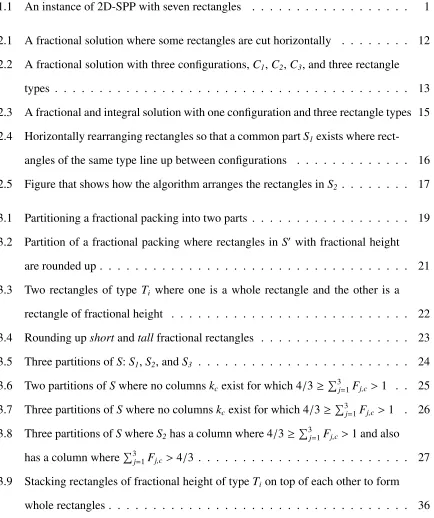
1.1 An instance of 2D-SPP with seven rectangles . . . 1
2.1 A fractional solution where some rectangles are cut horizontally . . . 12 2.2 A fractional solution with three configurations,C1,C2, C3, and three rectangle
types . . . 13 2.3 A fractional and integral solution with one configuration and three rectangle types 15 2.4 Horizontally rearranging rectangles so that a common partS1exists where
rect-angles of the same type line up between configurations . . . 16 2.5 Figure that shows how the algorithm arranges the rectangles inS2 . . . 17
3.1 Partitioning a fractional packing into two parts . . . 19 3.2 Partition of a fractional packing where rectangles in S0 with fractional height
are rounded up . . . 21 3.3 Two rectangles of type Ti where one is a whole rectangle and the other is a
rectangle of fractional height . . . 22 3.4 Rounding upshortandtallfractional rectangles . . . 23 3.5 Three partitions ofS:S1,S2, andS3 . . . 24
3.6 Two partitions ofSwhere no columnskcexist for which 4/3≥P3j=1Fj,c>1 . . 25
3.7 Three partitions ofSwhere no columnskc exist for which 4/3≥ P3j=1Fj,c>1 . 26
3.8 Three partitions ofSwhereS2has a column where 4/3≥P3j=1Fj,c>1 and also
has a column whereP3
j=1Fj,c>4/3 . . . 27
3.9 Stacking rectangles of fractional height of typeTion top of each other to form
whole rectangles . . . 36
3.11 Packing where we round up rectangles of fractional height inC3 . . . 40
3.12 Packing where we round up rectangles of fractional height inC1. . . 41
3.13 Rounding up rectangles with fractional height inS3 . . . 42
3.14 Aligning configurations so that whole rectangles that cross the border between two segments are not vertically cut . . . 43 3.15 Packing rectangles of configurationC2 inS3 . . . 48
3.16 Packing rectangles inSfor Scenario 2(a) where no pieces are discarded . . . . 51 3.17 Rectanglerof typeT2 with fractional height inC1 is vertically cut betweenS2
andS3 . . . 54
3.18 Rectangle rwith fractional height inC1 is vertically cut between segments S2
andS3such that only the part ofrinS3is rounded up . . . 56
3.19 A rectanglerwith fractional height inC2is vertically cut between segmentsS1
andS2such that only the part ofrinS2is rounded up . . . 57
3.20 Moving a piece ofrfright besiderrto form one whole rectangle of typeT2 . . . 58
3.21 A rectangler1with fractional height of typeT3inC3is vertically cut betweenS1
andS2; another rectangler2with fractional height of typeT2inC1is vertically
cut betweenS2 andS3 . . . 60
3.22 Moving piecesrf1 andrf2 as described in Figure 3.21 right besiderr1andrr2to
form one whole rectangle of typeT2and one whole rectangle of typeT3 . . . . 61
3.23 A rectangler1with fractional height of typeT1inC3is vertically cut betweenS1
andS2; another rectangler2with fractional height of typeT1inC1is vertically
cut betweenS2 andS3 . . . 63
4.1 An optimal fractional solution for an instance of 3T-SPP with three configurations 71 4.2 Using an output of 45 numbers to create an integral packing with only whole
rectangles . . . 74
List of Algorithms
3.1 roundThreeTypes(F) . . . 20
3.2 partitionPartS(T,C) . . . 34
3.3 packSegments(T,C) . . . 49
3.4 removeFractionalRectangles(T,C) . . . 64
3.5 resolveOneVerticalCut(Ti,rf,rr) . . . 65
3.6 resolveTwoVerticalCuts(Ti,rf,rr1,rr2) . . . 65
Chapter 1
Introduction
The two-dimensional strip packing problem (2D-SPP) involves packing a setR={r1, ...,rn}of nrectangular items into a bin of widthW and unbounded height, which we call a strip. Each itemri has widthwi ≤W and heighthi. The objective is to pack thenrectangles into the strip
such that they do not overlap and that the total height of the strip used is minimal. Figure 1.1 shows an instance of 2D-SPP.
1 height of
packing
h2
w2 h3
w3 h1
w1
h4 w4
h5
w5 w6 h6
w7 h7
R = { , , , , , , }
Figure1.1: An instance of 2D-SPP with seven rectangles. The width of the strip is 1. Note how the set
Rhas three distinct rectangle sizes or types.
This thesis assumes that packings for 2D-SPP are orthogonal, oriented, and normalized.
Chapter1. Introduction 2
In an orthogonal packing, every edge of every rectangle is parallel to either the bottom or the vertical side of the strip [1]. We assume that rectangles are oriented, so that the bottom edge of each rectangle is parallel to the bottom of the strip—this problem does not allow rectangles to be rotated. We also assume, without loss of generality, that the width of the strip and the height of the tallest rectangle inRare normalized to 1 so that each rectangleri has width 0<wi ≤ 1
and height 0<hi ≤1.
Martello et al. [2] prove that 2D-SPP is strongly NP-hard via a reduction from the one-dimensional bin packing problem (1D-BPP), which is known to be stronglyNP-hard [3]. The objective of 1D-BPP is to pack n items of different sizes into a minimal number of bins of capacity W so that the sum of sizes of the items in each bin is at most W. If in 2D-SPP we set all rectangle heights to 1, then we get an instance of 1D-BPP. Therefore, since 1D-BPP is stronglyNP-hard, 2D-SPP must also be stronglyNP-hard [2].
Currently, there is no known polynomial-time algorithm for anyNP-hard problem. ANP -hard problem is at least as -hard to solve as the -hardest problems inNP, whereNPis the class of problems that admit algorithms that can verify the feasibility of a solution in polynomial time [4]. In his seminal paper, Cook [5] proved that if we can design a polynomitime al-gorithm for aNP-hard problem, then we can transform that algorithm into a polynomial-time algorithm for anyNPproblem. However, unlessP, the class of problems that admit determin-istic polynomial-time algorithms, is equal to NP, no algorithm exists for a NP-hard problem that is (1) optimal and (2) has polynomial running time in the worst case [4].
In this thesis we relax condition (1) by focusing on approximation algorithms. An ap-proximation algorithm can produce in polynomial time solutions of values that are provably within some factor β of the value of optimum solutions. In this research we do not focus on heuristic-based approaches, because unlike approximation algorithms, they do not have a provable worst-case guarantee in regards to the quality of their solutions and/or run times. Section 1.1 further explains approximation algorithms.
having inputs that can be partitioned into relatively few groups (or types) of items, and in each group all the items are identical. The multiplicity of a type is the number of input items of that given type [6]. In the context of 2D-SPP, the rectangular items in the setRcan be partitioned into distinct rectangle sizes or types, where the multiplicity for a given rectangle type is the number of rectangles of that type that need to be packed. Rectangles of the same type have the same dimensions. In Figure 1.1, the number of distinct rectangles types is 3, the multiplicity of the tallest rectangle type is 3 and the multiplicities of the other two rectangle types are both 2.
In real-life problems where 2D-SPP arises, the number of distinct rectangle types is typi-cally a small number. This thesis considers the high multiplicity version of 2D-SPP (HM-SPP) in which the number of distinct rectangle types in the set R is a fixed, positive integer K. In particular, we focus on the special case whereK =3, i.e., the three-type strip packing problem (3T-SPP).
As the number of distinct rectangle types in 3T-SPP is constant, we can express the input for an instance of the problem in a very compact way because we only need to list the dimensions and multiplicity for each rectangle type. To be more formal, we can represent the input of an instance of HM-SPP as a set of rectangle typesT = {T1, ...,TK}, where each rectangle typeTi
has a multiplicityni, widthwi, and heighthi; note that we can represent these rectangle types
with 3K positive numbers, regardless of the number of rectangles. Similarly, we can specify the input of any instance of 3T-SPP with only 9 positive numbers.
Chapter1. Introduction 4
to the many rectangle types in the latter problem, because the input of HM-SPP is so small Price [7] states that it is more difficult to compute a solution for HM-SPP as it must have time complexity bounded by a polynomial function of the small size of the input.
1.1
Approximation Algorithms
Let A(I) denote the value of the solution produced by an approximation algorithm A for a instanceI of a problem. LetOPT(I)denote the value of an optimum solution for instanceI. In this thesis,A(I)is the height of the packing that our approximation algorithm generates for an instanceI of 3T-SPP;OPT(I) is the minimum possible height within which the rectangles inI
can be packed. Note that we sometimes writeOPT instead ofOPT(I)if the meaning is clear. Even if we do not know the value ofOPT, we can prove that an approximation algorithm
Aproduces a solution that is within a factorβof OPT by computing a lower bound forOPT. If an approximation algorithmA always produces a solution whose value is at most a factor
β larger than that lower bound, then A is also within a factor β from OPT. For an arbitrary instance I of a minimization problem, where β ≥ 1, if A(I) ≤ β· OPT(I) for every I, then approximation algorithm A has absolute approximation ratio β. 2D-SPP, HM-SPP, and 3T-SPP are all minimization problems because their objective is to minimize the total height of the strip used by the packing. If A(I) ≤ β· OPT(I) +γ for every I, where β ≥ 1, γ ≥ 0, andOPT(I)is much larger thanγ, then approximation algorithm Ais said to haveasymptotic approximation ratioβ. Note how theabsolute approximation ratiodoes not have the additive constant termγ; ifβ = 1, thenA is known asasymptotically exact. Another notation that we use isβ-approximation algorithm and asymptoticβ-approximation algorithm.
approxi-mation schemefully polynomial (FPTAS) if the running time of that approximation algorithm is bounded by a polynomial function in n and 1. Note that a PTAS and a FPTAS can be asymptotic as well, which we can call APTAS or AFPTAS.
1.2
Applications
Recall that the objective of 2D-SPP is to pack the nrectangular items into the strip such that they do not overlap and that the total height of the strip used is minimal. If we can model a real-life problem in terms of 2D-SPP, then an optimal solution to 2D-SPP is also an optimal solution to that real-life problem. Generally, if we can model a real-life problem in terms of 2D-SPP, we can also represent it in terms of HM-SPP with the following caveat: only a limited number of distinct item types can appear in the input.
A typical optimization problem in industrial manufacturing is stock cutting. Suppose we are given a standard-sized roll of material (such as cloth, paper, or metal) where the width of the roll is fixed but the length is unspecified. For manufacturing purposes, it is desirable to cut this roll of material into rectangular pieces of specified sizes while minimizing the material wasted: this problem directly corresponds to the strip packing problem. In the context of the high multiplicity version, consider a mass production scenario where we need large quantities of standardized rectangular stock units. A client could request arbitrary numbers of certain rectangular pieces: this problem directly corresponds to HM-SPP.
Chapter1. Introduction 6
scheduled: this problem directly corresponds to HM-SPP.
One of the goals of a smart electric grid is to better schedule electric consumption loads. In response to increasing peak power demand, existing electric grids typically invest in new infrastructure. However, peak power demand occurs in a relatively short fraction of the entire year; by minimizing peak power demand, we reduce the need to unnecessarily invest in expen-sive infrastructure [8]. We can model an instance of the problem as a set of rectangles, where each rectangle represents a demand for power. The width of the rectangle is the duration for which the power is needed; the height of the rectangle is the amount of power requested. As a simplification, we assume that each job requires a constant amount of power over its duration; this is true for the charging of certain types of electric vehicles [8]. This problem corresponds to the strip packing problem: the height of the packing is the total power that all demands re-quire. In the context of the high multiplicity version, suppose we know the numbers and types of demands: this problem directly corresponds to HM-SPP.
1.3
Related Work
Since the 1980s, researchers have designed approximation algorithms for 2D-SPP. Baker et al. [1] designed the Bottom-Left algorithm, which sorts rectangles by decreasing widths and has anasymptotic approximation ratio of 3. Because 2D-SPP includes 1D-BPP as a special case [2], no polynomial-time approximation algorithm for 2D-SPP can have an absolute ap-proximation ratiobetter than 3/2 unlessP=NP[3]. However,asymptotic approximation ratios
can have better approximation ratios than 3/2 ifOPT(I)1, where 1 is the height of the tallest rectangle in an instanceIof the problem. Note that many of the papers discussed in this section assume the height of the tallest rectangle is normalized to 1.
approximation ratioof 2.5. Schiermeyer [11] and Steinberg [12] both improved theabsolute approximation ratioto 2. Harren and van Stee [13] then designed an algorithm with an abso-lute approximation ratioof 1.9396. The best current result is by Harren et al. [14] which has anabsolute approximation ratioof 5/3+for any >0.
For asymptotic approximations, where OPT(I) is very large, Coffman et al. [9] extended two approximation algorithms for 1D-BPP to 2D-SPP: the Next-Fit Decreasing Height algo-rithm and the FFDH algoalgo-rithm. Coffman et al. [9] proved that these algorithms produce solu-tions of height at most 2·OPT(I)+1 and 1.7·OPT(I)+1, respectively. Golan [15] designed an approximation algorithm that produces solutions of height at most 4/3·OPT(I)+30718. Baker et al. [16] presented an approximation algorithm that produces solutions of height at most 5/4·OPT(I)+ 538.
In their seminal paper, Kenyon and R´emila [17] designed an AFPTAS for 2D-SPP that produces solutions with height at most (1+)OPT+O(12), for any > 0. Jansen and
Solis-Oba [18] designed an APTAS that improves upon [17] by reducing the additive term from
O(12) to 1, but this algorithm has a higher running time. Using a modification of the algorithm
of Kenyon and R´emila and using =
q log OPT
OPT , Sviridenko [19] obtained a polynomial-time
approximation algorithm that produces solutions of height at mostOPT+pOPT log OPT. We say an algorithm runs in pseudo-polynomial time if the algorithm runs in polynomial time in the numeric values of the input, but not necessarily polynomial in the number of bits needed to encode the input. Because 2D-SPP is stronglyNP-hard, no pseudo-polynomial time algorithm exists that is optimal. Jansen and Th¨ole [20] designed an approximation algorithm for 2D-SPP that runs in pseudo-polynomial time and has an approximation ratio of 3/2 +
Chapter1. Introduction 8
A variant of 2D-SPP is the multiple strip packing problem (M-SPP), where the objective is to pack n rectangles into a constant number of strips. One application of M-SPP is to find a schedule of minimal makespan for a set of parallel tasks to be executed on disjoint clusters of continguous processors [25]. Zhuk [26] proved that unlessP= NP, there is no algorithm for M-SPP withabsolute approximation ratiobetter than 2. Bougeret et al. [27] designed an ap-proximation algorithm that has anabsolute approximation ratioof 2, which is an improvement over the algorithm by Ye et al. [28] that has an absolute approximation ratioof 2+ for any
>0. Bougeret et al. [27] also present an AFPTAS with additive constantO(1)if the number of strips is sufficiently large. This AFPTAS is the best possible asymptotic result unlessP = NP[26].
A closely related problem to HM-SPP is HM-BPP. Recall that the objective of HM-BPP is to pack a set I = {I1, ...,In}ofnitems of different sizes into the minimal number of bins of
capacityWso that the sum of sizes of the items in each bin is at mostW. The items inIcan only haveK distinct typesT = {T1, ...,TK}, whereK is a positive, fixed integer, and each item size wifor a typeTihas a multiplicityni. McCormick et al. [29] designed an exact polynomial-time
algorithm for HM-BPP whenK=2 that runs inO((logW)2). In 2005, Filippi and Agnetis [30] designed anasymptotically exact, polynomial-time approximation algorithm that uses at most
OPT(I)+ K −2 bins. They also presented an exact polynomial-time algorithm that runs in
O(logW) time whenK = 2 [30]. Filippi [31] then further improved the approximation algo-rithm so that it uses at mostOPT +1 bins for 2<K≤6, andOPT +1+b(K−1)/3cbins forK >6. In 2010, Jansen and Solis-Oba [32] designed a polynomial-time approximation algorithm that uses at mostOPT+1 bins for any constantK. Finally, Goemans and Rothvoß [33] recently proved that HM-BPP can be solved in timeO( log∆2K
), where∆is the largest item size; this is an exact algorithm that runs in polynomial time.
Regarding HM-SPP, Price [7] designed a polynomial-time approximation algorithm that produces a solution of height at most OPT(I)+ K − 1. If OPT(I) K, this algorithm is
1.4
Contributions
The main contribution of this thesis is a new polynomial-time approximation algorithm for HM-SPP that produces packings of height at mostOPT(I)+5/3 for the special case where the number of different rectangle types is 3. IfOPT(I) 5/3, then our algorithm isasymptotically exact.
Our algorithm is an improvement over the algorithm in [7] for 3T-SPP; the algorithm in [7] produces a packing of height at most OPT(I)+2 for the case when K = 3. Although this improvement looks small, note that OPT(I)+2 is already very close to OPT and we would expect further improvements to be hard to obtain. Our research centers on the fundamental question: how closely can we approximate the optimum solution of a problem that is not known to be polynomially solvable? The work in [33] recently proved that HM-BPP is in the class
P; perhaps HM-SPP is also in the classP? Note that HM-BPP involves uni-dimensional items, so a proof for HM-SPP being in the classP would likely be more complex than that in [33]. Furthermore, we propose several new techniques that might lead to improved algorithms for other versions of HM-SPP. This research leaves open the question of whether we can design algorithms with an even better performance guarantee for 3T-SPP or for other versions of HM-SPP.
1.5
Outline of the Thesis
In Chapter 2 we introduce definitions and notations used throughout the thesis; we discuss the fractional strip packing problem and present a high-level overview of our algorithm. This chapter also briefly describes an important subroutine of our algorithm, namely a polynomial-time algorithm in [7] that solves the fractional strip packing problem with a constant number of rectangle types.
Chapter1. Introduction 10
Chapter 2
Overview of the Algorithm
2.1
The Fractional Strip Packing Problem
The fractional strip packing problem (F-SPP) is a relaxed version of the strip packing problem where we allow rectangles to be horizontally cut. Our algorithm first computes a solution for the fractional version of 3T-SPP and then the algorithm converts it to a solution for 3T-SPP by eliminating any rectangles that have been horizontally cut. LetC = {C1,C2, ...,CJ} be all
possible subsets of rectangles fromR such that the sum of widths of the rectangles in one of these setsCj is at most 1. Note then that all the rectangles in one of these setsCj fit together
side-by-side in the strip. Also observe that each setCj might contain several rectangles of the
same type. Recall from Chapter 1 that we can represent an instanceI of 3T-SPP as a set of three rectangle types T = {T1,T2,T3}, where each rectangle typeTi has multiplicity ni, width wi, and heighthi; the multiplicity of a typeTiis the number of rectangles of typeTi. Letαi,jbe
the number of rectangles of type Ti in set Cj ∈C. We can formulate the fractional 3T-SPP as
the following linear program:
Chapter2. Overview of theAlgorithm 12
Minimize: X
Cj∈C
xj (2.1)
Subject to: X
Cj∈C
xjαi,j ≥nihi, for alli=1,2,3 (2.2) xj ≥0
In this linear program there is a variablexj for each setCj ∈C. We know that if we put all
rectangles inCj side by side their total width is at most 1 so they fit within the strip. Imagine
that for each rectanglerofCj we stack on top of it more rectangles of the same type asruntil
the stack has heightxj, horizontally slicing the last rectangle in each stack if needed as shown
in Figure 2.1.
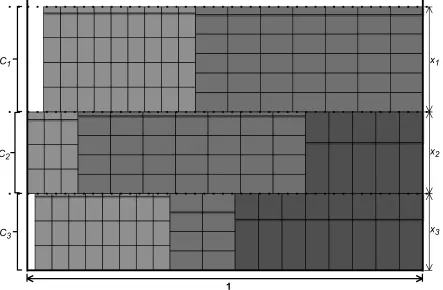
1 x3
x2 x1
C1
C2
C3
(a)
(b)
C
B
A
Figure2.1: A fractional solution where some rectangles are cut horizontally. (a) The setsC1,C2, and
If we put all these stacks of rectangles in the bin, one on top of each other for all setsCj∈C
we obtain a packing of total height equal toP
Cj∈Cxj; the above linear program minimizes this
value, thus minimizing the height of the packing. Note thatnihi represents the total height for
all rectangles of typeTi that need to be packed, hence the constraintPCj∈Cxjαi,j≥nihiensures
that all rectangles of typeTiare (fractionally) packed in the solution.
C2 C1
C3
1
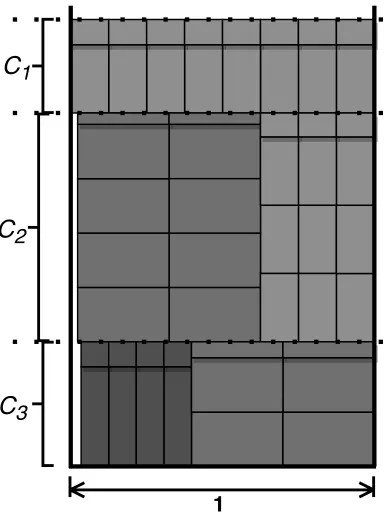
Figure2.2: A fractional solution with three configurations,C1,C2,C3, and three rectangle types.
In the linear program (2.1), the number of constraints or conditions of the form (2.2) that a solution must satisfy is equal to the number of rectangle types K = 3. The number of variables is equal to the number of sets Cj ∈ C, which is O(n3) because each set Cj can be
expressed as a vector (nj,1, nj,2, nj,3) where nj,i is the number of rectangles of type Ti in Cj.
Since eachnj,ican have at mostn+1 values, the number of setsCj ∈C is at most (n+1)3. In
Figure 2.1 note how the fractional solution has three distinct parts where rectangles are packed according to some set Cj ∈ C. We define a configuration to be a part of the packing where
Chapter2. Overview of theAlgorithm 14
possible configurations is equal to the number of sets inCand it is also equal to the number of variables; we index the configurations asC1,C2,C3, ...,CJ.
The set of feasible solutions for the linear program (2.1) consists of all solutions that satisfy the conditions of the form (2.2). Basic feasible solutions are solutions where the number of zero variables is at most the minimum between the number of constraints (excluding non-negativity constraints such as xj ≥ 0) and the number of variables of the linear program [34].
If the linear program (2.1) has an optimal solution, then it must have at least one basic feasible solution that minimizesP
Cj∈Cxj [34]. As the number of constraints of linear program (2.1) is
K = 3, then an optimum basic feasible solution for this linear program has at most 3 nonzero variables, and so it arranges the rectangles in at most three configurations.
For an instanceI of 3T-SPP, lets(I) be the total area of the rectangles inI and letlin(I) be the height of an optimal fractional packing for I (or, in other words, the value of an optimal solution for the linear program (2.1)). Recall that OPT(I) is the minimum possible height within which the rectangles in I can be packed in the bin. Observe that s(I) = P
iwihini.
Clearly, s(I) ≤ lin(I) ≤ OPT(I); the first inequality holds because all rectangles must be packed by any solution of the linear program, and the second inequality holds because the optimal fractional solution packs the rectangles at least as efficiently as the optimum solution since a fractional solution is allowed to cut the rectangles horizontally. Thus, solving the linear program (2.1) gives a lower bound for the value of an optimal solution for 3T-SPP.
2.2
High-Level Description of the Algorithm
is used to transform the solution of the dual linear program into a basic feasible solution for the linear program (2.1). This fractional solution consists of at most three configurations. Note that in a fractional solution, if we add all rectangles of some typeTi, including rectangles of
fractional height, over all configurations, we must get an integer value equal to the numberni
of rectangles of typeTi. We show below how to transform a fractional solution for 3T-SPP into
an integral solution (i.e., a solution without fractional rectangles).
If the fractional solution obtained by solving the linear program (2.1) only uses one con-figuration then we simply round up every rectangle with fractional height to its full height as shown in Figure 2.3. Note that the integral solution in Figure 2.3, obtained after rounding up the rectangles of fractional height, has more rectangles than the fractional solution. This solu-tion can easily be transformed into a solusolu-tion for the original instance by discarding the extra rectangles.
C1
1 C1
1
(a)
(b)
Figure2.3: A fractional and integral solution with one configuration and three rectangle types. (a) A
fractional solution. (b) An integral solution obtained by rounding up the height of each rectangle with fractional height in (a) to its full height.
If the fractional solution uses two configurations, we use the algorithm for HM-SPP in [7]. We briefly describe the algorithm below. Let the two configurations of the fractional solution beC1 andC2. Rearrange rectangles horizontally within each configuration so that a common
Chapter2. Overview of theAlgorithm 16
not cut at the boundaries betweenC1 andC2(see Figure 2.4). Let the non-common part beS2,
where no rectangle type appears in bothC1andC2.
C2 C1
S
1S
2Figure2.4: Horizontally rearranging rectangles so that a common partS1exists where rectangles of the same type line up between configurations. Rectangles inS1 are not cut at the boundaries betweenC1 andC2. Note how inS2, no rectangle type can appear in bothC1andC2.
Definition 2.1. Denote withfi,jthe fraction of each rectangle of typeTithat lies just below the
top of a configurationCj.
For each configuration C1 andC2 sort the rectangles in S2 by nondecreasing order of the
valuefi,j. For partS2ofC1andC2, round up rectangles with fractional height to their full height
as described in [7] so that they fit within a right triangular shape on top of each configuration. The partS2ofC1is then turned 180 degrees and placed above partS2ofC2so that the triangular
regions fit together without overlaps (see Figure 2.5).
In [7], Price proved that the total increase in the height of the packing caused by the above process is at most 1. For the common partS1ofC1 andC2, the rectangles of fractional height
are simply rounded up to their full height and this increases the height of S1 by at most 1.
Because the heights of both S1 andS2 increase by at most 1, the height of the whole packing
increases by at most 1.
the remaining configurations; this produces a packing of height at mostOPT(I)+K−1. IfK
=2, as mentioned above, the algorithm produces a packing of height at mostOPT(I)+1.
Figure 2.5: Figure from [7] that shows how the algorithm arranges the rectangles in S2. The height
increase is at most 1.
Chapter 3
Algorithm for the Three-Type Strip
Packing Problem
This chapter presents an algorithm that converts an optimal fractional packing for 3T-SPP into an integral packing with a height increase of at most 5/3 i.e. a performance bound ofOPT+5/3. The input to this algorithm is an optimal fractional solutionFfor 3T-SPP that uses at most three configurations, obtained by computing a basic feasible solution for the linear program (2.1). As mentioned above, if the fractional solutionFonly uses one configuration, then we round up the rectangles of fractional height, as described in Section 2.2, so they become whole and this produces a solution of height at mostOPT +1. IfF uses two configurations, then we use the algorithm for HM-SPP described in Section 2.2 to pack the rectangles in a solution of height at mostOPT +1. IfF uses three configurations, we convert it into an integral solution by using the algorithms described in Sections 3.1 – 3.7.
3.1
Partitioning the Fractional Packing
Let the fractional solutionF use three configurations: C1,C2, andC3. As explained in
Chap-ter 2, rectangles are packed according to these configurations into 3 sections, which are stacked one on top of the other, with the section corresponding toC3 at the bottom, C2 at the middle,
and C1 at the top. The rectangles are arranged within each one of these three sections into
columns, where each column is formed by rectangles of the same type. The three sections, or configurations, are placed so that the top of each configuration touches the bottom of the configuration on top of it. Figure 3.1 shows an example of three configurations in a fractional solution with three rectangle types.
C3 C2 C1
S' S
(a)
(b) T1 T2 T3
Figure 3.1: (a) Partitioning a fractional packing into two parts: S0 contains rectangles common in all
configurations, andScontains the remaining rectangles. (b) The three rectangle types used in (a).
We first show that we can rearrange the rectangles within each configuration so that a common partS0 exists where rectangles of the same type line up between configurations and,
Chapter3. Algorithm for theThree-TypeStripPackingProblem 20
For each rectangle type Ti, let ti,j be the total number of rectangles of typeTi across
con-figurationCj: here, the word “across” means that if we draw a horizontal line across Cj, this
line would intersect ti,jrectangles of typeTi. Letmi =min n
ti,j | j=1,2,3 o
. In Figure 3.1, for example, the value ofm1 is 3 becauset1,1 = 9, t1,2 = 3, and t1,3 =8. For each i= 1, 2, 3, we
shift mi columns of rectangles of type Ti to the rightmost position in all configurations. We
call the part of the solution containing the rectangles that were shifted,S0. The part containing
the remaining rectangles is calledS(see Figure 3.1). For alli= 1, 2, 3, the value ofti,j-mi is
zero for at least one configurationCj. In Figure 3.1 for example, the value oft1,2-m1 is zero.
Therefore, no typeTi will appear inSin all configurations.
Depending on the input, configurations could have different types of rectangles in S. For example, in Figure 3.1 each configuration has two rectangle types inS. For a different input, one configuration could have, for example, three rectangle types while the other two configurations could have only one rectangle type.
IfS0 is empty, the problem is simpler as only rectangles inSneed to be packed. Similarly,
ifSis empty, the problem is simpler as only rectangles inS0 need to be packed. Our algorithm
for converting a fractional solution for 3T-SPP into an integral solution is given below:
Algorithm 3.1roundThreeTypes(F)
1: In: An optimal fractional solutionFfor fractional 3T-SPP.
2: Out: An integral packing
3: Arrange the configurations C1, C2, andC3 inFso that they are stacked one on top of the
other, withC3at the bottom,C2at the middle, andC1at the top. 4: for allrectangle typesTi do
5: mi← min n
ti,j| j= 1,2,3 o
6: ifmi >0then
7: Horizontally rearrange rectangles by shiftingmi columns of rectangles of typeTi
in all configurations to the rightmost position of the strip.
8: Round up the rectangles with fractional height of typeTi located at the top ofS0,
as described in Section 3.2.
9: if the non-common partSis not emptythen
10: partitionPartS(T,C)//algorithm described in Section 3.4
11: packSegments(T,C)//algorithm described in Sections 3.5 and 3.6
3.2
Packing the Common Part
S
0InS0 we pack rectangles of the same type on top of each other (see Figure 3.2). Hence, rectan-gles now are not cut between adjacent configurations; only rectanrectan-gles in the uppermost config-uration,C1, might be cut at the top of the packing (see Figure 3.2). Therefore, we only need to
round up any rectangles with fractional height at the top ofS0 so that they become whole. This
rounding increases the height ofS0 by at most 1, because the tallest rectangle type has height
1.
C3 C2 C1
Rectangles of fractional height now rounded up
S' S
Figure3.2: Partition of a fractional packing where rectangles inS0 with fractional height are rounded
Chapter3. Algorithm for theThree-TypeStripPackingProblem 22
3.3
Rounding Up Rectangles with Fractional Height in the
non-Common Part
S
In partS, rectangles do not necessarily line up between configurations and hence they might be cut at the boundaries between configurations. Rectangles in the uppermost configuration,C1,
might also be cut at the top of the packing. We cannot just round up all the rectangles that have fractional height without increasing the height of partSby up to 3 units.
Cj
fi,jhi
hi
wi
r
Figure 3.3: Two rectangles of typeTi where one is a whole rectangle and the other is a rectangle of
fractional height. The horizontal dotted line indicates where the rectangle r is cut at the top of the configurationCj. From Definition 2.1fi,jis the fraction of the rectangler of typeTithat lies just below the top ofCj. Thenfi,jhiis the height ofr.
Letai,jbe the total area of the rectangles of typeTi that the fractional solution packs in
con-figurationCj. Recall thatwi andhi are the width and height of rectangle typeTi, respectively.
Thenni,j=ai,j/wihi is the (fractional) number of rectangles of typeTi that are inCj. Although
this number might be fractional, the total number,ni=ni,1 +ni,2 +ni,3, of rectangles of typeTi
over all configurations is integer for any typeTi.
Recall from Definition 2.1 thatfi,j is the fraction of each rectangle of typeTi that lies just
top ofCj (see Figure 3.3). We call a fractional rectangleshort iffi,j <1/3 and we call ittallif fi,j≥1/3. For example, in Figure 3.4, fractional rectangler0of typeTi0 istallasfi0,j ≥1/3.
Cj
fi',j hi' ≥ 1/3 hi' ≤ 2/3 hi'
r r'
fi,jhi < 1/3 hi ≤ hi hi
hi'
Figure3.4: Rounding upshortandtallfractional rectangles. Ashortfractional rectangleris to the left;
atallfractional rectangler0is to the right.
If we round up a short fractional rectangle to form a whole rectangle, the height of the packing might increase by up to 1; however, if we round up a tall fractional rectangle, the height of the packing will increase by at most 2/3 units (see Figure 3.4).
3.4
Partitioning the non-Common Part
S
For each configurationCj, we calculate the fractionfi,jfor each rectangle typeTi in partS. We
then sort these fractions in nondecreasing order so that rectangle types with smaller fractions
fi,j are to the left while rectangle types with larger fractions are to the right. For example, in
configuration C1 of Figure 3.5, rectangles of type T1 are to the left of rectangles of type T2
becausef1,1=1/4 is less thanf2,1=2/5.
Chapter3. Algorithm for theThree-TypeStripPackingProblem 24
several columns denoted bykc. Within a column, each configuration has at most one rectangle
type. The subscriptctakes values from 1 to the total number of columns (see Figure 3.5).
C3 C2
C1
S1 S3
2/5 h2
3/5 h3
1/2 h3 1/4 h1
1/5 h2
1/10 h1
S
C D E
B A k1 k2
S2
T
1T
1T
2T
2T
3 k5k4
k3 k6
Figure3.5: Three partitions ofS:S1,S2, andS3. Rectangle types inSare sorted for each configuration
Cjin nondecreasing order offi,j. As we scanSfrom left to right within a configuration, rectangles with small fractional values are to the left whereas rectangles with larger fractional values are to the right. We draw vertical lines at points A, B, C, D, E where a configuration switches from either empty space or some rectangle type to a different rectangle type; kc denotes the columns created by these vertical lines, where subscriptcincreases as we scanSfrom left to right. In each column, a configuration has at most one rectangle type.
either empty space or some rectangle type to a different rectangle type. For example, we draw a vertical line at pointAbecause inC3the vertical sweepline touches the left side of the leftmost
rectangle inC3. We draw a vertical line at pointCbecause inC3the vertical sweepline touches
the border between a rectangle of typeT1 and a rectangle of typeT3. We use the vertical lines
discussed above to create columnskc. Note how for each border of a column there is at least
one configuration whose rectangles are not split by that border.
Using these columns, we partitionSinto at most three segments,S1,S2, andS3, as follows.
LetFj,cbe the fraction of each rectangle that lies just below the cutting line in configurationCj
for columnkc. SegmentS1 contains all those columnskc for which P3
j=1Fj,c ≤ 1, segmentS2
contains those columns for which 4/3≥ P3
j=1Fj,c >1, and columns for whichP3j=1Fj,c>4/3
can be in either segmentS2orS3as described in Subsection 3.4.1. For example, in Figure 3.5, S1contains columnsk1,k2,k3andk4becauseP3j=1Fj,1andP3j=1Fj,2clearly have value less than P3
j=1Fj,3 = 1/4+1/5+ 1/10=11/20= 0.55, andP3j=1Fj,4 = 1/4+1/5+ 1/2= 19/20 =0.95.
SegmentS2contains columnk5becauseP3j=1Fj,5 =2/5+1/5+1/2=11/10=1.1. SegmentS3
contains columnk6 as explained in Subsection 3.4.1.
k4 C B A k 3
T
2T
3T
2 k2 k1 1/2 h2 2/5 h1 1/2 h3S1 S3
C3 C1
C2
1/10 h2
T
1Figure 3.6: Two partitions ofS where no columns kc exist for which 4/3 ≥ P3j=1Fj,c > 1. We draw vertical lines at points A, B, C where a configuration switches from either empty space or a rectangle type to a different rectangle type. Columns for which P3
j=1Fj,c ≤ 1 are to the left of point C, and columns for whichP3
Chapter3. Algorithm for theThree-TypeStripPackingProblem 26
3.4.1
Determining Which Columns are in
S
2or
S
3Definition 3.1. Denote with Pσ the position of the left border of the leftmost column kc for
whichP3
j=1Fj,c>4/3.
If P3
j=1Fj,c > 4/3 for each column kc ∈ S, then all these columns are in segment S3. If
fewer than two rectangles with fractional height cross the vertical cutting line atPσ, then those
columns for which P3
j=1Fj,c > 4/3 are all in S3. For example, one rectangle with fractional
height in Figure 3.5 crosses the vertical cutting line at pointE, soS3contains columnk6because P3
j=1Fj,6 = 2/5 + 3/5 + 1/2 = 3/2 = 1.5. In Figure 3.6 one rectangle with fractional height
crosses the vertical cutting line at pointC, soS3contains columnk4 becauseP3j=1Fj,4 =1/2+
2/5+1/2=7/5=1.4.
However, if two rectangles with fractional height cross the vertical cutting line atPσ, then
we need to consider two cases. Let r1 andr2 be the rectangles of fractional height that cross
the vertical line atPσ, and letr1andr2 belong to configurationsCk andCk0 respectively.
Definition 3.2. If two rectanglesr1andr2of fractional height cross the vertical cutting line at Pσ, letPminbe the leftmost position between the right sides ofr1 andr2.
k4 C B A k 3
T
2T
3T
2 k2 k1 1/2 h2 2/5 h1 1/2 h3S1 S3
C3 C1 C2 1/10 h2
T
1 r2 k5 D S2 r1Figure3.7: Three partitions ofSwhere no columnskcexist for which 4/3 ≥P3j=1Fj,c>1. Rectangles
1. If no column exists for which 4/3 ≥P3
j=1Fj,c>1, then segmentS2contains all columns
betweenPσ andPmin, and segmentS3 contains all columns that are to the right ofPmin.
For example, in Figure 3.7, the right border ofr2is closest to the left border of partSso
we draw a vertical line at point Dto create columnk4. SegmentS2 contains columnk4
because it is between pointsCandD. SegmentS3contains columnk5because it is to the
right of pointD. Note howS2cannot be empty in this case.
C3 C1 C2
T
3T
1T
1 r1T
2T
2 r2S3 S2
S1
C k k5
4 D E
B A k 3 k2 k1 k6
Figure 3.8: Three partitions of S where S2 has a column where 4/3 ≥ P3j=1Fj,c > 1 and also has a column whereP3
j=1Fj,c>4/3. Rectanglesr1andr2with fractional height cross the vertical line at point D. Note howr1andr2are not inC2; in this figure,C2has the largest fractional valueFj,cin columnk4. We draw a vertical line at point E because the right border ofr2is closest to the left border ofS; column
k5 is inS2. BecauseC3 has no rectangles that cross the boundary betweenS2 andS3, we rename and reorder configurations so thatC3becomesC2.
2. If columns exist for which 4/3≥ P3
j=1Fj,c>1, then define configurationCαas follows:
Definition 3.3. If columns exist for which 4/3 ≥ P3
Chapter3. Algorithm for theThree-TypeStripPackingProblem 28
which 4/3≥P3
j=1Fj,c>1.
In Figure 3.8, the leftmost columnkcfor which 4/3≥P3j=1Fj,c>1 isk4and soCα isC2.
Ifr1orr2are inCα, then all those columns for whichP3j=1Fj,c>4/3 are in segmentS3.
Otherwise, (recall from Definition 3.2 thatPminis the leftmost position between the right
sides ofr1andr2) we place in segmentS2all columns betweenPσandPminand we place
in segmentS3all columns that are to the right ofPmin.
For example, in Figure 3.8, the right border ofr2is closest to the left border of partSso
we draw a vertical line at pointEto create column k5. SegmentS2 contains columnk5
because it is between pointsDandE. SegmentS3contains columnk6because it is to the
right of pointE.
There cannot be three rectangles with fractional height that cross the vertical line at Pσ
because for each border of a column there is at least one configuration whose rectangles are not split by that border. For example, the border atPminwill not split eitherr1orr2.
3.4.2
Reordering Configurations
We vertically cut rectangles of fractional height at the boundary between two adjacent seg-ments; whole rectangles that cross the boundary between two segments are not vertically cut as explained in Section 3.6.
Lemma 3.4.1 We can rename and reorder configurations so that configuration C2 does not
have rectangles that cross the boundary between segment S3and its adjacent segment.
Proof Recall that for any border of a column there is at least one configuration whose rectan-gles are not split by that border. Thus, for each segment S1, S2, S3, at least one configuration
the configuration that has no rectangles that cross the boundary between the two rightmost
segments becomesC2.
In Figure 3.5, rectangles of typeT1 in configurationC1 do not cross the boundary between
segmentsS1andS2(see pointD); rectangles of typeT3in configurationsC2andC3do not cross
the boundary between segmentsS2 andS3 (see pointE). Therefore, we do not need to reorder
the configurations becauseC2does not have any rectangles that cross the boundary betweenS2
andS3. In Figure 3.8,C3 has no rectangles that cross the boundary betweenS2and S3, so we
rename and reorder configurations so thatC3becomesC2and vice versa.
Lemma 3.4.2 Assume segments S1 and S3 are not empty and segment S2 is empty. We can
rename and reorder configurations so that:
1. Lemma 3.4.1 holds, and
2. at most one rectangle with fractional height crosses the boundary between S1 and S3,
and this rectangle is in configuration C1.
Proof First, we rename and reorder configurations according to Lemma 3.4.1 so that configu-rationC2does not have any rectangle of fractional height that crosses the boundary betweenS1
andS3. In this case, no columnkc exists for which 4/3≥ P3j=1Fj,c>1 because as explained in
Section 3.4 thenS2would contain all these columns, butS2is empty. SinceS2is empty then, as
explained in Subsection 3.4.1, there cannot be two rectangles with fractional height that cross the vertical cutting line at Pσ. Therefore, at most one rectangle with fractional height crosses
the vertical cutting line atPσ (the cutting line is the left border ofS3). If configurationC3 has
a rectangle of fractional height that crosses the boundary between S1 andS3, we rename and
reorder the configurations so thatC3becomesC1and vice versa.
Lemma 3.4.3 Assume segment S2is not empty and it contains no columns kc for which4/3 ≥ P3
Chapter3. Algorithm for theThree-TypeStripPackingProblem 30
Proof In this case, at least one columnkc exists for which P3j=1Fj,c ≤ 4/3 because otherwise S2 would be empty as all columns in part S would be in segment S3 as described in
Subsec-tion 3.4.1. Therefore, by the assumpSubsec-tion of the lemma kc must belong to segment S1. As
described in Subsection 3.4.1, if fewer than two rectangles with fractional height cross the ver-tical cutting line atPσ, thenS2would be empty becauseS3would contain all columns for which P3
j=1Fj,c>4/3. Therefore, two rectangles with fractional height must cross the vertical cutting
line atPσ.
Definition 3.4. Assume rectangles r1 and r2 with fractional height cross the vertical cutting
line at Pσ, where Pσ is the position of the left border of the leftmost column for which P3
j=1Fj,c > 4/3 as stated in Definition 3.1. Let r1 andr2 belong to configurationsCk andCk0
respectively. We denote withCβ the configuration that is neitherCk norCk0.
Lemma 3.4.4 Assume segment S2 is not empty and contains no columns kc for which 4/3 ≥ P3
j=1Fj,c>1. Then Fβ,c >1/3 andP3j=1Fj,c−Fβ,c <1 for each column kc ∈S2.
Proof In this case two rectangles r1 and r2 with fractional height cross the vertical cutting
line at Pσ according to Lemma 3.4.3. As stated in Definition 3.2, let Pmin be the leftmost
position between the right sides of r1 and r2. Because no column kc exists for which 4/3 ≥ P3
j=1Fj,c > 1, S2 only contains columns between Pσ and Pmin as stated in Subsection 3.4.1.
Thus,P3
j=1Fj,c> 4/3 for each column inS2; these columns must have part ofr1 and part ofr2
because these rectangles intersect or touchPσandPmin.
Sincer1 andr2 cross the vertical cutting line atPσand columns to the left ofPσare inS1,
then part ofr1 and part ofr2must be in a column for whichP3j=1Fj,c ≤ 1. Therefore,Fk,c + Fk0,c <1 for each columnkc ∈S2. AsP3j=1Fj,c>4/3 for each column inS2, thenFβ,c> 1/3 for
each columnkcinS2. Thus,P3j=1Fj,c−Fβ,c<1 for each column inS2.
Lemma 3.4.5 Assume segments S2 and S3 are not empty and S2 contains no columns kc for
which4/3≥P3
1. Lemma 3.4.1 holds,
2. at most one rectangle with fractional height crosses the boundary between S2 and S3,
and this rectangle is in configuration C1, and
3. Cβis either configuration C2or configuration C3.
Proof According to Lemma 3.4.3, two rectangles r1 and r2 with fractional height cross the
vertical cutting line atPσ for this case. Recall from Subsection 3.4.1 and Definition 3.2 that Pminis the leftmost position between the right sides ofr1andr2, and that ifS3is not emptyPmin
is at the boundary betweenS2andS3. As stated in Definition 3.4, Cβis the configuration that
does not contain neitherr1norr2.
We first rename and reorder configurations according to Lemma 3.4.1. By Definition 3.2, only one ofr1andr2can cross the boundary atPmin; if that rectangle is inC3andCβisC2then
we rename and reorder configurations so thatC3becomesC1and vice versa.
If Cβ isC1, we rename and reorder configurations so that C3 becomesC1 and vice versa.
Then if there is a rectangle with fractional height that crosses the boundary atPminthat rectangle
must be inC1because by the definition ofPmin,Pminmust be the right boundary ofC2.
Recall from Definition 3.3 that if columns exists for which 4/3 ≥ P3
j=1Fj,c > 1, then Cα
is the configuration with the largest fractional valueFα,c in the leftmost columnkc for which
4/3≥P3
j=1Fj,c>1.
Lemma 3.4.6 Assume S2 is not empty and contains columns kc for which4/3 ≥ P3j=1Fj,c> 1. Then Fα,c >1/3 andP3j=1Fj,c−Fα,c<1 for each column in S2.
Proof In this case, if at most one rectangle with fractional height crosses the vertical line at
Pσ, then as described in Subsection 3.4.1 those columns for whichP3j=1Fj,c>4/3 are all inS3
so thatPσis at the boundary betweenS2andS3. There must be inS2at least one rectangle type TiinCαsuch thatfi,α>1/3 andFα,c >1/3 becauseP3j=1Fj,c>1 for each columnkc ∈S2. Thus, P3
Chapter3. Algorithm for theThree-TypeStripPackingProblem 32
If two rectangles r1 and r2 with fractional height cross the vertical cutting line at Pσ, we
need to consider two additional cases. Letr1andr2belong to configurationsCkandCk0 respec-tively.
1. If r1 orr2 is in Cα, then as described in Subsection 3.4.1 all those columns for which P3
j=1Fj,c >4/3 are in S3 so thatPσ is at the boundary betweenS2 and S3. By the same
above reasoning,Fα,c >1/3 andP3j=1Fj,c−Fα,c <1 for each column inS2.
2. If neitherr1 norr2are inCα then, as stated in Subsection 3.4.1,S2 contains columnskc
between Pσ and Pmin where P3j=1Fj,c > 4/3; recall from Definition 3.2 that Pmin is the
leftmost position between the right sides ofr1andr2. The columns betweenPσandPmin
must have part of r1 and part ofr2 because these rectangles intersect or touch Pσ and Pmin.
There must be inS2at least one rectangle typeTiinCαsuch thatfi,α>1/3 andFα,c>1/3
becauseP3
j=1Fj,c>1 for each columnkc ∈S2. Since r1andr2 cross the vertical cutting
line atPσ and columns for whichP3j=1Fj,c≤4/3 are to the left ofPσ, part ofr1 and part
ofr2must be in a column for which 4/3≥ P3j=1Fj,c>1. However, sincer1andr2are not
inCα, thenFk,c +Fk0,c < 1 for each column inS2 that contains parts ofr1 andr2. Thus, P3
j=1Fj,c−Fα,c<1 for each columnkc inS2.
Lemma 3.4.7 Assume segments S2and S3are not empty and S2contains columns kcfor which
4/3≥P3
j=1Fj,c>1. We can rename and reorder configurations so that: 1. Lemma 3.4.1 holds, and
2. any rectangle of fractional height not in configuration Cα that crosses the boundary
between S2and S3must be in configuration C1.
Proof According to Defintion 3.3,Cαis the configuration with the largest fractional valueFα,c
with fractional height crosses the vertical cutting line atPσ, then as described in Lemma 3.4.6 Pσis at the boundary betweenS2andS3. After renaming and reordering configurations
accord-ing to Lemma 3.4.1, if C3 has a rectangle with fractional height that crosses the vertical line
atPσandC3is notCα, then we rename and reorder configurations so thatC3becomesC1and
vice versa.
If two rectangles r1 and r2 with fractional height cross the vertical line atPσ, we need to
consider two cases.
1. If r1 or r2 is in Cα, then as described in Lemma 3.4.6 Pσ is at the boundary between S2 andS3. After renaming and reordering configurations according to Lemma 3.4.1, by
definitionr1andr2cannot be inC2. IfC3is notCα, we rename and reorder configurations
so thatC3becomesC1and vice versa.
2. If neitherr1 norr2are inCα then, ifS3is not empty,Pmin is at the boundary betweenS2
andS3; recall from Definition 3.2 thatPminis the leftmost position between the right sides
ofr1 andr2. We first rename and reorder the configurations according to Lemma 3.4.1.
By Definition 3.2, only one ofr1 andr2 can cross the boundary atPmin; if that rectangle
is inC3andCαisC2, then we rename and reorder configurations so thatC3becomesC1
and vice versa.
IfCαisC1, we rename and reorder configurations so thatC3becomesC1and vice versa.
Then if there is a rectangle with fractional height that crosses the boundary atPmin that
rectangle must be inC1because by the definition ofPmin,Pminmust be the right boundary
ofC2.
After renaming and reordering configurations according to Lemmas 3.4.2, 3.4.5, and 3.4.7, we invert configurationC1so that rectangles with fractional height are at the bottom ofC1; for
the rest of this thesis, we assume that the configuration at the top of the packing is inverted (for example, see Figure 3.14). Pseudocode for the algorithm that partitionsSinto segmentsS1,S2,
Chapter3. Algorithm for theThree-TypeStripPackingProblem 34
Algorithm 3.2partitionPartS(T,C)
1: In: A set T of three rectangle types and a set C of three configurations in an optimal fractional packing
2: colS1, colS2, colS3←empty sets//sets of positions for the columns ofS1,S2, andS3 3: positions←empty set//used to partitionSinto columns
4: if S0is emptythen
5: positions← positions∪ {1}//strip’s rightmost border is at position 1
6: else
7: positions← positions∪ {horizontal position of boundary betweenSandS0} 8: foreach configurationCjdo
9: Calculate the fractionfi,jas defined in Definition 2.1 for each rectangle typeTi in part SofCj.
10: Sort these fractions in nondecreasing order.
11: Sort rectangles in partSofCj by rectangle type so that rectangle types are in
nonde-creasing order offi,j.
12: positions← positions∪ {positions in partSwhereCj switches from a rectangle type
to a different rectangle type}
13: positions← positions∪ {1 - total width ofCj}//position whereCj ends 14: Sortpositionsin nondecreasing order and remove duplicates.
15: spotS2←-1//change value if we encounter a columnkc for which 4/3≥ P3j=1Fj,c>1. 16: foreach value P inpositionsdo
17: ifP is the last value inpositionsthen
18: Invert configurationC1.
19: return
20: P2←the first value after P inpositions
21: Letkc be the column created by positions P and P2 22: ifP3
j=1Fj,c ≤1then
23: if kcis the leftmost column of packingthen 24: colS1←colS1∪ {P}
25: colS1←colS1∪ {P2} 26: else if 4/3≥P3
j=1Fj,c>1then 27: if spotS2=-1then
28: spotS2←configuration with the largest fractional valueFj,cin columnkc 29: colS2←colS2∪ {P}
30: colS2←colS2∪ {P2} 31: else
33: Pmin ←-1//changes value ifS2contains column(s) for whichP3j=1Fj,c>4/3
34: Pσ ←-1//ifS3has an adjacent segment, then changes value to the position of the left 35: border of the leftmost columnkcfor whichP3j=1Fj,c>4/3
36: if colS1 is not empty or colS2 is not emptythen
37: Pσ ←max{largest value from colS1, largest value from colS2}
38: iftwo rectangles of fractional height cross the vertical cutting line atPσthen
39: Let r1 andr2 be the rectangles of fractional height that cross the vertical cutting
line at Pσ in configurationsCk andCk0 respectively. 40: if colS2 is emptythen
41: Pmin←leftmost position between the right sides ofr1andr2. 42: ifPminis not in positionsthen
43: positions← positions∪ {Pmin}//addPminin its sorted position
44: else
45: ifneitherr1 norr2are inCspotS2then
46: Pmin←leftmost position between the right sides ofr1andr2. 47: ifPmin is not inpositionsthen
48: positions← positions∪ {Pmin}//addPminin its sorted position 49: foreach value P inpositionsthat is greater than or equal toPσ do
50: ifP is the last value inpositionsthen
51: Break out of for loop
52: P2←the first value after P inpositions
53: Letkc be the column created by positions P and P2 54: ifS2is empty and P=Pσ andPmin,-1then 55: colS2←colS2∪ {P}
56: ifP=Pminor (P=PσandPmin=-1) orkc is the leftmost column of packingthen 57: colS3←colS3∪ {P}
58: ifP2≤Pminthen
59: colS2←colS2∪ {P2} 60: else
61: colS3←colS3∪ {P2}
62: if S1andS3 are not empty andS2is emptythen
63: Rename and reorder configurations according to Lemma 3.4.2.
64: else if S2andS3are not emptythen
65: Rename and reorder configurations according to Lemmas 3.4.5 and 3.4.7.
Chapter3. Algorithm for theThree-TypeStripPackingProblem 36
3.5
Packing Segments
S
1,
S
2, and
S
33.5.1
Packing Rectangles in
S
1fi,jhi hi
Cj
(a)
hi
C2 C1
(b)
Figure3.9: (a) Arrows show how rectangles of fractional height of typeTiinCjare stacked up forming whole rectangles and at most one rectangular piece of heighthi. (b) Arrows show how rectangles of fractional height of typeTifromC1andC2are stacked up in a region betweenC1andC2to form whole rectangles and at most one rectangular piece of heighthi. Note howC1is inverted.
Consider the set of rectangles with fractional height of type Ti in S1. We take all these
fractional height from the other configurations inS1(see Figure 3.9 (b)).
Lemma 3.5.1 The rectangles of fractional height of each configuration in segment S1 can be
reshaped to form rectangular pieces of full height that can be packed side-by-side into a region
of width w1, where w1is the total width of S1.
C3 C2 C1
S1 ≤ 1
A B k
3 k4
k2
k1 C D
Chapter3. Algorithm for theThree-TypeStripPackingProblem 38
Proof P kc∈S1
P3
j=1Fj,cWcHj,cis the total area of all rectangles with fractional height inS1, where kc ∈S1represents a column inS1,Wc is the width of columnkc, andFj,cHj,cis the height of the
rectangles with fractional height in columnkc of configurationCj; note that in a configuration
each column has at most one rectangle type. If we reshape all rectangles with fractional height of type Ti, including those rectangles of fractional height that were vertically cut at the right
boundary of S1, into rectangular pieces of full height and lay them side-by-side the width of
the resulting packing is at mostP kc∈S1
P3 j=1
Fj,cWcHj,c Hj,c
because we do not change the total area of these fractional rectangles. Note that
X
kc∈S1
3 X
j=1
Fj,cWcHj,c Hj,c
= X kc∈S1
3 X
j=1
Fj,cWc = X
kc∈S1
Wc
3 X
j=1 Fj,c ≤
X
kc∈S1
Wc =w1
The last inequality holds because in each columnkcof segmentS1,P3j=1Fj,c≤ 1.
According to Lemma 3.5.1, we can reshape all rectangles of fractional height that are in segmentS1to form rectangular pieces of full height; these pieces, when placed side by side, fit
into a region of the same width asS1. We place these rectangular pieces between C1 andC2,
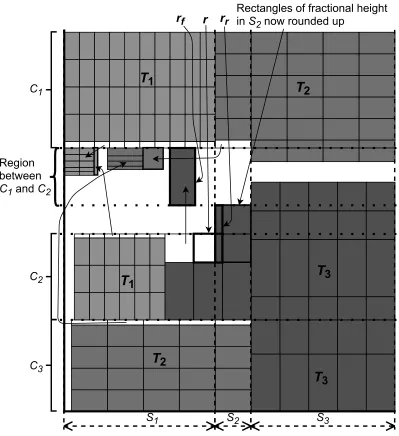
thus shifting downC2andC3; this increases the height ofS1by at most 1 (see Figure 3.10).
3.5.2
Packing Rectangles in
S
2By the way in which segmentS2was defined,P3j=1Fj,c>1 for each columnkc∈S2.
Lemma 3.5.2 There is a configuration Cγ in segment S2 such that Fγ,c > 1/3 andP3j=1Fj,c −
Fγ,c <1 for each column kc ∈S2.
Proof Consider first when S2 only contains columns for which P3j=1Fj,c ≤ 4/3. As stated in
Definition 3.3, letCα be the configuration with the largest fractional valueFα,c in the leftmost
columnkc for which 4/3 ≥ P3j=1Fj,c> 1. In this caseCα must exist because by the definition
ofS2, P3j=1Fj,c > 1 for each columnkc ∈S2, so ifS2 is not empty then there must be at least