Remote Integrity Check with
Dishonest Storage Server
Ee-Chien Chang Jia Xu
School of Computing National University of Singapore {changec,xujia}@comp.nus.edu.sg
Abstract. We are interested in this problem: a verifier, with a small and reliable storage, wants to periodically check whether a remote server is keeping a large filex. A dishonest server, by adapting the challenges and responses, tries to discard partial information ofx and yet evades detection. Besides the security requirements, there are considerations on communication, storage size and computation time. Juels et al. [10] gave a security model forProof of Retrievability(POR) system. The model imposes a requirement that the originalxcan be recovered from multiple challenges-responses. Such requirement is not necessary in our problem. Hence, we propose an alternative security model for Remote Integrity Check(RIC). We study a few schemes and analyze their efficiency and security. In particular, we prove the security of a proposed schemeHENC. This scheme can be deployed as aPORsystem and it also serves as an example of an effectivePORsystem whose “extraction” is not verifiable. We also propose a combination of the RSA-based scheme by Filho et al. [7] and the ECC-based authenticator by Naor et al. [12], which achieves good asymptotic performance. This scheme is not a PORsystem and seems to be a secureRIC. In-so-far, all schemes that have been proven secure can also be adopted asPORsystems. This brings out the question of whether there are fundamental differences between the two models. To highlight the differences, we introduce a notion,trap-door compression, that captures a property on compressibility.
1
Introduction
Recently, there is growing interests in remote verification of storage server. Con-sider the scenario where Alice has a large file x which she wants to store in a peer-to-peer backup system, and she does not want to keep it locally. Bob, a peer node, promises to keep the file for Alice. However, Bob might discard portion of
xto save storage, or temporarily move the file to a slower storage, hoping that Alice may not need it during the period. To prevent cheating, periodically, Al-ice wants to remotely check that Bob indeed hasxreadily available for reading without retrieving the whole x.
per verification should be small. (2) The storage at the verifier should be small. We want to limit it to a constant factor of κ, whereκ is a security parameter sufficiently large for cryptography, for e.g.κ = 1024. (3) The size of the addi-tional storage at the server should be small. Although it is desired to haveO(κ) additional storage, sublinear (w.r.t. the original file size) is also acceptable. (4) Finally, computation per verification should be low. To quantify the amount of computation, we measure the number of bits accessed from the storage.
Security model. Let us call the problem considered in this paperRemote Integrity Check (RIC). Formulating the security requirement is tricky since the server is free to transform the data. Juels et al. [10] proposed a security model for Proof Of Retrievability(POR) system. Roughly, a scheme is secure if, there is a polynomial time extractor, s.t. for any server that is able to pass the verification, the extractor can recover the original file by carrying out multiple verifications1.
There is a subtle but crucial difference between POR system and the RIC. Under POR, it is required that the original can be recovered by interacting with the server. This requirement on recovery is not necessary in RIC, where verification and recovery can be carried out in two different phases. For example, in the previous application of peer-2-peer backup, when Alice decides to recover the filex, she can retrieve the wholexand then checks the integrity ofxusing the usual message authentication code or signature, without carrying out the verification protocol.
Without the recovery requirement, we may be able to design schemes with better performance. One possible candidate is the simple and yet interesting RSA-based scheme by Filho et al. [7]. In this scheme, the server’s response is rx modn, where x is the file treated as a single integer, r a randomly chosen challenge and n a composite. Since the responses only contain information of
xmodφ(n), thus it is impossible to recoverxfrom multiple challenges-responses. Nevertheless, the RSA-based scheme seems able to detect a dishonest server who has discarded partial information. Another example is a scheme by Ateniese et al. [2]. Similarly, it is impossible to recover the original by interacting with their server. Thus it is inappropriate to prove the security of these schemes using security model ofPOR, and a “weaker” security model forRIC is needed.
a scheme is (β, γ)-secure (or weakly secure) if, for any server that can pass the verification with probability at leastβ, then there is an extractor who can recover the original from the verifier’s and server’s storages with probability at leastγ. In-so-far, all schemes that have been proven secure under RIC can also be employed as a securePOR. This indicates some intriguing differences between
PORand RIC. To highlight this issue, we reformulate the model to a simple form which we calltrap-door compression: Consider a keyed-hash family. With a secret key, the owner can lossily (that is, some information has been discarded) compress the filextoxe, s.t. for anyr, the hashed valueH(r,x) can be computed from ex, r and the secret key. However, without the secret key, any dishonest server is unable to discard partial information and yet able to compute the hash. In other words, without the secret key, compression w.r.t. the keyed-hash family is computationally difficult. Note that from a trap-door compression, it is easy to build aRICwhich is not aPORsystem. This property on “compressibility” could be of independent interest.
Proposed schemes. The error correcting code (ECC) based authenticator [4, 12] can be directly employed as aRICandPOR(we call this schemeAUTH).
The schemeAUTHintroduces redundancy into the file to achieve tradeoff between
additional storage and the number of bits read per verification. Such generic technique is effective and hence we want to design schemes whereby the technique can be incorporated. On the other hand, the main drawback ofAUTHis the large
server’s storage required. For example, it requires at least 4 times more storage space if a single verification achieves less than 0.5 false acceptance rate. To lower the false acceptance rate, multiple verifications can be made but that will incur more communication bits.
To reduce the communication bits, we can use a simple homomorphic MAC and an almost universal hash family. This scheme is also proposed by Shacham et al. [14] and this paper is an independent work. Let us call this schemeHTAG.
Essentially,HTAGhashes and aggregates multiple challenges-responses into one,
and thus reducing the number of communication bits to a constant factor ofκ. However, there is no reduction in the storage size.
We next give a simple schemeHENCwhich requires sub-linear (w.r.t. the file
size) additional storage but more communication bits.HENCsends a sequence of
the form (gαr modp),(gαr2
modp), . . .during verification, whereαandrare secrets. Using a bilinear map, the amount of communication bits can be reduced by square-root of the size of the original file. We can show thatHENCis a
weakly-secureRIC. By using the Paillier cryptosystem, we can obtain a variant that is a secureRIC.HENCcan be used asPORsystem: to recover the file, the owner
uses another algorithm to generate the queries. However, the response from the server cannot be verified. Hence, HENC also serves as an example of a POR
system whose extraction is not verifiable [5]. We also propose HYB, a hybrid of HENCwith HTAG, that further reduces communication bits.
Along another direction in improvingAUTH, we incorporate a redactable
κ. Let us call this scheme REDACT. During setting up, the original file x is
en-coded and expanded toyas inAUTH, and a redactable signature ofyis obtained.
However, the server only need to store the originalx and the signature. When the verifier wants to know thei-th object iny, the server derivesyfromx, and computes the redactable signature for the requested object. It is not difficult to show thatREDACTis a secureRICandPOR. Clearly, the main disadvantage is
the computation time, and it is not clear how to aggregate multiple responses to reduce communication bits.
Filho et al. [7] proposed a scheme based on a collision resistant hash, which is a candidate of trap-door compression function. Let us call itRSAb. It seems to be
secure but there is no rigorous proof.RSAbconsumes the same resource asREDACT
and require intensive computation. Fortunately, we can exploit its homomorphic properties to trade-off the number of bits read with the storage size, while keeping communication cost unchanged. Let us call this extension RSAh. Among the
schemes studied in this paper,RSAhachieves the best asymptotic performance.
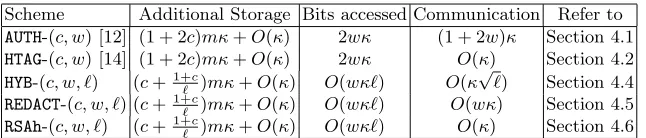
Performance. Table 1 gives a summary on performance. A reasonable choice of the parameters is:c = 0.2, w= 500, ℓ= 1000 and κ= 1000. Thus, if the file is 1Gbits, then for AUTH-(c, w), the total storage required at the server
is roughly 2.4Gbits, and the server has to send at least 1Mbits during verifica-tion. In contrast,HTAG-(c, w) requires only 4000 communication bits although it
still requires 2.4Gbits total storage.HYB-(c, w) andREDACT-(c, w, ℓ) require only
roughly 1.2Gbits total storage. RSAh-(c, w, ℓ) reduces the total storage size to
roughly 1.2Gbits and communication cost to 5000 bits.
Contribution. We propose a security model forRIC. Unlike the previously known model forPOR, the extractor can access the server’s storage. We propose a few schemes: HTAG, HENC, HYB, REDACTand RSAh. Shacham et al. [14] gave a
scheme same asHTAGand this paper is an independent work. The performance
of these schemes is summarized in Table 1. The scheme HTAG, HENC, HYB and REDACTcan be shown to be secure under reasonable cryptographic assumptions.
Interestingly, schemes that have been proven secure under RIC can also be deployed asPORsystems. To highlight the difference between the two models, we introduce the notion of trap-door compression.
2
Related Work
This paper is motivated by applications in remote-backup and peer-to-peer backup ([1, 3, 11]). Peer-to-peer backup system requires a mechanism to maintain the availability and integrity of data stored in peer nodes. Li et al. [11] proposed to choose neighboring nodes based on the social relationships and relies on the principle that people are more likely cooperative with friends.
Scheme Additional Storage Bits accessed Communication Refer to AUTH-(c, w) [12] (1 + 2c)mκ+O(κ) 2wκ (1 + 2w)κ Section 4.1 HTAG-(c, w) [14] (1 + 2c)mκ+O(κ) 2wκ O(κ) Section 4.2 HYB-(c, w, ℓ) (c+1+c
ℓ )mκ+O(κ) O(wκℓ) O(κ √
ℓ) Section 4.4 REDACT-(c, w, ℓ) (c+1+c
ℓ )mκ+O(κ) O(wκℓ) O(wκ) Section 4.5 RSAh-(c, w, ℓ) (c+1+c
ℓ )mκ+O(κ) O(wκℓ) O(κ) Section 4.6 Table 1.The size of the original file is mκ bits. The file is expanded to a factor of (1 +c) using ECC, grouped into blocks where each block contains ℓelements, and w
“requests” are made during a single verification. When w=κ andc= 1, they have “similar security level”. ForRSAh, there is no formal proof of its security.
not have the original. They described two potential applications: uncheatable data transfer anddemonstrating data possession, and proposed the RSA-based scheme. Juels et al. formulated the POR system and gave a security model [10]. They also proposed a sentinel-based method. However, the sentinel-based method can only support constant number of verifications. A refined security formulation is given in a recent technical paper [5]. The main difference ofPOR andRIC is in the requirement on file recovery. Ateniese et al. [2] gave a model forProof of Data Procession system, and proposed a few schemes that provide tradeoff of computing time and storage size. These schemes can be viewed as an extension of the RSA-based scheme. Our schemeRSAhexploits similar idea,
but is enhanced with ECC and in a simple form. Ateniese et al. [2] adopted the security model of POR and showed the security of the proposed schemes. However, it is inappropriate to applyPORsecurity model since the original file cannot be recovered by interacting with the proposed server. In a recent techni-cal paper, Shacham et al. [14] proposed a scheme which is essentially the same as the scheme HTAG independently given in this paper. The security model of
RICin this paper is based on notations and insight provided by Juels et al. [10] and an earlier manuscript [6].
Remote integrity checking is closely related to memory integrity verifica-tion [15, 4]. The noverifica-tion of authenticator proposed by Naor et al. [12] is formulated for memory integrity check. Nevertheless, an authenticator can also be deployed as a PORand RIC system. In particular, the idea of introducing redundancy to tradeoff resources is useful in our problem. Under the authenticator model, the queries sent must be requests of values at particular memory locations. Such restriction is not present in our problem, where the verifier may request for some computation to be done on the file.
3
Formulations and Definitions
Our formulation is based on thePORmodel proposed by Juels et al. [10] and the manuscript [6]. Roughly, a scheme is (β, γ) secure if, for any adversary who can pass verification with probability at leastβ, then there is an extractor who can recover the original with probability at leastγ. The main difference of our model fromPOR is the type of information accessed by the extractor and its ability. UnderPOR, the extractor is probabilistic polynomial time (PPT) and it can interact with the server, and has access of the verifier’s storage. Under
RIC, the extractor has access to both the verifier’s and the server’s storages. We consider two settings. Firstly, the extractor is a maximum likelihood decoder, whose performance is an upper bound on all PPTextractors. For schemes that satisfy this setting, we say that they are weakly secure. Next, we consider ex-tractor which isPPT . If a scheme is weakly secure, the adversary is unable to discard information and yet evade detection. However, there might not be an efficient algorithm in recovering the original. For instance, an adversary might apply an one-way function on the data and yet be able to carry out the verifica-tion. Although no information is lost, there is no efficient algorithm to transform it back to the original. Such weaker requirement is easier to handle.
3.1 Remote Integrity Check Model
A remote integrity check (RIC) system consists of two entities, the owner and the server. The life cycle of RIC starts with a setup phase followed by a sequence of verification phases. An owner has a small private and reliable memory and is associated with three PPT(polynomial w.r.t. the security parameterκ) algorithms, the key generator K, the encoder E and verifier V. A server has a large storage and is associated with aPPTalgorithm, theproverP.
Setup Phase. An owner has a file x∈ {0,1}∗, and chooses a keyk using the
key generator:k← K(κ). Givenxand k, the encoderE outputspublic data px
andprivate data sx, that is,E(x, k) = (px, sx). The public datapx is then sent
to the server and stored in server’s storage. The private datasxis stored in the
owner’s private memory.
Verification Phase. During this phase,V (on the owner side) interacts withP
(on the server side). Let Msdenote the (possibly modified) storage content at
the server. LethV(sx),P(Ms)ibe the output ofV after the interactions, which
is either 0 or 1. If it is 0, the owner rejects the server. A RIC system is valid if hV(sx),P(px)i always outputs 1. In this phase, the owner plays the role of
verifier, hence we use the terms “owner” and “verifier” interchangeably.
3.2 Security Model
accordingly. We denote the adversary withA. During the learning and challenge phase, we write it asAlearn andAchal respectively.
Learning Phase. The adversary chooses2a data filexand sends it to the owner.
The setup phase in the previous section is then carried out. Next, polynomial number of verifications are carried out and the adversary (who plays the role of server) does not need to honestly follow the verification protocol. The adversary may modify the storage but it will be fixed at the end of the learning phase. Let us denote the storage content asMs.
Challenge Phase. During the challenge phase, the memory content Mc of
the verifier and theMs at the adversary will be fixed, i.e. both the verifier and
adversary are stateless.
Table 2 gives a summary of the learning phase and challenge phase. In Ta-ble 2,O(·) is the oracle carrying out the owner’s algorithms.
Learning PhaseExplearn
A (κ) 1. k← K(κ)
2. (x,Ms,Mc)← A O(k)
learn
3. Output (x,Ms,Mc).
Challenge PhaseExpchal
A (Ms,Mc) 1. b← hV(Mc),Achal(Ms)i 2. Outputb.
Table 2.Summary of the learning and challenge phase.
Advantage of Adversary. The goal of an adversary is to discard some information, but yet evade detection. We will model the information loss in two different settings. Under the first setting, we consider the maximum likelihood decoder given Ms and Mc. Let Y0,Y1 and Y2 denote the random variable
for datax, adversary’s memoryMsand verifier’s memoryMc respectively. We
defineML(Ms,Mc) as follow.
ML(Ms,Mc) = max
x0
Pr(Y0=x0|Y1=Ms,Y2=Mc).
We defineSuccchalA (Ms,Mc) as the probability that adversaryApasses
ver-ification, given thatAhasMsand the verifier hasMc.
SuccchalA (Ms,Mc) =PrExp chal
A (Ms,Mc) = 1.
We define the advantageAdvMLA (β, γ;κ) of adversary w.r.t. security parameterκ
as follow.
AdvMLA (β, γ;κ) =Pr
(x,Ms,Mc)←Exp learn
A (κ)∧
SuccchalA (Ms,Mc)≥β ∧ ML(Ms,Mc)< γ
.
Intuitively, the advantage of the adversaryAis the probability that,Aachieves false acceptance rate of at leastβ after learning, but the information loss ofxis at least 1−γ.
Definition 1 A remote integrity check system is(β, γ)-weakly secure, if for any PPT adversary A, the advantageAdvMLA (β, γ;κ) ofA is negligible inκ, i.e. for
any positive polynomail poly(·), for all sufficiently large κ,
AdvMLA (β, γ;κ)≤
1 poly(κ).
Note that Definition 1 is equivalent with
Pr
(x,Ms,Mc)←Exp learn
A (κ) ∧ Succ
chal
A (Ms,Mc)≥β
⇒ML(Ms,Mc)≥γ
= 1−negl(κ).
That is, if A passes verification with high chance (≥β), then the information loss is low (<1−γ) with overwhelming high probability.
Similarly, we define the the security forPPT extractor. The success proba-bility of an algorithm extract, which tries to extractx from M
c and Ms, is
defined as follow.
SuccextractA (Ms,Mc;x) =Pr
h
x∗←extractA(·)(Ms,Mc) ∧ x∗=x
i .
We define the advantageAdvextractA (β, γ;κ) of adversary A w.r.t. algorithm extractand security parameterκas,
AdvextractA (β, γ;κ) =Pr
(x,Ms,Mc)←Exp learn
A (κ)∧
Succchal
A (Ms,Mc)≥β ∧ Succ extract
A (Ms,Mc;x)< γ
.
Definition 2 A remote integrity check system is (β, γ)-secure, if for any PPT adversaryA, there exists a PPT algorithmextract, the advantageAdvextractA (β, γ;κ)
ofAis negligible inκ, i.e. for any positive polynomailpoly(·), for all sufficiently largeκ,
Advextract
A (β, γ;κ)≤
1 poly(κ).
Trap-door Compression. To highlight the difference between POR and
RIC, we introduce a notion of compressibility on hash function. From such functions, we can design aRICsystem that is notPOR. We will give an informal description here. Consider a keyed hash function H. We say that it is a trap-door compression, if there is an efficient key generation algorithm that produces a public keye, and private keyd, and two PPTalgorithms, the compressionC which is a many-to-one function that discards information, andDs.t. for anyr,
D(d,C(d, x), r) =H(e, r, x).
However, without knowing d, for any PPT compression Ceand PPT algorithm e
D, there exist manyr’s, s.t.
e
D(e,Ce(e, x), r)6=H(e, r, x).
In other words, with the private key, it is possible to discard information and yet compute the hash value for anyr. However, it is difficult to do so without the knowledge of the private key.
4
Schemes for Remote Integrity Check
4.1 AUTH: MAC and ECC
For completeness, we will describe the authenticator that uses message authen-tication code (MAC) and error-correcting code (ECC) by Naor et al. [12].
Let us illustrate the scheme using Reed-Solomon code and a MAC that pro-duces aκbits tag. The file is represented asx=x1x2. . . xmwhere eachxi∈Zp
and p is prime. The owner chooses a secret key s. Next, x is encoded using Reed-Solomon code, giving y = y1y2. . . y2m. For each i, taking s as the key,
the MAC ti of (yi, i) is computed. Finally, the sequence of tuples (yi, ti), for
1 ≤ i ≤ 2m are sent to the server. During verification, the verifier chooses a random r,1≤r ≤2m, and requests for the pair (yi, ti). The consistency of yi
andti is then verified using the keys.
Any modifications of a pair (yi, ti) can be detected using MAC. From the
unmodified data, the original can be reconstructed using Reed-Solomon code as an erasure code. If the original is unable to be reconstructed, then at leastm+ 1 pairs of{yi, ti}’s have been modified. Therefore, with probability more than 1/2,
the verifier rejects. To reduce the probability of false acceptance to belowǫ, the verification can be carried outΘ(log1ǫ) times, but incurring communication cost. The storage required is large, which is at least 4 times larger than the original. This authenticator can be employed for remote integrity check, and we call it AUTH-(c, w), where the data of size mκis expanded to size (c+ 1)mκ using
ECC, andw randomly selected pairs (yi, ti)’s are accessed and checked during
4.2 HTAG: Homomorphic MAC
This scheme also appeared in an earlier technical paper by Shacham et al. [14]. The main idea is to reduce communication bits in AUTH using homomorphic
MAC and an almost universal hash function. Each xi is associated with an
authentication tagti. During verification, the verifier chooses a key rand asks
for the key-hashed value ofx withr. Due to the homomorphic property of the tags, the server can also compute the tag of the hashed value fromti’s. Thus the
verifier can check whether the server has carried out the computation honestly.
Setup. The owner chooses a κ bits primep. The file is represented as x = x1x2. . . xmwherexi ∈Zpfor eachi. The owner randomly choosessandαfrom Z∗p. Let si = G(s, i) fori = 1,2,3, . . . , m, where Gis a secure pseudo random
number generator. The owner computes a tag ti =αxi+si modp,for each i,
and sendsx,ti’s andpto the server. The valuesandαare kept as secrets.
Verification. The verifier chooses a random r from Z∗
p and sends r to the
server. The server computesAandB as follow and sends them to the verifier.
A=Hp(r;x), m
X
i=1
rixi modp, B= m
X
i=1
riti modp.
The verifier accepts ifB≡αA+Hp(r,s) (modp),where s=s1s2. . . sm.
Theorem 1 HTAGis(0.5,1−negl(κ))-secure, assumingG(·,·)is a cryptographic
secure pseudo random number generator, where negl(·) is a negligible function andκis the security parameter.
Tradeoff. By adding redundancy, the variant HTAG-(c, w) can reduce the
number of read accesses at the cost of storage size. The data x1x2x3. . . xm is
encoded as y1y2. . . ycm+m using an ECC. Each yi is associated with a tag ti.
During each verification, the verifier chooseswrandom indicesi1, i2, . . . , iwand
sends these windices together with the random keyr to the server. The server computes and sends A=Hp(r;yi1, yi2, . . . , yiw) andB =Hp(r;ti1, ti2, . . . , tiw) to the verifier. To further reduce communication bits, thewindices are generated from a seedr0, so that only two numbersrandr0 are sent.
4.3 HENC: Homomorphic encryption
We give another simple scheme HENC. It also uses a homomorphic tag similar
to HTAGbut its goal is to reduce storage size instead of communication bits. In
Setup. The owner chooses a p= 2q+ 1, where both p, q are primes, and a generatorg ofZ∗
p. The file is organized asx1x2x3. . . xm where eachxi∈Zp−1.
The file andpare then sent to the server. The owner also choosesrfrom Z∗p−1,
and computes
h=
m
X
i=1
rix
i mod (p−1). (1)
Bothrandhare kept as secrets. It is not necessary to keepg secret.
Verification. The verifier picks a randomα, and sends the sequence
hbi=gαr
i
modpii=1,2,3,...,m
The server is supposed to compute and return A = Qmi=1bxii modp. The
verifier accepts ifA≡gαh (modp).
Remarks.
1. HENC is (0.5,1−negl(κ))-weakly secure, assuming that it is difficult to
distinguishbi’s from random numbers.
Theorem 2 The scheme HENC is (0.5,1−negl(κ))-weakly secure under As-sumption 3, where negl(·)is a negligible function and κis the security param-eter.
Assumption 3 Letp= 2q+1wherep, qare primes, andgbe a generator ofZ∗p. The following two sequences, where r, r1, r2, . . . , rm are uniformly chosen from Z∗p−1, are computationally indistinguishable.
R0:hgr1modp, gr2modp, . . . , grmmodpi
R1:hgrmodp, gr
2
modp, . . . , grm modpi
The main idea of the proof is as follow. Suppose there is a successful ad-versary. Consider a tester who, on input ofmnumber,v1, v2, . . . , vm, generates
instances for the learning phases, and simulates the adversary. Each learning in-stance is the sequence va
i modp fori= 1, . . . , m, whereais randomly chosen.
Next, the tester simulates an honest server, and the adversary during the chal-lenge phase. If both produce the same response, the tester outputs 1, otherwise outputs 0. We can show that, if the input is from R0, the expected output is
less than 0.3, whereas if the input is of the form gri
modp, then the expected output is not less than 0.5. This contradicts Assumption 3.
property of the Paillier cryptosystem, with the knowledge of the private key, the verifier can perform discrete-log. To recover the original from the storage, the extractor simulates sufficiently large number of verifications by sending thebi’s
of the form
grˆmodn2, gˆr2
modn2, . . . gˆrm
modn2
where ˆris randomly chosen for each verification. The correct response from the server gives the sample of am-degree polynomial evaluated at ˆr. There may be “errors” in the server’s responses, which can be corrected using list decoding. Thus, we have a (0.5,1−negl(κ))-secure scheme.
3. Using bilinear map, communication required can be reduced to O(√m) numbers. Note that it is not necessary to use ther, r2, r3, . . . , rm as coefficients
in (1). They can be a sequence of pseudo random numbersr1, r2, . . . , rmchosen
during setup phase. We can also construct each of the mcoefficients using the productrisj, fori, j= 1,2, . . . ,√m, where theri’s andsj’s are pseudo random.
Now, using bilinear map, the number of values to be sent is reduced to 2√m. That is, the verifier just need to send the sequencesgri
1 ’s andg sj
1 ’s, and the server
can computee(gri
1, g sj
1 ) to obtaing risj
2 for anyiandj, wheree(·,·) is the bilinear
map and g1 and g2 are generators of the two respective groups. We can show
that this variant is weakly secure. However, it is not clear how to incorporate Paillier cryptosystem into this variant.
4.4 HYB-(c, w, ℓ): Hybrid of HENCwith HTAG
For simplicity, we first explain the algorithm whenc= 0 andw=mκ/ℓ, where the file size is mκ. Thus, the only parameter is ℓ. The data x is grouped into blocks. The schemeHENCis applied on each block to obtain a sequence of hash
values. Next, the homomorphic MAC is applied on the hash values.
Setup. The owner choose a κbits p= 2q+ 1 where bothp, q are prime, and a generatorg ofZ∗
p. Organized the file intoublocks and each block contains ℓ
numbers from Zp−1. Let xi,j be the j-th number in the i-th block. The owner
chooses a random r from Z∗
p−1, and a seed s. Let si = G(s, i) for 1 ≤ i ≤ u
whereGis a pseudo random number generator. Compute the tagti for thei-th
block as follow:
hi=Hp−1(r;xi,1, xi,2, . . . , xi,ℓ) = ℓ
X
j=1
xi,jrj mod (p−1),
ti= (hi+si) mod (p−1).
Send the dataxi,j’s, tagsti’s andpto the server. Keepsandr as secrets. It is
Verification.
1. The verifier chooses random numbersa, αfromZ∗p and computes a sequence
of numbersb1, b2, . . . , bℓ where bi = gαr
i
modp. The verifier sends a and thebi’s to the server.
2. The server computes valuesAandBas follow and sends them to the verifier.
B=
u
Y
i=1 ℓ
Y
j=1
baixi,j
j modp, A=
u
X
i=1
tiai mod (p−1).
3. The verifier accepts if BgαHp
−1(a;s1,s2,...,su)≡gαA (modp).
Security. We can show that HYB is (0.5,1−negl(κ))-weakly secure under
Assumption 3 and Assumption 4 (defined below). Assumption 4 is required to ensure “forgery” of tags is difficult.
Assumption 4 Let p be a κ bits prime, and g be a generator of Z∗p. Given a
sequenceb1, b2, . . . , bm, wherebi=gαr
i
modp, andα, rare uniformly randomly distributed overZp, it is infeasible to compute a pair of values(C, D) such that
C=DαandD
6
= 1.
Similarly, by using Paillier cryptosystem, we have a scheme that is (0.5,1− negl(κ))-secure.
Tradeoff. By adding redundancy, HYB-(c, w, ℓ) can tradeoff server’s storage
with the number of read accesses per verification, without incurring more com-munication bits. The mκ-bits file is first encoded using ECC and expanded to (c+ 1)mκbits. During each verification, only wblocks are selected. Therefore, the total number of bits accessed is reduced toO(wκℓ).
4.5 REDACT: Redactable Signature Scheme
Redactable signature scheme is a homomorphic signature scheme [9]. We consider such schemes for unordered sets where a message is a set x={x1, x2, . . . , xm}
of objects, and a set x′
is a redacted message of x if x′
⊂ x. As usual, with the private key, the signer can compute a signature σ. A redactable signature scheme enables an entity, known as the redactor, to compute a valid signature for a redacted messagex′
from the messagexand its signatureσ, without knowing the private key. Hence, the scheme consists of three algorithms Sign, Redact, andV erif y. There are known schemes [9] that produce short signature of length within a constant factor of the key sizeκ.
The main idea inREDACTis simple: The datax=x1x2. . . xmis first encoded
using ECC to gety=y1y2. . . y2m(so the redundancy ratec= 1). The encoded
datayis then represented as an unordered setpx={(1, y1),(2, y2), . . . ,(2m, y2m)}.
the signatureσ. Thus, the addition storage size isO(κ). During verification, the verifier sends an index, sayi. The server is supposed to computeyi fromx. By
property of the redactable signature scheme, the signature σi for the singleton
set{(i, yi)}can be computed by the server. The verifier then check whetherσiis
a valid signature of{(i, yi)}. Since the verifier does not need to know the private
key, this scheme can be employed in scenarios where the verifier is not the owner.
Theorem 5 REDACTis(0.5,1−negl(κ))-secure, if the redactable signature scheme
employed by REDACTis unforgeable, wherenegl(·)is a negligible function andκ
is the security parameter.
Tradeoff. Let us consider the extensionREDACT-(c, w, ℓ) which reduces
num-ber of bits accessed at the cost of the server’s storage. Using ECC, the dataxis expanded by a factor of (c+ 1). Next, the encoded data is divided into blocks, where each block containsℓelements and each elements isκbits. Each block is signed independently. Thus there are (c+ 1)m/ℓsignatures. During the verifica-tion phase, the verifier sends wrandom indices i1, i2, . . . , iw to the server. The
server computes signaturesσij’s for eachyij and sends them to the verifier.
4.6 RSAb: Trapdoor Compression
Filho et al. [7] proposed a RSA-based scheme. We will describe this scheme here and call it RSAb. Note that RSAbis not a POR system, and it seems to be a
trap-door compression and secureRIC system. However, there is no proof yet.
Setup. Dataxis represented as a single integer. Choose aκbits RSA modulus n. The owner keepss=x modφ(n) as secret, and sendsxandnto the server.
Verification. Verifier randomly choosesr∈Z∗
nand sendsrto the server. Server
computes z =rx modn and sends it back to the verifier. Verifier accepts if, rs≡z (modn).
Note that the function H(x, r0) = rx0 modn, where r0 is a fixed constant
with maximum order inZ∗
n, is collision resistant, assuming factorization is
diffi-cult. It is easy to show that, an adversary who can evade detection, must employ a one-way function to discard information. If not, the adversary can find a col-lision.
Tradeoff. We give an extensionRSAh-(c, w, ℓ) by exploiting a homomorphic
property and incorporating ECC. This hybrid achieves the best asymptotic per-formance among the schemes discussed here.
The data x of mκ bits is encoded using ECC. The encoded data of size (c+ 1)mκ is divided into blocks, where each block is represented as a single ℓκ-bits integer. Let bi be thei-th block. Eachbi is associated with a tag
wherenis theκ-bits RSA modulus,g an element with large order, and thesi’s
are secrets chosen by the owner. The data bi’s, tags ti’s, and nare sent to the
server.
During verification, the verifier randomly choosesαandrfromZn, and
com-putes h=gα modn. The verifier also chooses w random indicesi
1, i2, . . . , iw,
and sends these w indices, h and r to the server. Let ˆbj = bij, ˆsj = sij and ˆ
tj =tij for each 1≤j ≤w. The server is supposed to compute and send back H andT defined as follow:
H =hu modn, where u= w
X
i=1
ri ˆb
i, T =
w
Y
i=1
( ˆti)r
i
modn.
The verifier accepts ifHgαv≡Tα (modn) where v=Pw i=1riˆsi.
Thewindices can be generated from a short seed using pseudo random num-ber generator, andsi’s can also be generated from another short seed. Although
not obvious at first glance,RSAhcan be treated as an extension ofRSAb.
Efficiency. For RSAb, the communication cost, verifier’s storage size, and
additional server’s storage size are O(κ) bits, and the number of read access is mκ bits which is exactly the size of the data. The variant scheme RSAh
-(c, w, ℓ) reduces the number of read access to (1 +ℓ)wκ bits at the cost of (c+1+c
ℓ )mκ+O(κ) bits of additional storage. The communication cost are still
in O(κ) bits. Hence, in term of asymptotic performance, RSAh-(c, w, ℓ) is the
most efficient among the proposed schemes.
5
Conclusion
The subtle difference betweenRICandPORseems to be profound, and related to compressibility of hash functions. This is illustrated by the simple scheme
RSAb. Although in a simple form,RSAbis not easy to analyze and new techniques
seems to be required. In this paper, we focus on asymptotic performance. It is also interesting to investigate the performance of the proposed schemes in practical scenarios, and how to combine the underlying techniques for better tradeoff.
Acknowledgement. The authors wish to thank the anonymous reviewers for pointing out relevant references and their valuable suggestions, and Aldar Chan, National University of Singapore, for the insightful discussions.
References
1. S. Androutsellis-Theotokis and D. Spinellis. A survey of peer-to-peer content dis-tribution technologies. ACM Comput. Surv., 36(4):335–371, 2004.
3. C. Batten, K. Barr, A. Saraf, and S. Treptin. pStore: A secure peer-to-peer backup system. LCS Technical Memo 632, MIT Laboratory for Computer Science, 2001. 4. M. Blum, W. Evans, P. Gemmell, S. Kannan, and M. Naor. Checking the
cor-rectness of memories. IEEE Sym. on Foundations of Comp. Sci., pages 90–99, 1991.
5. K. D. Bowers, A. Juels, and A. Oprea. Proofs of retrievability: Theory and implementation. Cryptology ePrint Archive, Report 2008/175, 2008. http: //eprint.iacr.org/.
6. E.-C. Chang, S. Mukhopadhyay, and J. Xu. Remote integrity check without the original. Manuscript submitted to CRYPTO’07, 2007. http://www.comp.nus. edu.sg/$\sim$changec/publications/remote.pdf.
7. D. Filho and P. Barreto. Demonstrating data possession and uncheatable data transfer. Cryptology ePrint Archive, Report 2006/150, 2006.
8. D. Harnik and M. Naor. On the Compressibility of NP Instances and Cryptographic Applications. IEEE Sym. on Foundations of Comp. Sci., pages 719–728, 2006. 9. R. Johnson, D. Molnar, D. X. Song, and D. Wagner. Homomorphic Signature
Schemes. CT-RSA, pages 244–262, 2002.
10. A. Juels and Jr. B. S. Kaliski. Pors: proofs of retrievability for large files. ACM conf. on Computer and Communications Security, pages 584–597, 2007.
11. J. Li and F. Dabek. F2F: reliable storage in open networks. Intern. Workshop on Peer-to-Peer Systems, 2006.
12. M. Naor and G. N. Rothblum. The Complexity of Online Memory Checking.IEEE Symp. on Foundations of Comp. Sci., pages 573–584, 2005.
13. P. Paillier. Public-key cryptosystems based on composite degree residuosity classes. EUROCRYPT, pages 223–238, 1999.
14. H. Shacham and B. Waters. Compact proofs of retrievability. Cryptology ePrint Archive, Report 2008/073, 2008. http://eprint.iacr.org/.
15. G. E. Suh, D. Clarke, B. Gasend, M. van Dijk, and S. Devadas. Efficient memory integrity verification and encryption for secure processors. IEEE/ACM Int. Sym. on Microarchitecture, pages 339–350, 2003.
A
Proof of Theorem 1
Let us introduce two related terms:correct andvalid. We say a replyrito a queryqiis valid, ifripasses the verification. We sayriis correct, ifri equalsri∗, wherer
∗ i is the reply message for queryqi from the honest server. Correctness implies validity, but in general the converse is not true.
Theorem 1 HTAGis(0.5,1−negl(κ))-secure, assumingG(·,·)is a cryptographic secure pseudo random number generator, where negl(·) is a negligible function and κis the security parameter.
Proof: We first prove that if a reply from the adversary is valid, with overwhelming high probability it is correct, assumingG(·,·) is a cryptographic secure pseudo random number generator. Let the data bex. Given the queryr, let (A, B) be the adversary’s reply and (A0, B0) be the correct reply.
in Z∗p with equal likelihood. However, our si’s is pseudo random. Hence, if gcan be found, this will contradict the assumption thatsiis from a cryptographic secure PRNG. Hence, with high probability, the valid reply is correct.
Now, letAbe an adversary who can pass the verification with probability at least 0.5. We want to give an algorithm to recover the filex from the adversary’s storage. Note thatHp(r;x) is a m-degree polynomial with variabler. For each queryr0, the valueAis a sample of the polynomial atr0. To recover the original, the algorithm sim-ulates the verification for sufficient large enough rounds so that with high probability, more thanm+ 1 of the replies are correct. From these correct replies, we can determine the polynomial whose coefficients are the file.
B
Security analysis of
HENC
Theorem 2. HENC is (0.5,1−negl(κ))-weakly secure under Assumption 3, where
negl(·)is a negligible function andκis the security parameter.
Proof: Suppose there exists an adversaryA, who can pass the verification with prob-ability at least 0.5 and the information loss is larger than 1
poly(κ) for some polynomial
poly(·). More precisely,
SuccchalA (Ms,Mc)≥0.5, ML(Ms,Mc)<1− 1
poly(κ).
LetR0denote the distributions ofmuniformly and randomly chosen numbers from Z∗
p, andR1 denote the distribution of the sequence stated in ASSUMPTION 3. We now construct a testT, as shown in Table 3, which is able to distinguishR1 fromR0.
We want to determine the difference:
∆=|Pr[T(R1) = 1]| − |Pr[T(R0) = 1]|.
Let us consider the case when the input is fromR1. Note that the queries con-structed follows the same distribution of the queries concon-structed by the owner. Thus, the adversary can pass the verification with probability at least 0.5 and so,
Pr[D(R1) = 1]≥0.5
When the input is fromR0, we want to show by contradiction that the probability thatA=A∗
is less than 0.4. Suppose that it is greater than 0.4, consider an extractor (without constrain on its running time) that simulates the adversary. For verification, the extractor sends in random numbers. By treating thexi’s as unknowns, and taking discrete log onA, each verification gives an equation in a linear system. By carrying out sufficiently large number of verifications, with high probability, more than 0.3 fraction of the verifications are correct. Although there are errors, the extractor can recover the correct solution in the overdetermined system with overwhelming high probability. This contradicts the fact that the maximum likelihood decoder is unable to recover the original with high probability. Thus,|Pr[T(R0) = 1]|<0.4.
The input is a sequenceb1, b2, . . . , bmfromZ∗p.
1. Simulates adversary A in the learning phase. For each verification requested by the adversary, constructs the query in this way: picks a randoma, and takes the following as the query,
ba1modp, ba2modp, . . . , bammod p
Letx=x1x2. . . xmbe the generated data file.
2. Simulates the adversary in the challenge phase and takesbai’s as the query, where
ais randomly chosen. LetAbe the adversary output. 3. Simulates the honest server and computes
A∗= m Y
i=1
bxi
i modp.
4. Outputs 1 ifA=A∗. Otherwise, outputs 0.