Secure Ranging With Message Temporal Integrity
Nils Ole Tippenhauer, Kasper Bonne Rasmussen, and Srdjan ˇ
Capkun
Department of Computer Science, ETH Zurich8092 Zurich, Switzerland
{
tinils, kasperr, capkuns
}@inf.ethz.ch
ABSTRACT
In this paper, we address the problem of delay attacks on ra-dio frequency time of arrival (ToA) secure ranging. In secure ranging, two mutually trusted devices try to determine their distance in the presence of an attacker. A delay attack con-sists of delaying the ranging messages exchanged between the devices, resulting in an increase of the measured message arrival times and thus in an increase of the measured dis-tance. In this work, we propose the first secure ranging pro-tocol that enables the detection of delay attacks on ranging. This protocol therefore enables two trusted devices to obtain a secure estimate of their mutual distance; existing solutions enabled the devices only to obtain an upper bound on their mutual distance. We further discuss possible implementa-tions of our secure ranging protocol using Ultra-Wide-Band radio technology. Finally, we introduce and formally define the notion of message temporal integrity, a message security property which relates to message delay and advancement.
1.
INTRODUCTION
In this work, we address the problem of secure ranging be-tween two trusted devices in time-of-arrival systems. Secure ranging enables devices to measure their mutual distance, such that the measured distance corresponds to their actual physical distance (within the ranging system accuracy) and is not affected by the attacker. This mutual distance can be used e.g. to compute one’s correct position by using local-ization algorithms [17, 41]. This makes secure ranging rel-evant in systems and applications which critically rely on correct localization information and have no other conven-tional localization system such as GPS or WLAN localiza-tion; such conventional systems are also often susceptible to manipulation attacks [42, 35]. Examples of such systems in-clude vehicular networks, sensor networks, and networks of mobile robots [13, 12, 4] which use locations for tasks such as navigation, routing, and data harvesting.
Over the last years, several protocols have emerged that solve different subproblems of secure ranging, depending on the trust between the participating parties. If the devices are not mutually trusting, devices assume different roles: one assumes the role of a verifier (trusted device) and the other device assumes the role of the prover (untrusted device). In
this scenario, the verifier can have three security goals: to securely obtain the distance to the prover, an upper-bound on its distance to the prover or a lower-bound on its distance to the prover. In time-of-arrival systems, obtaining the actual distance to the prover or its lower-bound is inherently diffi-cult since the prover can easily delay its ranging messages. However, it has been shown that it is possible for the veri-fier to obtain an upper-bound on its distance to the prover; the protocols that achieve this are commonly referred to as distance-bounding protocols [6, 7, 11, 32, 36, 25, 21, 40]. In the scenario in which the devices are mutually trusting, the devices again have the same three possible goals: to obtain a range, an upper-bound or a lower bound. In [41], a trusting distance bounding protocol is presented to obtain an upper-bound on the distance of the devices; this protocol is referred to as authenticated ranging protocol. Different secure rang-ing goals and scenarios are summarized in Table 1.
In this work, we address the following problem: How can two mutually trusted devices obtain a correct estimate of their physical distance in the presence of an attacker?
The solution that we will propose inherently also contains a solution to the distance lower-bounding problem. To the best of our knowledge, this is the first protocol that enables secure ranging (and not only distance bounding) of mutually trusted devices. Our protocol consists of two components: one based on randomized ranging messages, which prevents message advancement (distance reduction) attacks, and the other one based on special message encoding, which enables the detection of message delay (distance enlargement) at-tacks.
Following our secure ranging protocol, we introduce the notion of Message Temporal Integrityand formally define it as a message property which is preserved if the message is neither advanced nor delayed in its transmission over the communication channel.
Trust Upper bound Lower bound Distance Mutual Authent. rang. [41] Our proposal No trust Distance bound. [6] No known protocols
Table 1: Secure ranging goals and protocols that achieve them. Distance bounding protocols yield an upper bound between untrusting devices and authenticated ranging protocols between mutually trusting devices. Until now, no protocols have been proposed which enable the mea-surement of a lower bound or of a secure distance be-tween either trusting or untrusting devices. Our protocol will provide an upper and lower bound, and therefore a distance, for mutually trusting devices.
2.
MESSAGE ADVANCEMENT AND DELAY
ATTACKS
In this section, we discuss attacks whose aim is to advance or delay messages exchanged between two trusted devices and therefore to reduce or increase, respectively, the distance measured by these devices. We will show that current pro-tocols can efficiently prevent message advancement attacks aiming to reduce distances, but do not prevent message de-lay attacks. In our analysis, we will therefore focus on the message delay attacks. We start by introducing our system and attacker model.
2.1
System Model
We address the following scenario: two (honest) entities AandB mutually trust each other and would like to deter-mine their respective distance. Whenever we speak of the security of a given protocol, we implicitly assume that the entities involved in the protocol are not compromised and correctly follow the protocol. We do assume that the entities know public protocol parameters and either share a secret key or hold each others’ authentic public keys. Finally, we assume thatA and B do not know if they reside in each others’ communication power range, i.e., if they can com-municatedirectly.
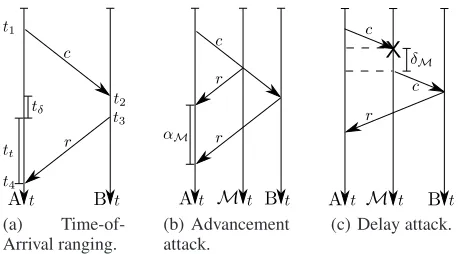
To determine their mutual distance,AandBrun a rang-ing protocol. A conventional non-secure rangrang-ing protocol, in which deviceAwants to measure the distance to the de-viceB operates as follows (Figure 1(a)). To measure the distance,Astarts a local clock at timet1and sends a chal-lengectoB;ccontains the IDs ofAandB, and the ranging command. Upon receipt ofc, B starts a local high preci-sion clock att2and prepares a reply messager, which con-tains both IDs, the response command, and the the process-ing timetδ =t3−t2between receipt ofcand transmission ofratt3. WhenAgetsratt4, it will stop its local clock to obtain the total runtime of the exchangett =t4−t1. Ais then able to compute the propagation time of one signal by subtracting the local processing time ofB and dividing by two,tp = tt−2tδ. Multiplyingtpwith the propagation speed
v(approximately speed of light) yields the distance between AandB:dAB=tpv.
(a)
Time-of-Arrival ranging.
(b) Advancement attack.
(c) Delay attack.
Figure 1: (a) A simple ranging protocol: A sendsc, B
replies withraftertδ. (b) The guessing-based advance-ment attack: The attackerMinterceptscsent fromAto
B.Mnow guessesrand replies earlier toA. The round trip time will beαMshorter than the expected
propaga-tion times. (c) The message delay attack: The attacker
M intercepts a message (e.g. c sent fromAtoB) and replays itδMtime later. B’s reply will then arrive later
than expected atA.
2.2
Attacker Model
We adopt the following attacker model, which we will use throughout the paper. The goal of the attackerMis to de-lay or advance the delivery of messages. This attack can be useful in protocols in which the exact time of arrival is used to measure distances (e.g. secure ranging protocols) or to synchronize clocks. We assume thatMcannot obtain the secret key shared betweenAandB. We do not specifi-cally address side-channel information leaks in the analysis; trusted devices are assumed not to leak information. Finally, we consider the cryptographic primitives being used in this work to be secure, e.g. no attacks better than brute force exist to decrypt without the correct key, and the attacker is computationally bounded.
2.3
Attacks on Distance Measurement
Protocols
Message advancement attackscan be easily performed on the distance measurement protocol that is described in Sec-tion 2.1 if the reply messageris known to the attacker be-fore the sender transmits it. If this is the case, in order to advance the message, the attacker simply needs to transmit it before the sender does (Figure 1(b)), and then jam the senders’ message if the receiver is in the power range of the sender. If the sender and the receiver are not in each others’ range, the attacker does not need to jam the sender’s mes-sage since the mesmes-sage would never reach the destination. It might seem odd that the sender would try to send a mes-sage to the receiver if it does not know whether the receiver is in its range. However, the sender might believe that the receiver is in its range, while it is not, if the attacker created a wormhole between the two devices [15] and uses it to con-trol the communication between the two devices. Another way to perform a message advancement attack is to speed up the transmission time of the message; this is not possible if the messages are transmitted using radio signals and travel at the speed of light.
The key to preventing message advancement attacks is to make bothcandrat least partially unpredictable for the at-tacker. An example would be the inclusion of previously shared noncesNcandNrin bothcandrfor authentication. In such an authenticated scenario, the attacker has to guess the nonce to correctly advance eithercorr, which she can do with a chance of2−|Nc|and2−|Nr|, respectively. The
authenticated ranging protocol in [41] is based on this ap-proach.
Message delay attackscan be considered in two scenarios. In the first one, the communicating parties are in each oth-ers’ range. In the second scenario, they are not (but e.g., believe that they are, as a result of a wormhole attack). The latter scenario is the most favorable for the attacker in the sense that she can simply record the message from one de-vice and relay it with a delay to the other node. As we show later on, this attack can be prevented using secure rang-ing protocols, which will enable the devices to measure an upper-bound on their mutual distance and deduce if they are in each others’ range. This attack as well as the notions of communication and physical neighborhood were previously discussed in [23]. The message delay attack is illustrated in Figure 1(c). To the best of our knowledge, except for the protocol that we propose in this work, there are no existing protocols that can successfully detect or prevent message de-lay attacks on ranging protocols.
3.
SECURE RANGING
Until now, the goal of secure ranging protocols [6, 41] was to provide a secure upper distance bound between the mutu-ally trusted verifier and prover. This is achieved by measur-ing the round trip time of challenges sent by one of the nodes and the corresponding replies by the other node. These
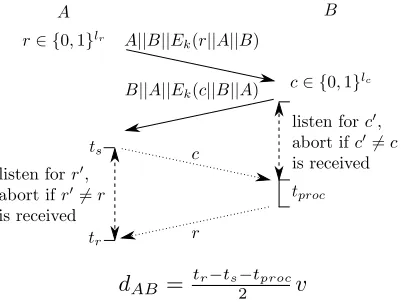
pro-Figure 2: The Delay Evident Secure Ranging protocol: in the initialization phase, A sends a fresh nonce r to
B, encrypted using a shared key k. B replies with an encrypted fresh nonce c. To transmit the subsequent messages candr, Aand B use our special modulation scheme as explained in Section 3.2. In the ranging phase,
Bstarts listening on the channel, recording the first (even incomplete) messagec′ it receives. Asendscand starts itself listening for any replyr′. Upon reception ofc′ =c,
B sends the replyrafter a constant delaytproc. IfA re-ceivesr′ = r, it computes the distance dAB toB. The protocol was successful iffc′ =c,r′ =r, anddAB ≤the communication range ofAandB.
tocols prevent an attacker from reducing the measured dis-tance by relying on authentication of the ranging challenges and replies, but not from increasing the distance using mes-sage delays. In this section, we will present a Delay Evident Secure Ranging (DESR) protocol, which allows the devices to measure securely both the lower- and the upper-bound of their mutual distance. This protocol therefore enables the devices to measure securely their physical distances. This protocol can serve as a basis for secure localization and can equally be adapted for precise secure time synchronization (see Section 5).
Our protocol is shown in Figure 2, it consists of two phases: the initialization phase and the measurement phase.
3.1
Initialization Phase
During the initialization phase, deviceAcontacts device B in order to initiate secure ranging. Here, we assume that AandB share a secret key, which they use to authenticate and encrypt their communication when needed.
Using this key, A generates and encrypts a nonce r of lengthlrand sends it toB.Breplies toAwith a fresh nonce
cof lengthlc, again encrypted usingk. Both nonces are used to ensure message freshness in the following ranging phase.
3.2
Ranging Phase
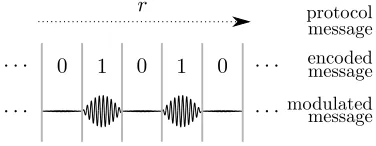
length and106symbols per second on devices like [33]). To send a binary sequence, for every One, a pulse is sent, and for every Zero no pulse is sent. To detect the message, the re-ceiver will integrate signals in the communication frequency band over a time window with length equal to the pulse rate. If the total energy in this integration window is above a cer-tain threshold, the signal is decoded as one, otherwise as zero. This threshold depends only on the expected signal strength of the UWB pulses used to communicate and not on the noise level on the channel. On-Off keying schemes are commonly being used in existing Ultra-Wide-Band ranging devices, which also provide the nanosecond precision, that is required by RF-ranging protocols [33]. To protect against delay attacks on our system, the receiver of a message does not only attempt to detect correct packets on the channel, but also incomplete messages, single pulses and any sig-nals within its operating frequency band, regardless of their shape. For this, the receiver of a message in the ranging phase will listen for the message continuously, until either (1) the expected message was successfully received, or (2) any other sequence of pulses was detected.
We will now explain the ranging phase step-by-step:
1. In the initialization phase,Asends its initial message toB.Bresponds toA, and starts listening on the chan-nel immediately afterwards, awaiting the challengec fromA.
2. A sends c using our modulation scheme and starts a local high precision clock.
3. Immediately after sendingc,Aalso starts to listen on the channel itself forr.
4. Breceivesc′
5. If c′ = c,B replies withr after tproc, otherwiseB aborts the protocol.
6. Areceivesr′and stops its local clock.
7. Ifr′ =r,Acomputes the round trip time passed
be-tween the transmission of c and the reception of r. Based on this time, the distance betweenAandBcan be computed. If this distance is smaller than the max-imal (conservative) communication range ofAandB, both parties consider the distance measurement suc-cessful.
8. In any other case,AandBconsider this distance mea-surement as failed.
In detail, the distance between both parties can be com-puted as dAB =
tr−ts−tproc
2 ·v, wherets andtr are the sending time ofcand the reception time ofr, respectively; tproc is the constant or known processing time at B andv is the constant propagation time of radio signals (approxi-mately the speed of light). Only if the measured distance dABis less than the maximum communication range of both
Figure 3: The challenges and replies in the secure rang-ing protocol are transmitted usrang-ing a variant of on-off keying.
parties, will they accept the result, otherwise they will either restart the protocol or assume the presence of an attacker. If the ranging phase was aborted during its execution, both par-ties can agree to repeat it using a new challengecand reply r, or simply assume the presence of an attacker and abort the protocol.
4.
SECURITY ANALYSIS
In this section, we analyze the security of our protocol. In particular, we will discuss attacks aiming to delay the chal-lenge or response on the channel. We will show that mes-sage advancement attacks on our protocol are prevented us-ing cryptographic primitives and that message delay attacks are effectively prevented due to the message encoding and modulation used to transmit protocol messages. Some of these attacks were already discussed in other contexts [39, 1, 2]. We will also show how the prerequisite of the commu-nicating partner’s proximity (presence in each others’ range) is verified in our protocol.
This analysis uses the attacker model as defined in Sec-tion 2.2. In particular, the goal of the attacker is to shorten or lengthen the measured distance betweenAandB.
4.1
Message Advancement
We will now show how we can ensure that neither the challenge nor the reply message can be advanced by the at-tacker. Given thatAandB are mutually trusted, the mes-sages have not been sent too early by the devices. To advance the challenge or reply on the channel, the attacker could try to guess the content of the messages, and send the message earlier. Therefore, advancing either the challenge or the re-ply by guessing can be done with probability2−|c|and2−|r|,
respectively. In the case the message was guessed correctly, we assume that the erasure of the following original message is automatically successful for the attacker, if this should be necessary.
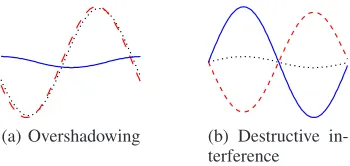
(a) Overshadowing (b) Destructive in-terference
Figure 4: (a) Overshadowing of two sine waves: the orig-inal signal (solid blue) is overshadowed by another sig-nal (dashed red) with different phase. At the receiver, the original message looks like noise on a strong signal (dotted black). (b) Destructive interference of two sine waves: the original signal (solid blue) is superposed by an echo signal (dashed red), shifted byπradians and 90% of its amplitude. The resulting received signal is attenuated to 10% of the original signal (dotted black).
faster.
4.2
Message Delay
We will now show how we can ensure that thec andr have not been delayed on the channel on the way from the sender to the receiver. This analysis is valid only ifAandB are in each other’s communication range (see Section 4.3); if they are not, the protocol is aborted. This proximity forces the attacker to prevent the reception of the original message at the receiver in order to replay it later for a delay attack.
We will now discuss different methods to prevent the re-ception of the original message, and conclude with a discus-sion of message manipulation attacks.
4.2.1
Effects of Noisy Jamming and Overshadowing
A simple attack to prevent a receiver from hearing a mes-sage on the channel is to send a second, stronger signal. This stronger signal will add to the legitimate signal from the original sender and overshadow it (Figure 4(a)). The con-tent of the added signal can range from random noise in the target band to fully modulated and coded messages. Typical radio hardware will drop malformed messages and ignore messages which are not intended for that recipient, higher level protocols will therefore not be able to detect this attack but will decode the message contained in the stronger signal. In our protocol, using the proposed on/off keying based modulation scheme, an attack using high levels of noise or other signals can be trivially detected. This follows from the observation that such a jamming attack will lead to con-stant high signal values, which will be decoded as ones at the receiver. Therefore, the data content of the message is changed, which will be detected. This forces the attacker to perform more subtle jamming attacks, such as signal anni-hilation, which will be discussed in Section 4.2.2. For this reason, we will only consider these more advanced jamming attacks in the remainder of the paper.
The same is true for na¨ıve overshadowing attacks, in which the attacker simply replays the original message with a small delay and at a higher gain is shown in Figure 5. In our
mod-Figure 5: Naive overshadowing attacks: The upper sig-nals are 10011010 encoded using On-Off Keying. An at-tacker trying to replay this message while it is still be-ing transmitted will cause a collision, yieldbe-ing an invalid message.
ulation scheme, this attempt will result in a decoding error at the receiver. Therefore, the attacker has to erase the signals for the original message first in order to replay the original message, just like in the jamming case as discussed above.
4.2.2
Signal Annihilation
A more subtle attack is to prevent the reception of the orig-inal message is to construct an annihilation (canceling) sig-nal based on destructive sigsig-nal interference. This is a well-known problem in communications and it sometimes occurs unintentionally in multipath environments [24]: objects in the environment of the sender or receiver reflect radio waves, which in effect add as correlated noise to the received signal. Due to the increased propagation path, a phase shift of the original signal occurs. In some cases, this will lead to a seri-ous signal degradation at the receiver, e.g. if the phase shift is around 180 degrees orπradians, the reflected signal will superimpose the original signal and significantly attenuate the strength of the original signal (Figure 4(b)).
Following the same principle, the attacker can artificially create such interference to attenuate or erase signals from the channel at the receiver’s location. In our security model, we consider a strong attacker who is always able to erase signals from the channel, if she knows or can predict these signals in advance. Nevertheless, in the case of our DESR proto-col, bothc andrare nonces unknown to the attacker. We will now discuss in more detail attacks attempting to erase unknown messages from the channel, and why we consider them infeasible.
To erase a message of unknown content, in addition to matching the signal baseband’s frequency and phase, most important the destructive signal sent by the attacker has to match the carrier’s frequency and phase. This can be done in two ways: by analyzing the received signal and sending out an own countersignal (demodulating attacker), or by sim-ply delaying and re-sending the received signal (repeating attacker). We will now discuss each of these and then dis-cuss the impact of the attacker’s position.
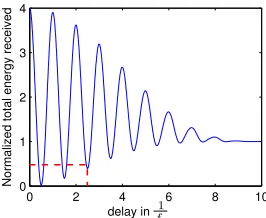
0 2 4 6 8 10 0
1 2 3 4
Normalized total energy received
delay in
Figure 6: Remaining energy at the receiver in a destruc-tive interference attack: if the original signal is replayed with the correct delay, the signal at the receiver is atten-uated. To achieve an attenuation to less than 50% of the original received squared signal strength, the delay can be maximal a quarter of the symbol duration, which is equivalent to 2.5 carrier frequency periods in this exam-ple.
before it is completely transmitted, and then start a corre-sponding counter signal to prevent the remaining part from arriving at the receiver. Assuming that the attacker’s goal is to attenuate the signal by at least 50%, she will have at most half of the symbol’s duration to demodulate the incom-ing signal and start her own transmission. This assumes that the attacker is positioned colinear with both sender and re-ceiver. We will discuss the influence of non-optimal posi-tioning later.
Repeating attacker: Another attack is the following: the at-tackerMpicks up all signals in the target band of the chan-nel and replays them with a certain delay. In order to max-imise the attenuation, this delay can be either half the wave-lengthλcof the carrier, or(n+ 0.5)λc, n∈N, if the attacker is positioned colinear with the sender and the receiver. If the attacker is not colinear with the sender and the receiver, the additional propagation delay of the cancelling signal has to be taken into account. We have simulated such signal cancel-lations and found that the maximum delay available toMin this scenario is approximately a quarter of the symbol length dp. This result can be obtained by computing the total en-ergy of the original and cancelling signal with respect to the phase shift, Figure 6 shows an example of such a result for a baseband wavelengthλb= 2000and a carrier wavelength
λc = 100. In this case, a maximal phase shift of25% sym-bol length will still attenuate the total signal power to 40%, any more delay will leave more than 50% of the energy on the channel.
Attacker’s Position: In the case thatMis not colinear with AandB, the signals by the attacker will be delayed addi-tionally . This delay is directly reducing the attacker’s time to react to a signal on the channel. For both demodulating and replaying attackers, the following inequality must hold:
dAM+dMB
v +δ≤ dAB
v +δmax
In this inequality,vis the signal propagation speed,dABis
the distance betweenAandB, andδis the attacker’s pro-cessing time to react to the signal. The maximal process-ing delay depends on the target attenuation and the attacker type, e.g. 50% attenuation by a demodulating attacker yields δmax=
dp
2, while for a repeating attackerδmax≈ dp
4 (dpis the length of the symbol).
Even if we assume an ideal attacker withδ = 0, the at-tacker is still restricted to an area very close to the signal path. For example, ifdp= 2ns, then the following has to be true for the attacker’s location:
dAM+dMB ≤dAB+ 15cm
Summary on message erasure: We conclude from our anal-ysis that the erasure of signals predictable for the attacker is possible using the methods discussed. Nevertheless, these attacks are much more difficult if the signals cannot be pre-dicted reliably, especially if only short symbols are used in the communication. Therefore, to be able to attack our se-cure ranging system, the attacker has to guess the content of c orrin advance in order to successfully erase them, with the chance of a successful guess as discussed in Section 4.1. Only then, the attacker will be able to match the legitimate signal’s carrier frequency and phase.
4.3
Communication Proximity Verification
As mentioned in Section 4.2, in order to make sure that the signals between them were not delayed, the devices need to be able to verify if they reside in each others’ direct commu-nication range. Only in this scenario unsuccessful message erasures at the destination will be detected at the receiver. We will now explain why the attacker cannot convince the devices that they are in direct communication range, if they are not. If both parties are not in direct communication range and the signals are instead forwarded by M, she will be able to delay the communication, and thus enlarge the mea-sured distance. However, the attacker is not able to reduce the measured distance. It therefore suffices that the devices compare their measured distance to their nominal commu-nications range. Note that the devices are mutually trusted and can thus share information about their radio antennas etc., based on which they can estimate their mutual commu-nications range. Only if the result of the range measurement shows that both devices can directly communicate, the re-sult of the protocol will be used, and then the parties will be sure that the measured distance is their exact distance, and was not enlarged by the attacker. Notice that the protection against distance shortening attack (message advancement) does not rely on the devices being in each others’ ranges.4.4
Replay Attacks
correctc to initiate the ranging. Likewise,Mcannot im-personateB by replaying a previous response to the initial-ization message, becauseMdoes not know the currentrto reply in the ranging phase.
4.5
Discussion on Modulation and Other
Physical Layer Attacks
The modulation scheme we proposed in Section 3.2 was chosen because it resembles UWB based on-off keying al-ready used in the context of insecure range measurements [33]. Therefore, our proposed changes do not require fundamental changes to the radio hardware. We expect that other modu-lation schemes can be found which would also be suited for a secure ranging system. The only basic requirement for such a modulation scheme is the prevention of full message erasure by the attacker. In particular, the area of jamming resistant communication promises to provide such solutions. Several of the attacks proposed on wireless distance mea-surements so far assume an untrusted, potentially malicious prover. In [7], guessing-based early-reply attacks are dis-cussed in which the malicious prover tries to reply prema-turely to challenges by the verifier, or starts sending the pream-ble before the complete challenge has been received. Both attacks are not applicable in our scenario, in which we trust the prover to behave correctly. In addition, our use of very short UWB signals mitigates the impact of single symbol advancement attacks by a third party. As the typical gain of these attacks is a fraction of the symbol length, in our case this attack would have a maximal gain in the order of a few nanoseconds.
4.6
Analysis Summary
As detailed in Section 2, the only chance for an attacker to delay a message unknown to the attacker is to erase it from the channel using destructive interference and to replay it later. According to our earlier analysis in Section 4.2.2, this erasure will only be successful with a probability of2−lc and2−lr, respectively, because the whole message has to be guessed correctly to erase it. Furthermore, if the attacker plans to only modify the content of a message unpredictable to her in advance, e.g. by using signal superposition, this problem is as hard as message erasure (which is, in fact, a modification of all Ones in the original message to Zero).
In summary, we can conclude that the attacker has at best a chance of2−min(lc,lr)to manipulate the outcome of a single round of ranging.
5.
MESSAGE TEMPORAL INTEGRITY
Unlike data communication systems, localization and rang-ing systems are focused on time measurements, not on data exchange. Ranging systems base their operation primarily on the measurements of the propagation of signals (i.e., on signal time-of-flight). To operate in adversarial settings, lo-calization and ranging protocols therefore require that both the data integrity and physical characteristics such as thetemporal integrity of their protocol messages (signals) are protected [16, 41]. Although the notion of time is impor-tant and can be crucial in a number of other, more tradi-tional security protocols (e.g., authentication and key estab-lishment [5]), what is particular to localization and ranging protocols, is the requirement that the attacker cannot ma-nipulate the message reception time. Whereas many secu-rity protocols can tolerate arbitrary message delays, and are proven to be secure against such attacks under the Dolev-Yao model [8], ranging protocols cannot tolerate message delays. If the attacker introduces a one nanosecond delay in the de-livery of a message, this delay will change the measured dis-tance by 30 cm. Due to the impordis-tance of device locations when nanosecond message delay attacks are considered, the detection of these attacks requires a more complex approach than the detection of longer delays (≥µseconds).
In this section we generalize the solution proposed in Sec-tion 3 and define the noSec-tion ofMessage Temporal Integrity. We say that the temporal integrity of the message exchanged between two parties is preserved, if the message is neither advanced nor delayed in its transmission over the commu-nication channel. Existing research has addressed message temporal integrity only partially. In recent years a number of protocols were proposed that only protect the commu-nication against message advancement attacks [15, 28, 29, 41]; however, there are no solutions in the open literature that fully protect the communication from message delay attacks. The solutions proposed so far enable detection of message delay attacks only if those delays are long (these solutions were discussed in the context of time synchroniza-tion in [10, 19, 34]). However, until now no solusynchroniza-tions exist that enable the detection of delay attacks if those delays are in the order of nanoseconds.
5.1
Message Temporal Integrity
We define Message Temporal Integrity more precisely as follows.
DEFINITION 1. The temporal integrity of a message m
sent at timetsis entirely preserved iff its propagation time
t′
p=t′r−tsfrom the sender to the receiver is equal, within
a specified accuracy, to the propagation timetp=tr−tsof
the same message, if the message would be sent at the same timets, and would propagate from the sender to the receiver
unaffected by the adversary. Here,tris the time at which the
message arrives at the receiver.
This definition states that if the message temporal integrity is preserved, the message propagated on the channel unaf-fected by the attacker; i.e., the attacker did neither advance nor delay the message. Following Definition 1, we further define two additional notions: Upper-Bound and Lower-Bound Message Temporal Integrity. These notions are defined in the same way as Message Temporal Integrity, except that the condition thatt′p=tpin Definition 1 is modified, in the case of Upper-Bound Message Temporal Integrity tot′p≥tp, and in the case of Lower-Bound Temporal Integrity tot′
This simply means that the Upper-Bound Message Tempo-ral Integrity is preserved if the message is not advanced, but could have been delayed. Similarly, the Lower-Bound Mes-sage Temporal Integrity is preserved if the mesMes-sage is not de-layed but could have been advanced. Examples of protocols that achieve Upper-Bound Temporal Integrity are existing secure ranging [41, 3] and distance-bounding protocols [6, 7, 11, 22, 32, 36, 25, 21, 40], which prevent the attacker from advancing the message by simply making the message unpredictable for the attacker. However, in those protocols the attacker can delay the message once it has been transmit-ted.
The verification of the message temporal integrity assumes that the communicating devices are able to accurately mea-sure propagation times of the messages that they exchange. However, these propagation times are very short, usually in the order of nanoseconds (e.g., if the devices are 100m dis-tant, the propagation time of the message between the sender and the receiver will be approx.330ns). Today, a number of devices, mainly those designed for ranging and localiza-tion applicalocaliza-tions, are able to measure message (signal) ar-rival times with such precision; examples include devices that use Ultra-Wide-Band radios [33]. However, in a number of other platforms (e.g., those based on 802.11 standards), the applications do not have access to precise signal acqui-sition times, and they cannot measure the message propaga-tion times. Instead, these devices will be only able to mea-sure the time interval that passed from the time at which the operating system handed the message to the sender’s radio, till the time at which the receiver’s radio passed the mes-sage to the receiver’s operating system. We call this time interval the message transmission time and we denote it by tt. For 802.11 based platforms,ttis usually in the order of microseconds.
Given this, we refine our definition of message tempo-ral integrity and we introduce a notion of aLoose and Tight Message Temporal Integrity, respectively. We say that the message temporal integrity is tight, if it refers to the mes-sage propagation timetp. We say that the message temporal integrity is loose, if it refers to the message transmission time tt, which consists oftp and other contributing factors such as the medium based access and message transmission times. Tight and loose upper and lower bound message integrity is defined analogously.
5.2
Preserving Loose Message Temporal
Integrity
In this section we show how the devices can, using a sim-ple challenge-response protocol, verify the loose temporal integrity of their messages. This can be achieved by a challenge-response protocol that we show in Figure 7; this protocol is a variant of the protocol proposed in the context of secure time synchronization in [10, 19, 34]. The protocol enables the deviceAto verify the loose temporal integrity of the mes-sagemsent from another entityB. This is achieved by the
Figure 7: The Loose Message Temporal Integrity Proto-col:Arequests a loose temporal integrity verifiable mes-sage fromBby sending a nonceNAand its name.Bthen replies with a MAC-secured message containing the data
m, the participating parties, the nonceNA, and the pro-cessing timet3−t2.Acan now verify if the transmission timet′
twas as expectedttwithµs precision.
following: (1) message advancement attacks are prevented by making parts of the exchanged messages unpredictable to the attacker; and (2) message delay attacks are detected by comparing the measured round-trip transmission timet′t with the expected round-trip transmission timett.
We assume that before the protocol execution, the parties share a secret key k. The protocol is started by A, which transmits a freshly generated nonce; this nonce is unpre-dictable for the attacker. Upon receiving the nonce,B com-putes a message authentication code (MAC) over this nonce and over the message that it intends to send, using the keyk, and transmits the computed MAC, along with the message back toA. Upon reception of the reply fromB,Ameasures the round-trip message transmission time(t2−t1)+(t4−t3), as a difference between the time at which it received the re-ply fromBand the time at which it transmittedNA. Based on this time, Acomputes the measured message transmis-sion timet′
t. Finally, to verify the temporal integrity ofm,
A verifies the received MAC, and compares the measured transmission timet′twith the expected (maximal) message transmission timett. Here,ttcan be generously defined, to allow for the measurement variability oft′
t. Ift′t ≤ tt, A concludes that the temporal integrity ofmwas not violated.
5.3
Problem Statement: Preserving Tight
Mes-sage Temporal Integrity
In the previous section, we showed that, using a simple protocol, devices can easily verify the loose temporal in-tegrity of the messages that they exchange. In this section, we show why a similar approach cannot be used to verify the tight message temporal integrity.
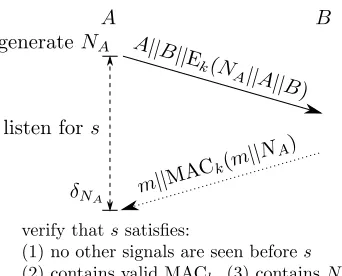
Figure 8: The Message Temporal Integrity Protocol: A
requests m, the message to be secured, by sending an encrypted nonceNA toB. After sending this request,
Astarts to listen to any signal son the channel. Upon reception of the nonce, B replies with a message con-structed usingNA, mand k. When A receives a mes-sages, she verifies the temporal integrity by checking the listed 5 conditions. In this check,tNA is the maxi-mum round trip time for the message exchange, andδNA the actual round trip time measured byA.
However, unlike in the case of message transmission time tt, which can be estimated independently of the distance be-tween the nodes, the expected message propagation timetp cannot be estimated without knowing the distance between the nodes. The reason for this is simple: the processing de-lays in the radios can makettat least an order of magnitude larger than the propagation time. The distance between the nodesdAB, which is directly proportional to the propagation time (dAB=v·t′p, wherevis the speed of light), therefore, for most considered distances (e.g.,≤100m) does not mat-ter in the measurement ofttandt′t. However,dABis crucial in the verification of the tight temporal integrity since it di-rectly determines the value oft′p.
This is why the LMTI protocol in Figure 7 cannot be used to verify the tight temporal integrity of the messages unless the distance between the communicating parties is known. However, in most scenarios, the tight temporal integrity of the messages is verified in order to secure ranging and lo-calization, where the goal of the application is to measure the distance between the nodes or their locations. The LMTI protocol therefore cannot be used in such applications.
In the remainder of this paper, we propose a protocol to verify the tight temporal integrity for messages between par-ties that do not know their mutual distance.
5.4
MTI Protocol Description
In this section, we propose our message temporal integrity protocol (MTIP). Using this protocol, the communicating parties can verify that all correctly received messages were neither advanced nor delayed by the attacker. We first present our protocol; we then analyze its security in detail.
The goal of our message temporal integrity protocol (MTIP)
is to verify the tight temporal integrity of a messagemsent fromBtoA. The protocol unfolds as follows (Figure 8):A requests a messagemfromB by transmitting a nonceNA encrypted with a shared keyk. Upon sending the nonce, Aactively listens on the channel for a predefined timetNA. If within that time,Adoes not receive the reply fromB, it aborts the protocol (or restarts it with a fresh nonce).
Upon receiving the nonce,Bsends back a reply contain-ing the same nonceNA, the messagemand a message au-thentication code (MAC) constructed usingkto protect mes-sage data integrity. Like the challenges and replies of the secure ranging protocol (DESR), this reply is specially en-coded on the physical layer using on-off keying.
Upon reception of this reply, A verifies that (1) during tNA and prior to the arrival of the message, there were no other signals (messages) on the channel, decodeable or gar-bled (2) the MAC corresponds to the message and toNA,(3) the transmission contains NAwhich corresponds with this protocol run, (4) the transmission was received beforetNA elapsed, and (5) A knows that it is in the power range of B. If all five conditions are met,Aconcludes that the tight temporal integrity ofmwas not violated.
The main intuition why the temporal integrity of the mes-sage can be verified is the same as in the secure ranging case (Section 4), and will be discussed in more detail in the fol-lowing security analysis.
The MTIP works under the assumption of presence aware-ness, that is, thatAwill accept thatB’s message preserved its temporal integrity only if it knows that during the proto-col execution,Awas inB’s power range. This condition can be validated right before the MTIP is run, by havingAand Brun a secure ranging protocol.
5.5
Security Analysis
We will now show that the proposed MTIP enables the verification of the tight message temporal integrity (upper and lower). In this analysis, we will use the attacker model defined in Section 2.2, and discuss lower and upper bound temporal integrity separately.
5.5.1
Upper Bound Message Temporal Integrity
Upper bound message temporal integrity guarantees that the messages have not been advanced on the communica-tion channel. In order to advance a message, the attacker Mneeds to know its content before it will be sent, which would enable her to send it earlier. In the context of our pro-tocol, this means that the attacker needs to guess either the nonceNA thatAwill send, and/or the MACk(m, NA)that
trustsB, it trusts that the message was sent at the expected time.
5.5.2
Lower Bound Message Temporal Integrity
We already argued about the protection against message delay in the case of unpredictable messages in Section 4. Messages with predictable content are assumed to be eas-ily delayable by the attacker in our attacker model. Unfor-tunately, even the prepending of predictable data to unpre-dictable data can weaken the security against delay attacks. Consider the following example: a nonceNAis appended to a messagemof content known to the attacker a priori, and the message is longer than the nonce (i.e.,|m|>|NA|). The receiver, however, has no way to verify the integrity ofm— it could be any data. This could be the case, for example, in a monitoring sensor network, in which a special sensor read-ing is caused inevitably by the attacker, who then wants to delay the reporting of this message. To delay the reporting message, the attacker can delete the message from the chan-nel, let the nonce pass unchanged and then transmit any data she wants followed by a replay of the nonce. In that case the message will appear in the following sequence to the re-ceiver: a||b||NA whereais the unchanged original nonce,
b is the data the attacker inserted and NA is the replayed nonce. Unless the receiver can detect that the message has changed, it will now believe that the temporal integrity of the message was not violated since the nonce is correct, when in fact the attacker delayed the transmission by up to the length of the original message|m|. This attack can be prevented in two ways: one is by transmitting the nonce before the mes-sage. In this case, the message data integrity is still not pre-served, but its temporal integrity is. The second possibility is to authenticate the message using a message authentication code. We chose to use the latter case in our MTIP, and will analyze it now in more detail.
To prevent the above mentioned attack, we protect the message integrity by appending a MAC. This MAC is com-puted by using the keyk, shared betweenAandB, and can-not be created for arbitrary messages by the attacker. There-fore, the data content of the shifted message must have the same data content of the original message, so that the at-tacker can re-use the original MAC. The atat-tacker can still easily erase the data partmfrom the channel, but hiding the original MAC in the data section would require the compu-tation of a new MAC for the changed data section – which is considered infeasible (as it requires guessing the MAC with a chance of2−|MAC|). The other alternative is the attempt
to change the MAC into the corresponding bits of data. But as the attacker does not know the MAC in advance, she es-sentially has to guess it in order to flip the right bits, with the same chances of success as before. We therefore conclude that the attackers chances are2−|MAC|to delay or erase the
original message if a MAC is used, even if the content ofm is known to the attacker in advance.
6.
RELATED WORK
The problem of message temporal integrity is closely re-lated to the problem of (secure) time synchronization, which has been studied in detail in the context of wireless net-works [10, 9, 38, 19, 20, 26, 31, 34].
Related research has also been done in the context of pro-tocols that upper bound the message round-trip time in rang-ing applications. Upper boundrang-ing of the round-trip time also gives an upper bound on the distance between the nodes — this family of protocols are therefore known as distance bounding protocols [6, 7, 11, 22, 32, 36, 25, 21, 40]. How-ever, these protocols allow only to verify an upper bound to an untrusted prover, but do not address distance enlargement attacks. Distance bounding protocols represent a subset of secure localization protocols [43, 28, 30, 14, 27, 18, 37]. Distance bounding protocols are attractive because they do not need dedicated positioning hardware but instead rely on nano-second precision of the radio to localize.
To ensure message temporal integrity with nano-second granularity in this work, we make use of the properties of on-off keying. On-off keying was first put in the context of secure communication in [39] where it was used for broad-cast authentication. In this work, we make use of on-off keying to achieve temporal integrity by making sure that an external attacker cannot erase legitimate transmissions from the channel and therefore is unable to violate the temporal integrity of the transmitted messages.
To the best of our knowledge, there are no solutions in the open literature that propose a ranging protocol that enables the detection of message delay (and thus also distance en-largement) attacks. One solution that detects range enlarge-ment attacks was proposed in [41] in the context of secure localization; however, that solution assumes that the location of a device (and thus the distances to the device) are verified by an infrastructure of at least three verifiers.
7.
CONCLUSION
In this paper, we discussed the problem of message ad-vancement and delay attacks on wireless communication chan-nels. Starting with well-known secure ranging protocols, we showed how to achieve protection not only against message advancement attacks but also against message delay attacks. The resulting new secure ranging protocol enables not only secure computation of an upper bound on the distance be-tween two trusted parties but also the secure computation of the actual distance between the devices.
We further introduced notions of Loose and Tight Mes-sage Temporal Integrity, new message properties that de-fine message temporal manipulations. We proposed and an-alyzed protocols that achieve message temporal integrity.
8.
REFERENCES
[1] David Adamy.EW 101: A First Course in Electronic Warfare. Artech House, February 2001.
[2] David Adamy.EW 102: A Second Course in Electronic Warfare. Artech House, August 2004. [3] A. Alkassar and C. Stuble. Towards secure IFF:
preventing mafia fraud attacks. InProceedings of MILCOM, 2002.
[4] Ljubica Blazevic, Jean-Yves Le Boudec, and Silvia Giordano. A location-based routing method for mobile ad hoc networks.IEEE Transactions on Mobile Computing, 4(2), 2005.
[5] Colin Boyd and Anish Mathuria. Protocols for authentication and key establishment, 2003.
[6] Stefan Brands and David Chaum. Distance-bounding protocols. InProceedings of EUROCRYPT, 1994. [7] Jolyon Clulow, Gerhard P. Hancke, Markus G. Kuhn,
and Tyler Moore. So near and yet so far:
Distance-bounding attacks in wireless networks. In
Proceedings of ESAS, 2006.
[8] D Dolev and A.C. Yao. On the security of public key protocols. InProceedings of the IEEE 22nd Annual Symposium on Foundations of Computer Science, 1981.
[9] J. Elson, L. Girod, and D. Estrin. Fine-grained network time synchronization using reference broadcasts.SIGOPS Operating System Review, 2002. [10] Saurabh Ganeriwal, Srdjan ˇCapkun, Chih-Chieh Han, and Mani B. Srivastava. Secure time synchronization service for sensor networks. InWiSe ’05: Proceedings of the 4th ACM workshop on Wireless security, 2005. [11] Gerhard P. Hancke and Markus G. Kuhn. An RFID
Distance Bounding Protocol. InProceedings of IEEE SecureComm, 2005.
[12] M. Hazas and A. Ward. A novel broadband ultrasonic location system. InProceedings of Ubicomp,
September 2002.
[13] J. Hightower and G. Borriello. A survey and taxonomy of location systems for ubiquitous computing, 2001. [14] Lingxuan Hu and David Evans. Localization for
mobile sensor networks. InProceedings of ACM/IEEE MobiCom, September 2004.
[15] Yoh-Chun Hu, Adrian Perrig, and David B. Johnson. Packet leashes: a defense against wormhole attacks in wireless networks. InProceedings of IEEE InfoCom, 2003.
[16] Loukas Lazos and Radha Poovendran. Serloc: secure range-independent localization for wireless sensor networks. InProceedings of ACM WiSe, 2004. [17] Loukas Lazos, Radha Poovendran, and Srdjan
ˇ
Capkun. Rope: robust position estimation in wireless sensor networks. InProceedings of IPSN, 2005. [18] Donggang Liu, Peng Ning, An Liu, Cliff Wang, and
Wenliang Du. Attack-resistant location estimation in wireless sensor networks. InACM Transactions on Information and System Security, 2008.
[19] M. Manzo, T. Roosta, and S. Sastry. Time
synchronization attacks in sensor networks. InProc. of the ACM Workshop on Security of Ad Hoc and Sensor Networks, 2005.
[20] M. Maroti, B. Kusy, G. Simon, and A. Ledeczi. The flooding time synchronization protocol. In
Proceedings of ACM SenSys, 2004.
[21] Catherine Meadows, Paul Syverson, and LiWu Chang. Towards more efficient distance bounding protocols for use in sensor networks. InProceedings of IEEE SecureComm, 2006.
[22] Jorge Munilla, Andres Ortiz, and Alberto Peinado. Distance bounding protocols with void-challenges for RFID. Printed handout at RFIDSec, July 2006. [23] Panos Papadimitratos, Marcin Poturalski, Patrick
Schaller, Pascal Lafourcade, David Basin, Srdjan ˇ
Capkun, and Jean-Pierre Hubaux. Secure
neighborhood discovery: A fundamental element for mobile ad hoc networking.IEEE Communications Magazine, 2008.
[24] Theodore Rappaport.Wireless Communications: Principles and Practice. 2001.
[25] Kasper Bonne Rasmussen and Srdjan ˇCapkun. Location privacy of distance bounding protocols. In
Proceedings of ACM CCS, 2008.
[26] Kasper Bonne Rasmussen, Srdjan ˇCapkun, and Mario ˇ
Cagalj. Secnav: secure broadcast localization and time synchronization in wireless networks. InProceedings of ACM/IEEE MobiCom, 2007.
[27] T. Ristenpart, G. Maganis, A. Krishnamurthy, and T. Kohno. Privacy-preserving location tracking of lost or stolen devices: Cryptographic techniques and replacing trusted third parties with DHTs. In
Proceedings of Usenix Security, July 2008.
[28] Naveen Sastry, Umesh Shankar, and David Wagner. Secure verification of location claims. InProceedings of ACM WiSe, 2003.
[29] Sarah Sedihpour, Srdjan ˇCapkun, Saurabh Ganeriwal, and Mani Srivastava. Implementation of Attacks on Ultrasonic Ranging Systems, demo at ACM SENSYS’05, 2005.
[30] Vitaly Shmatikov and Ming-Hsiu Wang. Secure verification of location claims with simultaneous distance modification. InIn Proc. of 12th Annual Asian Computing Science Conference (ASIAN), December 2007.
[31] M. Sichitiu and C. Veerarittiphan. Simple, accurate time synchronization for wireless sensor networks. In
Proc. of the IEEE Wireless Communications and Networking Conference, 2003.
[32] Dave Singel´ee and Bart Preneel. Distance Bounding in Noisy Environments. InProceedings of ESAS, 2007. [33] Multispectral Solutions. UPS (Urban positioning
system).
[34] Kun Sun, Peng Ning, and Cliff Wang. Tinysersync: secure and resilient time synchronization in wireless sensor networks. InProceedings of ACM CCS, 2006. [35] Nils Ole Tippenhauer, Kasper Bonne Rasmussen,
Christina P¨opper, and Srdjan ˇCapkun. Attacks on public wlan-based positioning. InProceedings of ACM MobiSys, 2009.
[36] Nils Ole Tippenhauer and Srdjan ˇCapkun. Id-based secure distance bounding and localization. In
Proceedings of the European Symposium on Research in Computer Security, 2009.
[37] Patrick Traynor, Joshua Schiffman, Thomas La Porta, Patrick McDaniel, Abhrajit Ghosh, and Farooq Anjum. Constructing secure localization systems with adjustable granularity. Technical Report
NAS-TR-0084-2007, December 2007.
[38] J. van Greunen and J. Rabaey. Lightweight time synchronization for sensor networks. InProceedings of the 2nd ACM international conference on Wireless sensor networks and applications, 2003.
[39] Mario ˇCagalj, Srdjan ˇCapkun, Ramkumar
Rengaswamy, Ilias Tsigkogiannis, Mani Srivastava, and Jean-Pierre Hubaux. Integrity (i) codes: Message integrity protection and authentication over insecure channels. InProceedings of the IEEE Symposium on Research in Security and Privacy, 2006.
[40] Srdjan ˇCapkun, Levent´e Buttyan, and Jean-Pierre Hubaux. Sector: Secure tracking of node encounters in multi-hop wireless networks. InProceedings of ACM SASN, 2003.
[41] Srdjan ˇCapkun and Jean-Pierre Hubaux. Secure positioning in wireless networks.IEEE Journal on Selected Areas in Communications, 2006.
[42] J. S. Warner and R. G. Johnston. Think GPS cargo tracking = high security? think again.Technical report, Los Alamos National Laboratory, 2003. [43] Brent R. Waters and Edward W. Felten. Secure,