Asynchronous Distributed Private-Key Generators for
Identity-Based Cryptography
Aniket Kate Ian Goldberg
David R. Cheriton School of Computer Science University of Waterloo
Waterloo, ON, Canada N2L 3G1 {akate,iang}@cs.uwaterloo.ca
June 29, 2010
Abstract
An identity-based encryption (IBE) scheme can greatly reduce the complexity of sending encrypted messages over the Internet. However, an IBE scheme necessarily requires a private-key generator (PKG), which can create private keys for clients, and so can passively eavesdrop on all encrypted communica-tions. Although a distributed PKG has been suggested as a way to mitigate this problem for Boneh and Franklin’s IBE scheme, the security of this distributed protocol has not been proven and the proposed so-lution does not work over the asynchronous Internet. Further, a distributed PKG has not been considered for any other IBE scheme.
In this paper, we design distributed PKG setup and private key extraction protocols in an asyn-chronous communication model for three important IBE schemes; namely, Boneh and Franklin’s IBE, Sakai and Kasahara’s IBE, and Boneh and Boyen’s BB1-IBE. We give special attention to the applica-bility of our protocols to all possible types of bilinear pairings and prove their IND-ID-CCA security in the random oracle model. Finally, we also perform a comparative analysis of these protocols and present recommendations for their use.
1
Introduction
In 1984, Shamir [60] introduced the notion of identity-based cryptography (IBC) as an approach to simplify public-key and certificate management in a public-key infrastructure (PKI) and presented an open problem to provide an identity-based encryption (IBE) scheme. After seventeen years, Boneh and Franklin [10] proposed the first practical and secure IBE scheme (BF-IBE) using bilinear maps. After this seminal work, in the last few years, significant progress has been made in IBC (for details, refer a recent book on IBC [41] and references therein).
Need for the Distributed PKG. Importantly, the amount of trust placed in the holder of an IBC master key is far greater than that placed in the holder of the private key of a certifying authority (CA) in a PKI. In a PKI, in order to attack a client, the CA has to actively generate a fake certificate for the client containing a fake public-key. In this case, it is often possible for the client to detect and prove the malicious behaviour of the CA. The CA cannot perform any passive attack; specifically, it cannot decrypt a message encrypted for the client using a client-generated public key and it cannot sign some document for the client, if the verifier gets a correct certificate from the client. On the other hand, in IBC,
• knowing the master key, the PKG can decrypt or sign the messages for any client, without any active attack and consequent detection (key escrow),
• the PKG can make clients’ private keys public without any possible detection, and
• in a validity period-based key revocation system [10], bringing down the PKG is sufficient to bring the system to a complete halt (single point of failure), once the current validity period ends.
Therefore, the PKG in IBC needs to be far more trusted than the CA in a PKI. This has been considered as a reason for the slow adoption of IBC schemes outside of closed organizational settings.
Boneh and Franklin [10] suggest distributing a PKG in their BF-IBE scheme to solve these problems. In an(n, t)-distributed PKG, the master key is distributed amongnPKG nodes such that a set of nodes of size tor smaller cannot compute the master key, while a client extracts her private key by obtaining private-key shares from anyt+ 1or more nodes; she can then use the system’s public key to verify the correctness of her thus-extracted key. Boneh and Franklin [10] proposeverifiable secret sharing (VSS) of the master key among multiple PKGs using Shamir secret sharing with adealer [59] to design a distributed PKG and also hint towards a completely distributed approach using the distributed (shared) key generation (DKG) schemes of Gennaro et al. [33]; however, they do not provide a security proof. Further, none of the IBE schemes defined after [10] consider the design of a distributed PKG.
From a practicality standpoint, the DKG schemes [33] suggested in [10] to design a distributed PKG are not advisable for use over the Internet. These DKG schemes are defined for thesynchronous communica-tion model, having bounded message delivery delays and processor speeds, and do not provide safety(the protocol does not fail or produce incorrect results) andliveness(the protocol eventually terminates) over the asynchronous Internet, having no bounds on message transfer delays or processor speeds.
As a whole, although various proposed practical applications using IBE, such as key distribution in ad-hoc networks [44], pairing-based onion routing [43] or verifiable random functions from identity-based key encapsulation [1], require a distributed PKG as a fundamental need, there is no distributed PKG available for use over the Internet yet. Defining efficient distributed PKGs for various IBE schemes which can correctly function over the Internet has been an open problem for some time. This practical need for distributed PKGs for IBC schemes that can function over the Internet forms the motivation of this work.
Contributions. We present asynchronous distributed PKGs for all three important IBE frameworks: namely, full-domain-hash IBEs, exponent-inversion IBEs and commutative-blinding IBEs [12]. We propose dis-tributed PKG setups and disdis-tributed private-key extraction protocols for Boneh and Franklin’s BF-IBE [10], Sakai and Kasahara’s SK-IBE [56], and Boneh and Boyen’s (modified) BB1-IBE [13, 12] schemes for use
We prove adaptive chosen ciphertext security (IND-ID-CCA) security of the defined three schemes in the random oracle model. Interestingly, compared to the security proofs for the respective IBE schemes with a single PKG, there are no additional security reduction factors in our proofs, even though the underlying DKG protocol used in the distributed PKGs does not provide a guarantee about the uniform randomness for the generated master secrets. To the best of our knowledge, there is no threshold cryptographic protocol available in the literature where a similar tight security reduction has been proven while using a DKG without the (more expensive) uniform randomness property.
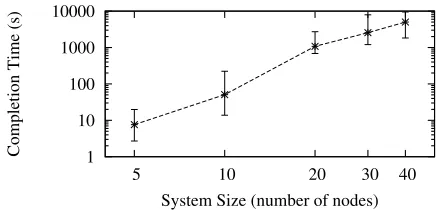
Observing that a distributed (shared) key generator (DKG) is the single most important component of distributed PKG, we implement a recently devised asynchronous DKG protocol [42] and demonstrate its efficiency and reliability with extensive testing over the PlanetLab platform [54]. Finally, using operation counts, key sizes, and possible pairing types, we compare the performance of the distributed PKGs we define and also briefly discuss the proactive security and group modification primitives for them.
In §2, we compare various techniques suggested to solve the key escrow and single point of failure problems in IBC. We also discuss previous work related to DKG protocols. In§3, we describe a realistic asynchronous system model over the Internet and justify the choices made, while we define and describe cryptographic tools in our model in§4. With this background, in§5, we define and prove distributed PKG protocols for the BF-IBE, SK-IBE and BB1-IBE schemes. We then implement a practical DKG protocol,
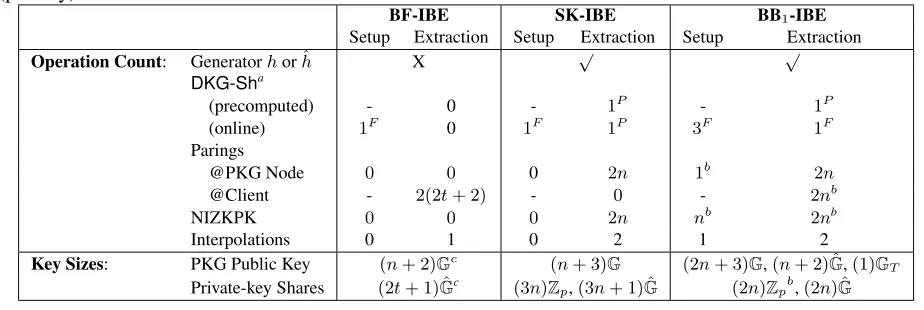
and test its performance over the PlanetLab platform in §6. We also compare the IBE schemes based on their distributed PKGs and touch upon proactive security and group modification protocols for the system.
2
Related Work
We divide the related work into two parts. Distributed (shared) key generation is the most important com-ponent for distributed private-key generation in identity-based cryptography. We first discuss the existing work towards distributed key generation. As designing distributed PKGs is our main goal in this work, we concentrate on protocols in computational (as opposed to unconditional / information-theoretic) settings. Although somewhat ignored, there have been some efforts to mitigate the single point of failure and the key escrow issues in IBC systems; in the latter part of this section, we compare these alternatives with distributed PKG.
Although we are defining protocols for IBE schemes, as we are concentrating on distributed crypto-graphic protocols and due to space constraints, we do not include a comprehensive account of IBE here. We refer readers to [12] for a detailed discussion on the various IBE schemes and frameworks defined in the literature. Pursuant to this survey, we work in the random oracle model for efficiency and practicality reasons.
Pedersen [53] introduced the concept of distributed key generation and developed a DKG, where each node runs a variation of Feldman’s VSS and distributed shares are added at the end to generate a combined shared secret without a dealer. Gennaro et al. [33] presented a simplification using just the original Feldman VSS called the Joint Feldman DKG (JF-DKG). Further, they found that DKGs based on the Feldman VSS (or using Feldman commitments [25]) do not guarantee uniformly random secret keys and define a new DKG combining Feldman and Pedersen commitments [53] which increases thelatency(number of communication rounds) by one. However, in [34], they observed that DKGs based on Feldman commitments produce hard instances of discrete logarithm problems (DLPs), which may be sufficient for the security of some threshold cryptographic schemes.
To the best of our knowledge, the first DKG scheme in an asynchronous setting was only defined recently by Kate and Goldberg [42]. This protocol modifies the AVSS protocol to a more realistic hybrid model and performs leader-based agreement with a leader-changing mechanism to decide which of the nodes’ VSS will be included in the DKG calculation; that is, whereas in synchronous DKG schemes such as Pedersen’s above, all of the successful VSSs can be added at the end of the protocol to determine the final master key shares, in the asynchronous setting, some global consensus must be reached in order to find a sufficiently large set of VSSs which all honest nodes have completed. We implement this DKG protocol and verify its efficiency and reliability. Consequently, this DKG system forms the basis of our distributed PKG protocols. The original asynchronous DKG protocol uses Feldman commitments and consequently does not guarantee uniform randomness of the key. However, we observe that, in the random oracle model, using non-interactive zero-knowledge proofs of knowledge based on the Fiat-Shamir methodology [26], if required, it is possible to achieve uniform randomness in their scheme. In such a scheme, Feldman commitments are initially replaced by Pedersen commitments; the Feldman commitments are introduced only at the end of the protocol to obtain the required private key. The zero-knowledge proofs are used to show that the Feldman and Pedersen commitments both commit to the same values.
All of the above schemes are proved secure only against a static adversary, which can only choose itst compromisable nodes before a protocol run. They are not considered secure against an adaptive adversary because their simulation-based security proofs do not go through when the adversary can corrupt nodes adaptively.[35, §4.4] Feldman claimed [25,§9.3] that his VSS protocol is also secure against adaptive ad-versaries even though his simulation-based security proof did not work out. Canetti et al. [16] presented a scheme provably secure against adaptive adversaries with at least two more communication rounds as com-pared to JF-DKG and with interactive zero-knowledge proofs. Due to the inefficiency of adaptive (provably) secure DKG protocols, we stick to protocols provably secure only against a static adversary, though they have remained unattacked by an adaptive adversary for the last22years.
Alternatives to a Distributed PKG. None of the IBE schemes except BF-IBE considered distributed PKG setup and key extraction protocols in their design. Recently, Geisler and Smart [32] defined a distributed PKG for Sakai and Kasahara’s SK-IBE [56]; however, their solution against a Byzantine adversary has an exponential communication complexity and a formal security proof is also not provided. We overcome both of these barriers in our distributed PKG for SK-IBE: our scheme is secure against a Byzantine adversary and has the same polynomial-time communication complexity as their scheme, which is secure only against an honest-but-curious adversary; we also provide a formal security proof.
is impossible to stop a dealer’s active attacks without completely distributed master-key generation. Further, as private-key extractions are less frequent than encryptions, it is certainly advisable to use more efficient options during encryption rather than private-key extraction. Finally, with the requirement of online access to the receiver’s public key, CL-PKC becomes ineffective for systems without continuous network access, where IBC is considered to be an important tool. Lee et al. [46] and Gangishetti et al. [31] propose variants of the distributed PKG involving a more trustworthy key generation centre (KGC) and other key privacy au-thorities (KPAs). As observed by Chunxiang et al. [23] for [46], these approaches are, in general, vulnerable to passive attack by the KGC. In addition, the trust guarantees required by a KGC can be unattainable in practice. Goyal [37] reduces the required trust in the PKG by restricting its ability to distribute a client’s pri-vate key. This does not solve the problem of single point of failure. Further, the PKG in his system still can decrypt the clients’ messages passively, which leaves a secure and practical implementation of distributed PKGs wanting.
Threshold versions of signature schemes obtained from some IBE schemes using the Naor transform have been proposed and proved previously [8, 61]. However, these solutions do not work for the corre-sponding IBE scheme. This is due to the inherent secret nature of a client’s private keys and correcorre-sponding shares as compared to the inherent public nature of signatures and corresponding signature shares. While designing IBE schemes with a distributed PKG, we have to make sure that a PKG node cannot derive more information than the private-key share it generates for a client and that private-key shares are not available in public as commitments.
3
System Model and Assumptions
In this section, we briefly discuss the assumptions and the system model for our distributed PKG system, giving special attention to its practicality over the Internet. We follow the system model of [42], which closely depicts the Internet, and as their DKG forms the basis of our distributed PKGs.
3.1 Communication Model
In the theoretical sense, distributed protocols designed with a synchronous or a partially synchronous (bounded message delivery delays and processor speeds, but the bounds are unknown and eventual [24]) communication assumption tend to be more efficient in terms of latency and message complexity than their counterparts designed with an asynchronous communication assumption. However, protocols defined in the synchronous or partially synchronous communication model invariably use some time bounds in their definition. An adversary, knowing those bounds, may slow down the protocol by appropriately delaying its messages, which makes deciding the time bounds correctly a difficult problem to solve. On the other hand, protocols defined for the asynchronous communication model use only numbers and types of messages and guarantee to finish quickly with only honest nodes communicating promptly. Therefore, we assume an asynchronous communication model.
that network faults are eventually repaired and DoS attacks eventually stop, this assumption is valid in practice. We further discuss this assumption in§6.1.
3.2 Hybrid Adversary Model
Instead of using a standard t-Byzantine adversary in a system withnnodesP1, P2, . . . , Pn, we use a hy-bridadversary introduced in [3], having anotherf non-Byzantine crashes, and modified in [42] to include network link failures.
For the standardt-Byzantine adversary,tnodes compromised or crashed by the adversary remain com-promised forever. This does not depict the adversary model over the Internet accurately. Along with arbitrary behaviour bytByzantine nodes, some nodes can just crash silently without showing malicious behaviour or just get disconnected from the system due to network failure or partitioning. As the adversary does not capture thesefnodes or their secret parameters, it is not computationally and communicationally optimal to consider these nodes as Byzantine. It also gives rise to a sub-optimal resilience ofn≥3(t+f) + 1instead of then≥3t+ 2f + 1bound effected by treating crashes and link failures separately from the Byzantine adversary.
In this hybrid adversary model, crashes and link failures belong to the same set of f nodes, as from a perspective of any other node of the system a crashed node behaves exactly same as a node whose link with it is broken. We recover secrets at these f nodes immediately after their trusted rebooting, which gives us the assumption that all non-Byzantine nodes may crash and recover repeatedly with a maximumf crashed nodes at any instant. If two nodes cannot communicate, then we treat at least one of two nodes as being either Byzantine or one of the currently crashed nodes. That is, following the standard asynchronous communication model literature, we assume that the adversary controls the network, but faithfully delivers all the messages between two honest uncrashed nodes.
3.3 Cryptographic Background
Bilinear Pairings. IBC extensively utilizes bilinear pairings over elliptic curves. For three cyclic groups
G,Gˆ, andGT (all of which we shall write multiplicatively) of the same prime orderp, abilinear pairinge
is a mape:G×Gˆ →GT with following properties.
• Bilinearity:Forg∈G,gˆ∈Gˆ anda, b∈Zp,e(ga,gˆb) =e(g,gˆ)ab.
• Non-degeneracy:The map does not send all pairs inG×Gˆ to unity inGT.
If there is an efficient algorithm to compute e(g,gˆ) for any g ∈ G and gˆ ∈ Gˆ, the pairing e is called
admissible. We also expect that it is not feasible to invert a pairing and come back toGorGˆ. All pairings
considered in this paper are admissible and infeasible to invert. We call such groups Gand Gˆ
pairing-friendlygroups. We refer readers to [6, Chap. IX and X] for a detailed mathematical discussion of bilinear pairings.
Following [29], we consider three types of pairings for prime order groups: namely, type1,2, and3. In type1pairings, an isomorphismφ: ˆG→Gas well as its inverseφ−1 are efficiently computable. These are
also calledsymmetric pairings as for such pairingse(g,gˆ) = e(φ(ˆg), φ−1(g))for any g ∈ Gand ˆg ∈ Gˆ,
and we usually just identify Gwith Gˆ in this case. In type 2pairings, only the isomorphism φ, but not
φ−1, is efficiently computable. Finally intype3pairings, neither ofφnorφ−1 can be efficiently computed.
Cryptographic Assumptions. As mentioned in§2, for efficiency reasons, we assume the random oracle framework. Further, our adversary is computationally bounded with a security parameterκ. We assume an instance of a pairing infrastructure of multiplicative groupsG,Gˆ andGT, whose common orderpis aκ-bit
prime. For commitments and proofs of knowledge, we use thediscrete logarithm (DLog) [49, Chap. 3] assumption.
We assume an instance of a pairing infrastructure of multiplicative groupsG,Gˆ andGT, whose common
orderpis such that the adversary has to perform2κ operations to break the system. For the security of the IBE schemes, we use thebilinear Diffie-Hellman(BDH) [38] andbilinear Diffie-Hellman inversion(BDHI) [50, 9] assumptions. Here, we recall the definitions of generic versions (for asymmetric pairings) of these two assumptions from [12]. Note that a functionǫ(·)is callednegligible if for allc > 0there exists aκ0
such thatǫ(κ)<1/κcfor allκ > κ
0.
BDH Assumption: Given a tuple (g,g, gˆ a,gˆa, gb,gˆc) in a bilinear group G = he,G,Gˆ,GTi, the BDH
problem is a problem to computee(g,gˆ)abc. The BDH assumption then states that it is infeasible to solve a random instance of the BDH problem, with non-negligible probability, in time polynomial in the size of the problem instance description.
BDHI Assumption: Given two tuples (g, gx, g(x2), . . . , g(xq)) and (ˆg,gˆx,gˆ(x2), . . . ,ˆg(xq)) in a bilinear groupG =he,G,Gˆ,GTi, theq-BDHI problem is a problem to computee(g,gˆ)1/x. The BDHI assumption
for some polynomially bounded q states that it is infeasible to solve a random instance of the q-BDHI problem, with non-negligible probability, in time polynomial in the size of the problem instance description.
4
Cryptographic Tools
In this section, we describe important cryptographic tools required to design distributed PKGs in the hybrid model having an asynchronous network ofn ≥ 3t+ 2f + 1 nodes with at-limited Byzantine adversary and f-limited crashes and network failures. Note that these tools are also useful in other asynchronous computational multiparty settings.
4.1 Homomorphic Commitments overZp
A verification mechanism for a consistent dealing is fundamental to VSS. It is achieved using distributed computing techniques in the unconditional setting. In the computational setting,homomorphic commitments provide an efficient alternative. LetC(α,[r])∈Gbe a homomorphic commitment toα∈Zp, whereris an
optional randomness parameter andGis a (multiplicative) group. For such a homomorphic commitment,
givenC1 =C(α1,[r1])andC2=C(α2,[r2]), we haveC1·C2 =C(α1+α2,[r]).
VSS protocols utilize two forms of commitments. Let gandh be two random generators ofG.
Feld-man, for his VSS protocol [25], used a commitment scheme of the formChgi(α) =gα with computational security under the DLog assumption and unconditional share integrity. Pedersen [53] presented another commitment of the formChg,hi(α, r) =gαhr with unconditional security but computational integrity under
theDLogassumption. In PKC based on computational assumptions, with adversarial access to the public key, unconditional security of the secret (private key or master key) is impossible. Further, in VSS schemes based on Pedersen commitments, in order to randomly select the generatorh, an additional round of com-munication is required during bootstrapping. Consequently, in our scheme, we use simple and efficient Feldman commitments, except during a special case described in the DKG discussion below.
commitment vectorCh(gs)i= [gs, gϕ(1),· · · , gϕ(n)]whereϕis a randomly selected polynomial of degreetover
Zpwithϕ(0) =s. Similarly, thePedersen commitment vectorC(s,s′)
hg,hi = [gshs
′
, gϕ(1)hψ(1),· · · , gϕ(n)hψ(n)]
whereϕis as above, andψis similar, but withψ(0) =s′. Thejthelement of a Feldman commitment vector
(counting from0) will be denoted by
Ch(gs)i
j (and similarly for Pedersen commitment vectors).
4.2 Non-interactive Proofs of Knowledge
As we assume the random oracle model in this paper, we can use non-interactive zero-knowledge proofs of knowledge (NIZKPK) based on the Fiat-Shamir methodology [26]. In particular, we use a variant of NIZKPK of a discrete logarithm and one for proof of equality of two discrete logarithms.
We employ a variant of NIZKPK of a discrete logarithm where given a Feldman commitment Chgi(s)
and a Pedersen commitment Chg,hi(s, r) for s, r ∈ Zp, a prover proves that she knowss and r such that Chgi(s) = gs and Chg,hi(s, r) = gshr. That is, the prover proves that the Feldman commitment and the Pedersen commitment are to the same values. We denote this proof as
NIZKPK≡Com(s, r,Chgi(s),Chg,hi(s, r)) =π≡Com∈Z3p. (1)
We describe it in detail in Appendix A; it is nearly equivalent to proving knowledge of two discrete loga-rithms separately.
We also use another NIZKPK (proof of equality) of discrete logarithms [20] such that given two Feldman commitmentsChgi(s) =gsandChhi(s) =hs, a prover proves equality of the associated discrete logarithms. We denote this proof as
NIZKPK≡DLog(s,Chgi(s),Chhi(s)) =π≡DLog ∈Z2p. (2)
and refer readers to Appendix A for details. Note thatgandhcan belong two different groups of the same order.
There exists an easier way to prove this equality of discrete logarithms if a pairing between the groups generated bygandhis available. Using a technique due to Joux and Nguyen [40] to solve theDDHproblem over pairing-friendly groups, givengx and hx′ the verifier checks ife(g, hx′) =? e(gx, h). However, when using a type3pairing, in the absence of an efficient isomorphism betweenGandGˆ, if bothgandhbelong
to the same group (sayGwithout loss of generality), then the pairing-based verification scheme does not
work. In such a situation, the above NIZKPK provides a less efficient but completely practical alternative.
4.3 DKG overZp
In an(n, t)-DKGprotocol overZp, a set ofnnodes generates an elements∈Zpin a distributed fashion with
its sharessi ∈Zpspread over thennodes such that any subset of size greater than a thresholdtcan reveal or use the shared secret, while smaller subsets cannot. A DKG protocol consists of asharing(DKG-Sh) phase and a reconstruction (DKG-Rec) phase. In theDKG-Sh phase, a distributed secret s ∈ Zp is generated
among nnodes such that each nodePi holds a sharesi and a commitment vector C(s) ofsand all of its shares. During the DKG-Rec phase, each node Pi reveals its share si and reconstructs s using verified revealed shares.
Definition 4.1. For our hybrid model having an asynchronous network ofn ≥ 3t+ 2f + 1nodes with a
Liveness: Once protocol DKG-Sh starts, all honest finally up nodes complete the protocol, except with negligible probability.
Agreement: If some honest node completes protocolDKG-Sh then, except with negligible probability, all honest finally up nodes will eventually complete protocolDKG-Sh.
Correctness: Once an honest node completes protocol DKG-Sh then there exists a fixed value s ∈ Zp
such that, if an honest nodePireconstructszi ∈Zp duringDKG-Rec, thenzi =s.
Secrecy: If no honest node has started protocol DKG-Rec then, except with negligible probability, an adversary cannot compute the shared secrets.
We assume that messages from all the honest and uncrashed nodes are delivered by the adversary.
A closer look at the secrecy property suggests that in the presence of an adversary, the shared secret in the above DKG may not beuniformlyrandom; this is a direct effect of using only Feldman commitments.[35, §3] However, in many cases, we do not need a uniformly random secret key; the security of these schemes relies on the assumption that the adversary cannot compute the secret. Most of the schemes in this paper similarly only require the assumption that it is infeasible to compute the secret given public parameters and we stick with Feldman commitments those cases. However, we do indeed need a uniformly random shared secret in few protocols In that case, we use Pedersen commitments, but we do not employ the methodology defined by Gennaro et al. [35], which increases the latency in the system. We observe instead that with the random oracle assumption at our disposal, the communicationally demanding technique by Gennaro et al. can be replaced with the much simpler computational non-interactive zero-knowledge proof of equality of committed values NIZKPK≡Comdescribed in Eq. 1.
We represent DKG protocols using Feldman commitments and Pedersen commitments as DKGFeld
andDKGPed respectively. For nodePi, the correspondingDKG-ShandDKG-Recschemes are defined as follows.
Ch(g,hs,s′i),[Ch(gs)i,NIZKPK≡Com], si, s′i
= DKG-ShPed(n, t, f,˜t, g, h, αi, α′i) (3)
Ch(gs)i, si
= DKG-ShFeld(n, t, f,˜t, g, αi) (4)
s = DKG-RecPed(t,Ch(g,hs,s′i), si, s′i) (5)
s = DKG-RecFeld(t,Ch(gsi), si) (6)
Here,˜tis the number of VSS instances to be chosen (t <˜t≤2t+ 1),g, h∈Gare commitment generators,
αi, α′i ∈Zp are respectively a secret and randomness shared byPi, andC(hgs)iandC(s,s ′)
hg,hi are respectively the
Feldman and Pedersen commitment vectors described in§4.1. The optional NIZKPK≡Com is a vector of zero-knowledge proofs of knowledge that the corresponding entries ofCh(gs)i andCh(g,hs,s′i) commit to the same values. (The polynomialϕfor the two types of commitments will be the same in this case.) The liveness and agreement proofs ofDKG-ShPed are the same as those ofDKG-ShFeld. In Appendix B, we prove the
correctness and secrecy properties ofDKG-ShPed.
The worst-case message and communication complexities of protocolDKG-Sh[42] areO(tdn2(n+d))
andO(κtdn3(n+d))respectively, while those of protocolDKG-RecareO(n2)andO(κn2)respectively. Here, the functiond(·)bounds the number of crashes that the adversary is allowed to perform.
Distributed Random Sharing over Zp. This protocol generates shares of a secret z chosen jointly at
with Feldman or Pedersen commitments asDKG-Sh(n, t, f,˜t=t+ 1, g,[h], ri,[ri′])where the generatorh and randomnessr′
i are only required if Pedersen commitments are used. Liveness, agreement, correctness, secrecy and message and communication complexities remain the same as those of theDKG-Shprotocol. We represent the corresponding protocols as follows:
Ch(gzi), zi
= RandomFeld(n, t, f, g) (7)
Ch(g,hz,z′i),[Ch(gzi),NIZKPK≡Com], zi, zi′
= RandomPed(n, t, f, g, h). (8)
4.4 Distributed Addition overZp
Let α, β ∈ Zp be two secrets shared among n nodes using the DKG-Sh protocol. Let polynomials
f(x), g(x) ∈ Zp[x] be the respectively associated degree-t polynomials and let c ∈ Zp be a non-zero
constant. Due to the linearity of Shamir’s secret sharing [59], a nodePiwith shares αi and βi can locally generate shares of α+β and cα by computing αi +βi and cαi, where f(x) +g(x) and cf(x) are the respective polynomials. f(x) +g(x) is random if either one off(x) org(x) is, and cf(x) is random if f(x)is. Commitment entries for the resultant shares respectively are Ch(gαi+β)
i =
Ch(gαi) i
Ch(gβi) i and
Ch(gcαi) i =
Ch(αgi)c i.
4.5 Distributed Multiplication overZp
Unlike addition, local distributed multiplication of two shared secrets α and β looks unlikely. We use a distributed multiplication protocol against a computational adversary by Gennaro et al. [36,§4]. However, instead of their interactive zero-knowledge proof, we utilize a pairing-based DDHproblem solving tech-nique [40] to verify the correctness of the product value shared by a node non-interactively. For shares αi and βi with Feldman commitments gαi and gˆβi, given a commitment gαiβi of the shared product, other nodes can verify its correctness by checking ife(gαi,ˆgβi)=? e(gαiβi,gˆ)provided the groups ofgandgˆare
pairing-friendly. We observe that it is also possible to perform this verification when one of the involved commitments is a Pedersen commitment. However, if both commitments are Pedersen commitments, then we have to compute Feldman commitments for one of the values and employ NIZKPK≡Com to prove its correctness in addition to using the pairing-based verification. In such a case, the choice between the latter technique and the non-interactive version of zero-knowledge proof suggested by Gennaro et al. [36] depends upon implementation efficiencies of the group operation and pairing computations.
In our IBC schemes, we always use the multiplication protocol with at least one Feldman commitment. We denote the multiplication protocol involving two Feldman commitments asMulFeld and the one
involv-ing a combination of the two types of commitments as MulPed. Liveness and agreement properties are
exactly the same as those ofDKG-Sh. For correctness, along with recoverability to a unique value (says), protocolMulalso requires thats=αβ. For secrecy, along with the secrecy ofαβuntilDKG-Recis started, the protocol should not provide any additional information about the individual values ofαorβonceαβis reconstructed.
Ch(gαβ∗i),(αβ)i
= MulFeld(n, t, f, g∗,Ch(gαi), αi
,C(hgβˆi), βi
) (9)
C(αβ,αβ′)
hˆg,ˆhi ,(αβ)i,(αβ ′)
i
= MulPed(n, t, f,g,ˆ ˆh,Ch(gαi), αi
,C(β,β′)
hg,ˆˆhi , βi, β ′ i
) (10)
ForMulFeld,g∗ =gorgˆ. ForMulPed, without loss of generality, we assume thatβis distributed with the Pedersen commitment. If insteadαuses Pedersen commitment, then the Pedersen commitment groups for
Briefly, the protocol works as follows. Every honest node runs theDKG-Sh(n, t, f,˜t = 2t+ 1,g,ˆ [ˆh], αiβi,[αiβi′])from Eq. 3 or 4. As discussed above, pairing-based DDH solving is used to verify that the shared value is equal to the product ofαiandβi.1 At the end of theDKG-Shprotocol, instead of adding the subshares of the selected VSS instances, every node interpolates them at index0to get the new share(αβ)i ofαβ.
Analysis. Here, we roughly prove the properties of protocolMul. This protocol is almost equivalent to the share renewal protocol in [42,§5.2] which is a slight modification of protocolDKG-Sh. The liveness and agreement proofs are exactly the same as those ofDKG-Sh[42,§4]. The basic correctness proof remains the same as that of the share renewal protocol [42,§5.2] except the starting polynomial is of degree2t+ 1
here. On the other hand, the pairing-based DDH problem solving technique assures that the value shared by a nodePi is equal to the product of its sharesαi andβi. The basic secrecy proof is same as that of the renewal protocol. Further, the adversary cannot determineαorβ even afterαβis reconstructed as the final shared polynomial forαβis independent of the shared polynomials forαandβindividually. The message and communication complexities are the same as those of the DKG protocol.
As the distributed addition can be performed locally, the aboveMulprotocols can be seamlessly extended for distributed computation of any expression having binary products. Forℓshared secretsx1, x2,· · ·, xℓ, and their corresponding Feldman commitments C(x1)
hgi ,C
(x2) hgi ,· · ·,C
(xℓ)
hgi , shares of any binary productx′ =
Pm
i=1kixaixbi with known constantskiand indicesai, bican be easily computed by extending the protocol
in Eq. 9. We denote this generalization as follows.
Ch(gx∗′)i, x′i
=MulBP(n, t, f, g∗,{(ki, ai, bi)},
C(x1) hgi ,(x1)i
, C(x2) hgi ,(x2)i
,· · · ,Ch(gxiℓ),(xℓ)i
) (11)
NodePj sharesPiki(xai)j(xai)j. For a type 1 pairing, verification of the correctness of the sharing is done
by other nodes as follows.
e(gPiki(xai)j(xbi)j, g)=? Y
i
e((g(xai)j)ki, g(xbi)j)
For type 2 and 3 pairings, NIZKPK≡DLog is used to provide Feldman commitments to the (xbi)j with
generator ˆg, and then a pairing computation like the above is used. We use the protocol in Eq. 11 during distributed private-key extraction in the Boneh and Boyen’s BB1-IBE scheme in§5.5.
4.6 Sharing the Inverse of a Shared Secret
Given an(n, t, f)-distributed secretα, computing shares of its inverseα−1 in distributed manner (without reconstructingα) can be done trivially but inefficiently using a distributed computation ofαp−1; this involves O(logp) distributed multiplications. However, using a technique by Bar-Ilan and Beaver [4], this can be done using just oneRandom, oneMuland oneDKG-Recprotocol.
This protocol involves aDKG-Recwhich outputs the product of the shared secretαwith a distributed random elementz. Ifzis created using Feldman commitments and is not uniformly random, the product αzmay leak some information aboutα. We avoid this by using Pedersen commitments while generatingz. We represent this protocol as follows:
Ch(gα∗−i1),(α−1)i
= Inverse(n, t, f,g,ˆ ˆh,Ch(gαi), αi
) (12)
Hereg∗belongs to any group of orderp. The liveness, agreement and secrecy properties of the protocol are
the same as those ofDKG-Shexcept secrecy is defined in the terms ofα−1instead ofα; for the correctness
1
property, along with recoverability to a unique value s, this protocol additionally mandates that s =α−1. For a distributed secret
Ch(gαi), αi
, protocolInverseworks as follows: every nodePi:
1. runs
C(z,z′)
hg,ˆˆhi, zi, z ′ i
=RandomPed(n, t, f,g,ˆ hˆ);
2. computes shares of (w, w′) = (αz, αz′) as
C(w,w′)
hg,ˆˆhi , wi, w ′ i
= MulPed(n, t, f,ˆg,h,ˆ Ch(gαi), αi
,
C(z,z′)
hg,ˆhˆi, zi, z ′ i
);
3. then sends(wi, w′i)to each node and reconstructs w = DKG-RecPed(t,C(w,w ′)
hˆg,ˆhi , wi, w ′
i). Ifw = 0, repeats the above two steps, else locally computes(α−1)
i=w−1zi;
4. finally, computes the commitmentCh(gα∗−i1) using w−1, C
(z,z′)
hˆg,ˆhi, and if required, any of the NIZKPK
techniques.
A modified form of this protocol is used in§5.4.
Analysis. This protocol is a combination of theRandomPed, MulPed and DKG-Rec protocols along with some local computations. Therefore, its liveness and agreement properties follow directly from the corresponding properties of protocolDKG. Uniqueness of the recovered value follows from the correctness property of protocolDKG, while its equality toα−1can be proven as follows: a share computed by a node Pi at the end of protocol Inverseis equal to zαzi, whereC
( z zα)
hg∗i is the associated commitment vector. When reconstructed, it providesα−1as follows:
DKG-RecFeld(t,C(
z zα)
hgi ,
zi
zα) =
1
zαDKG-RecFeld(t,C
(z)
hgi, zi) =
z zα =α
−1
Secrecy of protocol Inverse follows directly from secrecy of protocolsMul and DKG-ShPed. After the
reconstruction ofw=zα, the distributed uniformly random elementzandαremain private by the secrecy properties of protocolMul. As the final shares ofα−1 are generated using a local computation, there is no secrecy loss in the last step either. It has the same asymptotic message and communication complexities as those of protocolDKG-Sh.
5
Distributed PKG for IBE
We present and prove distributed PKG setup and private key extraction protocols for three IBE schemes: BF-IBE [10], SK-IBE [56], and modified BB1-IBE [12]. Each of these schemes represents a distinct
impor-tant category of an IBE classification defined by Boyen [11]. They respectively belong tofull-domain-hash IBE schemes,exponent-inversion IBE schemes, andcommutative-blindingIBE schemes. Note that the dis-tributed PKG architectures that we develop for each of the three schemes apply to every scheme in their respective categories. Our above choice of IBE schemes is influenced by a recent identity-based cryptogra-phy standard (IBCS) [13] and also a comparative study by Boyen [12], which finds the above three schemes to be the most practical IBE schemes in their respective categories. In his classification, Boyen [11] also in-cludes another category for quadratic-residuosity-based IBE schemes; however, none of the known schemes in this category are practical enough to consider here.
However, we recall the original encryption and decryption definitions for our proofs. We start by describing a bootstrapping procedure required by all IBE schemes.
5.1 Bootstrapping Procedure
Each of the IBE schemes under consideration here requires the following three bootstrapping steps.
1. Determine the node group sizen, the security thresholdtand the crashed-nodes thresholdf such that n≥3t+ 2f+ 1.
2. Choose the pairing type to be used and compute three groupsG,Gˆ, andGT of prime order psuch
that there exists a bilinear pairingeof the decided type withe:G×Gˆ → GT. The group orderpis
determined by the security parameterκ. We will write all of the groups multiplicatively.
3. Choose two generators g ∈ G and gˆ ∈ Gˆ required to generate public parameters as well as the
commitments. With a type1or2pairing, setg=φ(ˆg).
Any untrusted entity can perform these offline tasks. Honest DKG nodes can verify the correctness of the tuple (n, t, f) and confirm the group choicesG, Gˆ, and GT as the first step of their distributed PKG
setup. If unsatisfied, they may decline to proceed. We denote the generated bilinear pairing group as G=he,G,Gˆ,Gti.
5.2 Formal Security Model
An IBE scheme with an(n, t, f)-distributed PKG consists of the following components:
• Adistributed PKG setup protocolfor nodePi that takes the above bootstrapped parameters n,t,f, andGas input and outputs a sharesiof a shared master secretsand a corresponding public-key vector
Kpubof a master public key andnpublic-key shares.
• Adistributed key-extraction protocolfor nodePithat takes a client identityID, the public key vector
Kpub and the master-secret sharesi as input and outputs a verifiable private-key share(dID)i. The client computes the private keydIDafter verifying the received shares(dID)i.
• Anencryption algorithmthat takes a receiver identityID, the master public key and a plaintext mes-sageM as input and outputs a ciphertextC.
• Adecryption algorithmfor client with identityIDthat takes a ciphertextCand the private keydIDas input and outputs a plaintextM.
Note that the above distributed PKG setup protocol doesn’t require anydealerand that we mandate ver-ifiability for the private-key shares rather than obtaining robustness using error-correcting techniques. Dur-ing private-key extractions, we insist on minimal interaction between clients and PKG nodes—transferrDur-ing identity credentials from the client at the start and private-key shares from the nodes at the end.
To define security against an IND-ID-CCA attack, we consider the following game that a challenger plays against a polynomially boundedt-limited adversary.
to other n−t−f nodes that it runs. When the adversary modifies it choice of the crashed nodes, the challenger models the associated recoveries using the internal states computed during the protocol. Note that, for the simplicity and clarity of the protocols and the proofs, we ignore thesefcrashes in exposition of our distributed PKG setup and private-key extraction protocols.
At the end of the protocol execution, the adversary receives tshares of a shared master secret for itst nodes and a public key vectorKpub. The challenger knows the remaining n−tshares and can derive the master secret asn−t−f ≥t+ 1in any communication setting.
Phase 1: The adversary adaptively issues private-key extraction and decryption queries to the challenger. For a private-key extraction queryhIDi, the challenger simulates the distributed key extraction protocol for its n−t nodes and sends verifiable private-key shares for its n−t−f nodes. For a decryption query hID, Ci, the challenger decryptsCby generating the private keydIDor using the master secret.
Challenger: The adversary chooses two equal-length plaintextsM0 andM1, and a challenge identityIDch such that IDch does not appear in any private-key extraction query in Phase 1. The challenger chooses b∈R{0,1}and encryptsMbforIDchandKpub, and gives the ciphertextCchto the adversary.
Phase 2: The adversary adaptively issues more private-key extraction and decryption queries to the chal-lenger except for key extraction query forhIDchiand decryption queries forhIDch, Cchi.
Guess:Finally, the adversary outputs a guessb′∈ {0,1}and wins the game ifb=b′.
Security against IND-ID-CCA attacks means that, for any polynomially bounded adversary,b′ =bwith probability negligibly greater than1/2.
5.3 Boneh and Franklin’s BF-IBE
BF-IBE [10] belongs to the full-domain-hash IBE family. In a BF-IBE setup, a PKG generates a master keys ∈ Zp and an associated public keygs ∈ G, and derives private keys (d∈ Gˆ) for clients using their
well-known identities (ID) ands. A client with identity IDreceives the private key dID = (H1(ID))s =
hs
ID ∈Gˆ, whereH1:{0,1}∗ →Gˆ∗is a full-domain cryptographic hash function. (Gˆ∗denotes the set of all
elements inGˆ except the identity.) The security of BF-IBE is based on theBDHassumption.
Distributed PKG Setup. The distributed PKG setup involves generation of the system master key and the associated system public-key tuple in the(n, t)-distributed form amongnnodes. Each nodePi participates in a common DKG overZpto generate its sharesi∈Zpof the distributed master keys. The system
public-key tuple is of the formCh(gsi) = [gs, gs1,· · ·, gsn]. We obtain this using ourRandom
Feld protocol from Eq. 7 as
Ch(sg)i, si
= RandomFeld(n, t, g)
Private-key Extraction. After a successful setup, PKG nodes are ready to extract private keys for clients. As a client needst+ 1correct shares, it is sufficient for the client to contact any2t+ 1nodes (say setQ). The private-key extraction protocol works as follows.
1. Once a client with identityIDcontacts every node inQ, every honest nodePi ∈ Qverifies the client’s identity and returns a private-key sharehsi
ID ∈Gˆ over a secure and authenticated channel.
2. Upon receivingt+1valid shares, the client can construct her private keydIDasdID =
Q
Pi∈Q(h
si
ID)λi ∈
ˆ
G, where the Lagrange coefficientλi =Q
Pj∈Q\{i}
j j−i.
3. The client can verify the correctness of the computed private key dID by checking e(g, dID)
?
=
e(gs, h
e(g, hsi
ID)
?
= e(gsi, h
ID). An equality proves the correctness of the share, while an inequality indi-cates misbehaviour by the nodePi and its consequential removal fromQ.
In asymmetric pairings, elements ofGgenerally have a shorter representation than those ofGˆ.
There-fore, we put the more frequently accessed system public-key shares inG, while the occasionally transferred
client private-key shares belong toGˆ. This also leads to a reduction in the ciphertext size. However, for type
2pairings, an efficient hash-to-Gˆ is not available for the groupGˆ [29]; in that case we compute the system
public key shares inGˆ and use the more feasible groupGfor the private key shares.
Encryption and Decryption. Boneh and Franklin obtain an IND-ID-CCA secure IBE encryption proto-col (FullIdent) [10, §4.2] secure against the BDH assumption by applying the Fujisaki-Okamoto trans-formation [28] to their IND-ID-CPA secure scheme (BasicIdent). Along with H1 : {0,1}∗ → Gˆ∗,
this scheme uses three more random oracles: H2 : Gt → {0,1}ℓ, H3 : {0,1}ℓ × {0,1}ℓ → Zp, and
H4:{0,1}ℓ → {0,1}ℓ.
Encryption: To encrypt a message M of some fixed bit length ℓ for a receiver of identity ID, a sender chooses σ ∈R {0,1}ℓ, computes r = H3(σ, M) and hID = H1(ID), and sends C = (u, v, w) =
(gr, σ⊕H2(e(gs, hID)r), M ⊕H4(σ))to the receiver.
Decryption: To decrypt a ciphertext C = (u, v, w) using the private key dID, the receiver successively computesσ =v⊕H2(e(u, dID)),M =w⊕H4(σ), andr=H3(σ, M). Ifgr 6=u, then the receiver rejects
C, else it acceptsM as a valid message.
Proof of Security. We prove the IND-ID-CCA security of BF-IBE with the(n, t)-distributed PKG ((n, t)
-FullIdent) based on theBDHassumption in the random oracle model. Hereafter,qE,qDandqHi denote the
number of extraction, decryption and random oracleHiqueries respectively.
Theorem 5.1. LetH1,H2,H3andH4be random oracles. LetA1be an IND-ID-CCA adversary that has
advantageǫ1(κ)in running timet1(κ)against(n, t)-FullIdentmaking at mostqE,qD,qH1,qH2,qH3, and
qH4 queries. Then, there an algorithmBthat solves theBDHproblem inGwith advantage roughly equal to
ǫ1(κ)/(qH1qH2(qH3 +qH4))and running timeO(t1(κ), qE, qD, qH1, qH2, qH3, qH4).
For their proof, Boneh and Franklin define two additional public key encryption schemes: IND-CPA secure BFBasicPub[10, Sec. 4.1], and its IND-CCA secure versionBFBasicPubhy [10, Sec. 4.2]. We use distributed versions of these schemes:(n, t)-BFBasicPubhyand(n, t)-BFBasicPubrespectively. Both
(n, t)-BFBasicPubhy and(n, t)-BFBasicPubprotocols have three steps: keygen,encryptanddecrypt. We first define the protocol(n, t)-BFBasicPub:
keygen:Given a bilinear groupGfor a security parameterκ, a set ofnnodes runs the BF-IBE distributed PKG setup for threshold t (n ≥ 3t + 1) to generate individual private keys si and a public key tuple Ch(gs)i. nnodes also run protocol DKG-Shto generate ˆhID ∈R Gˆ. Assuming a random oracle
H2 : G → {0,1}ℓ, where ℓis the message length, the system public key ishG, g,g,ˆ Ch(gs)i,ˆhID, H2i.
Every node generates its private-key share(dID)i = ˆhsIDi corresponding to the system’s private key dID.
encrypt:To encryptM ∈ {0,1}ℓ, chooser ∈
RZ∗pand set the ciphertextC= (gr, M⊕H2(e(gs, hID)r)).
decrypt: To decrypt the ciphertext C = (u, v) using the private key shares (dID)i, compute and share
Protocol (n, t)-BFBasicPubhy only modifies theencrypt anddecrypt steps of the above protocol using the Fujisaki-Okamoto transformation [28], and random oracles H3 : {0,1}ℓ × {0,1}ℓ → Zp and H4 :
{0,1}ℓ→ {0,1}ℓ.
Boneh and Franklin prove the security of FullIdent in the following proof-sequence: FullIdent →
BFBasicPubhy → BFBasicPub → BDH. Galindo [30] corrects a flaw in their proof maintaining the same proof-sequence. We also follow the same proof-sequence through Lemmas 5.1, 5.2 and 5.3 to prove Theorem 5.1:
(n, t)-FullIdent→(n, t)-BFBasicPubhy →(n, t)-BFBasicPub→BDH.
Lemma 5.1. LetH1,H2,H3 and H4be random oracles. Let A1 be an IND-ID-CCA adversary that has
advantage ǫ(κ) in running timet(κ) against (n, t)-FullIdent. Suppose A1 makes at most qE, qD, qH1, qH2,qH3, andqH4 queries. Then there is an IND-CCA adversaryA2that has advantage at leastǫ(κ)/qH1
againstBFBasicPubhy. Its running time is at mostt(κ) +c(nqE+qD+qH
1)wherecis the average time
of exponentiation inGˆ.
Proof. (Outline) The game between the challenger and the adversaryA2starts with the challenger running
thekeygenstep of(n, t)-BFBasicPubhy.A2simultaneously starts adversaryA1and forwards all messages
from the challenger toA1 and vice versa. As a result, in this simulation game,tout ofnnodes are run by
A1, while the challenger runs the remaining n−tnodes. A2, however, knows all information gathered
byA1. At the end of the distributed PKG setup, along withA1’s public parameters, A2 also knows secret
sharessifor thetnodes run byA1. The rest of the game and the analysis remains the same as that of [30],
except during key extraction queries. Here, instead of a private keydID,A2has to providet+ 1private-key
shares toA1. This is, however, easily possible knowingA1’stsecret shares and the randomness used during
H1queries. Refer to [30,§3] for the rest of the proof.
Lemma 5.2(Fujisaki-Okamoto [28]). LetH3andH4be random oracles. LetA2be an IND-CCA adversary
that has advantageǫ2(κ)in running timet2(κ)against(n, t)-BFBasicPubhymaking at mostqD,qH3, and
qH4 queries. Then there is an IND-CPA adversary A3 that has advantage at least
1
2(qH3+qH4)[(ǫ2(κ) +
1)(1−2/p)qD−1]against(n, t)-BFBasicPub. Its running time is at mostt
2(κ) +O((qH3+qH4)ℓ), where
ℓis the message length.
Lemma 5.3. LetH2 be a random oracle. LetA3 be an IND-CPA adversary that has advantageǫ3(κ)in
running timet3(κ) against(n, t)-BFBasicPub making at mostqH2 queries. Then there is an algorithm
B that solves theBDHproblem in he,G,Gˆ,Gti with advantage at least 2ǫ3(κ)/qH
2 and a running time
O(t3(κ)).
Proof. AlgorithmBis given a random instance of theBDHproblemhg,g, gˆ a,gˆa, gb,gˆciin a bilinear group G. LetD=e(g,gˆ)abc∈G
tbe the solution to this problem. AlgorithmBfindsDby interacting withA3as
follows:
Setup: Bruns thekeygenstep of (n, t)-BFBasicPubusing theBDHinstance. LetPBad be the set oft parties corrupted or owned by A3. LetPGood be the set of remaining good parties which will be run by B. B wants to make sure that the challenge ga and gˆc are included respectively ings ∈ C(hgs)i and hˆID of
(n, t)-BFBasicPub. As in protocol DKG-Sh, the VSSs selection may not be under B’s control, B uses
(ga)µi and(ˆgc)µ′i forµi, µ′
i ∈RZ∗p as its contributions towards respectivelysandhˆIDinkeygenfor every Pi ∈PGood. More specifically, for everyPi ∈PGood,Bchoosesµi, µ′i ∈RZ∗pandsij, s′ij ∈RZpfor every
Pj ∈ PBad, wheresi,j and s′ij are subshares for Pj of VSSs run byPi. Although B does not know the
contributions µiaandµ′ic, it can provide consistent commitment vectorsC
(µia)
hgi andC
(µ′
ic)
hˆgi toA3 knowing
the exact contributionsνjandνj′ usingn−tsubshares obtained fromPj. Therefore, for any subset of VSSs
Q and Q′ chosen finally, s = aP
Pi∈QGoodµi +
P
Pj∈QBadνi and
ˆ
hID = ˆg cP
Pi∈Q′ Goodµ
′
i+
P
Pj∈Q′ Badν
′
i.
Note thatB knows ν = P
Pj∈QBadνi, ν
′ = P
Pj∈Q′Badν
′ i µ =
P
Pi∈QGoodµi and µ
′ = P
Pi∈Q′Goodµ
′ i. Letsi be the final share ofsfor each nodePi. Observe that the (unknown) associated private keydID =
ˆ
g(aµ+ν)(cµ′+ν′) = ˆgµµ′(ac)+µν′(a)+µ′ν(c)+νν′. B runs random oracle H
2 for A3 creating a list H2list of
hGt,{0,1}ℓi. An entryhxi, hiiindicates thathi =H2(xi). Finally, it is easy to see that this simulated view
ofA3is identically distributed as in a real execution ofkeygen.
The rest of the game and the analysis remains the same as that of [10, Lemma 4.3], except duringGuess
step. Here, instead of returningxifrom a random tuplehxi, hiifromH2listas answer to the BDH problem,
Breturns
xi
e(gb,gˆa)µν′
e(gb,ˆgc)µ′ν
e(gb,gˆ)νν′
(µµ′)−1
.
Here, ifxiis the correct choice, thenxi is equal toe(g,gˆ)abcµµ
′+abµν′+bcµ′ν+bνν′
instead ofe(g,ˆg)abc
in the original BF-IBE proof.
5.4 Sakai and Kasahara’s SK-IBE
SK-IBE [56] belongs to the exponent-inversion IBE family. The PKG setup here remains exactly same as BF-IBE and the PKG generates a master keys∈Zpand an associated public keygs ∈Gjust as in BF-IBE.
However, the key-extraction differs significantly. Here, a client with identity IDreceives the private key
dID = ˆg
1
s+H1′(ID) ∈Gˆ, whereH′
1 :{0,1}∗ →Zp. Chen and Cheng [21] prove the security of SK-IBE based on theBDHIassumption.
Distributed PKG Setup. The distributed PKG setup remains the exactly same as that of BF-IBE, where si∈Zpis the master-key share for nodePiandCh(gsi)= [gs, gs1,· · · , gsn]is the system public-key tuple.
Private-key Extraction. The private-key extraction for SK-IBE is not as straightforward as that for BF-IBE. We modify the Inverseprotocol described in §4.6; specifically, here a private-key extracting client receiveswi from the node in step 3 and instead of PKG nodes, theclient performs the interpolation step ofDKG-Rec. In step4, instead of publishing, PKG nodes forward ˆgzi and the associated NIZKPK
≡Com directly to the client, which computes gˆz and thend
ID = (ˆgz)w −1
. The reason behind this is to avoid possible key escrow if the node computes bothˆgz andw. Further, the nodes precompute another generator
ˆ
h∈Gˆ for Pedersen commitments usingC(r)
hˆgi, ri
=RandomFeld(n, t,ˆg), and setˆh=C(hgrˆ)i
0 = ˆg
r.
1. Once a client with identity IDcontacts all n nodes the system, every node Pi verifies the client’s identity, runsC(z,z′)
hˆg,ˆhi, zi, z ′ i
= RandomPed(n, t,g,ˆ ˆh) and computessID
i = si+H1′(ID)and for
0≤j≤n,
Ch(gsIDi ) j =
Ch(gs)i jg
H′
1(ID)=gsj+H1′(ID).
2. Pi performs
C(w,w′)
hˆg,ˆhi , wi, w ′ i
=MulPed(n, t,g,ˆ ˆh,Ch(gsIDi ), sID i
,C(z,z′)
hg,ˆhˆi, zi, z ′ i
), wherew=sIDz
= (s+H′
1(ID))zandw′ = (s+H1′(ID))z′and sends
C(w)
hˆg,ˆhi, wi
along with NIZKPK≡Com(wi, wi′,
Ch(gwˆi) i,
C(w,w′)
hˆg,ˆhi
i) to the client, which upon receivingt+ 1verifiably correct shares(wi) recon-structswusing Lagrange-interpolation. Ifw6= 0, then it computesw−1or else starts again from step
3. NodePisends
Ch(ˆgzi) i= ˆg
zialong with NIZKPK
≡Com(zi, zi′,
Ch(ˆgzi) i,
C(z,z′)
hˆg,ˆhi
i)to the client.
4. The client verifies
Ch(zˆgi)
iusing the received NIZKPK≡Com, Lagrange-interpolatest+ 1validˆg zito
computegˆzand derives her private key(ˆgz)w−1 = ˆg(s+H1(ID)).
This protocol can be used without any modification with any type of pairing. Further, online execution of theRandomPed computation can be eliminated using batch precomputation of distributed random elements
C(z,z′)
hg,ˆhˆi, zi, z ′ i
.
Encryption and Decryption. Chen and Cheng [21] define an IND-ID-CCA secure version of the SK-IBE scheme secure against the BDHIassumption. Here, the random oracleH1 in BF-IBE is replaced by
H1′ : {0,1}∗ → Zp. The other random oraclesH2, H3 and H4 remain the same. This scheme also uses
Fujisaki-Okamoto transformation [28] to achieve IND-ID-CCA security.
Encryption: To encrypt a message M of some fixed bit length ℓ for a receiver of identity ID, a sender chooses σ ∈R {0,1}ℓ, computes r = H3(σ, M) and hID = H1′(ID), and sends C = (u, v, w) =
((gsghID)r, σ⊕H
2(e(g,ˆg)r), M⊕H4(σ))to the receiver.
Decryption: To decrypt a ciphertext C = (u, v, w) using the private key dID, the receiver successively computesσ =v⊕H2(e(u, dID)),M =w⊕H4(σ), andr =H3(σ, M). If(gsghID)r 6=u, then the receiver
rejectsC, else it acceptsM as a valid message.
Proof of Security. The security of SK-IBE with a distributed PKG ((n, t)-SK-IBE) is based on theBDHI
assumption.
Theorem 5.2. LetH,H1′,H2,H3 andH4 be random oracles. LetA1 be an IND-ID-CCA adversary that
has advantage ǫ1(κ)in running time t1(κ) against(n, t)-SK-IBE making at mostqE, qD,qH′
1, qH2, qH3,
andqH4 queries. Then, there is an algorithmBthat solves theBDHIproblem inGwith advantage roughly
equal toǫ1(κ)/(qH′
1qH2(qH3 +qH4))and running timeO(t1(κ), qE, qD, qH, qH1′, qH2, qH3, qH4).
Chen and Cheng use the same technique as that of BF-IBE (with the modification by Galindo) to obtain the proof sequence SK-IBE→SKBasicPubhy →SKBasicPub→BDHI. We also use the same proof se-quence. Here, however, we divert from the proof of Theorem 5.1 for(n, t)-FullIdent. To prove Theorem 5.2 for(n, t)-SK-IBE, we show that(n, t)-SK-IBE→SKBasicPubhy, whereSKBasicPubhyis a public key encryption scheme based on SK-IBE as defined in [21,§3.2]. Note thatSKBasicPubhyis not a distributed scheme. Therefore, recalling Lemma2 and 3from [21] to prove SKBasicPubhy → SKBasicPuband
SKBasicPub→BDHIrespectively we complete the proof of Theorem 5.2. Next, we prove(n, t)-SK-IBE →SKBasicPubhy.
Lemma 5.4. LetH1′,H2be random oracles. LetA1be an IND-ID-CCA adversary that has advantageǫ(κ)
in running timet(κ)against(n, t)-SK-IBE. SupposeA1makes at mostqE,qD, andqH′
1 queries. Then there
is an IND-CCA adversary A2 that has advantage at least ǫ(κ)/qH′
1 againstSKBasicPub
hy. Its running
time is at mostt(κ) +c(nqE+qD+qH′
1)wherecis the average time of exponentiation in ˆ
G.
Proof. We construct an IND-CCA adversaryA2 that usesA1 to gain advantage againstSKBasicPubhy.
(For the definition ofSKBasicPubhy, refer to [21,§3.2].) The game between a challenger andA2starts with
the challenger running algorithmkeygenofSKBasicPubhyto generate a public keyKpub=hG, g,g, gˆ s, h0,
(h1,gˆ
1
h1+s), . . . ,(h
i,gˆ
1
hi+s), . . . ,(h
qH′1,ˆg
1
hqH′
1 +s
), H2, H3, H4i. Let ˆg
1
h0+s be the corresponding private
usingA1.A2simulates the challenger forA1as follows.
Setup: As the distributed PKG setup in SK-IBE is same as that of BF-IBE, we reuse much of the Setup simulation of(n, t)-BFBasicPub in Lemma 5.3. However, we do not require theirˆhID computation and ga is replaced by gs. The master key finally generated is equal tos′ = sP
Pi∈QGoodµi+
P
Pj∈QBadνi,
whereA2 knowsν =PPj∈QBadνiandµ=
P
Pi∈QGooddi. To make the pairs(hi,ˆg
1
hi+s)compatible with
s′,A2definesh′i =µhi−ν andgˆ′ = ˆgµ. To answerH1′ and key extraction queries forA1,A2uses pairs
(h′ i,gˆ′
1
h′
i+s′), whereA2 usesh′
i as a hash value andˆg′
1
h′
i+s′ as the corresponding private key. Further,A1is
providedgˆ′ instead ofgˆas a public parameter. A2also runs random oracleH1′ andHforA1, whereHis a
random oracle required in NIZKPK≡Com.
H1′ queries:Same as in [21,§3.2].
Phase1 - Extraction Queries: Though private keys in the form of (h′ i,gˆ′
1
h′i+s′) tuples are available, A 2
has to generate those forA1 in a distributed way as defined in the private-key extraction protocol. This is
non-trivial forA2as it has to provide shares ofw = (s′+h′i)ztoA2 without knowing its shares ofs′. To
achieve this, it first chooses w ∈R Z∗p and computes ˆg′
w h′
i+s′ = ˆg′zw, where zw is the randomness which
A2 wants to obtain fromRandomPed. It then completes the actualRandomPed and MulPed protocols
normally by playing the part of good parties. It determinesz and z′ generated byRandomPed using its
n−tshares and also knowswi, wi′ forPi ∈ PBad. Usingw and wi forPi ∈ PBad, it generates wi and
ˆ
gwi for all parties. To provide the required NIZKPK
≡Com forgˆwi,A2randomly generates challengeτ and
response(u1, u2), computes commitments (t1, t2)and includes an entryh(ˆg′,ˆh, F, P, t1, t2), τiin the hash
table ofHbefore forwarding π≡Com = (τ, u1, u2)toA1. Similarly, usinggˆ′zw = ˆg′ w
h′i+s′ andgˆ′zw i = ˆg′zi
forPi ∈PBad, it generatesgˆ′zw ifor eachPiand provides its NIZKPK≡Com, which results inA1generating
ˆ
g′h′1
i+s′ as its private key.
The rest of the game and the analysis remains exactly the same as [21,§3.2]. It is interesting to observe that despite the different master keys (sforSKBasicPubhyands′ =sµ+νfor(n, t)-SK-IBE), the cipher-text queriesC = hu, v, wi remain the same when transferred fromA1 to the challenger during decryption
queries and from the challenger toA1during the challenge phase.
5.5 Boneh and Boyen’s BB1-IBE
BB1-IBE belongs to the commutative-blinding IBE family. Boneh and Boyen [9] proposed the original
scheme with a security reduction to the decisional BDH assumption [39] in the standard model against selective-identity attacks. However, with a practical requirement of security against adaptive-identity chosen-ciphertext attacks (IND-ID-CCA), in the recent IBCS standard [13], Boyen and Martin proposed a modified version of BB1, which is IND-ID-CCA secure in the random oracle model under theBDHassumption. In
[12], Boyen rightly claims that for practical applications, it would be preferable to rely on the random-oracle assumption rather than using a less efficient IBE scheme with a stronger security assumption or a weaker attack model. Here, we consider the modified BB1-IBE scheme as described in [12] and [13].
In the BB1-IBE setup, the PKG generates a master-key triplet(α, β, γ) ∈ Z3p and an associated public key tuple(gα, gγ, e(g,gˆ)αβ). A client with identityIDreceives the private key tupled
ID = (ˆgαβ+(αH ′
1(ID)+γ)r, ˆ
gr)∈Gˆ2, whereH′
1 :{0,1}∗ →Zp.
Distributed PKG Setup. In [12], Boyen does not include the parametersgˆandˆgβ from the original BB1