Untraceable RFID protocols are not trivially
composable:
Attacks on the revision of EC-RAC
Ton van Deursen⋆ and Saˇsa Radomirovi´c University of Luxembourg
Abstract. It is well-known that protocols that satisfy a security prop-erty when executed in isolation do not necessarily satisfy the same se-curity property when they are executed in an environment containing other protocols.
We demonstrate this fact on a family of recently proposed RFID proto-cols by Lee, Batina, and Verbauwhede. We invalidate the authentication and untraceability claims made for several of the family’s protocols. We also present man-in-the-middle attacks on untraceability in all of the protocols in the family. Similar attacks can be carried out on some other protocols in the literature, as well.
We briefly indicate how to repair the protocols.
1
Introduction
It is well-known [1–5] that protocols satisfying a security property when executed in isolation do not necessarily satisfy the same security property when they are executed in an environment containing other protocols.
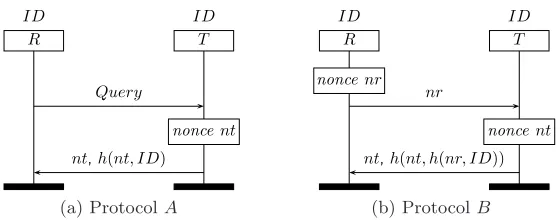
In particular, it has been shown that composition of two secrecy-preserving protocols may introduce attacks [6]. Similar results have been obtained for the composition of authentication protocols [7]. It is easy to see that the same holds true for untraceability. Consider for instance the two protocols shown in Figure 1. Each of the protocols can be shown to be untraceable in isolation. But if an RFID tag implements both protocols, it becomes traceable. An attacker selects protocol A to obtainnt, h(nt,ID) from any tag he is interested in tracing. To test whether a random tag is a tag the attacker is interested in, the attacker selects protocol B and sends the challengent to the tag. The tag answers with
nt′, h(nt′, h(nt,ID′)). The attacker can then obviously test whetherID =ID′.
While the protocols in Figure 1 can be considered as specially crafted pro-tocols, we show that the protocols of Lee, Batina, and Verbauwhede [8] suffer from the same type of problem. These protocols are a revision of EC-RAC [9] which has been shown to be flawed with respect to authentication and untrace-ability [10–12].
⋆Ton van Deursen was supported by a grant from the Fonds National de la Recherche
ID R
ID T
Query
noncent nt,h(nt, ID)
(a) ProtocolA
ID R
ID T
noncenr nr
nonce nt nt,h(nt, h(nr, ID))
(b) ProtocolB
Fig. 1: Protocols untraceable in isolation, but not in common environment.
2
The proposed family of protocols
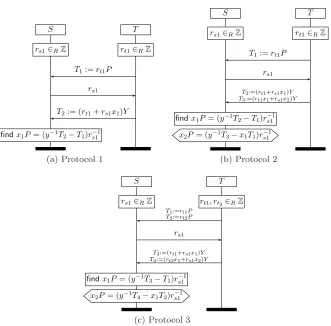
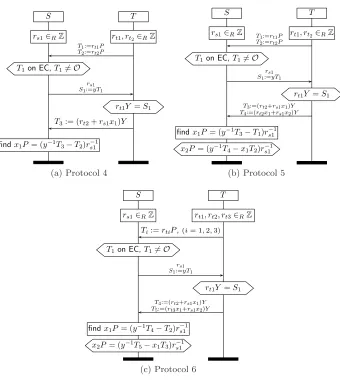
The protocols proposed by Lee, Batina, and Verbauwhede are constructed from four components. Proof sketches for the authentication property of the indi-vidual components have been given, then the components have been composed leading to the six protocols shown in Figures 2 and 3. We note that no proof of untraceability has been given.
The protocols are based on a fixed, system-wide elliptic curve over a finite field. The points P and Y = yP on the elliptic curve are publicly known, the scalar y and the points x1P and x2P are only known to the server, and the scalarsx1,x2 are unique to each tag and only known to the tag. For scalability reasons, the server additionally knowsx1in protocols 2, 3, 5, and 6. The elliptic curve is assumed to have been chosen such that the computational Diffie-Hellman problem is hard, that is, given only the points xP, yP, and P on the elliptic curve, it is hard to computexyP.
All the protocols follow the same commitment-challenge-response structure. More precisely, in all protocols the tag sends a random point on the elliptic curve which serves as a commitment. The server challenges the tag with a random integer upon which the tag answers with a point depending on the commitment and the challenge. The idea of such schemes is that anybody able to produce the correct response can also compute a particular secret, thus successful completion of the protocol constitutes a proof of knowledge for the secret. A moment’s thought shows that for the present protocols, the secrets in question are the pointsx1Y andx2Y.
Protocols 4 through 6 additionally include a challenge-response loop where the tag challenges the server and the server proves knowledge of its secret keyy.
3
Attacks on the protocols
S T
rt1∈RZ
rs1∈RZ
T1:=rt1P
rs1
T2:= (rt1+rs1x1)Y
findx1P= (y−1T2−T1)r−1s1
(a) Protocol 1
S T
rt1∈RZ
rs1∈RZ
T1:=rt1P
rs1
T2:=(rt1+rs1x1)Y
T3:=(rt1x1+rs1x2)Y
findx1P= (y−1T2−T1)r−1s1
x2P= (y−1T3−x1T1)rs−11
(b) Protocol 2
S T
rs1∈RZ rt1, rt2∈RZ T1:=rt1P
T2:=rt2P
rs1
T3:=(rt1+rs1x1)Y
T4:=(rt2x1+rs1x2)Y
findx1P= (y−1T3−T1)r−1s1
x2P= (y−1T4−x1T2)r−1s1
(c) Protocol 3
Fig. 2: Protocols 1 through 3
secret key y is being used for two different purposes. Both the tag-to-server authentication and the server-to-tag authentication depend on it. Thus the two components are not independent of each other (in the sense of [3]) and hence the security of the two components in isolation does not imply their security when they are composed.
To use the first two messages of protocols 4, 5, and 6 as an oracle, the adversary submits any non-zero point on the system’s elliptic curve and receives the multiple of the point by the server’s secret key y. In the following we will refer to this oracle as the functionP →O(P) =yP.
3.1 Untraceability attacks on protocols 4, 5, and 6
a tag presented to him is the same as the one he eavesdropped on earlier. By eavesdropping on another communication of a tag and server (or by querying a tag himself) the attacker learnsr′
t2P, rs1′ , (rt2′ +r′s1x′1)Y. He then computes
rs1r′t2P−r′s1rt2P = (rs1rt2′ −r′s1rt2)P and
rs1(r′t2+r′s1x′1)Y −rs1′ (rt2+rs1x1)Y (1) For rs1, rs1′ 6= 0, the term in (1) is equal to (rs1rt2′ −r′s1rt2)Y if and only if
x1=x′1, that is, if the tag being queried by the attacker is the same tag as the one that was observed earlier. The attacker uses the oracle to decide whether this is the case or not: On submitting (rs1r′t2−r′s1rt2)P to the oracle, the attacker receives (rs1rt2′ −rs1′ rt2)Y. This equals the term in (1) if and only if the tag has been observed before.
Thus none of the protocols 4, 5, and 6 are untraceable. In particular, pro-tocols 4 and 6 do not satisfy the claimed forward and backward untraceability properties either.
3.2 Authentication attacks on protocols 4, 5, and 6
In order to break tag-to-server authentication in these protocols, an adversary needs to know the termx1Y, and the termx2Y (in protocols 5 and 6). The ad-versary learns these two terms from the tag’s public keysx1P,x2P by computing
O(xiP1) =xiY, (i= 1,2). According to the attacker model specified for these protocols, an attacker is initially only allowed to knowY,P, and the order of the system’s elliptic curve, but not the tags’ public keys. Under this restriction, only a rogue server in the system is able to impersonate tags. Protocol 4, however, is even vulnerable if the adversary does not know the tag’s public keys. In this case the adversary can learn x1Y by eavesdropping on one protocol execution between a tag and a server and performing the following computation.
By eavesdropping on one communication between a tag and a server, an attacker obtainsrt2P, the challengers1, and (rt2+rs1x1)Y. He then computes
r−1
s1rt2P andr−s11(rt2+rs1x1)Y = (rs1−1rt2+x1)Y. Using the oracle, the attacker obtains O(r−1
s1rt2P) = r−s11rt2Y and computes the difference (rs1−1rt2+x1)Y −
r−1
s1rt2Y =x1Y. After learningx1Y andx2Y by using the oracles as described above, an attacker can impersonate a tag as follows.
Protocol 4.The attacker chooses a random integerrt1, submits rt1P to the server, and is challenged byrs1. To answer this challenge, the attacker computes
rs1x1Y, and rt2Y and sends back the sum of these two points.
Protocol 5.The attacker chooses random integers rt1, rt2, submits T1, T2 to the server, and is challenged byrs1. To answer this challenge, the attacker com-putesT3 from the sum ofrs1x1Y, andrt2Y. To computeT4, the attacker mul-tipliesx1Y byrt2 andx2Y byrs1and computes the sum of these two points.
S T
rs1∈RZ rt1, rt2∈RZ T1:=rt1P
T2:=rt2P
T1on EC,T16=O
rs1
S1:=yT1
rt1Y =S1
T3:= (rt2+rs1x1)Y
findx1P= (y−1T3−T2)rs−11
(a) Protocol 4
S T
rs1∈RZ T1:=rt1P rt1, rt2∈RZ
T2:=rt2P
T1on EC,T16=O
rs1
S1:=yT1
rt1Y =S1
T3:=(rt2+rs1x1)Y
T4:=(rt2x1+rs1x2)Y
findx1P= (y−1T3−T1)r−1s1
x2P= (y−1T4−x1T2)rs−11
(b) Protocol 5
S T
rs1∈RZ rt1, rt2, rt3∈RZ
Ti:=rtiP,(i= 1,2,3)
T1on EC,T16=O
rs1
S1:=yT1
rt1Y =S1
T4:=(rt2+rs1x1)Y T5:=(rt3x1+rs1x2)Y
findx1P= (y−1T
4−T2)rs−11
x2P= (y−1T5−x1T3)rs−11
(c) Protocol 6
3.3 Untraceability attacks on all protocols
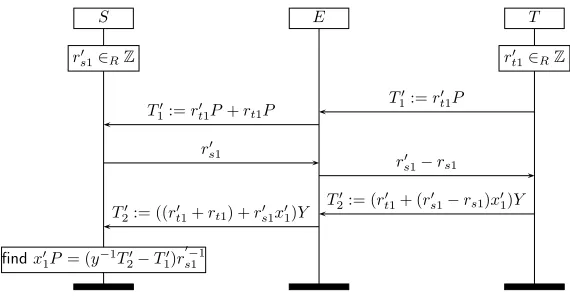
We demonstrate a man-in-the-middle attack on the ID-transfer component that allows a wide-strong adversary of (in the sense of Vaudenay [13]) to trace a tag in all of the six protocols.
S E T
r′
t1∈RZ
r′
s1∈RZ
T′ 1:=rt′1P T′
1:=r′t1P+rt1P
r′
s1 r′
s1−rs1
T′
2:= (r′t1+ (r′s1−rs1)x′1)Y T′
2:= ((rt′1+rt1) +rs′1x′1)Y
findx′
1P= (y−1T2′−T1′)r
′−1
s1
Fig. 4: Man-in-the-middle attack on Protocol 1
By eavesdropping on protocol 1, the adversary obtains the messages rt1P,
rs1, and (rt1+rs1x1)Y. He then mounts a man-in-the-middle attack on a second communication to test whether the same tag is present as shown in Figure 4. The adversary adds the previously observed rt1P to the commitmentr′t1P and subtracts rs1 from the new commitment rs1′ . The new and old responses are added and sent to the server:
T′
2= (rt1+rs1x1)Y + (rt1′ + (rs1′ −rs1)x′1)Y = ((rt1+r′t1) +rs1x1+ (rs1′ −rs1)x′1)Y
This response is accepted by the server if and only ifx1=x′1, i.e. if the tag is the same as the one that was previously observed. Therefore, a wide-strong adversary can trace tags. The same attack is possible on protocols 2 through 6 since they are extensions of protocol 1.
Note that a wide-strong adversary can also trace tags in the protocol proposed by Bringer et al. [11] using the same method. This protocol has, however, only been claimed and proven secure against narrow-strong adversaries.
4
Repairing the flaws
with a second secrety2, generated randomly and independently of y, and store the pointy2P in every tag. In the second message, the server sendsy2T1instead of yT1, to prove server authenticity to the tag. A similar approach improves protocols 5 and 6.
To defend against the man-in-the-middle attacks, a stronger form of authen-tication seems to be unavoidable. In its current form, protocol 1 provides recent aliveness [14]: the server is guaranteed that the tag has recently produced a mes-sage. However, agreement [14] is clearly not satisfied as shown by the attack in Figure 4. At the end of the run, the server believes the following messages were exchanged
(r′
t1+rt1)P r′s1 ((rt1′ +rt1) +r′s1x′1)Y, while for the tag the transcript reads
r′
t1P rs1′ −rs1 (r′t1+ (r′s1−rs1)x′1)Y.
As shown above, the adversary abuses this discrepancy and the reader’s reaction to it to trace tags. To foil the attack, we need to make sure that reader and tag agree on the contents of all messages.
The simplest solution is to use message authentication codes based on a shared secret. The last message would then include a hash of the previous mes-sages (including the payload of the current message) and a secret known only to server and tag. A suitable candidate would be h(rt1P, rs1,(rt1+rs1x1)Y, xyP). Since (rt1+rs1x1)Y is uniquely determined by the other three components of the hash it does not have to be included, reducing the message authentication code toh(rt1P, rs1, xyP).
Although this solution prevents these particular man-in-the-middle attacks, it is more resource intensive since it additionally requires a cryptographic hash function to be implemented (and computed) on the tag. We conjecture that protocol 5 can also be made resistant to man-in-the-middle attacks by modifying the computation of T4 in the third message. Replacing T4 by (rt2x1−rs1x2)Y prevents the presented man-in-the-middle attack and obvious derivatives thereof. It is unclear, however, whether this introduces new vulnerabilities.
References
1. Canetti, R.: Universally composable security: A new paradigm for cryptographic protocols. In: FOCS. (2001) 136–145
2. Canetti, R.: Universally composable security: A new paradigm for cryp-tographic protocols. Cryptology ePrint Archive, Report 2000/067 (2000) http://eprint.iacr.org/.
3. Andova, S., Cremers, C., Gjøsteen, K., Mauw, S., Mjølsnes, S., Radomirovi´c, S.: A framework for compositional verification of security protocols. Information and Computation206(February-April 2008) 425–459
4. Heintze, N., Tygar, J.D.: A model for secure protocols and their compositions. IEEE Trans. Software Eng.22(1) (1996) 16–30
6. Cremers, C.: Feasibility of multi-protocol attacks. In: Proc. of The First In-ternational Conference on Availability, Reliability and Security (ARES), Vienna, Austria, IEEE Computer Society (April 2006) 287–294
7. Tzeng, W.G., Hu, C.M.: Inter-protocol interleaving attacks on some authentication and key distribution protocols. Inf. Process. Lett.69(6) (1999) 297–302
8. Lee, Y., Batina, L., Verbauwhede, I.: Untraceable RFID authentication protocols: Revision of EC-RAC. In: IEEE International Conference on RFID – RFID 2009, Orlando, Florida, USA (April 2009)
9. Lee, Y.K., Batina, L., Verbauwhede, I.: EC-RAC (ECDLP based randomized access control): Provably secure RFID authentication protocol. In: Proceedings of the 2008 IEEE International Conference on RFID. (2008) 97–104
10. van Deursen, T., Radomirovi´c, S.: Attacks on RFID protocols (ver-sion 1.0). Cryptology ePrint Archive, Report 2008/310 (July 2008) http://eprint.iacr.org/2008/310.
11. Bringer, J., Chabanne, H., Icart, T.: Cryptanalysis of EC-RAC, a RFID identifi-cation protocol. In: CANS. (2008) 149–161
12. van Deursen, T., Radomirovi´c, S.: Algebraic attacks on RFID protocols. In: In-formation Security Theory and Practices. Smart Devices, Pervasive Systems, and Ubiquitous Networks (to appear). Lecture Notes in Computer Science, Brussels, Belgium, Springer (2009)
13. Vaudenay, S.: On privacy models for RFID. In: Advances in Cryptology - ASI-ACRYPT 2007. Volume 4833 of Lecture Notes in Computer Science., Kuching, Malaysia, Springer-Verlag (December 2007) 68–87