
for Storage Security in Cloud Computing
Qian Wang1, Cong Wang1, Jin Li1, Kui Ren1, and Wenjing Lou2 1 Illinois Institute of Technology, Chicago IL 60616, USA,
{qwang,cwang,jin.li,kren}@ece.iit.edu
2 Worcester Polytechnic Institute, Worcester MA 01609, USA,
{wjlou}@ece.wpi.edu
Abstract. Cloud Computing has been envisioned as the next-generation architecture of IT Enterprise. It moves the application software and databases to the centralized large data centers, where the management of the data and services may not be fully trustworthy. This unique paradigm brings about many new security challenges, which have not been well un-derstood. This work studies the problem of ensuring the integrity of data storage in Cloud Computing. In particular, we consider the task of allow-ing a third party auditor (TPA), on behalf of the cloud client, to verify the integrity of the dynamic data stored in the cloud. The introduc-tion of TPA eliminates the involvement of client through the auditing of whether his data stored in the cloud is indeed intact, which can be impor-tant in achieving economies of scale for Cloud Computing. The support for data dynamics via the most general forms of data operation, such as block modification, insertion and deletion, is also a significant step to-ward practicality, since services in Cloud Computing are not limited to archive or backup data only. While prior works on ensuring remote data integrity often lacks the support of either public verifiability or dynamic data operations, this paper achieves both. We first identify the difficulties and potential security problems of direct extensions with fully dynamic data updates from prior works and then show how to construct an el-egant verification scheme for seamless integration of these two salient features in our protocol design. In particular, to achieve efficient data dynamics, we improve the Proof of Retrievability model [1] by manip-ulating the classic Merkle Hash Tree (MHT) construction for block tag authentication. Extensive security and performance analysis show that the proposed scheme is highly efficient and provably secure.
1
Introduction
network connections make it even possible that clients can now subscribe high quality services from data and software that reside solely on remote data centers. Although envisioned as a promising service platform for the Internet, this new data storage paradigm in “Cloud” brings about many challenging design issues which have profound influence on the security and performance of the overall system. One of the biggest concerns with cloud data storage is that of data integrity verification at untrusted servers. For example, the storage service provider, which experiences Byzantine failures occasionally, may decide to hide the data errors from the clients for the benefit of their own. What is more serious is that for saving money and storage space the service provider might neglect to keep or deliberately delete rarely accessed data files which belong to an ordinary client. Consider the large size of the outsourced electronic data and the client’s constrained resource capability, the core of the problem can be generalized as how can the client find an efficient way to perform periodical integrity verifications without the local copy of data files.
In order to solve this problem, many schemes are proposed under different systems and security models [1–10]. In all these works, great efforts are made to design solutions that meet various requirements: high scheme efficiency, stateless verification, unbounded use of queries and retrievability of data, etc. Considering the role of the verifier in the model, all the schemes presented before fall into two categories: private verifiability and public verifiability. Although schemes with private verifiability can achieve higher scheme efficiency, public verifiability allows anyone, not just the client (data owner), to challenge the cloud server for correctness of data storage while keeping no private information. Then, clients are able to delegate the evaluation of the service performance to an independent third party auditor (TPA), without devotion of their computation resources. In the cloud, the clients themselves are unreliable or cannot afford the overhead of performing frequent integrity checks. Thus, for practical use, it seems more ratio-nal to equip the verification protocol with public verifiability, which is expected to play a more important role in achieving economies of scale for Cloud Com-puting. Moreover, for efficiency consideration, the outsourced data themselves should not be required by the verifier for the verification purpose.
for cloud data storage, in this paper we present a framework and an efficient construction for seamless integration of these two components in our protocol design. Our contribution can be summarized as follows: (1) We propose a general formal PoR model with public verifiability for cloud data storage, in which block-less verification is achieved; (2) We equip the proposed PoR construction with the function of supporting for fully dynamic data operations, especially to sup-port block insertion, which is missing in most existing schemes; (3) We prove the security of our proposed construction and justify the performance of our scheme through concrete implementation and comparisons with the state-of-the-art.
1.1 Related Work
Recently, much of growing interest has been pursued in the context of remotely stored data verification [1–9, 11, 13–15]. Ateniese et al. [2] define the “provable data possession” (PDP) model for ensuring possession of files on untrusted stor-ages. In their scheme, they utilize RSA-based homomorphic tags for auditing outsourced data, thus can provide public verifiability. However, Ateniese et al.
do not consider the case of dynamic data storage, and the direct extension of their scheme from static data storage to dynamic case brings many design and security problems. In their subsequent work [11], Ateniese et al. propose a dy-namic version of the prior PDP scheme. However, the system imposes a priori bound on the number of queries and does not support fully dynamic data oper-ations, i.e., it only allows very basic block operations with limited functionality and block insertions cannot be supported. In [13], Wang et al. consider dynamic data storage in distributed scenario, and the proposed challenge-response proto-col can both determine the data correctness and locate possible errors. Similar to [11], they only consider partial support for dynamic data operation. Juels
et al. [3] describe a “proof of retrievability” (PoR) model and give a more
D ata Fl ow
C l ou dS erv
i c ePr ov
i der C lient s
C l o ud S tor age S erver s Sec
urit y
M es
s ag
e F lo
w
Secur i t yMessag
eF l ow
S e
c uri t y M
essage F l
o w
Thi rdPar tyAud
i t or
Fig. 1: Cloud data storage architecture
especially for block insertion, they try to eliminate the index information in the “tag” computation in Ateniese’s PDP model [2]. To achieve this, before the verification procedure, they employ authenticated skip list data structure to au-thenticate the tag information of challenged or updated blocks first. However, the efficiency of their scheme remains in question. It can be seen that while ex-isting schemes are proposed to aiming at providing integrity verification under different data storage systems, the problem of supporting both public verifiabil-ity and data dynamics has not been fully addressed. How to achieve a secure and efficient design to seamlessly integrate these two important components for data storage service remains an open challenging task in cloud computing.
Organization.The rest of the paper is organized as follows. In section 2,
we define the system model, security model and our goal. Then, we present our scheme in section 3 and provide security analysis in section 4. We further analyze the experiment results and show the practicality of our schemes in section 5. Finally, we conclude in section 6.
2
Problem Statement
2.1 System Model
A representative network architecture for cloud data storage is illustrated in Fig. 1. Three different network entities can be identified as follows:Client: an entity, which has large data files to be stored in the cloud and relies on the cloud for data maintenance and computation, can be either individual consumers or organizations; Cloud Storage Server (CSS): an entity, which is managed by Cloud Service Provider (CSP), has significant storage space and computation resource to maintain clients’ data; Third Party Auditor (TPA): a TPA, which has expertise and capabilities that clients do not have, is trusted to assess and expose risk of cloud storage services on behalf of the clients upon request.
clients should be equipped with certain security means so that they can peri-odically verify the correctness of the remote data even without the existence of local copies. In case that clients do not necessarily have the time, feasibility or resources to monitor their data, they can delegate the monitoring task to a trusted TPA. In this paper, we only consider verification schemes with public verifiability: any TPA in possession of the public key can act as a verifier. We assume that TPA is unbiased while the server is untrusted. Note that we don’t address the issue of data privacy in this paper, as the topic of data privacy in Cloud Computing is orthogonal to the problem we study here. For application purposes, the clients may interact with the cloud servers via CSP to access or retrieve their pre-stored data. More importantly, in practical scenarios the client may frequently perform block-level operations on the data files. The most general forms of these operations we consider in this paper are modification, insertion, and deletion.
2.2 Security Model
Shacham and Waters propose a security model for PoR system in [1]. Generally, the checking scheme is secure if (i) there exists no polynomial-time algorithm that can cheat the verifier with non-negligible probability; (ii) there exists a polynomial-time extractor that can recover the original data files by carrying out multiple challenges-responses. Under the definition of this PoR system, the client can periodically challenge the storage server to ensure the correctness of the cloud data and the original files can be recovered by interacting with the server. The authors in [1] also define the correctness and soundness of PoR scheme: the scheme is correct if the verification algorithm accepts when interacting with the valid prover (e.g., the server returns a valid response) and it is sound if any cheating server that convinces the client it is storing the data file is actually storing that file. Note that in the “game” between the adversary and the client, the adversary has full access to the information stored in the server, i.e., the adversary can play the part of the prover (server). In the verification process, the adversary’s goal is to cheat the client successfully, i.e., trying to generate valid responses and pass the data verification without being detected.
Our security model has subtle but crucial difference from that of the original PoRs in the verification process. Note that the original PoR schemes [1,3,4,15] do not consider dynamic data operations and the block insert cannot be supported at all. This is because the construction of the signatures is involved with the file index informationi. Thus, once a file block is inserted, the computation overhead is unacceptable since the signatures of all the following file blocks should be re-computed with the new indexes. To deal with this limitation, we remove the index information i in generating the signatures and useH(mi) as the tag for block
mi (see section 3.3) instead of H(name||i) [1] orh(v||i) [3], so individual data
x1 x2 hc
h(x1) h(x2)
x3 x4
hd
h(x3) h(x4)
x5 x6
he
h(x5) h(x6)
x7 x8
hf
h(x7) h(x8)
ha hb
Root hr
A B
C D E F
: the sequence of access to the ordered set of leaves
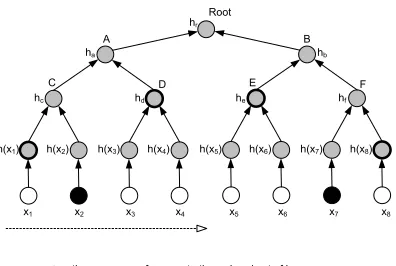
Fig. 2: Merkle hash tree authentication of data elements. We treat the leaf nodes
h(x1), . . . , h(xn) as the left-to-right sequence.
while achieving blockless, the server should take over the job of computingH(mi)
and then return it to the prover. The consequence of this variance will lead to a serious problem: it will give the adversary more opportunities to cheat the prover by manipulating H(mi) or mi. Due to this construction, our security
model differs from that of the original PoR in both the verification and the data updating process. Specifically, in our scheme tags should be authenticated in each protocol execution other than calculated or pre-stored by the verifier (The details will be shown in section 3). Note that we will use server and prover (or client, TPA and verifier) interchangeably in this paper.
2.3 Design Goals
3
The Proposed Scheme
3.1 Notation and Preliminaries
Bilinear Map. A bilinear map is a mape :G×G →GT, where Gis a Gap
Diffie-Hellman (GDH) group and GT is another multiplicative cyclic group of
prime orderpwith the following properties [16]: (i) Computable: there exists an efficiently computable algorithm for computinge; (ii) Bilinear: for allh1, h2∈G anda, b∈Zp,e(ha1, hb2) =e(h1, h2)ab; (iii) Non-degenerate:e(g, g)6= 1, whereg is a generator ofG.
Merkle Hash Tree. A Merkle Hash Tree (MHT) is a well-studied
authenti-cation structure [17], which is intended to efficiently and securely prove that a set of elements are undamaged and unaltered. It is constructed as a binary tree where the leaves in the MHT are the hashes of authentic data values. Fig. 2 depicts an example of authentication. The verifier with the authentic hr
re-quests for {x2, x7} and requires the authentication of the received blocks. The prover provides the verifier with the auxiliary authentication information (AAI)
Ω2=< h(x1), hd>andΩ7=< h(x8), he>. The verifier can then verifyx2 and
x7by first computingh(x2),h(x7),hc =h(h(x1)||h(x2))),hf =h(h(x7)||h(x8))),
ha = h(hc||hd), hb = h(he||hf) and hr = h(ha||hb), and then checking if the
calculatedhr is the same as the authentic one. MHT is commonly used to
au-thenticate the values of data blocks. However, in this paper we further employ MHT to authenticate both the values and the positions of data blocks. We treat the leaf nodes as the left-to-right sequence, so any leaf node can be uniquely determined by following this sequence and the way of computing the root in MHT.
3.2 Definition
(pk, sk)←KeyGen(1k). This probabilistic algorithm is run by the client. It takes
as input security parameter 1k, and returns public keypk and private key sk.
(Φ, sigsk(H(R)))←SigGen(sk, F). This algorithm is run by the client. It takes
as input private keyskand a fileF which is an ordered collection of blocks{mi},
and outputs the signature setΦ, which is an ordered collection of signatures{σi}
on {mi}. It also outputs metadata-the signaturesigsk(H(R))of the root R of a
Merkle hash tree. In our construction, the leaf nodes of the Merkle hash tree are
hashes of H(mi).
(P)← GenP roof(F, Φ, chal). This algorithm is run by the server. It takes as
input a file F, its signatures Φ, and a challenge chal. It outputs a data integrity
proof P for the blocks specified bychal.
{T RU E, F ALSE} ←V erif yP roof(pk, chal, P). This algorithm can be run by
either the client or the third party auditor upon receipt of the proof P. It takes
as input the public key pk, the challenge chal, and the proof P returned from
the server, and outputs T RU E if the integrity of the file is verified as correct,
(F′, Φ′, P
update)←ExecU pdate(F, Φ, update). This algorithm is run by the server.
It takes as input a fileF, its signaturesΦ, and a data operation request “update”
from client. It outputs an updated file F′, updated signatures Φ′ and a proof
Pupdate for the operation.
{(T RU E, sigsk(H(R′))), F ALSE} ← V erif yU pdate(pk, update, Pupdate). This
algorithm is run by the client. It takes as input public key pk, the signature
sigsk(H(R)), an operation request “update”, and the proof Pupdate from server.
If the verification successes, it outputs a signaturesigsk(H(R′))for the new root
R′, orF ALSE otherwise.
3.3 Our Construction
Given the above discussion, in our construction, we use BLS signature [16] as a basis to design the system with data dynamics support. As will be shown, the schemes designed under BLS construction can also be implemented in RSA construction. In the discussion of section 3.4, we will show that direct extensions of previous work [1,2] have security problems and we believe that protocol design for supporting dynamic data operation is a major challenging task for cloud storage systems.
Now we start to present the main idea behind our scheme. As in the previous PoR systems [1,3], we assume the client encodes the raw data fileFeintoF using Reed-Solomon codes and divides the encoded file F intonblocks m1, . . . , mn3,
where mi ∈Zp and pis a large prime. Lete:G×G→GT be a bilinear map,
with a hash function H :{0,1}∗→G, viewed as a random oracle [1]. Letg be
the generator of G. h is a cryptographic hash function. The procedure of our protocol execution is as follows:
Setup: The client’s public key and private key are generated by invoking
KeyGen(·). By runningSigGen(·), the raw data fileF is pre-processed and the homomorphic authenticators together with metadata are produced.
KeyGen(1k). The client generates a random signing key pair (spk, ssk). Choose
a randomα←Zp and computev←gα. The secret key issk= (α, ssk) and the
public key ispk= (v, spk).
SigGen(sk, F). Given F = (m1, . . . , mn), the client chooses a random element
u←G. Lett=name||n||u||SSigssk(name||n||u) be the file tag forF. Then the client computes signatureσi for each blockmi (i= 1, . . . , n) asσi ←(H(mi)·
umi)α. Denote the set of signatures by Φ = {σ
i}, 1 ≤ i ≤n. The client then
generates a root R based on the construction of Merkle Hash Tree (MHT), where the leave nodes of the tree are an ordered set of BLS hashes of “file tags”
H(mi) (i= 1, . . . , n). Next, the client signs the rootRunder the private keyα:
sigsk(H(R)) ←(H(R))α. The client sends {F, t, Φ, sigsk(H(R))} to the server
and deletes{F, Φ, sigsk(H(R))}from its local storage.
Default Integrity Verification: The client or the third party, e.g., TPA,
TPA CSS 1. Generate a random
set{(i, νi)}i∈I;
{(i,νi)}i∈I
−−−−−−−−−−−−−−−→
challenge requestchal
2. Computeµ=Piνimi; 3. Computeσ=Qiσνi
i ; {µ,σ,{H(mi),Ωi}i∈I,sigsk(H(R))}
←−−−−−−−−−−−−−−−−−−−−−−−
Integrity proof P 4. ComputeRusing
{H(mi), Ωi}i∈I; 5. Verifysigsk(H(R))
and outputFALSE if fail; 6. Verify{mi}i∈I.
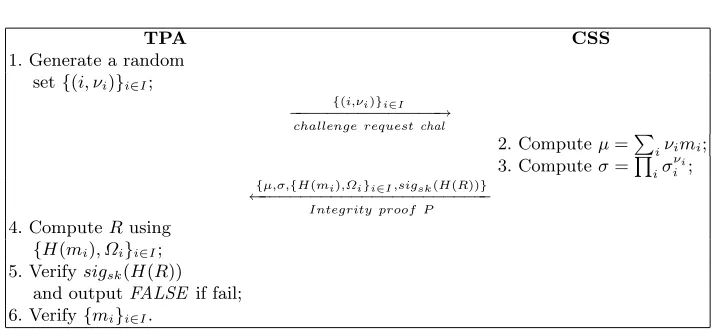
Fig. 3: Protocols for Default Integrity Verification
can verify the integrity of the outsourced data by challenging the server. Before challenging, the TPA first usespk to verify the signature ont. If the verification fails, reject by emitting FALSE; otherwise, recoveru. To generate the message “chal”, the TPA (verifier) picks a randomc-element subsetI={s1, . . . , sc}of set
[1, n], where we assumes1≤ · · · ≤sc. For eachi∈I the TPA chooses a random
elementνi←Zp. The message “chal” specifies the positions of the blocks to be
checked in this challenge phase. The verifier sends the chal {(i, νi)}s1≤i≤sc to the prover (server).
GenP roof(F, Φ, chal). Upon receiving the challengechal={(i, νi)}s1≤i≤sc, the
server computes
µ=
sc
X
i=s1
νimi∈Zp and σ= sc
Y
i=s1 σνi
i ∈G.
In addition, the prover will also provide the verifier with a small amount of aux-iliary information{Ωi}s1≤i≤sc, which are the node siblings on the path from the
leaves {h(H(mi))}s1≤i≤sc to the rootR of the MHT. The prover responds the verifier with proofP ={µ, σ,{H(mi), Ωi}s1≤i≤sc, sigsk(H(R))}.
V erif yP roof(pk, chal, P). Upon receiving the responses from the prover, the verifier generates rootRusing{H(mi), Ωi}s1≤i≤scand authenticates it by check-ing e(sigsk(H(R)), g)
?
=e(H(R), gα). If the authentication fails, the verifier
re-jects by emittingFALSE. Otherwise, the verifier checks
e(σ, g)=? e(
sc
Y
i=s1
H(mi)νi·uµ, v).
If so, output T RU E; otherwiseF ALSE. The protocol is illustrated in Fig. 3.
Dynamic Data Operation with Integrity Assurance: Now we show how
Client CSS 1. Generateσ′i= (H(m′i)·u
m′i)α;
(M(I),i,m′
i,σ′i)
−−−−−−−−−−−−−−−→
update request update
2. UpdateF and computeR′. (Ωi,H(mi),sigsk(H(R)),R′)
←−−−−−−−−−−−−−−−−−−
update proof Pupdate 3. ComputeRusing
{H(mi), Ωi}; 4. Verifysigsk(H(R)).
OutputFALSEif fail. 5. ComputeRnewusing
{Ωi, H(m′i)}. Verify
update by checking
Rnew ?
=R′. SignR′if succeed. sigsk(H(R′))
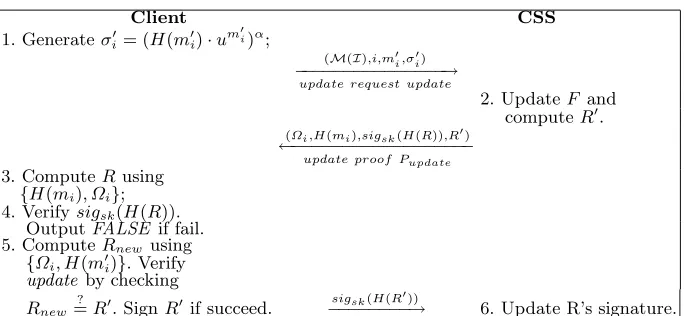
−−−−−−−−→ 6. Update R’s signature. Fig. 4: The protocol for provable data update (Modification and Insertion)
including data modification (M), data insertion (I) and data deletion (D) for cloud data storage. Note that in the following descriptions for the protocol design of dynamic operation, we assume that the fileF and the signatureΦhave already been generated and properly stored at server. The root metadata R has been signed by the client and stored at the cloud server, so that anyone who has the client’s public key can challenge the correctness of data storage.
-Data Modification: We start from data modification, which is one of the
most frequently used operations in cloud data storage. A basic data modification operation refers to the replacement of specified blocks with new ones.
Suppose the client wants to modify the i-th block mi to m′i. The protocol
procedures are described in Fig. 4. At start, based on the new block m′
i, the
client generates the corresponding signatureσ′
i= (H(m′i)·um
′
i)α. Then, he con-structs an update request message “update = (M, i, m′i, σ′i)” and sends to the
server, whereMdenotes the modification operation. Upon receiving the request, the server runsExecU pdate(F, Φ, update). Specifically, the server (i) replaces the blockmiwithm′iand outputsF′; (ii) replaces theσiwithσi′and outputsΦ′; (iii)
replacesH(mi) withH(m′i) in the Merkle hash tree construction and generates
the new root R′ (see the example in Fig. 5). Finally, the server responses the
client with a proof for this operation, Pupdate = (Ωi, H(mi), sigsk(H(R)), R′),
whereΩiis the AAI for authentication ofmi. After receiving the proof for
modi-fication operation from server, the client first generates rootRusing{Ωi, H(mi)}
and authenticates the AAI orR by checking e(sigsk(H(R)), g)
?
=e(H(R), gα).
If it is not true, outputFALSE, otherwise the client can now check whether the server has performed the modification as required or not, by further computing the new root value using{Ωi, H(m′i)}and comparing it withR′. If it is not true,
output FALSE, otherwise output TRUE. Then, the client signs the new root metadata R′ bysig
h(n1) h(n2) h(n3) h(n4)
ha hb
Root
hr
A B
h(n1) h(n3) h(n4)
h'a hb
Root'
h’r
A B
h(n’2)
h(n2) is replaced by h(n’2)
: the sequence of access to the ordered set of leaves
Fig. 5: Example of MHT update under block modification operation. Here, ni
andn′
i are used to denote H(mi) andH(m′i), respectively.
h(n1) h(n2) h(n3) h(n4)
ha hb
Root
hr
A B
n3
h(n1) hc h(n3) h(n4)
h'a hb
Root' h’r
A B
h(n*) h(n2)
C Insert h(n*) after h(n2)
: the sequence of access to the ordered set of leaves
Fig. 6: Example of MHT update under block insertion operation. Here, ni and
n∗ are used to denoteH(m
i) andH(m∗), respectively.
hc hd he hf
ha hb
Root hr
A B
Delete h(n5)
: the sequence of access to the ordered set of leaves h(n1) h(n2) h(n3) h(n4) h(n5) h(n6) h(n7) h(n8)
hc hd hf
ha h’b Root’ h’r
A B
h(n1) h(n2) h(n3) h(n4) h(n6)
h(n7) h(n8)
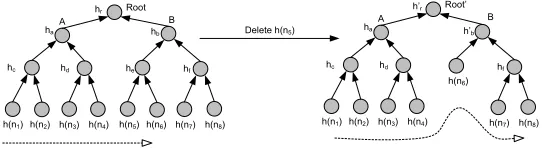
Fig. 7: Example of MHT update under block deletion operation.
-Data Insertion: Compared to data modification, which does not change
the logic structure of client’s data file, another general form of data operation, data insertion, refers to inserting new blocks after some specified positions in the data fileF.
Suppose the client wants to insert block m∗ after the i-th block m
i. The
protocol procedures are similar to the data modification case (see Fig. 4, now
m′
i can be seen as m∗). At start, based on m∗ the client generates the
cor-responding signature σ∗ = (H(m∗)· um∗)α. Then, he constructs an update
request message “update = (I, i, m∗, σ∗)” and sends to the server, where I
denotes the insertion operation. Upon receiving the request, the server runs
ExecU pdate(F, Φ, update). Specifically, the server (i) storesm∗ and adds a leaf
h(H(m∗)) “after” leaf h(H(m
adds theσ∗into the signature set and outputsΦ′; (iii) generates the new rootR′
based on the updated Merkle hash tree. Finally, the server responses the client with a proof for this operation, Pupdate = (Ωi, H(mi), sigsk(H(R)), R′), where
Ωi is the AAI for authentication of mi in the old tree. An example of block
insertion is illustrated in Fig. 6, to inserth(H(m∗)) after leaf nodeh(H(m
2)), only nodeh(H(m∗)) and an internal nodeCis added to the original tree, where
hc=h(h(H(m2))||h(H(m∗))). After receiving the proof for insert operation from server, the client first generates rootRusing{Ωi, H(mi)}and authenticates the
AAI orRby checking ife(sigsk(H(R)), g) =e(H(R), gα). If it is not true, output
FALSE, otherwise the client can now check whether the server has performed
the insertion as required or not, by further computing the new root value using
{Ωi, H(mi), H(m∗)}and comparing it withR′. If it is not true, outputFALSE,
otherwise output TRUE. Then, the client signs the new root metadataR′ by
sigsk(H(R′)) and sends it to the server for update.
-Data Deletion: Data deletion is just the opposite operation of data insertion.
For single block deletion, it refers to deleting the specified block and moving all the latter blocks one block forward. Suppose the server receives the update
request for deleting blockmi, it will deletemi from its storage space, delete the
leaf node h(H(mi)) in the MHT and generate the new root metadata R′ (see
the example in Fig. 7). The details of the protocol procedures are similar to that of data modification and insertion, which are thus omitted here.
The Enhancement for Multi-client Verification:As cloud servers may
concurrently handle multiple verification sessions from different clients, given
K signatures onK distinct data files fromK clients, it is more advantageous to aggregate all these signatures into a single one and verify it at one time. We can extend our scheme to allow for provable data updates and verifica-tion in a multi-client system. The key idea is to use the bilinear aggregate sig-nature scheme [18], which has the following property: for any u1, u2, v ∈ G,
e(u1u2, v) =e(u1, v)·e(u2, v) and for any u, v∈G, e(ψ(u), v) =e(ψ(v), u). As in the BLS scheme, the aggregate signature scheme allows the creation of signa-tures on arbitrary distinct messages. Assume there areK clients in the system, and each clientkhas data filesFi= (mk,1, . . . , mk,n), wherek∈ {1, . . . , K}. For
a particular clientk, pick randomxk←Zp, and computevk =gxk. The client’s
public key is vk ∈Gand the public key isvk ∈Zp. In theSigGen phase, given
the file Fk = (mk,1, . . . , mk,n), clientkchooses a random element uk ←Gand
computes signatureσk,i←[H(mk,i)·umkk,i]xk∈G. In thechallenge phase, the
verifier sends the queryQ={(i, νi)}s1≤i≤scto the prover (server) for verification of allKclients. In the GenProof phase, upon receiving thechal, for each client
k (k∈ {1, . . . , K}), the prover computesµk =P{(i,νi)}s1≤i≤scνimk,i ∈Zp and
σ = QKk=1(Q{(i,νi)}s
1≤i≤scσ
νi
k,i) =
QK k=1(
Q
{(i,νi)}s1≤i≤sc[H(mk,i)·u
mk,i
k ]xkνi).
The prover then responses the verifier with{σ,{µk}1≤k≤K,{Ωk,i},{H(mk,i)}}.
In the VerifyProof phase, similar as the single client case, the verifier first au-thenticates tags H(mk,i) by verifying signatures on the roots (for each client’s
map, the verifier can check if the following equation holds:
e(σ, g) =
K
Y
k=1
e( Y
{(i,νi)}s1≤i≤sc
[H(mk,i)]νi·(uk)µk, vk).
This establishes the validity of the scheme. The proof of security of this scheme is similar to the multi-client case, thus omitted here.
3.4 Discussion on Design Considerations
Instantiations based on BLS and RSA. As discussed above, we present a
BLS-based construction that offers both public verifiability and data dynamics. In fact, our proposed scheme can also be constructed based on RSA signatures. Compared with RSA construction [2, 14], as a desirable benefit, the BLS con-struction can offer shorter homomorphic signatures (e.g., 160 bits) than those that use RSA techniques (e.g., 1024 bits). In addition, the BLS construction has the shortest query and response (we does not consider AAI here): 20 bytes and 40 bytes [1]. However, while BLS construction is not suitable to use variable sized blocks (e.g., for security parameterλ= 80,mi∈Zp, wherepis a 160-bit prime),
the RSA construction can support variable sized blocks. The reason is that in RSA construction the order ofQRN is unknown to the server, so it is impossible
to find distinctm1andm2such thatgm1 modN=gm2 modNaccording to the factoring assumption. But the block size cannot increase without limit, as the verification blockµ=Psc
i=s1νimigrows linearly with the block size. Recall that h(H(mi)) are used as the MHT leaves, upon receiving the challenge the server
can calculate these tags on-the-fly or pre-store them for fast proof computation. In fact, one can directly use h(gmi) as the MHT leaves instead of h(H(m
i)).
In this way at the verifier side the job of computing the aggregated signature
σshould be accomplished after authentication ofgmi. Now the computation of aggregated signatureσis eliminated at the server side, as a trade-off, additional computation overhead may be introduced at the verifier side.
Support for Data Dynamics.The direct extension of PDP or PoR schemes
to support data dynamics may have security problems. We take PoR for exam-ple, the scenario in PDP is similar. When mi is required to be updated,σi =
[H(name||i)umi]x should be updated correspondingly. Moreover, H(name||i) should also be updated, otherwise by dividing σi byσ′i, the adversary can
ob-tain [u∆mi]x and use this information and ∆m
i to update any block and its
corresponding signature for arbitrary times while keeping σ consistent with µ. This attack cannot be avoided unlessH(name||i) is changed for each update op-eration. Also, because the index information is included in computation of the signature, an insertion operation at any position in F will cause the updating of all following signatures. To eliminate the attack mentioned above and make the insertion efficient, as we have shown, we useH(mi) instead ofH(name||i)
is remedied in our construction. Note that different from the public informa-tion name||i, mi is no longer known to client after the outsourcing of original
data files. Since the client or TPA cannot computeH(mi), this job has to be
as-signed to the server (prover). However, by leveraging the advantage of computing
H(mi), the prover can cheat the verifier through the manipulation ofH(mi) and
mi. For example, suppose the prover wants to check the integrity ofm1andm2 at one time. Upon receiving the challenge, the prover can just compute the pair (σ, µ) using arbitrary combinations of two blocks in the file. Now the response formulated in this way can successfully pass the integrity check. So, to prevent this attack, we should first authenticate the tag information before verification, i.e., ensuring these tags are corresponding to the blocks to be checked.
Designs for Blockless and Stateless Verification.The naive way of
realiz-ing data integrity verification is to make the hashes of the original data blocks as the leaves in MHT, so the data integrity verification can be conducted without tag authentication and signature aggregation steps. However, this construction requires the server to return all the challenged blocks for authentication, and thus is not efficient for verification purpose. Moreover, due to concern for security in the context of public verification, the original data files should not be revealed to TPA during verification process. To overcome these deficiencies, most exist-ing works in remote data checkexist-ing adopt a blockless strategy for data integrity verification. For the same reason, this paper adopts the blockless approach, and we authenticate the block tags instead of original data blocks in the verification process. As we have described, in thesetupphase the verifier signs the metadata
Rand stores it on the server to achieve stateless verification. Making the scheme fully stateless may cause the server to cheat: the server can revert the update operation and keep only old data and its corresponding signatures after com-pleting data updates. Since the signatures and the data are consistent, the client or TPA may not be able to check whether the data is up to date. Actually, one can easily defend this attack by storing the rootRon the verifier, i.e.,Rcan be seen as public information. However, this makes the verifier not fully stateless in some sense since TPA will store this information for the rest of time.
After a series of data operations like insertion and deletion, if assuming client or TPA does not keep structure of MHT locally, the verifier may lack knowledge of the MHT. At first sight, it seems that the server can reply to the client’s challenge with any blocks it is willing to provide. However, this is not the case since the verifier has tree rootR. Even if the MHT is stored on the server, the server cannot make any change of the MHT. Therefore, whenever necessary, the verifier can always ask the server to reveal the MHT structure during the auditing and the revealed MHT must be correctly authenticated by the tree root
as an illustration of the integrity verification of the dynamic data. A natural enhancement on the MHT data structure can be combiningB+ tree with MHT for storing the data. Compared to the classic MHT, such a structure can enable better performance on the worst case communication complexity.
4
Security Analysis
In this section, we present a formal analysis of the security of our proposed scheme.
Definition 1. (CDH Problem) The Computational Diffie-Hellman problem
is that, giveng,gx, gy ∈Gfor unknown x, y∈Z
p, to compute gxy.
We say that the (t, ǫ)-CDH assumption holds in G if no t-time algorithm has the non-negligible probability ǫ in solving the CDH problem. A proof-of-retrievability protocol is sound if any cheating prover that convinces the veri-fication algorithm that it is storing a file F is actually storing that file, which we define in saying that it yields up the file F to an extractor algorithm which interacts with it using the proof-of-retrievability protocol. We say that the ad-versary (cheating server) isǫ-admissible if it convincingly answers anǫ-fraction of verification challenges. We formalize the notion of an extractor and then give a precise definition for soundness.
Theorem 1. If the signature scheme is existentially unforgeable and the
compu-tational Diffie-Hellman problem is hard in bilinear groups, no adversary against the soundness of our public-verification scheme could cause verifier to accept in a proof-of-retrievability protocol instance with non-negligible probability, except by responding with correctly computed values.
Proof. It is easy to prove that the signature scheme is existentially unforgeable
with the assumption that BLS [16] short signature scheme is secure. In concrete, assume there is a secure BLS signature scheme, with public key y = gα and
a map-to-point hash function H. If there is an adversary that can break our signature scheme, we show how to use this adversary to forge a BLS signature as follows: Setu=gx0 by choosingx
0fromZp. For any signature query on message
m, we can submit this message to BLS signing oracle and get σ = H(m)α.
Therefore, the signing oracle of this new signature scheme can be simulated as
σ′ = σymx0=(H(m)gmx0)α. Finally, if there is any adversary can forge a new
signature σ′=(H(m′)um′
)α on a message m′ that has never been queried, we
can get a forged BLS signature on the message m′ as σ=σ′/ym′x
0=H(m′)α.
This completes the proof of the new signature scheme that the BLS signature scheme is secure.
proof-of-retrievability protocol or as the challenge tag, the challenger will abort if it is a valid tag that has never been signed by the challenger. Based on the definition of Game 0 and Game 1, it is obviously that we can use the adversary to construct a forger against the signature scheme, if there is a difference in the adversary’s success probability between Games 0 and 1.
Game 2 is the same as Game 1, except that in Game 2, the challenger keeps a list of its responses to queries from the adversary. Now the challenger observes each instance of the proof-of-retrievability protocol with the adversary. LetP =
{µ, σ,{H(mi), Ωi}s1≤i≤sc, sigsk(H(R))} be the expected response that would have been obtained from an honest prover. The correctness ofH(mi) can be
ver-ified through{H(mi), Ωi}s1≤i≤sc andsigsk(H(R)). The correctness of the proof can be verified based on the following equatione(σ, g) =e(Q{(i,νi)}s
1≤i≤scH(mi)
νi·
uµ, v). Assume the adversary’s response isP′. Because of the authentication in
MHT, the second part in P′ should be the same with {H(m
i), Ωi}s1≤i≤sc and
sigsk(H(R)). SupposeP′={µ′, σ′,{H(mi), Ωi}s1≤i≤sc, sigsk(H(R))}is the ad-versary’s response. The verification of (µ′, σ′) ise(σ′, g) =e(Q
{(i,νi)}s1≤i≤scH(mi)
νi·
uµ′, v). Obviously, µ′ 6= µ, otherwise, σ′ = σ, which contradicts our
assump-tion in this game. Define ∆µ=µ′−µ. With this adversary, the simulator could
break the challenge CDH instance as follows: Given (g, gα, h) ∈ G, the
sim-ulator is asked to output hα. The simulator sets v = gα and u = gahb for
a, b∈Z∗
p. The simulator could answer the signature query with similar method
as described in [1], by letting H(mi) = grih−mi. Finally, the adversary
out-puts P′ = {µ′, σ′,{H(m
i), Ωi}s1≤i≤sc, sigsk(H(R))}. We obtain e(σ
′/σ, g) =
e(u∆µ, v)=e((gahb)∆µ, gα). From this equation, we have e(σ′σ−1v−a∆µ, g) =
e(h, v)b∆µ. Therefore, hα = (σ′σ−1va∆µ)b∆µ1 because v = gα. To analyze the probability that the challenger aborts in the game, we only need to compute the probability thatb∆µ= 0 modp. Becauseb is chosen by the challenger and hidden from the adversary, the probability thatb∆µ= 0 modpwill be only 1/p, which is negligible.
Game 3 is the same as Game 2, with the following difference: As before, the challenger observes proof-of-retrievability protocol instances. Suppose the file that causes the abort is that the signatures are{σi}. SupposeQ= (i, vi)s1≤i≤sc is the query that causes the challenger to abort, and that the adversary’s re-sponse to that query was P′ = {µ′, σ′,{H(m
i), Ωi}s1≤i≤sc, sigsk(H(R))}. Let
P ={µ, σ,{H(mi), Ωi}s1≤i≤sc, sigsk(H(R))}be the expected response obtained from an honest prover. We have proved in Game 2 that σ = σ′. It is only
the values µ and µ′ that can differ. Define ∆µ = µ′ −µ. The simulator
an-swers the adversary’s queries. Finally, The adversary outputs a forged signa-ture P′ = {µ′, σ′,{H(m
i), Ωi}s1≤i≤sc, sigsk(H(R))}. Now we have e(σ
′, g) =
e(Q{(i,νi)}s1≤i≤scH(mi)
νi ·uµ′, v)=e(σ, g)= e(Q
{(i,νi)}s1≤i≤scH(mi)
νi · uµ, v).
From this equation, we have 1 = u∆µ. In this case, ∆µ = 0 mod p.
There-fore, we haveµ=µ′ modp.
Theorem 2. Suppose a cheating prover on ann-block file F is well-behaved in
the sense above, and that it is ǫ-admissible. Letω= 1/♯B+ (ρn)ℓ/(n−c+ 1)c.
Then, provided thatǫ−ω is positive and non-negligible, it is possible to recover
aρ-fraction of the encoded file blocks inO(n/(ǫ−ρ))interactions with cheating
prover and in O(n2+ (1 +ǫn2)(n)/(ǫ−ω))time overall.
Proof. The verification of the proof-of-retrievability is similar with [1], due to
space limitation, we omit the details of the proof here. The difference in our work is to replaceH(i) withH(mi) such that secure update can still be realized
without including the index information. These two types of tags are used for the same purpose (i.e., to prevent potential attacks), so this change will not affect the extraction algorithm defined in the proof-of-retrievability. We can also prove that extraction always succeeds against a well-behaved cheating prover, with the same probability analysis given in [1].
Theorem 3. Given a fraction of thenblocks of an encoded fileF, it is possible
to recover the entire original file F with all but negligible probability.
Proof. Based on the rate-ρReed-Solomon codes, this result can be easily derived,
since anyρ-fraction of encoded file blocks suffices for decoding.
5
Performance Analysis
We list the features of our proposed scheme in Table 1 and make a comparison of our scheme and state-of-the-art. The scheme in [14] extends the original PDP [2] to support data dynamics using authenticated skip list. Thus, we call it DPDP scheme thereafter. For the sake of completeness, we implemented both our BLS and RSA-based instantiations as well as the state-of-the-art scheme [14] in Linux. Our experiment is conducted using C on a system with an Intel Core 2 processor running at 2.4 GHz, 768 MB RAM, and a 7200 RPM Western Digital 250 GB Serial ATA drive with an 8 MB buffer. Algorithms (pairing, SHA1 etc.) are implemented using the Pairing-Based Cryptography (PBC) library version 0.4.18 and the crypto library of OpenSSL version 0.9.8h. To achieve 80-bit security parameter, the curve group we work on has a 160-bit group order and the size of modulusN is 1024 bits. All results are the averages of 10 trials. Table 2 lists the performance metrics for 1 GB file under various erasure code rate ρ while maintaining high detection probability (99%) of file corruption. In our schemes, rateρdenotes that anyρ-fraction of the blocks suffices for file recovery as proved in Theorem 3, while in [14], rate ρ denotes the tolerance of file corruption. According to [2], if t fraction of the file is corrupted, by asking proof for a constantc blocks of the file, the verifier can detect this server misbehavior with probability p = 1−(1−t)c. Let t = 1−ρ and we get the variant of this relationshipp= 1−ρc. Under this setting, we quantify the extra cost introduced
by the support of dynamic data in our scheme into server computation, verifier computation as well as communication overhead.
hh
hh
hh
hh
hh
hh
hh
Metric
Scheme
[2] [1] [11]∗ [14] Our Scheme
Data dynamics No Yes
Public verifiability Yes Yes No No† Yes Sever comp. complexity O(1) O(1) O(1) O(logn) O(logn) Verifier comp. complexity O(1) O(1) O(1) O(logn) O(logn) Comm. complexity O(1) O(1) O(1) O(logn) O(logn) Verifier storage complexity O(1) O(1) O(1) O(1) O(1) Table 1: Comparisons of different remote data integrity checking schemes. The security parameterλis eliminated in the costs estimation for simplicity.∗ The scheme only supports bounded number of integrity challenges and partially data updates, i.e., data insertion is not supported. † No explicit implementation of public verifiability is given for this scheme.
Our BLS-based instantiation Our RSA-based instantiation [14]
Metric\Rate-ρ 99% 97% 99% 97% 99%
Sever comp. time (ms) 6.52 2.29 13.42 4.76 13.80 Verifier comp. time (ms) 1154.39 503.88 794.27 208.28 807.90
Comm. cost (KB) 243 80 223 76 280
Table 2: Performance comparison under different tolerance rateρof file corrup-tion for 1GB file. The block size for RSA-based instantiacorrup-tion and scheme in [14] is chosen to be 4KB.
our BLS-based instantiation is more than 2 times faster than the other two in terms of server computation time. However, its has larger computation cost at the verifier side as the paring operation in BLS scheme consumes more time than RSA techniques. Note that the communication cost of DPDP scheme is the largest among the three in practice. This is because there are 4-tuple values associated with each skip list node for one proof, which results in extra commu-nication cost as compared to our constructions. The commucommu-nication overhead (server’s response to the challenge) of our RSA-based instantiation and DPDP scheme [14] under different block sizes is illustrated in Fig. 8. We can see that the communication cost grows almost linearly as the block size increases, this is mainly caused by the increasing in size of the verification blockµ=Psc
i=s1νimi.
However, at very small block sizes (less than 20KB), both schemes can achieve an optimal point that minimizes the total communication cost.
6
Conclusion
accom-0 20 40 60 80 100 120 140 160 180 200
220 240 260 280 300 320 340 360 380 400
Block size (KB)
Communication cost (KB)
DPDP
Our RSA−based Instantiation
Fig. 8: Comparison of communication complexity between our RSA-based instan-tiation and DPDP [14], for 1 GB file with variable block sizes. The detection probability is maintained to be 99%.
modatedynamic data files. In this paper, we explored the problem of providing simultaneous public verifiability and data dynamics for remote data integrity check in Cloud Computing. Our construction is deliberately designed to meet these two important goals while efficiency being kept closely in mind. We ex-tended the PoR model [1] by using an elegant Merkle hash tree construction to achieve fully dynamic data operation. Experiments show that our construction is efficient in supporting data dynamics with provable verification.
Acknowledgment
This work was supported in part by the US National Science Foundation un-der grant 0831963, 0626601, 0716306, 0831628 and CNS-0716302.
References
1. H. Shacham and B. Waters, “Compact proofs of retrievability,” in Proc. of ASI-ACRYPT’08. Springer-Verlag, 2008, pp. 90–107.
2. G. Ateniese, R. Burns, R. Curtmola, J. Herring, L. Kissner, Z. Peterson, and D. Song, “Provable data possession at untrusted stores,” inProc. of CCS’07. New York, NY, USA: ACM, 2007, pp. 598–609.
3. A. Juels and B. S. Kaliski, Jr., “Pors: proofs of retrievability for large files,” in
4. K. D. Bowers, A. Juels, and A. Oprea, “Proofs of retrievability: Theory and im-plementation,” Cryptology ePrint Archive, Report 2008/175, 2008.
5. M. Naor and G. N. Rothblum, “The complexity of online memory checking,” in
Proc. of FOCS’05, 2005, pp. 573–584.
6. E.-C. Chang and J. Xu, “Remote integrity check with dishonest storage server,” inProc. of ESORICS’08. Berlin, Heidelberg: Springer-Verlag, 2008, pp. 223–237. 7. M. A. Shah, R. Swaminathan, and M. Baker, “Privacy-preserving audit and ex-traction of digital contents,” Cryptology ePrint Archive, Report 2008/186, 2008. 8. A. Oprea, M. K. Reiter, and K. Yang, “Space-efficient block storage integrity,” in
Proc. of NDSS’05, 2005.
9. T. Schwarz and E. L. Miller, “Store, forget, and check: Using algebraic signatures to check remotely administered storage,” inProc. of ICDCS’06, 2006.
10. Q. Wang, K. Ren, W. Lou, and Y. Zhang, “Dependable and secure sensor data storage with dynamic integrity assurance,” in Proc. of IEEE INFOCOM’09, Rio de Janeiro, Brazil, Appril 2009.
11. G. Ateniese, R. D. Pietro, L. V. Mancini, and G. Tsudik, “Scalable and efficient provable data possession,” inProc. of SecureComm’08, 2008.
12. C. Wang, K. Ren, and W. Lou, “Towards secure cloud data storage,” Proc. of IEEE GLOBECOM’09, submitted on March 2009.
13. C. Wang, Q. Wang, K. Ren, and W. Lou, “Ensuring data storage security in cloud computing,” in Proc. of IWQoS’09, Charleston, South Carolina, USA, 2009. 14. C. Erway, A. Kupcu, C. Papamanthou, and R. Tamassia, “Dynamic provable data
possession,” Cryptology ePrint Archive, Report 2008/432, 2008.
15. K. D. Bowers, A. Juels, and A. Oprea, “Hail: A high-availability and integrity layer for cloud storage,” Cryptology ePrint Archive, Report 2008/489, 2008.
16. D. Boneh, B. Lynn, and H. Shacham, “Short signatures from the weil pairing,” in
Proc. of ASIACRYPT’01. London, UK: Springer-Verlag, 2001, pp. 514–532. 17. R. C. Merkle, “Protocols for public key cryptosystems,”Proc. of IEEE Symposium
on Security and Privacy’80, pp. 122–133, 1980.
![Fig. 1: Cloud data storage architectureC liespecially for block insertion, they try to eliminate the index information inthe “tag” computation in Ateniese’s PDP model [2]](https://thumb-us.123doks.com/thumbv2/123dok_us/1866534.1242713/4.612.210.405.117.218/storage-architecturec-liespecially-insertion-eliminate-information-computation-ateniese.webp)

![Fig. 8: Comparison of communication complexity between our RSA-based instan-tiation and DPDP [14], for 1 GB file with variable block sizes](https://thumb-us.123doks.com/thumbv2/123dok_us/1866534.1242713/19.612.196.412.126.298/comparison-communication-complexity-based-instan-tiation-dpdp-variable.webp)