KNOWLEDGE MANAGEMENT PRACTICES AND PERFORMANCE OF SMALL AND MEDIUM ENTERPRISES IN NAIROBI CITY COUNTY, KENYA
JANE WANJIKU MUNGAI D53/OL/CTY/26697/2014
A RESEARCH PROJECT SUBMITTED TO THE SCHOOL OF BUSINESS IN PARTIAL FULFILLMENT OF THE REQUIREMENTS FOR THE AWARD OF
DEGREE OF MASTERS IN BUSINESS ADMINISTRATION (STRATEGIC MANAGEMENT) OF KENYATTA UNIVERSITY
ii
DECLARATION
This project is my original work and has not been presented for a degree in any other University or for any other award.
Signature... Date... JANE WANJIKU MUNGAI
D53/OL/CTY/26697/2014
I confirm that the work reported in this project has been carried out by the candidate under my supervision
Signature... Date... Mrs. Phelgona A Genga
iii
DEDICATION
iv
ACKNOWLEDGEMENT
v
TABLE OF CONTENT
DECLARATION... ii
DEDICATION... iii
ACKNOWLEDGEMENT ... iv
TABLE OF CONTENT ... v
LIST OF TABLES ... vii
LIST OF FIGURES ... viii
OPERATIONAL DEFINITION OF TERMS ... x
ABBREVIATIONS AND ACRONYMS ... ix
ABSTRACT ... xii
CHAPTER ONE ... 1
INTRODUCTION... 1
1.1 Background of the Study ... 1
1.2 Statement of the Problem ... 8
1.3 Objectives of the Study ... 9
1.4 Research Questions ... 10
1.5 Significance of the Study ... 10
1.6 Scope of the Study ... 11
1.7 Limitation of the Study ... 11
1.8 Organization of the Study ... 11
CHAPTER TWO ... 13
LITERATURE REVIEW ... 13
2.1 Introduction ... 13
2.2 Theoretical Review ... 13
2.3 Empirical Review... 16
2.5 Conceptual Framework ... 24
CHAPTER THREE ... 26
RESEARCH METHODOLOGY ... 26
3.1 Introduction ... 26
3.2 Research Design... 26
3.3 Population ... 26
3.4 Sampling Design ... 27
3.5 Data Collection Instruments ... 28
3.6 Validity and Reliability of the Research Instruments ... 28
3.7 Data Analysis and presentation ... 29
3.8 Ethical Considerations ... 30
CHAPTER FOUR ... 31
DATA ANALYSIS, PRESENTATION AND INTERPRETATIONError! Bookmark not defined. 4.1 Introduction ... 31
4.2 Demographic Information ... 32
4.3 Descriptive Statistics ... 35
vi
4.5 Key Findings and Discussions ... 45
CHAPTER FIVE ... 47
SUMMARY, CONCLUSION AND RECOMMENDATIONS ... 47
5.1 Introduction ... 47
5.2 Summary of the Findings ... 47
5.3 Conclusion ... 49
5.4 Recommendations ... 50
5.5 Limitations ... 51
5.6 Contribution to Knowledge... 51
5.7 Areas for Further Research ... 52
REFERENCES ... 53
APPENDICES ... 59
APPENDIX I: Letter of Introduction ... 59
vii
LIST OF TABLES
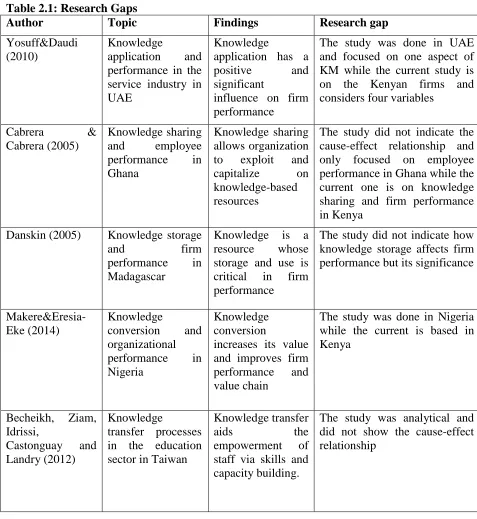
Table 2.1: Research Gaps ...24
Table 3.1: Target Population...27
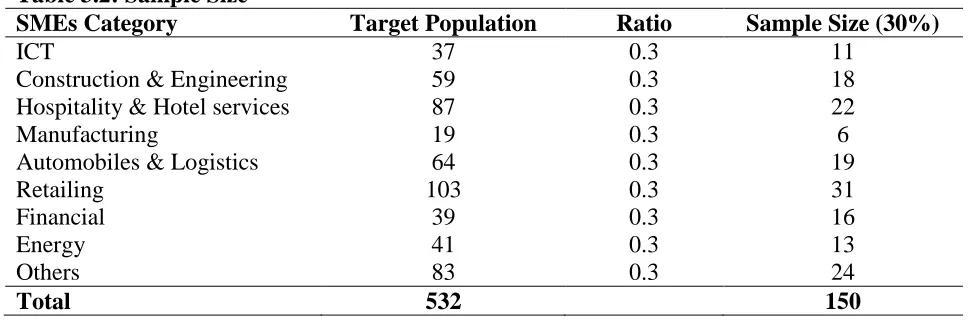
Table 3.2: Sample Size ...27
Table 4.1: Reliability Test...32
Table 4.2: Performance of Small and Medium Enterprises ...36
Table 4.3: Knowledge Creation and Performance of SMES ...37
Table 4.4: Knowledge Acquisition and Performance of SMES ...38
Table 4.5: Knowledge Sharing and Performance of SMES ...39
Table 4.6: Knowledge Implementation and Performance of SMES...40
Table 4.7: Correlation Analysis ...41
Table 4.8: Model Summary ...43
Table 4.9: ANOVA ...43
viii
LIST OF FIGURES
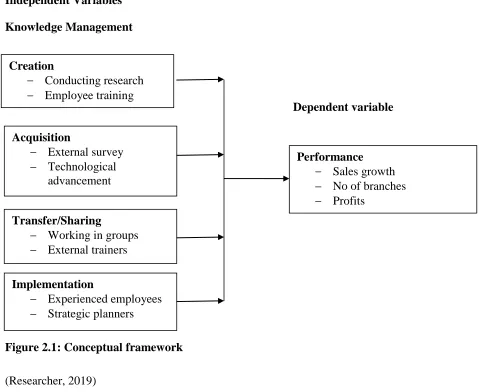
Figure 2.1: Conceptual framework ...25
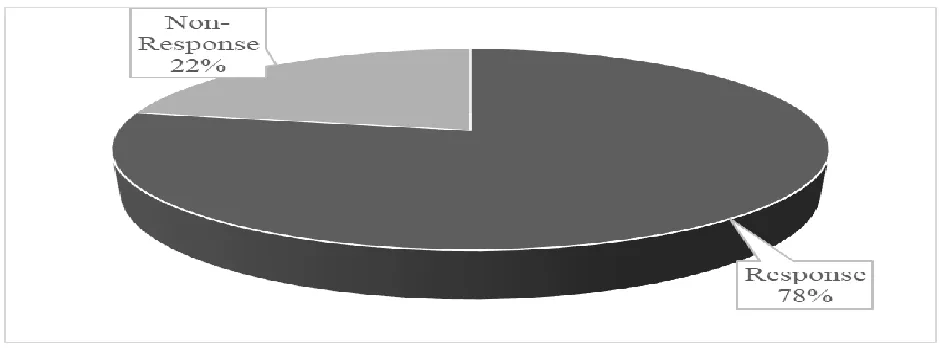
Figure 4.1: Response Rate ...31
Figure 4.2: Gender ...33
Figure 4.3: Highest Level of Education ...33
Figure 4.4: Length of Service ...34
ix
ABBREVIATIONS AND ACRONYMS
KV Knowledge View of a Firm
SME Small and Micro Enterprises RBV Resource Based View of a firm
KS Knowledge sharing
KM Knowledge management
x
OPERATIONAL DEFINITION OF TERMS
Knowledge acquisition- is the process of extracting, structuring and organizing knowledge from one source, usually human experts
Knowledge Management A means by which the organisation‟s core competencies can be focused and developed
Knowledge creation- according to the Nonaka's SECI model is about continuous transfer, combination, and conversion of the different types of knowledge, as users practice, interacts, and learns.
Knowledge implementation- can be considered as transforming knowledge as an idea spreading into new areas of application or as the replacement of an old concept by a new one
Knowledge sharing- is an activity through which knowledge (namely, information, skills, or expertise) is exchanged among people, friends, families, communities (for example, Wikipedia), or organizations.
Knowledge- the pool of information that results from experience and interpretation
xi
xii ABSTRACT
SMEs are an important component of the economy, especially with regard to absorbing a large percentage of the workforce. Good performance of these entities is therefore critical so that they can continue with their economic contribution. The general objective of this study was to investigate the influence of knowledge management practices on the performance of small and medium enterprises in Nairobi City County. Specifically, the study sought to: establish the influence knowledge creation, knowledge acquisition, and knowledge sharing/transfer and knowledge implementation on the performance of small and medium enterprises in Nairobi City County. This study was guided by Resource based view theory, Organizational learning theory and Knowledge based theory. The study was based on descriptive research design. The target population was 532 SMEs firms in Nairobi City County. The sample size was 150 SMEs covering different sectors. The study found out that knowledge creation significantly influenced performance of small and medium enterprises. Knowledge acquisition significantly influenced performance of small and medium enterprises. Knowledge sharing significantly influenced performance of small and medium enterprises. Knowledge implementation significantly influenced performance of small and medium enterprises. The study concludes that knowledge creation enabled creation of new products and services to meet customer need and satisfaction for increased loyalty. SMEs were encouraged to innovate for better services for better productivity and increased returns. SMEs were careful while hiring and put importance in hiring skilled employees for improved and better performance. SMEs put great importance on technological advancement and embraced technology in their daily running of the business. SME firm organized meetings to enable sharing of knowledge and borrowing of better ideas to the enterprises. SMEs achieved technological advantage by encouraging knowledge sharing on current issues. SMEs involved all departments for better exchange of views when implementing knowledge management. The study recommends that knowledge creation ought to enable creation of new products and services to meet customer need and satisfaction for increased loyalty. SMEs ought to be encouraged to innovate better services for better productivity and increased returns. SMEs ought to be careful while hiring and put importance in hiring skilled employees for improved and better performance. SMEs ought to send their employees for external training to increase their competence levels for better productivity. SME firm ought to organized meetings to enable sharing of knowledge and borrowing of better ideas to the enterprises. SMEs ought to achieve technological advantage by encouraging knowledge sharing on current issues. SMEs ought to take a rational decision as a key driver to knowledge implementation. SMEs ought to involve all departments for better exchange of views when implementing knowledge management.
1
CHAPTER ONE INTRODUCTION 1.1 Background of the Study
Small and Medium enterprises have been noted to play a significant role in employment and economic growth of many countries (Liedholm & Mead, 1999). Indeed, in many developing countries as well as developed countries, small and medium enterprises are the focal point of growth and self-employment. In low-income countries, it is estimated that small and medium enterprises account for more than 60 per cent of the GDP and provide over 70 per cent of employment opportunities (Lukacs, 2005).
Knowledge can be considered as the most important strategic resource for ensuring an organization‟s long-term success and survival, because it is unique and difficult to imitate (Grant, 1996; Kogut & Zander, 1992). Moreover, it is strategically important for the management of technology and innovation. These facts have motivated researchers to center their studies on the internal aspects of businesses as being fundamental to their competitiveness, particularly those of an intangible nature which are linked to organizational knowledge (Nonaka & Takeuchi, 1995). The Knowledge management practices (KMS) of a firm is based on the best possible strategic design to create, maintain, transfer and apply organizational knowledge to reach competitive goals (Liebeskind, 1996).
The role of Small and Medium Enterprises in job creation and economic growth globally cannot be disputed. The small and medium sized sector is increasingly being recognized as the prime vehicle for economic development in both developed and developing nations (Zacharakis et al.,
2
advancement. Therefore, SMEs have become a major asset in the economy. In most of the countries in the world, the level of economic dependence on small and medium enterprises has increased in recent years.
In Europe and the U.S. an estimated, 81% of the leading organizations are utilizing some form of knowledge management (Grossman, 2006). Consequently, the key question today is no longer whether to manage knowledge, but how to manage it (Lee & Choi, 2003). The contribution of Small and Medium Enterprises (SMEs) around the globe is unquestionable and especially in developing countries, where development in this sector is seen as a key strategy for economic growth, job generation and poverty reduction (Agupusi, 2007). According to Mutezo (2005), Japan‟s SME sector accounts for the bulk of the country‟s business establishment, proving vital support for employment, for regional economies and by extension for the day-to-day life of the Japanese people. In Taiwan the SME sector generates 98 percent of the economy‟s GDP.
3
In Sub Saharan Africa countries, the full potential of the SME sector has yet to be tapped due to the existence of a number of constraints hampering the development of the sector. SMEs in developing countries primarily face issues relating to business regulations and restrictions, finance, human resource capabilities and technological capabilities (Mwangiet al., 2013). Developing SMEs in developing countries is an important challenge. The main underlying constraints to their growth are lack of finance, lack of human resource capabilities and lack of technological capabilities (Visser, 2013).
4
percentage of the workforce. Adoption of knowledge management practices to these entities is therefore critical so that they can continue with their economic contribution.
1.1.1 Performance of SMEs
Performance assessment in Small and Medium Enterprises (SMEs) is essential to maintain the business viability. Companies with small and medium scale describe their business development in modest performance. For example, achieving sales targets, return on capital, profit and growth performance. Generally, few studies measure SMEs performance to assess the sales level, profitability, sales growth and profit growth (Subroto, Husnah, Aisjah & Djumahir, 2013). One solution to overcome the problems affecting SMEs performance is through business management of Resource-Based. With these arrangements, company able to create a special competence (St-Pierre & Audet, 2011). Resources Based Value (RBV) theory suggests that resources and capabilities are basis to create a strategy.
5
SME performance measurement is done by comparing financial ratios. The goal is to see the weaknesses and strengths that have done an SME in running their business operations. Next time they would be able to make repairs and improvements in processing business in an attempt to obtain a good SME (healthy), a measure of perceived performance. Studies that measure SMEs performance generally consider revenue from sales, profitability, sales growth and profit growth (Fairoz, Hirobumi & Tanaka, 2010).
1.1.2 Knowledge Management Practices
KM is predominantly becoming an essential and significant component in business strategy (Iyer and Ravindran, 2009) since the value of workers and organisational data have become more critical to the organisation‟s outcomes and competitiveness. As postulated by Choong and Wong (2010), KM acts as a means by which the organisation‟s core competencies can be focused and developed. Therefore, KM should not be viewed as just a management „fad‟ since researchers like Chen and Hatzakis (2008) interpreted KM as layers of assortment that can be broken down into norms, practices and, technology that covers most of the aspect of enterprise‟s core business process in increasing organisational effectiveness.
6
Hence, the creation of new knowledge in turn generates higher levels of innovative output, which is then manifested in maintaining business performance. The process of conversion involves creation of TK through informal sharing, moving from TK to explicit and enhancing explicit content by combining codified knowledge and using EK to create new TK through thinking and sharing. The most common method of knowledge transfer across companies in all industries is informal interactions between experts and practitioners through sustained mentoring or apprentice relationship, or through brief discussions by phone or video conference. Besides, transfer of knowledge requires an individual or a group to cooperate with each other to distribute knowledge and achieve mutual benefits (Syed-Ikhsan and Rowland, 2004).
7 1.1.3 SMEs in Nairobi City County
Nairobi City County is one of the forty-seven counties in Kenya. The Nairobi City County is the creation of the Constitution of Kenya 2010 and successor of the defunct City Council of Nairobi. It operates under the auspices of the Cities and Urban Areas Act, The Devolved Governments Act and a host of other Acts. Nairobi is largest and fastest growing cities in Africa. It is also Kenya's principal administrative, economic and cultural centre. Being the Kenyan capital, the national baseline survey (National Baseline Survey, 2014) indicated that about 17% of the total SMEs are located in Nairobi. According to the licensing record provided by Nairobi county licensing office (2015) there 30252 registered SMEs in Nairobi County Government.
The SMEs have gained much popularity among many young entrepreneurs due to the low capital required to start them. The SMEs however have a high motility rate which limits their capacity to make long haul sustainable employment and may likewise be in charge of the best number of riches and occupation misfortunes (Ahwireng, 2003). This is achieved by the SMEs' part being famously unpredictable and encounters a high level of business conclusion and shrinkage (Baard and Van Den Berg, 2004) and subsequently the administration has been attempting endeavors in helping with the advancement of the SME divisions.
Small and medium enterprises (SMEs) are very important for employment creation and are important sources of economic growth (Tambunan, 2005). Nairobi City County is a county in the
former North Eastern Province of Kenya. Its capital and largest town is Nairobi. The county has
a population of 661,94 and an area of 55,840.6 km². Nairobi City County has only one local
authority: Nairobi City County council. The county has four constituencies: Nairobi
8
fourteen administrative divisions. The number of SMEs in Nairobi City County is not well
established because of the locality (Economic Survey, 2015).
1.2 Statement of the Problem
Small and medium enterprises (SMEs) in Nairobi City County have been experiencing poor performance. The county is not well endowed with natural resources. Residents in urban areas tend to practice small and medium enterprises to meet their needs. However, most of these SMEs collapse after some time because of inadequate human capital, knowledge sharing and knowledge transfer. They SMEs owners lack better ways of managing and growing their businesses (Economic Survey, 2012). This is evidenced by World Bank (2014) which noted that many of the Jua Kali SMEs have collapsed in a span of 5 years. Kenya has about 1.6 million registered small and medium sized enterprises constituting about 96 per cent of all business enterprises in the country (Economic Survey, 2009).
9
In addition, the few midsized firms rarely transform to large firms. For an SME to graduate from being small, midsized to large size, a paradigm shift in knowledge management is required. The entrepreneurs of midsized firms may need to adopt a knowledge management practices that would break the obstacles that inhibit better performance. Marques and Simon (2006) conducted a study on biotechnology and telecommunication SMEs and found a positive relationship between knowledge development, transfer and protection processes with firm performance. This enhances a conceptual gap for the study. Chang and Chuang (2011) also noted that KM processes enhance firm performance in Taiwan manufacturing industries. This presents a geographical gap for this study. Mohrman et al. (2003) extended the concept of firm effectiveness measured by Gold et al. (2001) by including financial measures, and found a positive relationship between the extents to which firm creates and exploits knowledge with overall firm performances. This study therefore seeks fill the knowledge gap by establishing the effect of knowledge management practices on the performance of small and medium enterprises in Nairobi City County, Kenya
1.3 Objectives of the Study 1.3.1 General Objective
The main objective of this study is to investigate the influence of knowledge management practices on the performance of small and medium enterprises in Nairobi City County, Kenya. 1.3.2 Specific Objectives
10
i. To establish the influence knowledge creation on performance of small and medium enterprises in Nairobi City County, Kenya.
ii. To determine the influence knowledge acquisition on performance of small and medium enterprises in Nairobi City County, Kenya.
iii. To assess the influence of knowledge sharing on performance of small and medium enterprises in Nairobi City County, Kenya.
iv. To investigate the influence of knowledge implementation on performance of small and medium enterprises in Nairobi City County, Kenya.
1.4 Research Questions
The study was guided by the following research questions:
i. What is the influence of knowledge creation on performance of small and medium enterprises in Nairobi City County, Kenya?
ii. To what extent does knowledge acquisition affect performance of small and medium enterprises in Nairobi City County, Kenya?
iii. How does knowledge sharing influence performance of small and medium enterprises in Nairobi City County, Kenya?
iv. What is the influence of knowledge implementation on performance of small and medium enterprises in Nairobi City County, Kenya?
1.5 Significance of the Study
11
decisions concerning knowledge management to improve performance. Future researchers would find this study useful for it would provide insight into the influence of knowledge management practices on the performance of SMEs in Nairobi City County. The academic argument will then be able to go further than just identifying poor performance among SME‟s in the country, but provide insights about better knowledge management practices and its influence on performance. The researchers would therefore use the findings of this research to advance related argument in future.
1.6 Scope of the Study
This study aimed at determining the influence of knowledge management practices on the performance of the Top SMEs companies in Nairobi City County. The unit of analysis was the top 532 SMEs companies in Nairobi City County. The unit of observation was top management and owners of the 532 SMEs companies who reports to the overall management.
1.7 Limitation of the Study
12 1.8 Organization of the Study
13
CHAPTER TWO LITERATURE REVIEW 2.1 Introduction
The chapter aims at building a theoretical foundation upon which the project is based. It also reviews existing literature based on the specific objectives of the study to establish the knowledge gaps.
2.2 Theoretical Review
A theoretical review is a collection of interrelated concepts. It guides research to determine what things to measure, and what statistical relationships to look for (Defee et al., 2010). A good research should be grounded in theory (Mentzer et al., 2008). This study is anchored in resource-based view theory, organizational learning theory and knowledge-resource-based theory. These theories clearly explain the research in line with the topic.
2.2.1 Resource Based views Theory
14
The knowledge-based views of the firm considers knowledge as the most strategically significant resource of the firm (Grant, 1996) and identify the primary role for the firm in the creation and application of knowledge (Bierly and Daly, 2002).This view considers firm as a „distributed knowledge systems‟ composed of knowledge-holding employees, and believes firm‟s role is to co-ordinate these employees so that they can create knowledge and value for the firm (Spender, 1996). The rationale is that knowledge endows firms with various competencies and capabilities that account for firm performance and competitiveness in the market. Kogut and Zander (1992) suggested that for a firm to remain competitive, it must effectively and efficiently create, locate, capture and share knowledge and expertise in order to apply that knowledge to solve problems and exploit opportunities. Most of the research on the knowledge-based view is process-oriented.
Absorptive capacity is dependent on a firm‟s level of prior related knowledge. A firm‟s absorptive capacity could be enhanced through KM processes which allow the firm to acquire, convert and apply existing and new knowledge by adding value to internal resources, and at the same time sustain competitiveness in the market. Since this is resource based theory, the organization can efficiently with discipline utilize available resources a practice that can be replicated by the SMEs firms in Kenya to boost their performance. The resources marshaled by Small and Medium Enterprises in Kenya are small and so this theory is very important when budgeting for the available scarce resources.
2.2.2 Organization Learning Theory
15
creating, acquiring, and transferring knowledge and modifying behavior to reflect new knowledge and insights. Almost all of the published literature reviews on organizational learning agree on the notion that the process of organizational learning starts with acquiring and disseminating information.
Daft and Weick (1984) perceived the abilities of firms to interpret information as the main component of organizational learning. Such learning is said to occur when new knowledge is generated (Huber, 1991). This theory is applicable to our study as it emphasizes on the importance of knowledge to the development of SMEs in Kenya. These SMEs can share knowledge acquired through innovation, new methods of marketing increasing their customer base. Such initiatives increase SMEs‟ sales revenue.
2.2.3 Knowledge Based Theory
16 2.3 Empirical Review
2.3.1 Knowledge Creation and Performance
Gholami, Asli, Shirkouhi and Noruzy (2013) investigated the Influence of Knowledge Management Practices on Organizational Performance: An Empirical Study. The aim of the study was to investigate the influence of knowledge management practices on organizational performance in small and medium enterprises (SMEs) using structural equation modeling (SEM). A number of 282 senior managers from these enterprises were chosen using simple random sampling and the data were analyzed with the structural equation model. The results showed that knowledge acquisition, knowledge storage, knowledge creation, knowledge sharing, and knowledge implementation have significant factor loading on knowledge management; and also productivity, performance, staff performance, innovation, work relationships, and customer satisfaction have significant factor loading on organizational performance.
17
Considering the mediating effects on knowledge sharing, the study found that the direct effects of Teacher Involvement, Interaction between students and frequency on tacit knowledge creation were significantly positive. In particularly, Interaction between students had relatively negative indirect effects through tacit knowledge sharing. Finally, Website accessibility and usability had significant direct effect on tacit knowledge creation, and had indirect effects on both tacit and explicit knowledge creation through explicit knowledge sharing. In addition, Curriculum Professionalism was negative correlated with explicit knowledge sharing, and it only had indirect effects on knowledge creation.
Choe (2011) conducted a study on the taxonomy of knowledge management practices in manufacturing firms: Use of target costing and IT infrastructure. Based on the usage levels of target costing systems (TCS) and information technology (IT) infrastructure, this study aimed at developing a framework useful for classifying four types of knowledge management (KM) strategies in manufacturing firms: explorative, exploitative, mixed and negative. They adopted a multi-methodological approach by mixing both qualitative and quantitative methods. Before developing a framework, through a mini-case study of the H Motor Company in Korea, the paper aimed to investigate the functions of TCS in the management of tacit knowledge. The mini-case study indicated that with the use of TCS, a firm can create, transfer and share diverse kinds of tacit knowledge among employees for the facilitation of process innovation.
18
article investigated the relationship between knowledge management (KM), innovation and firm performance of smaller firms (less than 100 employees), based on a panel of more than 400 Dutch firms. Regression analyses explain the variations in sales turnover growth from various measures of KM strategies. They distinguished between KM input, throughput and output (or innovation) strategies. They found that KM input strategies related to knowledge acquisition are positively related to sales turnover growth. In contrast, they did not find a relation between KM throughput and KM output (innovation) measures and firm performance. The results emphasized the importance of both knowledge absorption and knowledge creation to the success of innovative efforts in small firms.
2.3.2 Knowledge Acquisition and Performance
Gholami, Asli, Shirkouhi and Noruzy (2013) Investigated the Influence of Knowledge Management Practices on Organizational Performance: An Empirical Study. The aim of the study was to investigate the influence of knowledge management practices on organizational performance in small and medium enterprises (SMEs) using structural equation modeling (SEM). A number of 282 senior managers from these enterprises were chosen using simple random sampling and the data were analyzed with the structural equation model. The results showed that knowledge acquisition, knowledge storage, knowledge creation, knowledge sharing, and knowledge implementation have significant factor loading on knowledge management; and also productivity, performance, staff performance, innovation, work relationships, and customer satisfaction have significant factor loading on organizational performance.
19
knowledge management practices and how they impact on organizational performance in the hospitality industry in Zimbabwe. The research made use of the Processes, Intellectual capital, Culture and Strategy (PICS) model which shows a substantial positive relationship between processes, intellectual capital, and knowledge acquisition and knowledge management. The research was based on case studies of 3 hotels in Zimbabwe. Structured interviews were used to elicit information from managerial employees and questionnaires were administered to non-managerial employees. Stratified random sampling was used to select a total 50 participants mainly 15 managerial and 35 non-managerial staff in the research from all the hotels. The findings from this research revealed that the organisations have in place knowledge management practices and these lead to development of new ideas, new products and also new ways of doing things that would eventually lead to improve the organizational performance.
Daud (2012) conducted a study on Knowledge management processes in SMES and large firms: A comparative evaluation. The competitiveness of a firm depends on the quality of knowledge they apply to their business processes. Knowledge management (KM) processes are part of the firm business processes. These processes require turning personal knowledge into corporate knowledge that can be widely shared throughout a firm and appropriately applied. This study examines how SMEs and large firms apply KM processes in their daily business activities and analyse the influence of KM processes on their financial and non-performance.
20
processes on financial and non-performance differ between SMEs and large firms. Findings from the survey could help these firms to enhance their financial and non-performance via appropriate KM processes.
2.3.3 Knowledge Sharing and Performance
Wanjiru and Gathenya (2015) conducted a study on the Role of Knowledge Management on Performance of Social Enterprises in Kenya: A Case Study of Nairobi City County. This study investigated the role of knowledge sharing on performance of social enterprises in Kenya. Ten social enterprises in Nairobi were selected for the study. A sample of 90 individuals was interviewed from the 10 organizations. Data was collected using questionnaires, interview guides and review organizations‟ document. Data was analyzed through quantitative and qualitative methods. Most social enterprises document share knowledge as indicated by 65% of the respondents who reported that their organizations had established ways of documenting and sharing knowledge.
21
Choe (2011) conducted a study on the taxonomy of knowledge management practices in manufacturing firms: Use of target costing and IT infrastructure. Based on the usage levels of target costing systems (TCS) and information technology (IT) infrastructure, this study aimed at developing a framework useful for classifying four types of knowledge management (KM) strategies in manufacturing firms: explorative, exploitative, mixed and negative. They adopted a multi-methodological approach by mixing both qualitative and quantitative methods. Before developing a framework, through a mini-case study of the H Motor Company in Korea, the paper aimed to investigate the functions of TCS in the management of tacit knowledge. The mini-case study indicated that with the use of TCS, a firm can create, transfer and share diverse kinds of tacit knowledge among employees for the facilitation of process innovation. They also empirically confirmed the four types of KM strategies, and demonstrated the characteristics (such as, size, total sales, age, and knowledge intensity) of the organizations adopting each strategy.
2.3.4 Knowledge Implementation and Performance
22
Gómez and Manzanares (2011) conducted a study on Knowledge management practices, Innovation and Firm Performance an Empirical Study. The study investigated, from the knowledge-based view of the firm, whether there are groups of firms with homogeneous behaviours, as regards to knowledge management practices. The results show important differences in the conception and implementation of KMS, and significant relationships between the performance of some firms and their efficiency in the transmission and application of existing knowledge.
Daud and Yusoff (2010) conducted a study on Knowledge Management and Firm Performance in SMEs: The Role of Social Capital as a Mediating Variable. The study examined knowledge management, social capital and firm performance through the use of a questionnaire directed to small- and medium-sized enterprises all of them situated within the Multimedia Super Corridor in the Klang Valley of Malaysia. The results based on 289 usable questionnaires demonstrated that, knowledge management processes (creation, sharing, acquisition and implementation) influence social capital positively; social capital enhances firm performance; and social capital is a mediator between knowledge management processes and firm performance. The research demonstrated that knowledge management processes (creation, sharing, acquisition and implementation) and social capital can be integrated to enhance firm performance.
23
24 2.4 Research Gaps
Table 2.1: Research Gaps
Author Topic Findings Research gap
Yosuff&Daudi (2010)
Knowledge
application and performance in the service industry in UAE
Knowledge
application has a positive and significant
influence on firm performance
The study was done in UAE and focused on one aspect of KM while the current study is on the Kenyan firms and considers four variables
Cabrera & Cabrera (2005)
Knowledge sharing and employee performance in Ghana
Knowledge sharing allows organization to exploit and capitalize on knowledge-based resources
The study did not indicate the cause-effect relationship and only focused on employee performance in Ghana while the current one is on knowledge sharing and firm performance in Kenya
Danskin (2005) Knowledge storage
and firm
performance in Madagascar
Knowledge is a resource whose storage and use is critical in firm performance
The study did not indicate how knowledge storage affects firm performance but its significance
Makere&Eresia-Eke (2014)
Knowledge
conversion and organizational performance in Nigeria
Knowledge conversion
increases its value and improves firm performance and value chain
The study was done in Nigeria while the current is based in Kenya
Becheikh, Ziam, Idrissi,
Castonguay and Landry (2012)
Knowledge
transfer processes in the education sector in Taiwan
Knowledge transfer
aids the
empowerment of staff via skills and capacity building.
The study was analytical and did not show the cause-effect relationship
2.5 Conceptual Framework
25
of the SME sector that was studied herein are sales growth, number of branches and profits. The independent variables to be included in the study are knowledge creation, Acquisition, Transfer, Storage, Sharing and Implementation.
Independent Variables Knowledge Management
Dependent variable
Figure 2.1: Conceptual framework (Researcher, 2019)
Creation
Conducting research Employee training
Acquisition
External survey Technological advancement
Transfer/Sharing
Working in groups External trainers
Implementation
Experienced employees Strategic planners
26
CHAPTER THREE
RESEARCH METHODOLOGY 3.1 Introduction
This chapter describes the methodology that was used in this study including the research design, study population, sample design, data collection method, data analysis, research procedures, reliability and validity, and data analysis methods.
3.2 Research Design
Descriptive design was used to conduct this study. This type of study attempts to define and describe a subject by creating a problem profile, events or population by collecting data and tabulating their frequencies or interaction (Mugenda and Mugenda, 2009). The study aimed at collecting data from respondents on their opinions in relation to the effect of knowledge management on performance of SMEs.
3.3 Population
27 Table 3.1: Target Population
SMEs Category Target Population Percentage
ICT 37 7.4
Construction & Engineering 59 11.8 Hospitality & Hotel services 87 17.4 Manufacturing 19 3.8 Automobiles & Logistics 64 12.8 Retailing 103 20.6 Financial 39 7.8 Energy 41 8.2 Others 83 16.5
Total 532 100
(Researcher, 2018) 3.4 Sampling Design
The sampling plan describes the sampling unit, sampling frame, sampling procedures and the sample size for the study. According to Mugenda and Mugenda (2003) a sample of 30% is good enough to represent a target population. From the above population of 532 the researcher had a sample of 30% using stratified random sample as follows:
Table 3.2: Sample Size
SMEs Category Target Population Ratio Sample Size (30%)
ICT 37 0.3 11
Construction & Engineering 59 0.3 18
Hospitality & Hotel services 87 0.3 22
Manufacturing 19 0.3 6
Automobiles & Logistics 64 0.3 19
Retailing 103 0.3 31
Financial 39 0.3 16
Energy 41 0.3 13
Others 83 0.3 24
Total 532 150
28 3.5 Data Collection Instruments
Burns and Grove (2003) define data collection as the precise, systematic gathering of information relevant to the research sub-problems, using methods such as interviews, participant observations, focus group discussion, narratives and case histories. The study used primary data. Primary data refers to information that a researcher gathers from the field Kothari (2008). Primary data was obtained from the original sources using questionnaires. The questionnaires were administered through drop and pick method to the respondents working in the selected SMEs.
3.6 Data Collection Procedure
The researcher informed the respondents that the instruments being administered were for research purpose only and the response from the respondents was kept confidential. The researcher obtained an introductory letter from the University in order to collect data from the field and then personally deliver the questionnaires to the respondents so that they can be filled in and then collect the questionnaires later. The drop and pick later method were used in the study.
3.6 Validity and Reliability of the Research Instruments 3.6.1 Reliability of the Research Instruments
29
allowed for modification of various questions in order to rephrase, clarify and or clear up any shortcomings in the questionnaires before administering them to the actual respondents.
3.6.2 Validity of the Research Instruments
Validity is the degree to which the test measures what it is supposed to measure. The questionnaire was in line with the definition used in the research. When a measure is reliable and valid the results can be correctly utilized and understood (Elstak, 2013). Validity of the instrument was established by the research supervisor. To ensure content validity, the questionnaires was subjected to thorough examination by two randomly selected SMEs company owners. They were asked to evaluate the statements in the questionnaire for relevance and whether they were meaningful. On the basis of the evaluation, the instrument was adjusted appropriately before subjecting it to the final data collection exercise. Their review comments were used to ensure that content validity is enhanced.
3.7 Data Analysis and presentation
30
The multiple linear regression models were used to measure the relationship between the independent variables and the dependent variable which are explained in the model.
Y = β0+β 1X1+β 2X2+β 3X3+ β 4X4+e
Where: Y = Performance of SMEs X1 = Knowledge creation
X2 = Knowledge acquisition
X3 = Knowledge sharing
X4 = Knowledge implementation
In the model a is the constant term while the coefficient β1 to β4 are used to measure the
sensitivity of the dependent variable (Y) to unit change in the independent variable (X1, X2, X3,
X4,). is the error term which captures the unexplained variations in the model? The results will
be presented in form of tables and pie charts. 3.8 Ethical Considerations
31
CHAPTER FOUR
RESEARCH FINDINGS AND DISCUSSION 4.1 Introduction
This chapter presents the findings of the analyzed data, presentation and interpretation. The study relied on primary data that was collected by use of structured questionnaires. The collected data was then coded into SPSS Version 23.0 for analysis and presentation. The findings are presented inform of figures and tables.
4.1.1 Response Rate
The sample size of the study was 150 managers and owners of the SMES in Nairobi county. The researcher therefore distributed questionnaires to all of the respondents. 117% of the questionnaires were dully filled and returned to the questionnaires. This gave a response rate of 78% which is deemed sufficient for the study. This is supported by Mugenda and Mugenda (2013) who states that a response rate of 50% and above is deemed sufficient for the study. The findings are as shown in Figure 4.1.
32 4.1.2 Reliability Test
The study carried out a reliability test to establish the reliability of the research instruments, a pilot test was carried out and a Cronbach alpha computed. The findings are as shown in Table 4.1.
Table 4.1: Reliability Test
Variable Number of Items Cronbach Alpha
Knowledge Creation 5 .825
Knowledge Acquisition 5 .799
Knowledge Transfer/Sharing 5 .783
Knowledge Implementation 5 .801
The study established that knowledge creation had a coefficient Cronbach alpha of 0.825, knowledge acquisition had a Cronbach alpha coefficient of 0.799, knowledge transfer/ sharing had a Cronbach alpha coefficient of 0.783 and knowledge implementation had a Cronbach alpha of 0.801. The study established that all the variables had a Cronbach alpha of above 0.7 an indication that the research instruments were sufficient to carry out the study. This is supported by Cronbach (1951) who asserts that a Cronbach alpha of 0.7 and above is sufficient for the study.
4.2 Demographic Information
The researcher asked the respondents to indicate their demographic information to assess their relevance in the study. The findings of gender, highest level of education, length of service and position are as shown in subsequent sections.
4.2.1 Gender
33 Figure 4.2: Gender
The study established that majority of the respondents 62% were male followed by 38% who were female. This shows that majority of SMES in Nairobi management level and owners were male.
4.2.2 Highest Level of Education
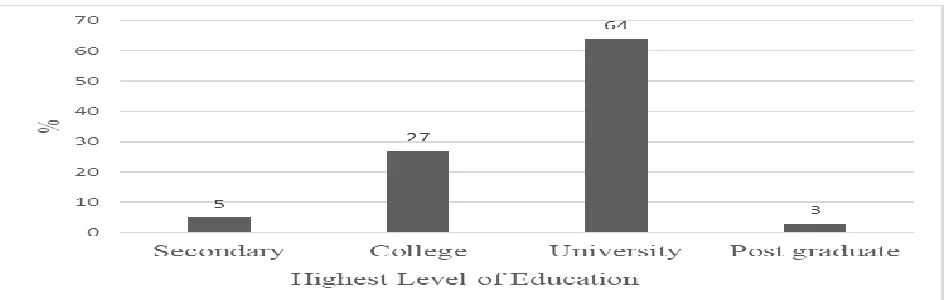
The researcher asked the respondents to indicate their highest level of education. The findings are as shown in Figure 4.2.
Figure 4.3: Highest Level of Education
34
secondary level and 3% had postgraduate degrees. The study shows that majority of the SMEs owners and managers were educated hence increasing their competence level in running the SMEs.
4.2.3 Length of Service
Respondents were asked to indicate how many years they had worked in the enterprise; the findings are as shown in Figure 4.4.
Figure 4.4: Length of Service
The study found out that 49% of the respondents‟ length of service was 3-5 years, followed by 29% whose length of service was less than 2 years and 22% had severed for more than 5 years. This shows that majority of the respondents had been in business for more than 3 years an indication that they had gained skills for running the business.
4.2.4 Position
35 Figure 4.5: Position
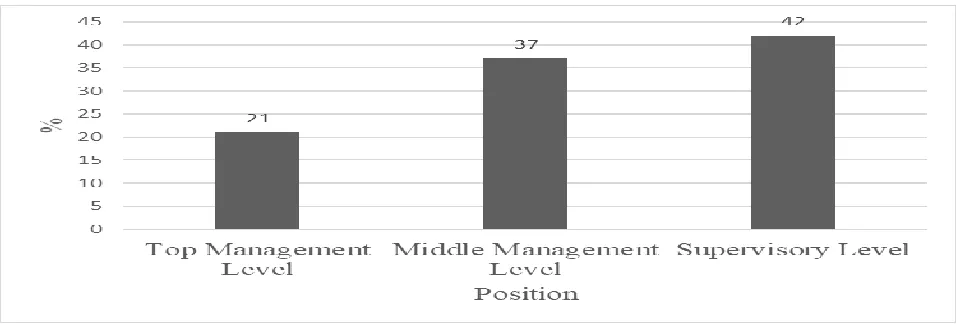
The study established that 42% of the respondents held supervisory position followed by 37% who held middle management level and 21% had top management level. This shows that all the management levels were presented in the study an indication that the researcher was not biased and relevant information was sought.
4.3 Descriptive Statistics
The researcher carried out descriptive statistics to establish the level of agreement on each statement per study variables. The findings are as shown in subsequent sections.
4.3.1 Performance of Small and Medium Enterprises
36
Table 4.2: Performance of Small and Medium Enterprises
Statements Mean Std. Dev
The SME has experienced an improvement in profitability 3.896 .917 The SME has experienced an improvement in total Return on Assets (ROA) 3.742 1.043 The SME has experienced an improvement in total Return on Investment
(ROI) 3.798 .894
The SME has experienced an improvement in Debt Equity Ratio 3.416 .795 The findings in Table 4.2 pointed out that majority of the respondents agreed that the SME had experienced an improvement in profitability as supported by a mean of 3.896 with standard deviation of 0.917. Majority of the respondents agreed that the SME had experienced an improvement in total Return on Assets (ROA) as supported by a mean of 3.798 with standard deviation of 1.043. Majority of the respondents agreed that the SME had experienced an improvement in total Return on Investment (ROI) as supported by a mean of 3.798 with standard deviation of 0.894.
The study further pointed pit that majority of the respondents moderately agreed that the SME had experienced an improvement in Debt Equity Ratio as supported by a mean of 3.416 with standard deviation of 0.795. This is supported by Gholami, Asli, Shirkouhi and Noruzy (2013) who showed that knowledge acquisition, knowledge storage, knowledge creation, knowledge sharing, and knowledge implementation have significant factor loading on knowledge management; and also, productivity, performance, staff performance, innovation, work relationships, and customer satisfaction have significant factor loading on organizational performance.
4.3.2 Knowledge Creation and Performance of SMES
37
Agree, 3 = Neutral, 4 = Disagree and 5 = Strongly disagree was used. The findings are as shown in Table 4.3.
Table 4.3: Knowledge Creation and Performance of SMES
Statements Mean Std. Dev
Knowledge enables creation of new products and services to meet customer
need. 3.914 .925
Our SMEs are encouraged to innovate for better services 3.893 .886 We use knowledge created to utilize available resources efficiently 3.441 .952 Our SME firm empress knowledge creation to obtain competitive advantage 3.687 .875 The study found out that majority of the respondents agreed that knowledge enabled creation of new products and services to meet customer need as shown by a mean of 3.914 with standard deviation of 0.925. Respondents agreed that their SMEs were encouraged to innovate for better services as supported by a mean of 3.893 with standard deviation of 0.886. This is supported by Gholami, Asli, Shirkouhi and Noruzy (2013) who showed that knowledge acquisition had significant factor loading on knowledge management and productivity, performance, staff performance, innovation, work relationships, and customer satisfaction have significant factor loading on organizational performance.
38
4.3.3 Knowledge Acquisition and Performance of SMES
The respondents were asked to examine the influence of knowledge acquisition on the performance of SMEs in Nairobi City County. A Likert scale of 1-5 was used where; 1= Strongly agree, 2 = Agree, 3 = Neutral, 4 = Disagree and 5 = Strongly disagree was used. The findings are as shown in Table 4.4.
Table 4.4: Knowledge Acquisition and Performance of SMES
Statements Mean Std. Dev
Our SME conducts external survey to acquire more knowledge 3.589 1.042 Our SMEs sent our employees for external training 3.394 .973 Our SME puts great importance in hiring skilled employees 3.746 .984 We put great importance on technological advancement 3.674 1.081
The study found out that majority of the respondents agreed that their SME conducted external survey to acquire more knowledge as supported by a mean of 3.589 with standard deviation of 1.042. Respondents moderately agreed that SMEs sent their employees for external training as supported by a mean of 3.394 with standard deviation of .9973. This is supported by Mahapa (2013) who revealed that the organizations had in place knowledge management practices and these lead to development of new ideas, new products and also new ways of doing things that would eventually lead to improve the organizational performance.
39 4.3.4 Knowledge Sharing and Performance of SMES
The respondents were asked to examine the influence of knowledge sharing on the performance of SMEs in Nairobi City County. A Likert scale of 1-5 was used where; 1= Strongly agree, 2 = Agree, 3 = Neutral, 4 = Disagree and 5 = Strongly disagree was used. The findings are as shown in Table 4.5.
Table 4.5: Knowledge Sharing and Performance of SMES
Statements Mean Std. Dev
Our SME empress‟s knowledge sharing as a key driver to innovation 3.768 1.084 Our SME firm organizes meetings to enable sharing of knowledge 3.694 1.042 External experts are invited to share knowledge to our employees 3.436 1.042 To achieve technological advantage, our SME encourage knowledge
sharing on current issues 3.583 .934
The study pointed out that majority of the respondents agreed that their SME impressed knowledge sharing as a key driver to innovation as supported by a mean of 3.768 with standard deviation of 1.084. Majority of the respondents agreed that their SME firm organized meetings to enable sharing of knowledge as shown by a mean of 3.694 with standard deviation of 1.042. The study established that majority of the respondents moderately agreed that external experts were invited to share knowledge to our employees as supported by a mean of 3.436 with standard deviation of 1.042. The study further established that majority of the respondents agreed that achieved technological advantage, their SME encouraged knowledge sharing on current issues as supported by a mean of 3.583 with standard deviation of 0.934. The findings are supported by Maroofi, Nayebi and dehghani (2013) who established that KM was had significant mechanism of increasing innovation and incorporated in performance.
4.3.5 Knowledge Implementation and Performance of SMES
40
Strongly agree, 2 = Agree, 3 = Neutral, 4 = Disagree and 5 = Strongly disagree was used. The findings are as shown in Table 4.2.
Table 4.6: Knowledge Implementation and Performance of SMES
Statements Mean Std. Dev
We address the problem of poor strategic business planning through
effective knowledge implementation 3.693 1.082
In order to make rational decisions regarding our SME knowledge
implementation is key driver 3.582 .918
Our SMEs business has a panel of experts in implementing knowledge
management practices 3.391 .872
Our SME involves all departments when implementing KM 3.962 .718 The study found out that majority of the respondents agreed that they addressed the problem of poor strategic business planning through effective knowledge implementation as supported by a mean of 3.693 with standard deviation of 1.082. Majority of the respondents agreed that in order to make rational decisions regarding their SME knowledge implementation was key driver as supported by a mean of 3.582 with standard deviation of 0.918. This is supported by Kombo (2015) who established that knowledge strategy had a positive and significant effect on innovation activities of the firms.
41 4.4 Inferential Statistics
The study conducted correlation and regression analysis to is to investigate the influence of knowledge management practices on the performance of small and medium enterprises in Nairobi City County, Kenya. The findings are as shown in subsequent sections.
4.4.1 Correlation Analysis
The study conducted correlation analysis to establish the relationship knowledge management practices and performance of small and medium enterprises in Nairobi City County, Kenya. The findings are presented in Table 4.7.
Table 4.7: Correlation Analysis
Performance
Creation Acquisition Sharing
Implementation Performance Pearson
Correlation 1 Sig.
(2-Tailed)
N 114
Knowledge Creation
Pearson
Correlation .720
**
1 Sig.
(2-Tailed) .000
N 114 114
Knowledge Acquisition
Pearson
Correlation .812
**
.726** 1 Sig.
(2-Tailed) .000 .000
N 114 114 114
Knowledge Sharing
Pearson
Correlation .701
**
.638** .714** 1 Sig.
(2-Tailed) .000 .000 .000
N 114 114 114 114
Knowledge Implementation
Pearson
Correlation .596
**
.568** .596** .573** 1
Sig.
(2-Tailed) .000 .000 .000 .000
42
Table 4.7 indicates the findings of correlation analysis. Huber (2004) state the interpretation results of linear relationship between variables. A weak correlation ranges from “r” ranges from ± 0.10 to± 0.29; in a moderate correlation, “r” ranges between ±0.30 and ±0.49; while in a strong correlation, “r” ranges from ±0.5 and ± 0.9.
The study found out that knowledge creation had a Pearson correlation of 0.720 an indication of a strong positive correlation with performance and a p value of 0.00 <0.05 an indication that the variable significantly influenced performance. Knowledge acquisition had a Pearson correlation value of 0.812 an indication of a strong correlation with performance and a p value of 0.00<0.05 an indication that the variable significantly influenced performance. Knowledge sharing had a Pearson correlation of 0.701 an indication of a strong correlation with performance and a p value of 0.00<0.05 an indication that the variable significantly influenced performance. The study further established that knowledge implementation had a Pearson correlation of 0.596 an indication of indication of a strong correlation with performance and a p value of 0.00<0.05 an indication that the variable significantly influenced performance.
4.4.2 Regression Analysis
43 4.4.2.1 Model Summary
The findings of coefficient of correlation and coefficient of determination are as indicate in Table 4.8.
Table 4.8: Model Summary
Model R R Square Adjusted R Square Std. Error of the Estimate
1 .865a .749 .736 1.48599
a. Predictors: (Constant), Knowledge Creation, Knowledge Acquisition, Knowledge Sharing, Knowledge
Implementation
According to Table 4.8, coefficient of correlation R was 0.865 an indication of strong positive correlation between variables. Adjusted coefficient of determination R2 was 0.736 which translates to 73.6%. This means that 73.6% variation in performance can be attributed by the following; knowledge creation, knowledge acquisition, knowledge sharing, knowledge implementation. The residual of 26.4% can be attributed to other factors beyond the scope of the current study.
4.4.2.2 ANOVA
An ANOVA was carried out at 5% level of significance. A comparison between F Calculated and F Critical was carried out. The findings are as indicated in Table 4.9.
Table 4.9: ANOVA
Model Sum of Squares df Mean Square F Sig.
Regression 494.188 4 123.547 83.534 .000b
Residual 165.612 112 1.479
Total 659.800 116
a. Dependent Variable: performance
b. Predictors: (Constant), leadership practices, leadership networking, leadership styles, leadership competency
From the findings, F Calculated was 83.534 and F Critical was 2.4936. Since F Calculated > F Critical, this
44
0.00<0.05 an indication that at least one variable influenced performance of small and medium enterprises in Nairobi City County, Kenya.
4.4.2.3 Coefficients
To determine the individual factor influencing performance of non-governmental organizations in Kiambu County, the following coefficient were generated.
Table 4.10: Coefficients
Model
Unstandardized Coefficients
Standardized Coefficients
t Sig.
B Std. Error Beta
(Constant) 1.149 1.367 .841 .403
Knowledge Creation .275 .071 .315 3.901 .000
Knowledge Acquisition .465 .099 .442 4.693 .000
Knowledge Transfer/Sharing .239 .097 .228 2.472 .016
Knowledge Implementation .392 .095 .310 4.125 .000
a. Dependent Variable: performance
The resultant equation becomes;
Y= 1.149 + 0.275X1+0.465X2+0.239X3+ 0.392X4
Where: Y = Performance of SMEs X1 = Knowledge creation
X2 = Knowledge acquisition
X3 = Knowledge sharing
X4 = Knowledge implementation
45
organizations by 0.275. An increase in knowledge acquisition while holding all the variables constant would lead to increase in performance by 0.465. An increase in knowledge sharing when holding all the variables constant would lead to an increase in performance by 0.239. An increase in knowledge implementation while holding all the variables constant would lead to decrease in performance by 0.012.
The p value of knowledge creation, knowledge acquisition, knowledge sharing and knowledge implementation were less than 0.05 and the t values were greater than 1.96 an indication that the variables significantly influenced performance of small and medium enterprises in Nairobi City County, Kenya.
4.5 Key Findings and Discussions
On knowledge creation, the study established that knowledge creation significantly influenced performance of small and medium enterprises in Nairobi City County, Kenya. This was due to the following factors; knowledge enabled creation of new products and services to meet customer need. SMEs were encouraged to innovate for better services and respondents used knowledge created to utilize available resources efficiently. This is supported by Gholami, Asli, Shirkouhi and Noruzy (2013) who showed that knowledge acquisition had significant factor loading on knowledge management and productivity, performance, staff performance, innovation, work relationships, and customer satisfaction have significant factor loading on organizational performance.
46
knowledge acquisition significantly influenced performance of small and medium enterprises in Nairobi City County, Kenya. SME conducted external survey to acquire more knowledge, puts great importance in hiring skilled employees and on technological advancement. This is supported by Mahapa (2013) who revealed that the organizations had in place knowledge management practices and these lead to development of new ideas, new products and also new ways of doing things that would eventually lead to improve the organizational performance. On knowledge sharing, the study established that knowledge sharing significantly influenced performance of small and medium enterprises in Nairobi City County, Kenya. The study pointed out that SME empress‟s knowledge sharing as a key driver to innovation, SME firm organized meetings to enable sharing of knowledge and SME encouraged knowledge sharing on current issues to achieve technological advantage. This agrees with Maroofi, Nayebi and dehghani (2013) who established that KM was had significant mechanism of increasing innovation and incorporated in performance.
47
CHAPTER FIVE
SUMMARY, CONCLUSION AND RECOMMENDATIONS 5.1 Introduction
This chapter presents summary of the findings as drawn in chapter four per objective. Conclusion and recommendation are drawn as per the study findings. The chapter also presents limitations, contribution to knowledge and areas for further research.
5.2 Summary of the Findings
The specific objectives of the study were; to establish the influence knowledge creation on the performance of small and medium enterprises in Nairobi City County, Kenya. To determine the influence knowledge acquisition on the performance of small and medium enterprises in Nairobi City County, Kenya. To assess the influence of knowledge sharing on the performance of small and medium enterprises in Nairobi City County, Kenya. To investigate the influence of knowledge implementation on the performance of small and medium enterprises in Nairobi City County, Kenya. The study adopted descriptive research design. The target population for the study was 532 SMEs in Nairobi City County and used primary data. descriptive statistics and inferential statistics were generated.
48
knowledge creation significantly influenced performance of small and medium enterprises in Nairobi City County, Kenya.
On knowledge acquisition, the study established that majority of the respondents agreed that their SME conducted external survey to acquire more knowledge. Majority of the respondents agreed that their SME puts great importance in hiring skilled employees. Majority of the respondents agreed that they put great importance on technological advancement. Majority of the respondents moderately agreed that SMEs sent their employees for external training. The findings of regression analysis established that knowledge acquisition significantly influenced performance of small and medium enterprises in Nairobi City County, Kenya.
On knowledge sharing, the study established that majority of the respondents agreed that their SME impressed knowledge sharing as a key driver to innovation. Majority of the respondents agreed that their SME firm organized meetings to enable sharing of knowledge. Majority of the respondents agreed that achieved technological advantage, their SME encouraged knowledge sharing on current issues. Majority of the respondents moderately agreed that external experts were invited to share knowledge to our employees. The findings of regression analysis established that knowledge sharing significantly influenced performance of small and medium enterprises in Nairobi City County, Kenya.
49
management practices. The findings of regression analysis established that knowledge implementation significantly influenced performance of small and medium enterprises in Nairobi City County, Kenya.
5.3 Conclusion
The study concludes that knowledge creation enabled creation of new products and services to meet customer need and satisfaction for increased loyalty. SMEs were encouraged to innovate for better services for better productivity and increased returns. SME firm‟s embraces‟ knowledge creation to obtain competitive advantage to their competitors. SMEs enterprises used knowledge created to utilize available resources efficiently.
The study concludes that their SME conducted external survey to acquire more knowledge on customer retention. SMEs were careful while hiring and put importance in hiring skilled employees for improved and better performance. SMEs put great importance on technological advancement and embraced technology in their daily running of the business. SMEs sent their employees for external training to increase their competence levels for better productivity. The study concludes that SME impressed knowledge sharing as a key driver to innovation and productivity. SME firm organized meetings to enable sharing of knowledge and borrowing of better ideas to the enterprises. SMEs achieved technological advantage by encouraging knowledge sharing on current issues. External experts were invited to share knowledge to SMES employees to increase their competency and efficiency level.
50
views when implementing knowledge management. SMEs business had a panel of experts in implementing knowledge management practices for better productivity and increased performance.
5.4 Recommendations
The study recommends that knowledge creation ought to enable creation of new products and services to meet customer need and satisfaction for increased loyalty. SMEs ought to be encouraged to innovate better services for better productivity and increased returns. SME firm‟s ought to empress‟s knowledge creation to obtain competitive advantage to their competitors. SMEs enterprises ought to use knowledge created to utilize available resources efficiently. The study recommends that their SME ought to conduct external survey to acquire more knowledge on customer retention. SMEs ought to be careful while hiring and put importance in hiring skilled employees for improved and better performance. SMEs ought to put great importance on technological advancement and embraced technology in their daily running of the business. SMEs ought to send their employees for external training to increase their competence levels for better productivity.