Image, Awareness, and Recognition ─ A Case Study of Multilevel Marketing
1Pin-Fenn Chou*, 2Ying-Chun Wang
1Department of Business Administration, Far East University, Tainan City, Taiwan, R.O.C.
2 Department of Airline and Transport Service Management, National Kaohsiung University of Hospitality and Tourism,
Kaohsiung City, Taiwan, R.O.C.
Abstracts
The multilevel marketing industry has existed for many years. Many companies, not just multilevel
marketing companies, always use this sales style for sale of the company's goods or services.
However, the marketing method of multilevel marketing must be that consumers have a certain
understanding and understanding of the multilevel marketing products provided by the company. It is
necessary to trust the company's product quality or to listen to the company's brand name, or even to feel
that the business's image is excellent, so that consumers will be willing to buy multilevel marketing products
or use their services.
The aim of this study is to understand whether differences between these different groups in business
image, awareness, and recognition, such as: gender, age, education, and amount of annual consumption for
personal in multilevel marketing products. Results shown that female is more affirmative of the image of
multilevel marketing companies. The higher the age, these groups are more recognized the awareness of
multilevel marketing companies. It is easy to recognize the multilevel marketing products that are often
purchased, the lower education groups had percept agreement level are higher than the higher education
Keywords: multilevel marketing, image, awareness, and recognition
* Corresponding Author
Motivation and Literatures
There is different of sale style for multilevel marketing and traditional. It is mainly people-oriented. Seller
and customer are directly face-to-face contact to complete sales or recommendations. Multilevel marketing
remuneration comes from buying products, selling products, recruiting multilevel marketing sellers to buy
products and selling products from subordinate distributors (Coughlan and Grayson, 1998).
Multilevel marketing can attract a lot of people to join the ranks of marketing. What it appeals is that
the way the channel is promoted is different from the traditional way of marketing. Moreover, the
distribution of profits is also very detailed. Therefore, users and customers of multilevel marketing products
can also become distributors of the company. Sometimes, based on the fact that more marketing profits can
be allocated, users and customers of multilevel marketing products will be easily attracted by this sale style,
and will also join the company and actively promote the company's products.
From the perspective of marketing theory, customer repurchase ratio is an important indicator of
corporate profitability (Reichheld and Schefter, 2000; Yang and Peterson, 2004).
Biel (1992) scholars believe that when a customer sees a brand name, a link between a set of attributes
and Lenovo can be called a brand image. Srivastava and Kamdar (2009) define the brand image as:
Consumers build their own understanding of the brand based on a set of subjective association perceptions
of a particular brand to form a brand image. Pars and Gulsel (2011) pointed out that the brand image is the
association of product perception in consumer memory, the consumer's understanding of the overall product
Aaker (1991) pointed out that brand awareness, that is, consumers have the ability to identify the name
of the brand under different circumstances. Keller (1993) argues that brand awareness is one of the most
important factors in making purchasing decisions. When consumers make purchases, most will only choose
familiar and well-known brands. Therefore, brand awareness is a useful tool to assist consumers, simplify
product complexity, and become a useful tool to assist in purchasing decisions (Aaker, 1991).
Shabbir, Khan and Khan (2017) pointed out that brand awareness plays a major role in consumer
purchasing decisions. As brand awareness increases, specific products or brands will become part of
consumer thinking. Macdonald and Sharp (2000) believe that brand awareness is a rule of thumb for
consumers to decide whether to buy a product. According to Jara and Cliquet (2012), brand awareness is the
consumer's experience with the brand from previous to present, and the number of times the brand has
accumulated in its memory.
Alba and Hutchinson (1987) define consumer product knowledge in two parts, namely familiarity and
expertise. Engel, Blackwell and Miniard (1995) suggested that product knowledge should include product
categories, brand perceptions, product-related terms and meanings, product attributes, product characteristics,
general beliefs or beliefs about specific brands, and product prices. Malhotra (1993) believes that Awareness
is a consumer's familiarity with a particular brand of product. If consumers are familiar with the product,
consumers will be more likely to be impressed.
Zeithaml (1988) defines product cognition, indicating that product cognition is a holistic judgment and
assessment of product specifications by consumers. Kotler (1991) argues that because of the different
characteristics of consumers, their cognitive attitudes will have a significant impact on consumers'
Test analysis
1. T-test
Firstly, this study to test whether significant difference between the gender and image, awareness, and
recognition.
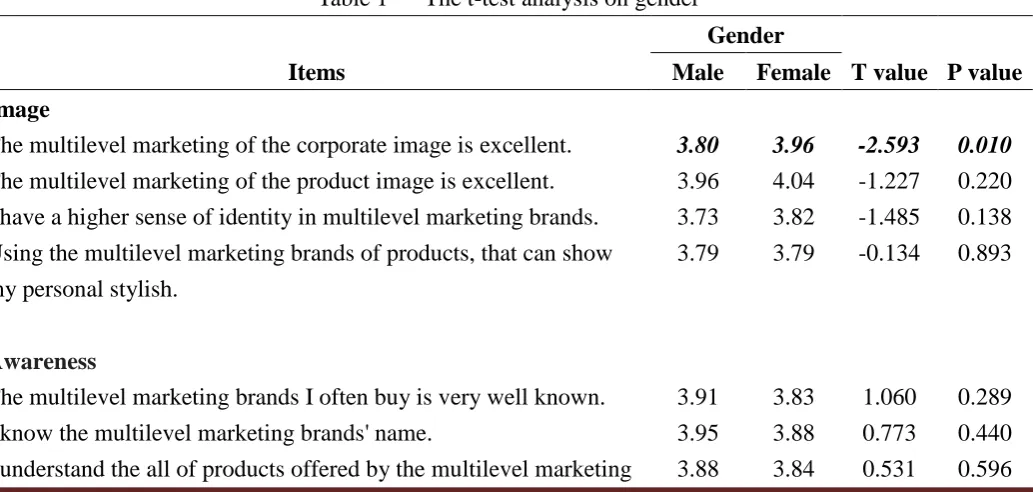
According to the ranking shown in Table 1, the female percept the image items are all higher than male.
‘The multilevel marketing of the product image is excellent’ item, the female had percept ‘agree’
(mean=4.04) highest score on the image items. However, in the awareness concept, the male percept all
items the scores are higher than female. ‘I know the multilevel marketing brands’ name’ is the highest score
by the male percept, and female too. In the recognition concept, ‘The quality of the multilevel marketing
brands I often buy is reliable’ item is the highest score item by male and female percept.
Further, this study uses the t-test analysis. The analysis results only item ‘The multilevel marketing of
the corporate image is excellent’ has a significant difference between gender (p=0.010).
Table 1 The t-test analysis on gender
Gender
Items Male Female T value P value
Image
The multilevel marketing of the corporate image is excellent. 3.80 3.96 -2.593 0.010
The multilevel marketing of the product image is excellent. 3.96 4.04 -1.227 0.220
I have a higher sense of identity in multilevel marketing brands. 3.73 3.82 -1.485 0.138
Using the multilevel marketing brands of products, that can show
my personal stylish.
3.79 3.79 -0.134 0.893
Awareness
The multilevel marketing brands I often buy is very well known. 3.91 3.83 1.060 0.289
I know the multilevel marketing brands' name. 3.95 3.88 0.773 0.440
brands I often to buy.
I know the differences between the multilevel marketing brands that
I often to buy and the general competitive brand (non- multilevel
marketing brands).
3.79 3.73 0.948 0.344
Recognition
Easily, I can recognize the products of the multilevel marketing
brands I often to buy.
3.76 3.76 -0.001 0.999
I think that, the name of the multilevel marketing brands I often to
buy is the synonymous with the multilevel marketing industry.
3.77 3.81 -0.441 0.659
The quality of the multilevel marketing brands I often buy is
reliable.
4.13 4.04 1.121 0.263
I think that the products of the multilevel marketing brands I often to
buy are very characteristic.
3.87 3.94 -1.046 0.296
2. One-way Analysis of Variance
In age, this study divided 6 groups. The item ‘The multilevel marketing of the product image is excellent’ is
the percept highest score item between these age groups. ‘I know the multilevel marketing brands' name’
item then the 6 age groups percept the highest score in awareness concept. And in recognition concept,
except with item ‘I think that, the name of the multilevel marketing brands I often to buy is the synonymous
with the multilevel marketing industry’ that is the percept highest score by the 46-55 age group; other, the
item ‘The quality of the multilevel marketing brands I often buy is reliable’ is the percept highest score in
others groups.
The test whether differences between different age groups to percept the image, awareness, and the
recognition, this study adopt the method of one-way analysis of variance. As shown in Table 2, in Image
concept, only item ‘The multilevel marketing of the product image is excellent’ had not difference between 6
general competitive brand (non-multilevel marketing brands)’ in Awareness concept, which had not
significant difference between 6 age groups. ‘Easily, I can recognize the products of the multilevel
marketing brands I often to buy’ and ‘I think that, the name of the multilevel marketing brands I often to buy
is the synonymous with the multilevel marketing industry’ two items in Recognition concept, there are
significance difference between 6 age groups percept.
In addition, in education, the 4 groups were divided, there are junior high school, senior school,
university, and master and Ph. D. The ranking analysis, item ‘The multilevel marketing of the corporate
image is excellent’ had a most percept level in the Image concept for four education groups. Item ‘The
quality of the multilevel marketing brands I often buy is reliable’ also had a most percept level in the
Recognition concept for four groups.
To used the ANOVA analysis, four items there are following ‘The multilevel marketing of the corporate
image is excellent’, ‘I understand the all of products offered by the multilevel marketing brands I often to
buy’, ‘Easily, I can recognize the products of the multilevel marketing brands I often to buy’, and ‘I think
that the products of the multilevel marketing brands I often to buy are very characteristic’ had a significant
and differences between four education groups (Table 3).
Table 2 Different age groups to percept the image, awareness, and the recognition
Age groups
Items <=15 16-25 26-35 36-45 46-55 >=56 T value P value
Image
The multilevel marketing of the corporate image is excellent. 3.54 3.64 3.84 4.03 4.10 3.95 7.533 0.000
The multilevel marketing of the product image is excellent. 4.04 3.89 3.88 4.13 4.00 4.04 1.538 0.176
I have a higher sense of identity in multilevel marketing
brands.
3.83 3.47 3.77 3.82 3.93 3.82 3.959 0.002
can show my personal stylish.
Awareness
The multilevel marketing brands I often buy is very well
known.
3.94 3.57 3.89 3.90 4.18 3.77 5.507 0.000
I know the multilevel marketing brands' name. 3.96 3.32 3.84 4.09 4.33 3.88 12.151 0.000
I understand the all of products offered by the multilevel
marketing brands I often to buy.
3.81 3.25 3.77 4.15 4.11 3.87 12.525 0.000
I know the differences between the multilevel marketing
brands that I often to buy and the general competitive
brand (non-multilevel marketing brands).
3.73 3.57 3.78 3.87 3.85 3.70 2.068 0.068
Recognition
Easily, I can recognize the products of the multilevel
marketing brands I often to buy.
3.69 3.40 3.73 4.01 4.04 3.60 8.891 0.000
I think that, the name of the multilevel marketing brands
I often to buy is the synonymous with the multilevel
marketing industry.
3.83 3.17 3.82 4.04 4.16 3.66 15.138 0.000
The quality of the multilevel marketing brands I often
buy is reliable.
4.10 4.00 4.12 4.16 4.01 4.07 0.398 0.850
I think that the products of the multilevel marketing
brands I often to buy are very characteristic.
3.88 3.81 4.15 3.83 3.92 3.88 1.834 0.105
Table 3 Different education level groups to percept the image, awareness, and the recognition
Education Items Junior high school Senior school
University Master and Ph.D
F test P value
Image
The multilevel marketing of the corporate image is
excellent.
3.75 3.95 3.98 3.63 4.974 0.002
The multilevel marketing of the product image is
excellent.
3.96 4.07 3.99 3.96 0.644 0.587
I have a higher sense of identity in multilevel
marketing brands.
3.79 3.81 3.76 3.63 0.590 0.622
that can show my personal stylish.
Awareness
The multilevel marketing brands I often buy is very
well known.
3.79 3.91 3.89 3.89 0.677 0.566
I know the multilevel marketing brands' name. 3.92 4.00 3.88 3.59 1.759 0.154
I understand the all of products offered by the
multilevel marketing brands I often to buy.
3.81 4.01 3.84 3.44 3.840 0.010
I know the differences between the multilevel
marketing brands that I often to buy and the general
competitive brand (non- multilevel marketing
brands).
3.65 3.80 3.81 3.74 1.563 0.198
Recognition
Easily, I can recognize the products of the multilevel
marketing brands I often to buy.
3.60 3.81 3.87 3.59 3.947 0.008
I think that, the name of the multilevel marketing
brands I often to buy is the synonymous with the
multilevel marketing industry.
3.77 3.80 3.85 3.44 1.882 0.132
The quality of the multilevel marketing brands I often
buy is reliable.
4.06 3.95 4.21 4.04 2.356 0.071
I think that the products of the multilevel marketing
brands I often to buy are very characteristic.
3.90 3.76 4.04 3.89 3.355 0.019
Amount of annual consumption for personal in multilevel marketing brands, there was shown in Table 4, the
groups were divided: ≦2000, 2001-3000, 3001-4000, 4001-5000, and ≧5001 group in this study,
respectively.
Table 4 Different groups amount of annual consumption for personal in multilevel marketing brands to
percept the image, awareness, and the recognition
Amount of annual consumption for personal
≦2000 2001-3000 3001-4000 4001-5000 ≧5001 F test P value
Image
The multilevel marketing of the corporate image is
excellent.
3.60 3.99 4.09 3.97 3.76 12.270 0.000
The multilevel marketing of the product image is
excellent.
3.86 4.07 4.01 4.13 4.24 2.888 0.022
I have a higher sense of identity in multilevel
marketing brands.
3.65 3.96 3.76 3.87 3.63 4.209 0.002
Using the multilevel marketing brands of products,
that can show my personal stylish.
3.65 3.93 3.88 3.84 3.45 5.150 0.000
Awareness
The multilevel marketing brands I often buy is very
well known.
3.76 4.03 3.88 3.92 3.63 3.426 0.009
I know the multilevel marketing brands' name. 3.82 4.10 3.90 3.92 3.61 3.206 0.013
I understand the all of products offered by the
multilevel marketing brands I often to buy.
3.71 4.11 3.83 3.87 3.61 4.951 0.001
I know the differences between the multilevel
marketing brands that I often to buy and the general
competitive brand (non- multilevel marketing
brands).
3.65 3.94 3.69 3.76 3.79 3.636 0.006
Recognition
Easily, I can recognize the products of the
multilevel marketing brands I often to buy.
3.67 3.88 3.73 3.82 3.74 1.434 0.222
I think that, the name of the multilevel marketing
brands I often to buy is the synonymous with the
multilevel marketing industry.
3.70 4.01 3.78 3.79 3.42 4.609 0.001
The quality of the multilevel marketing brands I
often buy is reliable.
3.93 4.29 4.06 4.03 4.11 2.899 0.022
I think that the products of the multilevel marketing
brands I often to buy are very characteristic.
3.71 4.06 3.98 3.87 3.89 3.536 0.007
Item ‘The multilevel marketing of the product image is excellent’ in the Image concept, and item ‘The
quality of the multilevel marketing brands I often buy is reliable’ in the Recognition concept, are the most
ANOVA analysis results also shown in Table 4, all item had significance differences between five
groups that except with item ‘Easily, I can recognize the products of the multilevel marketing brands I often
to buy’.
Conclusion
Although multilevel marketing has existed for many years, it is also one of the marketing methods used by
the business community. However, in order to enable consumers to understand more about multi-level
marketing products, it is necessary to explore the image and products of business, and consumer perception
level.
Summing up the findings, female is more affirmative of the image of multilevel marketing companies.
The higher the age, these groups are more recognized the awareness of multilevel marketing companies. In
terms of image, the middle-high age group also has a significant percept of identity than the younger groups.
In addition, for the corporate image of a multilevel marketing company, and it is easy to recognize the
multilevel marketing products that are often purchased, the lower education groups had percept agreement
level are higher than the higher education groups.
As the amount of annual consumption for personal in multilevel marketing brands, the 2001-3000
group is most percept the image, awareness, and recognition are then others groups. The imply the
multilevel marketing companies do not have to focus on the high-consumer customer base, but instead have
a significant recognition and made a sale plan for customers who spend less than 3,000 a year.
References
Alba, J. W., and J. W. Hutchinson (1987). Dimensions of consumer expertise. Journal of Consumer
Research, 13, 411-454.
Biel, A. L. (1992). How brand image drives brand equity. Journal of Advertising Research, 32(6),
6-12.
Coughlan, A. T., and K. Grayson (1998). Network marketing organizations: Compensation plans, retail
network growth, and profitability. International Journal of Research in Marketing, 15(5), 401-426.
Engel, J. F., Blackwell, R. D. and P. W. Miniard (1995). Consumer Behavior. (8th ed.) Chicago, New York:
Dryden Press.
Jara, M., and G. Cliquet (2012). Retail Brand Equity: Conceptualization and Measurement. Journal of
Retailing and Consumer Services, 19(1), 140-149.
Keller, K. L. (1993). Conceptualizing, measuring and managing customer-based brand equity. Journal of
Marketing, 57(1), 1-22.
Kotler,P.(1991). Marketing management : analysis, planning, implementation, and control, 7th,New Jersey:
Prentice-Hall.
Macdonald, E. K. and B. M. Sharp (2000). Brand awareness effects on consumer decision making for a
common, repeat purchase product: A replication. Journal of Business Research, 48(1), 5-15.
Malhotra, N. K. (1993). Marketing Research: An Applied Orientation. Consumer Behavior. New Jersey:
Prentice Hall, Inc.
Pars, S. R. and C. Gulsel, (2011). The effects of brand image on consumers' choice. International Journal
of Business and Social Science, 2(20), 227-238.
Reichheld, F.F. and P. Schefter (2000) E-Loyalty: Your secret weapon on the web. Harvard Business Review,
78, 105-113.
Shabbir, M. Q., Khan, A. A., and S. R. Khan (2017). Brand loyalty brand image and brand equity: The
mediating role of brand awareness. International Journal of Innovation and Applied Studies, 19 (2),
Srivastava, M. and R. M. Kamdar (2009). Brand image formation as a function of involvement and
familiarity. Paradigm, 13(1), 84-90.
Yang, Z., and R. T. Peterson (2004). Customer perceived value, satisfaction, and loyalty: The role of switching
costs. Psychology and Marketing, 21(10), 799-822.
Zeithaml, V. A. (1988). Consumer perceptions of price, quality and value: A means-end model and synthesis