SCHOOL SAFETY AND ITS INFLUENCE ON TEACHING AND LEARNING PROCESSES IN PUBLIC SECONDARY SCHOOLS IN
NAIROBI AND NYERI COUNTIES, KENYA
WANDERI ANNE NJOKI E83/CE/11189/08
A THESIS SUBMITTED TO THE SCHOOL OF EDUCATION IN PARTIAL FULFILLMENT OF THE REQUIREMENTS FOR THE
AWARD OF THE DEGREE OF DOCTOR OF PHILOSOPHY IN EDUCATIONAL MANAGEMENT OF KENYATTA UNIVERSITY
DECLARATION
This thesis is my original work and has not been presented in any other University for consideration. This thesis has been complemented by referenced sources duly acknowledged. Where text, data (including spoken words), or tables have been borrowed, including the internet, these are specifically accredited and references cited in accordance in line with anti-plagiarism regulations.
Signature Date
Wanderi Anne Njoki E83/CE/11189/08
Supervisors Declaration: We confirm that the work in this thesis was carried out by the candidate under our supervision as university supervisors.
Signature Date
Dr. George A. Onyango Lecturer,
Department of Educational Management, Policy and Curriculum Studies,
Kenyatta University
Signature Date
Dr. Martin Ogola Lecturer,
Department of Educational Management, Policy and Curriculum Studies,
DEDICATION
ACKNOWLEDGEMENTS
TABLE OF CONTENTS
DECLARATION... ii
DEDICATION... iii
ACKNOWLEDGEMENTS ... iv
TABLE OF CONTENTS ...v
LIST OF TABLES ... xi
LIST OF FIGURES ... xii
ACRONYMS AND ABBREVIATIONS ... xiii
ABSTRACT ...xv
CHAPTER ONE:INTRODUCTION ...1
1.1 Introduction ...1
1.2 Background to the Study ...1
1.2.1 Conceptualization of ―School Safety‖ and ―Teaching and Learning Processes‖ ...2
1.3 Statement of the Problem ...12
1.4 Purpose of the Study ...13
1.5 Research Objectives ...13
1.6 Research Questions ...13
1.7 Significance of the Study ...14
1.8 Limitations of the Study...15
1.9 Delimitations of the Study ...16
1.10 Assumptions of the study ...17
1.11 Theoretical Framework ...18
1.12 Conceptual Framework ...19
1.13 Operational Definition of Key Terms ...22
CHAPTER TWO: REVIEW OF RELATED LITERATURE ...26
2.1 Introduction ...26
2.2 Status of School Physical Infrastructure Safety ...26
2.4 Influence of School Physical Infrastructure Safety on Teaching and Learning
Processes ...34
2.4.1 Influence of Classroom Safety on teaching and learning processes .34 2.4.2 Influence of Dormitory Safety on teaching and learning processes .37 2.4.3 Influence of Dining Hall and Kitchen Safety on Teaching and Learning Processes...38
2.4.4 Influence of Laboratory and Library Safety on teaching and learning processes ...39
2.4.5 Influence of School toilets and playground Safety on teaching and learning processes ...41
2.5 Influence of School Social Environment Safety on Teaching and Learning Processes ...45
2.5.1 Alcohol, Drug and Substance safety and its influence on Teaching and Learning Processes ...46
2.5.2 Child Abuse safety and its influence on teaching and learning processes ...49
2.5.3 Special Needs/ Disabilities safety and its influence on teaching and learning processes ...50
2.6 Suggestions on Ways to enhance school safety for Teaching and Learning Processes ...53
2.7 Summary of the Key Research Gaps ...58
CHAPTER THREE:RESEARCH DESIGN AND METHODOLOGY...61
3.1 Introduction ...61
3.2 Research Design...61
3.3 Variables of the Study ...62
3.4 Location of the Study ...62
3.5 Population ...63
3.5.1 Schools ...63
3.5.2 Respondents ...64
3.6 Sampling Procedures ...65
3.6.1 Sample of Schools, Principals and Deputy Principals ...65
3.6.3 Sample of Quality Assurance Officers ...66
3.7 Description of the Research Instruments ...67
3.7.1 School Safety Questionnaire for Principals, (See Appendix I), Deputy Principals (Appendix ii) and Students (Appendix iii)...68
3.7.2 School Safety Interview Guide for County Quality Assurance and Standards Officers (see Appendix iv) ...69
3.7.3 Observation Guide for School Safety( see Appendix v) ...69
3.8 Validity of the Research Instruments ...70
3.8.1 Pre-Testing/Piloting study ...70
3.8.2 Reliability of the Instruments...71
3.9 Data Collection Procedure ...72
3.10 Data Analysis Procedure ...74
3.11 Logistical and Ethical Consideration ...76
CHAPTER FOUR:FINDINGS AND DISCUSSION ...78
4.1 Introduction ...78
4.2 Background Information about the Respondents ...79
4.2.1 Students‘ Background Information ...79
4.2.2 Deputy Principals, Principals and Quality Assurance and Standards officers (QASOs)s‘ Background information ...82
4.3 The Status of School Physical Infrastructure Safety in Public Secondary Schools in Nairobi and Nyeri Counties ...86
4.3.1 Safety status of Classrooms in Public Secondary Schools in Nairobi and Nyeri Counties ...87
4.3.2 Safety Status of Dormitories in Public Secondary Schools in Nairobi and Nyeri Counties ...94
4.3.3 Safety Status of Dining Halls and Kitchens in Public Secondary Schools in Nairobi and Nyeri Counties ...100
4.3.4 Safety Status of School Laboratories and Libraries in Public Secondary Schools in Nairobi and Nyeri Counties...107
4.4 Safety Status of School Social Environment in Public Secondary Schools in Nairobi and Nyeri Counties ...120 4.4.1 Alcohol, Drugs and Substance Safety in Public Secondary Schools in
Nairobi and Nyeri Counties ...121 4.4.2 Safety from Child Abuse in Public Secondary Schools in Nairobi and
Nyeri Counties ...125 4.4.3 Safety of Children with Special Needs in Public Secondary Schools in
Nairobi and Nyeri Counties ...129 4.5 Influence of School Physical Infrastructure Safety on Teaching and Learning
Processes in Public Secondary Schools in Nairobi and Nyeri Counties ....133 4.5.1 Influence of Classroom Safety on Teaching and Learning Processes
in Public Secondary Schools in Nairobi and Nyeri Counties ...134 4.5.2 Influence of Dormitory Safety on Teaching and Learning Processes in
Public Secondary Schools in Nairobi and Nyeri Counties ...137 4.5.3 Influence of Dining hall and kitchen Safety on Teaching and Learning
Processes in Public Secondary Schools in Nairobi and Nyeri
Counties ...139 4.5.4 Influence of Laboratory and Library Safety on Teaching and Learning
Processes in Public Secondary Schools in Nairobi and Nyeri
Counties ...140 4.5.5 Influence of School toilets and Playground Safety on Teaching and
Learning Processes in Public Secondary Schools in Nairobi and Nyeri Counties ...141 4.6 Influence of School Social Environment Safety on Teaching and Learning
Processes in Public Secondary Schools in Nairobi and Nyeri Counties ....144 4.6.1 Safety against Alcohol, Drug and Substance Abuse and its Influence
on Teaching and Learning Processes in Nairobi and Nyeri
Counties ...145 4.6.2 Safety against Child Abuse and its Influence on Teaching and
Learning Processes...145 4.6.3 Safety of Children with Special Needs and its Influence on Teaching
4.7 Suggestions on Ways School Safety can be enhanced to Promote Teaching and Learning Processes in Public Secondary Schools. ...149
CHAPTER FIVE:SUMMARY, CONCLUSIONS AND
RECOMMENDATIONS ...153 5.1 Introduction ...153 5.2 Summary ...153
5.2.1 The Status of School physical infrastructure safety in Public
Secondary Schools in Nairobi and Nyeri Counties...154 5.2.2 The Status of School social environment safety in Public Secondary
Schools in Nairobi and Nyeri Counties ...154 5.2.3 Influence of School Physical infrastructure Safety on Teaching and
Learning Processes in Public Secondary Schools in Nairobi and Nyeri Counties ...155 5.2.4 Influence of School social environment Safety on Teaching and
Learning Processes in Public Secondary Schools in Nairobi and Nyeri Counties ...155 5.2.5 Suggestions from respondents on ways that school safety can be
enhanced to promote teaching and learning in Public Secondary Schools in Nairobi and Nyeri Counties ...156 5.3 Conclusions ...157
5.3.1 The Status of School physical infrastructure Safety in Public
Secondary Schools in Nairobi and Nyeri Counties...157 5.3.2 The Status of School social environment safety in Public Secondary
Schools in Nairobi and Nyeri Counties ...157 5.3.3 Influence of School physical infrastructure Safety on Teaching and
Learning Processes in Public Secondary Schools in Nairobi and Nyeri Counties ...158 5.3.4 Influence of School Social environment Safety on Teaching and
5.3.5 Suggestions from respondents on ways that school safety can be enhanced to promote teaching and learning in Public Secondary
Schools in Nairobi and Nyeri Counties ...158
5.4 Recommendations ...159
5.4.1 Policy and Practice Recommendations ...159
5.4.2 Suggestions for Further Studies ...163
REFERENCES ...164
APPENDICES ...182
APPENDIX I: PRINCIPAL‘S QUESTIONNAIRE ON SCHOOL SAFETY INFLUENCES ON TEACHING AND LEARNING PROCESSES...182
APPENDIX II: DEPUTY PRINCIPAL‘S QUESTIONNAIRE ON SCHOOL SAFETY INFLUENCES ON TEACHING AND LEARNING PROCESSES...191
APPENDIX III: STUDENTS‘ QUESTIONNAIRE ON SCHOOL SAFETY INFLUENCES ON TEACHING AND LEARNING PROCESSES...200
APPENDIX IV: INTERVIEW GUIDE ON SCHOOL SAFETY INFLUENCE ON TEACHING AND LEARNING PROCESSES FOR COUNTY QUALITY ASSURANCE AND STANDARDS OFFICERS ...209
APPENDIX V: OBSERVATION GUIDE ON THE STATUS OF SCHOOL SAFETY INFLUENCE ON TEACHING AND LEARNING PROCESSES...212
APPENDIX VI: INFORMED CONSENT PARTICIPANT/GUARDIAN FORM ...214
APPENDIX VII: TABLE FOR DETERMINING SAMPLE SIZE ...215
APPENDIX VIII: RESEARCH AUTHORIZATION LETTER ...216
LIST OF TABLES
Table 3.1: Sampling Matrix ...67
Table 3.1.1: Summary of the Sample (n=473) ...67
Table 3.2: Data Analysis Framework...76
Table 4.1: Students‘ Gender and Age ...79
Table 4.2: Deputy Principals and Quality Assurance and Standards officers‘ gender ...82
Table 4.3: Deputy Principals and Quality Assurance and Standards officers‘ Working Experience ...83
Table 4.4: Deputy Principals and Quality Assurance and Standards officers‘ No. of years worked in current station ...83
Table 4.5: Deputy Principals and Quality Assurance and Standards officers‘ Academic Qualifications ...84
Table 4.6: Students‘, Deputy Principals‘ and Principals‘ Response on Classroom Safety ...88
Table 4.7: Students‘, Deputy Principals‘ and Principals‘ Responses on Dormitories Safety ...95
Table 4.8: Students‘, Deputy Principals‘ and Principals‘ Responses on Dining Hall and Kitchen Safety ...101
Table 4.9: Students‘, Deputy Principals‘ and Principals‘ Responses on School Laboratories and Libraries Safety ...108
Table 4.10: Students‘, Deputy Principals‘ and Principals‘ Responses on School Toilets and Play Grounds Safety ...113
Table 4.11: Students‘, Deputy Principals‘ and Principals‘ Responses on Alcohol, Drug and Substance Safety in Public Secondary Schools in Nairobi and Nyeri Counties ...122
Table 4.12: Students, Deputy Principals and Principals‘ Responses on Issues of Child Abuse ...126
LIST OF FIGURES
Figure 1.1: Conceptual Framework showing the relationship between school
safety and teaching and learning process ...21
Figure 4.1: Distribution of Students by Type of the School...81
Figure 4.2: An Example of a Classroom Window with Grills ...91
Figure 4.3: An Example of a Classroom Window without Grills ...91
Figure 4.4: An Example of a Classroom Door Opening Towards Outside ...92
Figure 4.5: An Example of a Classroom Door Opening Towards Inside ...92
Figure 4.6: An Example of a Congested Dormitory with Triple Deckers with Weak Front- Grills ...98
Figure 4.7: An Example of a Clean and Spacious Dormitory with Double Deckers but without Side-Grills...99
Figure 4.8: An Example of a Clean, Spacious Dining Hall with Appropriate104 Furniture ...104
Figure 4.9: An Example of a Dirty Squeezed Dining Hall with Inappropriate Furniture ...104
Figure 4.10: An Example of Properly raised Storage Grain Facility ...105
Figure 4.11: An Example of a Dirty, Open Drainage Channel to Dispose Waste Water from a Dining Hall ...105
Figure 4.12: An Example of a Poorly Constructed and Insecure School Gate 116 Figure 4.13: An Example of a Properly Fitted and Lockable Gate with a Security Officer ...116
Figure 4.14: An Example of Inappropriately Constructed Pit Latrines between Classrooms and Administration Block ...117
Figure 4.15: An Example of a Well Leveled Playground ...117
Figure 4.16: An Example of a Poorly Leveled Playground ...118
Figure 4.17: An Example of an Insecure Live Fence ...118
ACRONYMS AND ABBREVIATIONS
AC RWC African Charter on the Right and Welfare of the Children ADA Alcohol, Drug and Substance Abuse
ANOVA Analysis of Variance
AVID Advancement via Individual Determination BEST Building Educational Success Together CPSC Consumer Product Safety Commission CRC Convention on Rights of the Child
CWS Church World Service
CQASOs County Quality Assurance and Standard Officers
FTF First Things First
GAO The United States General Accounting Office GPS Global Positioning Systems
HISD Houston Independent School District
IAQ Indoor Air Quality
ICSS International Conference on School Safety
MDGs Millennium Development Goals
MOE Ministry of Education
NCLB No Child Left Behind Act
OBPP Olweus Bullying Prevention Program
OHC Opus Hamilton Consultants Ltd Organization PBIS Positive Behavioral Interventions and Supports PDE Provincial Director of Education
S.S.C Safe School Contract SSM Safety Standard Manual
TLEA Total Learning Environment Assessment TSC Teachers Service Commission
UNDCP United Nations Control Programme
UNESCO United Nations Educational, Scientific and Cultural Organization
USAID United States Agency for International Development U.S.D.E United States of America Department of Education TLEA Total Learning Environment Assessment
WASH Water, Sanitation and Hygiene
WCEFA World Conference on Education for All
ABSTRACT
CHAPTER ONE
INTRODUCTION
1.1 Introduction
This chapter provides the background to the study, statement of the problem, purpose of the study, objectives of the study and research questions that guided the study, significance of the study, limitations and delimitations of the study. The chapter also presents assumptions of the study, theoretical and conceptual frameworks as well as operational definition of key terms.
1.2 Background to the Study
Globally reviewed literature indicates that safety of learners is central to the provision of quality education (Glariana & Solar, 2015). A safe and secure school environment facilitates and fosters quality teaching and learning in educational institutions Maxwell et al, (2017).
Unsafe school environments have influences on child care, health, hygiene and sanitation (Munyasi, 2002). These influences underscore the urgent need for enhanced safety in learning institutions in order to provide safe school environment. Arum (2012) indicates that if students feel unsafe in school, they are less able to concentrate in class and perform poorly in assessments because feelings of safety are positively related to both behavioral and academic outcome.
establishing and maintaining a school that is a physically, cognitively and emotionally safe space for students and staff to carry out learning activities. This can include procedures for maintaining a structurally sound building, conducting emergency drills and having an outlet for students and staff to report abuses or concerns. Similarly, according to Lussier and Fitzpatrick (2016) and May (2014), a safe school is the foundation of a good education. Studies have shown that when students feel safe, they learn better. Teachers can become more effective when they know students are under control and can concentrate on instructing the class (Ozmen, Durb &Akgulc, 2010)).
The importance of school safety in the provision of education is well documented in various studies (Reyes et al, 2012, Glariana & Solar, 2015; Maxwell et al., 2017).The importance of provision of safety in schools has further been underscored by various international conventions notably the United Nations Conference (Hyogo; Japan, in 2005) and the United Nations Conference in Geneva, Switzerland, 2009). The United Nations conference in Geneva, Switzerland (2009) in particular called on all governments to undertake assessments of existing education and health facilities by 2011 and to develop and implement national action plans for safer schools and hospitals in all disaster prone countries by 2015. In the next sub section, the study conceptualizes the term ―school safety‖ and ―teaching and learning processes‖ as used across the globe.
1.2.1 Conceptualization of “School Safety” and “Teaching and Learning Processes”
(HFA); ―Building the Resilience of Nations and Communities to Disaster‖. This was followed by a series of other conferences that emphasized the importance of school safety. The United Nations Conference in Geneva, Switzerland (2009) insisted on National Assessment of School Infrastructure while The Global Platform for Disaster Reduction (2013) requested that a Global Safe Schools and Safe health infrastructures campaign be initiated in Disaster prone areas with a voluntary funding and commitments by 2015. The conference noted that provision of safety in school was deficient in terms of existing educational infrastructure facilities, disaster reduction and preparedness as well as lack of a holistic approach to school safety (UNESCO/UNICEF, 2012).
―Teacher Training and Development for Peace -building in the Horn of Africa and surrounding countries‖ project. It aimed to introduce teachers to the knowledge and skills needed for the establishment, maintenance and sustainment of basic school safety (UNESCO, 2017). The Manual states that it is the responsibility of schools to provide a safe environment for their students. This responsibility is affirmed in the United Nations (UN) Sustainable Development Goal Four on Education. Target 4a states:
Build and upgrade education facilities that are child, disability and gender sensitive and provide safe, non-violent, inclusive and effective learning environment for all (UNESCO, 2015).
According to Benbenishty and Astor (2005), every country to a certain extent is concerned with the issue of safety in learning institutions. This is as a result of recurrent accidents and disasters in schools which include fire, floods, gun attacks, collapsing buildings and which have disrupted teaching and learning activities in learning institutions. In view of the above, organizations in The United States of America, Europe, Australia, Asia and Africa took safe school initiative to fulfill the Hyogo Framework Action 2005 – 2015.
school contributing to 1.5 million student victims of nonfatal crimes, including 26 violent crimes per 1000 students; compared to 20 violent crimes per 1000 students away from school. Twenty five percent of schools reported student bullying occurred on a daily or weekly basis; and while the rate of crime for students away from school declined between 1992 and 2007, no measurable difference was found in schools between 2004 and 2007 (UNISDR, 2010; Alba & Gable, 2012).
In the United States of America, A Guide for preventing and responding to school violence, ―International Association of Chiefs Police 2rd edition‖ (2009), explains mitigation measures to ensure schools are safe. These include training school personnel on how to detect; prevent and respond to a violent individual within a school environment; security controls such as access controls; security procedures such as lock down and evacuation as well as rapid response to an incident in schools (Marquet, 2013).
academic initiatives with tangible factors of the school safety. Further, McGowen (2007) notes that on the one hand, student achievement, attendance and completion rate measures were not statistically significant in relation to school facility conditions as measured by the Total Learning Environment Assessment (TLEA) at the 0.05 level. On the other hand, discipline or behaviour was found to be significantly related to the TLEA. Thus, school safety could be used to predict discipline factors for schools which are very crucial to teaching and learning process (McGowen (2007).
Similar views have been echoed by Bullock (2007) who states that since the passage of The No Child Left behind Act of 2001(NCLB) in the USA, there has been a call Nationwide for school systems to be accountable for safety issues in schools .The United States General Accounting Office (GAO), 1996) and Schneider (2002) note that the average age of schools in United States of America was close to fifty years old and they had documented widespread physical deficiencies that had negative influences on teaching and learning process.
BEST (2005), indicates that safe schools create an environment that increases academic, social and emotional success - an environment of strong school connectedness, and that students who feel connected to school have both positive academic and behavioral outcomes. Increased student connectedness promotes classroom engagement and school attendance which increases students‘ academic achievement and competency to overcome challenges. Connected students are focused, achieve higher grades, and invest in relationships at school.
Positive Behavioral Interventions and Supports (PBIS) is a process for creating safer and more proper schools (Horner, 2009, pp.4). The process focuses on improving school‘s ability to teach and support positive behaviour for all students which is crucial for educational outcomes. It is a team-based process for systematic problem solving, planning, and evaluation. An assessment of 33 elementary schools (K–5) in Illinois and Hawaii showed that schools implementing PBIS were perceived as safer environments and reported improved educational performance (Horner, 2009).
In Australia, the National Crime Prevention, in partnership with other Commonwealth and state partners have developed an approach to school safety across all states and is investing in long term projects aimed at buttressing the capacity of schools, their staff and communities. According to Shaw (2002), a review of school based prevention policies have been undertaken. Innovative and restorative policies that deal with safety in schools have also been piloted in Queensland and the Australian Capital Territory. These approaches have improved school safety in Australia and positively impacted on educational outcome.
implemented to ensure physical, emotional and social safety which consequently influenced teaching and learning processes in schools.
In Asia, the Association of Southeast Asian Nations (ASEAN) Safe School Initiative (ASSI) was initiated in 2012 under the purview of the ASEAN Committee on Disaster Management. It partners with civil society organizations to promote a comprehensive approach to school safety so that children become more resilient to disasters and to have safe and secure learning environment in South - East Asia. The ASSI initiative is informed by the Global Framework for Comprehensive School Safety. It comprises three pillars - safe learning facilities, school disaster management and, risk reduction and resilience education.
Uganda has implemented the Safe School Contract (S.S.C) as one of the identified interventions which strengthen the role of teachers, pupils, parents and their involvement in children‘s education. The Ugandan Ministry of Education and Sports together with United States Agency for International Development (USAID) introduced more than 200 schools to S.S.C by the year 2008 so as to enhance safety in school. Through the experience in the 200 supported schools, S.S.C offers a mechanism for promoting safety in schools through strengthening school-community relationships and student participation (Lulua, 2008). These interventions have improved school safety and directly enhanced teaching and learning processes in Ugandan schools.
programme that the Ministry of Education with the support of CWS engaged a team of consultants to compile a Safety and Standards Manual for use in all Kenyan schools. The Safety and Standards Manual comprises the following safety issues: safety in physical infrastructure, safety in school environment, health and hygiene safety, food safety, safety against alcohol, drug and substance abuse, safety in teaching and learning environments, social-cultural environment of the school, safety of children with special needs, safety against child abuse, transportation safety, school community relations and safety on school grounds (MOE, 2008). The Manual embraces diverse issues that have influence on the safety of learners, personnel, parents and the catchment communities around the schools.
1.3 Statement of the Problem
Kenyan educational institutions have experienced several ghastly incidents, which other than leading to damage of properties, injuries and loss of lives through cases of fire and other health risk situations, have led to disruption of teaching and learning processes. From 1999 to 2008, a series of safety incidents were experienced in schools. These incidents included: St Kizito incidence in (1991), the Hawiga Girls‘ rape incident (1993), the Bombolulu fire tragedy (1998), Nyeri High school fire (1999), Kyanguli fire (2001) and Upper Hill fire (2008). The incidents prompted the Ministry of Education (MOE) in partnership with the Church World Service (CWS) to issue the Safety and Standards Manual for Schools (SSM) in 2008.
1.4 Purpose of the Study
The purpose of this study was to establish the status of school safety and its influence on teaching and learning processes in public secondary schools in Nairobi and Nyeri Counties, Kenya, in reference to Safety and Standards Manual issued in 2008 by the Ministry of Education.
1.5 Research Objectives The research objectives were:
1. To assess the status of physical infrastructure safety in Public Secondary schools in Nairobi and Nyeri Counties.
2. To assess the status of social environment safety in Public Secondary schools in Nairobi and Nyeri Counties.
3. To establish the influence of physical infrastructure safety on teaching and learning processes in public secondary schools in Nairobi and Nyeri counties. 4. To establish the influence of social environment safety on teaching and learning
processes in public secondary schools in Nairobi and Nyeri counties.
5. To seek suggestions from respondents on ways school safety can be enhanced to promote teaching and learning in Public Secondary Schools in Nairobi and Nyeri counties.
1.6 Research Questions
1. What is the safety status of school physical infrastructure in public secondary schools in Nairobi and Nyeri Counties, Kenya?
3. What influence does school physical infrastructure safety has on teaching and learning processes in public secondary schools in Nairobi and Nyeri counties? 4. What influence does school social environment safety has on teaching and
learning processes in public secondary schools in Nairobi and Nyeri counties? 5. How can schools enhance safety to promote teaching and learning processes in
Public Secondary Schools in Nairobi and Nyeri counties?
1.7 Significance of the Study
School safety is an integral and indispensable component of teaching and learning processes. Indeed, no meaningful teaching and learning can take place in an environment that is unsafe and insecure to both learners and staff. It is, therefore, imperative that educational stakeholders foster safe and secure school environment to facilitate increased learner‘s enrolment, retention and completion and hence attainment of quality education. As such, this study hoped to be of significance to the following stakeholders in education.
1. To the policy makers the study hoped to shed light on the safety issues
influencing teaching and learning processes in schools in Kenya. Further, based
on the recommendations of the study, the study hoped that policy makers were
likely to be drawn into initiating policy review process aimed at filling in the
existing gaps.
2. Based on the results of the study the researcher hoped that school administrators
and managers would be informed about how to deal with various safety issues in
order to have a safer school and therefore better performance. Moreover, the
riots, strikes, suspensions, expulsions and other disruptive actions that caused
suffering to both the students and school’s general teaching and learning
practices.
3. The researcher hoped that the students would be sensitized on the importance of
ensuring a safe social environment that may probably lead to their safety. When
students are not worried about being bullied, bitten, or being injured, they are
able to focus on learning.
4. Additionally, it was hoped that the teachers would benefit from this study since
proper implementation of the recommendation is likely to create an environment
conducive to their teaching rather than to have their attention divided due to lack
of school safety.
5. From the results of the study, the researcher hoped the study would add to the
existing knowledge on the benefits of ‘School-community collaborative
initiative’ where shareholders prudently use resources, and strategies to enhance
safe and caring in schools as well as give support to all youth to enable success
at school and beyond (Adelman &Taylor, 2006).
1.8 Limitations of the Study
important and that they would benefit from the findings. The approach however consumed a lot of time and money, but it finally worked.
2. There were some respondents who failed to respond to all items in the
questionnaire. Such incomplete responses were excluded during data analysis
and consequently in the final report which affected the sample size for that
particular response.
3. Researcher’s subjectivity during research process could not be completely
ignored; the researcher however allowed respondents adequate time to express
their views in order to balance subjectivity with objectivity.
4. The researcher used stratified random sampling and some of the schools were in the interior rural places that were difficult to access especially due to transport
related concerns and bad weather. This caused some delays and the researcher
could not submit the work at the stipulated time. The researcher however collected data in these places when the weather was conducive.
5. Finally, since ensuring school safety was a core responsibility of the school
administrators, some withheld crucial information for fear of being reprimanded.
However, the researcher addressed the issue by upholding ethical consideration
and assuring all respondents that confidentiality would be observed.
1.9 Delimitations of the Study
1. Although safety in schools is a concern in all learning institutions, the study
was restricted to public secondary schools in selected counties due to
were suggested by the study were expected to benefit all public secondary
schools in the counties.
2. It is evident that all school stakeholders have vital information regarding
safety in schools; however, respondents to the study were Education officers,
Principals, Deputy Principals and Students.
3. Out of various research designs and methodologies, the study used a
descriptive survey design to enable the researcher collect data on the status
of school safety and its influence on teaching and learning processes from a
wide range of respondents in a shorter period of time.
1.10 Assumptions of the study
This study was based on the following assumptions:
i) All schools have the safety standards policy in form of Safety Manual that they
were using as a guide to ensure school safety.
ii) The level of implementation of the safety guidelines could be different in
schools.
iii) There were programmes put in place to ensure safety in public secondary
schools in Nairobi and Nyeri counties
iv) It was assumed that data collection instruments would provide data that would
enable the researcher to answer the research questions. A pilot study was
conducted to make data collection instruments reliable.
1.11 Theoretical Framework
This study adopted the systems theory proposed in the 1940's by Ludwig von Bertalanffy (1968) in his General Systems Theory. The Systems theory is an interdisciplinary theory about every system in nature, in society and in many scientific domains as well as a framework with which we can investigate phenomena from a holistic approach (Capra, 1997). The elements in a system are rationally connected towards a shared purpose (Golinelli, 2009). A system can also be defined as an assemblage of objects united by some form of regular interaction or interdependence. According to Tien and Berg (2003):
A system can be natural (e.g., lake) or built (e.g., government), physical (e.g., space shuttle) or conceptual (e.g., plan), closed (e.g., chemicals in a stationary, closed bottle) or open (e.g., tree), static (e.g., bridge) or dynamic (e.g., human). In regard to its elements, a system can be detailed in terms of its components, composed of people, processes and products; its attributes, composed of the input, process and output characteristics of each component; and its relationships, composed of interactions between components and characteristics‖ (pp.23-24).
The theory has four key elements which guide it. The first element is the object which consists of the parts or variables within the system. The second element is that a system is made up of attributes which may include the qualities or properties of the system and its objects. Third, a system has internal relationships among its objects and last but not least, a system has been conceptualized as to exist in a given environment. A system, then, is a set of things that affect one another within an environment and form a larger pattern that is different from any of the parts.
teaching staff, Non teaching staff and students. In order for these elements to function properly, they have attributes that must interact .These are the qualities of the stake holders of the schools. Students are seen as raw materials that have to undergo processes in order to become useful in society. The school has to provide inputs that go through the necessary processes so that the desired outcome is realized. In the present study, in order for a school to be safe, all stake holders in education such as educational managers, school management, teaching and non teaching staff, students and parents among others have a responsibility of working together to ensure safety in their schools. Their cooperation is vital especially when it comes to creating an environment safe and conducive for proper teaching and learning process.
1.12 Conceptual Framework
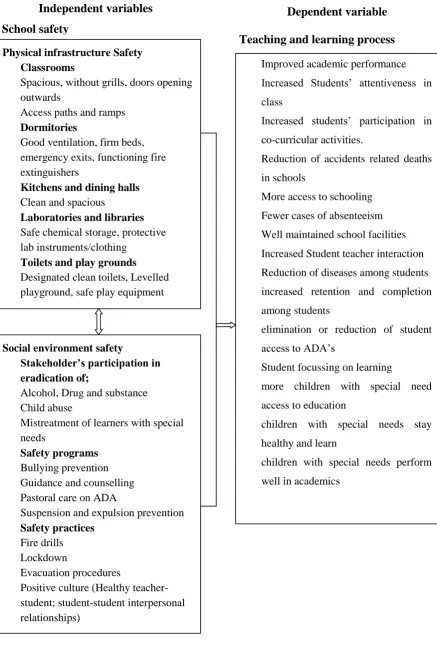
Proper teaching and learning processes depend on school safety status as indicated
in Safety and Standards Manual for Schools in Kenya (MOE, 2008) that no
meaningful teaching and learning could take place in unsafe and insecure school
environment. A safe school entails safety in school physical infrastructure such as
and mistreatment of children with special needs. For a school to ensure that the social environment is safe, safety programs such as bullying prevention, Guidance and counselling, pastoral care and suspension and expulsion prevention should be put in place (MOE, 2008). Similarly, safety practices such as Fire drills, Lock down, evacuation procedures and positive culture should prevail, and be embraced by all stakeholders.
Jagero (2011), notes that all stakeholders must be well aware of possible threats to school safety and provide a social environment that is supportive of proper teaching learning processes.
Schools that observe physical and social environment safety may enjoy improved academic performance, increased students‘ attentiveness in class, participation in co-curricular activities, fewer accidents and related deaths in schools compounds, fewer cases of absenteeism, well maintained school facilities, increased student -teacher interaction, increased retention and completion rate among students, elimination or reduction of student access to ADA, more student focussing on learning, and increased access and quality of learning for children with special needs among other positive benefits of quality education.
21
Figure 1.1: Conceptual Framework showing the relationship between school safety and teaching and learning process
Independent variables School safety
Dependent variable Teaching and learning process Physical infrastructure Safety
Classrooms
Spacious, without grills, doors opening outwards
Access paths and ramps
Dormitories
Good ventilation, firm beds, emergency exits, functioning fire extinguishers
Kitchens and dining halls
Clean and spacious
Laboratories and libraries
Safe chemical storage, protective lab instruments/clothing
Toilets and play grounds
Designated clean toilets, Levelled playground, safe play equipment
- Improved academic performance
- Increased Students‘ attentiveness in
class
- Increased students‘ participation in
co-curricular activities.
- Reduction of accidents related deaths
in schools
- More access to schooling
- Fewer cases of absenteeism
- Well maintained school facilities
- Increased Student teacher interaction
- Reduction of diseases among students
- increased retention and completion
among students
- elimination or reduction of student
access to ADA‘s
- Student focussing on learning
- more children with special need
access to education
- children with special needs stay
healthy and learn
- children with special needs perform
well in academics
Social environment safety
Stakeholder‟s participation in eradication of;
Alcohol, Drug and substance Child abuse
Mistreatment of learners with special needs
Safety programs
Bullying prevention Guidance and counselling Pastoral care on ADA
Suspension and expulsion prevention
Safety practices
Fire drills Lockdown
Evacuation procedures
1.13 Operational Definition of Key Terms
Child abuse: As used in the current study, the term refers to any inhuman act subjected to Children. It may be in any form - physical abuse such as corporal punishment and child labour, or emotional-exclusion from daily lesson attendance and different forms of bullying.
Children with Special Needs: As used in the study refers to learners who may have physical disabilities such as hearing, mild sight, walking and other psycho- motor challenges. It also refers to the lesser gifted in intellectual learning.
Influence: The term as used in this context refers to any influence that school safety, or lack of it, has on conditions that bring about teaching and learning in an educational institution.
Physical Infrastructure safety: In this study the term refers to school buildings, fences, compound, and all other physical facilities within the school. The conditions and measures put in place to ensure safety of school members, such as maintenance, repairs as well as disaster risk reduction mechanisms (Either adequate or inadequate according to the Safety Standards Manual), to determine the safety state of the school.
Rural: As used in the study refers to schools in the agricultural region. Safety of learners from these places may be affected by the socio- economic factors of the regions.
Safety against Alcohol, Drug and substance Abuse: The term as used in the current study refers to traditional liquor as well as processed beers, wine and spirits. It is the action taken to curb abuse of alcohol, drugs and substance by learners who have a notion that taking drugs may assist them to improve in academic performance. Teenagers, especially those who abuse these substances, find it difficult to cope with the learning process. Therefore, for proper teaching and learning to take place, schools need to ensure that learners are safe from any form of substance abuse. Teachers, peers, parents and community members have a responsibility to reduce if not totally eliminate abuse of alcohol, drug and substance use within and outside the schools.
Safety against Child Abuse: According to MOE (2008), incidents of Child Abuse are in the increase in the country. Children subjected to any form of abuse find it difficult to cope with the learning process. In the current study the term refers to schools‘ community attempt to shield learners from physical abuse such as corporal punishment, exclusion from daily lesson attendance, and all forms of bullying. Consequently, for proper teaching and learning to take place, schools need to ensure that learners are safe from any form of physical abuse and neglect by teachers, peers, parents and community members.
facilities, acceptance of these learners and provision of guidance and counselling programs. The Ministry of Education (2008) explains that there is a need to enable children with special needs access education at all levels without discrimination. It is the policy of Government to integrate or mainstream children with mild disabilities into the regular school programme to enhance their participation in formal education.
School Culture and Climate: In this study, it refers to school lifestyle or traditional way of doing things. It may include but is not limited to the school routine, the philosophy, traditions, mission and vision of the school.
School Safety: As used in the study refers to conditions in the school that ensure that the members are physically, psychologically, emotionally, socially and spiritually healthy. School safety is broadly concerned but not limited to status of physical facilities, negative or risky student behaviors, digital/Internet safety, gang activity in schools among other anti-social behaviours in the school.
School Safety practices: As used in this study refers to school practices such as fire drills, lock down, evacuation procedures and positive teacher- student and student- student interpersonal relationships.
School Social Environment safety: This term broadly refers to all community interactions associated with the school. However as used in this study, the term is limited to how members of the school handle cases against abuse of alcohol, drug and substance use, child abuse and safety of children with special needs. It also considers the cordial relationship that exists among the members of the school community.
Status: As used in this study refers to the existing conditions of safety in the selected schools. It is the way the physical facilities, school grounds, and the entire school social environment are, as far as safety is concerned, as indicated in the Safety and Standards Manual for schools provided by the Ministry of Education in Kenya.
Teaching and Learning Processes: This term as used in the study refers to the ongoing activities such as students‘ participation and corroborative learning in the classroom, library, school laboratory, and all other area activities in the school that enable teachers to teach and learners to learn. It requires participation of school administrators, teachers, learners and parents for it to run well and to improve the academic performance.
CHAPTER TWO
REVIEW OF RELATED LITERATURE
2.1 Introduction
The chapter provides a review of literature related to status of school safety and its influence on teaching and learning process in public secondary schools in Nairobi and Nyeri Counties. It is divided into five thematic sections. First, status of school physical infrastructure safety , Second, Status of school social environment safety, third, influence of school physical infrastructure safety on teaching and learning processes, fourth, influence of school social environment safety on teaching and learning processes. The last theme is on ways of enhancing school safety to promote teaching and learning processes in public secondary schools. Summary of the literature review and demonstration of research gaps is also provided in this chapter.
2.2 Status of School Physical Infrastructure Safety
The school‘s physical infrastructure is of paramount importance in as far as safety in schools is concerned. They include structures such as classrooms, dormitories, libraries, laboratories, dining halls, kitchen, toilets and playground among others. According to the Safety standards Manual (2008), such structures should be appropriate, adequate and properly located devoid of any risks to users or to those around them. They should comply with the provisions of the Education Act (Cap 211), Public health Act (Cap 242) and Ministry of public works building regulations / Standards.
that the most serious safety problems in schools in Malatya, Turkey came from lack of control in the playground and school corridors. Donmez and Guven also note that parents value adequate and clean school facilities. These findings highlight the significance of the safety of physical facilities in an institution. The current study assessed the status of physical facilities such as playgrounds and their influence on teaching and learning in the sampled schools. In addition, to fill the geographical gap, the current study looks at the school safety and its influence on teaching and learning processes in public secondary schools in Nairobi and Nyeri counties in Kenya.
sampling was used for CQASOs for Nairobi and Nyeri counties. Further, to fill the geographical gap, the current study was carried out in Kenya.
Disaster preparedness is very crucial for ensuring that schools are safe. Kipng‘eno and Kyalo (2009) noted that when head teachers, teachers and students were asked whether their schools had performed fire drills in the past one year, it was found out that neither head teachers nor teachers had participated in any fire drill a year before the time of the study. Ten respondents said that their school had performed a fire drill but they had not been involved. Only one respondent from the category of schools that had not performed any fire drills indicated to have participated. Kipng‘eno and Kyalo‘s study informs the present study on the importance of fire drills as a way of ensuring safety in a school setting. However, unlike Kipng‘eno and Kyalo‘s study, the present study goes further to analyse the nexus between school safety and its influence on teaching and learning processes in public secondary schools in Nairobi and Nyeri counties in Kenya.
examines physical infrastructural safeness in secondary schools in Kenya, it informs the present study on the methodology employed in the study. That is, the research design, research instruments and the respondents. However, unlike Maritim, King‘oo andBarmao‘s study, the current study employs the system theory. Further, in order to fill the geographical gap, the current study was carried out in selected public secondary schools in Nairobi and Nyeri Counties.
employs ANOVA in the analysis of data, the present study is based on descriptive statistics. In addition, the present study did not sample watchmen as respondents and did not limit its scope to national schools. These are some of the gaps addressed in the present study.
2.3 Status of School Social Environmental Safety
Reviewed studies indicate a safe school social environment as one where there is a clean facility and caring teachers. Respectful relationship between peers is also an important facet of a safe school social environment (DeVoe, 2006). According to Perkins (2006), a report by the National School Board Association noted that a positive school environment was a crucial factor that differentiates between schools with high and low rates of delinquency. In addition, Perkins notes that behaviour disturbance, attendance and academic attainment were also critical in differentiating schools.
According to the Safety Standards Manual (2008), the World Health Organization defines a safe school as one which is healthy. Health here is taken to mean a state of complete physical, mental and social well- being of human beings and not merely the absence of disease (MOE, 2008). The school health programme should therefore contribute to the maintenance and improvement of the health of learners and school personnel. It should be a shared responsibility of the school community, sponsors, parents and the entire surrounding community.
based on such considerations. Instead, they have to scramble for the little space available in the few schools that serve these communities, regardless of the social environment. Out of a desperate need, many children from the slum communities are enrolled in schools where infrastructure is wanting and where poor sanitary and hygiene conditions pose a major health threat (Kipng‘eno & Kyalo, 2009).
Drug abuse is a major concern to communities and governments all over the world. Press Reports indicate that the use of illegal drugs has spread at a high rate and has penetrated most parts of the world. No nation has been spared from the drug menace and the world has shown concern over the problem (Kenya Times, July 4, 2003). Drug barons have been identified in some countries as financing some politicians. Latin American countries, for example, have been identified as having large plantations of opium, cocaine and marijuana (Kenya Times, November 3, 2003).
Although the interest and expectation of the peer groups have an important bearing on whether or not a person will try dependence producing drug, homes where drugs are abused are likely to be the source of information for drug users about the availability of drugs and their allegeable effects (Pudo,1998 as cited by Gatua, 2015). Young people learn from what they see by imitating what parents and other people in the community do. Young people have often redirected their money into the purchasing of drugs. In order to try and solve drug problem, school administration should put in place administrative factors that address students‘ affairs (Gatua, 2015). The practice of good school community relations is crucial for an environment that is conducive, if any teaching and learning is to take place (MOE, 2008).The present study sought to find out how schools in Nairobi and Nyeri counties tackled alcohol and drug menace in their schools.
incidents were prevalent in schools where there existed an unappealing school culture. McMullen (1999) emphasizes the importance of a democratic policy and the investment in people towards making schools safer. This is because factors which threaten school safety stem generally from underestimating learners‘ safety, family safety, school safety and environmental safety. These studies inform the current study on the importance of safe social environment in ensuring school safety. However, the above studies were undertaken in United States of America, while the present study was undertaken in public secondary schools in Nairobi and Nyeri counties in Kenya.
2.4 Influence of School Physical Infrastructure Safety on Teaching and Learning Processes
This section discusses the influence of school physical infrastructure safety on teaching and learning processes. According to MOE (2008), school physical infrastructure include structures such as classrooms, dormitories, kitchen, dining halls, laboratories, libraries, toilets, and other related structures such as playgrounds. These facilities can either be permanent or temporary structures. To ensure safety, such buildings should be appropriate, adequate and properly located devoid of any risk to users or those around them. They should also comply with the provisions of the Basic education Act (2013) Public Health Act (Cap 242) and Ministry of Public Works Building Regulations and Standards.
2.4.1 Influence of Classroom Safety on teaching and learning processes
Safety of classrooms is important in a school since learners spend most of their time in these buildings. Reviewed literature on the impact of the availability of classroom furniture (desks, tables, chairs) on test scores in developing countries, however, has not been conclusive. While Njora (2008) found significantly negative results of impact of classroom furniture on the reading and Mathematics scores of grades 5 learners in urban and rural areas of Vietnam, Khan and Kiefer (2007), earlier results on the impact of classroom furniture on student learning were statistically insignificant. Concerning the impact of the status of classroom furniture on student‘s time in school, Glewwe and Krause (2016) found no significant impact.
Similarly, reviewed literature on influence of the availability of blackboards, flipcharts or chalk in the classroom on learners‘ test scores at both the secondary and elementary urban and rural areas of Madagascar were found to be statistically significant (Glick et al., 2011). In another study conducted in Indonesia to find out whether availability of blackboards, flipcharts or chalk in the classroom affected dictation test scores at the primary level in urban and rural areas of Indonesia, however, found no significant influence (Suryadarma, Suryahadi, Sumarto & Rogers, 2006). The above studies inform the current study on the importance of classroom facilities in the teaching and learning processes. The current study however, addresses the methodological gap by adopting the descriptive research design. Further, the study filled the geographical gap by undertaking classroom facility safety concerns in public secondary schools in Nairobi and Nyeri counties in Kenya.
Further, to fill the geographical gap the current study was carried out in public secondary schools in Nairobi and Nyeri counties in Kenya.
Okebukola (2000) provided a statistical analysis of the unsafe situations in the Nigerian classrooms as follows: 87% of the pupils were in overcrowded classrooms, 12% sat on the floor, 3% of the schools had no chalkboards, 38% of the classrooms had no ceiling, and 77% of the pupils lacked textbooks and 36% of the pupils had no writing materials. This kind of classroom environment impacted negatively on the classroom activities of both the teacher and the learner. Okebukola‘s study found out that when classroom environment is conducive, learners are able to concentrate on learning. The above study informs the current study on the impact of classroom safety in the teaching and learning processes. However, the current study attempts to fill the geographical gap by undertaking school safety in public secondary schools in Nairobi and Nyeri counties in Kenya.
HCHO was 0.62, and TBC was 1.16. Jung et al study informs the present study on the indoor air quality needed in classrooms. However, unlike Jung et al‘s study which is done in Korea, the present study is carried out in selected secondary schools in Nairobi and Nyeri Counties.
2.4.2 Influence of Dormitory Safety on teaching and learning processes
Dormitories are the single most used physical facility in boarding schools where learners spend the longest continuous period of time. It is, therefore, imperative to keep these facilities properly ventilated and clean (MOE, 2008). Reviewed studies on the influences of dormitory safety on teaching and learning are however somehow mixed.
dormitory safety on teaching and learning processes in Nairobi and Nyeri counties in Kenya.
2.4.3 Influence of Dining Hall and Kitchen Safety on Teaching and Learning Processes
Kitchen and dining halls are crucial facilities in any school since they boost health and hygiene safety of learners. Calabrese (2001) postulates that eating from unsafe places could lead to food poisoning which occurs as a result of eating contaminated food with certain types of bacteria, parasites, viruses or toxins. Carter (2002) asserts that food programmes in schools are commonly used to attract learners to school so that they can concentrate and learn. This is in line with the feelings of Ministry of Education Science and Technology (2005) in Sessional Paper No. 1 of 2005 that school feeding programme is an important tool of enhancing access, retention, completion and transition rates in all schools in Kenya. Similarly, according to Reid (2000), since cooking and catering can produce significant amounts of fumes and vapor as well as large amounts of heat, there is a need to have enough room for staff to work comfortably and a safe and proper storage of food. Apart from the issue of safety, when dining hall and kitchen facilities are clean, spacious, and accommodative, students‘ time in school is increased as well.
adequate, appropriate and well maintained furniture such as chairs and tables, this could lead to food poisoning which occurs as a result of eating contaminated food with certain types of bacteria, parasites, viruses or toxins. Utensils and other related facilities were worn out and unkempt. Jagero further revealed that dining halls were small and squeezed; furniture did not match the school enrolment in that most students did not have tables and chairs to use. Students were observed having their meals while standing. The above studies inform the present study on the importance of observing cleanliness in the Dining Halls and kitchen and also the environmental factors within a school affecting performance of boarding secondary students. However, while Jagero‘s study employs descriptive statistics and inferential statistics such as linear multiple regression and factor analysis, the present study is based on descriptive statistics. Further, to fill the geographical gap, the present study focuses on public secondary schools in Nairobi and Nyeri counties in Kenya.
2.4.4 Influence of Laboratory and Library Safety on teaching and learning processes
indicate confusing results in relation to education out comes. A study by Sprietsma (2012) on the impact of safe science laboratories on students‘ test scores in urban schools had significantly negative results while results for rural schools had significantly positive results. These studies inform the current study of the importance of observing laboratory rules and instructions in order to ensure safety in the science laboratory. However the current study aimed at filling the gap on the influence of laboratory safety on teaching and learning processes in Nairobi and Nyeri counties.
Studies on the influences of library safety on teaching and learning processes indicate that students benefit from these facilities when safety is provided. Reid (2000) states that library is a crucial resource in a school to enhance reading and comprehension skills. Similarly, Finkkle (2000) postulates that libraries should be acknowledged as an important ingredient of any school system and should be among top priorities.
2.4.5 Influence of School toilets and playground Safety on teaching and learning processes
Availability of adequate, clean, well maintained and safe toilets in a school enhances access to education and improves quality of learning (MOE, 2008).
survey design to assess whether availability of clean separate toilets for boys and girls in public secondary schools in Nairobi and Nyeri counties influenced teaching and learning processes.
properly and efficiently accomplish daily activities, the formation of social and professional relationships and the sharing of information and knowledge.
According to the US Consumer Product Safety Commission‘s Handbook (CPSC, 2010), adequate and proper surfacing of the school playground strongly influence how learner participate and benefit from activities carried out in the playground. CPSC (2010) further recommends installation and maintenance of shock absorbing or fall influence attenuating surface materials under and around the fall or exit zone of play equipment.
Peterson (2002) postulates that falls from around play equipment are the most common playground hazards accounting for 80% of the injuries that are serious as well as health and life threatening, while 68% are due to falls to the surface and over 10% are from falls to the equipment.
Peterson further states that fall cause injuries that can immobilize children thus reducing activity time and at times cause death. Safe conditions in the school grounds are essential for learners because they feel protected from life threatening injuries and when safety is integrated into children‘s learning activities, it stimulates more diverse and creative activities, children‘s confidence and self-esteem and hence more interest to engage more in teaching learning process (Wortham & Frost, 1990).
checking play areas and equipment for damage and repairs, modification and replacement or removal of any item that can cause injuries or harm such as; broken equipment, glasses, stones, potholes, sharp or protruding objects or edges, splitting wood, rusted or corroded metals and tall grass among others. Berry further contends that a well-maintained playground sends a message to the learners, teachers, parents and school administration that participation in the outdoor activities is important and that the result of safe school grounds are active learners, fewer injuries and increased capacity for handling more quality sensory input leading to cognitive and motor development.
Due to the inconsistencies in terms of findings, method of data collection and the sample size used concerning the influence of school physical infrastructure safety on teaching and learning, it was found prudent to carry a research to find out the influence of school physical infrastructure safety on teaching and learning processes in Nairobi and Nyeri counties.
2.5 Influence of School Social Environment Safety on Teaching and Learning Processes
School social environment safety refers to how the school community interacts and handles the social environment. In the present study, school social environment referred to how members of the school community ensured that there was safety from alcohol, drug and substance abuse, child abuse and that there was safety of children with special needs. Social environment encompasses the role played by the school culture, healthy positive relationships and engaged teaching and learning (Hoy, 2012; Macneil, Prater & Busc, 2009). It involves healthy environment activities where learners and school personnel are treated to a healthy programme that contributes to the maintenance and improvement of their health as well as ensures that school teaching and learning programmes take place as scheduled.
between various stakeholders are cordial, reinforcing, cooperative, and respectful and focused on promoting an environment conducive for teaching and learning.
The Safety and Standards Manual (2008) indicates that there should be quality interpersonal relationships in schools that are cordial, cooperative, and respectful that focuses on promoting an environment conducive for teaching and learning. When this is maintained, cases of students‘ indiscipline such as bullying, sexual harassment, abuse of drugs and learners being unruly may be minimized. The researcher in the current study sought to find out how the sampled school members handled social environmental issues such as alcohol, drug and substance abuse, child abuse and safety of children with special needs, in order to promote teaching and learning processes in the sampled schools.
2.5.1 Alcohol, Drug and Substance safety and its influence on Teaching and Learning Processes
The World Health Organization (WHO) defines a drug as any substance other than those required for maintenance of normal health, which when taken into the living organism, may modify one or more of its functions (Ghodse, 2003). A report by United Nations Drug Control Programme (UNDCP) shows that 60% of students abuse drugs (Njeri & Ngesu, 2014). According to United Nations office on drugs and crime UNODC (2011), alcohol and drug abuse posses a great threat to the social economic fabric of nations worldwide (Cheloti & Gathumbi, 2016).