1071-412X/04/$08.00⫹0 DOI: 10.1128/CDLI.11.6.1064–1069.2004
Copyright © 2004, American Society for Microbiology. All Rights Reserved.
Assignment of Weight-Based Antibody Units for 13 Serotypes to a
Human Antipneumococcal Standard Reference Serum,
Lot 89-S(F)
Sally A. Quataert,
1Kate Rittenhouse-Olson,
2Carol S. Kirch,
1Branda Hu,
1*
Shelley Secor,
1Nancy Strong,
1and Dace V. Madore
1Wyeth Vaccines Research, Rochester,1and Departments of Biotechnical and Clinical Laboratory Sciences and
Microbiology, The University at Buffalo, State University of New York, Buffalo,2New York
Received 26 April 2004/Returned for modification 8 June 2004/Accepted 18 August 2004
Weight-based immunoglobulin G (IgG), IgM, IgA, and total Ig antibody assignments were made to human
antipneumococcal standard reference serum lot 89-S, also known as lot 89-SF, forStreptococcus pneumoniae
capsular polysaccharide (PnPs) serotypes 2, 6A, 8, 9N, 10A, 11A, 12F, 15B, 19A, 17F, 20, 22F, and 33F, as well as for C-polysaccharide (C-Ps), extending the standard’s usefulness for pneumococcal vaccine evaluation be-yond the original serotype 1, 3, 4, 5, 6B, 7F, 9V, 14, 18C, 19F, and 23F assignments (S. A. Quataert, C. S. Kirch, L. J. Quackenbush Wiedl, D. C. Phipps, S. Strohmeyer, C. O. Cimino, J. Skuse, and D. V. Madore, Clin. Diagn. Lab. Immunol. 2:590–597, 1995). The additional 14 assignments were determined using an equivalence of ab-sorbance method with an anti-PnPs serotype 6B reference enzyme-linked immunosorbent assay (EIA). To assure accuracy, anti-PnPs EIA for serotype 14 antibodies, a previously assigned serotype, was performed concurrently. This method assures consistency of the new microgram-per-microliter assignments with previous antiserotype assignments to lot 89-S. The sum of the experimentally derived isotype assignments for anti-PnPs serotypes in lot 89-S agrees well with the separately determined total Ig assignment for each serotype. The lot 89-S assignments for serotypes 1, 5, 6B, 14, 18C, 19F, and 23F were used for pneumococcal conjugate vaccine clinical trial evaluation and to generate data in efficacy trials where serological correlates for protec-tion have been proposed. The assignment of antibody concentraprotec-tions to addiprotec-tional pneumococcal serotypes in this reference reagent facilitates the consistent and accurate comparison of serum antibody concentrations across clinical trials.
Streptococcus pneumoniaeis a major human pathogen
caus-ing pneumonia, bacteremia, mencaus-ingitis, and otitis media (6–9). Presently, a 23-valent pneumococcal polysaccharide vaccine is available for use in adults, and a 7-valentS. pneumoniae cap-sular polysaccharide (PnPs) protein conjugate vaccine, Prev-nar/Prevenar, is available for use in infants (27). Several other vaccine formulations are in clinical trials (16–18). Evaluation of new vaccines and extension of serotype coverage requires quantitation of anti-PnPs antibody response with a standard-ized method and reference serum (11, 12). Anti-pneumococcal standard reference serum lot 89-S (lot 89-S), prepared from adult sera postimmunization with a 23-valent PnPs vaccine, was previously characterized for quantitating PnPs anti-bodies to serotypes 1, 3, 4, 5, 6B, 7F, 9V, 14, 18C, 19F, and 23F (19, 20). This standard reference preparation has been used for quantitation of serotype-specific antibody toS. pneumoniaein both adult and pediatric sera in numerous clinical trials (2, 5, 13–15, 21, 25). Lot 89-S is available from the Center for Bio-logical Evaluation and Review (CBER) as United States stan-dard reference serum lot 89-SF.
The usefulness of the pneumococcal standard reference se-rum lot 89-S for vaccine trial evaluation is now extended through the assignment of weight-based antibody values for 13
additional PnPs serotypes (2, 6A, 8, 9N, 10A, 11A, 12F, 15B, 17F, 19A, 20, 22F, and 33F) and for theS. pneumoniaecell wall polysaccharide (C-Ps). The new antibody assignments were made by using an enzyme-linked immunosorbent assay (EIA)-based equivalence of absorbance method suggested by Concep-cion and Frasch for cross-standardization (3). To confirm the accuracy and consistency of the new assignments, a panel of adult sera were quantitated for total immunoglobulin (Ig), IgG, IgM, and IgA antibodies to PnPs serotype 19A by EIA us-ing the newly assigned concentration of serotype 19A antibodies.
MATERIALS AND METHODS
Sera.The human antipneumococcal reference standard serum lot 89-S was prepared by pooling 17 high-titer sera as described previously (20). Briefly, plasma units were obtained from 68 adult human donors following immunization with a 23-valent PnPs vaccine (PNU-IMUNE; Lederle), a meningococcal poly-saccharide vaccine (MENOMUNE; Connaught), and aHaemophilus influenzae
type b conjugate vaccine (ProHIBIT; Connaught). Relative antibody titers to 12 serotype-specific PnPs (1, 3, 4, 5, 6A, 6B, 7F, 9V, 14, 18C, 19F, and 23F) were determined by EIA. Plasma from the 17 individuals showing the highest antibody titers to a majority of the serotype-specific PnPs were pooled, defibrinated, and filtered. Adult sera used for the study whose results are given below (see Fig. 2) were obtained from 18 to 60 year olds pre- and postimmunization with a 23-valent PnPs vaccine (PNU-IMUNE).
PnPs.Antigens for coating or competition purposes were obtained from the American Type Culture Collection (ATCC; Manassas, Va.) for PnPs serotypes 1, 3, 4, 5, 6B, 7F, 9V, 14, 18C, 19F, and 23F Purified C-Ps was obtained from Statens Serum Institut (Copenhagen, Denmark). PnPs for serotype 6A was obtained from Wyeth.
PnA.Pneumococcal absorbent (PnA) is a preparation of soluble components, including C-Ps, from a serotype-specific capsule-negative variant (CSR-II) ofS.
* Corresponding author. Mailing address: Wyeth Vaccines Re-search, 401 N. Middletown Rd., 180/152A, Pearl River, NY 10965. Phone: (845) 602-3389. Fax: (845) 602-1885. E-mail: [email protected].
1064
on August 17, 2020 by guest
http://cvi.asm.org/
pneumoniae, as previously described (20). Human sera were absorbed with PnA to remove anti-C-Ps antibodies present in the sera. This absorbent was not used in the anti-C-Ps EIA (i.e., when quantitating anti-C-Ps antibodies).
Anti-PnPs EIA.The anti-PnPs EIA was performed as previously described (20). The antigens, PnPs serotypes 2, 6A, 8, 6B, 9N, 10A, 11A, 12F, 14, 15B, 19A, 17F, 20, 22F, 33F, and C-Ps, were diluted in sterile water for irrigation (Kendall-McGraw Laboratories, Inc., Irvine, Calif.) and stored at⫺20°C as 1-mg/ml stocks. One-hundred microliters of the optimal coating concentration of PnPs (1
g/ml for PnPs 14, 15B, 20, and 33F; 2g/ml for PnPs 2, 9N, 11A, 12F, and 17F; 5g/ml for PnPs 6A and 8; and 10g/ml for PnPs 6B, 10A, 19A, and 22F) or C-Ps (10g/ml) per well was used to coat (separately) NUNC C-IT polystyrene 96-well EIA plates (catalog no. 4-46140) for 5 h at 37°C in sterile phosphate-buffered saline (PBS) with azide and was stored at 4°C for use within 30 days. A 1:50 dilution of lot 89-S was absorbed with 2.5g of PnA (lot B or C) per ml for 30 min (except in the anti-C-Ps EIA, where lot 89-S was not absorbed). EIA plates were washed between each step by a 30-s soak and five wash cycles with 200l of PBS–0.1% Tween 20 per well. Fifty microliters of twofold serial dilutions of lot 89-S per well was added to washed antigen-coated plates, and the plates were incubated for 2 h at room temperature. Fifty microliters of the optimal dilution of the appropriate enzyme conjugate (alkaline phosphatase-linked goat anti-IgG, -IgM, -IgA or total Ig conjugate) (Biosource) per well was incubated for 2 h at room temperature. One-hundred microliters of a 1-mg/ml concentration ofp-nitrophenyl phosphate in diethanolamine-MgCl2buffer, pH 9.8, was added to all wells for 1 h. The reaction was stopped by the addition of 50l of 3 N NaOH per well. Absorbance readings were obtained with dual-wavelength readings at 405 nm (experimental) and 690 nm (reference) on a microtiter plate reader (model EL 403H; Biotek).
Intraplate and interplate variation of anti-PnPs EIA.The intraplate variation of each PnPs serotype-specific EIA was evaluated by performing the anti-PnPs EIA with the dilution of lot 89-S which yielded an absorbance reading of 1.0 under the assay conditions in 92 of the 96 wells, and with buffer in four assay control wells of three separate coated EIA plates. The intraplate coefficient of variation (CV) was determined from the mean of the 92 wells for each of the three plates and was averaged for the three plates to yield the interplate CV.
Specificity of the anti-PnPs EIA.Competitive inhibition EIA was performed as described above for the standard anti-PnPs EIA, with the following modification. Dilutions of lot 89-S giving an absorbance of 1.0 in each separate anti-PnPs EIA were preabsorbed with a 10.0-, 1.0-, 0.1-, or 0.01-g/ml concentration of the homologous or heterologous pneumococcal polysaccharide serotype 2, 6A, 8, 9N, 10A, 11A, 12F, 15B, 17F, 19A, 20, 22F, or 33F or with buffer alone, and 2.5
g of PnA per ml, for 30 min at 37°C. After preincubation with the competitor, 50l of the dilution of lot 89-S was added to each antigen-coated well and the anti-PnPs EIA was performed. Percent inhibition is calculated based on the
comparison of the absorbance obtained in the anti-PnPs EIA using lot 89-S with or without preincubation with competitor polysaccharide.
EIA quantitation method for assigning antibody values.The method for quantitating antibodies is based on equivalence of absorbance between a refer-ence EIA and the anti-PnPs EIA when performed in parallel under identical assay conditions, including buffers, enzyme conjugate dilutions, and incubation times and temperatures (20). The reference EIA used to previously quantitate lot 89-S for serotypes 1, 3, 4, 5, 6B, 7F, 9V, 14, 18C, 19F, and 23F was an antibody-capture EIA in which the immunoglobulin molecules in the human reference serum preparation, USNRP IS 1644, were captured by goat anti-human light-chain-specific reagents. Anti-PnPs serotype 6B EIA was used here as the reference assay to quantitate total Ig, IgG, IgM, and IgA antibodies to pneumococcal serotypes 2, 6A 8, 9N, 10A, 11A, 12F, 15B, 17F, 19A, 20, 22F, and 33F in lot 89-S. Assignments were made by comparing the endpoint dilutions of lot 89-S at 0.3 optical density (OD) units, as determined from a logarithmic regression of the reciprocal of serum dilution versus the OD, in the anti-PnPs reference (serotype 6B) and experimental EIAs. Anti-PnPs serotype 6B antibody assignments in lot 89-S are 24.3, 16.9, 3.0, and 1.5g/ml for Ig, IgG, IgM, and IgA, respectively (20). Antibodies to pneumococcal serotype 14, with previously assigned quantities in lot 89-S, were quantitated concurrently (in the anti-PnPs serotype 14 EIA) to assure accuracy.
RESULTS
To assure precision in making new serotype reference as-signments to standard reference serum lot 89-S, each serotype-specific anti-PnPs IgG EIA and the anti-C-Ps IgG EIA were examined for the consistency of results. The variability of each EIA performed in three microtiter plates on a single day was determined by using the dilution of lot 89-S yielding an absor-bance of 1.0 in each serotype assay. The interplate and in-traplate CV for each anti-PnPs IgG EIA and the anti C-Ps IgG EIA ranged from 3.8 to 8.6%, demonstrating acceptable con-sistency of performance variables in the EIA for the additional PnPs serotypes.
The specificity of lot 89-S binding with the 13 additional PnPs serotypes was examined by using competitive inhibition of binding in each EIA with 10-fold serial dilutions of compet-itor polysaccharide. The standard reference serum binding was
FIG. 1. Competitive inhibition of anti-PnPs serotype 2 antibodies. Standard reference serum lot 89-S was preincubated with homologous (serotype 2) or heterologous (serotypes 8, 9N, 10A, and 14) pneumococcal polysaccharides prior to anti-PnPs serotype 2 EIA.
on August 17, 2020 by guest
http://cvi.asm.org/
inhibited greater than or equal to 90% by homologous PnPs in each serotype EIA. In Fig. 1, typical competition curves are shown with both homologous and heterologous PnPs compet-itors in the anti-PnPs serotype 2 EIA. In general, inhibition with heterologous PnPs was less than 20%, which is within the expected assay variation for the EIA. Related PnPs serotypes, such as 6A/6B, 9N/9V, and 19A/19F, which share some epi-topes, did show expected serogroup cross-reactivity (data not shown).
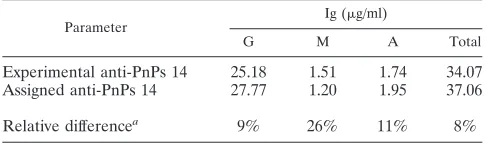
Antibody values for PnPs serotypes (2, 6A, 8, 9N, 10A, 11A, 12F, 15B, 17F, 19A, 20, 22F, and 33F) were assigned to lot 89-S from the mean of eight separate determinations in anti-PnPs EIA for each serotype, using the anti-PnPs serotype 6B EIA as the reference EIA (Table 1). The sum of the mean values for IgG, IgM, and IgA from eight separate determinations for each of 12 serotypes correlated well with the mean value for experimentally determined total Ig (also from eight separate determinations); the Ig isotype sums ranged from 80 to 114% of the total Ig anti-PnPs values. The variability of individual PnPs serotype-specific antibody assignments is comprised of two components, the variability of the reference EIA (i.e., serotype 6B EIA) and the experimental serotype EIA. The mean CV for each of the twelve PnPs serotype-specific EIAs (not including the separately determined anti-PnPs serotype 6A and C-Ps EIA) are 27.9% for total Ig, 19.4% for IgG, 29.4% for IgM, and 20.0% for IgA. The CV for anti-PnPs serotype 6A and C-Ps IgG are 4.8 and 7.2%, respectively. This is an acceptable level of variability in the anti-PnPs EIA used to quantitate serotype-specific antibodies. The overall average ratio for the sum of IgG, IgM, and IgA with the 12 PnPs serotypes relative to the total Ig was 95%⫾10%, demonstrat-ing cumulative agreement among the independent isotype de-terminations. This suggests that the assignments to each of the four independently determined Ig and isotype values did not show any bias and that the values were consistently assigned. To validate the accuracy of the new assignments to lot 89-S, the anti-PnPs serotype 14 EIA assay was performed concur-rently with the anti-PnPs experimental EIA (Table 2). The mean of eight values for anti-PnPs serotype 14 antibodies,
determined through the use of eight anti-PnPs serotype 6B reference assays, differed less than 12% for total Ig, IgG, and IgA and 26% for IgM from the previously assigned values for anti-PnPs serotype 14 antibodies in lot 89-S (20). The IgG antibody values for PnPs serotype 6A and C-Ps for lot 89-S were determined in EIAs performed separately from those of the other 12 serotypes. The results of the anti-PnPs serotype 14 EIAs run concurrently with either the anti-PnPs serotype 6A EIA or C-Ps EIA are shown in Table 3. The mean anti-PnPs serotype 14 IgG values were within 7 and 13% of the previously assigned values when run concurrently with the anti-C-Ps and anti-PnPs serotype 6A test EIA, respectively.
The cross-standardization method for quantifying antibodies requires parallelism (i.e., similar slopes) for the anti-PnPs ref-erence and experimental EIA (3). To examine for similarity of slopes, log-log linear regression analyses (absorbance versus reciprocal dilution) were performed for the anti-PnPs serotype 6B reference EIA and additional serotype experimental EIA. In Table 4, the mean slope for the anti-PnPs serotype 6B EIA is compared to the overall mean of the average slopes for the group of 12 additional PnPs serotypes. There was good agree-ment in the slopes of the reference and experiagree-mental EIAs, as
TABLE 1. Quantitation of anti-PnPs antibody in pneumococcal standard reference serum lot 89-S using an anti-PnPs serotype 6B reference EIA
PnPs serotype
Anti-PnPs antibody (mean⫾SD ing/ml [% CV])
IgGa
IgMa
IgAa
Total Iga
Sum Igb
Sum Ig/total Ig (%)
PnPs 2 12.24⫾1.95 (15.9) 5.13⫾1.25 (24.3) 3.88⫾0.52 (13.5) 21.37⫾5.95 (27.8) 21.26 99
PnPs 6A 6.05⫾0.29 (4.8) NDc ND ND ND ND
PnPs 8 5.15⫾0.88 (17.1) 1.96⫾0.43 (22.2) 2.04⫾0.43 (21.0) 11.46⫾2.46 (21.5) 9.15 80 PnPs 9N 7.77⫾1.50 (19.4) 2.40⫾0.52 (21.8) 2.10⫾0.37 (17.5) 12.66⫾2.70 (21.3) 12.26 97 PnPs 10A 6.79⫾1.75 (25.8) 3.87⫾1.50 (38.8) 1.18⫾0.34 (28.4) 10.85⫾3.45 (31.8) 11.83 109 PnPs 11A 6.44⫾1.25 (19.4) 1.04⫾0.29 (27.5) 0.95⫾0.16 (17.1) 9.31⫾2.08 (22.4) 8.43 91 PnPs 12F 1.75⫾0.39 (22.3) 1.36⫾0.55 (40.9) 0.45⫾0.12 (26.9) 3.13⫾1.26 (40.1) 3.56 114 PnPs 15B 16.62⫾2.72 (16.4) 1.62⫾0.49 (30.4) 3.19⫾0.64 (20.0) 26.25⫾8.11 (30.9) 21.42 82 PnPs 17F 10.13⫾1.64 (16.1) 1.75⫾0.46 (26.1) 0.84⫾0.12 (14.8) 15.11⫾4.60 (30.5) 12.72 84 PnPs 19A 18.57⫾3.63 (19.5) 2.27⫾0.57 (25.0) 3.35⫾0.52 (15.4) 26.87⫾5.78 (21.5) 24.2 90 PnPs 20 8.73⫾2.27 (26.0) 1.71⫾0.58 (33.6) 0.58⫾0.14 (23.6) 13.01⫾5.78 (44.4) 11.02 85 PnPs 22F 10.08⫾2.20 (21.8) 3.1⫾1.09 (35.2) 3.58⫾0.85 (23.9) 16.42⫾3.53 (21.5) 16.77 102 PnPs 33F 11.91⫾1.53 (12.9) 2.65⫾0.72 (27.3) 2.54⫾0.46 (18.0) 16.88⫾3.52 (20.9) 17.10 101
C-Ps 42.02⫾2.98 (7.2) ND ND ND ND ND
aBased on eight experimental values, except for C-Ps (n⫽3). bSum of IgG, IgA, and IgM.
cND, not done.
TABLE 2. Quantitation of antibodies to PnPs serotype 14: agreement of results when run with 12 serotype EIAsb
Parameter Ig (g/ml)
G M A Total
Experimental anti-PnPs 14 25.18 1.51 1.74 34.07 Assigned anti-PnPs 14 27.77 1.20 1.95 37.06
Relative differencea 9% 26% 11% 8%
aRelative difference⫽100⫻[(experimental⫺assigned)/assigned]. bThe quantity of anti-PnPs serotype 14 antibodies in pneumococcal standard
reference serum lot 89-S was determined from the mean of eight separate EIA, using the anti-PnPs serotype 6B EIA as the reference, run concurrently with anti-PnPs EIA for 12 serotypes. The values obtained by this cross-standardized method were compared to the previously assigned anti-PnPs serotype 14 values (20).
on August 17, 2020 by guest
http://cvi.asm.org/
indicated by the relative difference ofⱕ9% for each Ig isotype and total Ig.
In consideration of assay variability and ease of use, the antibody levels assigned for the 13 PnPs serotypes and for C-Ps were rounded to the nearest tenth of a microgram per milliliter and are listed in Table 5. To demonstrate the use of and to further validate the new assignments, one serotype was chosen for further analysis. Thirty serum specimens from immunized and nonimmunized adults were evaluated in anti-PnPs sero-type 19A EIA for total Ig, IgG, IgM, and IgA antibodies using the new assignments given to lot 89-S. Linear regression pa-rameters from these analyses yielded mean slopes for the adult sera equal to⫺0.93⫾0.08,⫺0.81⫾0.10,⫺0.76,⫾0.07, and
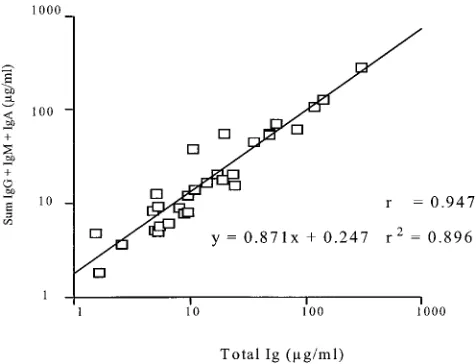
⫺0.88 ⫾ 0.09 for total Ig, IgG, IgM, and IgA, respectively. These mean slopes compared favorably to mean slopes for pneumococcal standard reference serum lot 89-S in the anti-PnPs serotype 6B EIA (Table 4). The sum of IgG, IgM, and IgA concentrations for each adult sample was compared to the corresponding total Ig value by linear correlation analysis (Fig. 2). The resulting slope (0.871) and correlation coefficient (r⫽
0.947) indicated near equivalence and a good linear correlation between the sum of individual immunoglobulin isotype com-ponents and total Ig over a broad range of values, as deter-mined by using the anti-PnPs serotype 19A assignments in lot 89-S.
DISCUSSION
Pneumococcal antibody concentrations in standard refer-ence serum lot 89-S for 11 of the 23 pneumococcal serotypes present in the current PnPs vaccine formulations were
re-ported previously by Quataert and coworkers (20). This infor-mation has provided the basis for numerous assessments of vaccine performance (12, 21, 27). Herein, we extend this in-formation by reporting antibody values for the 12 additional PnPs serotypes in the 23-valent PnPs vaccines, plus values for serotype 6A and for C-Ps. While PnPs serotype 6A is associ-ated with a substantial portion of disease, it is not present in the present PnPs vaccine formulations, where serogroup 6 cov-erage is provided by the more stable PnPs serotype 6B (26). Anti-C-Ps antibodies were also quantitated, because develop-ment of new vaccine approaches may require serologic analysis for C-Ps antibodies.
Our goal was to ensure that the 13 additional anti-PnPs serotype and anti-C-Ps assignments were consistent in charac-ter and weight-based unitage with the prior 11 assignments (12, 20). The equivalence of absorbance in the EIA method used to assign weight-based antibody units to the first 11 PnPs
sero-FIG. 2. Comparison of the sum of IgG, IgM, and IgA concentra-tions with that of total Ig antibodies. Thirty human adult sera were assessed in the anti-PnPs serotype 19A EIA for IgG, IgM, IgA, and total Ig. The sums of the obtained values for IgG, IgM, and IgA concentrations were plotted versus the experimentally derived total Ig values.
TABLE 3. Quantitation of antibodies to PnPs serotype 14: agreement of IgG results when run with serotype 6A and C-Ps EIA
Parameter
Ig (g/ml)
Ga
Gb
Experimental anti-PnPs 14 24.05c 29.71d
Assigned anti-PnPs 14 27.77 27.77
Relative differencee 13% 7%
aIn conjunction with anti-PnPs serotype 6A EIA. bIn conjunction with anti-C-Ps EIA.
cMean of eight determinations. dMean of three determinations.
eRelative difference⫽100⫻[(experimental⫺assigned)/assigned].
TABLE 4. Comparison of the mean slope for anti-PnPs 6B EIA to the mean slope for anti-PnPs 12 additional serotype EIA
Ig Anti-6B
slopea
Anti-PnPs slopeb
Relative difference (%)c
G ⫺0.95⫾0.07 ⫺0.86⫾0.07 9
M ⫺0.77⫾0.07 ⫺0.74⫾0.04 4
A ⫺0.90⫾0.05 ⫺0.88⫾0.07 2
Total ⫺0.99⫾0.07 ⫺0.92⫾0.07 7
aMean⫾standard deviation.
bMean⫾standard deviation of the average slope derived from eight
deter-minations of each anti-PnPs serotype 2, 8, 9N, 10A, 11A, 12F, 15B, 17F, 19A, 20, 22F, and 33F EIA (excludes anti-PnPs serotype 6A and C-Ps EIA).
cRelative difference⫽100⫻[(PnPs slope⫺6B slope)/6B slope].
TABLE 5. Antibody assignments for pneumococcal standard reference serum lot 89-S
PnPs serotype
Ig (g/ml)
G M A Total
2 12.2 5.1 3.9 21.4
6A 6.1 NDa ND ND
8 5.1 2.0 2.0 11.5
9N 7.8 2.4 2.1 12.7
10A 6.8 3.9 1.2 10.8
11A 6.4 1.0 0.9 9.3
12F 1.7 1.4 0.4 3.1
15B 16.6 1.6 3.2 26.2
17F 10.1 1.7 0.8 15.1
19A 18.6 2.3 3.3 26.9
20 8.7 1.7 0.6 13.0
22F 10.1 3.1 3.6 16.4
33F 11.9 2.6 2.5 16.9
C-Ps 42.0 ND ND ND
aND, not done.
on August 17, 2020 by guest
http://cvi.asm.org/
types (1, 3, 4, 5, 6B, 7F, 9V, 14, 18C, 19F, and 23F) for lot 89-S employed an Ig capture EIA as the reference method, using human reference serum preparation USNRP IS 1644. Rather than the Ig capture reference EIA used in the prior quantita-tion, we used anti-PnPs serotype 6B EIA, chosen arbitrarily from the previously quantitated serotypes, as the reference EIA from which micrograms of antibody equivalent optical densities could be assigned for the additional serotype deter-minations. Because the equivalence of absorbance in the EIA quantitation method relies on the constancy of all assay pa-rameters in the experimental and the reference assays (i.e., incubation times, temperatures, equilibrium kinetics, and all reagents), an anti-PnPs EIA is an ideal choice for the reference EIA. This cross-standardization approach has been supported in other studies (3, 22, 23). To assure that the anti-PnPs EIA quantitation method was providing assignments consistent with the previously determined antibody assignments in lot 89-S, the anti-PnPs serotype 14 EIA was run concurrently with the PnPs serotype and C-Ps EIAs. The experimentally deter-mined control values for anti-PnPs serotype 14 antibodies were within 11% of the previously assigned values, except for IgM, where the relative difference was about 26%. However, IgM was the least abundant isotype, and IgM assays are generally less precise than other Ig isotypes due to avidity differences to antigen, as evidenced by lower slopes in titration (1, 24).
Parallelism in titration of lot 89-S between the anti-PnPs 6B reference EIA and each serotype-specific anti-PnPs EIA for the isotypes is an important parameter for the accuracy of the antibody assignment. While the slopes obtained from new anti-PnPs EIA assays measuring IgM (mean⫽ ⫺0.74) were lower than those of the other isotypes, the mean slope was consistent with the anti-PnPs serotype 6B IgM reference EIA slope (mean⫽ ⫺0.77) and with the previous anti-PnPs IgM EIAs, ranging between⫺0.70 and⫺0.80 (20). This apparent differ-ential in IgM antibody binding kinetics may be influenced by the multivalency of binding sites in both the antibody and the pneumococcal polysaccharide antigen target.
The method used in this report has been validated according to ICH guidelines for analytical assays (10). Critical reagents such as antigens, EIA microtiter plate, and secondary enzyme conjugates have been qualified to ensure consistent EIA per-formance and specificity. Most importantly, the concurrent assessment of anti-PnPs serotype 14 antibodies bridges to the prior quantitative results for the same standard reference se-rum. Further confirmation of the accuracy of the assignments was demonstrated with the serum specimens from adults, where serotype 19A antibodies were quantitated. The reliabil-ity of the assignments was important to confirm, as lot 89-S will continue to be used as an internationally available reagent for assessment of antibody levels in serum specimens from vaccine clinical trials.
Antibodies in pneumococcal standard reference serum lot 89-S are highly specific. However, serum from nonimmunized individuals may bind to any ionically charged PnPs serotype in EIA. These antibodies do not appear to be functional in op-sonophagocytic assays. Immunization with PnPs or conjugate vaccines induces serotype- and/or serogroup-specific antibody responses to the vaccine components and does not increase the proportion of nonspecifically binding antibodies. However, it should be noted that universal absorbents may not be
appro-priate if new candidate vaccines contain such contaminants. Any charged heterologous PnPs, such as PnPs 22F, when added as an absorbent to sera can increase serogroup speci-ficity (4). Therefore, we recommend absorbents such as PnPs 22F be used to absorb heterologous binding antibodies in spec-imens where required. Only absorbents for C-Ps, such as PnA, should be added to lot 89-S, as other absorbents may affect weight-based assignments. These assignments appear rugged with respect to different sources and purity of C-Ps. Concep-cion and Frasch confirmed Quataert and coworkers’ assign-ments, even though they used purified C-Ps and a cross-stan-dardization method (3). Additionally, further studies by Strong and coworkers, using a panel of pediatric sera, showed no difference in antibody assignments when the two different sources of C-Ps were used as absorbent (N. Strong, S. Qua-taert, J. Skuse, T. Mininni, and D. Madore, Abstr. Pneumo-coccal Vaccines World, abstr. 46, 1998).
The method described here for assigning anti-PnPs serotype and C-Ps antibody levels can be applied to new reference standards when this reference standard serum requires re-placement (3, 22). Such reagents provide a valuable means to compare immune status of the most common serotypes of
S. pneumoniaeacross studies and time.
ACKNOWLEDGMENT
We gratefully acknowledge the scientific and editorial critique of the manuscript by Thomas R. Jones.
REFERENCES
1.Anttila, M., H. Ahman, J. Eskola, and H. Kayhty.1999. Differences in the avidity of antibodies evoked by four different pneumococcal conjugate vac-cines in early childhood. Vaccine17:1970–1977.
2.Black, S., R. Austrian, I. Chang, K. Edwards, K. M. Ensor, B. Fireman, J. Hackell, J. R. Hansen, R. Kohberger, I. Levin, E. Lewis, D. Madore, F. Malinoski, P. Ray, H. Shinefield, G. Siber, and W. Watson.2000. Efficacy, safety, and immunogenicity of heptavalent pneumococcal vaccine in chil-dren. Pediatr. Infect. Dis. J.19:181–182.
3.Concepcion, N., and C. E. Frasch.1998. Evaluation of previously assigned antibody concentrations in pneumococcal polysaccharide reference serum 89SF by the method of cross-standardization. Clin. Diagn. Lab. Immunol. 5:199–204.
4.Concepcion, N. F., and C. E. Frasch.2001. Pneumococcal type 22f polysac-charide absorption improves the specificity of a pneumococcal-polysaccha-ride enzyme-linked immunosorbent assay. Clin. Diagn. Lab. Immunol. 8:266–272.
5.Daum, R. S., K. Bewley, S. Block, D. Hogerman, H. Keyserling, F. Malinoski, K. Reisinger, M. B. Rennels, E. Rothstein, and M. Steinhoff.1997. Infant immunization with pneumococcal CRM197vaccines: effect of saccharide size on immunogenicity and interactions with simultaneously administered vac-cines. J. Infect. Dis.176:445–455.
6.Fedson, D. S., G. Scott, and J. A. Scott.1999. The burden of pneumococcal disease among adults in developed and developing countries: what is and is not known. Vaccine17(Suppl.):S11–S18.
7.Greenwood, B.1999. The epidemiology of pneumococcal infection in chil-dren in the developing world. Philos. Trans. R. Soc. London Ser. B354:777– 785.
8.Hausdorff, W. P.2002. Invasive pneumococcal disease in children: geo-graphic and temporal variations in incidence and serotype distribution. Eur. J. Pediatr.161(Suppl.):S135–S139.
9.Hausdorff, W. P., J. Bryant, R. Cohen, R. Dagan, M. R. Jacobs, S. L. Kaplan, T. Kilpi, E. L. Lopez, E. O. Mason, Jr., S. I. Pelton, V. Syriopoulou, B. Wynne, and G. Yothers.2002. Multinational study of pneumococcal sero-types causing acute otitis media in children. Pediatr. Infect. Dis. J.21:1008– 1016.
10.International Conference of Harmonization Steering Committee. 1995. Q2A-guidance for industry: validation of analytical procedures. [Online.] http://www.fda.gov/cder/guidance/ichq2a.pdf.
11.Jodar, L., J. Butler, G. Carlone, R. Dagan, D. Goldblatt, H. Kayhty, K. Klugman, B. Plikaytis, G. Siber, R. Kohberger, I. Chang, and T. Cherian. 2003. Serological criteria for evaluation and licensure of new pneumococcal conjugate vaccine formulations for use in infants. Vaccine21:3265–3272.
on August 17, 2020 by guest
http://cvi.asm.org/
12.Kayhty, H., and H. Ahman.2001. Bridging phase 2 and phase 3 pneumo-coccal immunologic data for future combination vaccines. Clin. Infect. Dis. 33(Suppl.):S292–S298.
13.King, J. C., J. J. Farley, R. Lichenstein, D. Madore, F. Malinoski, M. Parks, M. Smilie, and P. E. Vink.1996. Comparison of the safety and immunoge-nicity of a pneumococcal conjugate with a licensed polysaccharide vaccine in HIV and non-HIV infected children. Pediatr. Infect. Dis. J.15:192–196. 14.King, J. C., Jr., I. Chang, J. J. Farley, A. Kimura, R. Lichenstein, M. Parks,
M. Smilie, and P. E. Vink.1998. Antibody titers eight months after three doses of a five-valent pneumococcal conjugate vaccine in HIV and non-HIV-infected children less than two years of age. Vaccine16:361–365. 15.King, J. C., Jr., I. Chang, J. J. Farley, A. Kimura, R. Lichenstein, M. Parks,
M. Smilie, and P. E. Vink.1997. Safety and immunogenicity of three doses of a five-valent pneumococcal conjugate vaccine in children younger than two years with and without human immunodeficiency virus infection. Pedi-atrics99:575–580.
16.Lee, L. H., C. E. Frasch, and C. J. Lee.2002. Development and evaluation of pneumococcal conjugate vaccines: clinical trials and control tests. Crit. Rev. Microbiol.28:27–41.
17.Makela, P. H., and H. Kayhty.2002. Evolution of conjugate vaccines. Exp. Rev. Vaccines1:399–410.
18.Poland, G. A.2001. The prevention of pneumococcal disease by vaccines: promises and challenges. Infect. Dis. Clin. North Am.15:97–122. 19.Quataert, S., P. Anderson, D. Barnes, H. Faden, G. S. Giebink, D. M.
Granoff, J. Henrichsen, M. Leinonen, D. V. Madore, D. Martin, H. Russell, and G. Siber. 2001. A multi-laboratory evaluation of an enzyme-linked immunoassay quantitating human antibodies to Streptococcus pneumoniae polysaccharides. Immunol. Investig.30:191–207.
20.Quataert, S. A., C. S. Kirch, L. J. Quackenbush Wiedl, D. C. Phipps, S.
Strohmeyer, C. O. Cimino, J. Skuse, and D. V. Madore.1995. Assignment of weight-based antibody units to a human antipneumococcal standard refer-ence serum, lot 89-S. Clin. Diagn. Lab. Immunol.2:590–597.
21.Rennels, M. B., I. Chang, K. M. Edwards, D. A. Hogerman, H. L. Keyserling, A. Kimura, D. V. Madore, F. J. Malinoski, P. R. Paradiso, and K. S. Reisinger.1998. Safety and immunogenicity of heptavalent pneumococcal vaccine conjugated to CRM197 in United States infants. Pediatrics101:604– 611.
22.Rubins, J. B., M. Alter, J. Loch, and E. N. Janoff.1999. Determination of antibody responses of elderly adults to all 23 capsular polysaccharides after pneumococcal vaccination. Infect. Immun.67:5979–5984.
23.Soininen, A., H. Kayhty, I. Seppala, and T. Wuorimaa.1998. Assignment of immunoglobulin G1 and G2 concentrations to pneumococcal capsular poly-saccharides 3, 6B, 14, 19F, and 23F in pneumococcal reference serum 89-SF. Clin. Diagn. Lab. Immunol.5:561–566.
24.Soininen, A., J. Eskola, H. Kayhty, T. Nieminen, and I. Seppala.1999. IgG subclass distribution of antibodies after vaccination of adults with pneumo-coccal conjugate vaccines. Vaccine17:1889–1897.
25.Steinhoff, M. C., K. Edwards, D. Hogerman, C. Johnson, H. Keyserling, D. Madore, and M. L. Thoms.1994. A randomized comparison of three biva-lent Streptococcus pneumoniae glycoprotein conjugate vaccines in young children: effect of polysaccharide size and linkage characteristics. Pediatr. Infect. Dis. J.13:368–372.
26.Vakevainen, M., C. Eklund, J. Eskola, and H. Kayhty.2001. Cross-reactivity of antibodies to type 6B and 6A polysaccharides of Streptococcus pneu-moniae, evoked by pneumococcal conjugate vaccines, in infants. J. Infect. Dis.184:789–793.
27.Wuorimaa, T., and H. Kayhty.2002. Current state of pneumococcal vaccines. Scand. J. Immunol.56:111–129.