Available Online at www.ijcsmc.com
International Journal of Computer Science and Mobile Computing
A Monthly Journal of Computer Science and Information Technology
ISSN 2320–088X
IJCSMC, Vol. 4, Issue. 7, July 2015, pg.16 – 20
RESEARCH ARTICLE
PHASE PRESERVING DENOISING AND
BINARIZATION OF ANCIENT
DOCUMENT IMAGE
Somadi Ajay M. Tech (DSCE) [email protected]
JITS, Karimnagar
Ramesh Jitty Assistant Professor [email protected]
JITS, Karimnagar
Abstract: In this paper, we present a phase-based binarization model for degraded document images, also a post processing method that can improve any binarization method and a ground truth generation tool. Usually, many binarization techniques are implemented in the literature for different types of binarization problems. It include an adaptive image contrast based document image binarization technique that is tolerant to different type of document degradation such as uneven illumination document smear involving smudging of text, seeping of ink to the back side of page, degradation of paper ink because of aging and so on similar reasons. An objective evaluation based methodology for handwritten document image binarization techniques that aims to reduce the human involvement in the ground truth construction and consecutive testing Image binarization is the method of separation of pixel values into dual collections, foreground for black and background for white. In images the grayscale and color images into black and white images. Ancient and degraded document improvement using image processing is attracting many researchers in the recent period. Binarization is very popular cleaning the document for further processing.
Keywords: Phase-based binarization model, degraded document images, grayscale images, binarization method, ground truth construction tool.
1. Introduction
Binarization method is an important for improving degraded document image preprocessing to eliminate background noise and improve the document quality. This process consists of converting the original image in binary image which can be used for further processing (Optical character recognition “OCR‟, Intelligent character recognition “ICR‟, Word spotting [6].
or background. Binarization is one of the pre-processing steps which consist to separate foreground and background of documents images. It converts a gray-scale document image into a binary document image. The need of automatic archiving and processing of large volumes of old documents and manuscripts had got attention of many researchers.
To the best of our knowledge, none of the proposed methods can deal with all types of documents and degradation.
In this, a robust phase-based binarization method is proposed for the binarization and enhancement of historical documents and manuscripts. There are three steps in the proposed method: i) preprocessing, ii) main binarization, and iii) post-processing. The preprocessing step mainly does image denoising with phase preservation, also contain some morphological methods.
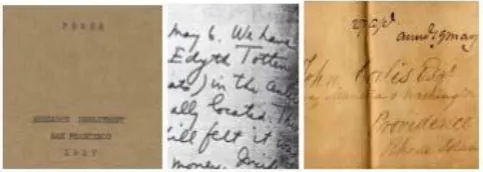
Then, the phase congruency features used in the main binarization step. Phase congruency is used in the machine vision and image processing literature. Phase congruency is a feature detector e.g. palmprint verification, finger-knuckle-print recognition, object detection, and biomedical applications[4]. We show that the foreground of ancient documents can be modeled by phase congruency. Phase congruency is a robust and stable way to process historical documents, both handwritten and machine-printed manuscripts. After completing the three binarization steps on the input images using phase congruency features and a denoised image, the enhancement processes are applied. A median filter and a phase congruency feature are used to construct an object exclusion map image. This map is then used to remove unwanted lines and interfering patterns [3][9]. The proposed binarization method is stable and robust to various types of degradation and to different datasets, with this purpose designed steps; we provide comprehensive experimental results to demonstrate this robustness of documents. Sample document images selected from various places.
Figure 1: Three degraded document image samples fromDIBCO’11.
2. Literature Review
In this section, we describe some selected binarization methods. Otsu‟s method [5] assumes the presence of two distributions (one for the text and another one for the background). It calculates a threshold value in such a way that it maximizes the variance between the two distributions.
Lu's et al [10][13] proposed a binarizatition method mainly based on background estimation. In first step, background of document was estimated via a one-dimensional iterative Gaussian smoothing procedure. After that for accurate binarization of strokes and sub-strokes, L1-norm gradient image was utilized. This method selected among 43 algorithms submitted to the DIBCO'09 competition.
Su et al [10] used local maximum and minimum to build a local contrast image. After that a sliding window was applied across the contrast image to determine local thresholds, where bright pixels shows foreground and dark pixels refer to background pixels. A version of this method ranked one of the two sharing _rst-rank winners among 17 algorithms participated in H-DIBCO'10 contest.
3.1 Phase Congruency-Based Feature Maps
Two features of phase congruency [5] are used to preprocess document images: i) the maximum moment of phase congruency covariance (MMPCC), and ii) the locally weighed mean phase angle (LWPMA). The MMPCC is a measure of edges strength which is used as an accurate edge detector. The LWMPA can be used to estimate the structure of foreground text.
3.2 Binarization Model
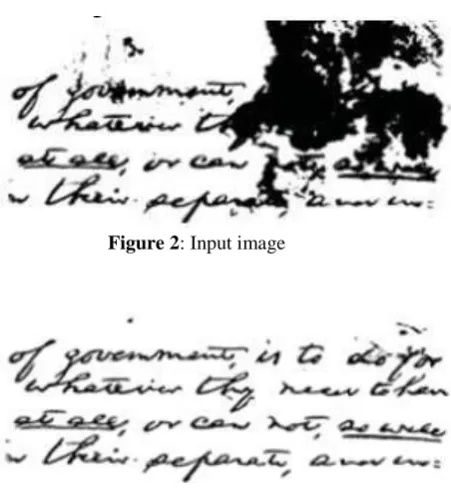
An extended version of the one proposed in our previous work [19]. We have added a diagnosed image, which is another phase-based feature to the binarization model, and achieved 5% improvement, on average.
Figure 2: Input image
Figure 3: Binarized image
3.2.1 Preprocessing
In the preprocessing step, we use a denoised image instead of the original image to obtain a binarized image in rough form. The image denoising method discussed in section III is applied to preprocess the binarization output
3.2.2 Main Binarization
The next step is the main binarization, which is based on phase congruency features: i) the maximum moment of phase congruency covariance (IM); and ii) the locally weighted mean phase angle (IL). 1) IM: In this, IM is used to separate the background from potential foreground parts[11]. This step performs very well, even in badly degraded documents, where it can reject a majority of badly degraded background pixels by means of a noise modeling method. To achieve this, we set the number of two-dimensional log-Gabor filter scales ρ to 2, and use 10 orientations of two-dimensional log-Gabor filters r.
3.2.3 Post processing
Computing, Vol.4 Issue.7, July- 2015, pg. 16-20
Figure 4: Binarization results of an Arabic historicaldocument image: (a) Original image, (b) Otsu‟s, (c) Niblack‟s,
(d) Sauvola‟s, (e) NICK and (f) Proposed method.
3.2.4 Ground truth Generation tool
A ground truth binary image is produced using the proposed PhaseGT software. The PhaseGT is an application for historical document ground truthing. It uses phase congruency features [8] [9] and a priori knowledge about the characteristics of the input document image to preprocess input document image. Based on the provided information, the PhaseGT will generate a rough binarized image.GT generation is difficult and time consuming task. For this benchmark datasets are required i.e. PHIBD 2012, H-DIBCO 2012.
Figure 5: Sample original and ground truth image
We have also proposed a rapid method to determine the type of document image been studied, which will be of great interest. The behavior of ancient handwritten document images and machine-printed images shows differences in terms of binarization. The strokes and sub-strokes of handwritten images require accurate binarization, and the binarization of the interior pixels of the text of machine-printed images needs to be performed with care. Although the proposed binarization method works well on both handwritten and machine-printed documents, better results for both types of documents are achieved, when a priori information about the type of input document is available.
4. Conclusion
In this, we have introduced an image binarization method that uses the phase information of the input image, and robust phase-based features extracted from that image are used to build a model for the binarization of ancient manuscripts. Phase-preserving denoising followed by morphological operations are used to preprocess the input image.
Then, two phase congruency features, the maximum moment of phase congruency covariance and the locally weighted mean phase angle, are used to perform the main binarization[1][7]. For post-processing, we have proposed a few steps to filter various types of degradation; in particular, a median filter has been used to reject noise, unwanted lines, and interfering patterns.
5. Acknowledgments
I would like to thank, specifically Mayur S. Burange Sir who provided helpful information about this topic and helped to quickly resolve issues that I encountered.
References
[1] H. Z. Nafchi, R. F. Moghaddam, and M. Cheriet, “Historical document binarization based on phase information of images,” in Proc. ACCV, 2012, pp. 1–12.
[2] K. Ntirogiannis, B. Gatos, and I. Pratikakis, “An objective evaluation methodology for handwritten image document binarization techniques,” in Proc. 18th IAPR Int. Workshop DAS, 2008, pp. 217–224.
[3] E. Saund, L. Jing, and P. Sarkar, “Pixlabeler: User interface for pixel- level labeling of elements in document images,” in Proc. 10th ICDAR, Jul. 2009, pp. 646–650.
[4] H. Z. Nafchi, S. M. Ayatollahi, R. F. Moghaddam, and M. Cheriet, “An efficient ground truthing tool for binarization of historical manuscripts,” in Proc. 12th ICDAR, Aug. 2013, pp. 807–811.
[5] R. F. Moghaddam and R.F.Nafchi, “Phase Based Binarization of Ancient document,” IEEE Trans. Image Process., vol. 23, no. 7, 2014.
[6] M. Valizadeh and E. Kabir, “Binarization of degraded document image based on feature space partitioning and classification,” Int. J. Document Anal. Recognit., vol. 15, no. 1, pp. 57–69, 2010.
[7] H. Z. Nafchi and H. R. Kanan, “A phase congruency based document binarization,” in Proc. IAPR Int. Conf. Image Signal Process., 2012, pp. 113–121.