Vol. 4, Issue 5, May 2015
Grasping Objects Using Shadow Dexterous
Hand with Tactile Feedback
Sivakumar k 1, Priyanka Ch2
P.G. Student, School of Mechanical and Building Sciences, VIT University, Chennai, India1
Assistant Professor, School of Mechanical and Building Sciences, VIT University, Chennai, India2
ABSTRACT: The robotic hand is a wider field in Robotics. Improving the dexterity of the robotic hands play a major
role in the development of Humanoid Robots. The aim of this project is to perform a more precise grasping on objects using a Shadow Dexterous Hand. The hand used for this project was designed by an UK based company named Shadow Robot. Joining hands with syntouchllc.they embedded the BioTac (tactile) sensors into the Hand. The BioTac sensors are installed at each tip of the five fingers and they provide nineteen different force outputs depending on the area of finger in contact with the object. The shadow hand supports the Robot Operating System software. ROS packages and libraries are used to simulate and perform control actions on the robotic hand in order to perform precise grasping on objects. Moveit! Package of ROS is used here for planning the joint movements of the robot.
KEYWORDS: Shadow hand, ROS, Moveit!, Move Group Interface.
I. INTRODUCTION
performance by modifying hand design and articulation, mechanics of movement, hand dexterity and tactile sensing. It has been stated that bio-oriented dexterous robotic hands could be the challenge of the near future. Once this is done, then number of interesting questions like how new technologies can be integrated to manufacture robotic hands with some desired behaviour concerning to the reliable bio-oriented dexterous robotics can be addressed. It has also been stated that there are quite a large number of attempts to acquire biologically inspired hands and very rear attempts towards employment of brain and cognitive sciences in robotic hand control. However building a robust and accurate controller for a typical design is a complicated task. Use of compliant tendon cables and one way shape memory alloy (SMA) wires in an agonist-antagonist artificial muscle pair configuration for the required flex-ion/extension has a number of features like anthropomorphically accurate size and appearance, kinematically accurate joint motion, compliant and tendon driven muscle-like actuation and biomimetic sensor. A more realistic sensing with electronic processing power has been introduced through which a robotic hand can be able to detect an event of slippage while grasping. This has been further processed to determine tactile and touching events such as making/breaking contact while grasping, slip between the hand and the grasped objects as well as contact location and static pressure. It is more like use of body signals to control finger movements was also discussed [5].Mimicking a human finger using tactile sensor is being implemented and this model was based on soft contact modelling with a full friction description. This sensor was tested on the most common use cases of tactile sensors in robotic grasping. It performed stable grasping without any errors. But problems arose when trying to calibrate the tactile model to correspond exactly to a certain real tactile sensor. Improving the collision detection and computational efficiency are to be concentrated more [6].Using a single control output they have produced co-ordinated movements. The use of families of functions produced highly anthropomorphic hand motions. This method is capable of capturing and reproducing an arbitrary level of motion without affecting the dimensionality of the input space and can be used with various biological signals [7].Adopting the best possible postures to maintain the balance during the reach to grasp movement is an integral part of the grasping. And it also states that ample freedom to choose the posture is important without which the arm will not be able to move in the same manner. Rock climbing was given as an example [8]. The tactile sensing surface, tactile transducing elements for higher force resolution and lower noise level, faster scanning and processing are required in real time. It also demonstrated that tactile sensor array can provide contact force, centre of gravity and orientation for the objects curvature [9].A design support tool named as actuation dexterity is introduced here which is to be considered while designing a device. It is the result of observations made from experiments on five dexterous hands [10]. Finger deflict was calculated here as the difference between the sum of maximum individual finger forces during single finger pressing tasks and the maximal force produced by those fingers during an all finger press task. Finger independence was calculated as the average non task finger forces normalised by the task finger forces and subtracted from 100 percent. Here the critical role of tactile feedback is demonstrated [11].
II. HARDWAREMODEL
A. HAND DESCRIPTION
Vol. 4, Issue 5, May 2015
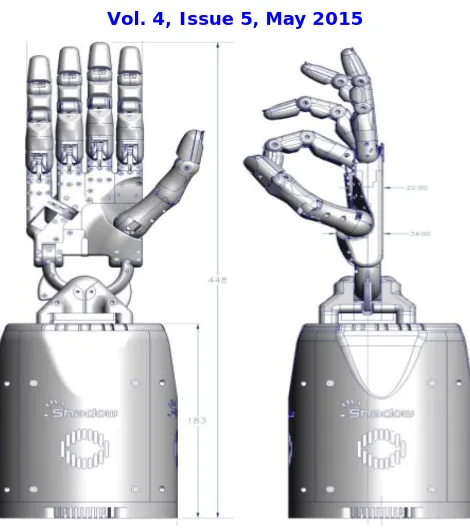
Fig 1 Shadow hand
The above figure represents the Shadow Hand model with the base forearm containing smart motors (one for each joint) and five fingers attached to the palm that is further attached to the wrist. It is to be noted that there is an extra joint provided for the little finger which can be seen at the bottom of the little finger.
B. KINEMATICS OF THE SHADOW HAND
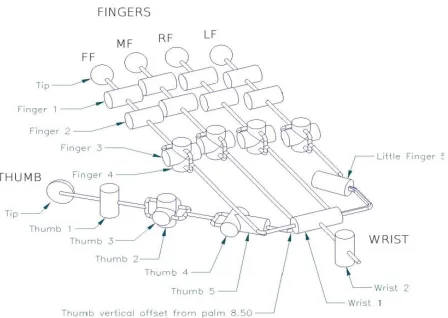
In total the hand produces 24 movements to reproduce as closely as possible the dexterity and kinematics of the human hand. All the five fingers are of the same length but their knuckles are tottered in such a way to give comparable locations for the fingertip similar to the human hand. The forearm of the hand is somewhat wider than the normal human hand because, all the motors actuating the joints are arranged in the forearm of the hand. Smart motors are used here and each smart motor nodes use PWM to drive a Maxon motor. The motor also constitutes a PID controller and uses a pull/pull mechanism onto the tendons in order to control the position of the joints in the hand
Table 1 Representation of finger joints and movements
Finger Joints Movements
First 3 4
Middle 3 4
Right 3 4
Little 4 5
Fig 2 Kinematics of Shadow Hand
The kinematics of the shadow hand is described in the above figure. LF represents little finger, RF for right finger, MF for middle finger, FF for first finger and TH for thumb finger respectively. The joints are represented as fingertip joint, distal joint, middle joint, proximal joint and metacarpal joint.
III. MODELING AND PLANNING
A. ROBOT OPERATING SYSTEM
The robot operating system is the software used for simulating the hand since it contains all the essential packages and libraries needed to perform configuration, calibration, control and simulation of the hand. Nodes, topics, messages and services are some important parameters in Robot operating system. ROS core or master should be running in-order to performing all the above operations. It provides naming and registration services to all the other nodes in the system. When a node (executable) tries to publish or subscribe from or to another node via topics, it passes messages and the ROS master keeps tracking the information. The moveit! Package of ROS is used here to plan the movements of the joints in the simulation. The codes are written in C++ involving the move-group function of moveit!. Move group interface is a primary user interface which provides handy functionality for the users to carryout the operations like setting goal states for the joints, motion planning, adding objects in the working environment and attaching or detaching objects to or from the robot.
B. MODELLING
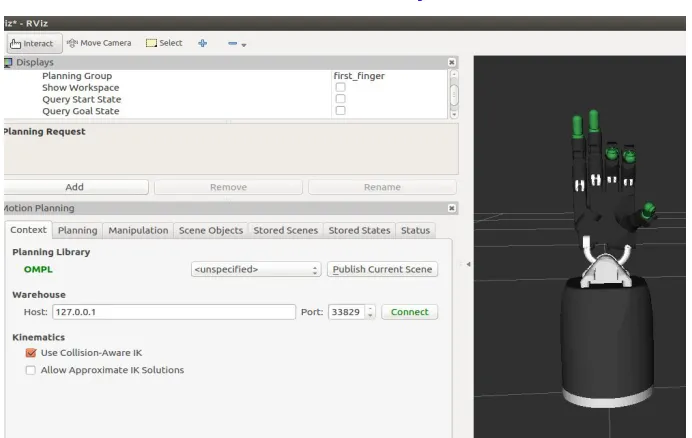
The initial step in the simulation is to bring the Robotic Hand into the moveit planner. The URDF (Unified Robot Description Format) file contains all the structural information of the robot. The moveit setup assistant is launched through terminal and a new moveit package is created by loading the urdf file of the hand discussed above.
Vol. 4, Issue 5, May 2015
Fig 3 Shadow Hand Model
C. PLANNING
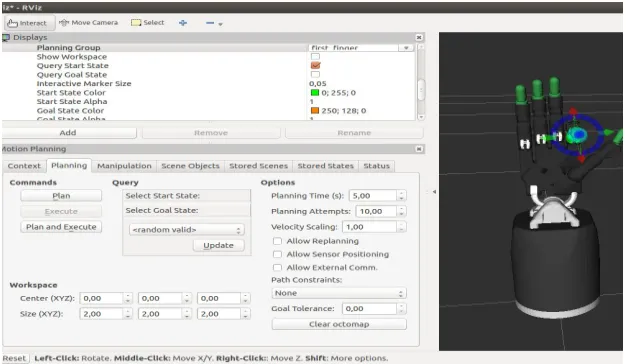
The generated package in the previous step contains a launch file which should be launched into the moveit planner using roslaunch<package_name><launch_file>. Now in the planning window the first finger is selected as the planning group in-order to plan movements for that particular finger. The tip of the first finger appears with a marker to interact with it. In this way the joint movements are planned and Later this is continued for planning movements for all the other fingers. After planning movements for the first finger the window appears as shown.
Fig 4 Planned joints using marker
Firstly the move group class is set using the name of the group to be planned and controlled. The class is declared as follows
moveit::planning_interface::MoveGroup group("three_fingers");
moveit::planning_interface::PlanningSceneInterfaceplanning_scene _interface;
The above commands involve planning movements for the first three fingers of the hand and the planning scene interface allows the declared class to deal directly with the world. The group.getcurrentstate() function allows us to get information on the current state of the joints in the hand. Once the current states are known, the target postures of each joint is planned and using group.setJointValueTarget(group_variable_values);
Fig 5 Step by step movements of finger joints
Vol. 4, Issue 5, May 2015
Fig 6 Simulated Shadow Hand
B. CONTROL
The code generated in moveit! is now interfaced with the real robot and communication between moveit! and the real robotic hand is established through the sr_standalone library of the robot operating system. The for loop executes seven times and for each time the joint moves step by step depending on the value provided to each joint in the array. Finally when it touches the object and if the force sensed by the tactile sensor exceeds 200 mV, the loop is terminated. The joint values for the shadow robotic hand is declared in the following order as follows
FFJ4, FFJ3, FFJ2, MFJ4, MFJ3, MFJ2, THJ4, THJ5, THJ3 & THJ2.
int joint = 0, times = 10, moves = 0, maxmoves = 3; moveit::planning_interface::MoveGroup::Plan my_plan;
float movement[]={0.0,0.16,0.16,0.0,0.16,0.16,0.0,0.35,0.0,0.08};
for( moves = 1; moves <= 7; moves = moves + 1 ) {
group_variable_values[1] += movement[1]; // FFJ3 group_variable_values[2] += movement[2]; group_variable_values[4] += movement[4];
group_variable_values[5] += movement[5]; group_variable_values[6] += movement[6];
group_variable_values[7] += movement[7]; group_variable_values[8] += movement[8]; group_variable_values[9] += movement[9];
group.setJointValueTarget(group_variable_values); group.move();
tactiles[0].
F_thumb = tactiles[4].pdc; F_index = tactiles[0].pdc; F_middle = tactiles[1].pdc; force_zero[0] = tactiles[0].pdc; force_zero[1] = tactiles[1].pdc; force_zero[4] = tactiles[4].pdc;
}
if ( F_index - force_zero[0] > 200 || F_thumb - force_zero[4]> 200 || F_middle - force_zero[1] > 200) {
break; }
V. RESULTS AND DISCUSSION
A. RESULTS
As a result of this experiment when the simulation is interfaced with the real robot, the Shadow hand moves in sequence of steps and till it touches the object. The tactile sensors provides the force output and these readings are used to control the position of the joints by terminating the loop inside the move group C++ code and resulting the hand in performing more precise grasping of an object.
Fig 7 Precise Grasping by Shadow Hand using tactile feedback
B. DISCUSSION
Vol. 4, Issue 5, May 2015
cyber glove undergoes a change in angle .This angle can be passed as arguments to the code and corresponding actions can be transferred to the real hand.
ACKNOWLEDGEMENT
The work and the robotic platform have been developed during a research stay at IFMA/Institut Pascal (Clermont-Ferrand, France) with the support of IMobS3 project.
REFERENCES
[1] EbrahimMattar, “A Survey of Bio-Inspired Robotics Hands Implementation: New Directions in Dexterous Manipulation”, Robotics and Autonomous Systems, Volume 61, Issue 5, Pages 517-544, May 2013.
[2] Schmitz, A.; Maiolino, P.; Maggiali, M.; Natale, L.; Cannata, Giorgio; Metta, G. "Methods and Technologies for the Implementation of Large-Scale Robot Tactile Sensors", Robotics, IEEE Transactions on,On page(s): 389 - 400 Volume: 27, Issue: 3, June 2011.
[3] Mittendorfer, P.; Cheng, G. "Humanoid Multimodal Tactile-Sensing Modules", Robotics, IEEE Transactions on, On page(s): 401 - 410 Volume: 27, Issue: 3, June 2011
[4] Akter, T.; Joseph, J.; Kim, W.S. "Fabrication of Sensitivity Tunable Flexible Force Sensor via Spray Coating of Graphite Ink", Electron Device Letters, IEEE, On page(s): 902 - 904 Volume: 33, Issue: 6, June 2012
[5] Hanna Yousef, Mehdi Boukallel, KasparAlthoefer (2011) Tactile Sensing for Dexterous in-hand Manipulation in Robotics – A Review, Sensors and Actuators Vol. A 167, pages171-187, 2011.
[6] H. Kawasaki, T. Komatsu and K. Uchiyama, “DexterousAnthropomorphic Robot Hand with Distributed Tactile Sensor: GifuHand II”, IEEE/ASME Transactions on Mechatronics, Vol. 7, no. 3, pp. 296-303, Sep2002.
[7] P. Michelman, “Precision Object Manipulation with a MultifingeredRobot Hand”, IEEE Transactions on Robotics and Automation, Vol. 14,no. 1, pp.105-113, Feb 1998 [8] A. Bicchi, “Hands for Dexterous Manipulation and Robust Grasping: ADifficult Road toward Simplicity”, IEEE Transactions on Robotics andAutomation,
Vol. 16, no. 6, pp. 652-662, Dec 2000.
[9] D. Dornfeld and C. Handy, “Slip Detection Using Acoustic EmissionSignal Analysis”, in Proc. IEEE Int. Conf. Robotics and Automation, Vol. 4, pp. 1868-1875, Mar 1987. [10] C. Melchiorri, “Slip Detection and Control Using Tactile and ForceSensors”, IEEE/ASME Transactions on Mechatronics, Vol. 5, no. 3, pp 235-243, Sep2000. [11] R. Maldonado-Lopez, F. Vidal-Verdu, G. Linan and A. Rodriguez-Vazquez, “Tactile Retina for Slip Detection”, in Proc. IEEE Int. Conf.Virtual Environments, Human-Computer
Interface and MeasurementSystems, La Coruna, Spain, Vol 10, pp 96-101, July 2006.
[12] D. Gunji, Y. Mizoguchi, S. Teshigawara, A. Ming, A. Namiki, M.Ishikawaand and M. Shimojo, “Grasping Force Control of Multi-fingered Robot Hand Based on Slip Detection Using Tactile Sensor”, inProc. IEEE Int. Conf. Robotics and Automation, ICRA 2008, Pasadena,CA, , pp 2605-2610, 19-23 May, 2008.
[13] Sami Moisio, Beatriz Leon, Pasikorkealaakso, Antonio Morales., “Model of Tactile Sensors using Soft Contacts and its Application”, in Robot Grasping Simulation, Robotics and Autonomous Systems Vol. 61, pages1-12, (2013).
[14] Benjamin A. Kent, John Lavery, Erik D. Engeberg., “Anthropomorphic Control of a Dexterous Artificial Hand via Task Dependant Temporarily Synchronized Synergies”, Journal of Bionic Engineering Vol.11, pages 236-248, 2014.
[15] B.Barkat, S.Zeghloul, J.P.Gazeau., “Optimization of Grasping Forces in Handling Brittle Objects”, Robotics and Autonomous Systems, Vol 57, pages 460-468, 2009.