CHRISTIAN, DAVID B. Strategic Deception in Agents. (Under the direction of Assistant Professor R. Michael Young).
Despite its negative ethical connotations, deception is a useful tool for human social interaction, and plays an important role in the process of creating the stories that pervade our popular culture. In this paper, we describe the deception planner, an implementation of a model of strategic deception. Strategic deception is deception performed in order to achieve or enable some higher goal, as opposed to deception that is performed for the sake of deceiving, or for an unstated purpose.
Given a model of a deceiver holding ulterior goals, a model of the goals and abilities of a target agent to be deceived, and a model of the relevant pieces of the world, the deception planner generates a set of statements about the current world state which may be either true or false. Those statements are communicated to the target agent, which updates its world state to reflect this new information. The target then performs planning to achieve its own goals, with no knowledge of the deceiver’s goals. If the deception planner generates an successful set of statements, the target agent will create a plan that achieves the deceiver’s ulterior goals despite no knowledge of those goals.
deceiver’s goals, but are of equivalent or better quality than the candidate plan according to some metric shared by the target and deceiving agent. Because they are of the same or better quality, the target agent may choose a competing plan instead of the candidate plan. A competing plan is countered by undermining through lying a belief that is necessary for that plan to be executable.
by
David Christian
A thesis submitted to the Graduate Faculty of North Carolina State University
in partial satisfaction of the requirements for the Degree of
Master of Science
Department of Computer Science
Raleigh
2004
Approved By:
Dr. James Lester Dr. Munindar Singh
Dr. R. Michael Young
Biography
David Christian was born in Minneapolis, Minnesota, on May 23, 1979. He spent his formative years in Edina, a suburb of the Twin Cities.
David went to a year of college at Knox College, in Galesburg, Illinois, before deciding that Macalester College in Saint Paul, MN, was a better fit for him, if for no other reason than because the nearest large city wasn’t Peoria. He also had met his fu-ture wife while visiting the school. At Macalester, he majored in Computer Science and minored in Math. His favorite classes in college were Introductory Poetry, Modern Art, So-ciology, Ethics, and Indian Philosophy. Number theory, Artificial Intelligence, and Parallel Programming weren’t bad either. David graduated with a Bachelor of Arts in Computer Science and a minor in mathematics. Magna Cum Laude with Departmental Honors and joined the honor societies Phi Beta Kappa, and Pi Mu Epsilon, and three different honors societies, including Phi Beta Kappa. Most importantly, David met his future wife, Sarah Goetz.
Acknowledgements
Many people have helped to make this document possible. Thanks go firstly to my advisor, Dr. R. Michael Young, who funded several years of my research and has helped me figure out how to be a graduate student. Thanks also to the members of the Liquid Narrative Lab who listened to all of my crazy ideas past and present, and who make me laugh, including Mark R., Yuna, Arnav, Kevin, Alex, Brian, Justin, Joe, Tommy, and Jim. Also, thanks especially to the lab administrators, who are of a special breed, and who are sorely missed, R.J, Mark B., and Kevin.
Thanks to the University Graduate Student Association, an organization which has helped me discover parts of myself that have little to do with my Master’s thesis, but I think will serve me just as well. Thanks especially to Dr. Rufty, Esther, Christina, Elana and the other people who served as representatives and executive board members to serve the graduate student population at NC State.
Thanks to my sisters, who have served as inspiration through their own successes. Now if they would just slow down some so I could catch up. . . And thanks to my mom, who always makes me feel like I could conquer the world whenever I ask her for advice.
Contents
List of Figures vii
1 Introduction 1
2 Related Work 3
2.1 Deception by Agents . . . 3
2.2 Competitive and Opposing Agents . . . 6
3 Problem and Solution Definition 8 3.1 Example and Overview . . . 8
3.2 Formal Model of Standard Planning Input and Output . . . 10
3.3 A Formal Model of Deception Planning . . . 12
3.3.1 The Target Agent Model . . . 12
3.4 Problem and Solution Definition . . . 16
4 The Deception Planner Algorithm 19 4.1 The LPG Planner . . . 19
4.1.1 LPG Plan Search Overview . . . 20
4.1.2 Neighbor Generation . . . 22
4.1.3 Neighbor Evaluation . . . 24
4.1.4 Plan Repair . . . 25
4.2 The Deception Planner . . . 27
4.2.1 The Ulterior Goal Heuristic . . . 29
4.2.2 The Lie Heuristic . . . 34
4.2.3 Negating Competing Plans . . . 38
5 Example 44 5.1 Initial Setup . . . 44
5.2 Preprocessing . . . 45
5.3 Neighborhood Creation . . . 49
5.4 Neighborhood Ranking . . . 49
5.6 The Final Ulterior Goal . . . 53 5.7 The Competing Plans . . . 54
6 Future Work 57
6.1 Improvements to the Target Agent Model . . . 57 6.2 Improvements to the Deceiver Agent Model . . . 59 6.3 Verification and Improvement of the Deception Planning Algorithm . . . . 59 6.4 Integration of the deception planner in a larger project . . . 61
7 Conclusion 62
Bibliography 64
A LPG Plan Evaluation Heuristic 66
B Input For The Deception Planner 68
List of Figures
3.1 Pseudocode for the target agent’s behavior (control cycle) after the deceiver
has given it the updated information . . . 15
4.1 Pseudocode for the LPG (Local Planning Graphs) planner . . . 22
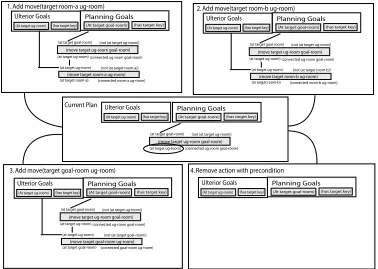
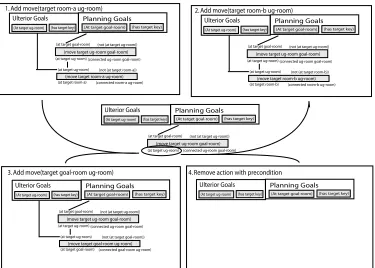
4.2 Neighborhood generation example. A precondition is chosen from the current partial plan and solved in 4 ways. Three ways involve adding a new action to assert the precondition. The fourth way removes the action which the selected precondition. . . 23
4.3 pseudocode for LPG planner . . . 26
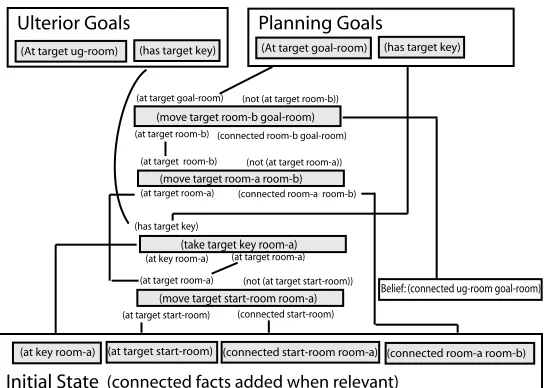
4.4 Deception Planning Example. Column 1 shows the planning goals, ulterior goals, and initial state. Column 2 shows the actions allowed in this world. Column 3 shows the beliefs of the target, the plan the deceiver would like the target to develop, and the statements the deceiver gives to get the target agent to act accordingly. Statements with *s next to them are lies. . . 28
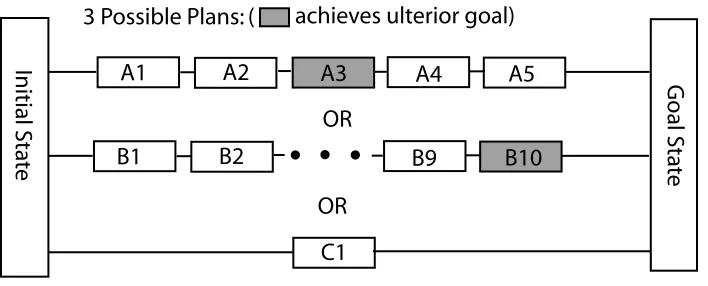
4.5 Ulterior goal cost example. There are three ways to solve a particular plan-ning problem which differ both in how many total steps they have and how easily they achieve the ulterior goal. . . 31
4.6 Sample Observation Rule . . . 35
4.7 A sample initial state and set of actions . . . 37
4.8 Pseudocode for the entire deception planner . . . 41
4.9 Pseudocode for countering a competing plan . . . 42
4.10 Pseudocode for creating the competing initial state . . . 42
4.11 Example for countering competing plans. Two shorter competing plans can be found and countered. . . 43
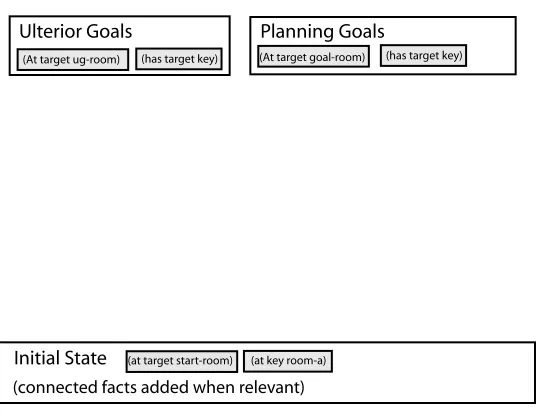
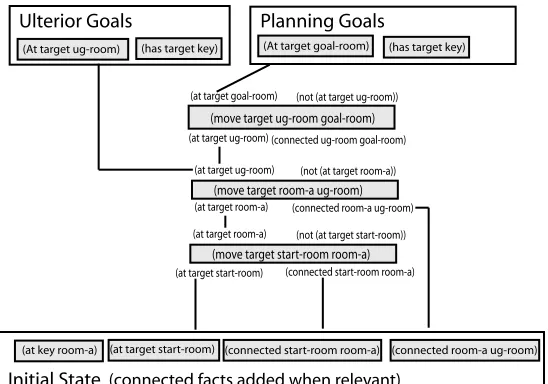
5.1 Deception Planning Example. Column 1 shows the planning goals, ulterior goals, and initial state. States that the agents believes or knows to be true are marked with a (B) or (K). States unknown to the agent are marked with a (U). Column 2 shows the actions allowed in this world. Column 3 shows the observation rules of the target agent. . . 46
5.2 Initial State before any actions added . . . 46
5.4 Plan after first action added . . . 51
5.5 The developing candidate plan after actions 2 and 3 are added . . . 52
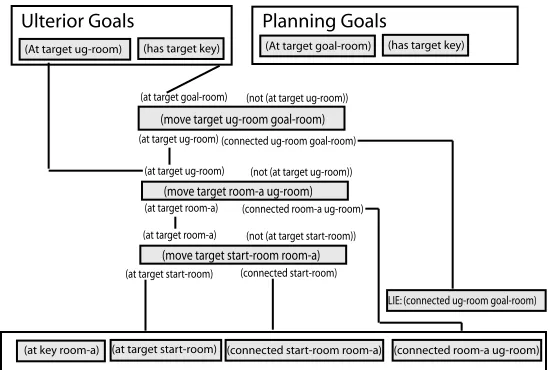
5.6 Add lie . . . 53
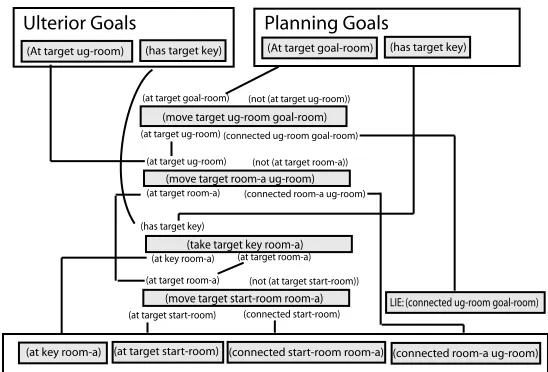
5.7 Take key and complete plan . . . 54
Chapter 1
Introduction
Deception is a powerful tool with a capacity for destruction. Despite its potential negative consequences, studies show that we lie almost every day, often to those who are closest to us [8]. Because deception triggers powerful reactions when discovered by humans, developing models and algorithms for computer deception poses a sometimes controversial yet fascinating research area. This thesis develops an algorithm to allow strategic, manipu-lative lying — lying which can cause a deceived agent or human to behave in a way which is to the benefit of the deceiver. We call the algorithm which determines the manipulative lies thedeception planner.
Researchers have studied agent communication since the inception of the field of artificial intelligence (AI), but they generally make the simplifying assumption that the agents involved in communication are telling the truth. We will, like others before us, call this assumption the sincerity assumption [19]. It is based on a set of maxims for human conversation developed by Grice in 1975 [15]. The value of the sincerity assumption lies in occluding such conversational “anomalies” including sarcasm and deception, which require a more nuanced model of the workings of communication.
with the truth) in order to steer a conversation away from particular topics [4]. If agents become consultants about matters of health or politics, such a conversational tactic may prove to be useful.
Story-telling, or narrative, is another compelling case for endowing computational agents with deceptive capabilities. We expect and accept that characters in a story lie to each other. Their lies help form the conflict and tension that make a story interesting. Likewise, it is an accepted narrative practice for an author to “deceive” the story’s audi-ence by occluding important information or using an unreliable narrator. Thus, narrative provides for both the deception of characters within the narrative and the deception of the narrative’s audience.
Deception can be seen as more than just a component of narrative, however. Re-lating a fictional narrative involves the consensual communication of false information [17]. Like deception, developing a coherent narrative requires a model of the audience’s relevant knowledge, as well as what he will be able to observe and deduce from what has been communicated to him. Because both the communicator and the audience know that the information passed is false, there is little, if any, moral ambiguity. Deception, then, may be a useful paradigm for considering the process of creating narratives.
We describe an algorithm, implemented as the Deception Planner, that develops a set of lies intended to cause a target agent or human (from now on denoted as simply thetarget ortarget agent) to perform actions in pursuit of its goals in a way that benefits the deceiver. Specifically, the target acts on false information, and then begins to act out a plan based on that information, and in the process of acting out that plan achieves the ulterior goals without knowing of the existence of these goals. The deception planner uses a modified heuristic search planner to create the lies necessary for this process.
Chapter 2
Related Work
The work related to deception planning can be divided into two broad categories: those projects directly related to deception by agents, and those related to anticipating the behavior of an opponent agent.
2.1
Deception by Agents
Researchers developing models of social interaction between agents have often asserted that agents do or should follow a Gricean model of communication [15, 6]. Grice claimed that people communicate cooperatively, following simple maxims to ensure that they are understood and that communication is efficient. The four maxims that Grice posits are the maxims of quality (the information must be accurate), quantity (the information must be no more or less than necessary), relation (the information must be related to the topic), and manner (it must be presented in an appropriate manner).
For example, if the hearer is given only a partial description of an event by a speaker, and if the speaker is following Grice’s maxims, then the hearer may assume that the speaker wants the hearer to assume reasonable defaults for any missing information. It is the possibility of deriving extra information from utterances that has made Grice’s maxims particularly valuable to the study of agent communication.
Despite its value, some researchers have allowed agents to depart from the maxims of quality and quantity. In the most direct case, such a departure implies deception — either through the deliberate falsification or the omission of information. These forays into deception also rely on the existence and presumption of cooperative communication — without some rules for honest communication, deception loses its effectiveness.
Castelfranchi has built a simplified deception model called GOLEM based on the blocks world initially defined in planning research [5]. The two agents in this world have disparate goals and capabilities. For example, Eve may want to build one large tower out of the blocks, while Adam may want to build two smaller ones. Eve can lie or tell the truth to Adam about her abilities, and depending on Adam’s attitude towards Eve, Adam will either help her or not. Castelfranchi describes a set of attitudes that affect how agents deceive. For example, a lazy agent might lie in order to avoid doing work that she could do, while a pragmatic agent might lie only when it was necessary to win.
belief-nets model how strongly a target believes a particular fact. The model of implicature and the agent’s current beliefs contain enough information to practice “safe” argumentation methods, which preserve a degree of separation between the deceiver and the deception. For example, the deceiver might claim uncertainty where there is certainty, a claim which is very difficult to disprove, or state afterwards that the false information came from an unreliable source.
The goals of Carofiglioet. al.’s MOUTH-OF-TRUTH system are complementary to those of the deception planner described in this thesis. While MOUTH-OF-TRUTH focuses on the safe communication of deceptive information to convince a target of the truth of a desired fact, the deception planner focuses on determining which facts a target must believe in order to act in a way that is beneficial to the deceiver. It is possible that the MOUTH-OF-TRUTH could be used as a method to cause a target to believe the lies needed for the deception planner.
Finally, contestant programs in the Loebner Prize Contest can be considered to be deceptive [10]. The Loebner Prize Contest is an implementation of the Turing Test [22]. The Turing Test was devised to answer the question ‘If a computer can think, how do we tell?’. The Loebner Prize Contest sets up a judge to communicate through text with both computer programs and humans. The judge must rate how human the entity with which he is communicating seems. The computer program that seems the most human wins that year’s contest. A computer that could fool a high enough percentage of humans all of the time could be considered to be intelligent.
Entries into the Loebner Prize Contest continually break Grice’s maxims [21]. Loebner Prize Contest programs depart from the Gricean maxims by default: they are trying to assert their humanity, an assertion of low or no quality. Beyond this general violation of the Gricean maxims, Loebner Prize Contest entries break the maxims for pragmatic reasons: they do not have enough world knowledge to behave intelligently in all situations, so they cover by providing mostly irrelevant information, by evading questions, and even by acting angry or paranoid. Although the algorithms are forced to break the maxims because the have limited abilities, a study shows that breaking these maxims can actually improve the program’s chances of being seen as human — especially by showing extreme emotion, even in violation of the manner maxim [21].
that the techniques used in the Loebner Prize Contest test may be complementary to the deception planner in the same way that the techniques used in MOUTH-OF-TRUTH are. Their evasion, omission, and deception techniques may be valuable to convince a target agent of the truth of a false fact, which is a task outside of the scope of the deception planner.
The above models focus mostly on the process of communicating a particular deception, without any concern about how the deception will effect the future behavior of the agent being deceived. Castelfranchi’s GOLEM does concern itself with the effect of its deception, however it does not take any extra steps to ensure that the deceptions it tells will be successful. Our model uses extra information about the motivators and abilities of a target as well as the context of the deception to help choose which facts are important for the target agent to believe. In this way, we take the deception from the abstract to the purposeful: the deceiver deceives for its own self-interest, and calculates the set of mix of truths and falsehoods it tells in order to ensure that its interests are met.
2.2
Competitive and Opposing Agents
The deception planner focuses on guessing the target agent’s potential moves, and using that information to its own ends. In this way, the deception planner is similar competitive systems, which attempt to either explicitly or implicitly discover and counter another agent’s moves. Like communication, competition, especially games playing, has been a focus of AI since the field’s early days.
Many algorithms for modeling competitive situations assume an opposing agent. The minimax algorithm computes the best move for the agent based on a search of potential moves by both the agent and the competition[20]. The possible combinations of moves is decreased by applying the assumption that each will only choose that action which is best for him.
keep the system agent from achieving its goals. By ensuring that the system agent acts to stay within a set of acceptable states that always allow a path to the goal, the system agent can usually ensure its achievement of its goals. In deception planning, the deceiver is similar to the system agent, in that it anticipates the target’s moves and uses them to ensure the deceiver’s goals are achieved.
Chapter 3
Problem and Solution Definition
In this chapter we give an informal overview of the problem solved by the de-ception planner, followed by a formal definition. The formal definition of the dede-ception planner describes the scope of the problem the deception planner solves and the required characteristics of a solution to a deception planning problem.
3.1
Example and Overview
Consider the following example of strategic deception:
Danielle wants to get to a pay-phone so she can call to get her car fixed. She is walking towards the gas station when a passerby, noticing her situation, tells her that the gas station phone is out of order. “But you can use my phone” says the serial killer, smiling widely. “My house is right over there.”
The deceiver wants the target to achieve another set of goals, calledulterior goals. These goals are part of a larger, implied plan held by the deceiving agent. The nature of this larger plan is outside of the scope of this work, but in the above case we can assume that the serial killer wishes to murder Danielle out of sight. The ulterior goal is the state that the target agent must achieve in order to make this plan possible — in the above example, it is simply to get Danielle into the house. The deceiver does not wish to ask the target to explicitly achieve the ulterior goal or goals, because the target agent may not wish to help the deceiver. Instead of asking the target to perform acts to achieve the ulterior goal as a favor or for no reason, the deceiver gives the target agent planning advice, in the form of new information about the current state of the world. Some of these pieces of information may be lies, however, there is no requirement that all of the statements told by the deceiver be false. The information passed from the deceiver to the target is the total output of the deception planner.
The new information given to the target is integrated into the target’s understand-ing of the world. In this work, it is assumed that the deceiver has already determined which facts he can convince the target agent about, and only tells lies about facts that fit in that category. Determining whether a lie is believable or not is outside of the scope of this work, but a process that makes this distinction is assumed to have been previously applied.
After integrating this new information, the target generates a new plan of action to achieve her planning goals. If the deceiver has delivered a successful set of information, the target’s plan will achieve the ulterior goals along the way to achieving the planning goals. However, because some of this new information that the target agent incorporated into the new plan may be false, the plan may not actually achieve the planning goals when executed. Imagine, for example, that the serial killer does not really have a phone in his house - if the target does not find this out until after entering the house, the deceiver’s ulterior goals are still achieved, but the target’s plan is guaranteed to fail.
Finally, in order to ensure that the target agent will use the plan provided, the deceiver should ensure that the target does not have a better alternate solution available, where better is measured by a metric that is specific to the target agent. In the above example, any plan that does not involve relying on a stranger might seem better to Danielle. Thus it is imperative that the deceiver force Danielle to rely on him through making her believe that any plan that does not do so will not succeed. To ensure that the provided plan is the best plan available, the deceiver must consider the alternate solutions to the target’s planning goals. These alternate solutions are calledcompeting plans, while the plan that the deceiver hopes the target will assume is called a candidate plan. The deceiver’s preferred plan for the target is called a candidate plan in recognition of the fact that it is one possible solution to a target’s problem, and that more lies may have to be told in order to make it the best solution to the problem.
3.2
Formal Model of Standard Planning Input and Output
To complement the informal overview of the deception planner given above, we give a formal model of the inputs and outputs of the deception planner in the next section. Because the deception planner relies heavily on planning, in this section a formal definition of the terms used in planning is given as an aid.
Planning has been formalized into logical representations on multiple occasions. The following definitions of plan components are derived from those earlier formalizations [1, 18, 16]. However, the planning functionality described below is restricted, and not include quantifiers or existence operators, among other modern planning features. The functionality is complete enough for the planning used by the deception planner.
A planning problem can be split into a planningdomain, and a planninginstance. A planning domain consists of plan predicates and plan operators. A plan predicatep is a first-order predicatep(a1...ak), with a fixed number of parameters,k. Let a substitutions=
{a1=o1, ...ak =ok}be a pairing of each ofk predicate parameters with anobject. Consider
a parameterakbebound in a substitution if the parameter is listed in the substitution. And
ak be grounded in a predicate when a substitution that bindsak has been applied to that
predicate. Let a factf be a predicate where all of its parameters are grounded.
effects. Preconditions, add effects, and delete effects are sets of predicates. The utility of precondition, add effect, and delete effect sets is apparent only after a substitution has been applied on all these sets in order to transform the predicates into facts, creating anaction. The operator parameter set is the union of the parameters used in the preconditions and effects, and lists all the variables which must exist in a substitution to convert an operator to an action.
Letsbe a substitution that substitutes for all variables in an operatoro’s param-eter set. The application of that substitution to the precondition and effect sets ofocreates an action. The action preconditions and effects are sets of facts. The action preconditions describe what facts must be true before the action can be executed. Facts in the add effect set are made true, or achieved when the action is executed, whereas those actions in the delete effects are made false after the executed is applied. Let a state be the complete set of facts which are true about the world at some unnamed time. Let the application of an action a on state S be written as a(S). Given a state S before an action ais applied, the state S0 after the action is applied is S0 = (S∪A)−D, whereA is the add effects ofaand
D is the delete effects of a.
The planning instance contains the set of objects, O, that are available in the current planning problem, an initial state,I, and a goal state, G. The initial state and goal states are states such that the facts are based only on predicates in the planning domain, and the substitutions applied to those predicate only use objects available in O. Objects, predicate parameters, and operator parameters have types associated with them. Objects may only be substituted for predicate parameters of the same type.
Given both the set of objects from the planning instance and the operators from the planning domain, the complete set of actions that are possible in this planning problem can be derived by performing all possible substitutions on all operators.
A complete plan is defined as a set of ordered actions (a1, a2, a3, ..., an). When
these actions are applied in orderan(an−1(...a3(a2(a1(I)))...)), the following conditions hold.
Before the application of each actionai,ai’s preconditions are true in the current state, and
3.3
A Formal Model of Deception Planning
A standard planner is given a domain and an instance of that domain, and tries to create a plan that achieves the goals listed in the instance of that domain. In contrast, the deception planner is a meta-planner, or a pre-planner. Its output is not a set of actions, but rather a set of inputs to the target agent’s planner. We have informally defined the relationship between the deception planner and the target agent in Section 3.1. We now define the relationship formally.
3.3.1 The Target Agent Model
The deception planner DP takes as input a model of the target agent t. The makeup of this agent model help determine the constraints, complexity, and applicability of the deception planner. The deception planner’s model of the target agent consists of enough information to infer the inputs to the target agent’s planning process. It is this standard planning process that the deceiver subverts through deception.
The target agent t’s planning input consists of a goal set G, an operator set OP, and an initial state that is divided into two sets of facts, a knowledge set K, and a belief setB. The target agent also has a planning metricP M which is used to rank whether one plan is better than another.
The target’s understanding of the initial state is incomplete, or at least uncertain — that is one of the underlying requirements for the applicability of the deception planner. If the target knew everything about the current world state, then there would be no way to deceive the target into acting in the deceiver’s best interest. The belief set contains those facts which the deceiver is an authority on, or is able to convince the target about. The target agent believes facts in B only until it is told otherwise, whereas the knowledge set represents all knowledge that the target is certain about and will not believe lies about. Note that this distinction between knowledge and belief is pragmatic, not philosophical.
believe lies aboutf.
The target agent’s plan metricP M allows the target to compare plans in a mean-ingful way by calculating whether one plan is better than another. For example, assume the target agent’s metric measures only the length of a plan. If the deceiving agent gives the target information that allows it to generate a plan with twenty steps, and achieves the ulterior goals, but the target agent can also generate a plan with three steps, the target may decide to ignore the new information given by the deceiver and execute the plan taking three steps. To avoid this result, the deceiver must counter shorter plans that do not achieve the ulterior goals. Alternatively, if the deceiver can offer a plan that takes three steps, the deceiver does not need to worry about the target agent determining that a plan of length twenty is more desirable. The planning metric used by the agents in this thesis is always the length of a plan.
The goal, operator, knowledge and belief sets, and planning metric contain enough input for the standard planning process. However, because the deception planner models process of lying, we also model the process through which the target agent can discover lies. This process is modeled through two additional components of the target agent. The target’s observation rules,OR, define how the target agent observes facts about the world. The control cycle, C, defines how the target proceeds in acting out a plan, with particular focus on when the target agent abandons a plan that will not work.
Observation rules describe those facts that the target agent may observe while acting out its plan. They could be used to catch the deceiver in a lie by observing that some statement told by the deceiver is not true. The deception planner uses them to ensure that the target does not catch the deceiver in a lie in that fashion.
Observation rules contain atrigger, which contains the conditions under which the observation rule fires, and aneffect, which contains those conditions which will be observed when the rule is fired.
Observation rules rely on the concept of groundedness. A partially grounded predicate is a predicate in which only some of the substitutions which transform a predicate into a fact have been made. For example, a partially grounded predicate may have an object substituted for its first parameter, while the rest of its parameters are still unbound.
Let an observation rule o in OR be a tuple < T Ro, EFo >. Let T Ro be the
rule’s trigger, andEFo be the rule’s effect. LetT Ro and EFo be sets of partially grounded
world state, then all conditions inEFo/sare observed. If, after applyingsto EFo, there is
still some unbound variable inEFo, then all objects of the correct type may be substituted
in turn, and all the resulting facts are observed.
At every step in the execution of the target’s plan, the trigger rule is matched against all possible substitutions sthat might make all the facts resulting from the substi-tution true. For example, it is possible to have an observation rule o1 for an agent agent
that had T R(o1) =at(agent,?loc). If at(agent, school) were true, perhaps after the agent
moved from some other location to school, theno1 would be triggered with the substitution
s={?loc=school}.
Once a trigger is matched with a substitutions, then that substitution is applied to the effect of the observation rules. If there are any partially grounded predicate in the resulting effect, all possible objects, given type constraints, are substituted for the still ungrounded parameters. The resulting set of facts are observed, meaning that if they are true, the agent knows they are true, and if they are false, the agent knows that they are false.
Continuing the example, let EF(o1) be at(?obj,?loc). After applying
s={?loc=school}, the effect would be at(?obj, school). The predicate at(?obj, school) is only partially grounded. All objects would be substituted in turn into the ?obj variable, meaning that the target would know the truth value of at(agent, school), at(car, school), and so on.
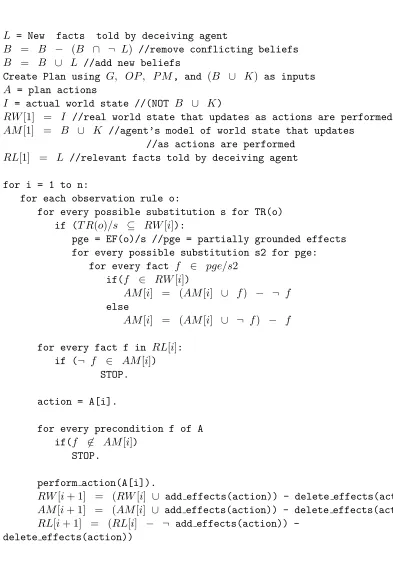
The observation rules, applied in combination with the agent’scontrol cycle, ensure that the deceiver cannot lie about a fact if the target would discover its truth value before the target has achieved the ulterior goals. The control cycle C describes how the target agent executes its plan. Once the target has developed a plan, the target will act out its plan, step by step, until all steps have been executed, or until the target agent observes a lie, or until a plan action fails because its preconditions do not hold, due to a lie. The control cycle can be written as the pseudo code shown in Figure 3.1.
L = New facts told by deceiving agent
B = B − (B ∩ ¬ L) //remove conflicting beliefs
B = B ∪ L //add new beliefs
Create Plan using G, OP , P M, and (B ∪ K) as inputs
A = plan actions
I = actual world state //(NOT B ∪ K)
RW[1] = I //real world state that updates as actions are performed
AM[1] = B ∪ K //agent’s model of world state that updates //as actions are performed
RL[1] = L //relevant facts told by deceiving agent
for i = 1 to n:
for each observation rule o:
for every possible substitution s for TR(o) if (T R(o)/s ⊆ RW[i]):
pge = EF(o)/s //pge = partially grounded effects for every possible substitution s2 for pge:
for every fact f ∈ pge/s2
if(f ∈ RW[i])
AM[i] = (AM[i] ∪ f) − ¬ f
else
AM[i] = (AM[i] ∪ ¬ f) − f
for every fact f in RL[i]:
if (¬ f ∈ AM[i])
STOP.
action = A[i].
for every precondition f of A
if(f 6∈ AM[i])
STOP.
perform action(A[i]).
RW[i+ 1] = (RW[i] ∪ add effects(action)) - delete effects(action))
AM[i+ 1] = (AM[i] ∪ add effects(action)) - delete effects(action))
RL[i+ 1] = (RL[i] − ¬ add effects(action)) -delete effects(action))
There are two points to note about the control cycle pseudo code. First, the planning algorithm used by the target agent is not specified. The target agent may use any algorithm, and consider plans in any order, so long as when the planner finds a plan that is better than the current plan according to the planning metric, it adopts that plan. Second, the target agent stops running a plan as soon as it believes that the preconditions of an action it is performing are not true, or it believes that the statement of the deceiving agent is not true.
For the purposes of this algorithm, we assume that the target has access to a perfect planner, and will always pick a plan of optimal length. This assumption puts the deception planner at a disadvantage: it has access only to a real planner, which must choose between optimalty and speed. The deception planner chooses to sacrifice optimality for speed and an ability to improve the plan as time progresses. In some cases, the deception planner may fail to find a shorter plan that the target agent finds, and thus fail to successfully perform deception planning. We believe this potential failure is aceptable, as it mirrors a potential flaw in a human’s plan for deception.
3.4
Problem and Solution Definition
Below is a concise definition of the problem solved by the deception planner, given the above definitions.
The Deception Planner is given a set of ulterior goals, the current world state, and a model of the target agent as described in Section 3.3. Given these inputs, the deception planner outputs a set of facts,F, and negations of facts,N F. These sets have the properties that∀f∈F(f 6∈K)∧(f 6∈B), and ∀f∈N Ff ∈B. Intuitively, the deception planner tells the
target agent information that the target agent does not already know (is not in the target’s knowledge of belief sets), or actually denies something the target currently believes.
Let the target’s updated initial state U I be (K∪B∪F)−N F. Then we define the target’s planning problem as the planning problem created by attempting to achieve the target’s planning goals G given the updated initial state U I and the target’s available actions A.
First, given the ordered execution of the steps in the candidate plan, at some point after the execution of stepsinCP, all the facts in the ulterior goal set will be true.
Second, if there is a fact f such that f ∈ F : f 6∈I or a fact in f ∈ N F : f ∈I, then f is a lie. As such, the following extra conditions much hold: f must not be used as a precondition for an action in CP before step s, and any observation rules which would trigger the observation off must not be triggered before step s.
Finally, a successful solution to the deception planning problem will generate a planning problem in which the only optimal solution is the candidate plan as determined by the target’s plan metric P M. Any such solution to the above planning problem that does not achieve the ulterior goals or allows the early observation of a lie is a competing plan.
Intuitively, the deceiving agent is searching for a set of lies to tell that will cause the target to create a plan that will achieve the ulterior goals. The deceiving agent does not care whether the target agent’s planning goals are achieved, but must consider them when crafting the lies that it tells. The target cannot be expected to take any action simply because the action fulfills an ulterior goal — the target agent does not know about those goals. Instead, any action that achieves an ulterior goal must serve some other purpose by helping to achieve the planning goals.
To this end, the deception planner searches for a candidate plan. A candidate plan is a plan that could be executed by the target agent that achieves all of the deceiving agent’s ulterior goals in the process of achieving the planning goals. The ulterior goals do not have to be true at the end of the candidate plan. Instead, consider the candidate plan to be fully ordered. To be a candidate plan, all of the ulterior goals must be asserted after the execution of some action a, and no lies must be observed until after the execution of that same action. A candidate plan must also be crafted to ensure that, if the plan is acted out by the target, the target agent will not halt the plan due to the discovery of a lie before the ulterior goals are achieved. A lie about a fact f is discovered iff it is observed: that is, if an observation rule is triggered before or during the execution of the candidate plan, and that observation rule has as an effect the fact f.
Finally, the candidate plan must not add any extraneous actions which do not help achieve the target’s planning goals. Such actions would not make sense for the target agent to execute, and so are not acceptable in a candidate plan.
cause the target agent to create a plan to achieve the ulterior goals. If the target agent does not know anything of the surrounding environment, the simplest way to do that is to communicate only those facts (or lies) needed to develop the candidate plan. If the target agent has initial knowledge (expressed as facts in B(a) or K(a)), or if the candidate plan contains within it a shorter plan that achieves the planning goals but not the ulterior goals, the target agent may learn the facts stated by the deceiving agent, go through the planning process, and develop a different plan, a competing plan.
There may be an almost limitless number of competing plans, depending on the knowledge held by the target agent. As the knowledge of the target agent increases, de-ception becomes harder and harder, as there may be more competing plans to discover and counter. In the limit case, there is no possible successful deception planner, because the target agent has enough knowledge to keep the deceiver from ever successfully leading her astray.
In order to find as many competing plans as possible, the algorithm continually tries to find competing plans that are better by some metric than the candidate plan and do not achieve the ulterior goals. As it finds a better plan, it searches for a lie that would not be discovered and could void the competing plan. This lie is then added into the set of facts to communicate to the target agent, and new competing plans are sought with this new lie in place.
Chapter 4
The Deception Planner Algorithm
In this chapter we describe the deception planner algorithm in detail. The decep-tion planner algorithm solves the problem set out in Chapter 3, by finding a candidate plan and countering its competing plans. We first describe the standard planning algorithm that serves as the backbone for the deception planner. We then describe the modifications to this planning algorithm that are necessary to search for candidate plans, followed by the process used to search for competing plans. Finally, we describe how the search for candi-date and competing plans is translated into a set of statements which are communicated to the target agent.
4.1
The LPG Planner
The deception planner used in this work uses a modified version of the LPG (Local Search for Planning Graphs) planner [12, 13]. The LPG algorithm is a complete implemen-tation of the latest standards in planning research, as listed in the Planning Domain Defi-nition Language 2.1 (PDDL)[11]. Its support for numerical and time based plans, resource maximizing and user-defined plan-quality metrics make it state-of-the-art, while its ability for plan repair make it relatively unique in the planning world.
(it also happens to be freely available). Its other features are unused by the current version of the deception planner. LPG’s plan search algorithm is described in the following section, followed by LPG’s plan repair algorithm.
4.1.1 LPG Plan Search Overview
The LPG planner, like many other planners, treats planning as a exploration of a search space, where the nodes in the search space are partial or complete plans [18]. A partial plan may have zero or more actions in it, and must at least one flaw in it, meaning that the actions in the plan cannot be executed in order and achieve the goal state, given that they are executed in the context of the initial state. The most common plan flaw is an
open preconditions. Recall that a precondition is a fact that must be true when an action is executed for that action to execute successfully. An open precondition p in plan P is a precondition for some action inP such thatp is not asserted by the actions beforepor the initial state. Conditions in the goal state can be considered preconditions of a special “goal action”. Most planners treat planning as a search problem, and are distinguished by how they search that space.
Most search algorithms depend on a heuristic to help them determine which node in the search space to search first. The search algorithms for planners in the late 80s and early 90s such as UCPOP were systematic, meaning that they were guaranteed to find a solution eventually, given that such a solution exists.
Unfortunately, the heuristic used by such planners to find the solution quickly were generally not very informed. A heuristic is informed if its estimate of the value of a node (in this case, the likelihood that the partial plan being examined will lead to a good solution to the planning problem) is accurate. For example, the default UCPOP heuristic counts the number of steps currently in a plan plus the number of flaws in the plan (usually open preconditions), and considers that total to be the partial plan’s heuristic value. This value can be thought of as an estimate of the number of steps that will be in the final plan that could be created from this partial plan. The number of steps currently in the plan accounts for the current length of the plan, and the number of open preconditions gives an estimate of the number of steps that will need to be added to create a complete solution to the planning problem.
preconditions will take to achieve. In general, not all open preconditions are alike. Nothing about a precondition indicates how many actions it will take to achieve that precondition. Indeed, the number of actions needed to achieve a precondition is highly context dependent. For example, if a precondition states that you must be at the top of the Eiffel Tower, that precondition will be much easier to achieve if you are already in Paris. Although the default UCPOP heuristic is not very informed, UCPOP and other planners used it because of its low calculation cost, which allowed for the fast examination of many search nodes. Designers were also encouraged to design their own heuristics which could take into account domain specific information about the difficulty of a precondition.
In 1996, McDermot developed a heuristic that traded the ability to quickly search a large number of nodes for the ability to accurately estimate the quality of a partial plan, and thus more quickly arrive at a soltuion. His planning system, named UNPOP, uses
relaxed planning in order to calculate the estimated number of actions needed to complete a partial plan. Relaxed planning achieves the current open preconditions while ignoring the delete lists of all actions added to the plan. The number of actions used in this relaxed plan is used as the cost of completing the current partial plan. The calculation is guaranteed to underestimate the number of steps needed to complete the plan. McDermot’s more accurate heuristic costs more to calculate, but actually leads a solution more quickly. His planners and others with more informed heuristics are called Heuristic Search Planners (HSP).
HSPs not only use a more advanced heuristic, they also generally are not system-atic. A systematic planner must explore each node currently visible in a search space within a finite amount of time. This is only possible if a queue of all the partial plans seen so far is kept. These plans are ranked along with all plans expanded by generating children of the current node, and the best plan from the queue is expanded next.
In a HSP, no such queue of older partial plans is kept. The heuristic is often good enough to make such a queue unnecessary. Instead, heuristic planners perform local search. Local search algorithms, such as hill-climbing, consider only the neighbors of the current search node. The neighbors are created by considering a set of possible alterations to the current plan, based on solving a flaw with the current plan. The behavior of HSPs upon reaching a node with no better neighbors is varied. Some algorithms allow the removal a previous addition to the plan, if that change makes a positive difference in the evaluation of the algorithm.
function search(Initial Plan) {
current plan = Initial Plan
while current plan is not finished: get neighbors(current plan) evaluate neighbors(current plan) current plan = best neighbor
final plan = current plan }
Figure 4.1: Pseudocode for the LPG (Local Planning Graphs) planner
search algorithm is displayed in Figure 4.1. An empty plan with only the preconditions from the “goal state action” is passed in to the search function. The LPG search algorithm can be divided into two parts: creating the neighborhood of plans for the current plan, ranking the neighborhood plans. The next two sections describe these parts.
4.1.2 Neighbor Generation
LPG’s generation of neighbors for a partial plan is straightforward. LPG picks an open precondition in the current plan. By default, LPG picks an open precondition from the action was most recently added. Picking open preconditions that are recently added leads to a search of the plan-space where one particular goal condition is solved entirely before the next is considered.
For each action a that can be added to the plan P in order to achieve this open precondition, a copy of the current plan with the additional action ais added to the partial plan’s neighborhood. Ifaasserts some fact which is deleted by some other action, or deletes another action’s assertion, then then multiple neighbors are created for a, one before and after each point inP wherea’s effects interact with other actions in P.
If p is a precondition to the action a0
, then a neighbor plan is created with a0
(At target goal-room) (has target key) (has target key)
(At target ug-room)
Planning Goals Ulterior Goals
(move target ug-room goal-room)
(at target goal-room) (not (at target ug-room))
(at target ug-room) (connected ug-room goal-room)
(move target goal-room ug-room)
(at target ug-room) (not (at target goal-room))
(at target goal-room) (connected goal-room ug-room)
(At target goal-room) (has target key) (has target key)
(At target ug-room)
Planning Goals Ulterior Goals
(At target goal-room) (has target key) (has target key)
(At target ug-room)
Planning Goals Ulterior Goals
(move target ug-room goal-room)
(at target goal-room) (not (at target ug-room))
(at target ug-room) (connected ug-room goal-room)
(move target room-a ug-room)
(at target ug-room) (not (at target room-a))
(at target room-a) (connected room-a ug-room)
(At target goal-room) (has target key) (has target key)
(At target ug-room)
Planning Goals Ulterior Goals
(move target ug-room goal-room)
(at target goal-room) (not (at target ug-room))
(at target ug-room) (connected ug-room goal-room)
(At target goal-room) (has target key) (has target key)
(At target ug-room)
Planning Goals Ulterior Goals
(move target ug-room goal-room)
(at target goal-room) (not (at target ug-room))
(at target ug-room) (connected ug-room goal-room)
(move target room-b ug-room)
(at target ug-room) (not (at target room-b))
(at target room-b) (connected room-b ug-room)
1. Add move(target room-a ug-room) 2. Add move(target room-b ug-room)
3. Add move(target goal-room ug-room) 4. Remove action with precondition Current Plan
4.1.3 Neighbor Evaluation
LPG evaluates its neighbors using a complex heuristic that, given a partial plan, attempts to estimate accurately the cost of the complete plan that would be derived from that partial plan. The details of the heuristic are complex, and somewhat tangential to the focus of this paper. For completeness, the detailed heuristic used in LPG is included in Appendix A. Broadly, the heuristic for altering a planP by adding an actionais as follows:
H(P, a) = (1 +λam∗CostT oF ixM utexes(P, a) (4.1)
+λap∗CostT oF ixOpen(P, a))
The LPG heuristic is based on the open preconditions in plan P as well as the mutexes inP. Amutex is created when the actionamid negates a fact as its effect that was
asserted earlier in the plan by actionabef ore, and is required to be true for a preconditionpof
an actionaaf ter later in the plan. The addition of action amid in between these two actions
requires that p be reasserted after amid. The cost of reasserting this precondition is what
is calculated in CostToFixMutexes. The weights λa
m and λap are dynamically calculated
stochastic weights that take into account the empirical difficulty of solving a particular precondition within a particular planning problem. Their exact calculation is beyond the scope of this thesis.
LPG estimates the number of actions in this chain through performing relaxed planning to complete the current partial plan. In relaxed planning, the delete lists of added actions are ignored. Because the deletion of facts is ignored, once an action is added to solve a precondition, its effects can always be used to solve preconditions using the same fact elsewhere in the plan. The total number of actions that must be added to ensure that all the necessary preconditions are asserted using relaxed planning is used as the estimate of the number of actions needed when using real planning.
LPG’s heuristic is used to find a complete plan quickly. The heuristic is modified for the deception planner to also find a plan that reaches the more stringent criteria set for plans that achieve the deceiver’s ulterior goals as well as the target’s planning goals.
4.1.4 Plan Repair
function LPGPlanner(initial_state,goal_state,actions): initial plan = empty plan
do forever:
current plan = initial plan
while current plan is not finished:
get neighbors(current plan) evaluate neighbors(current plan) current plan = best neighbor
final plan = current plan
if(final plan is good enough): return final plan else:
initial plan = add_errors(final plan)
repeat
LPG is capable of plan repair because its search algorithm is local: given a starting partial plan P, it can consider all possible modifications to the plan, including removing actions already in the plan. When improving a plan, the LPG algorithm executes code similar to that in Figure 4.3.
The functionadd errors(final plan)takes a complete plan, and removes several actions from the plan in order to create open preconditions that need to be fixed. The actions that are removed are chosen based on the cost that they add to the plan. By removing these actions, the LPG achieves these open preconditions in a different context than they were considered before. It is possible that there is a better way to solve these preconditions that is available now because the partial plan that is the context for resolving the precondition has changed. This partial plan is taken as an input for the heuristic search. The deception planner uses this ability of LPG to consider whether the candidate plan it has created is actually optimal.
4.2
The Deception Planner
The deception planner is implemented as a modification and extension of the LPG planner. Like LPG, its input includes the plan actions, initial state, and planning goals held by the target. Beyond this standard planning input, the deception planner takes as input the ulterior goals held by the deceiver, the target’s beliefs and knowledge, and observation rules. Its output consists of the set of possibly false statements about the initial state that the deceiver should tell the target to cause the target to achieve the ulterior goals.
Planning Goal:
(towed danielles-car)
Ulterior Goal:
(at danielle house)
Initial State:
(at car road) (at phn1 gas-stn) (working g-phn) (at h-phn house) (connected road house) (not (working h-phn)
Actions:
(move ?agent ?from ?to):
Preconditions:
(at ?agent ?from) ∧ (connected ?from ?to)
Effects:
(at ?agent ?to)∧ (not (at ?agent ?from))
(call ?agent ?phn ?loc):
Preconditions:
(at ?agent ?loc) ∧ (at ?phn ?loc) ∧ (working ?phn)
Effects:
(towed danielles-car)
Danielle’s beliefs
(at g-phn gas-stn) (working g-phn)
(connected road gas-stn) (connected road house)
Resulting Candidate Plan
(move danielle house) (dial danielle h-phn house)
Statements told by deceiver
(at h-phn house) * (working h-phn) * not (working g-phn)
For example, Figure 4.4 shows an initial state, candidate plan, and resulting state-ments for the serial killer example used in Chapter 3. The following subsections below give more detail on how the deception planner generates its output, through modifying the deception planner heuristic to handle ulterior goals and effective deception, and through countering alternative solutions.
4.2.1 The Ulterior Goal Heuristic
While the LPG heuristic searches for plans of good quality, the deception planner must search for plans that are of good quality and achieve the ulterior goals in the process of achieving the planning goals. Fortunately, heuristic planning makes it simple to modify the characteristics of the preferred plan. By modifying the function used to rank each plan, the deception planner will to prefer plans that are more likely to achieve the ulterior goals; as a result the deception planner can skew the search towards those plans. In order to prefer plans that will achieve ulterior goals, we add a fourth element to the abstract LPG heuristic given in Formula 4.2.
HDP(P, a) = (1 +λam∗CostT oF ixM utexes(P, a) (4.2)
+λap∗CostT oF ixOpen(P, a))
+υugCostT oAchieveU ltGoals(P, a)
Formally, letF D(A, q, g) define thefact distance between q and gusing A, where A is the target’s action library and q and g are facts. The fact distance from a fact q to another factg is the minimum number of actions in an ordered lista1, a2, ..., an required to
create a link such thatq is asserted by a1, anasserts g, and anhas a precondition which is
asserted byan−1, and so on. The fact distance of a fact to another fact where no such path
exists is infinite.
If the stipulation of a particular preconditionp is no longer required and instead the use of any open precondition in a plan P is allowed, the minimum fact distance for a factq in the plan P can be defined.
LetM F D(A, P, q) define the minimum fact distance to q from P using A, where action library A is the action library used to create P, P is a partial plan, andq is a fact expressible in the domain used to create P. The minimum fact distance toq from P is the minimum of all the distances between q and the open preconditions in P. M F D(A, P, q) whereq is already asserted by some step inP is 0, except as noted below.
Intuitively,CU G(P) is simply the sum of the minimum fact distances for all the ulterior goals. Formally, CU G(P) =Pn
i=1M F D(A, P, ugi) where {ug1, ug2, ..., ugn} is the
set of ulterior goals for this deception problem.
OR
A1
A2
A3
A4
A5
B1
B2
B9
B10
OR
C1
Initial S
ta
te
G
o
a
l S
ta
te
3 Possible Plans: (
achieves ulterior goal)
Figure 4.5: Ulterior goal cost example. There are three ways to solve a particular planning problem which differ both in how many total steps they have and how easily they achieve the ulterior goal.
Consider the following example, shown in Figure 4.5. In this domain there are three ways to achieve a planning goal, through chaining actionsA1 throughA5 together in order, or through chaining actionsB1-B10 together, or simply applying actionC1. Assume that action B10 achieves the single ulterior goal, as does action A3, while action C does not.
At the beginning of the planning process, the planner considers the heuristic values of the neighbors of the empty plan. The neighbors are a planPA with the action A5 in it,
a planPB with the action B10, and a planPC with the action C.PC has a CUG of infinity,
and can be thrown out without consideration1. P
Ahas a CUG of 3 since the length of the
action chain that links an action that asserts the ulterior goal, A3, to an open precondition is 3: A3-A4-A5. The number of steps needed for the plan is 5, making the total cost of this plan 5 + 3 = 8. PB has a CUG of 1, and a step cost of 10, making the total cost of this plan
11. The deception planner will makePA its current plan, and start looking at neighbors to
this plan.
1Actually, plans that have high heuristic values do on occasion get considered by LPG. For some
Note that it is trivial to construct an example slightly different than the above one that will choose the suboptimal planning solution, using the B actions and thereby creating a plan that is twice as long as neccesary. This possibility is unavoidable, due to the conflicting goals of the deception planner. Since ensuring that ulterior goal’s achievement is a necessary precondition for successfully completing the plan, we boost plans that achieve ulterior goals quickly, despite the fact that this additional weight may cause the planer behave less optimally. Indeed, even without this extra weight, the planner is not guaranteed to behave optimally, because its heuristic is not completely accurate.
The above ulterior goal heuristic favors plans that achieve all of the ulterior goals, but it does not specify whether they are all true at the same time. All the ulterior goals must be asserted at a particular point in the execution of a planP forP to be considered a valid candidate plan. It is possible that the execution of a plan may accomplish one ulterior goal u1 at time t1, and assert the negation of that goal at time t2, and assert a second
ulterior goalu2 at timet3, wheret1 < t2 < t3. In this case, one of the ulterior goals must be
reasserted — eitheru1must be asserted aftert2, oru2 must be asserted beforet2. However,
the naive CU Gof a plan with this configuration would be 0.
This problem stems from the delete effects of actions, and can be even more com-plicated. Imagine that there is one point in the plan whereu1 is asserted, but notu2 oru3,
and another whereu2 is asserted, but not u1 oru3, and another whereu3 is asserted. The
ulterior goal cost would still be 0, and now there are three potential levels at which all the ulterior goals could be asserted.
This problem can be eliminated by modifyingCU Gso that it recognizes the pos-sibility for multiple potential time points where all of the ulterior goals are asserted at the same time. We call this new cost function CU G+. The modified ulterior goal heuristic is as follows:
Let S be a group of connected steps in A such that the step before the first step in S deletes an ulterior goal or is the initial state and the next step after the last step in S deletes an ulterior goal or is the goal state. For every such group S, calculate CU Gr(P, S)
(restricted CUG).
CU Gr(P, S), where S runs from time tb to te, sums the M F D for each ulterior
goal with the following restriction:
1. If the ulterior goal u is deleted at td < tb, then any assertion ofu beforetd is
2. Any assertion of any ulterior goal afterte shall be ignored.
Note that there is no restriction about whetherM F Dmay consider open precon-ditions after te. This is because a precondition may be filled at any time, so long as it is
not deleted by any intervening action. So a precondition for the final action in a plan could be asserted by the first action in the plan.
CU G+ is equal to the minimum value of CU Gr for all S. In simple cases, this
calculation is equivalent to the original CU G.
Consider the previous example using the actions A1-A5 and B1-B10. Assume now that there are two ulterior goals, UG1 and UG2. Assume that A1 asserts UG1, A5 asserts UG2, but A3 deletes UG1. Also, let B1 assert UG1 and UG2. As before, PA is a plan in
the neighborhood that has one action, A5 in it, and PB is a parallel plan with B10 in it.
Note that since no action currently in the plan deletes an ulterior goal, the calculation of CU G+ is equal to CU G. CU G(PA) = M F D(U G1, PA) +M F D(U G2, PA) = 1 + 5 = 6,
and CU G(PB) = 10, so PA’s neighborhood will be expanded.
Eventually, the search will evaluate the partial plan with the actions A3-A4-A5. As noted, action A3 deletes UG1. The addition of A3 will create two alternate positions where the ulterior goals could be achieved, before A3 and after. Correspondingly, there are two S values, one called S1 including A3’s precondition and the other one containing
the open preconditions of the steps which are after A3. In this case there are no open preconditions after A3. CU GR(P, S1) will be infinity, because while A1 assertsU G1, there
is no way to achieveU G2 with the current open preconditions. Similarly,CU GR(P, S2) will
The ulterior goal heuristic must also handle the effects of lies on the achievement of ulterior goals. As noted in the control cycle for the target agent, shown in Figure 3.1, the target will stop executing a plan if its preconditions are false. To handle the possibility of lie discovery stopping the achievement of an ulterior goal, CU G+(P) does not consider an ulterior goal u achieved if u is only asserted by an action that depends upon a lie, or by an action which occurs after a action that depends upon a lie. This restriction can be stated as requiring that S groups cannot include actions that have a precondition which is asserted by a lie, and cannot come after any action that depends on a lie.
4.2.2 The Lie Heuristic
The ulterior goal heuristic ensures that the ulterior goals are all asserted simul-taneously at some point during the execution of the candidate plan. A similar heuristic is added to the deception planner to regulate the use of lies in the deception planner. After its addition, the deception planner heuristic is as follows:
HDP(P, a) = (1 +λam∗CostT oF ixM utexes(P, a) (4.3)
+λap∗CostT oF ixOpen(P, a)) +υugCostT oAchieveU ltGoals(P, a)
+υlieCostT oF ixLies(P, a)
CostToFixLies (abbreviated CFL) is 0 when the deception planner has told no lies which will be observed before all of the ulterior goals are achieved. Therefore, the deception planner heuristic reaches 0 when all of the planning goals and ulterior goals are achieved in a complete plan, and the lies used in this plan are not observed before the ulterior goals are achieved. Such a plan is a complete plan.
Trigger: (a ∧ b ∧ c)
Effect: (p1 ∧ p2)
Trigger: (d ∧ e ∧ f)
Effect: (p2)
Figure 4.6: Sample Observation Rule
The algorithm must ensure that the observation triggers for a liel are false for as long as necessary — that is, until a point in the plan where all of the ulterior goals are met. For example, consider the observation rule in Figure 4.6. If the deception planner uses a lie about the fact p1 (by stating p1 or (not p1), whichever is false), the deception planner must ensure that¬(a∧b∧c) holds until all of the ulterior goals are satisfied. Similarly, if the deception planner depends on a lie about p2, then both observation triggers listed must be kept from firing, meaning that at every point in the plan up until the ulterior goals are achieved, ¬(a∧b∧c)∧ ¬(d∧e∧f) must hold.
These negated observation triggers, collated by the condition they observe, form a
lie precondition for a telling a lie. This precondition must hold at every step of the candidate plan until all of the ulterior goals are achieved. Doing so will ensure that the lie will not be observed by the target agent.
It is reasonable to allow the way the a lie precondition is held to change through time. For example, if you do not want an agent to see inside a box, you may at one point keep the agent out of the room the box is in, and at another point close the box. Using the above abstract example, it is acceptable to have¬a∧b∧c∧¬d∧e∧fsatisfy the preconditions forp2 at one point in the plan, anda∧ ¬b∧c∧d∧ ¬e∧f at another point, since both sets of states keep the observation rules from being triggered. In order to ease these calculations, lie preconditions are converted into disjunctive normal form (DNF). The DNF of the above observation rule, for example, would list (¬a∧b∧c∧ ¬d∧e∧f)∨(a∧ ¬b∧c∧ ¬d∧e∧f) ∨(a∧b∧ ¬c∧ ¬d∧e∧f), and so on, with all possible combinations of negating the first observation trigger combined with all possible ways to negate the second observation trigger, creating a total of 7 * 7 = 49 possible ways to keep p2 from being observed.
The lie preconditions are used byCostT oF ixLies(P) to determine how hard it is to fix P so that a lie which is currently observable is not observable. The CFL calculates theminimum observation negation distance (MOND) for each lie that is observed. MOND is an estimate of how many steps must be added to keep a lie from being observed.
CF L(p) =
0 if no ulterior goal has yet been achieved
0 if no lie has been observed before an ulterior goal
P
l∈Lies(P)M ON D(P, l) otherwise
TheM ON Dfor a lielinP depends on how many times during the execution ofP the lielwould be observed. We letQ(P, l) be the set of sets of actionsq1={an, an+1, ..., am},
such that before an and after am, l is not observable, or is observable due to a different
trigger, and any achievement of an ulterior goal is afteram.
LetLP(l) =C1∨C2∨C3 be the lie precondition forlin disjunctive normal form. Let{f1, f2, ..., fn}be the facts that make up one clause in the lie precondition.
M ON D(P, l) = X
q∈Q(P,l)
M IN(∀C∈LP(l) n X
i=1
M F D(fi, P)) (4.4)
Intuitively, the MOND for a lie is the sum of the number of steps that must be added to remove the possibility of observation of the lie at each step in the plan.
Initial State: (INIT O1)
A1: Pre: (INIT) Add: (P2) Delete: (O1) A2: Pre: (P2) Add: (P3 O2)
A3: Pre: (P3) Add: (P4 ULTGOAL O2) A4: Pre: (P4 L) Add: (P5 O2)
A5: Pre: (P5) Add: (GOAL ULTGOAL)
Observation Rule:
Trigger: (O1 ∧ O2)
Effect: (L)
Figure 4.7: A sample initial state and set of actions
For example, consider a domain where there are is a single solution to a planning problem that uses actions A1-A5, as described in Figure 4.7.
The only possible standard plan that can be created is one that contains the actions A1-A2-A3-A4-A5 in that order. A5 and A2 both assert the ulterior goal ULTGOAL. A4 relies on a false fact, L. The target agent has a single observation rule, which observes L and requires that O1 andO2 be true to be triggered. ActionsA3 andA4 assert one half of the observation trigger, and the other half is asserted in the initial state.
When the deception planner is given this domain, it will first add the action A5, since that is the only action that solves the planning goal GOAL2 . After this action is added theCU G+ value will be 0 as well, since A5 achieves the ulterior goal.
The planner calculates CFL(P) once it has added the action A4, since A4 depends on a precondition which is false, but can only be asserted by lying. If it were possible to assert L either by lying or by achieving L through some action, the algorithm would wait to consider a lie as having been told until the precondition L had been filled by a specific examination of the alternatives for filling that precondition.
2In reality, when given only one choice of action, the deception planner does not calculate the heuristic
CF L(P) when P =A4-A5 is 0, however, for two reasons, either of which would be enough to ensure that the CFL was 0. First, the lie cannot currently be discovered by observation. The preconditions for the observation trigger, O1∧O2, are not true at any point before the use ofL. WhenLis used, it will be discovered anyway by the target when the target tries to perform some action whose preconditions are false.
Second, the ulterior goal ULTGOAL is no longer asserted at a valid point in the plan and therefore there is no cost associated with lying. Note that theCU G+value for this plan must be recalculated, sinceA5, which previously achieved the ulterior goal, is after an action which depends on a lie, and thus will not be executed by the target agent. The new value forCU G+ is 1, becauseF D(P4, U LT GOAL) = 1.
The actionA3 is added next. A3 reassertsU LT GOAL, and also assertsO2. The lie cost heuristic value is still 0, because the assertion ofO2 takes placeafter the execution of the action A3, which asserts ULTGOAL. Although the ulterior goal and the observation occur at the same time, the algorithm assumes that the execution of the action A3 is impossible to retract once started.
When A2 is added, it asserts O2. As this point, both O1 and O2 are true at time point 2, which means that L can be observed before the execution of the action that achieves the ulterior goal. The lie cost heuristic is finally greater than 0. The minimum observation negation distance for L is one - the preconditionP2 can be linked to (notO1) through A1. When A1 is added, the lie cost is 0, CU G+(P) is 0, and the LPG heuristic value is 0, meaning that the plan in question is complete.
4.2.3 Negating Competing Plans