• No results found

HIGH NEGATIVE INTERFERENCE OVER SHORT SEGMENTS OF THE GENETIC STRUCTURE OF BACTERIOPHAGE T4

N/A
N/A
Protected

Academic year: 2020

Share "HIGH NEGATIVE INTERFERENCE OVER SHORT SEGMENTS OF THE GENETIC STRUCTURE OF BACTERIOPHAGE T4"

Copied!
22
0
0

Loading.... (view fulltext now)

Full text

(1)

HIGH NEGATIVE INTERFERENCE OVER SHORT SEGMENTS

OF

THE GENETIC STRUCTURE OF BACTERIOPHAGE T4’*

MARTHA CHASE . ~ N D A. H. DOERMANN

Department of Biology, University of Rochester, Rochester, New York

Received June 18, 1957

HROUGH the development of highly specialized selective techniques, it T h as recently become possible to do genetic experiments which may ulti- mately permit a quantitative correlation between genetic material and chemical structure. The rII mutants of bacteriophage T4 are especially well suited for such studies, since there is a large number of genetically recombinable markers which fall into two distinct functional genes on the linkage map of this organism (BENZER 1955, 1957). If attempts to relate “genetic length” to “molecular length” are to be successful, and if the markers are to be profitably employed in radiological genetics studies (DOERMANN and CHASE 1958; KRIEG 1957), it is of utmost importance to establish unambiguously whether map linearity exists even within the individual functional units.

During the course of crosses designed to test linear order within functional units, an unexpected result was encountered. A high degree of negative inter- ference, or a positive correlation of recombination events, was observed and was found to increase as the map intervals under study were decreased. Similar ob- servations have been reported among h f mutants in phage (STREISINGER and

FRANKLIN 1956) and adenine-requiring mutants in Aspergillus niduluns ( PRIT-

CHARD 1955). At the present time, the rII mutants of phage provide most favor-

able material for a systematic and thorough investigation of this phenomenon. It

is possible to decide conclusively that the aberrantly high coefficients of coinci- dence obtained in these experiments are the result of multiple recombinations in short segments of the genetic structure. They cannot be accounted for by the hypothesis of gene conversion.

MATERIALS A N D METHODS

Phage and bacterial strains: The Escherichia coli bacteriophage T4, specifically the variety now called T4B (the strain used by BENZER 1955, 1957), was used in all experiments reported in this paper. The authors are indebted to DR. SEY-

MOUR BENZER for kindly supplying the wild type phage and the ten rII mutants

which were used in this study. The rII mutants used are distributed over nearly

1 This investigation was supported by a research grant, C-2306, from the National Cancer

2 Part of the experiments reported in this paper were done in the summer laboratories of the Institute of the National Institutes of Health, Public Health Service.

(2)

HIGH N E G A T I V E INTERFERENCE 333

the entire length of the two functionally distinguishable segments (cistrons, see BENZER 1957) of the rII region thus far identified. Except for two mutants, all markers satisfy two technical criteria: (1) they have low transmission coeffi- cients, and (2) they have finite reversion indices (BENZER 1955) of less than or less, assures that the stock will not contribute a background of r f in the crosses, while a finite reversion rate eliminates from use mutants which appear to be long “deletions” (BENZER 1955, 1957) and to exhibit peculiar genetic properties (DOERMANN and CHASE 1958). The two exceptions, I,,, and rIFR, are “stable”: that is, reversions to I+ have not been observed in samples of up to lo9 particles, but according to BENZER (1957)

neither seems to show a mapping anomaly, and by cross-reactivation (CR) tests, r,,, is indistinguishable from the other mutants used in this study (DOERMANN and CHASE 1958).

The bacterial strains are all E . mZi. Strains B and S/6 are those described by DOERMANN and HILL (1953). B was used as the host in all crosses, and S/6 as the host in the preparation of phage stocks and for assay of the total yields from crosses. Strain K12(xZ), obtained from DR. DAVID R. KRIEG, was used for the selective assay of I+. Streptomycin resistant strains B/s, obtained from DR. DOR-

OTHY FRASER, and K12(X)/s, obtained from DR. S. E. LURIA, were used in the

replica-plating technique (described below) to isolate double-rII phages.

Media: “Plain” broth was used as the medium for crosses and for the growth

of all bacterial cultures except S/6. It contains 8 gm Difco Nutrient Broth and

5 gm NaCl per liter demineralized water.

HERSHEY’S nutrient broth was used for the growth of cultures of S/6 and for the preparation of stocks. It contains, in addition to the ingredients in plain broth,

5 gm Bacto-peptone and 1 gm glucose per liter.

The bottom-layer agar for plates is composed of 12 gm Bacto-agar, 13 gm Bac- to-tryptone, 8 g m NaC1, 2 gm sodium citrate dihydrate, and 1.3 g m glucose per liter demineralized water. The top layer contains 6 gm Bacto-agar, 10 gm Bacto- tryptone, 8 gm NaC1, 2 gm sodium citrate dihydrate, and 3 gm glucose per liter. Freshly poured plates were not incubated before use but were left overnight at room temperature, since it was found that the efficiency-of-plating (e.0.p.) of

r+ on K12(kZ) is lower on dry plates.

Preparation of stocks: Phage stocks were prepared by essentially the same

procedure described by DOERMANN and HILL (1953). All stocks were made using S/6 as the host cell, because it was discovered, early in the course of the ex- periments, that the use of stocks made on K12S [a host which is nonselective for

r+ (BENZER 1955)] results in up to 80 percent loss of infected bacteria at multi- plicities as low as four per bacterium, and up to 95 percent loss of infected cells at multiplicities of 15, which is the average total multiplicity desired in crosses to map markers. This phenomenon is not observed when S/6-grown phages are used at comparable, and even higher multiplicities, many of which exceeded 15

(3)

334 M. CHASE A N D A. H. D O E R M A N N

growth at the lower temperature proved to result in both appreciably higher titers of phage and lower reversion indices.

Double- and multipled1 strains were isolated by a replica-plating technique especially developed for this purpose. The basic method, originally devised by

LEDERBERG and LEDERBERG (1952) for bacterial colonies, was modified for use

with phage plaques by BAYLOR, HURST, ALLEN, and BERTANI (1957). Further modifications of the procedure have made it possible to distinguish T4 plaques of different single- and multipled1 composition in the progeny from crosses and to isolate the double- and multiple-mutant genotypes. The discovery by BENZER

(1955) that T4r+ can grow in K12(A) but that rII mutants cannot, and the selective techniques developed by him, form the basis of the method. I n crosses between nonallelic rII’s the recombinant rr is phenotypically indistinguishable from the two parents when the progeny of the cross are plated on B or S/6. The new procedure involves replicating from B plates to K12(A) plates, and is based on the fact that two nonallelic rII’s, when both infect the same bacterium, will, under certain conditions, multiply and produce r+ recombinants. The r+ from an infected cell of this type will multiply and produce a plaque on K12(h). On

the basis of this information, the following procedure was devised: A L‘parent7’ plate is seeded with B and approximately thirty phages from a mixture (for example, the progeny from a cross r, X I,,, which contains I,, r b , I+, and rarb).

This parent plate is incubated 18 to 24 hours at 37°C. For each parent plate to be tested, two “replica” plates are prepared. To the top layers of both are added two drops of a solution ( 5 mg/ml) of dihydrostreptomycin sulfate [to prevent growth of B which will be transferred from the parent plate

(BERTANI

1951)] and three drops of a one to 50 mixture of B/s and Kl2(h)/s. I n addition, one of the replica plates is seeded with lo8 ra phages and the other with lo8 i b phages. All three plates are immediately refrigerated for about two hours (or more) to harden the top layer and prevent peeling during the transfer process. After this interval, a sterile silk velvet is stamped lightly onto the parent plate and trans- ferred onto one replica plate. A second piece of velvet must be used to print onto the second replica plate, in order to prevent transfer of the seeding phages from one replica plate to the second. The replica plates are incubated overnight and examined for spots. Phages from an ra plaque on the parent plate, when trans- ferred to the ra replica plate, cannot form any r f recombinants; but on the i b plate they can, since they infect bacteria which are already infected with rb. A large, clear spot will be formed on the rb plate, but not on the r, plate. I n this manner, all four genotypes, three of which are indistinguishable on the parent plate, can be differentiated: the I+ spots on both replica plates; r, spots on the

(4)

HIGH NEGATIVE INTERFERENCE 335

replated, and then retested by replication. If it proves to be a correct identifica- tion, a stock is made and is then further tested by backcross to each of the com- ponent single r's. The method permits the selection of double-rII's in a manner which is practical, and thus makes it possible to obtain double mutants composed of very closely linked markers.

Experimental techniques: The procedure for genetic crosses has been somewhat

modified from the methods described by DOERMANN and HILL (1953) and by

HERSHEY and ROTMAN (1949) in order that it should conform as nearly as

possible to the methods used in the CR experiments with the same markers ( D O E R - MANN and CHASE 1958). Aerated overnight cultures of bacteria

(B)

are diluted

1 to 1000 into fresh broth and aerated 2 hours and 20 minutes at 30°C, then

concentrated by centrifugation to a final titer of 2 X loR per ml, and put into the adsorption tube, with aeration. KCN (M/500 in the bacterial suspension) is add- ed 2.5 minutes prior to infection of the cells with phage. An equal volume of the approximate phage mixture containing 1.4 x 10" of each parent per ml ( a multi- plicity of 7 of each type) is added to the adsorption tube at time (t) = 0. At t =

3.5, an aliquot is taken for an assay of unadsorbed phage; and at t = 4 , anti-T4

serum is added to neutralize the remaining unadsorbed virus. Addition of serum to the adsorption tube, rather than dilution into a tube containing serum, makes it possible to introduce another dilution step away from the serum, and thus to assay the yield of r f at a higher total-yield concentration than was possible by

the DOERMANN and HILL (1953) method. At t = 9, the growth tube dilutions

are made and an aliquot plated for the count of infected bacteria. At t = 90 (after complete lysis), the progeny are plated (at appropriate dilutions) for the total yield on S/6 and for the r+-recombinant yield on K 1 2 ( ~ 1 ) . It was learned during the course of the experiments that the adsorption mixture (containing KCN and antiphage serum) must be diluted to a concentration of 2 x or lower before the end of the latent period. Postlysis platings from tubes which originally con- tained higher concentrations of infected cells showed recombination values which were twice those obtained by plating from greater dilutions. The interpretation of this observation remains obscure.

Phage assays were made by the usual agar-layer technique described by

HERSHEY and ROTMAN ( 1949). Plating bacteria were always overnight, aerated

broth cultures grown at 30°C. Bacterial assays were made by spreading 0.05 ml on the plate. All plates were incubated 18 to 24 hours at 37°C.

EXPERIMENTAL RESULTS

Calculation of the data: As discussed in detail by DOERMANN and HILL (1953)

,

(5)

336 M. C H A S E A N D A. H. D O E R M A N N

plicities was less than 0.67, or when the average multiplicity of either parent was less than three. Of the 275 individual experiments included in this study, 34 were discarded because they did not meet these criteria. The experiments which will be discussed are, therefore, all of the kind which give maximum and comparable recombination values. The number of experiments per cross ranged from one to 22; all crosses, excepting those of the type r& >: rc (to be discussed below), have been done at least twice with acceptable multiplicities.

The recombination value is determined by multiplying the titer of r+ by two (assuming that the rr recombinant not scored is equally frequent)

,

dividing the product by the total-phage titer, and multiplying the frequency thus obtained by 100. Concurrent with most of the experiments, a control of the e.0.p. of r+ on K12(AZ) and rII on S/6 was done, using the count on B as a standard. The ratio of the e.0.p. on K12(AL) to the e.0.p. on S/6 in 40 comparisons averaged 0.79, with 95 percent confidence limits of 0.74 and 0.84 based on the statistics of a normal distribution. Thus, the determinations of r + , which are made from Kl2(Al) plat- ings, are, on the average, only 79 percent as efficient as the estimates of the total phage populations, which are made from S/6 platings. All the data have been corrected for this error by dividing rf frequencies by 0.79.

In the analysis of results where multiple recombinations are involved, the observed values (0) are compared with calculated values (C)

.

The latter are the products of the individual recombination values. The calculation of O/C for each type of cross is detailed with the appropriate tabulation of the data.

In crosses where very low frequencies of recombinants are expected (e.g., crosses requiring double or triple recombination events), it is necessary to be certain that the observed r+ progeny are really the result of the type of exchange under consideration and not the consequence of lower order recombination events. The latter could arise from matings involving single-r contaminants in the rr

stocks, presumably due to reversion at one locus or the other. A maximum esti- mate of the r f frequency for each locus of the rr stock has been made. It is based on the number of r f recovered in the backcrosses of the stock. From the I+ frequency in the backcross yield is subtracted one half the reversion index of the single-r parental stock (because the stock represents only one of the two parents in the backcross). The remaining r f are the most which could have arisen from recombination between the backcross parent r and the concealed single-r particles contributed by the presumptive rr stock. Dividing this value by the frequency of r+ observed in the two-factor cross r

x

r gives a maximum esti- mate of the frequency of phage with r+ at one locus.

(6)

HIGH NEGATIVE INTERFERENCE 337

from the appropriate cross in which the locus under analysis is wild type. Correc- tions for input multiplicity and mating kinetics (VISCONTI and DELBRUCK 1953) roughly cancel one another. If used, they reduce slightly the upper limit of lower order recombinants. Since the greatest correction indicated by these tests changes the observed r f frequency by only 2.0 percent, such correction of the data was not made.

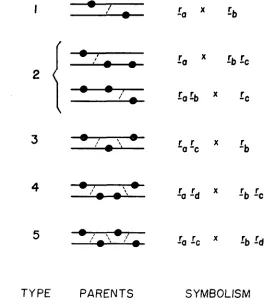
Crosses: Since the experiments to be discussed are not easily visualized until one is familiar with the genetic material involved, a n artificial symbolism will be employed. All crosses to be discussed involve rII markers, and five types of ex- periments (diagrammed in Figure 1 ) have been done with various combinations of single- and multiple-r parents. The r markers will be given the subscripts a, b, c, d, etc., the alphabetical order indicating their order from left to right on the map (Figure 2). When no symbol is given, the wild type allele ( r + ) is indicated. Thus, a cross of the type r,,,r',,, x T-,~,, where I,,, lies outside the interval

TYPE

PARENTS

SYMBOLISM

FIGURE 1.-Types of crosses between the rII mutants in T4B included in this study. Each

(7)

338

8.68

0.55 1.71

2. I 8 1.31 1.57 2.04 4.17 6.49 7.84 8.54 1.16 I .63 3.76 6.08 7.43 8.13

0.7 3 2.86 5. I 8 6.53 7.23

2.6 0 4.9 2 6.27 6.97

4.45 5.80 6.5 0 3.67 4.37 2.05

M. CHASE A N D A. H. D O E R M A N N

0.14 0.41 0.26 0.47

),,4::0.90;;fp& 2.13 2.32 ,. 1.35

,*

I , I , to711

- 1 . 7 8 1

1--11.14-1

k 1 . 3 7 1 +-1.84----1

+

1.22- -4.65-

t 6.32 1

I 7.04 1

6.06 J

+l.171

+I.IO+

-

4.29-

P 5 . 0 8 1

c

5.87 1

P c V. oa L J J

t0.754

- 3 . 3 8 1

7 5.19

-

t 6.38 1

t- 6.83 1

+

2.72-

-4.94-

-

5.97 4

t 414-4.

a

3.90-

-

5.13-

-3.52- -3.84-1

-1.64-

I- 4.34 1

+A

C I S T R O N - A c - 8 CISTRON-\

(8)

H I G H NEGATIVE INTERFERENCE 339

I,,, to I,,,, will be designated as ?-arb X r,; or, another example, the crosses of

the type I ~ , , I ~ ~ , x I,,~I~,,, in which the left-to-right order is r,,,, rS2,,, T - , ~ ~ , rlG3, wd1 be designated by rare X ?-$-d. The wild type is the only phenotypically

distinguishable recombinant in the progeny. Thus, in this symbolism (Figure 1 )

,

crosses of types 1 (I, x r b ) and 2 (r,rb x rc or r , x I b r c ) require one recom-

bination event; crosses of types 3 (rare x r b ) and

4

( I a r d x r , , ~ , ) require two

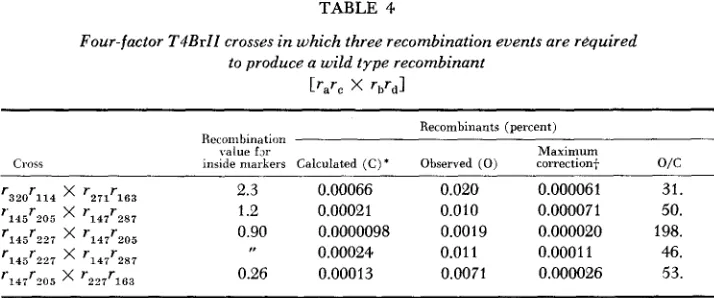
recombination events; and crosses of type 5 (rare x rbrd) need three recombi- nation events to yield the recognizable wild type.

From the results of 110 two-factor ( r , X r b ) experiments, the map of the rII

region of T4B has been constructed (Figure 2 ) . When the markers are arranged in the order given, the various intervals are roughly additive. I n 12 of the 31 comparisons, the value obtained by adding the component intervals is less than that obtained from the cross between the two terminal markers for the overall interval being considered; in 19 cases, it is greater. The 31 comparisons are not, of course, independent of one another, and consequently additivity cannot be evaluated precisely. It is also difficult to assess the error introduced into addi- tivity considerations by nonrecombinant heterozygotes in intercistron crosses. Phages of that type usually make a plaque on K12(X) which would be scored as a recombinant (EDGAR 1958a).

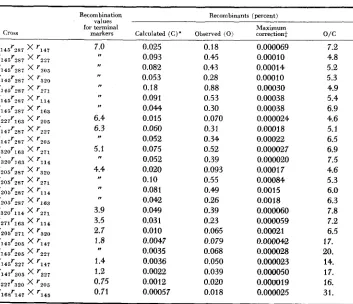
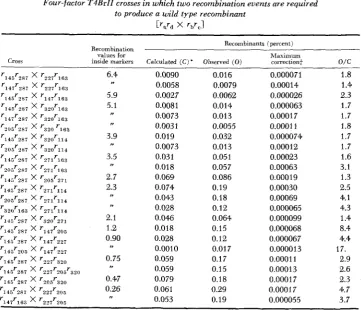
Three-factor crosses of both types were done originally to check the map order obtained from the two-factor crosses. In these crosses, the phenomenon of high negative interference was first noticed. The data from 52 three-factor experiments of the type r,r, X r b (requiring a double recombination event to produce r f )

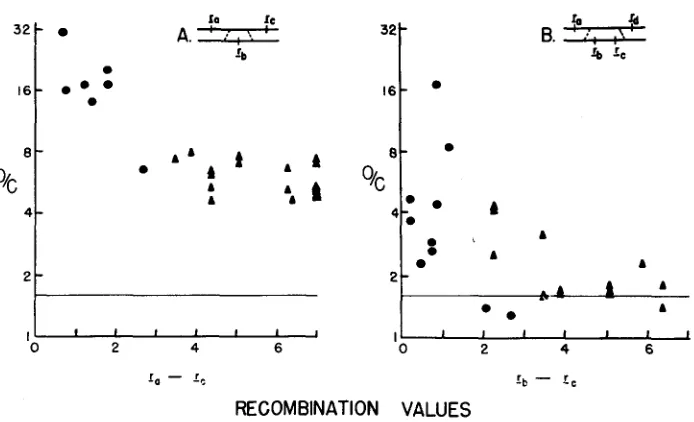
are presented in Table 1 and Figure 3a. The crosses are arranged according to the recombination value for the markers I, and r,. The high order of negative inter- ference (high O/C) apparent in these crosses indicates a positive correlation be- tween recombinations in adjacent regions. The value of O/C is inversely related to the map interval between the terminal markers I, and rc. It is fairly inde- pendent of the length of that interval in the range from 2.7 to 7.0 units (O/C = 4.6 to 7.8 in 19 crosses). For intervals less than 2.7 (1.8 to 0.7 units), the factor rises sharply (O/C = 14 to 31 in six crosses), showing that the phenomenon is most pronounced over very short regions of the linkage structure.

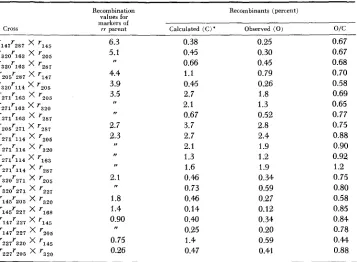
The observation of high negative interference should be apparent also in three- factor crosses of the type ?-&, x I, (or I, x r b r c ) . I n X r, crosses, wild type is produced by a single recombination event between rb and r,, and with no ac- companying single or odd number of recombinations permitted in the region be- tween r, and rb. The positive correlation between recombinations in adjacent intervals, however, predicts that the observed frequency of wild type will be re- duced from what is expected on the basis of the two-factor cross i b X re. In the

three-factor experiment, the recombination event between )rb and I, will fre- quently be accompanied by a second exchange between ra and rb, and this will

(9)

340 M. CHASE A N D A. H . D O E R M A N N

TABLE 1

Three-factor T4BrII crosses in which two recombination events are required to produce a wild type recombinant

[Tarc x rbl

Cross

Recombination values for terminal

markers

Recombinants (percent)

Maximum Calculated ( C ) * Observed (0) correctionj 7.0 ,t ,, ,P 6.4 6.3 5.1 4.4 ,, rr , 3.9 3.5 2.7 1.8 1.4 1.2 0.75 0.71 rr 0.025 0.093 0.082 0.053 0.18 0.091 0.ow 0.015 0.060 0.052 0.075 0.052 0.020 0.10 0.081 0.042 0.049 0.031 0.010 0.0047 0.0035 0.0036 0.0022 0.0012 0.00057 0.18 0.45 0.43 0.28 0.88 0.53 0.30 0.070 0.31 0.34 0.52 0.39 0.093 0.55 0.49 0.26 0.39 0.23 0.065 0.079 0.068 0.050 0.039 0.020 0.018 0.000069 0.00010 0.00014 0.00010 0.00030 0.00038 0.00038 0.000024 0.00018 0.00022 0.000027 0.000020 0.0001 7 0.00084 0.0015 0.0018 0.000060 0.000059 0.00021 0.00004.2 0.000028 0.000023 0.000050 0.000019 0.000025 7.2 4.8 5.2 5.3 4.9 5.4 6.9 4.6 5.1 6.5 6.9 7.5 4.6 5.3 6.0 6.3 7.8 7.2 6.5 17. U). 14. 17. 16. 31.

* The calculated frequenry, expressed in percent, is the product of the recobination values from the crosses ra x rb

and r,, X r C , assuming the coefficient of coincidence to be one.

+

The correction which represents the calculation of the maximum frequency of recombinants which may come from

I contaminants in the rr stock is done in the following manner: For lorus r a , it is the product of the frequency of rl+

in the rare stock times the frequency of recombinants in the cross rb X r , . For the locus r e , the corresponding calcula- tion is made. The maximum frequency of r+ from this source is the sum of the two calculated maximum frequencies a n d is expressed in,percent for direct comparison with the observed value.

than expected on the basis of the two-factor mapping experiments. There is some indication that O/C is inversely related to the map value between r, and i b , but

this cannot be demonstrated statistically. The mean of O/C is 0.76 with a standard deviation of 0.16. The standard error of the mean is 0.035, which shows that, with

99 percent confidence limits, the mean value falls significantly below one. There- fore, these crosses, also, indicate a positive correlation between recombinations in adjacent regions.

(10)

H I G H NEGATIVE INTERFERENCE 341

3 2 -

16-

8 -

O/C

4 -

2 -

0 0 '

0

A b

t

4 A A

: < A

;

1:

,

I 0 - 12 4 6 0 2 4 6

I,

-

1, ' 0

-

1 ,

RECOMBINATION VALUES

FIGURE 3.-Relationship of high negative interference ( O / C ) to map distance. Data are plot-

ted from three- and four-factor crosses requiring double recombinations to yield wild type. The circles represent values from intracistron crosses and the triangles from intercistron crosses. The horizontal lines at 1.6 represent the factor expected from mating kinetics (STAHL personal communication).

A. Data from Table 1.

B. Data from Table 3.

rard X i b r c can, in principle, measure the length of the map interval over which

the correlation may be observed. It has been shown above that O/C increases as the intervals studied are decreased. Extrapolation of that observation predicts that

o/c

should decrease in the crosses rard X ibr, as the 7-b to rc interval be- comes longer. Enlarging the ?-b to r, value separates more and more the two re- gions in which recombination must occur to produce a wild type particle. Data from 48 four-factor experiments of this type are given in Table 3 and Figure 3b. The crosses are arranged according to the recombination value from the cross r b X rc. While the results here are not so clear-cut as in the three-factor experi- ments, at least qualitative agreement with prediction is indicated. Theoretically, a negative interference introduced by mating kinetics ( VISCONTI and DELBRUCK 1953) would give O/C equal to 1.6 ( STAHL personal communication). Figure 3b indicates fair agreement with this expectation, except at shorter map intervals, where the anticipated excess is observed. The data are obviously too variable for a n estimation of the length of the interval over which correlated recombination events are observable.

(11)

342 M. CHASE A N D A. H. D O E R M A N N

TABLE 2

Three-factor T4BrII crosses in which a single recombination event is required to produce a wild type recombinant Ira’,,

x

r e /

Recombination

values for Recombinants (percent) markers of

Cross rr parent Calculated (C)’ Observed (0) O/C

‘14“1287 ‘145

r 3 2 0 r 1 6 3 ‘ 2 0 5

‘320’163 r287 ‘ 2 0 5 r 2 8 7 r147 r320r114 r205 ‘271r163 ‘ 2 0 8

‘271r163 ‘320 ‘271‘163 ‘287 r205r271 r287

‘271‘114 ‘205 ‘271‘114 r320

r271r114 ‘‘163

‘271r114 r287

‘320‘271 r205 ‘320‘271 r227 r145r205 ‘320

‘145‘227 ‘168 ‘147’227 r145 r147r227 ‘205 ‘227‘320 r145 ‘227‘205 ‘320

6.3 5.1 4.4 3.9 3.5 ,, 2.7 2.3 ,, , ,P 2.1 1.8 1.4 0.90 0.75 0.26 ,, 0.38 0.45 0.66 1.1 0.45 2.7 2.1 0.67 3.7 2.7 2.1 1.3 1.6 0.46 0.73 0.46 0.14 0.40 0.25 1.44 0.47 0.25 0.30 0.45 0.79 0.26 1.8 1.3 0.52 2.8 2.4 1.9 1.2 1.9 0.34 0.59 0.27 0.12 0.34 0.20 0.59 0.41 0.67 0.67 0.68 0.70 0.58 0.69 0.65 0.77 0.75 0.88 0.90 0.92 1.2 0.75 0.80 0.58 0.85 0.84 0.78 0.44 0.88

‘The calculated frequency, expressed in percent, is the recombination value obtained in the cross rb X re multiplied by one minus the recombination value in the cross ra X rb.

a high probability, on K12 ( A), of making plaques, which would here be scored as recombinants. The over-all effect is to exaggerate the length of the intercistron region, especially where the adjacent markers involved are close together.

The final series of crosses to be considered is composed of four-factor crosses,

(12)

HIGH NEGATIVE INTERFERENCE 343

DISCUSSION

Linearity and additivity at the level of the cistron: The experiments presented in this paper were originally undertaken because of the importance of investi- gating whether mutants in a given cistron can be arranged in a linear order. While

BENZER'S (1955, 1957) experiments suggest that the rII mutants fall in linear

order on the linkage structure, his conclusions are based on the results of two- factor experiments. I n the present paper, also, it may be seen (Figure 2 ) that,

if the loci are arranged in the order shown, the values obtained from two-factor crosses between adjacent markers, within a set of three, are generally smaller

TABLE 3

Four-factor T4Brll crosses in which two recombination euents are required to produce a wild type recombinant

[Tard x rbrcl

Recombinants (percent) Recombination

values for RIasimum

Cross inside niarken Calculated (C) * Observed (0) correction+ O/C

6.4 0.0090 0.016 0.000071 1.8

0.0058 0.0079 0.00014 1.4

r145'2S7 r 1 4 7 r 1 6 3 5.9 0.0027 0.0062 0.000026 2.3

5.1 0.0081 0.014 0.000063 1.7

0.0073 0.013 0.0001 7 1.7

0.003 1 0.0055 0.0001 1 1.8

3.9 0.019 0.032 0.000074 1.7

0.0073 0.013 0.00012 1.7

3.5 0.031 0.051 0.00023 1.6

0.018 0.057 0.00063 3.1

'14Sr287 r 2 0 5 r 2 7 1 2.7 0.069 0.086 0.000 19 1.3

2.3 0.074 0.19 0.00030 2.5

0.043 0.18 0.00069 4.1

0.028 0.12 0.000065 4.3

'145'287 r320r271 2.1 0.046 0.064 0.000099 1.4

'148'287 r147r205 1.2 0.018 0.15 0.000068 8.4

0.90 0.028 0.12 0.000067 4.4

0.0010 0.01 7 0.000013 17.

0.75 Q.059 0.17 0.0001 1 2.9

0.059 0.15 0.00013 2.6

r145'287 '205'320 0.47 0.079 0.18 0.0001 7 2.3

0.26 0.061 0.29 0.0001 7 4.7

0.053 0.19 0.000055 3.7

'14!ir287 r 2 2 7 r 1 6 3

'147r?87 r227'163

r145r287 r 3 2 0 r 1 6 3

r 1 4 7 r 2 8 7 r320'163

r 2 0 5 r 2 8 7 '320 '163 r145r287 r320'114

' ? 0 5 r 2 8 7 '320'114 '148'287 r271r163

r ? 0 5 r 2 8 i r271r163

,t

'14gr287 r271r114 r ? 0 5 r 2 8 1 r271r114 '320'163 r271r114

'143'287 r 1 4 7 r 2 2 7

r145'205 r147r227 r145r287 '227'320 r 1 4 5 r 2 8 7 '227'205'320

r145'?8i r 2 2 7 r 2 0 5

'147'163 ' 2 d 2 0 5

* The calculated frequency, expressed as percent, is the product of the recombination frequencies from the crosses ra X rb and r , X rd multiplied by one minus the recombination frequency for rb X r e .

t The correction which represents the calculation of the masinmm frequency of recombinants which may come from r

(13)

344 M. CHASE A N D A. H. D O E R M A N N TABLE 4

Four-factor T4Brll crosses in which three recombination euents are rdquired to produce a wild type recombinant

[Tarc x r b r d l

Cross

Recombinants (percent) Recombination

value f x Maxin?um

inside markers Calculated ( C ) * Observed (0) correction+ O K

2.3 0.00066 0.020 0.000061 31.

1.2 0.00021 0.010 0.00007 1 50.

0.90 0.0000098 0.0019 0.000020 198.

0.00024 0.01 1 0.0001 1 46.

0.26 0.00013 0.0071 0.000026 53.

r320r114 ‘271r163

r 1 4 5 r 2 0 B r147r287 r145r227 r147r205 ‘145‘227 r147r287 r147r205 ‘227‘163

* The calculated frequency, expressed In percent, is the product of the reconibination frequencies from the crosses

ra X rb, rb X r , , and r , X r d , assuming the coefficient of coincidence to be one.

f The correction which represents the calculation of the maximum frequency of recombinants which may come from r coiitaminants in the rr stocks is done in the following manner: For the locus ra, it is the product of the maximum estimate of the frequency of rll+ in the rare stock times the reconibination frequency in the cross rbrd X r c . For the locus rd. a corresponding calculation is made. For the locus rb. it is the product of the maximum estimate of the fre- quency of rb+ in the rbrd stock times 0.7G of the recombination frequency from the cross rc X rd (0.76 is the mean O/C

obtained from crosses of the type rare X r d ) . For the locus r , , a parallel calculation is made. The maximum frequency of r+ from this source is, therefore, the sum of these four upper limits, and is expressed in percent for direct comparison with the observed value.

than those obtained from crosses between nonadjacent markers. A stronger ar- gument than this, however, comes from the results of three-factor crosses (Tables 1 and 2), which are the conventional genetic test for linearity. The order of the loci as shown in Figure 2 gives the most reasonable coefficients of coincidence

(O/C) for all the three-factor tests done, even those in which the three markers

are very close together. Linear order in the cistron is, therefore, firmly estab- lished.

It seems worthwhile to discuss here the calculations made by BENZER (1957) in his attempt to correlate quantitatively the number of genetic map units with the number of nucleotide pairs in the DNA molecule. His experiments indicated that map intervals, as measured by two-factor crosses, are not additive; that is, when he summed the shortest individual map distances between rII markers, he obtained a value which was several fold greater than the value obtained from crosses between terminal markers of the rII region. To correct for such discrep- ancies, he multiplied the total map length by four. The data in Figure 2 indicate that BENZER’S factor is far too high.

One reason for apparent lack of additivity, which applies to either set of data, is that intercistronic crosses give recombination values [if measured by plating on K12(h) ] which are higher than the actual length of the map interval (EDGAR

(14)

H I G H NEGATIVE INTERFERENCE 345

tervals is lower than the observed value from the cross of terminal markers. These results seem to bear out the predictions from EDGAR'S data. Correction for the effect of the intercistron region would, therefore, improve additivity.

An additional reason which may account for the extreme deviation from addi- tivity in BENZER'S experiments is based on a technical difference in methods used.

RENZER uses parental stocks which are prepared with K12S as the host cell. As

mentioned above, the present authors find that this procedure can result i n 80

percent loss of infected bacteria in crosses with a total multiplicity as low as four.

RENZER uses an average total multiplicity of six in his mapping experiments. If

he loses any infected cells, he probably selectively loses those with higher multi- plicities. The actual multiplicities in his experiments may then be much lower than three of each parent, and this could well result in recombination values widely deviant from the true values, producing an unusually high variance in

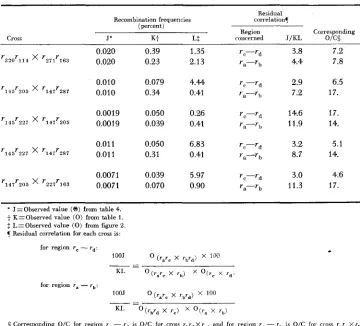
TABLE 5

Residual correlation in

rare

x rbrd crosses

Residual Recombination frequencies correlation9

(percent)

Region Corresponding

Cross J' Kf L: concerned J/KL O/CS

0.020 0.39 1.35 ',-'a 3.8 7.2

'320'11& '271'163 0.020 0.23 2.13 'a-'b 4.4 7.8

0.010 0.079 4.44 'r-'d 2.9 6.5

'345'205 '147'287 0.010 0.34 0.41

'

a-'h 7.2 17.

0.0019 0.050 0.26 'c-'a 14.6 17.

'145'227 r147r203 0.0019 0.039 0.41 'a-'b 11.9 14.

0.01 1 0.050 6.83 'r-'d 3.2 5.1

'143'227 '147'287 0.01 1 0.31 0.41 'a--'h 8.7 14.

0.0071 0.039 5.97 'c-'d 3.0 4.6

'147'203 '227'163 0.0071 0.070 0.90 'a-'b 11.3 17.

* JzObserved value (e) from table 4.

f K = Observed value ( 0 ) from table 1. : L=Observed value (0) from figure 2.

9 Residual correlation for each cross is:

for region re - rd:

0 (rare x r,,rd) X IN 1 OOJ

-=

KL O ( r a r c x rbj X O ( r c x r d I for region ra

-

r b :

100.1 O ( r a r e x r,,rd) X 100 -

--

KL O ( r b r d x r a ) X 0 ( r a x r,,)

(15)

346 M . C H A S E A N D A. H . D O E R M A N N

BENZER’S estimate of the map intervals. A greater deviation from additivity may,

of course, be found in studies with many markers which are much closer to- gether than those used for the data presented here. The authors of this paper believe, however, that the correction factor cannot be as high as a factor of four. and is probably less than 1.5.

The concept of switch ureus: In addition to the demonstration of linearity and additivity, the experiments permit analysis of high negative interference. Multi- ple recombination events over short regions of genetic structure have been pre- viously described in phage (STREISINGER and FRANKLIN 1956; EDGAR 1956,

1958b), in Aspergillus niduluns ( PRITCHARD 1955), in Neurospora: crussa

(DE SERRES 1956), and in Drosophila melunogaster ( STURTEVANT 1951 )

. An

idea which has proved useful in thinking about negative interference in phage is one similar to the model proposed by PRITCHARD (1955). His “effective pair- ing segments” would be directly comparable to the “switch areas” which, in the present model, are assumed to include all recombination events. The switch areas occur randomly throughout the genome, and, since they are short, represent only a fractional part of the genome. Recombination must, then, have a much higher probability of occurring in a given physical or genetic length of switch area than in a n equivalent length of average genome. When markers are, on the one hand, far apart, the chance of multiple recombination being observed depends largely on the probability that switch areas will occur in the appropriate inter- vals. In this circumstance, any interference would be a function of the effect of one switch area on another. On the other hand, the chance of multiple recombi- nation between markers which are sufficiently close together to be encompassed in a single switch area depends both on the probability of the intervening region being included in a swtitch area and on the probability of recombination per unit length of switch area. High negative interference will, consequently, become more pronounced as the markers under study are located closer and closer to- gether, since their chance of inclusion in a single switch area will thereby be increased.

(16)

H I G H N E G A T I V E INTERFERENCE 347

seen that the three-factor crosses of the type rare x rb (Figure 3a) agree with prediction, and the four-factor crosses of the type +ard X rbre (Figure 3b) appear to show a similar trend.

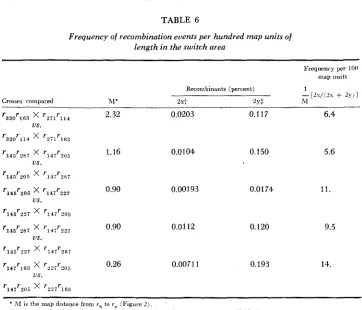
If the hypothesis that all recombination events take place in switch areas is tentatively accepted, consideration of the two types of four-factor crosses per- mits a n estimate of the frequency of recombination events per unit length of switch area. The frequency of wild type phage from the cross rare X i b r d may be represented by x and the frequency from the cross rard x rbrc by y. Further, the plausible assumption can be made that the wild type recombinants are pro- duced from a single switch area which overlaps the crucial interval. rather than from two adjacent switch areas. Under these conditions, wild type phage is, in both types of cross, produc,ed from switch areas which cover the central interval (from r b to r e ) completely. Then 2x represents the fraction of cases i n which

a recombination did occur in the central interval in addition to one in each of the neighboring intervals, and 2y the fraction in which a recombination did not occur. Continuing, 2x/(2x x 2y) is the frequency of recombination events in a switch area of the length measured by the map interval I,, to r,. If the resulting number is divided by the number of map units in the central interval, the fre- quency of recombination events per map-unit length of switch area is found. Calculations of this type are given in Table 6 for five comparisons in which the central interval (NI) varies from 0.26 to 2.32 map units. Thus, while two-factor mapping experiments give a probability of recombination of 0.01 per map unit, the probability of recombination within such a length of switch region would be 0.06 to 0.14 or more.

The tacit assumption was also made in these calculations that the probability of recombination is unifrom over the entire length of the switch area. If one assumes further that a single switch area is involved for the entire span between terminal loci, then experiments of the types considered can test the assumption of uniformity, since it predicts that the estimates of the probability of recombina- tion per unit switch area should be independent of the length of the interval rb to re. The results presented are not extensive enough to allow a conclusion on this point, especially in view of the high variance introduced into the calcula- tions because each one involves three independent experimental determinations. Nevertheless, it should be added that the data suggest clustering of recombina- tion events even within switch areas, since the cases involving a shorter central interval show higher probability of recombination per map unit than those where the rb to r, distance is longer.

Inadequacy of gene conversion: A number of investigators (NI. B. MITCHELL 1955a, 1955b, 1956; H. K. MITCHELL 1957; ST. LAWRENCE 1956; ST. LAWRENCE

(17)

348 M. CHASE A N D A. H. D O E R M A N N

TABLE 6

Frequency of recombination events per hundred map units of

length in the switch area

Frequency per 100 niap units

Recombinants (percent) 1

Crosses compared M’ 2xt 2Y: R2

r320r163 r2i1r114 2.32 0.0203 0.117 6.4

-[[Lx/(2x

+

zy)]

us.

r320r114 ‘.’71r163

r145r28i r14ir?05 1.16 0.0104 0.150 5.6

us.

‘145‘205 r 1 4 i r 2 8 7

r1 45 r2 06 ‘14ir227 0.90 0.00193 0.01 74 11.

r 1 4 5 r m x r 1 4 i r 2 2 7 0.90 0.01 12 0.120 9.5 r l 4 e r 2 2 i X ’14ir28;

us.

r145r227 r 147 r? 0 8

us.

r147r163 r 2 2 7 r 2 0 j 0.26 0.0071 1 0.193 14.

us.

r147r203 r 2 ? 7 r 1 6 3

* h l i s the map distance from rh to r , (Figure 2 ) .

f .?I i s twxe the observed percentage of wild type from the cross i n r e X rbrd (Table 4 ) . 7 y is twice the observed percentage of wild type from the cross raid X rhrc (Table 3 ) .

alleles into the corresponding recessive allele, or vice versa.” If events of this type occur in phage, they are unsatisfactory as an explanation of the present data. The following arguments seem to be conclusive against a simple gene con- version [or more properly here, “muton”

(BENZER

1957) conversion] model to account for the excess of wild types which is observed in the crosses with closely linked rII markers.

It may be assumed that a coefficient of coincidence of unity exists for the true multiple recombinants, and that any excess over expectation arises from gene conversion. It may further be assumed that the two-factor mapping crosses

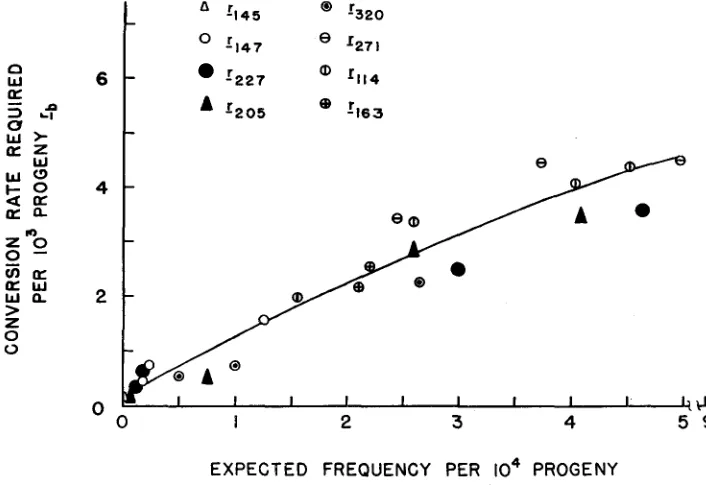
(ra x rb) give wild type principally from true recombination events. Evidence for this assumption comes from the observation that the map intervals are ap- proximately additive, a result which would not occur if gene conversion rates ap- proached the map values. With the two assumptions, one can make an approxi- mation of the rate of gene conversion for the central marker in the three-factor crosses rare x rb. This is done in Figure 4. For example, the rate of gene con- version for r Z Z 7 in four estimates ranges from 0.0036 to 0.00037, and for I,,,,

(18)

H I G H N E G A T I V E INTERFERENCE 349

of conversion is necessary when a higher frequency of double recombinants is expected. The requirement that the rate of gene conversion must vary in this way by a factor 10 in one case and 18 in another renders the simple hypothesis untenable.

Another fairly conclusive argument can be made from comparison of the two types of four-factor crosses which include the same markers. It must first be es- tablished that the presumed rates of conversion for the various markers are similar, a conclusion which can again be reached on the basis of the data in Figure 4. It is seen that none of the points deviates widely from the line drawn, even though in any particular range of expected double recombinant frequency, various r's have been tested. It is clear, therefore, that the presumed rates of gene conversion for the different markers are similar. If the excess of observed wild types, corrected for the expected multiple recombinations, in the cross T a r c X r b r d

is compared with that from the cross r a i d X rbrc, the two values should be equal, because in either cross, two gene conversions are required to produce a wild type phage. Table 7 shows that the excess is always greater in the type of cross rard x

rbrc, the factor ranging from 4.2 to 20 in the five comparisons.

a

LL

3

.-

U W >

a z

W W W

a n

m

2 0

0

cna a u

W

W Q

>

z

0 0

4 t

n

'145 @ '320

'I47

e

'271

I 2 2 7

a

'I14

A

I 2 0 5 e !IS3

I I I I I I I I I k $

" 0 1 2 3 4 5 9

EXPECTED FREQUENCY PER

to4

PROGENY

(19)

350

M . CHASE A N D A. H . D O E R M A N N

TABLE 7

Comparison of presumed gene (muton) conversion rates f o r double conversions in two types of four-factor crosses

Frequency of wild-type

Relative

Cross 0’ C’ 0 - c excesq

‘ 3 2 0 r 1 6 3 ‘ 2 7 I r 1 1 4 0.00055 0.00014 0.00041 4.2

r 3 2 0 r 1 1 4 r 2 7 1 r 1 6 3 0.00010 0.0000033 0.000097

‘ i d 2 8 7 X r i 4 7 r w 5 0.00075 0.000090 0.00066 13.

r i d z n 5 X r i 4 7 r 2 8 7 0.000050 0.000001 0 0.000049

r i 4 5 r m 5 X r i 4 7 r 2 2 7 0.000085 0.0000050 0.000080 8.4

r i 4 5 r 2 2 7 X ‘ i 4 7 ) * 2 n 5 0.0000095 0.000000049 0.0000095

‘ 1 4 q r 2 8 7 r 1 4 7 r 2 3 7 0.00060 0.00014 0.00046 8.5

r 1 4 6 r 2 2 7 r 1 4 7 r 2 8 7 0.000055 0.0000012 0.000054

r i 4 , r i 6 3 X r 2 ? 7 r 2 n 5 0.00095 0.00026 0.00069 20.

r i 4 , r ? n 5 X r ? 2 7 r i 6 3 0.000036 0.00000065 0.000035

-

Values from Tables 3 and 4, multiplied by 1/200.

f (0 - C ) from first cross ( l a r d X r b r c ) divided by (0 - C) from the second ( r a r e X r,,rd)

Thirdly, all the data taken together show that the events which give rise to the excessive wild types occur in clusters. It seems unnecessary to invoke a new, and in this case untenable, mechanism, i.e., gene conversion, to account for the results. Clustering of recombination events seems to be a much more plausible explanation.

Occurrence of high negative interference in other organisms: Considerable data are being accumulated which suggest that high negative interference may be a general phenomenon. The interpretation suggested here may be extended to ex- plain apparently aberrant results in higher organisms. STURTEVANT’S ( 195 1 )

data with the fourth chromosome of Drosophila melanogaster seem, at least superficially, to be a case of similar results which may be understood on a switch mechanism. The studies of DEMEREC (1928) on the reddish-alpha character of

D.

uirilis might also involve this type of model. His “reversions” seem to be associ- ated with a high frequency of crossing over in the reddish-scute region of the X

chromosome.

The extension of the present interpretation seems justified especially in view of the work of PRITCHARD (1955) with Aspergillus nidulans and DE SERRES

(1 956) with Neurospra crassa, both of which show high negative interference in short intervals. The studies of ST. LAWRENCE (1956; S T . LAWRENCE and BON- NER 1957), also with N . crassa, suggest a similar situation. The data mentioned

by DE SERRES are particularly indicative. He observed that recovery of adenine-

(20)

H I G H NEGATIVE INTERFERENCE 35 1

by the crosses described here, which show that negative interference gets more intense as the markers involved are closer and closer to one another. PRITCHARD

has already explained his data in this way; it seems unnecessary to postulate a non-crossover mechanism to account for either DE SERRES’ or ST. LAWRENCE’S

results.

The observation of gene conversion which has n o t been given a n explanation on a recombination model is the occurrence within a tetrad of three copies of one allele and only one of the other. In N . crassa, a thorough study of such aberrant recombination of pyridoxine mutants has been undertaken by M. B. MITCHELL

(1955a, 1955b, 1956) and H. K. MITCHELL (1957). They wish to invoke “a mechanism which is different and distinguishable from that of crossing over”

(H.

K.

MITCHELL 1957). Such an interpretation may, in this case also, be un- necessary. If one can accept a copy choice kind of model in which effective pair- ing sites are the regions of copy choice, the unusual ratio may be easily accounted for. It is unnecessary to assume that copying takes place simultaneously and at equal rates throughout the pairing segment. Equally plausible is the notion that copying on one strand may sometimes precede replication on the homologue. Then, in the closely paired region, an allele, already copied, may by a switch from the other strand, be copied again, giving rise to the 3:l ratio. Since the phenomenon is postulated to occur in a pairing segment, it is expected to be strongly correlated with crossing over, as observed.

The same argument may be applied to cases of gene conversicin in Sac-

charomyces cereuisiae. Many of the examples of conversion cited by LINDEGREN

(1953, 1955) may be explained by the occurrence of supernumerary mitoses (WINGE and ROBERTS 1954) and other types of abnormal segregation patterns (EMERSON 1956). Those which remain

(LINDEGREN

and LINDEGREN 1956) can be interpreted as occasional mistakes in copy-choice. This does not require the existence of two different phenomena, but only some revision of ideas about the mechanism of recombination, and the latter may well become necessary with the advent of selective methods which permit detailed scrutinjzation of short map intervals.

SUMMARY

(21)

352 M. CHASE A N D A. H. DOERMANN

model is presented which accounts for all the observations here and may be ap- plied also to explain apparently aberrant results in several other organisms.

ACKNOWLEDGMENTS

The authors are indebted to DR. NILS AALL BARRICELLI, DR. ROBERT S. EDGAR,

and DR. DAVID R.

KRIEG

for many stimulating discussions, and to DR. THOMAS R.

PUNNETT for aid in the statistical analysis of the data.

LITERATURE CITED

BAYLOR, M. B., D. D. HURST, S. L. ALLEN, and E. T. BERT4N1, 1957 BENZER, S., 1955

The frequency and distri- bution of loci affecting host-range in the coliphage T2. Genetics 42: 104-120.

Fine structure of a genetic region in bacteriophage. Proc. Natl. Acad. Sci.

U.S. 41 : 344-354.

The elementary units of heredity. Pp. 70-93. The Chemical Basis of Heredity. Edited by W. D. MCELROY and B. GLASS.

Studies on lysogenesis. I. The mode of phage liberation by lysogenic Escherichia coli. J. Bacteriol. 62 : 293-300.

1957

The Johns Hopkins Press. Baltimore. BERTANI, G., 1951

DE SERRES, F. J., 1956 Discussion following paper by D. M. BONNER. Cold Spring Harbor

DEMEREC, M., 1928 Mutable characters of Drosophila virilis. I. Reddish-alpha body character. DOERMANN, A. H., and M. CHASE, 1958

DOERMANN, A. H., and M. B. HILL, 1953

EDGAR, R. S., 1956

Symposia Quant. Biol. 21 : 170.

Genetics 13 : 359-388.

(Manuscript in preparation)

Genetic structure of bacteriophage T4 as described

Discussion following paper by G. STREISINGER and N. C. FRANKLIN. Cold Phenotypic properties of heterozygotes in the bacteriophage T4. Genetics 43 : 235-248. High negative interference and heterozygosis: a study on the mechanism of recombi-

EMERSON, S., 1956 Notes on the identification of different causes of aberrant tetrad ratios in HERSHEY, A. D., and R. ROTMAN, 1949 Genetic recombination between host-range and plaque- KRIEG, D. R., 1957 A study of gene action in ultraviolet-irradiated bacteriophage. University of

LEDERBERG, J., and E. M. LEDERBERG, 1952 Replica plating and indirect selection of bacterial LINDEGREN, C. C. 1953

by recombination studies of factors influencing plaque morphology. Genetics 38 : 79-90.

Spring Harbor Symposia Quant. Biol. 21: 109. 1958a

1958b

nation in bacteriophage T4. (Manuscript in preparation.)

Saccharomyces. Compt.-rend. trav. lab. Carlsberg, SBr. physiol. 25: 71-86.

type mutants of bacteriophage in single bacterial cells. Genetics 34: 44-71.

Rochester Atomic Energy Project Report, UR-482.

mutants. J. Bacteriol. 63 : 399-406.

Gene conversion in Saccharomyces. J. Genet. 51 : 625-637.

Non-Mendelian segregation in a single tetrad of Saccharomyces ascribed to gene con- 1955

version. Science 121 : 605-607.

the genotype. Nature 178: 796-797. LINDEGREN, C. C., and G. LINDEGREN, 1956

MITCHELL, H. K., 1957

Effect of the local chromosomal environment upon

Crossing over and gene conversion in Neurospora. Pp. 94-113.

(22)

HIGH NEGATIVE INTERFERENCE 353

MITCHELL, M. B., 1955a Aberrant recombination of pyridoxine mutants of Neurospora. Proc. 1955b Further evidence of aberrant recombination in Neurospora. Proc. Natl. Acad. Sci. 1956 A consideration of aberrant recombination in Neurospora. Compt.-rend. trav. lab. The linear arrangement of a series of alleles of Aspergillus nidulans.

The q locus of Neurospora crassa. Proc. Natl. Acad. Sci. U.S. 42: Gene conversion and problems of allelism. Pp. 114-122. The Chemical Bmis of Heredity. Edited by W. D. MCELROY and B. GLASS. The Johns Hopkins Press. Balitimore.

STREISINGER, G., and N. C. FRANKLIN, 1956 Mutation and recombination at the host range genetic region of phage T2. Cold Spring Harbor Symposia Quant. Biol. 21: 103-109. STURTEVANT, A. H., 1951 A map of the fourth chromosome in Drosophila melanogaster, based

on crossing over in triploid females. Proc. Natl. Acad. Sci. U.S. 37: 4 Q 5 4 7 .

WINGE, @., and C. ROBERTS, 1954 On tetrad analyses apparently inconsistent with Mendelian law. Heredity 8 : 295-305.

VISCONTI, N., and M. DELBRUCK, 1953 The mechanism of genetic recombination in phage. Genetics 38: 5-33.

Natl. Acad. Sci. U.S. 41 : 215-220. U.S. 41 : 935-937.

Carlsberg, SBr. physiol. 26: 285-298. Heredity 9 : 343-371.

PRITCHARD, R. H., 1955 ST. LAWRENCE, P., 1956

Figure

FIGURE 1.-Types linkage structures represent the recombination events which are required to produce the only parents
FIGURE 2.-Map for all two-factor crosses which meet the selective criteria. The numbers in the left-hand column represent the sums of the shortest map intervals and are of the rII region of T4B
TABLE 1 Three-factor T4BrII crosses in which two recombination events are required to produce a wild type recombinant
FIGURE 3.-Relationship of high negative interference circles represent values from intracistron crosses and the triangles from intercistron crosses
+7

References

Related documents