ISSN(Online): 2319-8753
ISSN (Print): 2347-6710
International Journal of Innovative Research in Science,
Engineering and Technology
(An ISO 3297: 2007 Certified Organization)
Vol. 5, Issue 1, Januray 2016
Misconceptions about HACCP by Producers
Júlia Toropilová
1*, PavelBystrický
1, LidijaKozačinski
2, Martina Brenesselová
1, Adriána
Fečkaninová
11
University of Veterinary Medicine and Pharmacy in Košice, Department of Hygiene and Food Industry Technology,
Komenského 73, 041 81 Košice, Slovak Republic.
2
Faculty of Veterinary Medicine of University of Zagreb, Department of Hygiene, Technology and Food Safety,
Vjekoslava Heinzela 55, 10 000 Zagreb Croatia.
ABSTRACT: Hazard Analysis and Critical Control Points (HACCP) is a risk management system or tool, in which
risk assessment is one of steps in its development. All European producers have to apply HACCP principles in food-related processes. Questionnaire-based study of HACCPs allows to estimate attitude of food producers towards this system, their level of understanding the HACCP concept and gives a possibility to analyze problems that have cumulated over the years. The questionnaire was answered by 26 from the 50 addressed FBOs from Slovakia. In Croatia 15 FBOs were addressed and from that 9 responded. Slovak (17) and Croatian respondents (5) has positive attitude towards the HACCP and would establish the system voluntarily and agree that the HACCP really improved the health safety of their products. The controlling authorities are supposed to audit the HACCP, functionality included. 17 Slovak and the all of Croatian respondents consider them useful and believe that audits have helped to improved operations in their premises. Almost 22 Slovak and 6 Croatian producers consider communication about hazards to be sufficient, but their interpretation is not everywhere as. Conclusions from the analysis provide feedback for individual producers and also for the national food protection system.
KEYWORDS:HACCP, GMP, risk assessment, hazard analysis, food safety.
I. INTRODUCTION
ISSN(Online): 2319-8753
ISSN (Print): 2347-6710
International Journal of Innovative Research in Science,
Engineering and Technology
(An ISO 3297: 2007 Certified Organization)
Vol. 5, Issue 1, Januray 2016
Establishing HACCP in such scenario gives very little chance to become a meaningful exercise and there is a real risk that it will be seen as a burden by all personnel.
Large-scale food-borne diseases outbreaks, food contamination incidents or food recalls of major importance continue to occur [7]. In the last two decades there were series of food scandals and scares all over the world and in the EU as well which staggered consumers’ confidence in food safety and in the food chain (e.g. BSE, dioxins or E.coli O104:H4 in foods, loss of control over the origin of meat in Europe) [8]. Penetration of hazards into foods in an unexpected extent may suggest a system failure not only in the local production but also at the national level. The producers failed to carry out the most basic control of their incoming ingredients to determine whether the products were as actually declared [9]. All traceability concepts for checking the food ingredients origin seem to have been ignored completely. Adulterated food scandals are significant because they reveal a problem in the execution on basic HACCP procedures [9]. These scandals often obtain wide coverage in the news media and in publications and as a result consumers are familiar with them and act as a feedback lever [10]. In Slovakia, application of HACCP system as a part of GMP in food production is obligatory since 2001 [11] and HACCP-related legislative regulations were adopted during the following years. However, even after many years of having HACCP as a duty, too many producers still have quite negative attitude towards it. Within process of integration to EU, Croatian's laws and institution regarding food safety followed similar path. The basic law on food safety in Croatia is the Food Act (Official Gazette No. 46/07) [12] which sets out a general overview and requirements on food and animal feed safety. The Food Act strictly divides responsibilities of governmental institutions dealing with food safety control along the food chain. Since 2000 all Croatian food business establishments have been reviewed in order to meet structural EU standards [13]. On the 1st July 2013 Croatia became a member of the EU and the HACCP system is implemented in accordance with EU legislation. In both countries for many small enterprises the HACCP is not well understood although its importance is recognized in terms of access to some international markets. Ignoring the fact that HACCP evolves may lead to loss of control over it and jeopardize its functionality on the local and also on the national level. It is the producers’ attitude that too often changes the HACCP into GMP degrading the preventive approach towards hazard control to repressive operation practices and becomes only a document for controlling authorities, prone to fail.
The purpose of this study is to point out the main barriers and difficulties in developing and implementing HACCP in Slovakia and Croatia.
II. MATERIALS AND METHODS
The results of a HACCP field study were conducted by means of a questionnaire survey. In Slovakia, the survey was carried out from February 2014 to February 2015 and in Croatia from April 2014 to middle of July 2014 with focus on food producers who produce food of animal origin, mainly slaughterhouses. In the first step, an explaining letter with questionnaires were sent through the Internet to 50 registered Slovak slaughterhouses and meat product processing enterprises (the register is available at www.rvps.sk.) in order to minimize costs and get quick response. The questionnaire was composed of seventeen YES or NO questions with comment options to allow for better understanding of the producers’ attitude towards HACCP system after many years from its establishing in their plants. It was anonymous, the names of establishments and their addresses were not required and not to be published and it was answered on a voluntary basis. The questionnaire was divided to three areas.
III.RESULTS
The questionnaire was answered by 26 from the 50 addressed FBOs from all over Slovakia. In Croatia, because of time limitations, only 15 FBOs were addressed and from that 9 responded.
Table 1 shows the percentage of companies from Slovakia and from Croatia that answered the questionnaire. In total the size of plant can be divided on the basis of employees number or capacity. The respondents ranked their premises themselves by number of employees into four groups: micro, small, medium and large employing up to, 9, 10-49, 50-249, ≥250 employees, respectively.
ISSN(Online): 2319-8753
ISSN (Print): 2347-6710
International Journal of Innovative Research in Science,
Engineering and Technology
(An ISO 3297: 2007 Certified Organization)
Vol. 5, Issue 1, Januray 2016
implementation, were there any changes in the system after years of use, etc.). In the Table 3 there are answers from the Slovak and Croatian FBOs to questions about their attitude towards the functionality improvements of HACCP due to audits and the controlling authorities (were audits useful, were there improvements in operations afterwards, etc.). Table 4 there shows the opinions of the FBOs about current regulations in relation to HACCP (would you appreciate changes in law in relation to HACCP, was the communication about hazard(s) with controlling authorities sufficient, do you feel that HACCP-related regulations are sufficient and enforced equally, etc.).
Table 1. Percentage of companies from Slovakia (n = 26) and from Croatia (n = 9) which answered to questionnaire
divided by size of plants.
State,
number of respondents n (%)
Size of plant n (%)
Big ( ≥250 employees) Middle (50-249
employees)
Small (10-49 employees)
Slovakia 26 (52 %) 5 (19.23 %) 4 (15.38 %) 17 (65.38 %) Croatia 9 (60 %) 5 (55.5 %) 2 (22.2 %) 2 (22.2 %)
Table 2.Part 1 of the questionnaire. Answers from Slovakia (n = 26) and from Croatia (n=9) to the questions about the
establishment and implementation of HACCP in FBO procedures
Question Slovak answer n (%) Croatian answer n (%)
Yes No Yes No
Would you establish the HACCP system as a part food hygiene management system in food production if it were not duty?
17 (65.38 %) 9 (34.61 %) 5 (55.5 %) 4 (44.4 %)
Did the controlling authorities help you with the HACCP implementation?
22 (84.61 %) 4 (15.38 %) 6 (66.6 %) 3 (33.3 %)
Do you thing that the HACCP really improved the health safety of the food that you produce?
17 (65.38 %) 9 (34.61 %) 6 (66.6 %) 3 (33.3 %)
Since establishing did you any changes in your HACCP system?
21 (80.76 %) 5 (19.23 %) 9 (100 %) -
Did you establish the HACCP system by yourself or have it established by hired experts?
Yourself Expert Yourself Expert
17 (65.38 %) 9 (34.61 %) 3 (33.3 %) 6 (66.6 %)
Since establishing have you been forced to modify your HACCP because of the
Production conditions
Change in law By both Production conditions
ISSN(Online): 2319-8753
ISSN (Print): 2347-6710
International Journal of Innovative Research in Science,
Engineering and Technology
(An ISO 3297: 2007 Certified Organization)
Vol. 5, Issue 1, Januray 2016
Table 3.Part 2 of questionnaire. Slovak (n=26) and Croatian answers (n=9) to questions about attitude of producers
towards the functionality improvements of HACCP due to audits and the controlling authorities.
Question Slovak answer n (%) Croatian answer n (%)
Yes No Yes No
The role of controlling authorities is to control the functionality of the HACCP by audits. Do you find the
audits useful?
17 (65.38 %) 9 (34.61 %) 9 (100 %)
Did have controlling authorities sometimes complaints in relation to
the functionality of your HACCP?
10 (38.46 %) 16 (61.53 %) 8 (88.8 %) 1 (11.1 %)
Do you think that the audit to improve
operations running in your plant? 19 (73.07 %) 7 (26.92 %) 8 (88.8 %) 1 (11.1 %) Do you think you have enough
technical requisites to ensure the functionality of HACCP?
25 (96.15 %) 1 (3.84 %) 7 (77.7 %) 2 (22.2 %)
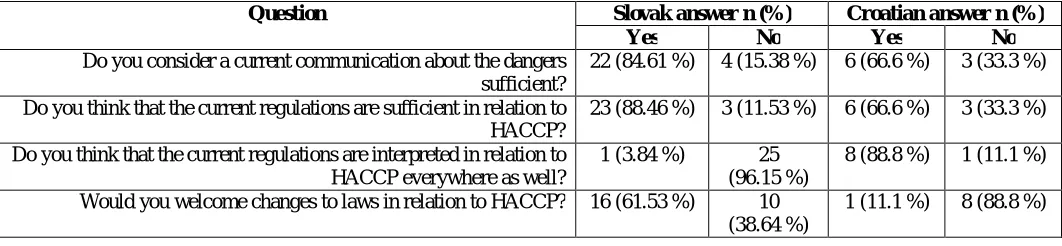
Table 4.Part 3 of questionnaire.Opinion about current regulations in relation to HACCP by Slovak and Croatian
producers.
Question Slovak answer n (%) Croatian answer n (%)
Yes No Yes No
Do you consider a current communication about the dangers sufficient?
22 (84.61 %) 4 (15.38 %) 6 (66.6 %) 3 (33.3 %)
Do you think that the current regulations are sufficient in relation to HACCP?
23 (88.46 %) 3 (11.53 %) 6 (66.6 %) 3 (33.3 %)
Do you think that the current regulations are interpreted in relation to HACCP everywhere as well?
1 (3.84 %) 25 (96.15 %)
8 (88.8 %) 1 (11.1 %)
Would you welcome changes to laws in relation to HACCP? 16 (61.53 %) 10 (38.64 %)
1 (11.1 %) 8 (88.8 %)
IV.DISCUSSION
From the collected answers we see that the motivation to achieve the HACCP goal is still the principle factor in actually developing the individual systems as identified by Taylor and Kane [14].
Because of the EU legislation, all producers (100%) of the respondents have a fully operating HACCP system in place. We asked respondents from slaughterhouses and meat product processing enterprises if HACCP was not enforced by law, they would establish it. Slovak producers (65%) 17 from 26 answered yes and 9 respondents (less than 34%) said no. In Croatia, 5 out of 9 respondents (more than 55%) would like to establish HACCP anyway and 4 of the FBOs would not like to introduce HACCP in practice (less than 44%). In Slovakia, 17 out of 26 surveyed respondents (65%) put HACCP system into practice by themselves, while 6 Croatian plants prefer cooperation with experts (more than 66%
ISSN(Online): 2319-8753
ISSN (Print): 2347-6710
International Journal of Innovative Research in Science,
Engineering and Technology
(An ISO 3297: 2007 Certified Organization)
Vol. 5, Issue 1, Januray 2016
companies). In both countries the controlling authorities were helpful with HACCP system implementation. In Slovakia, it happened in 22 out of 26 companies (more than 84%) and in 6 out of Croatian companies (66%) (Table 2).
Food safety measures, products and food processes are always changing. To keep pace with these changes and to demonstrate continued commitment to food safety through HACCP compliance, establishments need to re-evaluate their food safety management systems. HACCP plans should undergo review or update annually at least. Results show that 21 out of 26 producers from Slovakia (>80%) and 9 producers from Croatia (100%) have modified/corrected their HACCP system after the initial establishment. It shows that most of the producers do respect the development pressure. In 5 Slovak respondents (23%) the changes were necessary solely due to the production process and in Croatia 1 out of 9 surveyed companies (11%). Almost 5 of producers from Slovakia (23%) and 3 companies from Croatia (34%) modified their HACCP due to changes in legislation. Necessary changes have been forced into the HACCP systems by both technological and legal influences in 11 Slovak plants (>52%) and more than half of respondents from Croatia (5 respondents (55%)). Failure to keep HACCP system under control can have disastrous consequences for consumer health and subsequently for the producer too. More than 17 out of 26 of Slovak (65%) and 6 out of 9 Croatian respondents (67%) agree that the HACCP really has improved the health safety of their products (Table 2).
Production and distribution companies in the food sector cooperate in many areas and therefore must have full control over all incoming and outgoing goods. All companies have to apply HACCP systems and mutual trust is a must. Because of the episodical occurrence of food-borne diseases we suppose that not all individual HACCPs are perfectly prepared and have potential to pass unrecognized hazard(s) further in the production line till consumer. To enforce system validation, all enterprises have to undergo audits on regular basis. The attitude of the FBOs towards the audits seems to be positive. In Slovakia 17 out of 26 respondents (65%) and 9 out of all respondents from Croatia (100%) considered audits useful. In 8 out of 9 enterprises from Croatia (>88%) and almost in 10 out of 26 enterprises from Slovakia (38%) the FBOs admitted that the controlling authorities had uncovered imperfections of their HACCP systems and helped to correct them. In the remaining facilities 16 out of 26 Slovak respondents (61%) and only 1 out of 9 respondents from Croatia (11%) the controlling authorities had no objections regarding HACCP systems functionality. 19 out of 26 Slovak producers (almost 73%) and 8 out of 9 respondents from Croatia (>88%) agree that the audits really improved operations running in their plants. Failure to deliver safe food could because of unrecognized imperfection within HACCP system leads to loss of confidence in the system itself. Therefore it is necessary not only to monitor operations, or verify whether work has been completed according to the plan but also verify the hazard analysis and review and validate the controlling activities after each change in the plan that is done because of technological or legislative reasons. Almost all respondents from Slovakia (25 out of 26 respondents (96%)) and 7 out of 9 Croatian respondents (77%) believe in the functionality of their HACCP to produce safe products (Table 3). Clearly, food safety isn’t a luxury but the most economical way of human population health management. One side effect of the current regulations is an overly increased trust of the consumers in the marketed food. When there is a leaked hazard in the food and someone is hurt there is immediate feeling of “scandal”. Rational communication about food scandals and their risk analysis is very important. A risk communication is a basic element of the risk analysis process and according to the FAO definition the risk communication is an interactive process of rapid exchange of information among institutions and producers [15]. A key tool to ensure swift reaction on the identified food-related hazard on the cross-border basis is RASFF. Early and rapid warning about emerging foods hazards is to decrease foodborne diseases outbreaks. Hazard communication on the local level, tends to be much faster and very effective. The majority of respondents from Slovakia (22 out of 26 respondents (84%)) and 6 out of 9 respondents from Croatia (66%) consider the current communication about the potential hazards sufficient.
When we asked for opinion about HACCP-related regulations 23 out of 26 asked producers from Slovakia (>88%) and 6 out of 9 producers from Croatia (almost 67%) is concurred that the HACCP-related regulations are sufficient. However, most of them think that the interpretation and enforcement of the law is not the same everywhere (25 out of 26 producers from Slovakia (96%) and 8 out of 9 producers from Croatia (89%)) (Table 4).
ISSN(Online): 2319-8753
ISSN (Print): 2347-6710
International Journal of Innovative Research in Science,
Engineering and Technology
(An ISO 3297: 2007 Certified Organization)
Vol. 5, Issue 1, Januray 2016
meet all the requirement concerning hygiene, include adequate legal regulations as well as in General Principles of Food Hygiene Codex [16,17]. The reason for misunderstanding is that the producers have either negative attitude towards HACCP or/and lack of understanding the functionality of HACCP, being difficult to say which barrier take place first [18].
In this study, the questionnaires were prepared so that all producers could talk freely about experiences with HACCP system and any difficulties which emerged in surveyed countries. Results also show that only some producers had interest to discuss this topic. Although in the questionnaire there were few comments, they are an important addition to our understanding of the FBOs’ attitude. Comments from Slovakia were: "It proved to be good. This system is very important for risk-free food production and raw materials."; "System HACCP is for small plants, as is my establishment, unnecessarily complicated and brings a disproportionate administrative low."; "All producers know and heard about this system but HACCP is an unnecessary bureaucratic burden on businesses".
The question whether the HACCP system improved the health safety of the food that they produce, the comment from Slovakia was "Without HACCP system, we would not work" and from Croatia: "It is difficult to answer this question with respect to the volume of production increased significantly since the implementation of HACCP and before have control microbiological parameters in the products in such a way as it currently operates in accordance with the legislation" ; "We work the same as before but we spend a lot more time and paper for the same job".
The opinions of Slovak respondents in the questionnaire to audits were more or less positive: "Each audit of functionality of HACCP must be responsibly approached both by the auditor as well as the audited. Basically it is about control of functionality of the system in plant."; "Who has a positive relationship with audit...the audit is always stressful but on the other hand, audits move the operations forward".
The general attitude of producers towards audit by the controlling authorities is described by a FBO: "The HACCP system is written so elaborately that sometimes the controlling authorities have a problem to understand it" or "The audit has really improved operations running in plant but everything depends on the expertise of auditors." As for the interviewed Croatian producers, they did not have any comment to the audits.
A risk communication is a basic element of the risk analysis process and a rapid warning about emerging foods hazards by a functional system such as the RASFF. But there are also emerging new risks sometimes without early warning. The ability of food producers and control authorities to react quickly can prevent large damage. Legislative texts sometimes respond to changes in the risk of hazards with some delay and such a delay may affect food safety. The part of questionnaire about risk communication was more commented by respondents from Slovakia with significant inclination towards GMP. A FBO wrote "Risks and their monitoring in food production plants should be in implemented in much easier way than by HACCP in the future...". Another comment was: "Information about the risks is of a general nature and is sufficient. Everyone does his own hazard analysis in the HACCP system upon his criteria at the end".
The question whether the current regulations are interpreted in relation to HACCP everywhere equally, more of interviewed commented: "The interpretation of law in relation to the HACCP is not equal everywhere and therefore, not everyone has it done the same way. But everywhere there is the point that the system is correct and addresses the requirements of the processor and controls all risks in their production process".
On the question about need of changes in HACCP-related law, several of our interviewees commented: "Yes, easier hygienic procedures... easier to understand for everyone"; "If the changes do not exceed already implemented rules of HACCP and do not increase the financial budget of producers, so yes".
The communication plays a paramount role. But during the survey we noted existence of some barriers. Most important would be the communication barrier created by fear that the controlling authorities would not have the same understanding and the attitude towards HACCP. Other communication barriers came of lack of motivation, outcome expectancy (misinterpretation of questionnaires, incompetency to answer on questionnaire).
ISSN(Online): 2319-8753
ISSN (Print): 2347-6710
International Journal of Innovative Research in Science,
Engineering and Technology
(An ISO 3297: 2007 Certified Organization)
Vol. 5, Issue 1, Januray 2016
below. Food safety is a shared responsibility. The HACCP is designed to strengthen our food supply at the producer level, which have an effect on all parties, includingconsumers.
V. CONCLUSION
HACCP is accepted throughout the food business. Its successful implementation, however, requires an understanding of its principles and commitment of all involved personnel. From the presented results it is obvious that there is lack of motivation in respect to the HACCP. All producers have HACCP established but it seems that its efficiency is degrading and the system has tendency to mislead the consumers. The major problem may be economic demand and then rigid attitude of controlling authorities. Creative communication between producers and controlling authorities becomes thus even more important. It is imperative to understand the open concept of HACCP and enforce the legal requirements without bureaucratic refusal of invention. Discrepancies may and should be resolved by means of audits. Ignoring the fact that HACCP evolves will lead to loss of control over it and jeopardize its functionality, not only on the local level but on the national level too.
All food suppliers should respond by reviewing their production systems, including HACCP. However, our research shows that they are quite satisfied with the present status and do not intend to develop their food safety controls further because it is very resources-demanding.
REFERENCES
1.UlusoySözen B and Hecer C. Is HACCP a Difficult Food Safety System to Implement? Journal of Biological & Environmental Sciences. (2013);7:33-38.
2.Bata D, et al. Cost of GHP improvement and HACCP adoption of an airline catering company. Food Control. (2006);17:414-419. 3.Luning PA, et al. (2006) Safety in the agri-food chain. (1stedn), Wageningen academic publishers.
4.David A Kessler MD. Seafood Safety: The Next Step. Commissioner of Food and Drugs, National Fisheries Institute Annual Convention, Washington, DC, November 4, 1993, http://www.fda.gov/newsevents/speeches/speecharchives/ucm106917.htm
5.Taylor E. HACCP in small companies: benefit or burdens? Food Control. (2001);12:217-222.
6.Popelka P, et al. Development of good hygiene practices in food industry in Slovakia. MESO: The first Croatian meat journal. (2005);7:34-39. 7.Motarjemi Y, et al. (2014) Food Safety Management: A Practical Guide for the Food Industry. (1stedn), Academic Press.
8.Bánáti D. Consumer response to food scandals and scares. Trends in Food Science & Technology (2011);22:56–60. 9.Coxsall M. (2014) Ethical eating: A Complete Guide to Sustainable Food. (1stedn), Malcolm Coxall - Cornelio Books.
10.Beulens AJM, et al. Food safety and transparency in food chains and networks Relationships and challenges. Food Control. (2005);16:481-486. 11.The Food Code of the SR, Head 8, GMP Principles. Act of the Ministry of Agriculture and of the Ministry of Health # 557/1998-100, (1997). 12.The Food Act. Official Gazette of the Republic of Croatia No. 46/2007.
13.Miškulin M, et al. Food safety system in Croatia. NATO Advanced Research Workshop (ARW): Environmental and food security and safety in Southeast Europe and Ukraine /Vitale, K ;Shtemenko, N (ed). - Dnipropetrovs΄k: Ministry of Education and Science of Ukraine, Dnipropetrovs΄k
National University (2011);29-30.
14.Taylor E and Kane K. Reducing the burden of HACCP on SMEs. Food control. (2005);16:833-839.
15.Food and Agricultural Organization of the United Nations. Food quality and safety systems – A training manual on food hygiene and the Hazard Analysis and Critical Control Point (HACCP) system. Publishing Management Group, FAO Information Division. (1998).
16.Konecka-Matyjek E, et al. Actual situation in the area of implementing quality assurance systems GMP, GHP and HACCP in polish food production and processing plants. Food Control. (2005);16:1-9.
17.Orriss GD and Whitehead AJ. Hazard analysis and critical control point (HACCP) as a part of an overall quality assurance system in international food trade. Food Control. (2000);11:345-351.
18.Vela R and Fernandez JM. Barriers for the developing and implementation of HACCP plans: results from a Spanish regional survey. Food Control. (2003);l4:333-337.
19.EFSA. The European Union summary report on trends and sources of zoonoses, zoonotic agents and food-borne outbreaks in 2013.EFSA Journal. (2015);13:1-165.