Abstract
MALLYA, ASHOKULLAL. Specifying and Resolving Temporal Commitments. (Under the
direction of Munindar P. Singh).
Commitments are a powerful representation for modeling multiagent protocols,
espe-cially for applications such as electronic commerce, where contracts are a natural com-ponent of the desired interactions. Previous approaches have considered the semantics
of commitments and how to check compliance with them. However, these approaches,
although valuable, do not capture some of the subtleties that arise in applications of com-mitments in real-life settings. In particular, practical contracts and institutions have subtle
temporal properties. The present thesis develops a rich representation for the temporal
content of commitments. This enables us to capture realistic contracts and institutions
rig-orously, and avoid subtle ambiguities. Consequently, this approach enables us to reason about questions of great practical import, for example, whether and when exactly a
SPECIFYING AND RESOLVING TEMPORAL
COMMITMENTS
BY
ASHOK ULLALMALLYA
A THESIS SUBMITTED TO THE GRADUATE FACULTY OF NORTH CAROLINA STATE UNIVERSITY
IN PARTIAL FULFILLMENT OF THE REQUIREMENTS FOR THE DEGREE OF
MASTER OF SCIENCE
DEPARTMENT OF COMPUTER SCIENCE
RALEIGH DECEMBER 2002
APPROVED BY:
PETER R. WURMAN DENNIS R. BAHLER
MUNINDAR P. SINGH
Biography
Ashok Mallya was born on September 10, 1978 in Mangalore, India. He received his
Bachelors Degree in Computer Science from the Karnataka Regional Engineering College, Surathkal, India – now known as the National Institute of Technology, Surathkal – in the
Acknowledgment
You can take a kid to college, but you cannot make him think.
Dr. Singh did not take me to college, but he made me think in more ways than I thought
possible. His constant encouragement has been inspiring.
I thank Dr. Bahler and Dr. Wurman for being on my thesis committee and suggesting
changes that improved this work.
I thank, in no particular order, Raghu, Pınar, Subhayu and Amit for pretending to be interested in this thesis and giving valuable feedback. I thank Amit also for letting me win
at Tennis and Badminton once in a while, just to keep me happy.
I thank Mike Maximillien, Zhengang Cheng, and Dr. Bin Yu for their opinions about this work, and Ruben, Bhargava, Vishwas, and Kolli for making our apartment a
comfort-able place to go back to after long hours of work.
I thank NC State University and the United States of America for making it very easy
for an honest graduate student to earn a good living.
I thank Rasquinha, Sandhya, Mathai, and Pise for the Friday-evening debates.
I also owe a debt of gratitude to Champions Pool and Billiards and Mitch’s Tavern; to
I thank Rashmi and Vikram for their support and friendship.
I am forever indebted to my parents for all that they have done for me.
There are many more people that have helped in one way or another during the course of
this work. Although I cannot thank them individually here for fear of making the
acknowl-edgments section larger than the actual thesis, they will always be gratefully remembered. This research was supported partly by the North Carolina State University, and partly
Table of Contents
List of Tables viii
List of Figures ix
1 Introduction and Objectives 1
2 Background Concepts 5
2.1 The Temporal Framework . . . 5
2.2 Commitments . . . 8
2.2.1 Representation and Semantics . . . 9
2.2.2 Commitment Operations . . . 9
2.2.3 Commitment Predicates . . . 10
2.2.4 Commitment Identifiers . . . 10
3 Technical Framework 11 3.1 Temporal Commitments . . . 11
3.2 The Formal Language . . . 13
3.2.1 Notational Convention for Propositions . . . 14
3.3 New Predicates for Commitments . . . 15
3.4 Semantics . . . 15
3.5 Commitment Life Cycle . . . 18
4 Resolving Temporal Commitments 21 4.1 Nested Interval Expressions . . . 21
4.2 Resolving Nested Interval Expressions . . . 27
4.3 Disjunctive Forms . . . 29
List of Tables
List of Figures
2.1 A schematic representation of the model of time . . . 6
3.1 Temporal behavior of thepredicate . . . 20
3.2 Temporal behavior of the predicate . . . 20
4.1 Allen’s intervals for
. . . 23
4.2 Bounds on resolvability of
. . . 26
4.3 Bounds on resolvability of
. . . 26
4.4 A schematic for
, where
Chapter 1
Introduction and Objectives
Protocols help streamline the complex interactions that can take place between autonomous, heterogeneous agents in a multiagent system. A special application setting is electronic
commerce, where the agents represent different parties that do business online.
The role of commitments in modeling such rich interactions is widely recognized, be-cause they enable the key content of an interaction to be represented and reasoned about,
especially in the face of opportunities or exceptions. Commitments are thus more
expres-sive than traditional formalisms such as finite state machines. Commitments have begun to be operationalized in recent work. Yolum and Singh [2002b; 2002a] introduce
commit-ment machines to show how to build and execute commitcommit-ment-based protocols and show how to reason about commitment protocols in the event calculus. Fornara and Colombetti
[2002] capture key aspects of the commitment life-cycle and further advance the idea of
commitments as a data structure. Some compliance aspects of commitment protocols in a
Motivation. The above approaches show that commitments provide a viable
representa-tional framework for designing, executing, and validating flexible protocols in multiagent systems. However, current approaches take an impoverished view of the temporal aspects
of commitments. This can prove to be a drawback for their use in real systems, since
business deals and legal agreements are usually not merely simple if-then-else rules about atomic propositions. They typically involve many clauses and sub-clauses, and most
ser-vices have subtle time periods of reference. The following is an informal list of some
properties that are relevant in practice, but not naturally handled by current approaches.
Time intervals. Contracts and real-life commitments in general often involve
time bounds. Having these time bounds simplifies decisions about the
sat-isfaction or breach of commitments, which is one of the reasons traditional
representations (e.g., paper documents) rely on them.
Maintenance. Current work on commitments has concentrated on achievement
conditions, whereas in real-life settings commitments are as likely to be about the maintenance of certain conditions. For example, a typical service-level
agreement (SLA) may involve committing to maintaining network
connectiv-ity during business hours.
Temporal anaphora. A particular variety of time bounds arise in the notion
of temporal anaphora, as introduced by Partee [1984]. A promise such as “I
will send you the goods” or a claim such as “I tried to call you five times” involves an implicit range of salient times within which the specified action
occurred or will occur. Although we are not concerned here with commonsense
reasoning, our representational framework for commitments should be able to
Point-based temporal logics, which are commonly used in distributed system specifications,
are inadequate to express the above requirements. Accordingly, we develop an extension of the well-known branching-time logic, Computation Tree Logic (CTL) [Emerson, 1990],
which can capture the cases of interest here. Our main contribution is in applying this
ex-tension to commitments and showing how commitments can be specified using it and how their satisfaction or breach can be detected. Further, the temporal aspects of commitments
are independent of the domain-specific semantics of the condition that the commitment
is about, so that we can reason about the temporal aspects of commitments in a
domain-independent manner.
Challenges. We use the fishmarket protocol as a framework for our motivating
exam-ples to show how our approach applies to various problems in a simplified, but still quite
realistic, electronic commerce setting [Rodr´ıguez-Aguilar et al., 1998].
The fishmarket protocol is a bidding protocol in which the price of the commodity
being auctioned increases as bidding proceeds in the auction. The protocol is based on
traditional Spanish fishmarkets where the seller of the fish is the auctioneer, who shouts out the price of the fish to a crowd of bidders. The bidders say “yes” if they are willing
to buy at that price, or say “no” (or stay quiet) if they are not interested in buying at that
price. The auctioneer goes on raising the price of the fish and announcing it as long as there are multiple bidders who are ready to buy the fish for the announced price. Normally, we
expect the number of bidders who say “yes” to decrease with increasing price. The auction
ends when only one bidder says “yes” for a particular price. The fish is sold to that bidder for that price.
The following cases of agent interactions that could take place in a fishmarket-based
Example 1 The fishmarket wants to assure its buyers that it will hold an auction on at least
one day this week. How would we specify this commitment?
Example 2 The fishmarket promises the buyers that sometime today (a Tuesday) it will
bring about the condition that there will be a continuous auction on weekends. Such a statement makes no sense in natural language, since something about the future can be
promised today, but not brought about today. But can agents that do not comprehend natural language as well as we do detect the impossibility of resolution of such commitments?
Example 3 An auctioneer in the fishmarket assures potential buyers that the fish will
re-main fresh for two days, or she will give them their money back. However, the auction will
end two hours from now, after which she can leave the auction house and has no obligations
towards the buyers or the auction house. How can buyers detect such clauses that render a seemingly well intentioned commitment unenforceable?
These questions are answered in Sections 4.1, 4.2, and 4.3, respectively.
Organization. The organization of the paper is as follows. Chapter 2 provides an
in-troduction to the background concepts of branching time and commitments. Chapter 3
develops our technical approach, including our formal language and how to reason with it. Sections 4 explains our results on the resolution of commitments that use temporally
qualified propositions, and Chapter 5 summarizes our proposal and identifies directions of
Chapter 2
Background Concepts
We next briefly explain our model of time and our temporal logic, and introduce the notion of commitments.
2.1
The Temporal Framework
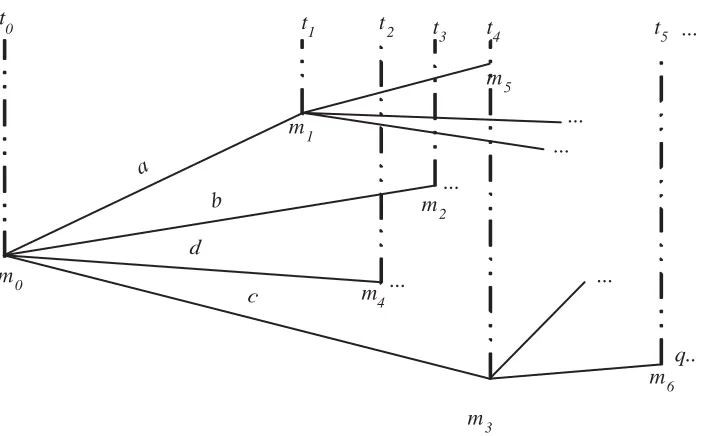
We use a discrete, branching-time model, as shown in Figure 2.1.
The temporal model has the following features:
F. The world is a set of discrete moments in time.
is the set of all possible moments.
F. Moments are partially ordered by the relation
, which indicates temporal
prece-dence. That is, if moment
occurs before
, then
. Also,
is
defined as
or
, where
iff
and
both denote the
same moment. The relationis transitive, asymmetric, and irreflexive.
F. Each moment is associated with a state of the world, which is fully defined by the
state of all the propositions that hold at that moment. A condition is said to be
a
b
c
d
... ...
... ... m1
m2
m3 m4
m0
... t
0 t1 t2 t3 t4
q.. ...
m5
m6 t5
Figure 2.1: A schematic representation of the model of time
F. The past is considered linear, and the future branches into as many branches as
there are outcomes of actions that are possible at that moment (for the agents in the
system).
F. We use timestamps to be able to represent deadlines and fixed intervals. Each
times-tamp denotes an instant of time. denotes the set of all timestamps. Timestamps
are assumed to be discrete.
F. Moments and timestamps are assumed to be equally dense; i.e, we can relate exactly
one timestamp with every moment and exactly one moment in any scenario with
every timestamp. The function assigns a timestamp to every moment, i.e.,
F. The relation
defines a total ordering over the set. That is,
or
or
F. Since
is a partial ordering andis a total ordering,
However,
For example, in Figure 2.1, , , and . However, .
F . A scenario at a moment is a maximal set of moments containing the given
mo-ment and all momo-ments along some branch in the future of the given momo-ment. It represents one possible path of progression of the universe. The set of all scenarios
at a momentis represented by
. A scenario is a subset of
. A scenariohas
the following properties:
is rooted; i.e.,
is linear; i.e., or or
For example, in Figure 2.1, the path
is a scenario rooted at
We use an extension of Computational Tree Logic (CTL) [Emerson, 1990] as the
tem-poral logic to model commitments. We now introduce the components of the CTL language
and their intended meanings.
1. Boolean operators. The logical operatorstrue,false,,,carry their usual
mean-ing.
U:A proposition, read p until q, is true at a moment
on a scenario,
iff holds at some moment
in the future on the given scenario and
holds at all moments between and
.
F: A proposition, read eventually p, means thatholds at some point
on the future in the given scenario. It is equivalent to .
G:A proposition, read always p, means thatholds at all moments in
the future on the given scenario.
GandFare duals.
3. Branching temporal operators. These are operators that apply over a set of
scenar-ios.
E: The proposition means thatholds in some scenario rooted at the
present moment. It is the existential quantifier operator over the set of all
branches emanating from the present moment.
A: The proposition means that holds in all scenarios rooted at the
present moment. It is the universal quantifier operator over the set of all
branches emanating from the present moment.
EandAare duals. Ep p.
2.2
Commitments
Commitments are obligations that one agent has towards another because of a promise.
They can, in principle, be legally enforced. Commitments are created because of the social
explains in his “first principles” of commitments. Singh [1999] gives a computational
perspective.
2.2.1
Representation and Semantics
A commitment, written (d, x, y, p), relates a debtor , a creditor , and a condition
[Yolum and Singh, 2002b]. The commitment has a unique identifier. When a
commit-ment is created, becomes responsible tofor satisfying the condition; the commitment
is said to be satisfied when the condition holds. There can be at most one commitment
with a particular identifier in our entire model.
2.2.2
Commitment Operations
Commitments are created, satisfied, and transformed in certain ways. The following
oper-ations that can be performed on commitments were introduced in [Singh, 1999].
1. CREATE(x, c) establishes the commitment c in the system. This operation can only be performed by the debtor x of the commitment.
2. DISCHARGE(x,c) satisfies the commitment c. It can only be performed by the debtor x of the commitment.
3. CANCEL(x, c) cancels the commitment c. It can only be performed by the debtor x of the commitment. Generally, cancellation of a commitment is followed by the
creation of another one to compensate for it.
4. RELEASE(y, c) releases the debtor in the commitmentfrom the commitment. This
5. ASSIGN(y, z, c) replaces y with z as the creditor of the commitment. This operation
can only be performed by the creditor y of the commitment.
6. DELEGATE(x, z, c) replaces x with z as the debtor of the commitment. This
opera-tion can only be performed by the debtor x of the commitment.
We note that a commitment has to be created using theCREATEoperation for it to exist. We also introduce two predicates in Section 3.3 that help us capture the notion of fulfillment of a commitment rigorously.
2.2.3
Commitment Predicates
For every operation on commitments listed in Section 2.2.2 we introduce a corresponding
predicate. These predicates are represented by the same name as the operation, with low-ercase letters. The predicates are true at the moment where the corresponding operation
succeeds. For example, if an agent invokes aCREATE(x,c) operation, and this operation succeeds at a moment
, then the predicate create(x,c) is said to be true at the moment
.
2.2.4
Commitment Identifiers
Every commitment is assumed to have a unique identifier that helps to distinguish it from
other commitments that may have the same debtor, the same creditor, and the same
condi-tion. For example, if I promise to pay you $5 twice, then a single payment of $5 should not suffice. The predicates in question also apply to specific commitments, i.e., respecting
their unique identifiers. For example, I may cancel one of my two commitments to pay
Chapter 3
Technical Framework
This chapter introduces the concept of time intervals, describes the formal language for our scheme, and introduces two key predicates dealing with the resolution of commitments.
3.1
Temporal Commitments
In real-life settings where commitments are used, commitments often must be satisfied
either within a fixed, bounded interval or at a specified instant in the future. A temporal
specification that is used to specify commitments should therefore be able to specify time-bounded propositions.
Temporal Quantification
The temporal commitment structure specified by Fornara and Colombetti [2002] forms the
basis for our temporal commitment scheme. Every condition specified in the commitment
language is potentially specified with the following elements:
A time interval.
A proposition.
We use timestamps to denote endpoints of time intervals. Two timestamps, like and
are used to represent an interval that begins at
and ends at
, both instants inclusive. For
any such time interval, either or .
An interval provides a set of instants over which to evaluate logical propositions. We
introduce the following temporal quantifiers to quantify over instants in the interval:
1. is interpreted as an existential quantifier over a time interval. That is,
means the propositionhas to hold at one or more instants in the interval beginning
at
and ending at
.
2. is interpreted as a universal quantifier over a time interval. That is,
means
the propositionhas to hold at every instant in the interval beginning at
and ending
at .
The existential and the universal temporal quantifiers are duals of each other.
(3.1) (3.2)
Propositions that are temporally quantified are referred to as temporally quantified
propositions, and commitments which contain such propositions in their conditions are
3.2
The Formal Language
The following is a grammar for, the propositional language we use, expressed in
Backus-Naur Form (BNF). In this grammar, the uppercase letters denote nonterminals; the
lower-case letters denote lexical items that are not analyzed by this grammar; stands for any
agent symbol;is a meta-symbol of the BNF; items enclosed withinandcan appear
zero or more times; all other symbols are terminals. is the unique starting symbol for the
language of.
G.
G.
G.
G.
G.
G.
G.
G.
In the grammar, is an atomic proposition in the domain, is a unique commitment
identifier, and is a timestamp; i.e., .
The features of are:
accepts temporally quantified propositions as well as propositions without
allows arbitrary nesting of time intervals. The implications of such a nesting
are discussed in Chapter 4.
3.2.1
Notational Convention for Propositions
As a convention, we shall use
andto denote simple propositions, which may be a single literal or a
con-junction or discon-junction of literals, where such a literal is either an atomic
propo-sition or a commitment predicate.
and
to denote temporally quantified propositions or temporal
commit-ments, and are collectively referred to as temporal propositions.
Any proposition that is denoted by a unique symbol in the language of the domain we are modeling is an atomic proposition. Atomic propositions are assumed to be known by
all participants and to be understood by all participants to have the same meaning. For
example, might denote the atomic proposition “The auction house is in open.” This is
a simple proposition. might denote “An auction is in progress.” This is also a simple
proposition. is therefore a simple proposition meaning “The auction house is open
and there is an auction in progress.” , which is equivalent to , is also a simple
proposition which means “If the auction house is open, then an auction is in progress.” However, if we quantify an atomic proposition or a simple proposition with a time
inter-val and a temporal quantifier, it becomes a temporally quantified proposition. Continuing
with the above examples,
is a temporally quantified proposition; it means “At all
times from to
, the auction house is not open.”
is also a temporally
quan-tified proposition; it means “The auction is open and there is an auction in progress at least
for one instant between and
3.3
New Predicates for Commitments
We propose the addition of two new predicates, breached() and satisfied(), indicating
violation and fulfillment of the given commitment, respectively.
Whenever a commitment is created, it is neither breached nor satisfied. Eventually, it might be breached and thus remain breached forever; or it may be be satisfied and remain
satisfied forever. That is, in contrast to the predicates corresponding to commitment
oper-ations (as introduced in Section 2.2.2), both breached and satisfied are stable [Francez and Forman, 1996]. However, a commitment may remain forever possible without being
satis-fied, in which case it will never be breached nor satisfied. This has the effect of applying a
three-valued logic for the satisfaction of commitments.
Section 3.4 defines a language for specifying rules about the behavior of commitments,
using the concepts developed here.
3.4
Semantics
We now describe the semantics for the language.
For a proposition,
means that a model satisfies propositionat
moment. means that the model satisfiesat momentin the
scenario.
As is customary in formal semantics, we define an interpretation, which
la-bels each moment with the elements that are interpreted as being true at that moment. In our case, the elements are the atomic propositions of the domain
along with the elementary facts about commitments, i.e., which operations on
logic. For example, the domain atomic propositions might be observed to be
true and the commitment-predicates might be mapped to various linguistic or other conventions. For instance, a predicate might be taken to hold
when a party submits a form over the Web.
Letbe a set containing the domain atomic propositions as well as operations
on commitments as generated from the nonterminal in our grammar. Then
.
Let be a model for the formal language, where , , and
have the meaning as explained in Section 2.1, is a set of agent symbols, and is an
interpretation as defined above.
The semantics of is given by the following postulates. For convenience, we define
as or
and as an abbreviation for
. The meaning of
is that the commitmenthas not been operated upon using a commitment operation.
R.
iffwhere
R.
iff and
R.
iff or
R.
iff
R.
iff
R.
iff
R.
R. iff and and and Ü R . iff and and and Ü
R.
iff and ¿ and and ½ and( ¾
R.
iff and ¿ and and ½ and ¾
R.
iff ½ and and ¾
Apart from these semantics, we impose the following constraints on the model to
cap-ture operations on commitments.
C. A commitment cannot be created more than once with a given identifier. This
captures the uniqueness of commitment identifiers (Section 2.2.4).
¼ ½ ¼
C. When a commitment is assigned , a new commitment with the new creditor is
created with the new creditor, and the old commitment no longer holds. In other
words, anASSIGN leads to a new commitment being created.
where
and ¼
¼
¼
.
C. When a commitment is delegated, it is as good as canceled, but a new commitment
is created with a different debtor. In other words, a DELEGATE leads to new a commitment being created.
¼
where
and
¼
¼
¼
.
C. When a commitment is created, it is neither breached nor satisfied.
and
Note that in both the delegation and the assignment rules, ¼
has a condition ¼
, which
might be different from
in that the time bounds on the newly created commitment may
be different. However, such issues of assignment of new time bounds and how they should
be decided are in the realm of the study of responsibility among agents, and are beyond the
scope of our work. We discuss this issue in Section 5.
3.5
Commitment Life Cycle
Using the above semantics, we can infer additional results about the life cycle of com-mitments, especially dealing with the breach or satisfaction of a temporal commitment.
First we establish the following simple but important lemmas indicating the stability of the
and predicates.
Lemma 1
iff
Lemma 2
iff
Lemma 3
Lemma 4
The following observations are also provably correct with respect to our semantics. Below,
andrepresent simple propositions; ,
, and the
’s represent instants in time.
A commitment that is canceled does not exist in the system. Recall that because of unique identifiers, a commitment cannot be created again. However, a new commitment
with the same debtor, creditor, and proposition as an older commitment can be created, but
the logic has nothing to say about it.
Observation 1
where
.
When a debtor is released from a commitment, that commitment no longer holds.
Observation 2
where
.
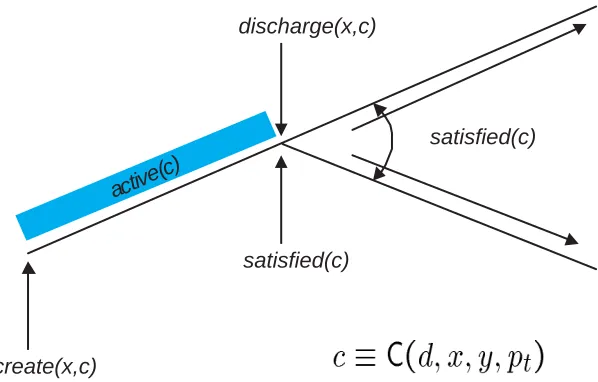
The semantic rulesR. andR., and the Lemmas 1 and 2 are diagrammatically given
active( c)
create(x,c)
breached(c)
breached(c)
Figure 3.1: Temporal behavior of thepredicate
active( c)
create(x,c)
satisfied(c)
satisfied(c) discharge(x,c)
Chapter 4
Resolving Temporal Commitments
A temporal commitment is resolvable if its satisfaction or breach can be determined at some moment. Under certain conditions, the unresolvability of a temporal commitment can be
ascertained even before the specified time interval occurs.
We now discuss some cases where a temporally quantified proposition is not resolvable, and develop methods to detect such cases. Based on the resolvability of such propositions,
we can detect satisfaction or breach of commitments that have temporally quantified
propo-sitions as their condition.
4.1
Nested Interval Expressions
The temporal propositional language given in Section 3.2 allows for propositions to be nested within multiple levels of time intervals. Although there are many nested intervals
whose interpretation in common language does not make sense or induces redundancy,
Consider the proposition , where
(case 4.1,
Fig-ure 4.1). This proposition means thatwill hold at all moments in the interval
, and
this interval will occur at least once within the time interval
. This proposition could
therefore be used to express events that take a finite, continuous amount of time at every
occurrence within an interval, like the event mentioned in Example 1 in Chapter 1.
Example 1 mentions that the auction house wants to assure its buyers that there will be
at least one auction held this week.
Solution 1
would denote this week,
would denote the duration of one
auc-tion, andwould denote “An auction in progress.” Hence “At least one auction this week”
could be represented by
, and the commitment made by the auction house
to its buyers could be represented as
, where represents the
auction house, andrepresents a buyer.
Note that our current grammar does not say anything about specifying timestamps
rel-ative to one another; i.e., specifying relationship between timestamps within a formula formed according to the rules of our grammar. Such an extension to the grammar would
be very beneficial in specifying statements like “sometime before an event”, but would be
computationally expensive. This issue is discussed in Section 5.
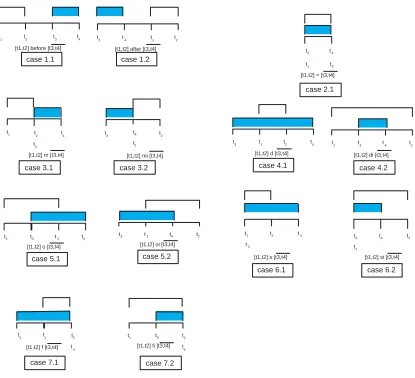
Allen [1983] defines 13 possible temporal relationships between any two given time
intervals. Figure 4.1 shows a visual interpretation of of these 13 relationships for the two
intervals contained in the temporally quantified proposition
; i.e., the
inter-vals and
. In the figure, time moves forward (increases) from left to right. The
shaded portions are intervals of the type
, and the unshaded portions are of the type
. 13 such diagrams can be constructed for each combination of temporal quantifiers
case 1.1 case 1.2
t3 t4 t1 t2 [t1,t2] = [t3,t4]
case 2.1
t3 t1 t2 t4
[t1,t2] m [t3,t4]
t3 t1
t2 t4
[t1,t2] mi [t3,t4]
case 3.1 case 3.2
t3 t1 t2 t4 [t1,t2] d [t3,t4]
t1 t3 t4 t2 [t1,t2] di [t3,t4]
case 4.1 case 4.2
t1 t3 t2 t4 [t1,t2] o [t3,t4]
t3 t1 t4 t2 [t1,t2] oi [t3,t4]
case 5.1 case 5.2 [t1,t2] s [t3,t4]
case 6.1 t1 t2 t4
t3
[t1,t2] si [t3,t4] case 6.2 t1 t2 t4 t3 case 7.2 [t1,t2] fi [t3,t4]
t3 t1 t2
t4 [t1,t2] f [t3,t4]
case 7.1 t3 t1 t2
t4
t3 t4 t1 t2 [t1,t2] after [t3,t4] t1 t2 t3 t4
[t1,t2] before [t3,t4]
Figure 4.1: Allen’s intervals for
If we consider nested temporally quantified propositions as being conditions of
com-mitments, we can see which kinds of nesting will make the success of the commitment
unresolvable. Cases 1.1, 3.1, 4.1, 5.1, and 6.1 are not resolvable, but cases 1.2, 2.1, 3.2,
4.2, 5.2, 6.2, 7.1, and 7.2 can be resolved for reasons listed below. The term inner
proposi-tion is used to refer to the temporal proposiproposi-tion
.
In cases 1.1, 3.1, 4.1, 5.1, and 6.1 the inner proposition’s time interval does not
has references to instants in the future. Since the future cannot be seen in
advance, these cases cannot be resolved.
In cases 1.2, 2.1, 3.2, 4.2, 5.2, 6.2, 7.1, and 7.2 the inner proposition’s success
can be resolved at at least one instant within the interval of the outer
proposi-tion. Since the outer proposition has an existentially quantified time interval
and we have at least one instant of resolvability, these cases can be
re-solved.
We now formalize the notions of nested intervals and results about their resolution.
These results can be used to detect some commitment protocol violations before the actual violation occurs due to unresolvability.
Definition 1 A temporally quantified proposition is said to be positive-resolvable at an
instant if its value is known to be true at that instant; it is said to be negative-resolvable at an instant if its value is known to be false at that instant.
Definition 2 A temporal commitment is said to be positive-resolvable at an instant if its
satisfaction can be known at that instant; it is said to be negative-resolvable at an instant if
its breach can be known at that instant.
Definition 2 means that if one of or predicates of a temporal
com-mitment is true, then the comcom-mitment has been resolved. Expressed in the negative, this
definition means that a temporal commitment is unresolved at an instant if both the
and the predicates for that commitment are false at that instant.
We use the following notation to denote some important instants with respect to an
interval. Below,
is a temporal proposition, and
is used to denote resolvability.
represents the earliest instant at which
is positive-resolvable.
represents the latest instant at which
represents the earliest instant at which
is negative-resolvable.
represents the latest instant at which
is positive-resolvable.
We assume that the past is observable because it has already occurred, and the future is
not.
The following lemmas state results about earliest and latest bounds respectively, of the detection of resolvability for a simple proposition. These bounds form the base case for
calculating resolvability of propositions that have intervals nested to any arbitrary depth
and the resolvability of temporal commitments.
Lemma 5 Lemma 6 Lemma 7 Lemma 8
Table 4.1 and Table 4.2 summarize the above lemmas.
Interval Earliest breached at ( ) Earliest satisfied at (
)
Table 4.1: The earliest instant of resolvability of a temporally quantified proposition
We make the following observations using Table 4.1 and Table 4.2, wher
is a
tempo-rally quantified proposition:
is not positive-resolvable at any instant before .
is not negative-resolvable at any instant before .
Interval Latest breached at ( ) Latest satisfied at (
)
Table 4.2: The latest instant of resolvability of a temporally quantified proposition
is negative-resolvable at any instant after
.
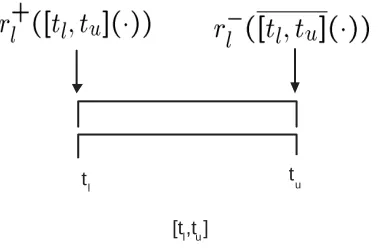
Figures 4.2 and 4.3 are a diagrammatic representations of the bounds on resolvability of a proposition with a universally quantified interval and an existentially quantified interval
respectively.
tl tu
[tl,tu]
Figure 4.2: Bounds on resolvability of
tl tu
[tl,tu]
Figure 4.3: Bounds on resolvability of
we have developed to solve some of the challenges that were outlined earlier.
4.2
Resolving Nested Interval Expressions
Using the rules in Section 4.1, we can now see why some of the two-level interval nesting
cases shown in Figure 4.1 were determined to be unresolvable.
In cases 1.1, 4.1, and 5.1, we cannot determine the if the proposition
is true
within the outer interval
. More specifically, the earliest instant at which the
satis-faction of
can be determined is
, which is beyond
, the latest instant for the
satisfaction of
. As a consequence, the expression
as a whole
can-not be resolved, which is why commitments whose conditions are temporally quantified
propositions of these types are disadvantageous for the creditor.
We now use the concepts of earliest and latest instants of resolvability to solve Exam-ple 2 of Chapter 1. This examExam-ple mentions that the auction house promises to bring about
the condition that there will be a continuous auction on the upcoming weekend. However, the auction house promises to bring about the condition today (a Tuesday).
Solution 2 To model Example 2, the auction house makes a commitment to a set of
buyers . The commitment is , where , denotes
the interval “today” (a Tuesday),
denotes the interval “this weekend”, and is an
atomic proposition that means “There will be a continuous auction”. The condition of this commitment corresponds to case 1.1 of Figure 4.1. In this case,
cannot be
resolved at least until , and
has to be resolved at most by
. But since
,
this condition cannot be resolved. Hence the commitment cannot be satisfied. Formally,
As a final example of an unresolvable commitment, consider a case , as
shown in Figure 4.4 where
. The outer interval is not resolvable, since
the inner proposition cannot be resolved at all instants in it. Formally, .
t3 t1 t2 t4
[t1,t2] oi [t3,t4]
Figure 4.4: A schematic for , where
To summarize, the following conditions are necessary to ensure resolvability of a
tem-porally quantified proposition.
A temporally quantified proposition of the form
must have at least one
instant in the interval
, at which
it is resolvable A temporally quantified proposition of the form
must have
resolv-able at all instants in the interval
Since we classify commitments as either breached or satisfied based on the intervals in their condition, the following lemmas hold:
Lemma 9 Lemma 10 where .
We have shown how unresolvable commitments can be detected. In cases where an
unresolvable commitment is as good (or as bad) as one that is breached, such resolution
4.3
Disjunctive Forms
Another important aspect of commitment resolution concerns commitments whose
condi-tions are disjunccondi-tions of temporally-quantified proposicondi-tions, which can also be modeled as
implications or conditional commitments. We call such commitments disjunctive
commit-ments.
Disjunctive commitments regularly arise in common business interactions and can
some-times lead to what we call the warranty paradox, where a disjunctive temporal commitment turns out to be favorable to the debtor and unfavorable to the creditor. More specifically, the
warranty paradox is a situation where a merchant provides a warranty on some good she
sells, but also specifies some clauses, which render the warranty void before the customer can ascertain the quality of the good. This can happen if ascertaining the quality of the
good takes more time than the time over which the warranty for that good is valid.
The debtor of a disjunctive commitment is committed to satisfying at least one of the disjuncts. But the different bounds on positive- and negative-resolution of these disjuncts
can lead to an unfavorable situation for the creditor of the commitment, as in Example 3.
Intuitively, we reason as follows about the satisfiability of a disjunction of temporal propositions: A disjunction of temporal propositions is satisfiable if it has not already been
satisfied, and at least one of the disjuncts is still resolvable.
Let
denote the disjunction of temporally quantified propositions, in
which
denotes the earliest instant among all instants contained in the intervals of the
’s, and
denotes the latest. Then, for the disjunction to be satisfiable, the requirement
is:
Ü
Ü (4.1) where, , and .
Let us apply Equation 4.1 to Example 3 from Chapter 1. This example describes a
scenario where the auctioneer who sold the fish guarantees that it will remain fresh for two days or the buyers will be given their money back. However, the fish market will close
operations in two hours, after which the auctioneers commitments made in the fish market
would be invalid.
Solution 3 Example 3 can be modeled by the commitment
, where the atomic proposition “ ” means the the fish are fresh,
the atomic proposition “” represents the warranty that the auctioneer gives by
say-ing she will refund the money if the fish rot before two days, represents the auctioneer,
andrepresents the buyer. We see that there exists a moment in the set of all moments of
the disjuncts, such that every literal is either breached or is beyond the upper bound of its
positive-resolution. If the fish rots three hours after it was bought, then the only proposition
that is not yet breached at that point is the payback guarantee by the auctioneer. However, the upper bound of positive resolvability of this proposition has passed. More formally,
Ü
Hence the warranty that the auctioneer provided on the freshness of the fish is unfavorable for the customer, since the warranty becomes invalid before the buyer can ascertain the
freshness of the fish. Thus we show how the warranty paradox can be captured in our
scheme of temporal commitments.
Example 4 An electronics manufacturer sells computers with a 90-day money back
war-ranty on the parts. However, if the company goes bankrupt within a month after a customer bought a computer, then the warranty is void because the company has no money to pay
anyone who makes a claim.
However, the violation of the warranty in this example cannot be detected beforehand because the bankruptcy of the company cannot be foreseen.
We have shown in this chapter how the three examples given in Chapter 1, which cannot
be handled by commitments without deadlines, can be represented and reasoned about in our scheme. We have provided examples which illustrate how our scheme decouples the
actual content of propositions from their temporal implications by specifying time intervals
Chapter 5
Discussion
The concept of deadlines in commitments is doubtless necessary for practical uses of com-mitments. Traditionally, deadlines are not formally modeled and are hidden within the
atomic propositions. However, an explicit formulation of temporal commitments, as
devel-oped above is highly desirable. It offers a uniform treatment of operational characteristics across domains. We have shown how a such a system of commitments with deadlines
can be developed, and used to reason about the possibility of satisfaction of commitments.
Our approach not only allows for expression of statements that involve temporal anaphora, but also decouples the temporal quantification from the proposition itself, thus allowing
us to reason about the temporal aspect, without regard to the meaning of the propositions. Our scheme for temporal quantification of propositions is related to the notion of temporal
quantification presented by Fornara and Colombetti [2002], but develops interesting results
about the resolution of fulfillment of commitments.
Grosof et al. develop semantics for systems that represent business rules using
Cour-teous Logic Programs [1999]. Their approach uses explicit rules to use to decide between
conflicting rules. However, temporal constraints are specified as part of the language, not
reasoning about the temporal aspects independent of the domain specific details.
Minsky and Ungureanu [2000] propose Law Governed Interaction, which is a way of specifying laws about rules and hierarchies of rules, so priorities between rules can be
resolved. This approach too does not emphasize temporal aspects.
Dignum et al. [1996] describe a temporal deontic logic that helps specify obligations and constraints. Their logic is based on obligations, which are similar in spirit to
commit-ments. The logic has one generalized obligation, which is used to derive four specific type
of obligations: One to perform some action with respect to the begin and end conditions
of an interval, one to perform an action depending on another, one to perform some ac-tion immediately and one to periodically perform some acac-tion. Their theory of obligaac-tions,
however, considers only actions of unit length. Maintenance conditions for states of the
world cannot be handled. Our approach, on the other hand, can not only specify all the above kinds of obligation as commitments, but also model actions of variable duration.
Research Directions
Our work on temporal aspects of commitments is far from complete. We have identified
three important related topics that need to be explored to extend and improve upon this
work.
Potential Causality
One direction is to marry this approach with the work on compliance checking based on potential causality as developed by Venkatraman and Singh [1999]. Their work develops
a theory for verifying compliance of an agent to a protocol which is modeled by
messages in a protocol can be ordered with respect to an observer because messages are
tagged with vector timestamps. A local model of messages is built by an agent, and this model is used to check if all commitments made to the agent have been fulfilled.
Our results on resolution of commitments and unenforceable commitments applies at a
finer granularity than theirs, since we do not work with protocols, but only with individual commitments. Also, their work does not use the concept of deadlines on commitments.
Compliance verification in agent interaction protocols could be done more effectively if a
fusion of our work with Venkataraman and Singh’s is achieved.
Relativized Timestamps
Our current specification of the grammar for does not allow us to specify timestamps
relative to one another. That is, we cannot say
.
Such a statement would be of value in specifying statements that involve an event that ends
before some other event.
Adding the property of specifying relative time intervals to our grammar would be
simple but such a grammar would be computationally expensive. We leave this as future
work.
Delegation and Responsibility
Another direction for further research is to extend our scheme to accommodate concepts of
responsibility and trust to clearly define the semantics of commitment operations such as
DELEGATE andASSIGN.
Realistic delegations of tasks oftentimes require that the delegator be accountable for
the task that was delegated.
Although we have specified rules about the effect of the DELEGATE and the ASSIGN operations on the life-cycle of a commitment in Section 3.5, canceling a commitment when
it is delegated is a naive approach. A clear concept of responsibility and its flow with the
Bibliography
James F. Allen. Maintaining knowledge about temporal intervals. Communications of the
ACM, 26(11):832–843, November 1983.
Cristiano Castelfranchi. Commitments: From individual intentions to groups and
organi-zations. In Proceedings of the AAAI-93 Workshop on AI and Theories of Groups and
Organizations: Conceptual and Empirical Research, 1993.
Frank Dignum, Hans Weigand, and Egon Verharen. Meeting the deadline: On
the formal specification of temporal deontic constraints. In International
Sy-posium on Methodologies for Intelligent Systems, pages 243–252, 1996. URL
citeseer.nj.nec.com/dignum96meeting.html.
E. Allen Emerson. Temporal and modal logic. In Jan van Leeuwen, editor, Handbook of
Theoretical Computer Science, volume B, pages 995–1072. North-Holland, Amsterdam,
1990.
Nicoletta Fornara and Marco Colombetti. Operational specification of a commitment-based agent communication language. In Proceedings of the International Joint Conference on
Autonomous Agents and Multiagent Systems, pages 535–542. ACM Press, 2002.
Coordinated Distributed Programming. ACM Press and Addison-Wesley, New York,
1996.
Benjamin N. Grosof, Yannis Labrou, and Hoi Y. Chan. A declarative approach to business
rules in contracts: Courteous logic programs in xml. In Michael P. Wellman, editor,
Proceedings 1st Annual ACM Conf. on Electronic Commerce, EC’99, Denver, CO, USA,
3–5 November 1999. ACM Press, 1999.
Naftaly H. Minsky and Victoria Ungureanu. Law-governed interaction: a coordination
and control mechanism for heterogeneous distributed systems. ACM Transactions on
Software Engineering and Methodology (TOSEM), 9(3):273–305, 2000.
Barbara Partee. Nominal and temporal anaphora. Linguistics and Philosophy, 7(3):287–
324, 1984.
Juan A. Rodr´ıguez-Aguilar, Francisco J. Mart´ın, Pablo Noriega, Pere Garcia, and Carles
Sierra. Towards a test-bed for trading agents in electronic auction markets. AI
Commu-nications, 11(1):5–19, 1998.
Munindar P. Singh. An ontology for commitments in multiagent systems: Toward a
unifi-cation of normative concepts. Artificial Intelligence and Law, 7:97–113, 1999.
Mahadevan Venkatraman and Munindar P. Singh. Verifying compliance with commit-ment protocols: Enabling open Web-based multiagent systems. Autonomous Agents and
Multi-Agent Systems, 2(3):217–236, September 1999.
Pınar Yolum and Munindar P. Singh. Commitment machines. In Proceedings of the 8th
International Workshop on Agent Theories, Architectures, and Languages (ATAL-01).
Pınar Yolum and Munindar P. Singh. Flexible protocol specification and execution:
Apply-ing event calculus plannApply-ing usApply-ing commitments. In ProceedApply-ings of the 1st International
Joint Conference on Autonomous Agents and MultiAgent Systems (AAMAS). ACM Press,