ABSTRACT
RICHARDS, EVAN THOMAS. Selecting the Correct Solution to a Physics Problem When Given Several Possibilities. (Under the direction of Ruth W. Chabay.)
Despite decades of research on what learning actions are associated with effective learners (Palincsar and Brown, 1984; Atkinson, et al., 2000), the literature has not fully addressed how to cue those actions (particularly within the realm of physics). Recent reforms that integrate incorrect solutions suggest a possible avenue to reach those actions. However, there is only a limited understanding as to what actions are invoked with such reforms (Groβe and Renkl, 2007).
Selecting the Correct Solution to a Physics Problem When Given Several Possibilities
by
Evan Thomas Richards
A dissertation submitted to the Graduate Faculty of North Carolina State University
in partial fulfillment of the requirements for the Degree of
Doctor of Philosophy
Physics
Raleigh, North Carolina 2010
APPROVED BY:
__________________________ ________________________ Dr. Bruce Sherwood Dr. John Risley
__________________________ ________________________ Dr. Robert Beichner Dr. Ruth Chabay
DEDICATION
To my wife, Holly, who has kept me going for many years through thick and thin. Without her encouragement and support throughout the years, none of this would have
BIOGRAPHY
I have taken the scenic route to arrive at North Carolina State University’s (NCSU) Physics Education R&D Group. Since I was young, I have always enjoyed exploring the technical fields. After earning a few degrees in engineering, I worked in the semiconductor industry for a while as an engineer. However, my interest in physics never wavered, and I began to take physics courses on the side. During the same time period, I also fully realized my interest in teaching.
One fateful night changed the course of my life. As I was waiting for a professor to arrive for office hours, I pursued a nearby billboard of available physics opportunities. One such opportunity combined the sciences of physics and teaching. This notice
introduced me to the world of physics education research. After returning home, I worked through the night to learn about this exciting field of research. By the next morning, I knew that my life was about to dramatically change its course.
ACKNOWLEDGMENTS
I had the great fortune and honor to have found incredible mentors throughout my time at a variety of universities. Without their help, support, and tremendous patience with my never-ending questions, my dreams would be much further away.
I thank the faculty of the North Carolina State University’s Physics Education R&D Group (PERD group) for training me in the field of physics education research. I have transitioned from a naïve graduate student thinking of teaching solely through the lens of anecdotal experiences to an instructor with a more disciplined view on the science of teaching. I also want to thank the National Science Foundation for their funding and support.
I thank my researcher advisor, Dr. Ruth Chabay, for her insight and guidance generously given over the past several years. Her disciplined approach to research has been a key influence to my professional development. My thoughts continually turn to asking, “how would Ruth respond?”
I thank Dr. Robert Beichner for his insightful comments and questions over the years. On countless occasions, his insights have caused me to reflect upon (and in many cases redefine) my initial analysis. Without his support and the North Carolina State University’s STEM Education Initiative, the Qualitative Educational Research
Laboratory would not have been possible. I greatly enjoyed my time building and using the laboratory, not to mention my appreciation on the knowledge that I gained through those efforts. I am continually amazed by his boundless energy. Despite his busy
schedule, he always made time to talk whenever I (or any other graduate student) needed advice, and his humor always made those conversations particularly memorable (may I never forget “bogus points”).
I thank Dr. Bruce Sherwood for his kind advice and equally wonderful humor over the years. He provided a never-ending stream of fascinating physics problems to ponder, many of which I think back upon within the context of my own courses. He has always been generous with his time, and I deeply appreciate the many conversations we have had. His insights helped hone my own thinking on many occasions.
I thank Dr. H. Vince Kuo now of the Colorado School of Mines. I very much appreciated his time as a postdoctoral research associate at North Carolina State
University. His door was always open for the graduate students. I deeply appreciate the training and advice he gave me (not to mention showing me around my first AAPT meeting).
University. They were always happy to provide guidance and answers to my many questions as a new graduate student to the research group. When I assumed the same role later on, I tried to uphold their superb legacy.
I also extend my thanks to my fellow graduate students in the PERD group. In many ways, our progress through the program is a result of a collective effort not only on the part of the faculty, but also the graduate students. I appreciate the many sanity checks and sounding board sessions. I especially want to thank Jon Gaffney for his collaboration and our many insightful conversations, Jeff Polak for his above-and-beyond the call of duty efforts in helping me with this research, Brandon Lunk for his help with the data collection, and Shawn Weatherford for his contributions to the coding scheme
verification.
I extend my appreciation to Dr. Roy Chaney and Dr. Gregory Earle of the University of Texas at Dallas. They made it possible for me to return to graduate school and follow my dreams. I thank Dr. Glenn Smith of the Georgia Institute of Technology for his mentorship (his advice heavily influenced my decision to return to graduate school to pursue my dreams). I thank Dr. Kai Chang and Dr. Robert Nevels for starting me on the path to academia at Texas A&M University. Thanks to them, I gained my first
research experiences. They fostered my sense of fascination and wonder along instilling a work ethic that has seen me through life’s winding path.
TABLE OF CONTENTS
LIST OF TABLES... xi
LIST OF FIGURES ...xiii
CHAPTER 1: INTRODUCTION... 1
CHAPTER 2: LITERATURE REVIEW ... 4
2.1: Worked Examples versus Conventional Problem Solving ... 7
2.2: Observed Actions ... 15
2.2.1: Good versus Poor Performers... 17
2.2.2: Action Profiles ... 30
2.3: Modified Worked Examples ... 44
2.3.1: Action Leveraged Modifications ... 45
2.3.2: Memory Model Inspired Modifications ... 51
2.3.2.1: Integrated Worked Examples ... 52
2.3.2.2: Modular Worked Examples... 55
2.3.2.3: Multimode Worked Examples... 59
2.3.3: Transition Implementations... 62
CHAPTER 3: METHODOLOGY ... 69
3.1: Task Development... 69
3.1.1: Problem Set Development ... 71
3.2: Structure of the Study ... 73
3.2.2: Study Sequence ... 75
3.2.3: Study Environment... 76
3.3: Analysis Methodology... 76
3.3.1: Action-Coding Pass... 79
3.3.2: Context-Coding Pass ... 82
3.3.3: Focus-Coding Pass ... 83
3.3.4: Correct/Incorrect-Coding Pass... 84
3.3.5: Restate Type-Coding Pass ... 85
CHAPTER 4: RESULTS ... 87
4.1: Task Actions... 88
4.1.1: Connections to Palincsar and Brown (1984) ... 89
4.2: Distinctions in the Data... 97
4.2.1: Distinctions across Participants ... 98
4.2.2: Distinctions across Problem Sets ... 103
CHAPTER 5: CONCLUSIONS ... 132
5.1: Future Work Directions ... 132
REFERENCES ... 137
APPENDICES ... 148
APPENDIX A: PROBLEM AND SOLUTION SETS... 149
A.1: “Close the Door” problem and solution set ... 149
A.2: “UCM Spring” problem and solution set ... 152
A.4: “Two Pucks” problem and solution set ... 160
APPENDIX B: RESEARCHER SCRIPTS ... 164
B.1: Welcome and introduction script – lead-in to the protocol warm-up exercises... 164
B.2: Think aloud protocol warm-up exercises... 166
B.3: Follow-up script to the warm-up exercises – the final instructions to the participants ... 167
B.4: Reference Sheet... 168
APPENDIX C: FOCUS CODING BREAKPOINTS... 171
C.1: “Close the Door” solutions ... 171
C.2: “UCM Spring” solutions... 173
C.3: “Fission” solutions... 176
LIST OF TABLES
Table 2.1 Four experimental states for the proximity effect... 9 Table 2.2 Worked example modifications... 65 Table 3.1 Error distribution across information representations
(an “X” indicates the presence of an error(s) in the associated
representation) ... 72 Table 3.2 Coding pass overview ... 77 Table 3.3 Coding reliability ... 78 Table 4.1 Whitney-Mann U-test results for Judgers vs. Others average
percent actions for all problems... 102 Table 4.2 Planning segments from “Close the door” problem ... 104 Table 4.3 Whitney-Mann U-test results for Judgers vs. Others average
percent actions for “UCM spring” problem ... 106 Table 4.4 Whitney-Mann U-test results for Judgers vs. Others average
percent actions for “Fission” problem... 107 Table 4.5 Whitney-Mann U-test results for Judgers versus Other
absolute change in actions for “Close the door” with
Table 4.8 Example segments of participants rejecting the correct
solution to “Two Pucks” ... 121 Table 4.9 Physics Context Judgments for the “Close the door” problem ... 123-124 Table 4.10 Example segments of undergraduates judging
LIST OF FIGURES
Figure 2.1 Underlying connections between Palincsar and Brown (1984) factors and worked example study actions (the
factor number appears in parentheses)... 40
Figure 2.2 Links across worked example implementations (the bold text represents shared underlying ideas of the implementations) ... 66
Figure 4.1 Ven Diagram illustrating the connections of the participant actions exhibited in the study to the actions in the Palincsar and Brown (1984) framework ... 89
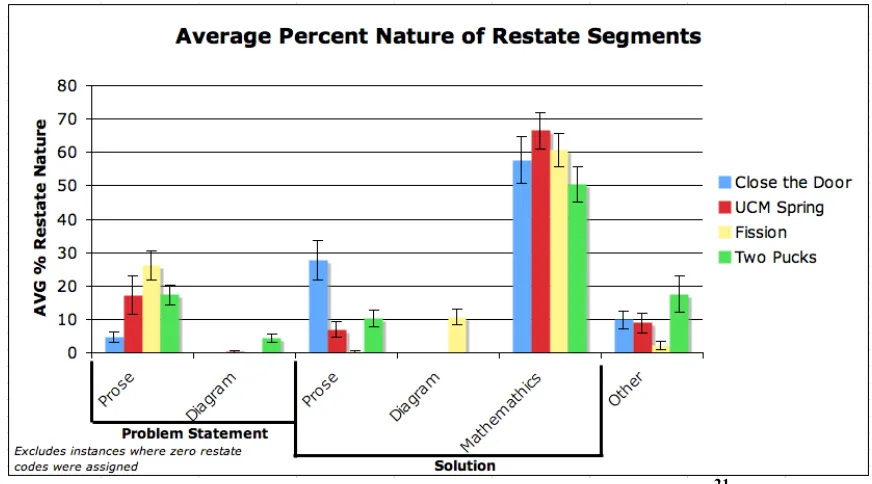
Figure 4.2 Average percent nature of restate segments ... 95
Figure 4.3 Diagram in the “Two pucks” problem statement ... 96
Figure 4.4 Diagram in the “UCM” problem statement... 96
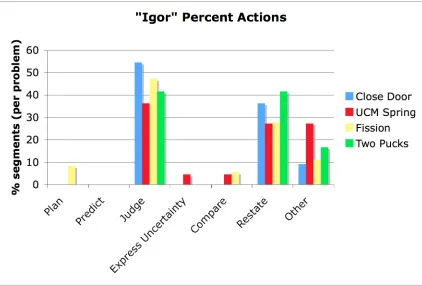
Figure 4.5 “Igor’s” percent actions (note the concentration upon Judging, Restating, and Other) ... 99
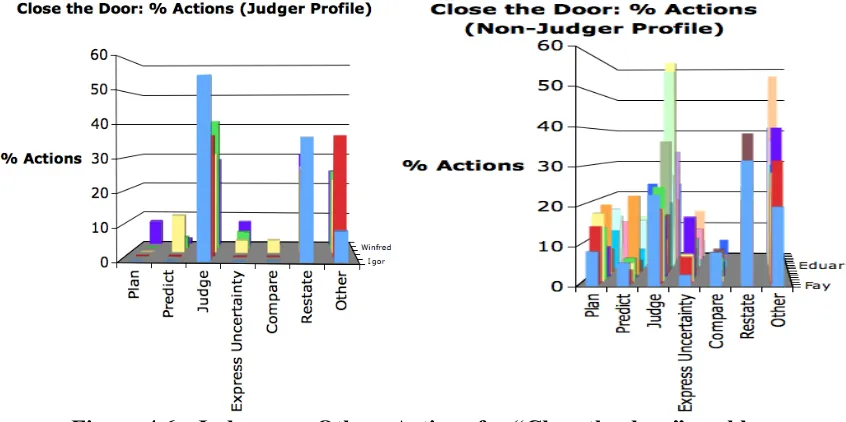
Figure 4.6 Judgers vs. Others Actions for “Close the door” problem ... 100
Figure 4.7 Judgers vs. Others Actions for “UCM Spring” problem... 100
Figure 4.9 Judgers vs. Others Actions for “Two Pucks” problem ... 101
Figure 4.10 Judgers vs. Others actions for all problems... 102
Figure 4.11 Judgers vs. Others actions for the “Close the door problem”... 103
Figure 4.12 Judgers vs. Others actions for the UCM spring problem ... 106
Figure 4.13 Judgers vs. Others actions for the “Fission” problem... 107
Figure 4.14 Judgers vs. Others absolute change in average % actions for Close the door and Two Pucks minus UCM Spring and Fission ... 109
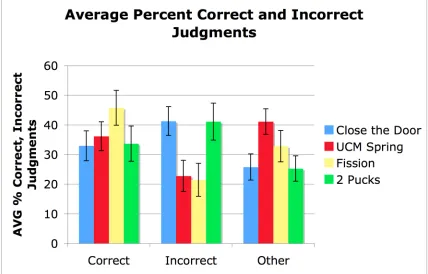
Figure 4.15 Average percent correct and incorrect judgments ... 110
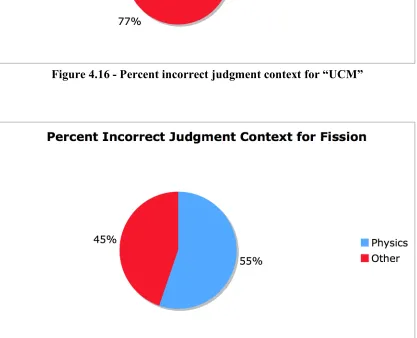
Figure 4.16 Percent incorrect judgment context for “UCM”... 111
Figure 4.17 Percent incorrect judgment context for “Fission”... 111
Figure 4.18 Percent incorrect judgment context for “Close the door” ... 112
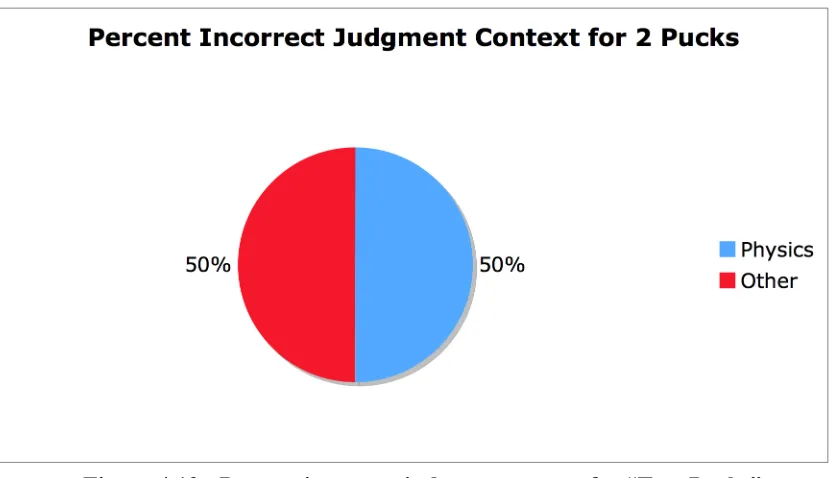
Figure 4.19 Percent incorrect judgment context for “Two Pucks” ... 112
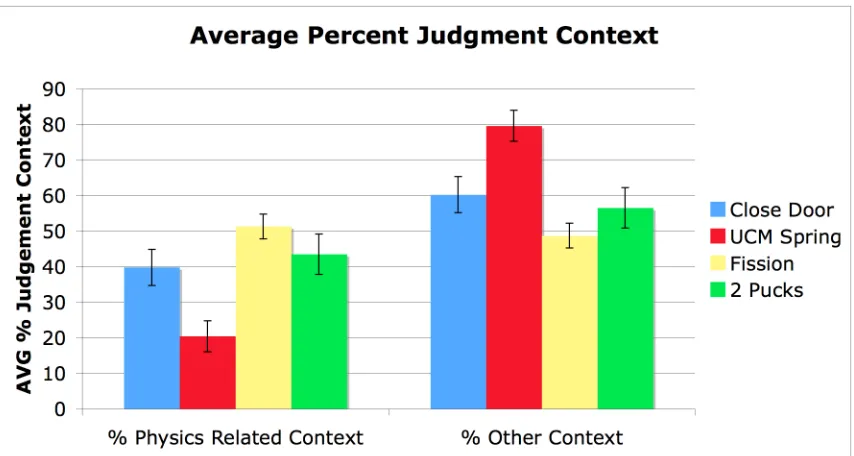
Figure 4.20 Average Percent Context of the Judging Segments... 113
Figure 4.21 Detailed Average Percent Context of the Judging Segments... 114
Figure 4.22 Average number of equal signs in the given solutions for each problem... 115
Figure 4.24 Average percent focus of comparisons ... 127
Figure 4.25 Average percent context of judgments for “Two Pucks”... 128
Figure 4.26 Detailed average percent context of judgments for “Two Pucks”... 129
Figure A.1 “Close the door” problem statement ... 149
Figure A.2 “Close the door” given solution #1... 150
Figure A.3 “Close the door” given solution #2... 151
Figure A.4 “Close the door” given solution #3... 152
Figure A.5 “UCM Spring” problem statement... 152
Figure A.6 “UCM Spring” given solution #1 ... 153
Figure A.7 “UCM Spring” given solution #2 ... 154
Figure A.8 “UCM Spring” given solution #3 ... 155
Figure A.9 “Fission” problem statement ... 156
Figure A.10 “Fission” given solution #1 ... 157
Figure A.11 “Fission” given solution #2 ... 158
Figure A.12 “Fission” given solution #3 ... 159
Figure A.13 “Two Pucks” problem statement ... 160
Figure A.15 “Two Pucks” given solution #2 ... 162
Figure A.16 “Two Pucks” given solution #3 ... 163
Figure B.1 First page of reference sheet... 169
Figure B.2 Second page of reference sheet... 170
Figure C.1 “Close the door” given solution #1 with breakpoint... 171
Figure C.2 “Close the door” given solution #2 with breakpoint... 172
Figure C.3 “Close the door” given solution #3 with breakpoint... 173
Figure C.4 “UCM Spring” given solution #1 with breakpoint ... 173
Figure C.5 “UCM Spring” given solution #2 with breakpoint ... 174
Figure C.6 “UCM Spring” given solution #3 with breakpoint ... 175
Figure C.7 “Fission” given solution #1 with breakpoint... 176
Figure C.8 “Fission” given solution #2 with breakpoint... 177
Figure C.9 “Fission” given solution #3 with breakpoint... 178
Figure C.10 “Two pucks” given solution #1 with breakpoint ... 179
Figure C.11 “Two pucks” given solution #2 with breakpoint ... 180
CHAPTER 1: INTRODUCTION
Decades of research have demonstrated that worked examples can be used as effective instructional material (overviews of such research include: Sweller, et al., 1998; Atkinson, et al., 2000; Renkl, et al., 2002; van Merrienboer, et al., 2005).
Earlier work tended to focus upon comparing the use of worked examples versus problem solving practice (some examples are: Sweller and Cooper, 1985; Cooper and Sweller, 1987; Ward and Sweller, 1990; Trafton and Reiser, 1993). Such work generally argued for the use of worked examples as opposed to problem solving only.
Later work tended to focus on what processing was associated with such learning gains. Not only has the literature reported on the beneficial learning actions in the field of physics (Chi, et al., 1989 and 1991), but other areas such as computer programming (Pirolli and Recker, 1991), probability (Renkl, 1997), and accounting (Stark, et al., 2002) have been explored. Such studies have provided a profound understanding as to what actions are associated with effective learners.
However, the ascension of reforms employing incorrect solutions provided another interesting avenue for possible cueing (some examples include Evaluation Tasks from Etkina, et al., 2006; What If Anything is Wrong Tasks with TIPERS1; WRONG
Problems from Harper, et al., 2007; Reciprocal Teaching as applied in Reif and Scott, 1999). There are unfortunately limited results available on the processing of interventions that include incorrect solutions (Groβe and Renkl, 2007), particularly within the realm of
physics. Hence, the processing invoked by the integration of incorrect solutions has largely not been previously explored2.
This study addresses the open issue of processing tasks integrating incorrect solutions. In particular, will such a task cue the beneficial learning actions within the realm of physics? The participants were given three possible solutions to a physics problem. Only one of the solutions was correct, while the other solutions had errors. The participants were asked to identify the correct solution and the errors in the other
solutions. Not only is this work is focused upon identifying what actions were initiated in response to this task, but is also focused upon whether the related actions from the reading comprehension literature (as summarized in Palincsar and Brown, 1984) emerge with this task.
Overall, the results are encouraging. Actions related to those from prior work do indeed emerge. Particularly satisfying is the emergence of the internal consistency check
1 TIPERS (Tasks Inspired by Physics Education Research), see
http://tycphysics.org/tipers.htm, downloaded on 11/8/09
2 There certainly has been work focused on the assessment of reforms integrating
action as predicted by Palincsar and Brown (1984) but unseen in the worked example literature.
The results further suggest that participant discussion tended to include those physics-related solution features that were varied across solutions (such as fundamental principle selection or final and initial state selections).
To report on the answers to the above research questions, this paper is organized into three sections. The first section reviews the prior related research with a particular focus on the worked example literature, augmented by the reading comprehension literature. Most relevant to the questions addressed in this study, the review places an emphasis on the available beneficial learning action frameworks from both areas of the literature, and the connections spanning the worked example realm to the reading comprehension realm.
The second section encompasses both the development of the task itself as well as the research methodology employed for the data collection and subsequent analysis.
CHAPTER 2: LITERATURE REVIEW
This chapter discusses the development of the research leading to the study reported in this paper. Early on, conventional wisdom considered that problem solving practice was the best way to learn new material. However, research began to question this assertion, and began to compare using worked examples against problem solving practice (for example, see Sweller and Cooper, 1985; Cooper and Sweller, 1987; Zhu and Simon, 1987). Much of such research tended to favor the use of worked examples. Not
surprisingly, researchers desired to understand how worked examples aided learning. Hence, the research began to focus on what actions are invoked when learning from worked examples (for instance, see the seminal studies of Chi, et al., 1989 and 1991). After gaining a robust understanding of what actions are beneficial for learning,
researchers then turned to designing worked examples (or more generally, supplementary materials) to foster those beneficial actions (some examples are Ward and Sweller, 1990; Catrambone, 1998; Renkl, et al., 1998). Unfortunately for those interested in
implementing such reforms in the realm of physics, the research is largely untested for physics or yields rather mixed results. In addition, there are limited results for reforms integrating incorrect solutions (an exception is Groβe and Renkl, 2007), and yet such
reforms are arising in the research (such as Reif and Scott, 1999 and Etkina, et al., 2006). As discussed in the previous chapter, there are several relevant branches of research leading to the study reported in this paper.
2. Observed actions that students exhibit while examining worked examples 3. Worked example implementation reforms
This chapter discusses each of these branches of research in separate sections. Section 2.1 examines the literature providing evidence of worked examples aiding learning. The use of worked examples have demonstrated advantages in learning not only in the realm of physics (Ward and Sweller, 1990), but also in other subjects such as mathematics (Sweller and Cooper, 1985; Cooper and Sweller, 1987; Zhu and Simon, 1987), and computer programming (Trafton and Reiser, 1993). The advantages of worked examples leads to the underlying questions covered in the subsequent sections: what activities do students engage in while using worked examples, and can worked examples be improved upon? If so, then how?
Section 2.2 delves into the actions of students while examining worked examples. In general, the actions fall into four categories: monitoring (Chi, et al., 1989; Pirolli and Recker, 1994; Renkl, 1997; Stark, et al., 2002), application of prior knowledge (Chi, et al., 1989; Pirolli and Recker, 1994; Renkl, 1997), extraction of knowledge (Chi, et al., 1989 and 1991; Pirolli and Recker, 1994; Zhu, et al., 1996; Stark, et al., 2002), and prediction (Renkl, 1997). Monitoring refers either to the acknowledgement of a comprehension failure (negative monitoring) or the affirmation of understanding (positive monitoring). Application of prior knowledge encompasses the use of relevant background information to make sense of a worked example, while extraction of knowledge refers to the inference or abstraction of information. Finally, prediction
actually occurs. Section 2.2 concludes with a discussion of the connections between the observed actions and a framework from the reading comprehension literature (Palincsar and Brown, 1984).
Section 2.3 reviews research focused upon improving worked examples. The reformed implementations can be grouped into three classes: design elements,
complementary scaffolding, and presentation strategies (see Table 2.2). Design elements refer to the use of a non-traditional layout of the worked example (such as integrating the solution directly into the problem statement as in Ward and Sweller, 1990) or the
inclusion of non-traditional constituents (such as the subgoal labeling researched in Catrambone, 1995, 1996, and 1998). Complementary scaffolding provides support in addition to the worked example. For instance, Renkl, et al. (1998) provided training on active methods to examine worked examples. Presentation strategies refer to methods of configuring and delivering information supplied in the worked example (such as fading3
from Renkl, Atkinson, Maier, and Staley, 2002). As with the actions in section 2.2, much of the underlying ideas of the implementations in section 2.3 are shared with propositions listed by Palincsar and Brown (1984). Palincsar and Brown (1984) listed four training design elements: active participation, feedback on active participation, include
information on how and when to perform pertinent actions, and structure scaffolding to a level appropriate for the student (i.e., ensure that the instructional material is not at a level beyond the student’s ability to master or at a level that the student has already mastered).
3 Fading is a method of presenting a sequence of worked examples, where the solution for
Section 2.3 concludes with a discussion on how the worked example implementations are in part extensions of the training design propositions listed above.
2.1: Worked Examples versus Conventional Problem Solving
A perception quoted in a review of worked example research by Atkinson, Derry, Renkl, and Wortham (2000) states that problem solving should be taught by requiring students to solve multitudes of problems. Zhu and Simon (1987) called this “learning by doing” (p. 138)4. However, this adage came into question as several studies compared
the use of worked examples as an alternative to conventional problem solving (Sweller and Cooper, 1985; Cooper and Sweller, 1987; Ward and Sweller, 1990; Trafton and Reiser, 1993). Indeed based on self-reported data, Kim and Pak (2002) present evidence of a limited correlation between conceptual understanding and solving a substantial number (hundreds or in some cases thousands) of problems.
The overarching research questions within the aforementioned studies are generally centered about whether the use of worked examples paired with related problems as instructional material yields comparable or superior performance on subsequent problem solving as compared to providing paired, practice problems as instructional material. Furthermore, questions of learning efficiency are also addressed: do students learn more efficiently from worked examples as opposed to traditional instruction?
4 For consistency, I will adopt the term “conventional problem solving” typically used by
In examining the use of worked examples as instructional material, this early work encompassed only unmodified5 worked examples. Typically, these type of studies provide instructional material containing related worked example-problem pairs to half of the participants, while providing only corresponding pairs of problems to the remaining participants. Following a learning period, where the participants are allowed to examine the instructional material, a post-test is administered.
Sweller and Cooper (1985) recruited eighth and ninth grade mathematics students to participate in a series of studies comparing isomorphic6 and transfer7 post-test
performance covering topics in algebraic manipulation. No differences in transfer performance between the worked example group and conventional problem solving group were reported. However, the worked example groups required less time to complete the isomorphic post-test problems and yielded superior isomorphic performance.
A proximity effect related to isomorphic performance emerged. When the transfer post-test problems preceded the isomorphic post-test problems (effectively increasing the “distance” between the worked examples and the isomorphic post-test problems),
5 For the purposes of this review, I define an unmodified worked example as a worked
example that is not constructed nor have additional scaffolding developed on a research basis.
6 I will use the term isomorphic problem to describe the class of problems that share a
common structure with the worked examples and/or problems in the instructional material.
7 I will use the term transfer post-test problem to describe the class of problems that have
isomorphic post-test performance decreased as compared to reordering the post-test problems to provide a closer proximity of the isomorphic problems to worked examples.
Trafton and Reiser (1993) extended the proximity effect to a different domain, LISP programming. They examined the proximity effect of four different example and problem sequences (see table 2.1).
Table 2.1 - Four experimental states for the proximity effect
Alternating Example
Example (topic 1), Problem (topic 1)
Example (topic 2), Problem (topic 2)
… Example (topic 4) Problem (topic 4)
…
Alternating Solve
Problem (topic 1), Problem (topic 1)
Problem (topic 2), Problem (topic 2)
… Problem (topic 4), Problem (topic 4)
…
Blocked Example
Example (topic 1), Example (topic 2)
Example (topic 3), Example (topic 4)
… Problem (topic 1), Problem (topic 2)
…
Blocked Solve Problem (topic 1),
Problem (topic 2) Problem (topic 3), Problem (topic 4) … Problem (topic 1), Problem (topic 2) …
Consistent with the proximity effect in Sweller and Cooper (1985), the alternating worked example group outperformed the blocked worked example group. In contrast to Sweller and Cooper (1985), the blocked solve group outperformed the blocked example group. Trafton and Reiser (1993) propose that the lowered recall levels due to the blocked condition hinder the value of the examples, whereas solving problems in the blocked condition provides additional practice, thereby aiding subsequent problem solving. Given the increased complexity of the LISP domain as compared to the Sweller and Cooper study (1985), the participants would presumably need to maintain a more substantial information set in memory, possibly impacting post-test performance. More extensive domain and participant variations are required to confirm this conjecture.
In particular, Trafton and Reiser (1993) were interested in testing two premises that have been proposed to characterize the impact of worked examples on learning. Sweller and his colleagues (Sweller and Cooper, 1985; Cooper and Sweller, 1987;
Tarmizi and Sweller, 1988; Sweller, et al., 1998) largely frame their discussion of worked examples in terms of schema8 acquisition. Worked examples are contended to foster formation of schemas, which affords the student procedural information that can be applied to subsequent problem solving. From a related viewpoint, learners generate a rule set for problem solving based upon the information presented in worked examples
(VanLehn, et al., 1992). Trafton and Reiser (1993) label such a viewpoint as example generalization.
8 Schema are “…mental frameworks for representing knowledge…” (Sternberg, 2003,
Alternatively, the knowledge compilation view contends that pertinent knowledge application information is obtained when solving problems rather than when examining worked examples. Instead, worked examples simply provide declarative information that forms the basis of subsequently obtained problem solving knowledge (Anderson, 1987; Pirolli, 1991; Pirolli and Recker, 1994).
Trafton and Reiser (1993) proposed a series of predictions based upon both viewpoints.
The knowledge compilation theory (applied knowledge is gained through working problems) would predict that the blocked solve sequence would be preferred versus the blocked example sequence since knowledge is retained from working problems as opposed to studying examples. By extension, the notion that little knowledge is retained from examples implies that the alternating example sequence would be superior to the blocked example sequence, since the alternating sequence has a smaller separation between examples and their related problems.
In contrast, if one ascribes to the view that much knowledge is indeed retained from worked example study, then either example sequence (alternating or blocked) would be equivalent. In addition, one would predict that the example sequences would be
preferred to the problem (or solve) sequence.
elements (but not necessarily a complete framework) of problem solving knowledge are obtained during worked example study, much less from prior learning episodes. In the absence of supporting protocol data, such distinctions have not been definitively addressed.
Unfortunately, Trafton and Reiser (1993) did not pursue transfer effects. However, Cooper and Sweller (1987) revisited the question of transfer performance raised in their earlier paper (Sweller and Cooper, 1985). They hypothesized that a less complex domain (a subset of the algebraic manipulations encompassed by the earlier paper) would aid transfer performance since less material would be required to be learned within a limited amount of time. With the less complex domain, the initial studies
indicated a ceiling effect (no isomorphic performance differences), while confirming a difference in transfer performance (favoring the worked example group over the conventional problem solving group).
the conventional problem solving groups), while the low practice groups received only four sets of pairs.
Consistent with the aforementioned studies, the worked example group outperformed the conventional problem solving group on the isomorphic post-test problems, but only for the low practice, weak background students (i.e., the students presumably requiring the most aid). When compared to the longer acquisition times, such data suggests that learning from worked examples is more efficient than conventional problem solving (i.e., the effect of the worked examples manifests earlier for the weaker background students than with conventional problem solving). The worked example impact emerged with the transfer problems for low practice groups (both strong and weak backgrounds). Yet again, the worked example groups required less instructional material to yield superior performance as compared to the conventional problem solving groups (in this case, the more challenging transfer problems presumably degraded the
background impact). However, significant worked example transfer gains for the long acquisition time groups (as opposed to their conventional problem solving counterparts) only emerged for the weaker background participants. Thus, for the more difficult transfer problems, the weaker background students needed the impact of the worked examples (over a more substantial knowledge acquisition phase) to achieve significant gains beyond conventional problem solving.
traditional classroom instruction (a control group, “… who were taught by lecture in the normal way.”, Zhu and Simon, 1987, p.156) against instruction emphasizing the use of worked examples. Of course, testing at the classroom level introduces additional confounds that were damped in the laboratory controlled environments (such as
variations across schools, classroom populations, instructor variations, etc.). In turn, the results from Zhu, et al. (1987) were more mixed than in the discussion so far. Initially, selected topics spanning the areas of geometry to polynomials were tested. Overall, the results suggest that worked example instruction yields comparable or better performance as well as comparable or increased learning efficiency. The studies culminated into a dramatic comparison between, “…a Beijing middle-school class judged to be of ‘average’ ability.” (Zhu and Simon, 1987, p.159), which implemented the worked
example learning material, and three other control classes in session during the same time period. The experimental class completed a three year curriculum in only two years with comparable standard assessment test scores to three other classes that finished the same year on the standard three year curriculum.
In summary, several common themes arise from the above studies, which largely favor the use of worked examples, rather than conventional problem solving. Worked examples can be a more efficient use of learning time (Sweller and Cooper, 1985; Zhu, et al., 1987). With careful ordering of worked examples and problems (Sweller and
domains (Cooper and Sweller, 1987). The impact of worked examples manifests itself with limited exposure (Cooper and Sweller, 1987), although the worked example effect does emerge with weaker background students given a longer exposure as well (Cooper and Sweller, 1987).
However, the above body of literature does not address the underlying questions of how and why do worked examples aid learning? What are students doing while examining worked examples? How are worked examples mentally processed? The next section sheds some light on these questions.
2.2: Observed Actions
This section discusses the research that sought to address the aforementioned question: What are learners doing when examining worked examples? In particular, what actions distinguish more skilled learners from less skilled learners while studying worked examples?
Transcripts of the protocols are subsequently segmented and coded. Much of the codes used in studies following the seminal research of Chi, et al. (1989) were influenced by the codes developed by Chi and her colleagues (for instance, see Pirolli and Recker, 1994; Renkl, 1997; Stark, et al., 2002). Finally, the codes can be quantitatively analyzed to augment a qualitative analysis of the protocol data.
In order to establish distinctions across participants, this class of research categorizes participants in two manners: good versus poor performers (as in Chi, et al., 1989 and 1991; Pirolli and Recker, 1994) and action profiles (as in Renkl, 1997; Stark, et al., 2002). A good or poor performer is sorted based upon post-test performance. Hence, distinctions of more productive (associated with the good performers) and less productive (associated with the poor performers) actions are gauged by the post-test. The other method of sorting participants for analysis resides in cluster analysis. Cluster analysis is a general term for a collection of methods9, which group together elements (in the case of
this research, group together participants) sharing common characteristics. As a result, cluster analysis yields groups of participants exhibiting a similar action profile, whose post-test scores can then be compared.
In a sense, cluster analysis is the reverse of good versus poor performer
comparisons. The analysis for the good versus poor performers begins with analyzing the post-test scores (to group the participants), and subsequently analyzes the actions to compare the two groups, whereas, cluster analysis begins with examining the actions (to
group the participants), and subsequently analyzing the post-test scores to compare the action profiles. In addition, the latter methodology allows for post-test performance and action comparisons prior to any grouping scheme (such as correlation measures as done in Renkl, 1997). Both methodologies have their merits. For instance, consider the most extreme case (in terms of sample size) of Chi, et al. (1989). Out of eight protocols used in the analysis, the top four post-test performers were categorized as good performers and the lower four were categorized as poor performers. Such a course segmenting (only two bins), is more apt to draw out larger trends, which was of interest with the early work (identifying distinctions between good and poor performers). Renkl (1997) expressed concern that participants on the lower end of the good performing group and on the upper end of the poor performing group may in reality be more comparable to each other, rather than to their other respective group members. Such concerns might be reduced by
imposing a more substantial difference between the binned post-test scores of the good and poor performers (i.e., do not include the data of additional middle performers in the analysis). On the other hand, Renkl (1997) prefers the use of statistical measures allowing for analysis of fluctuations across the individual participant level, rather than a
predetermined performance grouping (essentially, varying the analysis grain size).
2.2.1: Good versus Poor Performers
Chi, et al. (1989) recruited students with minimal physics background to
textbook (Halliday and Resnick, 1981). Chi, et al. (1989) used an elaborate training scheme necessitated by the amount of prerequisite background knowledge required to comprehend the target material. The participants were required to self-study the first three chapters of the textbook. At the end of each chapter, the participants were tested for relevant knowledge (and additional learning episodes were provided as needed to address deficiencies). Upon completing a self-study of the target chapter (chapter five), the participants were tested for declarative knowledge. In addition, they were given worked examples to examine (and concurrently provide verbal protocols). Finally, a post-test was administered. Such a research design has the advantage of controlling for participant background. Given the participants’ limited prior exposure to physics, the researchers were better able to control prior physics domain training as opposed to recruiting participants with a more extensive background (who would in turn allow for a less extensive training routine to prepare for the material in the target chapter). The training scheme allowed the researchers to normalize (to a degree) the prerequisite knowledge basis of the participants, thereby, better isolating the impact of the target chapter’s instructional material.
stated, “Okay, cause the acceleration is due to gravity.” (Chi, et al., 1989, p.165) Aside from the questionable validity of the statement, there is minimal elaboration of the meaning underlying the given relationship. On the other hand, regarding the same step in the worked example a good performer noted, “Okay, so it’s basically a way of adding them together and seeing if there is anything left over. And if there is anything left over, it equals the force: mass times acceleration.” (Chi, et al., 1989, p.165) The good
performer provides a fuller elaboration of the same equation including inherent connections to material covered in the Halliday and Resnick (1981) textbook.
1989, p.171) monitoring statements. In contrast, the good students tended to raise more targeted questions about their misunderstandings (“Why the force has to change?” Chi, et al., 1989, p.171). Chi and her colleagues (1989) conclude that, “… the Poor students seem oblivious to the fact that they do not understand, in part because they only have a superficial understanding of what they read.” (p.172)
Good performers also tended to apply relevant background information to construct explanations. In a prior paper, Chi, et al. (1982) delineated elements of
Newton’s Laws. Chi, et al. (1989) identified and tallied the explanations following from the elements. The good performers referenced more elements than the poor performers. Chi, et al. (1989) do acknowledge that one may argue that the good learners produced more explanations based on physics principles simply due to a better understanding of the principles from the prior studying. However, they propose that the comparable results of the declarative testing following the self-study periods provide evidence against that possibility (although, such an issue cannot be fully discounted). Furthermore, good performers referenced more elements while examining worked examples not previously mentioned in prior testing. Chi, et al. (1989) suggests that the additional elements
Another distinction of the good performers is the tendency of, “…relating
consecutive example statements to each other.” (Chi, et al., 1989, p.166) In other words, the good performers tended to subgoal10. Indeed, Catrambone (1998) has proposed a
Subgoal Learning Model, which can be distilled into three steps: “ 1. A cue leads learners to group a set of steps.
2. After grouping the steps, learners are likely to try to self-explain why those
steps go together.
3. The result of the self-explanation process is the formation of a goal that
represents the purpose of that set of steps.” (Catrambone, 1998, p.358)
However, why is the formation of subgoals useful? The literature details several advantages. Upon encountering a novel problem, a student learning from worked examples must search through the solution steps of the example and determine which steps must be modified to solve the novel problem. Subgoals reduce the search space (Catrambone, 1998). Rather than searching through individual steps, a student can begin a reduced search by subgoal instead. Once the student identifies the appropriate subgoal to modify, then the individual steps within the subgoal can be examined for appropriate modifications. Thus, the student avoids searching through all of the example’s steps individually. Similarly, if the student recognizes that an error has been made in the problem solution, the search space for the error can be reduced by searching through subgoals first. Once the subgoal with the error has been identified, then the subgoal’s individual steps can be examined to isolate the error (Eylon and Reif, 1984).
Subgoals promote a hierarchical knowledge structure, which has been associated with expert problem solvers (Larkin, et al., 1980). Dufrense, et al. (1992) promoted a hierarchically structured solution with a software tool called HAT (Hierarchical Analysis Tool). HAT requires the student initially to select a physical principle. Once the principle was selected, HAT would then proceed to more specific prompts further analyzing the principle in accordance with the problem under investigation until the required quantity is isolated and calculated. Dufrense, et al. (1992) report that enforcing a hierarchical
solution structure promotes student recognition and application of problem deep structure as well as aiding schema formation.
Furthermore, Chi, et al. (1989) noted that the participant explanations discussed the application conditions of the subgoals. For instance, one participant responded to the selection of an axis along an inclined plane by stating, “and it is very, umm, wise to choose a reference frame that’s parallel to the incline, parallel and normal to the incline, because that way, you’ll only have to split up mg, the other forces are already, component vectors for you.” (Chi, et al., 1989, p.164)
be applied. Thus, not only must learners obtain procedural knowledge, knowing “how”, but they must also understand the appropriate application of the procedural knowledge, knowing “when” (cf., van Gog, et, al., 2004).
Chi, et al. (1989) also reported on how students used worked examples during problem solving. Generally, the poor performers tended to refer back to the worked examples more often than the good performers, thereby, supporting the notion that the good performers gained more from the initial study of the worked examples. In turn, the poor performers were more likely to simply reread the worked examples. Chi, et al. (1989) assert that the poor performers are seeking to map a solution to the problem (cf., Tuminaro and Redish, 2007) while the good students, who read fewer lines, have in mind a more specific piece of information to reference. Other data consistent with the
distinction between good and poor performers include: starting point for the reading cases (the poor performers begin reading at the start of the example while good performers begin elsewhere in the example) and the questions posed while searching the examples (a good performer was noted as stating the specific goal of, “I’m looking at the formula here, trying to see how you solve for one (Force I) given the angle.” Chi, et al., 1989, p.175, while a poor performer declared a less focused question of, “What do they do? then proceeded to read the first line.” Chi, et al., 1989, p.175).
In a subsequent paper, Chi, et al. (1991) revisited two issues raised in the prior paper (Chi, et al., 1989). Prior to examining the worked examples, is the initial
is the content of the good and poor performer self explanations? To address these questions, Chi, et al. (1991) reanalyzed data obtained from Chi, et al. (1989).
In Chi, et al. (1989) the researchers argued that the prior assessments in the training phase supported the claim that the good and poor performers possessed
comparable knowledge states prior to studying the worked examples. Chi, et al. (1991) provides additional data supporting their claim. This data can be classified into
Expanding on the explanation content analysis from Chi, et al. (1989), Chi and her colleagues (1991) analyzed knowledge constituents (“…propositions that are abstracted from each self-explanation.” Chi, et al., 1991, p.87). Overall, the good performers provided more knowledge constituents than the poor performers. The knowledge constituents were coded into four categories: systems, technical procedures, principle related, and concepts.
System related constituents embody information related to a mental model of the worked example’s situation. For instance, in reference to a worked example that involved two masses connected by a non-extendable string, a participant noted, “…since they're connected by a string that doesn’t stretch, ummm, their accelerations are going to be opposite but equal.” (Chi, et al., 1991, p.89). Chi, et al. (1991) report that only 5% of the system constituents could be traced back to information from the textbook, thereby, leaving the bulk of the systems constituents stemming from the worked examples. Of course, the results do not preclude the possibility that prior experience plays a role in mental model elaboration as well.
Indeed, the technical procedure category encompasses the largest amount of constituents coded from the transcripts.
Principle related constituents encompass information pertaining to physics
principles. Chi and her colleagues (1991) report that the principle related constituents are dominated by phrases that rearticulate Newton’s Laws in various ways. For illustration, sample phrases for Newton’s Second Law are provided:
“If the forces acting on a body do not sum to zero, then the body will move.
If a body is accelerating, then its net force must not be zero.
When a body has acceleration, then it must experience a net force.
If a body has a net force, then it is accelerating.
If a body is not at rest, then the net force will not equal zero (incorrect).” (Chi, et
al., 1991, p.94)
foster application of the principle in its mathematical form (for instance, t p Fnet d dr v
= for
Newton’s Second Law) to a given problem by denoting the conditions of the specific application of the principle to the problem (one might argue that such application
information is parallel to the aforementioned subgoal application elaborations). However, due to the influence of the student’s, “…naïve intuitions.” (Chi, et al., 1991, p.95), Chi, et al. (1991) note that errors can be introduced through the integration of the knowledge constituents into the student’s pre-existing mental framework (cf., Reif and Larkin, 1991). The common misconception of motion implying a non-zero net force (Clement, 1982; Halloun and Hestnes, 1985; diSessa, 1993; Reiner, et al., 2000) is provided as an example of such an error.
Concept constituents elaborate on a given quantity such as force. Chi, et al. (1991) contend that concept related constituents elucidate the properties (cases) of the respective concepts. For instance, while reading through a worked example, one participant arrived at the realization that weight is simply a type of force, and not a distinct quantity. The construction of a broader list of concept instances is suggested to increase the learner’s flexibility in using the concepts. As an example, Chi, et al. (1991) referred to a transcript passage, where a participant recognizes that a point can be a body.
performers were associated with more meta-cognitive activities (monitoring, strategy11, and activity12) while reading an introductory text to LISP13 along with more domain and strategy statements while studying the worked examples.
Pirolli and Recker (1994) further analyzed what type of LISP related (domain) elaborations distinguished the good performers from the poor performers. Collectively, the domain elaborations from the good performers tended to link the examples to external information. Thus, as noted in Chi, et al. (1989), the good performers are not viewing the worked example in isolation, rather they are generalizing by drawing upon a larger (more global) context. Good performers also tend to generalize through abstraction. Pirolli and Recker (1994) examined participant spontaneous statements made upon completing a post-test problem. The good performers tended to abstract the problem’s solution by discussing the underlying facets, rather than simply restating the solution. Additionally, the good performers tended to compare and contrast the problem’s solution against other solutions. Similar actions have been found to foster problem solving. Catrambone and Holyoak (1989) found that providing more relevant examples (across surface features), more learners were able to apply the underlying concepts to subsequent problem solving. Scaffolding explicitly promoting a comparison of the worked examples further enhanced performance. In a review of literature pertaining to acquiring cognitive abilities, VanLehn (1996) characterizes this effect as generalization. In particular, VanLehn (1996) is
11 Statements that plan an action (“I’ll look at an example; maybe that will help.” Pirolli
and Recker, 1994, p.257)
12 Comments on the learning materials or learning task at hand.
13 A preliminary passage from a LISP textbook (Anderson, Corbett, and Reiser, 1987)
referring to the use of worked examples when solving problems by mapping solutions (cf., Tuminaro and Redish, 2007). If the learner is recalling the example solutions by deep structure rather than surface features, then in subsequent problem solving the student is, “…fooled less by surface features during mapping.” (VanLehn, 1996, p. 520) Thus, VanLehn (1996) argues a deep structure focus can be fostered by comparing multiple examples with the same deep structure but varying surface features.
Recall the characterization from Chi, et al. (1989) that poor performers provided more vague (less targeted) monitoring statements. Pirolli and Recker (1994) reported a similar phenomenon when characterizing self explanation prompts. Two self explanation prompts were identified: “… comprehension failures or self-imposed explanation goals.” (Pirolli and Recker, 1994, p.261) In addition to providing more overall self explanations, the good performers had more self explanations initiated in response to a self-imposed goal than the poor performers, which yet again suggests that the good performers exhibit more targeted actions in processing the instructional material.
Pirolli and Recker (1994) also propose a law of diminishing returns for self explanations. They acknowledge that the available data from prior work argues simply that more explanations are desirable. However, Pirolli and Recker (1994) question
test their conjecture, the researchers calculated curve fits (linear, power, and exponential) for number of errors while solving problems to the number of explanations while
examining the worked examples. The power curve did exhibit the best fit. However, there are contradictory results. In a subsequent study also centered on self explanations from worked example study protocols, Renkl (1997) reported that his data does not support a diminishing return hypothesis. Although, Renkl (1997) argues that the ideas motivating Pirolli and Recker’s (1994) hypothesis is based upon data obtained from a single person (intraindividual), whereas, both self explanation studies (Pirolli and Recker, 1994; Renkl, 1997) used data across several individuals (interindividual). Renkl (1997) conceded that an intraindividual law may indeed exist. “Perhaps the power law relation was not
confirmed on the interindividual plane, because there were no subjects that explained the worked-out examples to themselves in a redundant, “over’‘-thoroughly manner so that additional explanations were of diminishing use.” (Renkl, 1997, p.25) Hence, more research is required to confirm or falsify the diminishing return hypothesis.
2.2.2: Action Profiles
by a computer interface. Each worked example was incrementally displayed (i.e., rather than initially providing a complete solution, the learner would have to click on a button to see a new solution step until all steps were displayed). At the end of twenty-five minutes, the computer would cease to display worked examples. Think aloud protocols (Ericsson and Simon, 1993) were obtained during the twenty-five minutes of worked example study. Thus, depending on the study pace of the individual participant, the amount of worked examples examined per subject varied. In essence, Renkl (1997) exchanged normalized time on task for normalized amount of worked examples (as in Chi, et al., 1989; Pirolli and Recker, 1994). Indeed, Renkl (1997) did note an association between post-test transfer performance and number of worked examples examined. Such a confound is suggested by prior literature (Catrambone and Holyoak, 1989; VanLehn, 1996) indicating that examining more worked examples with common deep structures fosters subsequent problem solving. Another distinction from the work of Chi, et al. (1989) is the knowledge domain used. Rather than physics, Renkl (1997) focused on probability.
In contrast to the results from Chi, et al. (1989), Renkl (1997) reported that lower post-test scores were associated with increased instances of negative monitoring. Renkl (1997) argues that the effectiveness of negative monitoring depends upon the student’s ability to resolve the comprehension failure. Hence, Renkl suggests that the instructional material available in his study may have been insufficient to aid the student in
conductive to the “… illusion of understanding” (Renkl, 1997, p.24), where learners casually accept a given result without critical evaluation of their own understanding (i.e., taking a result at “face value”). Ferguson-Hessler and de Jong (1990) reported a similar phenomenon with less skilled readers. They found that students who exhibited a less comprehensive knowledge structure from reading reference material tended not to question a result, but rather “taking [a result] for granted.” (Ferguson-Hessler and de Jong, 1990, p.47) Effectively, the “…illusion of understanding” (Renkl, 1997, p.24) represents the misuse of positive monitoring (affirming one’s understanding). In summary, “…the number of negative monitoring statements was more or less an
indicator of difficulties in the learning process and not of effective metacognitive control. Taken together, many negative monitoring statements cannot be generally viewed as characteristic of good learners. Depending on context variables, such as the quality and difficulty of the instructional materials or the availability of help devices, negative monitoring statements may also be a characteristic of poor learners.” (Renkl, 1997, p.24) However, the discrepancy in negative monitoring results remains an open question to be addressed more definitively by further research.
operators to domain principles and to goals.” (p.14) In more general terms, as found with Chi, et al. (1989) and Pirolli, et al. (1994), participants with higher post-test scores tended to exhibit actions conductive to a more global view and a broader framework.
Additionally, given the weaker correlations spanning the other actions, Renkl (1997) argues that learners are not necessarily proficient in all types of explanations. That is, learners who exhibit a tendency toward one type of action may not necessarily exhibit tendencies toward other types of actions.
Thus, the question arises: are there any patterns of action combinations associated with the good performers? As previously discussed, Renkl (1997) performs a cluster analysis to determine action profiles of the participants. Two profiles standout with higher assessment scores. One such profile is consistent with the prior work discussed, with an emphasis on principle-based explanations and goal-operator connections.
the prediction was correct. If the prediction does not hold true, then a comprehension failure is indicated (Markman, 1981).
Stark, et al. (2002) reanalyzed data from a prior study (Renkl, et al., 1998) which provided self explanation training to half of the participants in an effort to induce the self explanation effect raised in Chi, et al. (1989). Renkl, et al. (1998) succeeded in producing significant post-test gains with the trained group versus the control group, so Stark, et al. (2002) sought to characterize the self explanations of the participants. The trained group exhibited significantly more principle related explanations, subgoal explanations, and system explanations, which have previously been associated with good performers (Chi, et al., 1989 and 1991; Pirolli and Recker, 1994; Renkl, 1997). In addition, the trained group was associated with comparing solutions from multiple examples (cf., Catrambone and Holyoak, 1989; Pirolli and Recker, 1994). However, the meta-cognitive actions (e.g., monitoring) were not significantly weighted to the trained group. Stark, et al. (2002) argue that such a result is reasonable considering that the training focused only on the cognitive actions.
Overall, the meta-cognitive profile had the highest post-test performance on both isomorphic and transfer problems. The cognitive group yielded significant transfer performance gains as compared to the less elaborative participants, and in turn the meta-cognitive group significantly outperformed the meta-cognitive group on transfer performance as well. The participants were asked to gauge their mental effort after each worked example. Only the meta-cognitive group reported a significantly higher mental load than the passive group. Stark, et al. (2002) conjecture that the additional mental effort of the meta-cognitive group may be a factor in the enhanced post-test performance that emerged across the training split. At the onset of the study, participants also completed a
questionnaire (Dalbert, 1999 as cited in Stark, et al., 2002) gauging their tolerance of ambiguity. The meta-cognitive group had the highest tolerance of ambiguity rating. Stark and her colleagues (2002) suggest that the association of monitoring with a high
ambiguity tolerance implies that those with a high tolerance are not intimidated by the prospect of comprehension failures; rather, they identify and attempt to reconcile the failure. On the other hand, those with lower tolerance shield themselves from such inconsistencies by a more superficial analysis of the example’s solution; thereby, making the “illusion of understanding” possible. They conjecture that the learner might be cognizant of deficiencies, and the superficial analysis might be a defensive mechanism.
Monitoring encompasses both the affirmation of understanding (positive
monitoring) and the acknowledgement of a comprehension failure (negative monitoring). Two factors have been suggested which influence the utility of monitoring while
examining worked examples: the quality of the monitoring statements and availability of resources to resolve comprehension failures. Negative monitoring statements must extend beyond a surface question and strike at the heart of the misunderstanding (Chi, et al. 1989). Once the specific issue of the comprehension failure is identified, then there must exist resources (whether internal or external) to allow for resolution of the disconnection (Chi, et al., 1989; Renkl, 1997). Furthermore, positive monitoring statements must exist at a deeper level to avoid the “illusion of understanding” effect as termed in Renkl (1997) or as Ferguson-Hessler and de Jong (1990) noted of less skilled learners, “taking for granted” (p. 47) a given result.
In conjunction with the reading comprehension literature, worked example research denotes several comprehension failure triggers14. A noted internal or external inconsistency is an indication of a comprehension failure (Markman, 1981). An internal inconsistency refers to seemingly incompatible statements within a single worked example (according to the perception of the learner). Assuming that the worked example is written correctly, any inconsistencies within the solution is due to a flawed
understanding of the solution. On the other hand, external inconsistencies refer to
incompatible information from the worked example versus information obtained from an
14 By comprehension trigger, I refer to a mechanism by which the presence of a
external resource such as previous lectures, textbook readings, etc. Hence, again assuming that the worked example and external material do not contain errors, the inconsistency resides within the learner’s understanding of the material. If a statement allows for multiple interpretations without a clear indication of the correct meaning according to the learner’s perception (i.e., the statement is seemingly ambiguous, see Markman, 1981), then the learner’s understanding is incomplete (assuming that the flaw does not lie with the worked example). A third comprehension failure trigger denoted in Markman (1981) is a prediction failure. If the learner is anticipating a specific result (for instance, see Renkl’s, 1997, anticipative reasoners) but a different result occurs, then the learner is alerted to a flaw in their perception of the material. The final comprehension failure trigger is an inability to understand how a given step (or steps) within a solution of a worked example follows from the prior step(s) (i.e., a derivation standstill, VanLehn, et al., 1992).
Throughout the literature, higher post-test performance is associated with learners applying relevant background knowledge to the instructional material (Chi, et al, 1989 and 1991; Pirolli and Recker, 1994; Renkl, 1997; Stark, et al., 2002). In particular, good performers tend to invoke relevant information to interpret and expand upon the
Extracted knowledge refers to the inference or abstraction of information from a worked example. In particular, good performers extract the following types of
information:
1. Procedural knowledge (Catrambone and Holyoak, 1989; Chi, et al., 1991; Pirolli and Recker, 1994)
2. Subgoals, including when they can be used (Chi, et. al., 1989 and 1991; Zhu, et al., 1996; Renkl, 1997; Stark, et al., 2002)
3. Concept related knowledge (Chi, et al., 1991)
4. System related knowledge (Chi, et al. 1991; Stark, et al., 2002) 5. Principle related knowledge (Chi, et al., 1989 and 1991).
Resulting from a review of the literature on reading comprehension, Palincsar and Brown (1984) identified six actions that are at the root of comprehension skills and strategies. “(1) understanding the purposes of reading, both explicit and implicit; (2) activating relevant background knowledge; (3) allocating attention so that concentration
can be focused on the major content at the expense of trivia; (4) critical evaluation of
content for internal consistency, and compatibility with prior knowledge and common
sense; (5) monitoring ongoing activities to see if comprehension is occurring, by
engaging in such activities as periodic review and self interrogation; and (6) drawing
and testing inferences of many kinds, including interpretations, predictions, and
conclusions.” (Palincsar and Brown, 1984, p.120)
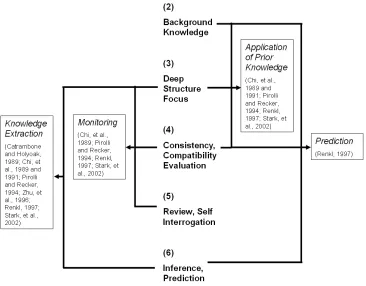
These factors15 are strikingly similar to the actions described above (monitoring, application of relevant background knowledge, extraction of information, and prediction).
15 The first factor can be viewed in terms of epistemology (in the case of worked
Figure 2.1 – Underlying connections between Palincsar and Brown (1984) factors and worked example study actions (the factor number appears in
parentheses)
Successful monitoring requires the integration of several factors. Periodic self interrogation is at the core of monitoring (Chi, et al., 1989; Pirolli and Recker, 1994; Stark, et al., 2002). Both positive and negative monitoring consists of comparing one’s knowledge against information contained in instructional material (includes checking for compatibility and consistency). Without careful (deep) periodic checks on one’s
The most direct link of prior knowledge application to the Palincsar and Brown (1984) framework is the factor of invoking pertinent background knowledge. Skilled learners tend to address worked examples in a global fashion, whereas less skilled
learners have a more restricted view (Chi, et al., 1989 and 1991; Pirolli and Recker, 1994; Renkl, 1997; Stark, et al., 2002). By linking the examples to a broader context, a more general understanding can emerge (for instance, see the aforementioned sample dialogs from Chi, et al., 1989, that are noted as being typical for good and poor performers). Inherent to drawing more general connections to external information is the factor of attending the deep structure (Catrambone and Holyoak, 1989; Pirolli and Recker, 1994; Catrambone, 1998). Finally, as Markman (1981) argues, a coherent structure is required for understanding. Thus, when integrating information from worked examples into one’s mental structure, the factor of verifying compatibility between existing knowledge and information from the worked example is needed to foster comprehension.
At the heart of knowledge extraction is the factor of inference. Successful knowledge extraction fosters generalization through abstraction (Pirolli and Recker, 1994), deep structure focus (Catrambone and Holyoak, 1989; Catrambone, 1998), and broadening of relevant background knowledge (Chi, et al., 1989 and 1991). As part of broadening background knowledge and subgoaling is the exploration of both the
Finally, prediction (Renkl, 1997) follows directly from Palincsar and Brown’s (1984) creating and testing inferences and predictions. Inherent to creating the predictions is the use of relevant background knowledge, while verifying the predictions follows from checking one’s knowledge for compatibility and consistency.
Much of the literature (for instance, see relevant literature overviews by Atkinson, Derry, Renkl, and Wortham, 2000; Renkl and Atkinson, 2002) describes the above
actions through an overarching concept stemming from Chi, et al. (1989): the self
explanation effect. “Self-explaining (i.e., generating new knowledge), whether prompted or spontaneous … is a process of reflection. Students are encouraged to reflect, think about, and infer what they are reading … the process of generating explanations is adding inferences and constructing a mental structure.” (Chi, et al., 1994, p.459) Chi, et al. (1994) propose three aspects of self explanations which foster learning. These aspects follow directly from the factors denoted in Palincsar and Brown (1984): self explanation, “… is a constructive activity.” (Chi, et al., 1994, p.470) (factor 6), self explanations incorporate extracted information into pre-existing knowledge (factor 4), and “… self-explaining is carried out in a continous (sic), ongoing, and piecemeal fashion …” (Chi, et al., 1994, p.472) (factor 5).
The above connections between reading comprehension and learning from worked examples suggest that both activities (perhaps in part) share underlying