Copyright 0 1996 by the Genetics Society of America
Molecular Basis of the Pleiotropic Phenotype of Mice Carrying
the
hy#wvariable
yellow
(Ahq)
Mutation
at
the
agouti
Locus
Alysia C. Argeson,
Kelly
K. Nelson and Linda D. Siracusa
Jefferson Cancer Center, Jefferson Medical College, Department of Microbiology and Immunology, PhiladeLphia, Pennsylvania 19107-5541
Manuscript received August 22, 1995
Accepted for publication November 7, 1995
ABSTRACT
The murine agouti locus regulates a switch in pigment synthesis between eumelanin (black/brown pigment) and phaeomelanin (yellow/red pigment) by hair bulb melanocytes. We recently described a spontaneous mutation, hyperuan'ableyellow (Ah") and demonstrated that AhS is responsible for the largest range of phenotypes yet identified at the agouti locus, producing mice that are obese with yellow coats to mice that are of normal weight with black coats. Here, we show that agouti expression is altered both temporally and spatially in Ah" mutants. Agouti expression levels are positively correlated with the degree
of yellow pigmentation in individual A", mice, consistent with results from other dominant yellow agouti
mutations. Sequencing of 5' RACE and genomic PCR products revealed that ALS resulted from the integration of an intracisternal A particle (IAF') in an antisense orientation within the 5' untranslated
agouti exon 1C. This retrovirus-like element is responsible for deregulating agouti expression in A*? mice; agouti expression is correlated with the methylation state of CpG residues in the IAP long terminal repeat as well as in host genomic DNA. In addition, the data suggest that the variable phenotype of AhZB
offspring is influenced in part by the phenotype of their Any female parent.
T
HE protein product of the murine agouti gene acts as a paracrine signaling molecule within the mi- croenvironment of the hair follicle to control the deci- sion between the production of eumelanin (black or brown pigment) and phaeomelanin (yellow or red pig- ment) by hair bulb melanocytes (reviewed in SILVERS 1979; SIRACUSA 1994). Expression of the agouti gene leads to the production of phaeomelanin, whereas lack of agouti expression results in eumelanin production. Because the agouti gene is normally expressed during the middle of the hair growth cycle, mice that are wild type at the agouti locus exhibit a subapical band of yel- low pigment on an otherwise black hair, producing the overall classic agouti pattern. In addition to mice, this pattern is found in many mammals including cats, rac- coons and sheep (reviewed in SEARLE 1968).The agouti gene was cloned (BULTMAN et al. 1992;
MILLER et al. 1993) and found to contain three coding exons (2, 3, and 4) and four alternatively spliced 5' untranslated (UTR) exons ( l A , l B , lC, and 1D) (BULT- MAN et al. 1994; VRIELING et al. 1994). Exons 1A and 1B are located -120 kb upstream of the first coding
exon. Transcripts containing exons 1A and 1B are
found only in the ventral skin of light-bellied mice. Exons 1C and 1D are hair cycle-specific exons that re- side 18 kb upstream of exon 2. Transcripts containing exons IC and 1D are found in both dorsal and ventral
Corresponding aulhur; Linda D. Siracusa, Jefferson Cancer Center, Jefferson Medical College, Department of Microbiology and Immu-
nology, 233 S. 10th St., Philadelphia, PA 19107-5541.
E-mail: [email protected]
Genetics 142 557-567 (February, 1996)
skin (BULTMAN et al. 1992, 1994; MILLER et al. 1993;
VRIELING et al. 1994).
The agouti gene encodes a predicted 131-amino acid protein that contains a cysteine-rich region at the car- boxyl-terminal end and a highly basic central region
(BULTMAN et al. 1992; MILLER et al. 1993). The function of these regions is not known, but it has been postulated that the cysteine-rich carboxyl-terminal end of the agouti protein may have a role in the interaction with specific neurotransmitter receptors or ion channels (KLEBIG et al. 1995; MANNE et al. 1995). Consistent with this hypothesis is the recent work by ZEMEL and col- leagues (1995) that implicates the agouti protein in the regulation of intracellular Ca2+ levels. The predicted agouti protein also contains an N-terminal consensus signal sequence but does not contain a transmembrane domain, suggesting that the agouti protein is secreted
(BULTMAN et al. 1992; MILLER et al. 1993). Receptor- binding studies revealed that the agouti protein acts as an antagonist to the a-melanocyte stimulating hormone receptor (a-MSHR) (Lu et al. 1994). These studies suggest that eumelanin is produced when a-MSH is bound to its native receptor, and conversely, phaeomelanin is
produced when the agouti protein antagonizes the
binding of the a-MSHR to its ligand (a-MSH).
558 A. C. Argeson, K K. Nelson and L. D. Siracusa
the production of yellow pigment is dominant to the production of black pigment. In addition to controlling coat color, dominant yellow alleles at the agouti locus are associated with a number of pleiotropic effects in- cluding adult-onset obesity, noninsulin dependent dia- betes, hyperinsulinemia and increased susceptibility to neoplasms (reviewed in YEN et al. 1994; SIRACUSA 1994). Most mutations at the agouti locus produce mice of a single color. However, the alleles agouti mottled ( a m )
(RUSSELL 1964), agouti mottledfAX (a"') (HUSTAD et al.
1995), uiable yellow ( A y ) ( DICKIE 1962), and intracisternal Aparticle yellow (Aiae) (MICHAUD et al. 1994b) produce mice that exhibit variations in coat color. The am muta- tion resulted from radiation of an (C3H/Rl X 101/Rl) F1 mouse, and therefore the mutated allele is either
agouti ( A ) or light-bellied agouti ( A " ) (RUSSELL 1964). The urn' mutation arose spontaneously fKom a (C3H/
HeJ X C57BL/6J) F1 mouse and therefore the mutated
allele is either A or nonagouti ( a ) (HUSTAD et al. 1995). Mice carrying the am and amJ alleles can range in color from pseudoagouti to nonagouti (arni mice can also be completely black) and often exhibit mottling. Mice car- rying the dominant A" and AimB alleles, which both arose spontaneously in the C3H/HeJ strain, can range in coat color from pseudoagouti to pure yellow and, like am and am?, often exhibit mottling. The intermediate yellow (AiY) mutation also occurred spontaneously in the C3H/HeJ strain and results in another dominant allele that produces mice that are sooty yellow (DICKIE 1966). However, mice carrying the AtY allele have not been reported to display mottled coats (DUHL et al. 199413).
We recently identified a mutation at the agouti locus, named hypmariable yellow (Ah'ly), that arose spontane- ously in the C3H/HeJ strain (SIRACUSA et al. 1995). We demonstrated that Ah"Y is responsible for the largest range of phenotypes yet identified at the agouti locus. Mice heterozygous or homozygous for Ah" can be obese with yellow coats or of normal weight with almost pure black coats. In addition, most Ah" mice are highly mot- tled, with yellow stripes or patches on an otherwise black or agouti background. Because of the extreme cellular heterogeneity exhibited by mice carrying the
Ah" mutation, we were interested in characterizing this allele at the molecular level. Here, we show that the
Ah" mutation results from the insertion of an intracis- ternal A-particle
(IAP)
within the UTR hair cycle-spe- cific exon 1C. We show that methylation of CpG sites within this region is correlated with agouti expression. We postulate that an enhancer and/or cryptic pro- moter within the long terminal repeat (LTR) of theIAP
controls agouti gene expression in Ah? mice. Ahuy is the fourth example of an agouti allele that resulted from the insertion of an LAP that usurps control of agoutigene expression (reviewed in SIRACUSA 1994). Other mutations that resulted from IAP-element insertions in- clude the dominant alleles AiaB, AT, and Aiy (DUHL et
al. 1994b; MICHAUD et al. 1994b). Although each of
these insertions occurred in unique sites within the
agouti gene, the agouti coding sequence was left intact, indicating that in Ah", as well as
A""e,
A"
and XY, the phenotypes result from ectopic overexpression of theagouti gene due to regulatory mutations. Finally, we show that mostly yellow Ahy female mice tend to pro-
duce offspring with greater amounts of phaeomelanin in their coats, suggesting that the maternal phenotype can influence the phenotype of resulting offspring.
MATERLALS AND METHODS
Mice: The spontaneous Ahv mutation arose on the C3H/
HeJ (C3H) strain at The Jackson Laboratory (Bar Harbor, ME) (SIRACUSA et al. 1995). The radiation-induced extreme
nonagouti (a? mutation arose on the S strain (HOLLANDER and GOWEN 1956). The radiation-induced nonugouti lethal (a')
mutation arose on a (C3H/HeH X lOl/H)F, background (LYON et al. 1985) and was obtained from Harwell (MRC Ra- diobiology Unit, Chilton, UK). The A*,, a', and a' mutations were maintained and propagated on a C57BL/6J (B6) back- ground at the National Cancer Institute-Frederick Cancer Re- search and Development Center (Frederick, MD) and trans- ferred to the Jefferson Cancer Center (Philadelphia, PA). Mutant progenitors were kindly provided by Dr. N. A. JENKINS and Dr. N. G. COPELAND (NCI-FCRDC, ABLBRP, Frederick, MD). Most Ah? mice used for these studies were at the Nyn-
N24 backcross generation. Mice of the C57BL/6J strain were purchased from The Jackson Laboratory.
Probes: The Clexl probe was isolated from C3H A / A geno- mic DNA by PCR using primers specific to exons 1C and 1D.
The primers were 1C2-5'TGGCCTCTGGGACGAGTCTGA-
ACCTA" and lDZ-"AGCACAAGTGACTCTATTCC"'. The re- sulting 205-bp fragment was cloned into the TA cloning vector
(Invitrogen, San Diego, CA). The Clexl probe contains 55 bp of the 3' end of exon l C , all of exon l D , and the 40-bp intronic region that separates them. The E0.7 probe is a 0.7- kb EcoRI fragment that contains all of exon 2 and surrounding intron sequences. The H0.6 probe is a O.&kb Hind111 frag- ment that contains all of exon 4 and sequence from the 5' intron. The E0.7 and H0.6 probes were isolated from a cosmid clone kindly provided by Dr. R. P. WOYCHIK (Oak Ridge Na- tional Laboratory, Oak Ridge, TN). The agouti cDNA probe used in Northern blot analysis, CRA, begins 10 bp 5' to the ATG start codon and ends 10 bp 5' to the TGA stop codon. CRA was isolated by PCR from a wild-type agouti cDNA con- struct kindly provided by Dr. M. P. ROSENBERG (Glaxo Phar- maceuticals, Morrisville, NC). The primers used to generate CRA were ZA-"GCTTCTCAGGATGGATGTCAC" and 4D- "GTTGAGTACTCGACAGGTGC3'. The probes and primers listed above are shown in Figure 2.
Northern blot analysis: Total RNA was isolated from tissues as described with slight modifications (CHOMCZWSKI and SAG CHI 1987). Poly(A)+ RNA was isolated from the skin of 4-6 day neonatal C3H/HeJ mice using oligo d(U) sephadex as described (MOORE and SHARP 1984). RNA was electropho- resed through 1 .O or 1.5% formaldehyde gels and transferred to Hybond N+ (Amersham Corp., Arlington Heights, IL) or Zetabind (Cuno, Inc., Meriden, CT) membranes using stan- dard procedures (SAMBROOK et al. 1989). Membranes were hybridized as described (CHURCH and GILBERT 1984) to ran- dom primed [a-"P]dCTP labeled CRA or E0.7 probes.
Characterization of A"'? 559
gels, transferred to Hybond N' nylon membranes (Amersham Corp., Arlington, Heights, IL), and hybridized to the [a-
"'PIdCTP-labeled Clexl probe. Resulting fragment sizes were 14.3 kb for the a allele, 7.7 kb for the a'' allele, and 5.3 kb for the A"'?allele. A"?/a'mice were distinguished from A'"?/a mice by the presence of a single 5.Skb RamHI restriction fragment for Ak"/a' mice compared to the presence of both 5.3- and 14.3kb restriction fragments for A"'?/a mice. For other South- ern blot analyses, genomic DNA5 were digested with restric- tion endonucleases (Roehringer Mannheim, Indianapolis, IN), transferred to nylon membranes, and hybridized to ran- dom primed [a-'2P]dCTP-labeled probes. Hybridization and washing conditions were as described (SIRACUSA el al. 1989).
Isolation of cDNA clones: cDNA clones were isolated using the 5"Amplifinder RACE kit (Clontech, Palo Alto, CA). Poly (A)+ RNA was isolated from adult BG.C3H-A"'?/A"'T spleen using oligo d ( U ) sephadex as described (MOORE and SHARP
1984). The cDNA synthesis reaction was primed with an oligo-
nucleotide from exon 3 ( S E - v ~ ~ ~ ~ ~ ~ ~ ~ ~ ~ ~ ~ ~ ~ ' )
that corresponds to bp 207-225 of the a p t i coding region (A in the ATG start codon is base # l ) . An oligonucleotide anchor was ligated to the 5' end of the cDNA. PCR fragments ranging in size from 300 to 350 bp were amplified using an oligonucleotide specific to the ligated anchor and an oligonu- cleotide (2R"CCACGATAGAAACAGAGGAG") that corre- sponds to bp 141-160 of the a p t i coding region. PCR was performed using an initial denaturation at 94" for 4 min, followed by 35 cycles of 94" for 45 sec, 60" for 45 sec and 72" for 2 min with a final elongation step of 7'2" for 7 min. Re- sulting PCR fragments were cloned using the TA Cloning Kit (Invitrogen, San Diego, CA).
Long-range PCR PCR fragments of 5.7 kb were amplified from 100 ng of BG.CSH-A""/A"'? genomic DNA as described (BARNES 1994) with modifications. The PCR protocol used was an initial denaturation at 94" for 4 min, followed by 25 cycles of 95" for 5 sec, 65" for 30 sec, and 68" for 7 min. DNA primers were synthesized with an Applied Biosystems Model 394 DNA/RNA Synthesizer (Foster City, CA). Oligonucleo-
tide sequences were 1 C4""CATTAACTCTITCTATAGAGTA-
ACCTCAGTGC" and 1 D2L5'ACAGCACAAGTGACTCTATT-
CCGCATCAG"'. Oligomer 1C4 is from the intron 5' to exon lC, and oligomer 1D2L is from the 3' end of exon 1D.
Plasmid isolation and sequencing: Plasmid DNAs from the cDNA clones were isolated using the Qiagen Robotic Worksta- tion (Qlagen Inc., Chatsworth, CA) at the Jefferson Cancer Center Nucleic Acid Facility (Philadelphia, PA). All clones were sequenced in both directions with oligonucleotides from the polylinker of the TA Cloning vector. DNA fragments cor- responding to exons 2, 3, and 4 of the a p t i coding region were obtained by PCR using primers specific to the flanking introns (J. MANNE, A. C. ARGESON, M. F. FERRARO and L. D. SIRACUSA, unpublished results). PCR products were purified with centricon-100 columns (Amicon, Inc., Beverly, MA) or with the QIAquick spin PCR purification kit (Qiagen Inc., Chatsworth, CA) to remove excess oligonucleotides and se- quenced using primers specific to the surrounding introns. All sequencing was done with an Applied Biosystems Model 373 DNA Sequencer (Foster City, C A ) at the JCC Nucleic Acid Facility.
RESULTS
Yellow Ahq mice ectopically overexpress a 0.8-kb
agouti message: We previously showed that Ah'' is a new allele at the agouti locus that produces mice ranging in color from yellow to nonagouti with most mice exhib iting mottling (SIRACUSA et al. 1995). Expression of the
-1
. I
-0.8
FIGURE 1 .-The a p t i transcript in Ah'? mice does not a p pear to vary in size from the wild-type transcript in A mice. Northern blot analysis of agouti RNAs hybridized to the [a-
'lP] dCTP-labeled CRA probe from the a p t i coding region. RNA samples from left to right are as follows: 7 pg poly (A)' RNA from C3H A/A 4-6 day neonatal skin and 20 pg total RNA from B6 A'/a adult liver, B6 Ah'?/AhIT adult liver, and Ah"/Ak" adult kidney. Ah'?/Ah" liver and kidney RNAs were isolated from the same mouse. Total RNA from the liver of an Ay/u mouse was used for size comparison, since Ay/a mice, unlike wild-type mice, ectopically overexpress a mutant 1.1- kb a p t i message detectable at all developmental stages exam- ined (BULTMAN el al. 1992; MILLER et al. 1993). Sizes of the a p t i transcripts, in kb, are listed to the right.
0.8-kb wild-type agouti message is normally detected in
4-6 day neonatal skin (BULTMAN et dl. 1992; MILLER et al. 1993). At this time, pigment synthesis by melanocytes switches from the production of eumelanin to the pro- duction of phaeomelanin, which results in the subapical yellow band that exemplifies the classic agouti pattern. Expression of the agouti gene in murine adult tissues has only been detected in testes (BULTMAN et al. 1992;
MILLER et al. 1993) and in hair follicles during hair regeneration following plucking (MILLER et al. 1993). The different colored coat hairs exhibited by individual
A'"' mice, coupled with the ectopic overexpression of the agouti gene in obese yellow mice and a reduction in expression in nonagouti mice (reviewed in SIRACUSA
1994), led us to suspect that a regulatory mutation had occurred in the Ah'? chromosome. To test this hypothe- sis and to determine the size of the agouti transcript in
Ah" mice, we performed Northern blot analysis using poly (A)+ RNA from 4-6 day neonatal skin of control
C3H A/A mice and total RNA from the liver and kidneys of a mostly yellow B6.C3H-Ah'?/AnS mouse (Figure 1). Total RNA from B 6 A-'/a was included for comparison, since A-' produces the largest aberrant agouti transcript yet identified.
The results indicate that both wild-type A/A and Ah"/ AhIT mice express a 0.8-kb agouti transcript (Figure 1). This experiment also shows that agouti expression is deregulated in Ah" mice. The 0.8-kb agouti transcript is not expressed in C 3 H A/A adult tissues (BULTMAN et al.
A. C . Argeson, K. K. Nelson and I,. D. Siracusa
A
B
1A 1B 1C 1D 2 3 4
AW
-
100 kb 40 bP I8 k b127bp 46bp 78bp
-
111 bp 170 bp 65 bp 3R.5 bpClexl
E0.7
-
H0.6
-
U
I-
4
a
7
Uexon exon exon exon
1 C o r 1D 2 3 4
2 A 2 8
+
c
c f3 8 4 D
FIGCRII 2.-Diagram of the ngoltli gene, probes used in Northern and Southern blots, and primers for PCR analyses. (A) The structure of the wild-type A"' allele is shown from proximal (left) to distal (right) (reviewed in SIKA(:USA 1994). Noncoding ventrum-specific exons IA and 1R are shown as white striped boxes and noncotling hair cycle-specific exons I C and ID arc
shown as Idack striped boxes. Coding exons 2, 3, and 4 are shown as
a.
Numbers below the boxes indicate the length of exons, and numbers between the exons indicate the length o f introns. The Clexl, E0.7, and H0.6 probes used for thcsc studies are shown at the bottom (see wvrmIAI-% AND S I E T I I O I ) ~ ) . ( R ) Two different transcripts containing exons I C o r 11) are expressed during hair growth in A/A mice; an additional two alternativclv spliced transcripts containing exon IA or exon 1A and 1B are expressed continuously in the ventrum of A"'/A"' mice (not shown) but rarely in C3H A / A mice, the strain upon which A"" arose (RLx:nf,.\x cl nl. 1992, 1994; VRIF,IJSG ct 01. 1994; SIR.\CLW rt 01. 1995). The 2A and 4D primers used t o amplifv the (;RAprobe, and the 2R and 3R primers used for the PCR step and cDNA synthesis step of 5' RACE, respectively, are shown. T h e relative positions of the AT<; start codon and the TGA stop codon are indicated.and kidneys of adult A'"' mice (Figure 1) and in other adult tissues (see below). The deregulation of agouti
expression ohsenred in A"'? mice is consistent with the findings of ectopic overexpression of agolcti detected in other dominant yellow ngouti alleles such as A?, A'"!", A", A'?, and Ai! (BULTMAN pt nl. 1992; MICHALTI pt 01.
1993, 1994a,b; MILLEU rt nl. 1993; DUHI. pt nl. 1994b).
These findings suggested that the mutation in the A"'?
allele affected a regulatory element such as a promoter and/or enhancer, or that a new promoter had usurped control of the ngmti gene.
Agouti expression in Ahs mice: Previous studies have shown that the level of expression of the ngouti gene in mice carrying various n p u t i alleles is positively corre- lated with the amount ofyellow in their coats (RULTMAN
rt ccl. 1992; MICHALII) rt 01. 1994b; M11.r.m Pt nl. 1993;
DUHI. ~t nl. 199411). To determine if this correlation was also true in A'''' mice with identical genotypes (A"'*/n)
but exhibiting various coat color phenotypes, we per- formed Northern blot analysis of total RNA from A"'?/ n mice exhibiting a gradation of colors. We hypothe- sized that mostly yellow A"'?/a mice would ectopically overexpress the ngouti gene, but mostly black A"'?//n
mice would express ngouti at much lower levels. Total RNA from the skin, liver, kidney, spleen, thymus, bone marrow, brain, and lung of adult mostly yellow and mostly black BG.C3H-A""'/n mice was screened with the E0.7 probe (see Figure 2). In mostly yellow A""/n mice, we detected ngozcti expression in all adult tissues tested (Figures 1 and 3) (data not shown). Significantly lower levels o r lack of expression of the agolcti gene was o h
served in the tissues of black A"'?//n mice. A representa-
tive expression panel of RNA from the adult kidneys of mostly yellow, intermediate, and mostly black A""/u
mice is shown in Figure 3. The results demonstrate that mostly yellow A"''/n mice ectopically overexpress the
ngotcti transcript and that expression of the ngouti gene is positively correlated with the amount of yellow in the coats of AI"'! mice. Accordingly, we previously showed
that the amount of yellow in the coats of Ah'?/n' and
AhrW/n mice is also positively correlated with the weight of the mice (SIRACUSA pt nl. 1995) (data not shown).
Southern blot analysis reveals a genomic alteration in the 5' end of the ugmti gene: The ectopic overex- pression of the agouti gene observed in yellow A'"' mice suggested that a mutation in a regulatory element is present in the A"'W chromosome, similar to mutations in the agouti alleles A', A'", A", A" and A'"" that result in mostly yellow mice (MICHAUD Pt nl. 1993, 1994a,b;
MILLER Pt al. 1993; DUHL Pt al. 1994a,b). In support of
this hypothesis, overexpression of the wild-type ngouti cDNA in transgenic mice results in yellow mice dis- playing the same pleiotropic effects seen in spontane- ous dominant yellow mutations (KI.ERI<: pt (/I. 1995;
PERRY rt nl. 1995; WIISON pt nl. 1995), whereas the cod-
ing region of the agouti gene remains unaffected. To date, only the nonagouti-ICiH (n'""), p x t r m p nonngouti
( 0 3 ,
and rxtrmw nonagouti-5mntc (n5"""') alleles are caused by mutations within the coding region of the agouti gene and result in mostly or completely black mice, respectively (BULTMAN ~t (11. 1992; HUSTAI) rt 01.Characterization of A”” 56 1
1 2 1
2 1 2 1 2 1
2 1
2
23.1
-
9.4
-
6.6
-
4.4
-
-1.1
-0.8
2.3
-
2.0
-
0.6
-
B
FIGURE %--Expression of the ngm~ti gene is altered in A”’? mice. (A) Ten micrograms of total RNA from the kidneys of C3H A / A , B&A’/n, three different colored Ah“/n mice, (la- beled mostly yellow, intermediate, and mostly black to describe the relative amount of yellow pigment in their coats) and B6
n/n was electrophoresed through a 1.5% formaldehyde gel and transferred to a nylon membrane. The resulting blot was hybridized to the [a-:”P]dCTP-labeled E0.7 probe (Figure 2). Sizes of the ngouti transcripts, in kb, are listed to the right. (B) Hybridization of the same Northern blot with a Gnpd
probe serves as an indicator of RNA loading in each lane.
alterations spanning the entire coding region of the agouti gene as well as the UTR hair cycle-specific exons 1C and 1D using the probes Clexl, E0.7, and H0.6 (Figure 2). Transcripts containing the 5’ UTR ventral- specific exons 1A and 1B are rarely expressed in mice
of the C3H A/A strain (VRIEIJNC et a1. 1994) o n which
A’“? arose (SIRACUSA et al. 1995). We therefore omitted these regions from our analysis.
To identify a genomic alteration specific for the A”‘?
mutation, A’’‘?/Ah‘? a n d A/A genomic DNAs were
cleaved with restriction endonucleases to generate a
Southern blot that was hybridized to the three probes listed above. The probes E0.7 and H0.6, which are spe- cific to exons 2 and 4 of the agouti coding region respec- tively, did not detect polymorphisms between the DNA
of A”’?/A”‘? and A/A mice (data not shown). In contrast, the Clexl probe, which contains the hair cycle-specific UTR exons 1C and lD, detected polymorphisms with
every restriction endonuclease tested (Figure 4). These results demonstrate that the alteration in A”’? mice is within the genomic region surrounding exons 1C and
1D. PCR amplification and sequencing of agouti coding exons 2-4 using primers specific to the flanking introns
FIGLIRE 4.--Southern blot analysis of genomic DNA from
A”“/A”” and A / A mice reveals an alteration in the 5’ end of the agouti gene. Genomic DNAs (7.5 pg) from R6.C3H-A”’“/ A’”’ and CSH A / A livers were digested with the restriction endonucleases listed at the top, electrophoresed through 0.8% agarose gels, transferred to nylon membranes and hv- bridizecl to the [a-:“P]dCTP Clexl probe. Lanes marked 1 contain genomic DNA from BG.C3H-A’”’/A”’’ mice and lanes marked 2 contain genomic DNA from CSH A / A mice. The sizes of HindIII-digested lambda DNA standards are listed on
the left.
confirmed that there were no mutations in these exons and that the splice donor and acceptor sites were intact in A’“? mice. These findings supported the hypothesis of a regulatory mutation, rather than a structural muta- tion, in the A”‘?’ product.
AhS results from an insertion in the 5’
UTR
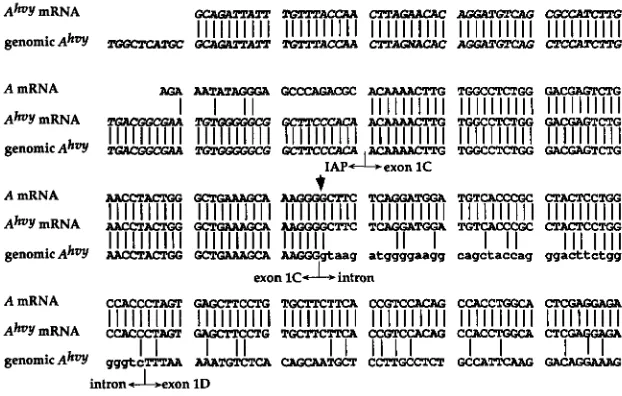
exon 1C: To further characterize the agouti mRNA in A”‘? mice, 5’ RACE of Ah‘?/Ah‘? poly(A)’ RNA was performed using oligonucleotide 3B for the RT and oligonucleotide 2B and an anchor primer for the PCR (Figure 2B) (see MATERIALS AND METHODS). Sequencing of several cDNA clones showed that the 5‘ e n d of agouti exon 1C was replaced with novel sequences. The A”‘? cDNA did con- tain the last 55 bp from the 3’ e n d of exon 1C that were spliced perfectly to wild-type sequences from exon 2 (Figure 5). A CENBANK search revealed that thenovel 5’-most sequences corresponded to the U3 region of an
I A P
LTR and suggested that an IAP had inserted within the UTR exon 1C in an antisense orientation(Figure 5). This finding also explains why the A”’? tran- script did not appear to vary in size from the wild-type agouti transcript (Figure l ) , since in the mutant 80 b p from the IAP LTR replace the first 23 bp from the 5’
e n d of exon 1C or the entire 11 1 b p of exon 1D. No
5‘ RACE clones containing exon 1D were found.
To confirm that the IAP had inserted directly into exon 1 C, we performed long-range PCR of Ahz?/Ah71V ge-
562 A. C . Argeson, K. K. Nelson and L. D. Siracusa
A b Y mRNA -Am mmr- cxrmm FIGURE 5."Sequence comparisons of A""' genomicAhvy -m -Am
I I I I I I I I I I I I I I I I I I I I
cxrAollAcAcI I I I I I I I I I I I I I I I I I I I I I I I I I I I I I
and A m W A s and the A""' chromosome. The 5' portion of the hair cycle-specific A tran-A mRNA script containing exon 1C is shown on the top
AGA AATATAGGGA GcccAGAcGc AcAAAAcTTG GAcGAGTcN; line; the dark arrowhead demarcates the
A b Y mRNA -G mCTG boundary between exon 1C and exon 2. The
genomicAhoy TcAax;cGAA TGToGGEGcG OCTTCCCACn AcAAAAcTTG T-GG GAcwLGTm mFWA is show on the middle line. The geno- mic A"' seauence is shown on the bottom line
I
I
1 1
I I I I I I I I I I I I I I I I I I I I I I I I I I I I I I
T'iVIT7m
7TiTlTi
" l T 7 1
I I
I
I I
I I
I I I
I
I
I I I I I I
I I
I
I
I I
I
I
I
I
I
I
I
I I
longest sequence from 5' RACE clones of A"'YI I M L e x o n IC
A mRNA ACK;C GCTG~AAGCA TCAGGATGGA TGTCACCCGC CTACTCCTGG with dual direction arrows showing the differ- A h mRNA
~ " ~ I I I I I
AcN;G GCTGANGC&I I I I I I I I I I
AAGGcGclTcIIIIIIIIII
TCAGWLTGGhI I I I I I I I I I
T-I I I I I I I I I I
CTACTCCTGGIIIIIIIIII
entjunctions. Lettersin italicsrepresentmI
I
I
I
I
I
I I
I I
I
I I
sequences, uppercase letters represent exongenomicAhW AACCTACTOO atggggaagg cagctaccag ggacttctgg sequences and lowercase letters represent in-
exon I C - L intron t r o i sequences. The diagram shows-that in 14"'~
I I I I I I I I I I I I I I I I I I I I
IIIIIIIIII
I I I I I I I I I I I I I I I I I I I I I I I I I I I I I I
o f t h e LTRand continuesdirectly intoA,,,RNA ccAcccrnoT TocTTcTTcA ccAccTGocA CTcGAGcAwL mice, transcription starts within the U3 region
AhoymRNA CCACCCTAGT GXCIWCTG TGCCPCETCA ccmc~c~o CCACCTOOCA m the 3' end of exon 1C. The 3' end of exon 1C genomicAhvy ggptc,mTAA
I I
wmI
1 1
--
I I 1 1 1 1
ccTTGccmI
I
is.perfectly spliced to exon 2 in both A andh t r o n t L e x o n ID
335-bp fragment for control C3H A/A DNA (data not shown), demonstrating that a 5.4kb insertion had oc- curred. Full-length
IAP
elements are7.2
kb, but differ- ent types of IAPs are characterized by deletions (with or without substitutions) within the full-length IAP lead- ing to a number of smaller classes of IAPs (reviewed inKUFF and LUEDERS 1988). The restriction map (data not shown) and size of the IAP are consistent with Type I A l
IAP
elements (KUFF and LEUDERS 1988). Sequenc- ing of the 5.7-kb genomic PCR product confirmed that both the genomic DNA and cDNA of A""? diverge from wild-type exon 1C sequences at the same location (Fig- ure 5). The data demonstrate that a truncatedIAP
in- serted directly into exon 1C in an antisense orientation, and that transcription of the agouti gene from the Ah7?chromosome initiates within the LTR of this IAP.
The coat color phenotype of Ahq/almice is correlated with the methylation status of CpG residues: We per- formed Southern blot analysis to determine if there were differences in the genomic DNA of AhZT mice of different coat color phenotypes. To test the methylation status of only one homologue of the A*"" chromosome in each mouse, we crossed B6-Ahu~/A""~ mice to B&a'/a mice and selected for mice of the Ah7'y/a1genotype. Since the a' allele is characterized by a deletion of the agouti
gene (BULTMAN et nl. 1991; A. C. ARGESON, M. A. FER- RARO and L. D. SIRACUSA, unpublished results), the methylation status and expression of the agouti gene
would be solely dependent upon the AhS chromosome
in A""~/a' mice.
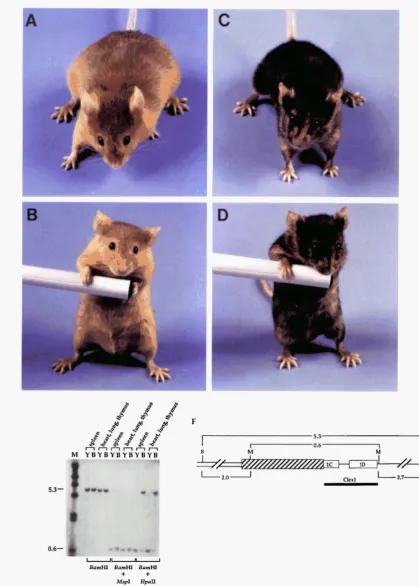
Southern blot analysis of genomic DNA from different tissues of mostly yellow and mostly black AhrT/u' mice was performed (Figure 6). We were testing the methylation status of two MspI/HpaII sites that flank the Clexl probe: one in the IAP LTR and one in the intron just 3' to exon 1D. A 5.3kb BamHI restriction fragment that en- compasses the junction including the IAP LTR and exon 1C was observed in all samples. BamHI/MspI double digestions produced a 0.7-kb restriction fragment in
A'"' transcripts.
each sample, since neither of these two enzymes are sensitive to methylation differences. Ah7?/a' genomic DNA was also cleaved with BumHI and HpaII, the methyl- ation sensitive isoschizomer of MspI. We expected a 2 . 6
kb BamHI/HpaII restriction fragment if only the 5' HpaII site was methylated and conversely, a 3.3-kb restric- tion fragment if only the 3' HpuII site was methylated. However, a prominent 5.3-kb restriction fragment was observed in genomic DNA from the black mouse but not the yellow mouse. An additional, less intense 0.7-kb restriction fragment was observed in genomic DNA from the black mouse. A prominent 0.7-kb restriction frag- ment was the only fragment detected in genomic DNA from the yellow mouse (Figure 6). The results indicate that the majority of A"" DNA is methylated at both sites in black A""'/a' mice and that hypomethylation at both sites is correlated with expression of the agouti gene.
The coat color phenotype of Ah? progeny is depen- dent on maternal phenotype: We performed several ge- netic crosses as a first step to investigate the factors responsible for the variable phenotypes exhibited by
A""? mice. Mostly black (A""'/a) or mostly yellow (A""V/
A""7 mice were mated with alternate sex black ( a / a )
mice. Offspring were classified into the following three categories: yellow, which includes mice that had
270%
yellow fur; black, which includes mice that had 270% black fur; and intermediate, which includes mice that had mottled yellow and black fur that represented a roughly equal mixture of the two coat colors (Table 1).The Chi-square statistic was used to evaluate differ- ences between the proportions of AtAW offspring within each coat color classification produced from the crosses listed in Table 1. Analysis of the proportions of off- spring from crosses of yellow AhzfS/Ah"' us. black A'"3/a females to a / a males showed a significant difference
Characterization of A””! 563
A
C
< .
B
~-
-,.. .r
-r ~ - r - ~~
564 A. C. Argeson, K. K. Nelson and L. D. Siracusa
TABLE 1
Percentage of Ah"Y progeny of different coat color phenotypes resulting from backcrosses of AhT mice to B6 a/a mice
Color of Ahg/a
Cross" Ahy parent Yellowb Intermediate Black a/ a
B6 a / a X B6.C3H-Ahy/Ahy Yellow 31 (44.9) 14 (20.3) 24 (34.8) 0
B6.C3H-AhY/Ahy X B6 a / a Yellow 26 (89.7) 2 (6.9) 1 (3.4) 0
B6 u / a X B6.C3H-AhY/a Nonagouti 14 (58.3) 0 (0) 10 (41.7) 25
B6.C3H-AhT/u X B6 a / a Nonagouti 10 (50.0) 3 (15.0) 7 (35.0) 20
Offspring from the last two crosses were tail-clipped to determine genotype. Only AhY/a mice were classified into the three phenotypic categories.
"For description of coat color classifications see RESULTS. Values in parentheses are percentages.
(x2
= 3.67, P>
0.1). However, a highly significant difference was found between offspring proportionsfrom crosses of yellow females to a/a males us.
a/a females to yellow Ah"/AhY males
(x2
= 17.04, P<
0.005). Finally, differences in the proportions of off- spring from a/a females crossed to black Ahs/a or yellow
A ~ ~ ~ / A ~ " males were not significant
(x2
= 5.74, 0.1>
P>
0.05). These results show that yellow Ahy/Ahy moth- ers produce offspring with more yellow pigment in their coats than black Ahy/a or a / a mothers. In addition, offspring that inherited Ah" from a yellow mother were more likely to be yellow than offspring that inheritedAh" from a yellow or black father.
DISCUSSION
The results presented here identify the molecular basis of the Ah" mutation at the agouti locus in the mouse. A Type I A l
IAP
is inserted in an antisense orien- tation within the 5' UTR exon 1C in the Ah" chromo- some. The Ahy mRNA originates from the LTR of the truncated I A P ; U3 LTR sequences are directly adjacent to sequences from the 3' end of exon lC, followed by the wild-type sequence of agouti coding exons 2, 3, and 4. Although normal agouti protein is made, the protein is ectopically overexpressed in obese yellow Ahy mice and is not expressed or is expressed at low levels in lean black Ah" mice. Thus, aberrant agouti gene expression due toIAP
LTR activity is the cause of Ah"y phenotypes. IAPs are endogenous retrovirus-like particles widely dispersed (-2000 copies per haploid genome) through- out the mouse genome that are capable of transposi- tion, thus leading to insertional mutagenesis (reviewed in KUFF and LUEDERS 1988).IAP
elements are flanked by LTRs that include a 218-bp U3 regulatory region that contains at least five binding sites for transcription factors (FALZON and KUFF 1988) as well as the retroviral promoter (LUEDERS et al. 1984). Based on the resultsof 5' RACE experiments, an enhancer element and/or
cryptic promoter within the LTR of the
IAP
appears to control agouti gene expression in Ah" mice.During murine development, abundant
IAP
gene ex- pression has been detected from the four to eight cellstage to the mid- to late-blastocyst stage (YOTSUYANAGI
and SZOLLOSI 1984). High levels of expression have also been found in many mouse tumors (reviewed in KUFF and LUEDERS 1988). Although IAP expression in later stage embryos and most adult cells (excluding thymus) is typically low, tissue-specific expression found in adult tissues is believed to be controlled by the binding of transcription factors and the methylation state of the
LTRS (reviewed in KUFF and LUEDERS 1988). In most
nontransformed cells, the LTRs of IAPs are highly methylated, which presumably results in low levels of gene expression
(MIETZ
and KUFF 1990). In contrast, IAP LTRs of many transformed cells are hypomethyl- ated, correlating with high levels ofIAP
gene expression (FEENSTRA et al. 1986). A correlation between methyla- tion status of theIAP
5' LTR and agouti gene expression was found in the variably expressed agouti allele A'"fv(MICHAUD et al. 1994b). Preliminary evidence has
shown at least two hypomethylated CpG sites in the IAP
5' LTR of yellow
A'"*
mice that are highly methylated in pseudoagouti-colored mice of the same genotype(MICHAUD et al. 1994b). Our data show that the hypo- methylation of at least two CpG sites, one in the
IAP
LTR and the other in host genomic DNA, is correlated with agouti gene expression in Ah" mice.
To date, Ah"y is one of six dominant mutations (A', Ah", A", A'?, A'Y, and
A""@)
identified at the agouti locusthat result in the ectopic overexpression of the agouti
gene product leading to greater phaeomelanin and less eumelanin in coat hairs. In each of these alleles, the
agouti coding region remains unaltered whereas tran- script overexpression is evident and caused by inser- tions or deletions that place the agouti gene under the control of heterologous promoters (see below). In the
Characterization of A"'"
Coat Color
2 9 4 yellow
to
AZY
AiY
-
Coat Color
Eq
A
s , yellow
to pseudoagouti
A&Y
promoter to usurp control of agouti expression (BULT-
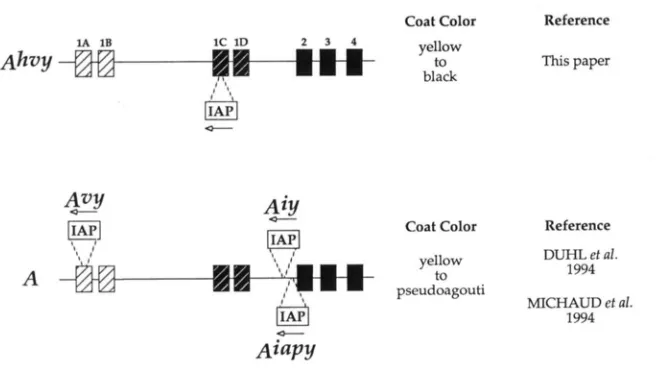
MAN et al. 1992; MILLER et al. 1993; VRIELINC et al. 1994). Each of the other five dominant agouti alleles that pro- duce completely or mostly yellow mice have also re- sulted from genomic insertions (Figure
7).
A"'?, A'?,,
and A'? contain insertions ofIAP
elements in anti- sense orientations within distinct regions of the agouti gene that control agouti expression in mice carrying these alleles (DUHL et al. 1994b; MICHAUD et al. 1994b; SIRACUSA et al. 1995). In addition, the AT mutation pre- sumably places the agouti gene under the control of yet another promoter, but unlike the alleles mentioned above, AT results from the insertion of novel sequences 10-15 kb upstream of exon2
(DUHL et al. 1994b).A number of agouti alleles produce offspring that exhibit variable coat color phenotypes. Mice carrying the a'" and a'"' mutations can range in color from nona- gouti to pseudoagouti (RUSSELL 1964; HUSTAD et al.
1995), whereas mice carrying the A'*, A'!, and A'"m al-
leles can range from pseudoagouti to pure yellow or
sooty yellow (DICKIE 1962; MICHAUD et al. 1994b; J. R.
KERSHNER, A. C. ARCESON and L. D. SIRACUSA, unpub- lished results). Mice carrying any of these variable al- leles can exhibit mottling or striping. In contrast, A'''? is the only mutation at the agouti locus that can produce mice ranging in color from almost pure black to pure yellow with a similar broad range in their overall weights (SIMCUSA et al. 1995). A'?, A", A'"/? and A"'" are similar in that they are caused by IAP insertions in an antisense orientation and produce variable phenotypes. However, unlike A'"?, the A'", A'?, and A"'!? mutations cannot pro- duce nonagouticolored (black) mice. Differences in the methylation state of the
IAP
LTRs in each allele could account for the variable expression (MICHAUD etal. 1994b) but not the lack of nonagouti colored mice in A'", A'? and A'"'". This lack is probably due to the position of the
IAP
insertion in each allele (Figure7).
The A", A'?, and A"'!"mutations are caused by IAPs
inserting into either the 5' UTR exon 1A or into the intron just upstream of coding exon 2 (DUHL et al.
1994b; M I C I - I A L ~ et al. 1994b). Thus, these insertions A ;fl/n
Reference
This paper
Reference
DUHL et al. 1994
MICHAUD et al.
1994
565
FIGURE 7.-Genomic structure o f the A"'" mutation compared to other ogmlli alleles. The A"" allele is shown at the top, with cod- ing exons represented as
.,
and noncoding exons rcpresented as striped boxes. The clear boxes represent the IAPs. The dashed line indicates the site of inserted sequences in each mutant allele. Arrows depict the di- rection of transcription of the IAP element. Below the A"" allele, three other agouti al- leles that arose on the C;?JH/H~J strain as a result of IAP insertions (A'", A" and A'"'") are shown. In each case, Type IAl IAP elements have inserted in an antisense orientation. The columns to the right list the range o f coat colors that can result from each muta-tion and references describing the molecu- lar basis of each mutation.
do not disrupt hair cycle-specific promoters. In Ahrrv, the insertion within exon 1C can essentially block agouti expression from both hair cycle-specific promoters, re- sulting in black mice. Yellow Ah'"/A"'? and A"'?/a mice result from the constitutive expression of agoutidictated by the IAP insertion. Furthermore, several lines of evi- dence indicate that A'"? cannot result in pseudoagouti- colored offspring. First, crosses of [C3H A/A X R6.C3H- Ah'?/A''7?] F1 females to B6 a/a males revealed no agouti- colored progeny carrying the A'"* allele in >95 mice examined. Second, intercrosses of Ahl"/An'? and A"'?/a mice, backcrosses of Ahr*/Ah'? and A'""/a X a/a mice and testcrosses of A"'T/AhrT and Ah"/a X a'/a' mice revealed no agouticolored progeny carrying the A'"' allele in >500 mice examined (A. C . ARCESON and L. D. SIRA-
CUSA, unpublished results). Thus, the absence of agouti- colored A"'?/A'''? and A""J/a mice makes this mutation unique in the agouti series and appears due to the posi- tion of the
IAP
insertion in A"'* relative to the hair cycle- specific promoters. Since individual A'"? mice can have both black and yellow coat hairs, A"'* is both a dominant gain of function and a loss of function mutation.The four Type IAl
IAP
insertions found in the A'?, AiY, A'"/T and Ah'" mutations lead to the question of whythe agouti gene appears susceptible to insertion of these retroviral-like elements. One hypothesis is that the agouti gene sequence contains a target or integration hotspot for
IAP
elements. This idea assumes that agouti is expressed before separation or differentiation of ger- minal and somatic lineages so that its chromatin is in a566 A. C. Argeson, K. K. Nelson and L. D. Siracusa
example of a readily observable phenotype. This second hypothesis may be true, since IAP insertions within the
agouti gene have produced dominant alleles in which the original mutant mosaic contains readily observable stripes or patches of yellow or agouticolored hairs on
an otherwise agouti or nonagouti background (DICKIE
1962, 1966; MICHAUD et ul. 1994b; SIRACUSA et ul. 1995). Finally, it is intriguing that all four spontaneous muta- tions that occurred in C3H/HeJ contain Type I n 1 IAPs in an antisense orientation. This orientation may favor direct expression of adjacent genes leading to domi- nant visible phenotypes.
The factors responsible for the variation in pheno- type of A'"" offspring could in part be the result of genomic imprinting, since larger numbers of yellow Ah"
offspring result from yellow A"" mothers than from yel- low AhS fathers (Table l ) . Previous studies had shown that in reciprocal crosses of mottled yellow Auy/u and nonagouti u/u mice, crosses of yellow mothers resulted in significantly fewer AUy/a pseudoagouti progeny than crosses of yellow AS/a fathers (WOLFF 1978).
An
even greater maternal effect was observed for the a" allele in reciprocal crosses of mottled a"/a and a/u mice (WOLFF1978), although the etiology of the urn mutation remains unknown. The expression of the A'"fi allele is also de- pendent on parental inheritance; higher expressivity of
Xuev is observed when passed through the female germ line (MICHAUD et al. 199413). Although these sex-specific effects could be due to genomic imprinting, our data also suggest that differences between the maternal phe- notype of yellow us. black Ah" mothers can influence the spectrum of phenotypes of Ahuy offspring. This finding is consistent with a report that demonstrates a difference in agouti phenotypes depending on the parental coat color of female Auy/a mice (WOLFF 1978).
The proportion of pseudoagouti AUy/u mice also dif- fered depending on the strain of the female parent
(WOLFF 1978), and preliminary results for Ah" suggest similar effects (A. C. ARCESON and L. D. SIRACUSA, un- published results). These strain-specific differences sug- gest the existence of modifier loci that could influence the phenotype of mutant progeny. The factors that reg- ulate these processes may include host genes that inter- act with
IAF'
LTRS (FALZON and KUFF 1988), genes in- volved in establishing imprints, or genes that regulate DNA methylation (reviewed in SURANI 1994). Identifi- cation and characterization of the factors that influence the phenotype of Ah" offspring would provide insight into the molecular mechanisms responsible for cellular heterogeneity.We thank Dr. J. MANNE, Dr. M. A. FERRARO, J. R. KERSHNER and
Dr. H. ALDER for valuable assistance. We thank Dr. A. M. BUCHBERG,
Dr. J. ROTHSTEIN and J. R. KERSHNER for reviewing the manuscript.
We thank Dr. K. LUEDERS for valuable discussions, Drs. N. A. JENKINS
and N. G. COPELAND for providing mutant mouse strains, Dr. R. P. WOYCHIK for providing an agouti cosmid clone, Dr. E. J. MICHAUII for providing a genomic clone containing agouti exons 1C and lD, and Dr. M. P. ROSENBERG for providing a clone of the agouti coding
region. This research was supported by grants from the American Cancer Society UFRA-428) and the National Institutes of Health (DK- 45717) to L.D.S. A.C.A. is the recipient of a National Research Service Award Training Grant (5T32CA09678).
LITERATURE CITED
BARNES, W. M., 1994 PCR amplification of u p to 35-kb DNA with high fidelity and high yield from bacteriophage templates. Proc. Natl. Acad. Sci. USA 91: 2216-2220.
BULTMAN, S. J., L. B. RUSSELL, G. A. GUTIERREZ-ESPELETA and R. P. WOYCHIK, 1991 Molecular characterization of a region of DNA associated with mutations at the agouti locus in the mouse. Proc. Natl. Acad. Sci. USA 88: 8062-8066.
BULTMAN S. J., E. J. MICHAUD and R. P. WOYCHIK, 1992 Molecular
characterization of the mouse agouti locus. Cell 71: 1195-1204. BULTMAN, S. J., M. L. KLEBIG, E. J. MICHAUD, H. 0. SWF.ET, M. T.
DAVISSON et al., 1994 Molecular analysis of reverse mutations from non-agouti ( a ) to black-and-tan (a') and white-bellied agouti (A"') reveals alternative forms of agouti transcripts. Genes Dev. 8: 481-490.
CHOMCZYNSKI, P., and N. SACCHI, 1987 Single-step method of RNA
isolation by acid guanidinium thiocyanate-phenol-chloroform extraction. Anal. Biochemistry 162: 156-159.
CHURCH, G. M., and W. GILBERT, 1984 Genomic sequencing. Proc.
Natl. Acad. Sci. USA 81: 1991-1995.
DICKIE, M. M., 1962 A new viable yellow mutation in the house mouse. J. Hered. 53: 84-86.
DICKIE, M. M., 1966 Intermediate yellow (A'J). Mouse News Letter
34: 30.
DUHL, D. M. J., M. E. STEVENS, H. VRIELING, P. J. SAXON, M. W. MII.I.ER et al., 1994a Pleiotropic effects of the mouse lethal yellow (A') mutation explained by deletion of a maternally expressed gene and the simultaneous production of agouti fusion RNAs. Devel-
opment 120: 1695-1708.
DUHL, D. M. J., H. VRIELING, K. A. MILLER, G. L. WOIEF and G. S.
BARSH, 1994b Neomorphic agouti mutations in obese yellow
mice. Nature Genet. 8: 59-65.
FALZON, M., and E. L. KUFF, 1988 Multiple protein binding sites in an intracisternal A-particle long-terminal repeat. J. Virol. 62:
4070-4077.
FEENSTRA, A., J. FEWELI., E. L. KUFF and LUEDERS, K. K., 1986 In
vitro methylation inhibits the promoter activity of a cloned intra- cisternal A-particle LTR. Nucleic Acids Res. 1 4 4343-4352.
HOLIANDER, W. F., and W. F. GOWEN, 1956 An extreme non-agouti
mutant in the mouse. J. Hered. 47: 221-224.
HUSTAD, C. M., W. L. PERRY, L. D. SIRACUSA, C. RASBERRY, I,. COBB et al., 1995 Molecular genetic characterization of six viable re- cessive alleles of the mouse agouti locus. Genetics 140: 255-265.
KLEBIG, M. L., J. E. WILKINSON, J. G. GEISIXR and R. P. WOY(:HIK, 1995 Ectopic expression of the agouti gene in transgenic mice causes obesity, features of type I1 diabetes, and yellow fur. Proc. Natl. Acad. Sci. USA 9 2 4728-4732.
KUFF, E. L., and K. K. LUEDERS, 1988 Intracisternal A-particle gene family: structural and functional aspects. Adv. Cancer Res. 51:
Lu, D., D. W I I U R D , I . R. PATEI., S. UDWELI., L. OVERTON et ab, 1994 Agouti protein is an antagonist of the melanocyte-stimulating- hormone receptor. Nature 371: 799-802.
LUEDERS, K. K., J. W. FEWELL, E. L. KUFF and T. KOCH, 1984 The long-terminal repeat of an endogenous intracisternal A-particle gene functions as a promoter when introduced into eucaryotic cells by transfection. Mol. Cell Biol. 4: 2128-2135.
LYON, M. F., G. FISHER and P. H. GLENISTER, 1985 A recessive allele of the mouse agouti locus showing lethality with yellow, A'. Genet. Res. 46: 95-99.
MANNF., J., A. C. ARCESON and L. D. SIRACUSA, 1995 Mechanisms for the pleiotropic effects of the agouti gene. Proc. Natl. Acad. Sci. USA 92: 4721-4724.
MICHAUD, E. J., S. J. BULTMAN, L. J. STUBBS and R. P. WOYCHIK, 1993 The embryonic lethality of homozygous lethal yellow mice (A'/
AJ) is associated with the disruption of a novel RNA-binding
MICHAUD, E. J., S. J. BULTMAN, M. L. KLEBIG, M. J. VAN VUCT, L. J. protein. Genes Dev. 7: 1203-1213.
Characterization of Ah'? 567
phenotypic characteristics of the mouse lethal yellow (A') muta- tion. Proc. Natl. Acad. Sci. USA 91: 2562-2566.
MICHAUD, E. J., M. J. VAN VUGT, S. J. BULTMAN, H. 0. SWEET, M. T. DAVISSON et al., 1994b Differential expression of a new domi- nant agouti allele (AI'M) is correlated with methylation state and is influenced by parental lineage. Genes Dev. 8: 1463- 1472. MIETZ, J. A,, and E. L. KUFF, 1990 Tissue and strain-specific patterns
of endogenous proviral hypomethylation analyzed by twodimen- sional gel electrophoresis. Proc. Natl. Acad. Sci. USA 87: 2269- 2273.
MILLER, M. W., D. M. J. DUHL, H. VRIELINC, S. P. CORUES, M. M. OI.I.MANN et al., 1993 Cloning of the mouse agouti gene pre- dicts a secreted protein ubiquitously expressed in mice carrying the A' mutation. Genes Dev. 7: 454-467.
MOORE, C. L., and P. A. SHARP, 1984 Site-specific polyadenylation in a cell-free reaction. Cell 36: 581-591.
PERRY, W. D., C . M. HUSTAII, D. A. SWING, N. A. JENKIXS and N. G.
COPEIAND, 1995 A transgenic mouse assay for agouti protein activity. Genetics 140 267-274.
RUSSLI.I., L. B., 1964 Genetic and functional mosaicism in the mouse, pp. 153-181 in The Role of Chromosomer in Development,
edited by M. LOCKE. Academic Press, New York.
SAMBROOK, J., E. F. FRITSCH and T. MANIATIS, 1989 Molecular Clon- ing: A Labmatmy Manual. Cold Spring Harbor Laboratory Press, Plainview, NY.
S E M . E , A. G. 1968 Comparative Genetics of Coat Colour in Mammals. Academic Press, New York.
SILVERS, W. K. 1979 The agouti and extension series of alleles, um- brous, and sable, pp. 6-44 in The Coat Colors of Mire: A Model f o r Mammalian &e Action and Interaction, Springer-Verlag, New York.
SIRACl'SA, L. D., 1994 The agouti gene: turned on to yellow. Trends Genet. 10: 423-427.
SIRACL'SA, L. D., L. B. RUSsEt.L, N. A. JENKINS and N. G. COPELAND 1987 Allelic variation within the Emv-15 locus defines genomic
sequences closely linked to the agouti locus on mouse chromo- some 2. Genetics 117: 85-92.
SIRACUSA, L. D., A. M. BUCHBERG, N. G . COPEIAND and N. A. JENKINS, 1989 Recombinant inbred strain and interspecific backcross analysis of molecular markers flanking the agouti coat color lo- cus. Genetics 1 2 2 669-679.
SIRACUSA, L. D., L. L. WASHBURN, D. A. SWING, A. C. ARGESON, N. A. JENKINS et al., 1995 Hypervariable yellow (A"", a new murine agouti mutation: Ah" displays the largest variation in coat color phenotypes of all known agouti alleles. J. Hered. 86: 121-128.
SURANI, M. A,, 1994 Genomic imprinting: control of gene expression by epigenetic inheritance. Curr. Opin. Cell Biol. 6: 390-395. VRIELING, H., D. M. J. DUHI., S . E. MILIAR, K. A. MIILER and G. S.
BARSH, 1994 Differences in dorsal and ventral pigmentation result from the temporal- and region- specific expression of alter- native isoforms of the mouse agouti gene. Proc. Natl. Acad. Sci.
WILSON, B. D., M. M. OI.I.MANN, L. K A N c ; , M. STOFFEI., G. I . BEI.I. et
nl., 1995 Structure and function of ASP, the human homolog o f the mouse agouti gene. Human Mol. Genet. 4 223-230.
WOI.FF, C . L., 1978 Influence of maternal phenotype on metabolic differentiation of agouti locus mutants in the mouse. Genetics
88: 529-539.
YEN, T. T., A. M. GII.I., L. G. FRIGERI, G. S. BARSH and G. L. WOI.FF, 1994 Obesity, diabetes, and neoplasia in yellow A'"/a mice: ec- topic expression of the agouti gene. FASEB J. 8: 479-488. YOTSUYPLNAGI, Y., and D. SzoLI.osr, 1984 Virus-like particles and re-
lated expressions in mammalian oocyte and preimplantation
stage embryos, pp. 218-234 in Ultrastructure of Repodudion Gu-
metogaesis, Fertilization, and Emlnyogenesis, edited byJ. VAN BI.ER-
K O M and P. M. MOTTA. Martinus Niijhoff Publishers, Boston.
ZEMEL, M. B., J. H. KIM, R. P. WOYCHIK, E. J. MICHAUD, S. H. W W E I . I .
e2 ul., 1995 Agouti regulation of intracellular calcium: role in
USA 92: 4733-4737.
the insulin resistance of viable yellow mice. Proc. Natl. Acad. Sci.
USA 91: 5667-5671.

![FIGURE %--Expression C3H and transferred to the relative amount mice. beled mostly yellow, intermediate, and mostly black to describe Sizes of the probe serves hybridized to the [a-:”P]dCTP-labeled n/n (B) of the ngm~ti gene is altered in A”’? (A) T](https://thumb-us.123doks.com/thumbv2/123dok_us/1694933.1214567/5.590.45.281.74.353/figure-expression-transferred-relative-intermediate-hybridized-labeled-altered.webp)