Copyright1998 by the Genetics Society of America
Genetic Analysis of the Drosophila
a
PS2Integrin Subunit Reveals Discrete
Adhesive, Morphogenetic and Sarcomeric Functions
James W. Bloor and Nicholas H. Brown
Wellcome/CRC Institute, Cambridge CB2 1QR, United Kingdom, and Department of Biochemistry, Cambridge University, Cambridge CB2 1QW, United Kingdom
Manuscript received June 10, 1997 Accepted for publication October 8, 1997
ABSTRACT
The integrin family of cell surface receptors mediates cell-substrate and cell-to-cell adhesion and transmits intracellular signals. In Drosophila there is good evidence for an adhesive role of integrins, but evidence for integrin signalling has remained elusive. Each integrin is anabheterodimer, and the DrosophilabPS subunit forms at least two integrins by association with differentasubunits:aPS1bPS(PS1) andaPS2bPS(PS2). The complex pattern of PS2 integrin expression includes, but is more extensive than, the sites where PS2 has a known requirement. In order to investigate whether PS2 integrin is required at these additional sites and/or has functions besides mediating adhesion, a comprehensive genetic analysis of inflated, the gene that encodesaPS2, was performed. We isolated 35 new inflated alleles, and obtained 10 alleles from our colleagues. The majority of alleles are amorphs (36/45) or hypomorphs (4/45), but five alleles that affect specific developmental processes were identified. Interallelic complementation between these alleles suggests that some may affect distinct functional domains of the aPS2 protein, which specify particular interactions that promote adhesion or signalling. One new allele reveals that the PS2 integrin is required for the development of the adult halteres and legs as well as the wing.
A
feature of many cell surface receptors is the ability viewed inHynes 1992). Integrins were first identifiedby their ability to promote cell adhesion to the extracel-to elicit multiple responses at different times or
places within the organism. This diversity of function lular matrix and to other cells. Each integrin is a
hetero-dimer composed of a single a subunit noncovalently
is reflected by the genetic complexity of the loci that
encode these receptors. In Drosophila this is particularly linked to a single b subunit. The heterodimers form
during synthesis, and the subunits must form a hetero-well documented for the loci encoding Notch and the
epidermal growth factor (EGF) receptor, which are both dimer to become transported from the endoplasmic
reticulum to the plasma membrane, suggesting that sin-complex genes displaying interallelic complementation
(e.g.,Foster1975;Portin1975;CliffordandSchu¨ p- gle subunits have no activity (ChereshandSpiro1987;
Kishimotoet al. 1987;Leptinet al. 1989). Both subunits
bach 1989). Such complementation can occur when
the gene product has multiple functions and particu- contribute to extracellular ligand binding and,
there-fore, the specificabcombination defines the ligand(s) lar alleles eliminate or alter single functions; an
indi-bound by a particular integrin, which include both se-vidual transheterozygous for alleles that mutate
differ-creted extracellular matrix proteins and other types of ent functions will still retain wild-type function for both
cell surface protein (reviewed inHynes1992). The
abil-activities and therefore appear to be wild type. The
ity of integrins to bind their ligands can be modulated characterization of the molecular lesions associated with
by the cell through an increase in the affinity of integrins particular classes of Notch and EGF receptor alleles has
for their ligands, which appears to occur by a combina-greatly contributed to our understanding of how the
tion of integrin aggregation and conformational changes. different segments of these proteins contribute to the
In addition, there is increasing evidence that integrin function of these receptors (Hartleyet al. 1987;
Kel-binding to extracellular ligands results in the
transduc-leyet al. 1987;Xuet al. 1990;CliffordandSchu¨ pbach
tion of signals within the cells, such as changes in tyro-1994). In this work we have examined whether a similar
sine phosphorylation (ClarkandBrugge1995). These
genetic complexity is found for the PS2 integrin cell
signals may not only play a role in the reorganization surface receptor.
of the cytoskeleton, but may also lead to changes in Integrins are a family of cell surface adhesion
mole-gene expression. As a link between the extracellular cules found in both vertebrates and invertebrates
(re-environment and the inside of the cell, integrins also interact with cytoplasmic proteins via their cytoplasmic tails, which are unusually short (15 –45 amino acids vs.
Corresponding author: Nicholas Brown, Wellcome/CRC Institute,
600–1200 amino acids in the extracellular domains).
Tennis Court Rd., Cambridge CB2 1QR, UK.
E-mail: [email protected] Current data suggests that theacytoplasmic tail
lates the accessibility of thebcytoplasmic tail for interac- aPS1bPS(PS1) andaPS2bPS(PS2) also show complementary
expression in the developing wing (Wilcox et al. 1981;
tion with a variety of proteins, both cytoskeletal proteins
such as talin and a-actinin, and signaling molecules Broweret al. 1984), with PS1 expressed in the
presump-tive dorsal surface and PS2 expressed in the ventral such as focal-adhesion kinase and integrin-linked kinase
(CraigandJohnson 1996). While a large number of surface. Disruption of integrin function in the
devel-oping wing, either in animals homozygous for viable molecules colocalize with integrins at sites of function,
such as focal adhesions where the cell attaches to an integrin mutations or those containing clones of cells
in the wing homozygous for lethal amorphic alleles, extracellular substrate, it is not yet clear which
mole-cules are normally linked directly to the integrins. results in a failure of adhesion between the two layers
of the wing blade and formation of a wing blister In Drosophila five integrin subunits have been
identi-fied to date: thebPSsubunit, which forms heterodimers (BrowerandJaffe1989;Wilcoxet al. 1989; Zusman
et al. 1990; BrabantandBrower1993;Broweret al.
with threea subunits, aPS1, aPS2 and aPS3; and a novel
b subunit, bv, whose a subunit partner has yet to be 1995). The PS2 integrin is not only expressed in the
wing imaginal disc; it is also expressed in specific regions
characterized (Brown1993;Gotwalset al. 1994).
Ge-netic loci have been identified for three of the integrin of the haltere, eye-antennal, and leg imaginal discs
(Broweret al. 1985). However, defects in these tissues
subunits: thebPSsubunit is encoded by the myospheroid
(mys) locus (MacKrellet al. 1988;Leptinet al. 1989), have not yet been characterized.
Because the bPS subunit associates with different a aPS1by the multiple edematous wings (mew) locus (Brower
et al. 1995), andaPS2by the inflated (if ) locus (Brower subunits, it seems likely that one could generate alleles
of this locus that specifically disrupt a subset of its func-and Jaffe 1989; Wilcox et al. 1989; Brabant and
Brower 1993; Brown 1994). Amorphic mutations at tions; however, it is not clear that this would be true for
a single a subunit. Like Notch and the EGF receptor
each of these loci cause lethality when hemizygous or
homozygous, and to date all mutations at these loci are the aPS2 subunit is also a large protein (1263 amino
acids) that is modular in structure; in common with recessive. As expected, the phenotype of an amorphic
mys allele, which lacks the function of all three integrins, other a subunits, it contains seven repeated domains that have recently been proposed to form ab-propeller is more severe than the phenotypes of mutations in
singleasubunits (Wright1960;NewmanandWright structure (Springer1997). Prior to this work only two
types of allele of inflated, which encodes theaPS2subunit,
1981; Brabant and Brower 1993; Brown 1994;
Brower et al. 1995; Roote and Zusman 1995). The had been recovered: spontaneous adult viable alleles
and embryonic lethal amorphic alleles (Weinstein
phenotype of embryos mutant for mys has several
fea-tures: the somatic muscles detach and round up; the 1918; Curry 1939; Wilcox et al. 1989;Brabant and
Brower1993;Brown1994). We have therefore
gener-midgut fails to elongate, and the gastric caecae and
proventriculus are defective; the nerve cord fails to con- ated new mutations in the inflated locus with two aims
in mind. First, can we find evidence for more than one dense; and dorsal closure is defective, resulting in a
dorsal hole in the cuticle. Embryos mutant for theaPS2 type of function for this cell surface receptor, which
would be consistent with the modular structure of the subunit (if ) have a phenotype that is similar to mys,
except that the onset of muscle detachment is later, the a subunit and the proposed functions of integrins in
both adhesion and signaling. Such multiple functions midgut phenotype is milder, and dorsal closure occurs
normally. In contrast, amorphic mutations in the aPS1 would be revealed by the isolation of alleles that show
different subsets of the null phenotype and interallelic subunit (mew) do not cause complete embryonic
lethal-ity, and most of the mutant embryos hatch with a defec- complementation; this would also reveal that inflated is
a complex gene. Second, can we find mutants that reveal tive gut. In the embryo, the twoasubunits have
comple-mentary patterns of expression, with aPS2 restricted to functions of the PS2 integrin in other adult structures,
which might be predicted from the specific patterns of
the mesoderm andaPS1expressed in the epidermis and
endoderm (Bogaert et al. 1987; Leptin et al. 1989; expression of this integrin in the other imaginal discs.
Through the isolation of 35 inflated alleles we show that
Wehrliet al. 1993).
Our current interpretation of the phenotypes de- the PS2 integrin does have additional functions during
development and that inflated is a complex locus. scribed above is that the integrins are required for
adhe-sion between the different embryonic cell layers. For example, theaPS2bPSintegrin is required in the somatic
MATERIALS AND METHODS
muscles to maintain their attachment to the body-wall
epidermis and in the visceral mesoderm to mediate The Tubingen fly food recipe (Steward and Nu¨
sslein-Volhard 1986) was used in all experiments. New inflated
interactions with the midgut endoderm. However, we do
alleles are shown in Table 1; other mutations are described
not know to what degree the integrins directly mediate
inLindsleyandZimm(1992), with the exception of the newly
adhesion—by adhesion to extracellular matrix or cell characterized enhancer of inflated, e(if )1, which we found in surface proteins, or by the more indirect role of signal- our cn1; ry506stock, and has been mapped to 2L. This mutation enhances the penetrance of the if3phenotype, rather than its
severity. The various screens we performed for new inflated be described in detail elsewhere (E. P. Walsh and N. H. Brown, unpublished results).
alleles are described inresults, and mutagenesis with 25–50
mmEMS in 1% sucrose was as described inGrigliatti(1986). Phenotypic analysis:In order to be able to unambiguously determine the genotype of the mutant inflated male embryos, The F1 progeny were either directly screened or individually
crossed to three virgin attached X females that were obtained if/Y, we crossed y1onto those alleles that did not have it, and balanced the if alleles with an FM6 balancer chromosome from the stock shits/C(1)DX, y w f/Y, following a shift to 288
to kill the males and ease the collection of virgin females. In containing an insertion of a y1P -element construct, FM6y1 (Martı´n-Bermudoet al. 1997). When females that are y ifB4/ one F1 screen we mutagenized with 3.3 mmENU in 10%
acetic acid. In the F1 screen using e(if )1, we used 25 mmEMS FM6y1are crossed to y1males, only the inflated mutant males will be yellow, which can be distinguished at the end of em-in 1% sucrose and 0.002% acetic acid to provide a more
reproducible pH in the EMS solution. We have previously bryogenesis by the pale mouth hooks and denticle belts. We characterized the inflated muscle phenotype in two ways: by described an F1 screen usingg-ray mutagenesis at a dose of
4000 r (Brown1994). For the FLP-FRT screen, the flies were examination of embryos under polarized light as described inDrysdaleet al. (1993), and by staining with embryos with mutagenized with X rays at a dose of 4500 r. This screen will
phalloidin conjugated to rhodamine. Staining of embryos and no difference in the phenotype of T(1:4)ifV2/Y; 1males imaginal discs with anti-PS2 antibodies was performed us- compared with T(1:4)ifV2/T(1:4)ifV2females. This stronger ing standard conditions (e.g.,Bogaertet al. 1987;Martı
´n-allele was used in an F1 screen similar to the one described
Bermudo et al. 1997). A polyclonal antisera was prepared
above (M. D. Martı´n-BermudoandN. H. Brown,
un-commercially against a peptide of the COOH terminal 15
amino acids ofaPS2. To examine the gut phenotype and the published results) and one new allele was recovered.
extent of nerve-cord condensation, embryos were dissected We performed F2 lethal screens for new inflated alleles with tungsten needles, the midguts and nerve cords mounted by screening for mutations in the intervals covered by in phosphate-buffered saline, and examined with Nomarski
one or other of two different duplications of the inflated
optics (Carl Zeiss, Thornwood, NY ). To examine the
sarco-locus. One duplication is a P-element construct, P[PS2,
meric phenotype of the muscles at the end of stage 17, embryos
were dissected, fixed with 4% formaldehyde, and stained with ry1], containing 39 kb of genomic DNA encompassing
phalloidin conjugated to rhodamine. These embryos were the inflated gene, inserted on a TM3, Sb balancer chro-then examined by confocal microscopy (MRC 1000; Bio-Rad, mosome (Brown1994). This construct rescues null
in-Richmond, CA). Micrographs were scanned using a Nikon
flated alleles (Brown 1994); however, because it was
(Garden City, NY ) Coolscan, and the scanned or confocal
possible that it would not cover every inflated allele, we
images were assembled in Photoshop 3.0 (Adobe Systems,
Mountain View, CA) and labeled with FreeHand 5.5 (Macro- used a larger duplication for the bulk of the F2 screen.
media, San Francisco). We used Dp (1:4)f3c [also known as Dp(1)80f3c and
Df(1)80f3c], which extends 110 kb downstream of the inflated gene and extends a division upstream (14E;
RESULTS
16A1–2;Falket al. 1984). This duplication fully
comple-ments a deletion of the entire inflated transcription unit,
Isolation of new inflated alleles:To determine whether
inflated is a complex gene, it was initially essential to Df(1)rif (Brown1994), and therefore must complement
all loss-of-function inflated alleles. The two screens are isolate additional mutant alleles. We chose to use a
variety of different screening approaches in case a single shown in Figure 1; five inflated alleles were recovered from 2529 X chromosomes screened against P[PS2, style of screen would miss certain types of mutations,
which did turn out to be the case. The first approach ry1] and seven from 11,945 X chromosomes screened
against Dp(1;4)f3c. used was an F1 screen for mutations that fail to
comple-ment the viable if3allele, an example of which is shown Another approach made use of a fortuitously
identi-fied enhancer of inflated, e(if )1, which increases the in Figure 1. Flies heterozygous for if3/Df are fully viable
and fertile, and contain a large centrally positioned penetrance of the if3phenotype. Stocks containing this
mutation were used in an F1 screen (Figure 1) and 10 bubble in one or both wings. Two EMS alleles isolated
by this method have already been described (Brabant new inflated alleles were isolated from a screen of less
than 15,000 F1 females. The effectiveness of this en-andBrower1993), as have threeg-ray alleles (Brown
1994). We isolated 3 additional alleles from a screen hancer is highlighted by the fact that one of the alleles
we isolated in this screen almost fully complements if3
of 30,000 F1 females that were the progeny of ENU
mutagenized males, and 2 from 30,000 F1 females aris- in the absence of e(if )1 (Table 2).
The final approach was to use the FLP-FRT system ing from EMS mutagenized males (see Table 1). This
frequency of new mutations was low, and lower than for mitotic recombination (Golic1991;XuandRubin
1993) to generate mutant clones in the F1 generation. the rate of mutation of the white or yellow locus, which
we also scored during the F1 screen (data not shown). Clones homozygous for an embryonic lethal inflated
al-lele in the wing cause bubbles if they are on the ventral As confirmed by subsequent screens, the low frequency
of point mutations recovered by this screen is because surface (BrabantandBrower1993). Therefore, one
can use the FLP-FRT system to isolate new alleles of of a combination of two factors: the incomplete
pene-trance of the if3 phenotype and the fact that some in- inflated and other genes involved in the adhesion of the
two surfaces of the wing by screening for mutations that flated alleles complement the if3allele. We tried to
cir-cumvent these problems in four ways: by screening over give bubbles in clones. A screen of this type on the X
chromosome was performed (E. P. Walsh andN. H.
the stronger semi-lethal allele ifV2, by performing F2
screens; by utilising a fortuitously identified enhancer Brown, unpublished results; see Figure 1), which
pro-duced four inflated alleles. Similar screens were per-of inflated, which increases the penetrance per-of if3; and
by performing FLP-FRT-induced mosaic screens. formed by Broweret al. (1995) who have sent us the
six inflated alleles that they recovered. In our previous g-ray screen for inflated alleles we
recovered a semiviable allele, ifV2, with a very strong With these different screens we have isolated 35
in-flated alleles; combining these with the 4 preexisting adult phenotype described in more detail below.
Cyto-logical analysis showed that this allele is a translocation alleles and 6 alleles donated by our colleagues provides a bank of 45 alleles (Table 1) for our genetic analysis between the X and the fourth chromosome (15A;101F,
data not shown; inflated maps at 15A4). The break in of the inflated locus.
inflated is a complex locus:Through phenotypic anal-the fourth chromosome does not appear to have
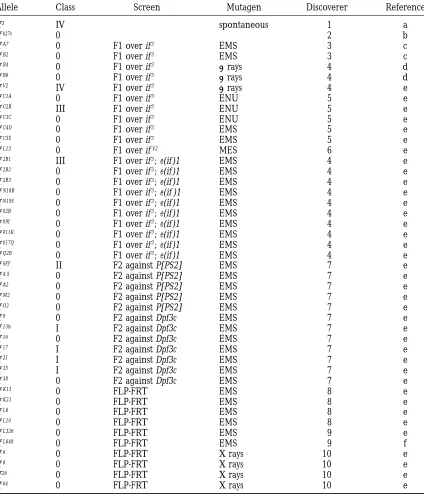
TABLE 1
inflated alleles
Allele Class Screen Mutagen Discoverer Reference
if3 IV spontaneous 1 a
ifk27e 0 2 b
ifA7 0 F1 over if3 EMS 3 c
ifB2 0 F1 over if3 EMS 3 c
ifB4 0 F1 over if3 grays 4 d
ifB6 0 F1 over if3 grays 4 d
ifV2 IV F1 over if3 grays 4 e
ifC1A 0 F1 over if3 ENU 5 e
ifC2B III F1 over if3 ENU 5 e
ifC3C 0 F1 over if3 ENU 5 e
ifC4D 0 F1 over if3 EMS 5 e
ifC5E 0 F1 over if3 EMS 5 e
ifL13 0 F1 over ifV2 MES 6 e
if2B1 III F1 over if3; e(if )1 EMS 4 e
if2B2 0 F1 over if3; e(if )1 EMS 4 e
if2B3 0 F1 over if3; e(if )1 EMS 4 e
ifN18R 0 F1 over if3; e(if )1 EMS 4 e
ifN19S 0 F1 over if3; e(if )1 EMS 4 e
if02B 0 F1 over if3; e(if )1 EMS 4 e
if09I 0 F1 over if3; e(if )1 EMS 4 e
if011K 0 F1 over if3; e(if )1 EMS 4 e
if017Q 0 F1 over if3; e(if )1 EMS 4 e
ifQ2B 0 F1 over if3; e(if )1 EMS 4 e
ifSEF II F2 against P[PS2] EMS 7 e
if4.5 0 F2 against P[PS2] EMS 7 e
ifA2 0 F2 against P[PS2] EMS 7 e
ifM2 0 F2 against P[PS2] EMS 7 e
ifO2 0 F2 against P[PS2] EMS 7 e
if9 0 F2 against Dpf3c EMS 7 e
if13ts I F2 against Dpf3c EMS 7 e
if16 0 F2 against Dpf3c EMS 7 e
if17 I F2 against Dpf3c EMS 7 e
if21 I F2 against Dpf3c EMS 7 e
if35 I F2 against Dpf3c EMS 7 e
if38 0 F2 against Dpf3c EMS 7 e
ifK13 0 FLP-FRT EMS 8 e
ifK23 0 FLP-FRT EMS 8 e
ifL6 0 FLP-FRT EMS 8 e
ifL10 0 FLP-FRT EMS 8 e
ifL326 0 FLP-FRT EMS 9 e
ifL648 0 FLP-FRT EMS 9 f
if6 0 FLP-FRT X rays 10 e
if8 0 FLP-FRT X rays 10 e
if26 0 FLP-FRT X rays 10 e
if64 0 FLP-FRT X rays 10 e
Discoverers: 1)Curry(1939), 2)Falket al. (19840, 3)BrabantandBrower(1993), 4)Brown(1994), 5)Brown, BloorandDuncan (1992), 6)Martı´n-Bermudo(1993), 7)Bloor (1996), 8)Brower(1995), 9)Zusman(1995), 10)Walsh(1994).
References: a)Curry(1939), b) Falket al. (1984), c) BrabantandBrower(1993), d)Brown(1994), e) the present article, f )Broweret al. (1995).
the alleles against each other we have divided the 45 alleles on the two branches. Previous work has shown
that amorphic inflated alleles are embryonic-lethal when inflated alleles into five classes (see Tables 1 and 2). We
cannot fit all the alleles into a simple hypomorphic hemi- or homozygous (Brabant and Brower 1993;
Brown1994). The epidermis and the resultant secreted
series: there is a “branch” caused by some alleles showing
complementary subsets of the null phenotype, and this cuticle appear normal in these mutant embryos, but
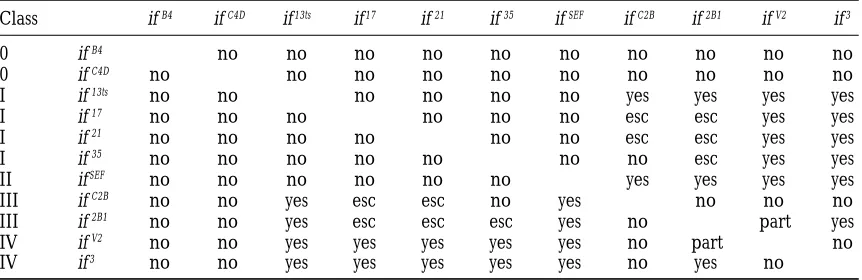
TABLE 2
Interallelic complementation
Class ifB4 ifC4D if13ts if17 if21 if35 ifSEF ifC2B if2B1 ifV2 if3
0 ifB4 no no no no no no no no no no
0 ifC4D no no no no no no no no no no
I if13ts no no no no no no yes yes yes yes
I if17 no no no no no no esc esc yes yes
I if21 no no no no no no esc esc yes yes
I if35 no no no no no no no esc yes yes
II ifSEF no no no no no no yes yes yes yes
III ifC2B no no yes esc esc no yes no no no
III if2B1 no no yes esc esc esc yes no part yes
IV ifV2 no no yes yes yes yes yes no part no
IV if3 no no yes yes yes yes yes no yes no
The number of if transheterozygotes that eclose and look wild type was scored relative to the if/FM6 siblings. Alleles were scored as complementing (yes) when the normal-looking transheterozygotes were greater than 50% of the siblings; partially complementing (part) when the transheterozygotes were between 20–50%; escapers (esc) when the transheterozygotes were between 0–20%; noncomplementing (no) when no normal transheterozygotes eclosed (compared to at least 100 siblings).
(1) The somatic muscles detach and round up; (2) gut tested do so (Brabant andBrower 1993;Brower et
al. 1995; our unpublished observations), and they all morphogenesis is defective in that the anterior midgut
does not become a slender tube and only two fat gastric fail to complement the wing bubble phenotype of if3.
Four of the new alleles (class I) show weaker pheno-caeca are formed rather than the normal four slender
caeca; and (3) the ventral nerve cord does not fully types in all three tissues when compared to the amorphs,
although they remain embryonic lethal. All the pheno-condense. The first two defects can be attributed to
the loss of inflated function in the somatic and visceral types are enhanced over Df(1)rif and so we define this
class as hypomorphs. The weakest class I allele, if13ts, is
muscles, respectively. The third defect may be a result
of loss of inflated function in the mesodermal neurons, temperature sensitive. Three of the new alleles (class
II and class III) are phenotypically unusual; we have and seems unlikely to be a secondary effect of the muscle
detachment because embryos mutant for other loci that separated these into two classes that complement each
other and, thus, define the “branches” in the allelic also cause severe muscle abnormalities can undergo
nerve cord condensation normally (unpublished obser- series. The single class II allele (ifSEF) particularly affects
the structure of the sarcomeres within the striated so-vations). The only adult phenotype that has been
de-scribed to date is the separation of the two surfaces of matic muscles, whereas the class III alleles (ifC2B, if2B1)
particularly affect the gut. Finally, for simplicity we have the wing to produce a bubble. This is observed in the
viable alleles if1 and if3, and when clones homozygous put the adult viable alleles into a single group, class IV,
even though the new allele ifV2is semilethal and gives a
for amorphic inflated alleles are produced on the ventral
wing surface (Weinstein 1918; Curry1939; Brower much stronger phenotype than if3. Two other published
viable alleles would also be members of this group, if1
and Jaffe 1989; Wilcox et al. 1989; Brabant and
Brower1993). and ifN(Weinstein 1918;Lindsley andZimm 1992),
but they appear to be lost. The majority (36) of the inflated alleles isolated are
amorphs or strong hypomorphs (class 0). This group The different classes of inflated alleles show interallelic
complementation (Table 2). Both class I and class II of alleles includes the null allele ifB4, which is a small
deficiency within the gene (Brown1994). When hemi- alleles fully complement class IV alleles, and the class
II allele fully complements the class III alleles. The if13ts
zygous, the other 35 alleles in this group exhibit the
embryonic inflated amorphic phenotype and are pheno- class I allele also fully complements class III alleles, but
the transheterozygotes between the other class I alleles typically indistinguishable from the ifB4 mutation (as
determined by observation of the somatic muscles un- and the class III alleles generally die, although a few
adult escapers are observed. Our working model for der polarized light and dissection of the midgut and
nerve cord). The ten inflated alleles isolated from the these results (taking into account results discussed
be-low) is that the complementation between class II and clonal screens of the wing all fall into this amorphic
class. The remaining amorphic alleles have not been III alleles arises because these alleles are mutant in
sepa-rate inflated functions. The class II function is not re-systematically tested for their ability to produce wing
bubbles when homozygous mutant clones are generated quired in the development of the adult epidermis, and
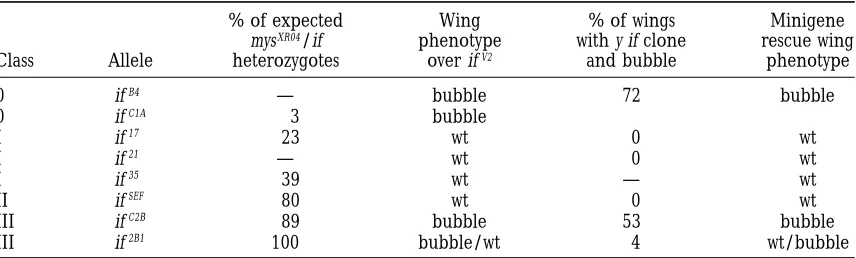
TABLE 3
Wing phenotypes and genetic interactions of inflated alleles
% of expected Wing % of wings Minigene
mysXR04/if phenotype with y if clone rescue wing
Class Allele heterozygotes over ifV2 and bubble phenotype
0 ifB4 — bubble 72 bubble
0 ifC1A 3 bubble
I if17 23 wt 0 wt
I if21 — wt 0 wt
I if35 39 wt — wt
II ifSEF 80 wt 0 wt
III ifC2B 89 bubble 53 bubble
III if2B1 100 bubble/wt 4 wt/bubble
types of the class IV alleles. The ability of the class I to the epidermis (Figure 2). The somatic muscles in
ifSEF mutant embryos, however, do exhibit a defect in
hypomorphic alleles to complement viable class IV
al-leles suggests that the level of inflated activity in these the contractile ultrastructure. Examination by polarized light shows little evidence of sarcomeric structure in mutations is sufficient to mediate the adult functions
of inflated. Our results emphasize that the class of inflated these muscles, and staining for filamentous actin with rhodamine-phalloidin reveals that the f-actin fails to mutant one can recover is dependent on the type of
screen used to isolate the mutations, because screening become properly organized (Figure 2; see also below).
We examined embryos at earlier times during stage 17 for new mutations in the wing will fail to isolate class I
and class II alleles as these alleles are able to support with polarized light and did not observe the appearance
of striations in ifSEFmutant embryos, suggesting that the
normal wing development.
We also examined the extent of the dominant genetic PS2 integrin is required for the formation of muscle
sarcomeric structure rather than for its maintainance. interaction of the different classes of inflated alleles with
the antimorphic myospheroid allele, mysXR04. With amor- The strong waves of muscle contraction that normally
accompany hatching from the vitelline membrane and phic inflated alleles, 90–100% of mysXR04 1/1 if flies
die (Wilcox 1990;Brabant andBrower1993). One chorion are not observed in these mutants, although
some residual muscle function is present, as weak mus-rationale for this is that the aPS2subunit expression is
limiting and PS2 integrin heterodimers containing the cle contractions occur if the mutant animal is poked
with a needle (not shown). Therefore, the ifSEFmutant
mutant bPS subunit encoded by the mysXR04 allele are
stable but impaired in function, and, therefore, in the appears to be unable to form normal contractile somatic
muscles. When we stained ifSEFmutant embryos with the
double heterozygote the level of the active PS2
hetero-dimer will be reduced to one-fourth (Bunchet al. 1992). PS2hc/2 monoclonal antibody (Bogaert et al. 1987),
we did not detect any staining; however, we could detect We tested the different classes to find out if they were
altered in their interaction compared with amorphic wild-type staining with a polyclonal antisera directed
against the C-terminal 15 amino acids of theaPS2subunit
alleles (Table 3). The amorphic allele ifC1Abehaves as
expected, with only 3% of the double heterozygotes (data not shown). This suggests that this mutant alters
the conformation of the PS2 integrin (and the PS2hc/2 surviving, and the class I hypomorphic alleles if17and
if35 show a partial genetic interaction, with 23% and epitope) rather than its expression.
The muscle phenotype of the ifSEF allele is not
en-33% survival, respectively, suggesting that these alleles
produce some active protein and supporting the identi- hanced when placed over a deficiency and the midgut
and nerve cord remain wild type in appearance (results fication of this class as hypomorphs. The class II and
III alleles show almost no genetic interaction with mysXR04 not shown), demonstrating that this allele is amorphic
for a subset of inflated function. Additionally, the muscle suggesting that the level of the aPS2 subunit is not
re-duced in these mutations, just particular functions. phenotype is partially ameliorated when ifSEF is placed
in trans with the hypomorphic alleles, demonstrating
Embryonic functions of inflated: An examination of
the phenotypes of the new classes of inflated alleles dem- that the hypomorphs supply some of the function
miss-ing in the ifSEFmutant.
onstrates that the inflated gene has separate functions
in the somatic musculature vs. the gut and nerve cord. Examination of the phenotype of the class I
hypomor-phic alleles shows that all embryonic inflated activities, The class II allele, ifSEF, is embryonic lethal yet the
phe-notype is surprisingly mild: the nerve cord is fully con- including the sarcomeric function of inflated, are
per-turbed in these mutants. Detachment of somatic mus-densed (not shown), midgut morphogenesis occurs
Figure 2.—inflated mu-tant phenotypes. Embryos at the end of embryogenesis (stage 17, 20–24 hr at 258) that are mutant for the dif-ferent classes of inflated al-lele were examined by po-larized light, staining for filamentous actin with rho-damine phalloidin, or the guts dissected and exam-ined with Nomarski optics. In each case anterior is to the left.
class I alleles, but in addition many of the muscles that there is some detachment of the visceral muscle layer,
but that the sarcomeric structure is not perturbed. remain attached lack or show disturbed sarcomeric
structure (Figure 2). These mutants also display a mild Hatched ifC2Blarvae possess the same phenotypic
charac-teristics as their unhatched counterparts, that is, wild-disruption of midgut morphogenesis (Figure 2) and
incomplete nerve cord condensation (not shown). The type muscles and abnormal midguts, and it seems likely
that the larval lethality is a result of their inability to muscle detachment and midgut and nerve cord
pheno-types are all increased in severity when class I alleles are feed, but we do not know why some of the mutant
embryos fail to hatch. The if2B1 allele appears to be a
placed over the deficiency Df(1)if (not shown). Within
this class an allelic series (if13ts,if21, if17, if35) can weaker class III allele because a greater proportion of
mutant embryos hatch (80%); however, no mutant third be identified based upon observations of mutant stage
17 embryos (not shown). instar larvae have been observed (the mutant larvae are
marked with y; seematerials and methods). As with
A significant fraction of embryos mutant for the class
III inflated alleles ifC2B and if2B1, hatch to first instar ifC2Bthe lethal if2B1embryos and a proportion of hatched
larvae have a defective gut, but normal muscles. How-larvae. Approximately one-fifth of the mutant
individu-als carrying the ifC2Ballele hatch, and these larvae slowly ever, some if2B1 larvae appear to have normal guts and
survive longer. These individuals survive until the sec-become less motile and die over the next 48 hr. ifC2B
mutant embryos that failed to hatch were examined ond instar stage when they start to show some muscle
detachments (not shown). The lethal class III embryos by polarized light and rhodamine-phalloidin staining
(Figure 2 and see below). We observed that the muscles also have defective nerve cord condensation (not
shown). When these alleles are placed over Df(1)rif, the remained attached and had normal sarcomeric
struc-ture. In contrast, the midgut fails to elongate and only gut and nerve cord phenotypes are enhanced, and rare
muscle detachments are observed (not shown). Unfor-two fat gastric caecae are formed (Figure 2). Staining
PS2 integrin in the midguts of these mutants proved and III alleles (Figure 2), we see that the circumferential visceral muscles fail to surround the gut in these mutants inconclusive, due to the difficulty in getting
reproduc-ible staining of the visceral muscles in stage 16 embryos (Figure 3, D and F). The if17midgut has a small gap at
the seam, whereas in ifC2Bmidguts the circular visceral
with the PS2 antibodies.
To get a better view of the effect of the different muscles are found as two plates of muscles that are
almost completely separated, and the longitudinal mus-classes of inflated mutant on sarcomeric structure, we
dissected class I, II, and III if mutant embryos at the cles are also disordered. This phenotype could arise if
the layers of the mesoderm have failed to migrate across end of embryogenesis, stained the muscles and midguts
with phalloidin conjugated to rhodamine, and exam- the midgut and thus never meet, or by failure of the
muscle-muscle attachment, so that they detach along ined them by confocal microscopy. In the somatic
mus-cles of wild-type (not shown) and ifC2Bembryos (Figure the seams following contraction.
The analysis of these new classes of inflated allele has 3C) the actin filaments are aligned and visible as bright
stripes and the H bands, containing just myosin fila- shown that in addition to the known function of the PS2
integrin in mediating the attachment of the muscles, it ments, appear as the dark stripes (see Figure 3G). In
the ifSEF embryos the actin filaments are seen to be also has a role in the formation or maintainence of the
muscle contractile ultrastructure. We have also found continuous strands, with no intervening H bands
(Fig-ure 3B). Somatic muscles from the hypomorphic muta- that the function of the PS2 integrin in the
morphogen-esis of the midgut and the nerve cord is distinct from tion if17show a mixture of striated and nonstriated
mus-cles (Figure 3A), and the defects in the sarcomeric its function in muscle attachment and sarcomeric
struc-ture. From our existing data it seems likely that the ifSEF
structure can occur in muscles that remain attached.
None of the mutants appears to disrupt the sarcomeric mutant affects the structure of the protein, but we have
not been able to determine whether the class III muta-structure of the visceral muscles (Figure 3, D–F),
al-though both if17 and ifC2B affect the integrity of the tions disrupt cis-regulatory regions or protein domains.
Functions of inflated in the adult:Our current data visceral muscle layer. However, it is clear from the
phal-loidin staining and previous ultrastructural examina- suggest that viable inflated alleles arise only when
muta-tions specifically alter expression in the imaginal tissues.
tions (Sandbornet al. 1967;GoldsteinandBurdette
1971) that the sarcomeric structure of visceral muscles We have been unable to generate viable wing bubble
alleles of inflated with EMS. The one viable allele we is different from the somatic muscles (Figure 3G), and
therefore it is not so suprising that the PS2 integrin is recovered is theg-ray allele ifV2, which is a translocation
between the X and the fourth chromosome (15A;101F; required for one but not the other. The circumference
of the midgut is covered by hemi-circular sets of mono- data not shown). This allele causes a substantial
reduc-tion of the expression of theaPS2 subunit in the third
nucleate visceral muscles, which attach end to end, and
an outer layer of longitudinal muscles. One of the two instar wing imaginal disc (Figure 4) and is semilethal
with a very strong adult phenotype. There is some larval “seams” where the circular muscles attach end to end
can be seen in the ifSEF gut (Figure 3E, white arrow), lethality (but no embryonic lethality; not shown),
judg-ing by the reduced numbers of ifV2pupae and adults
which is indistinguishable from a wild-type gut (not
shown). Within each visceral muscle the phalloidin relative to their siblings, and the majority of the mutant
individuals die while eclosing: they get their head and stains rectangles of actin, which are interspersed by a
dark region containing a bright dot of phalloidine stain- legs out but then become stuck. We think that this is
due to the inflated wings sticking to the pupal case. A ing (Figure 3, D–G). Ultrastructural analysis has shown
that there are no H bands in these muscles and unusual few mutant individuals do successfully eclose and have
severe adult abnormalities (Figure 4), although they are filaments link the punctate Z bands to the thin filaments
that overlap the myosin filaments (Sandbornet al. 1967; viable and fertile. The two layers of the wing blade are
completely separated and the wings appear as
hemo-GoldsteinandBurdette1971). Therefore, our
inter-pretation of the phalloidin staining is that the Z bands lymph filled balloons. The hemolymph often becomes
dried and blackened within the wing. In addition to this stain as the bright dot, the gap represents the unusual
filaments (which could be actin that does not bind phal- extreme version of the wing blister phenotype previously
observed for inflated, two novel phenotypes are observed loidin or some other protein), and the rectangles
repre-sent actin filaments (see Figure 3G). The length of the in this mutant. The halteres are distorted, appearing
longer and less rounded than in wild type and having a rectangles varies depending on whether the muscle is
relaxed or contracted (e.g., Figure 3E vs. F; both are rougher surface (Figure 4). The legs are also misshapen,
with a kink in the femur of particularly the second and seen in wild-type guts). The number of thin filaments
surrounding each thick filament in cross section is larger third legs (Figure 4). The latter phenotype is not due
to detachment of leg muscles as no detached muscles
than in the somatic muscles (Sandborn et al. 1967;
Goldstein andBurdette1971), supporting the idea are observed in the mutant legs (not shown), nor is it
an injury that arises during eclosion as the leg kinks that the actin filaments overlap. Consistent with the
Figure 3.—Sarcomeric phenotypes of inflated mutants. Mutant late stage 17 embryos/first instar larvae were dissected open, fixed, and stained with rhodamine-phalloidin. Some disruption of the somatic muscles occurred during the dissection. The comatic muscles are shown in A–C, with partial disruption of the sarcomeres seen in the class I mutant if17, complete disruption in the class II mutant ifSEF, and wild-type appearance in the class III mutant ifC2B. The region of the midgut just posterior to the gastric caecae is shown in D–F. None of the mutants affects the sarcomeric structure of the circular visceral muscles, but in the class I and class III mutants the visceral muscles do not completely surround the gut, with a gap observed at the position where the two layers of muscles normally attach end-to-end at a “seam,” indicated by a white arrow in the class II gut in E (which is indistinguishable from wild type). Bar, 20mm. The proposed relationship between the phalloidin staining and the underlying sarcomeric structure is shown in G, with enlargements corresponding to a 20-mm long segment of the muscles, a schematic of the phalloidin staining below and models of muscle structure underneath. The staining of the somatic muscles is consistent with standard models of sarcomeric structure; however, the visceral muscle pattern is puzzling. The lack of a dark H band region, containing just myosin, is consistent with the complete overlap of the myosin filaments by actin filaments (see text for details), but the regions that do not stain with phalloidin suggest an unusual filament between the punctate Z disc and the bulk of the actin filaments. The bright thin band within the dark region suggests that the Z discs contain actin filaments.
The ifV2allele has no phenotype in the eye, as expected The breakpoint of the ifV2 allele is approximately
5 kb downstream of the inflated transcription unit (data from the lack of any phenotype in the eye of clones of
cells homozygous for inflated amorphic alleles (Brower not shown). This mutation does not remove essential
regulatory elements since a P-element construct, which et al. 1995). The antennae and mouth parts also appear
Figure4.—The class IV ifV2allele has reduced expression of theaPS2subunit and defects in wing, haltere, and legs. Late third instar imaginal discs from wild-type (A) and ifV2 (B)
Figure 5.—The strong adult phenotypes of ifV2 and ifB4; larvae were dissected and stained together with an antibody Dp(1:3)f171b are due to position effect variagation. The effect
against theaPS2subunit. Anterior is to the left and ventral is of the loss of the Y, which enhances PEV, and the dominant at the top. Wings (C, D), halteres (E, F), and third leg (G, suppressor of PEV, Su(var)205, were examined. Adults were H) are shown from wild-type (C, E, G) and ifV2mutant (D,
compared to their siblings to determine those that died prior
F, H) adults. to puparation (the missing adults5“dead”), those that
par-tially eclosed (one-half eclosed), and those that eclosed and had wing bubbles of wild-type wings. We do not understand the suppression of lethality of ifV2by the loss of the Y, but it
39 to the poly A site, fully rescues inflated mutations
may be strain variation.
(Brown1994). Instead the defect in inflated function
in the ifV2allele arises from position effect variegation
that suppresses the enhancers within the transcription
(80-81). The ifB4/Y; Dp(1:3)f1
71b/1phenotype is also
unit. Thus, the adult phenotypes are enhanced by lower
suppressed by Su(var)205 and enhanced by the loss of temperature (not shown) and the removal of the Y
(Fig-the Y (Figure 5). ure 5; in this experiment the removal of the Y improved
Class I alleles and the class II allele ifSEFfully
comple-the survival of mutant larvae), and it is suppressed by
ment the ifV2allele (Tables 2 and 3). In order to
deter-the suppressor of position effect variagation Su(var)205
mine whether this is because these alleles have wild-type (Sinclair et al. 1983; Figure 5). We can also generate
function in the wing or whether it represents some more a very similar phenotype from another genetic
combina-complicated genetic interactions, we made clones of tion using the duplication part of Tp(1:3)f171b (Craymer
some of these alleles by FLP-FRT-induced recombina-and Roy 1980): ifB4/Y; Dp(1:3)f171b/1. Dp(1:3)f171b
tion (Table 3). While clones of the null allele ifB4and
extends from far upstream of the inflated transcription
the class III alleles ifC2B and if2B1 give bubbles in the
unit (16C2) to just 39 of it (15A4) and is inserted in
or two of the class I alleles. The difference in wing cially the adhesion between the two surfaces of the wing. Amorphic inflated alleles affect all these processes, while function between the allelic classes was confirmed when
we attempted to rescue inflated alleles with a shortened the other four classes of allele only affect a subset of
them. The class I hypomorphs are complementary to P-element if1construct that lacks cis-elements required
for adult function. In an effort to shorten the P -element the class IV viable alleles: the partial activity of the class I alleles is sufficient for function in the adult but not rescue construct, we initially removed sequences from
both 59and 39to the gene (Figure 6), and found that for any of the other functions. Therefore, it appears
that the only way to generate adult viable class IV alleles this shorter gene still fully rescues the ifB4 null allele
(data not shown). We then deleted three of the introns is by making mutations that specifically perturb
expres-about 15 kb 39to the start of transcription to generate sion of the PS2 integrin in the imaginal discs. This
an if1 “minigene” (Figure 6). When we attempted to contrasts to many other loci where weak alleles give a
rescue the null ifB4 allele with this minigene, we only
phenotype in the adult but not in the embryo, or strong
obtained a small number of rescued adults, which had alleles give a dominant adult phenotype (seeLindsley
eclosed with severe defects in the wings, halteres, and andZimm 1992). The class II allele is complementary
legs, similar to ifV2 (not shown). In contrast, the
mini-to the class III alleles: it produces a PS2 integrin that is gene fully rescues ifSEFand the hypomorphs (Table 3).
largely wild-type except that it is unable to aid in the The minigene rescues the lethality of ifC2B, but the adults
formation of the somatic muscle sarcomeres (sarco-have bubbles in the wing of variable severity, depending meric function), whereas class III alleles eliminate a PS2
on the minigene insertion site. The minigene almost function that is required in midgut and gastric caecae
fully rescues if2B1 but a few adults are observed with
morphogenesis, as well as the contraction of the nerve
bubbles in the wing. Finally, the minigene does not cord and morphogenesis of the adult structures
(mor-rescue the ifV2phenotype at all (not shown). Thus, these
phogenetic function). Both class II and class III alleles results confirm that ifV2, ifC2B, and if2B1 (weakly) are
still retain the ability to mediate muscle attachment mutant in inflated function in the adult, while ifSEF and
(adhesive function).
the hypomorphs have wild-type function in the adult. The single class II allele, ifSEF, is one of the 12 alleles
recovered in the F2 screens, and it has a unique pheno-type. It is embryonic lethal, but the only defect we have
DISCUSSION observed is a failure in the formation of the normal
somatic muscle sarcomeric structure, thus confirming In this study of the inflated gene we have analyzed the
the existence of a sarcomeric function of the PS2 inte-phenotypes and allelic interactions of 45 inflated alleles
grin. The existence of this defect would have been pre-(summarized in Table 4). We have found that inflated
dicted from the study ofVolket al. (1990) who noted
is a complex locus and contains at least two separably
that the PS2 integrin is localized at the Z-discs of somatic mutable activities. These results suggest that the integrin
muscles cultured in vitro, and who observed that muscles
aPS2subunit, encoded by inflated, has different kinds of
from embryos mutant for thebPSsubunit did not form a
activities in the different tissues of the developing
ani-normal sarcomeric structure. However, this sarcomeric mal, as indicated by the five classes of alleles we have
defect could have been a secondary effect of the recovered. We have examined the role of the PS2
inte-rounding up of the muscles due to their detachment. grin in the attachment of the somatic muscles, the
for-This has been resolved by the ifSEF mutant where the
mation of muscle sarcomeres, the morphogenesis of the
sarcomeric structure is disrupted in somatic muscles midgut, gastric caecae and the contraction of the ventral
nerve cord, and the morphogenesis of the adult, espe- that remain attached, clearly demonstrating that the
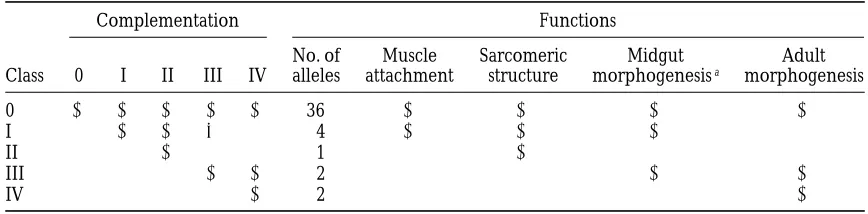
TABLE 4
Summary of different classes of inflated alleles
Complementation Functions
No. of Muscle Sarcomeric Midgut Adult
Class 0 I II III IV alleles attachment structure morphogenesisa morphogenesis
0 2 2 2 2 2 36 2 2 2 2
I 2 2 6 1 4 2 2 2 1
II 2 1 1 1 1 2 1 1
III 2 2 2 1 1 2 2
IV 2 2 1 1 1 2
aThis category includes elongation of the midgut, formation of gastric caecae, and condensation of the ventral nerve cord.
PS2 integrin itself is required for the formation of the the dense bodies and is required for the subsequent
localization of talin and vinculin to them (Williams
normal sarcomeric structure in the somatic muscles. In
contrast, PS2 does not appear to be required for the andWaterston 1994;Gettneret al. 1995). Not only
do mutants that lack this integrin subunit fail to localize formation of the visceral muscle sarcomeres, which
dif-fer in structure. This difdif-ference may aid in the elucida- either talin or vinculin, they also do not form distinct dense bodies and fail to organize their contractile cy-tion of the role of the PS2 integrin in organizing the
sarcomeres of the somatic muscles. toskeleton. If the PS2 integrin works in a similar way,
then at each Z disc it would link the sarcomeres to the The muscle sarcomeric defect is also observed in some
of the muscles in embryos mutant for hypomorphic membrane, to help organize the sarcomeric structures.
The class III alleles are rare alleles recovered from alleles, raising the possibility that ifSEF might be simply
an even weaker hypomorph. However, there are several F1 screens for wing bubble phenotypes; only 2 were
recovered from a total of 24 EMS- or ENU-induced arguments against this. The ifSEFallele does not behave
like a hypomorph because its phenotype is unaltered mutants. Their phenotype is distinct from the amorphic
and hypomorphic alleles and complementary to the ifSEF
when in trans to a deficiency. In addition, the phenotype
of ifSEFgets weaker in trans to the hypomorphs, instead phenotype, as indicated by their ability to fully
comple-ment ifSEFgenetically. Thus, the class III alleles
specifi-of stronger as it would if it were a weak hypomorph,
showing that in fact the hypomorphic alleles are weaker cally disrupt the morphogenetic PS2 function, at the
same time retaining the adhesive and sarcomeric func-for the PS2 sarcomeric function than ifSEF. Finally, the
hypomorphic alleles have a fully penetrant gastric cae- tions. An alternative interpretation of the class III alleles is that they are regulatory mutations in an enhancer cae phenotype and an incompletely penetrant
sarco-meric phenotype, suggesting that the development of that drives inflated expression in the visceral mesoderm,
imaginal discs, and whatever cells require inflated to the gastric caecae is a developmental event that is very
sensitive to a reduction in PS2 integrin activity, and the mediate nerve cord condensation. However, this is not
consistent with the little we know about inflated cis -regu-ifSEFallele has wild-type development of these structures.
Thus it seems that the ifSEF allele specifically disrupts latory elements. The second intron contains an
en-hancer for expression in the embryonic somatic and the sarcomeric function of the PS2 integrin.
The sarcomeric function of PS2 could work by playing visceral mesoderm, which contains sites for the
tran-scription factors Twist (A. Dokidis, N. H. Brown and
a role in the organization of each unit of the contractile
cytoskeleton, consistent with the localization of PS2 to F. C. Kafatos, unpublished observations) and D-MEF2
(Ranganayakulu et al. 1995). When we constructed
the Z discs of muscle cultured in vitro (Volket al. 1990).
This would be similar to the role of integrins in the the minigene we retained this intron, but in deleting
introns 3–5 we appear to have deleted cis-regulatory formation of muscle sarcomeric structure in C. elegans,
even though the muscles form in a different way. In the elements that are important for inflated expression in
the imaginal tissues because the minigene does not res-body wall muscles of this organism, multiple structures
per muscle, called dense bodies, anchor the contractile cue the adult phenotypes. Thus, unless there are
addi-tional essential enhancers it would be difficult to gener-ultrastructure through the membrane to the hypoderm
(Hreskoet al. 1994). Dense bodies appear to be equiva- ate a mutation that removed both mesodermal and
imaginal disc enhancers while retaining all inflated cod-lent to the Z discs of vertebrate and Drosophila striated
muscle, and like Z discs, they are rich in actin and ing exons. Therefore, we favor the view that the class
III mutations disrupt a specific morphogenetic function
a-actinin. The pat-3 gene encodes abintegrin subunit,
The PS2 morphogenetic functions are required for ever, the mature structures are unaffected in ifV2
mu-tants (not shown). This confirms the previous reports midgut morphogenesis, nerve cord condensation, and
the adult phenotypes, but not for muscle attachment that clones of null inflated alleles in the eye disc have
no phenotypic consequence (Broweret al. 1995).
or the formation of muscle sarcomeric structure. The
wing and the gut share the feature that the interaction In the absence of data on the sequence changes of
the mutations we can only speculate as to the nature of between the two layers of cells occurs over a large
sur-face, in contrast to the specific points of muscle attach- these classes of allele. Because integrins do not have any inherent enzymatic activity they are thought to function ment. We do not have a clear picture of how the loss
of the PS2 morphogenetic function in the visceral meso- through their binding to other proteins inside and
out-side the cell. Therefore, it is likely that the Class II and derm leads to the defects in the morphogenesis of the
midgut and gastric caecae. We have found that PS2 Class III mutations alter the ability of PS2 integrin to
bind to specific proteins. All inflated mutations have the function is required to maintain the integrity of the
visceral muscle layer, but do not know whether it is highest probability of being in the extracellular domain
of theaPS2subunit since 96% of the amino acids (1307/
required when the visceral muscles initially surround
the endoderm or later to mediate the end-to-end attach- 1363) are extracellular. However, mutations in the
ex-tracellular domain could alter the binding of integrins ment of the visceral muscles or their lateral adhesion
to the endoderm. The defects in the shape of the gut to either extracellular ligands or intracellular proteins.
By altering the ligand-binding pocket, the mutations epithelia that occur in the absence of PS2 function could
be a consequence of the loss of the continuous contrac- could destroy the ability of the integrin to bind to
spe-cific extracellular ligands. The aPS2 integrin is
alterna-tile layer of muscles, which is required mechanically to
change the shape of the gut, or they could be due to a tively spliced; exon 8 encodes a 25 amino acid exon
that is either omitted or inserted into the extracellular loss of signal transduction between the mesoderm and
gut. A failure in the close apposition of the visceral part ofaPS2, near to the region where the ligand-binding
domain resides (Brown et al. 1989). The suggestion
mesoderm and midgut could indirectly cause defects in
signal transmission between these cell layers. It is also that this alternative splicing alters the ligand specificity and/or affinity has been demonstrated by the different possible that the PS2 integrin morphogenetic role is
itself part of the signaling machinery necessary for mid- ability of these two forms of theaPS2bPSintegrin to bind to
vertebrate ligands (Zavortinket al. 1993) and Tiggrin
gut morphogenesis.
Underlying the adult phenotypes observed in muta- (Fogertyet al. 1994). Furthermore, recent site-directed
mutagenesis of the vertebratea4 subunit has identified tions in members of the PS integrin family is their
ex-pression in the imaginal discs. This is particularly so in three residues specifically required for ligand binding (Irieet al. 1995), and the homologous residues inaPS2
the wing imaginal disc where they are expressed in a
striking reciprocal pattern; PS2 is expressed in the cells are the last three residues in exon 7, adjacent to the
alternatively spliced region. Thus, one of the new muta-destined to become the ventral layer of the wing blade
and PS1 is expressed in the cells destined to become tions could alter this region ofaPS2and specifically block
binding to some but not all ligands. Expression of the the dorsal layer (Wilcoxet al. 1981;Broweret al. 1984).
In large clones, loss ofaPS2 from the ventral cells,aPS1 single isoforms of theaPS2subunit using the GAL4 system
allows rescue of inflated phenotypes (Rooteand
Zus-from the dorsal cells, orbPSfrom either set of cells leads
to a failure in attachment between the two cell layers man1996;Martı´n-Bermudoet al. 1997), but perhaps
defects would be observed if wild-type levels of the single and the formation of a wing bubble in the adult
(BrowerandJaffe1989;Zusmanet al. 1990;Brabant isoforms were expressed. Mutations in the extracellular
domain of the aPS2 subunit could alter the interaction
andBrower1993;Broweret al. 1995). Surviving adults
mutant for the class IV inflated allele ifV2 presumably of the PS2 integrin with cytoplasmic proteins by altering
the ability of extracellular ligand-binding-induced con-have no PS2 integrin-mediated adhesion function in the
cells of the ventral wing blade, resulting in the formation formational changes to be transmitted to cytoplasmic
tails. This could alter the ability of the integrins to bind of balloon-like wings. These survivors also display defects
in the morphogenesis of the adult legs and halteres. In to specific cytoskeletal proteins involved in cell shape
changes or linkage of the contractile apparatus to the the haltere the PS2 integrin is expressed in a small patch
similar in position to the presumptive ventral wing blade membrane. It could also alter the interaction of the
integrin with intracellular signaling molecules. Clearly,
in the wing disc (Brower et al. 1985), but how this
mediates the formation of a round haltere is unclear. a rare mutation in the cytoplasmic tail could also cause
defects in the intracellular interactions. In the third instar larval leg discs, PS2 is only weakly
expressed (Brower et al. 1985); however, it may be This genetic analysis of inflated alleles suggests that
PS2 functions can be categorized as adhesive, sarco-more strongly expressed during pupal development and
therefore account for the phenotype we have observed. meric, or morphogenic. The different functions could
all involve adhesion to extracellular ligands to promote Distinct patterns of PS2 expression are observed in the