DESAI, NIRMIT V. Scalable Distributed Concurrency Protocol with Priority Support. (Under the direction of Assistant Professor Frank Mueller).
Middleware components are becoming increasingly important as applications share com-putational resources in large distributed environments, such as web services, high-end clusters with ever larger number of processors, computational grids and an increasingly large server farms. One of the main challenges in such environments is to achieve scalability of synchronization. Another challenge is posed by requirement for shared resources with a need for QoS and real-time suppoprt. In general, concurrency services arbitrate resource requests in distributed systems. But concurrency protocols currently lack scalability and support for service differentiation based on QoS require-ments. Adding such guarantees enables resource sharing and computing with distributed objects in systems with a large number of nodes and supporting a wide range of QoS metrics.
The objective of this thesis is to enhance middleware services to provide scalability of synchronization and to support service differentiation based on priorities. We have designed and implemented middleware protocols in support of these objectives. Its essence is a novel, peer-to-peer, fully decentralized protocol for multi-mode hierarchical locking, which is applicable to transaction-style processing and distributed agreement.
by
Nirmit V. Desai
A thesis submitted to the Graduate Faculty of North Carolina State University
in partial satisfaction of the requirements for the Degree of Master of Science in Computer Science
Department of Computer Science
Raleigh 2003
Approved By:
Dr. Vincent Freeh Dr. Gregory Byrd
To my parents
Biography Nirmit Desai was born on
Acknowledgements
A lot of people have played a very important role in the successful completion of this thesis. Firstly, I thank my advisor, Dr. Frank Mueller, for his continuous guidance, mentoring and support. This work could not have been a success without his insightful remarks and advice. I also extend my gratitude to Dr. Vincent Freeh and Dr. Gregory Byrd for being on my advisory committee and providing me with valuable suggestions.
I also thank my colleagues and friends Jaydeep Marathe, Kiran Seth and Yifan Zhu for instantly helping me on any issues, sharing their creative ideas and providing me with an excellent research environment.
Contents
List of Figures vii
List of Tables viii
1 Introduction 1
1.1 Motivation . . . 1
1.1.1 Middleware Concurrency Services . . . 1
1.1.2 Clusters and Grid . . . 2
1.1.3 Issues . . . 2
1.2 Approach . . . 3
1.2.1 Scalability . . . 3
1.2.2 Priority support . . . 4
1.3 Outline . . . 5
2 The Unprioritized Protocols 6 2.1 Prior Work . . . 6
2.2 Our Hierarchical Locking Protocol . . . 8
2.2.1 Compatibility between Lock Modes . . . 8
2.2.2 Local Queues, Intent Locks and Copysets . . . 10
2.2.3 Request Granting . . . 11
2.2.4 Request Queuing/Forwarding . . . 13
2.2.5 Lock Release . . . 15
2.2.6 Fairness and Absence of Starvation . . . 19
2.2.7 Upgrade Request . . . 21
2.3 Summary . . . 23
3 The Prioritized Protocol 24 3.1 Motivation . . . 24
3.1.1 Prior Work . . . 24
3.1.2 Basic Protocol . . . 26
3.2 Freezing Mechanism . . . 27
3.4 Queue/Forward Policy . . . 28
3.5 Example . . . 29
3.6 Bounding Priority Inversion . . . 30
3.7 Priority Inheritance . . . 33
3.7.1 Priority Ceiling Emulation Protocol(PCEP) . . . 34
3.7.2 Priority Inheritance Protocol (PIP) . . . 35
4 Experiments 40 4.1 Environment Setup . . . 40
4.2 Unprioritized Experiments . . . 41
4.2.1 Comparison . . . 41
4.2.2 Effects of Concurrency Level . . . 44
4.2.3 Message Overhead Breakups . . . 48
4.3 Prioritized Experiments . . . 50
4.3.1 Comparison . . . 51
4.3.2 Effects of Inheritance Protocols . . . 52
4.3.3 Queuing Preference Degree . . . 54
4.4 Summary . . . 55
5 Related Work 56
6 Conclusions 59
Appendix. Glossary of Terms 61
List of Figures
2.1 Non-hierarchical Example . . . 7
2.2 Request Granting Example . . . 12
2.3 Request Queuing/Forwarding Example . . . 14
2.4 Pseudocode for Requesting and Granting Locks . . . 16
2.5 Pseudocode for Entering Critical Section on Grant/Token . . . 17
2.6 Lock Release Example . . . 18
2.7 Pseudocode for Lock Release Handling . . . 18
2.8 Frozen Modes Example . . . 19
2.9 Pseudocode for Freezing Mechanism . . . 21
2.10 Request Upgrade Example . . . 22
2.11 Pseudocode for Request Upgrade . . . 22
3.1 Non-hierarchical Priority Support Example . . . 25
3.2 Request Queuing/Forwarding Example (Prioritized) . . . 29
3.3 Prioritized Protocol Example . . . 31
3.4 Priority Inversion Example . . . 32
3.5 Time Line Representation of Priority Inversion Scenario . . . 32
3.6 Wait-for Graphs . . . 33
3.7 Extensions for Ceiling Emulation . . . 35
3.8 Extensions for Inheritance . . . 37
4.1 Comparison with Naimi’s Protocol . . . 42
4.2 Varying Non-Critical/Critical Ratios . . . 45
4.3 Constant Concurrency Level . . . 48
4.4 Message Overhead Breakup . . . 49
4.5 Comparison with Unprioritized Protocol . . . 51
4.6 Pure Prioritized and PCEP . . . 53
List of Tables
2.1 Incompatibility of Lock Modes . . . 10
2.2 Granting New Lock Requests by Children . . . 12
2.3 Queue / Forward Decision . . . 14
2.4 Rules for Freezing Lock Modes at the Token Node . . . 20
3.1 Rules for Freezing Lock Modes at the Token Node (Prioritized) . . . 28
Chapter 1
Introduction
1.1
Motivation
Resource arbitration is rapidly becoming a commodity in distributed computing where, data, objects and devices are shared on a larger and larger scale. In the past, applications relied on message passing, shared memory, remote procedure calls and their object counterparts, such as remote method invocations, to exploit parallelism in distributed environments or invoke remote ser-vices in a client-server paradigm. The problem with these approaches is their reliance on access to a centralized facility. Centralized approaches are inherently unreliable and suffer from the classical single point of failure problem. Also, more importantly, they have very limited scalability when applied to large distributed system environments. This is mainly due to the number of server(s) in the system remain constant while the population of requesters may be arbitrarily large and dynamic.
1.1.1 Middleware Concurrency Services
as resource arbitration in distributed systems. The CORBA/IIOP and RT-CORBA specifications by Object Management Group (OMG) [19] define one such middleware. The corresponding OMG concurrency service specification [18] describes a hierarchical locking model coupled to the core middleware to enable scalability of synchronization. However, existing implementations of such middlewares do not fully implement the concurrency services as specified in [18]. They, either have fairly thin and primitive implementations of the distributed locking mechanisms or they do not support concurrency services at all. For example, TAO (The ACE ORB) described in [38], one of the best known and supported implementations of CORBA/IIOP middleware, supports a thin concurrency service without hierarchical locking support. For these reasons, current middleware concurrency service implementations remain poorly scalable by in large and mostly non-applicable to large scale distributed systems and services.
1.1.2 Clusters and Grid
Another relevant trend regarding our work relates to clusters and the Grid [13, 20]. High-end clusters and the Grid have increased considerably in size over the past years. These clusters profit not only from advances in processor design and interconnects but their main advantage is their mere size, currently ranging up to 8,000 processors with future projections over 10,000, e.g., for IBM’s Blue Gene Light and potentially even larger systems in the Grid [1, 13]. We see a similar trend in commercial computing areas, such as server-style computing. Servers are increasingly organized in ever larger server farms. This trend is in response to requirements for high availability and faster response times. Multiple server farms may exist in geographically distant locations so that accesses can be quickly delegated to a server in the requester’s vicinity. In such environments, the traditional approaches for fault-tolerance have to be enhanced or replaced due to the shrinking mean-time-to-failure (MTTF) margins with growing sizes of clusters and Grids as described in [15]. Redundant computing is emerging as an alternative in such environments to cope with the failures efficiently where multiple replicas of a computation exist in the system simultaneously.
1.1.3 Issues
distributed agreement and distributed transactions. Another issue is service differentiation based on the priorities to ensure predictable response times for real-time applications. This thesis is moti-vated by these unique and emerging challenges in the area of large scale distributed systems and middlewares.
1.2
Approach
We first investigate the issue of scalability and discuss the design and implementation of a scalable protocol for synchronization supporting hierarchical locking. Next, we focus on providing support for real-time applications by means of supporting priorities of lock requests. We also discuss the problem of priority inversion and bound inversion duration by supporting priority inheritance protocols. The results demonstrate that the additional support for hierarchical locking and priorities does not affect the scalability of the protocol.
1.2.1 Scalability
protocol. The resulting protocol supports a high degree of concurrency for a number of locking modes. The protocol is aimed at global state replication in distributed systems. The underlying protocol follows a peer-to-peer paradigm, which is applicable to transaction-style processing and distributed agreement. The peer-to-peer paradigm ensures scalability by relying only on fully de-centralized data structures and symmetric algorithms. As a result, our protocol is highly scalable with O(log n) message complexity for n nodes. It accommodates a large number of concurrent re-quests, provides progress guarantees to prevent starvation and delivers short response times, even in large networks.
1.2.2 Priority support
We demonstrate how the middleware concurrency protocol for distributed objects and services can be extended to support real-time requirements. The use of such protocols in real-time systems requires support for priorities and should address the requirements imposed by real-time schedulability theory, namely, guaranteed end-to-end response times and bounded priority inversion. Priority support for distributed mutual exlusion has been studied in [30] without the support for hierarchical locking scheme. Contemporary distributed real-time systems exploit locking schemes in real-time database systems and transaction protocols, just to name a few [44, 39, 38]. The protocol developed in this thesis not only fits these requirements but also provides a more efficient solution to prioritized hierarchical locking in distributed systems than any of the previous protocols, to the best of our knowledge.
1.3
Outline
Chapter 2
The Unprioritized Protocols
In this chapter, we focus on the problem of achieving scalablity of synchronization and support for hierarchical locking without taking priorities into account. Therefore, the protocol in-troduced in this chapter is suitable for general distributed applications with a focus on the average throughput of the entire system. After introducing a non-hierarchical protocol by Naimi [32], we present our novel base protocol with a set of governing rules and tables. We provide examples covering important aspects of the operational details.
2.1
Prior Work
a fully decentralized token-based protocol is introduced.
Token-based algorithms for mutual exclusion employ a single token representing the lock object, which is passed between nodes within the system [32]. Possession of the token represents the right to enter the critical region of the lock object. Requests that cannot be served right away are registered in a distributed linked list originating at the token owner. Once a token becomes available, the owner passes it on to the next requester within the distributed list. In addition, nodes form a logical tree pointing via probable owner links toward the root. Initially, the root is the token owner. When requests are issued, they are guided by a chain of probable owners to the current root. Each node on the propagation path sets its probable owner to the requester, i.e., the tree is modified dynamically.
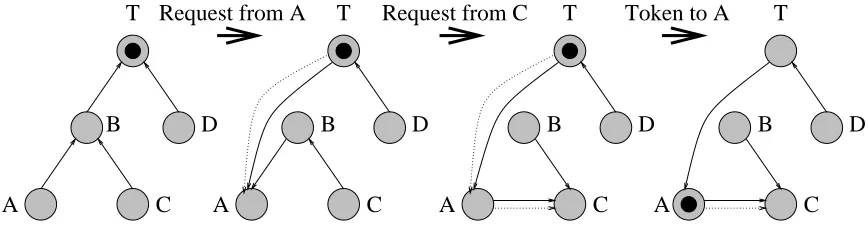
In Figure 2.1, the root initially holds the token for mutual exclusion. A request by is sent to following the probable owner (solid arcs). Node forwards the request along the chain of probable owners to and sets its probable owner to. When the request arrives at the root , the probable owner and a next pointer (dotted arc) are set to the requester. The next request from
is sent to. forwards the request to following the probable owners and sets its probable owner to
. Nodesets its next pointer and probable owner to
. When the token owner returns from its critical section, the token is sent to the target node that next points to. Hence, passes the token to and deletes the next pointer.
C A
T
D B
A C
T
D B
C T
D
A
B
Request from A Request from C Token to A
C A
T
D B
Figure 2.1: Non-hierarchical Example
to. At this point, one logical tree
is rooted in while another tree
is still rooted in . Once the request reaches , the separate trees are merged again (2nd tree of Figure 2.1).
Should requests be in transit, then there may be up to separate trees in the forest. Once all requests have arrived at current or future token owners, the forest collapses to a single tree again rooted in the last requester. The next pointers form a distributed queue of pending requests from the current token owner to the last requester. A new request would simply be appended at the end as described above.
This algorithm has an average message overhead of since requests are relayed through a dynamically adjusted tree, which results in path compression with regard to future request propagation. It is fully decentralized, which ensures scalability for large numbers of nodes. In the worst case, requests can be forwarded via messages and one additional message is needed to send the token. The model assures that requests are ordered FIFO. Our contribution in prior work was to alleviate shortcomings in priority support [29, 30]. In this work, we develop a novel protocol for hierarchical locking building on our past results and demonstrate its suitability to deliver short latencies and low message overhead in cluster environments.
2.2
Our Hierarchical Locking Protocol
This section introduces our novel locking protocol. This protocol strictly follows a peer-to-peer paradigm in that all data structures are fully decentralized and each node runs a symmetric instance of the protocol. These operational characteristics combined with an O(log n) message complexity ensure scalability and are also demonstrated to yield low response times. The protocol distinguishes a number of access modes in support of concurrency services for distributed com-puting. In the following, we refer to the Concurrency Services of CORBA, which follows the de facto standard hierarchical locking model widely used in database systems, as the underlying model without restricting the generality of our proposed protocol [18].
2.2.1 Compatibility between Lock Modes
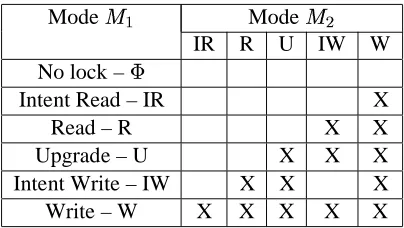
possible by supporting a set of five locking modes compatible with common access requirements of database systems and distributed object systems.
As in Naimi’s protocol, nodes form a logical tree structure by maintaining their local parent pointers. But our protocol does not require next pointers. The root node of the tree holds the token and is referred to as the token node. All other nodes are non-token nodes. We support the following access modes. First, we distinguish read (R) locks and write (W) locks with shared and exclusive access, respectively. Second, we support upgrade (U) locks, which represent an exclusive read lock that is followed by an upgrade request for a write lock. Upgrade locks ensure data consistency between a read followed by an update value that was derived from the read value as described in [18]. Third, we provide intent locks for reading (IR) and writing (IW).
Intent locks are motivated by hierarchical locking paradigms, which allow the distinction between lock modes on the structural data representation, e.g. when a database, multiple tables within the database, and entries within tables are associated with distinct locks [17, 26]. For ex-ample, an entity may first acquire an intent write lock on a database and then disjoint write (or upgrade) locks on the next lower granularity. Since the low-level locks are assumed to be disjoint, hierarchical locks greatly enhance parallelism by allowing simultaneous access for such threads. In general, lock requests may proceed in parallel if modes for a lock are compatible.
The compatibility between these basic lock modes defines which modes may be used in parallel by different requesters. Conversely, incompatibility of lock modes indicate a need for seri-alization of two requests. Let be a resource and
be the lock associated with it. Table 2.1 shows the rules for granting
in different modes according to the specification of concurrency services [18]. Column one specifies the presently held lock modes for
and the remaining columns repre-sent the type of mode requests received for
. To define our protocol, we derive several rules for locking and specify if concurrent access modes are permissible through a set of tables. These tables not only demonstrate the elegance of the protocol, but they also facilitate its implementation.
Rule 1:
Modes and are said to be compatible with each other if and only if they are not in conflict according to Table 2.1.Definition 1:
Lock is said to be stronger than lock if the former constrains the degree of concurrency over the latter. In other words, is compatible with fewer other modes than is. The order of lock strengths is defined by the following inequations:
Mode Mode
IR R U IW W
No lock –
Intent Read – IR X
Read – R X X
Upgrade – U X X X
Intent Write – IW X X X
Write – W X X X X X
Table 2.1: Incompatibility of Lock Modes
A higher degree of strength implies a potentially lower level of concurrency between mul-tiple requests. For example, a write lock allows less concurrency than a read lock, so W is stronger than R. Table 2.1 depicts lock modes in increasing order of lock strength – with the exception of upgrade and intent writes that, conceptually, share the same degree of concurrency. In the following, we distinguish cases when a node holds a lock vs. when a node owns a lock.
Definition 2:
Node is said to hold the lock
in mode if is inside a critical section protected by the lock, i.e., after has acquired the lock and before releases it.
Definition 3:
Node is said to own the lock
in mode if is the strongest mode being held by any node in the sub-tree rooted in node.
2.2.2 Local Queues, Intent Locks and Copysets
In our protocol for hierarchical locking, we employ a token-based approach. A novel aspect of our protocol is the handling of requests. While Naimi’s protocol constructs a single, distributed FIFO queue, our protocol combines multiple local queues for logging incompatible re-quests. These local queues are logically equivalent to a single distributed FIFO, as will be seen later.
it will request a read (R) lock on the attribute it wants to read without releasing IR. Note that the resources being requested in the above requests are at different levels of granularities – the object contains the attribute. Each of these resource requests can only be granted in accordance with lock compatibility requirements.
Compatible requests can be served concurrently by the first receiver of the request with a sufficient access mode. Concurrent locks are recorded, together with their access level, as so-called copysets of child nodes whose requests have been granted. This is a generalization of Li/Hudak’s more restrictive copysets [27].
Definition 4:
The Copyset of a node is a set of nodes holding a common lock at the same time with any parent node owning the lock in a mode stronger than the mode granted to its children.
2.2.3 Request Granting
The next rule governs the dispatching of the lock requests.
Rule 2:
A node sends a request for the lock in mode
to its parent if and only if the node owns the lock in mode where
(and may be
), or and
are incompatible. In all other cases, only the local copyset is updated and critical section is entered without sending any messages. Furthermore, lock requests are granted under the following conditions.
Rule 3:
1. A non-token node holding
in mode can grant a request for in mode if and
are compatible and
. 2. The token node owning
in mode can grant a request for
in mode
if and
are compatible.
The operational specification for our protocol further requires that
in case 1: the requester becomes a child of the granter
in case 2: if modes are compatible and if
, the token is transferred to the requester. Thus, the requester becomes the new token node and parent of the original token node. If
, the requester receives a granted copy from the token node and becomes a child of the token node. (See Rule 4 for the case when and
Table 2.2 depicts legal modes for granting another mode according to this rule, indicated by the absence of an . For the token node, compatibility represents a necessary and sufficient condition. Hence, access is subject to Rule 1 in conjunction with Table 2.1.
Non-token Owned Requested Mode
Mode IR R U IW W
No lock –
X X X X X
Intention Read – IR X X X X
Read – R X X X
Upgrade – U X X X
Intention Write – IW X X X
Write – W X X X X X
Table 2.2: Granting New Lock Requests by Children
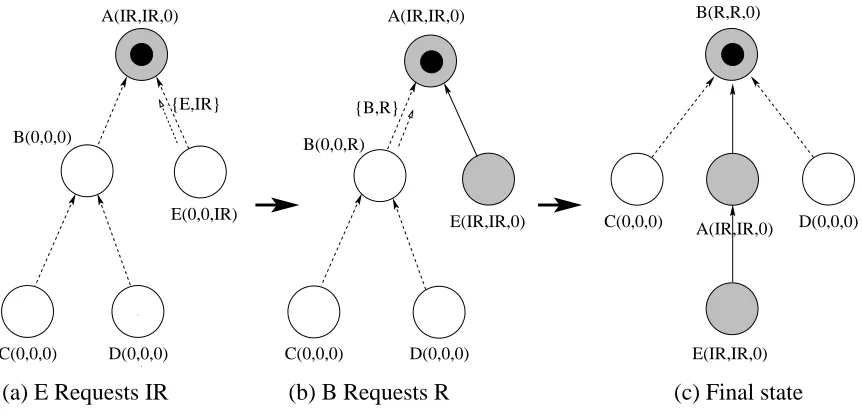
In the following, we denote the tuple ( ) corresponding to the owned, held and pending mode for each node, respectively. Shaded nodes are holding a lock and constitute the copyset, which indicates the degree of concurrency achieved at that state. A dotted, directed arc from to indicates that the parent/child relation is only known to the source but not yet to the sink. Solid arcs indicate mutual awareness. The token is depicted as a solid circle inside a node.
B(0,0,0)
A(IR,IR,0)
C(0,0,0) D(0,0,0) {E,IR}
D(0,0,0) C(0,0,0)
A(IR,IR,0)
E(0,0,IR) E(IR,IR,0)
{B,R} B(0,0,R)
B(R,R,0)
C(0,0,0) D(0,0,0)
E(IR,IR,0) A(IR,IR,0)
(a) E Requests IR (b) B Requests R (c) Final state
Example: Consider the initial state as shown in Figure 2.2(a). When requires the lock in , it checks Rule 2 to decide if sending a request is necessary. As
, it sends the request to its parent, node . receives the request, checks Rule 3.2 and responds to the request by sending a grant message. becomes a child of according to the operational specification. In (b) when requires the lock in , it checks Rule 2 and sends the request to its parent, node. receives the request, checks Rule 3.2 and grants the request by transferring the token to (for,
). becomes the new token node and becomes a child of. (c) shows the final state of the nodes.
2.2.4 Request Queuing/Forwarding
When a node issues a request that cannot be granted right away due to mode incompatibility, the following rule applies.
Rule 4:
1. If a non-token node cannot grant a request, it will either forward the request to its parent or queue the request locally based on the present state of a pending request of the node according to Table 2.3.
2. If the token node cannot grant a request, it will queue the request locally regardless of the state of its pending request.
Rule 4 is supplemented by the following operational specification: Locally queued re-quests are considered for granting when the pending request comes through or a release message is received. In Table 2.3, local queuing and forwarding are indicated as Q and F, respectively. The aim here is to queue as many requests as possible to suppress message passing overhead without compromising FIFO ordering.
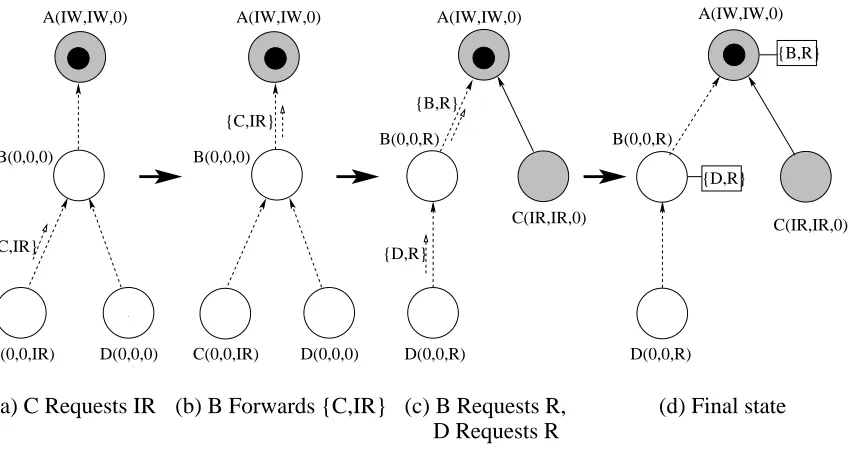
Example: In Figure 2.3(a),
sends a request for
to its parent (after checking Rule 2). When receives the request (as it cannot grant it due to Rule 3.1), it derives from Table 2.3 that it can queue the request locally or not (according to Rule 4.1). As does not have any pending requests,
, so has to forward the request to its parent node , as shown in (b). receives the requests and sends a grant as discussed above. In (c), and
concurrently make requests sent to their respective parents, nodes and. When receives
’s request (as it cannot grant it due to Rule 3.1), it derives from Table 2.3 that it can queue the
Non-token Pending Requested Mode
Mode IR R U IW W
No pending –
F F F F F
Intention Read – IR Q F F F F
Read – R F Q F F F
Upgrade – U F F Q Q Q
Intention Write – IW F F F Q F
Write – W Q Q Q Q Q
Table 2.3: Queue / Forward Decision
D(0,0,0) C(0,0,IR)
{C,IR}
(a) C Requests IR
C(0,0,IR) D(0,0,0) {C,IR}
B(0,0,0) B(0,0,0)
A(IW,IW,0) A(IW,IW,0)
(b) B Forwards {C,IR}
A(IW,IW,0)
{B,R}
{D,R}
D Requests R
B(0,0,R)
D(0,0,R)
C(IR,IR,0)
(c) B Requests R,
A(IW,IW,0)
C(IR,IR,0)
(d) Final state
B(0,0,R)
{D,R}
{B,R}
D(0,0,R)
Figure 2.3: Request Queuing/Forwarding Example
3.2), it locally queues the request (Rule 4.2), as shown in (d). These queued requests are eventually granted when releases
, as specified by Rule 5 (see below).
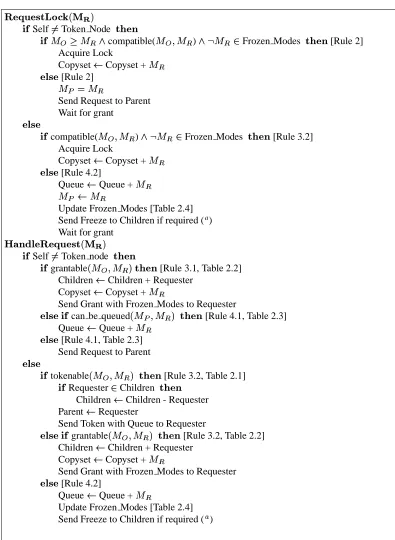
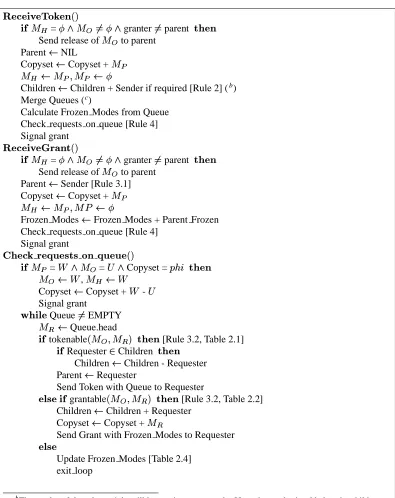
Figure 2.4 and 2.5 depict the pseudo-codes for the above described rules for lock request handling. RequestLock() represents the user API whereas other operations are handlers invoked in response to message reception. (Ignore the details regarding frozen modes for now).
The predicate grantable(,
) indicates whether and
satisfy Rule 3.1. to-kenable (,
) indicates whether and
the compatibility matrix of Table 2.1 shows a conflict betweenand. The pseudo-procedure Check requests on queue() in Figure 2.5 handles locally queued requests as described in Rules 4 and 5.
2.2.5 Lock Release
The following rule governs the handling of lock releases. As an implementation detail, remember that the parent nodes keep track of the owned mode of their immediate children. (The request granter records the granted modes while granting requests and the requester becomes the child of granter).
Rule 5:
1. When the token node releases a lock or receives release from one of its children, it considers the locally queued requests for granting under constraints of Rule 3.
2. When a non-token node releases a lock or receives a release in some mode
, it will send a release message to its parent only if the owned mode of is changed (weakened) due to this release.
The first part of this rule is similar to Naimi’s protocol in that queued requests are served upon a release. If a token node has received release notifications from its children and if the token node is no longer engaged in a critical section, it will send the token to the first requester in its local queue. In addition, the local queue is piggybacked to ensure that other requests will be considered by the token recipient and so on.
The second part of the above rule ensures that release messages are only sent if necessary, i.e., when owned modes change. Upon receipt of a release message, the parent may safely assume that neither the child nor its children (or grandchildren) are holding the lock in the released mode. Nonetheless, the child may still own the lock in some weaker mode, which is included in the mes-sage to allow the parent to update the log of owned modes for its children. Overall, this protocol reduces the number of messages compared to a more eager variant with immediate notification upon lock releases. In our approach, one message suffices, irrespective of the number of grandchildren.
Example: Consider Figure 2.6(a) as the initial configuration. Here,
is waiting for the
request to be granted, which is queued locally by. Suppose releases the lock in . According to Rule 5.2, it will not notify its parent about the release as the owned mode of is still due to
(one of its children) still owning the lock in mode . However, the held mode of is changed to
Self Token Node compatible( ) Frozen Modes [Rule 2] Acquire Lock
Copyset Copyset +
[Rule 2]
Send Request to Parent Wait for grant
compatible( ) Frozen Modes [Rule 3.2] Acquire Lock
Copyset Copyset +
[Rule 4.2] Queue Queue +
Update Frozen Modes [Table 2.4] Send Freeze to Children if required (a)
Wait for grant
! Self Token node grantable
[Rule 3.1, Table 2.2] Children Children + Requester
Copyset Copyset +
Send Grant with Frozen Modes to Requester
can be queued
[Rule 4.1, Table 2.3] Queue Queue +
[Rule 4.1, Table 2.3] Send Request to Parent
tokenable
[Rule 3.2, Table 2.1]
Requester
Children
Children Children - Requester
Parent Requester
Send Token with Queue to Requester
grantable
[Rule 3.2, Table 2.2] Children Children + Requester
Copyset Copyset +
Send Grant with Frozen Modes to Requester
[Rule 4.2] Queue Queue +
Update Frozen Modes [Table 2.4] Send Freeze to Children if required (") #
Freeze is sent to the child only if the child is potential granter of the mode to be frozen and the mode is not already frozen
= granter parent
Send release of
to parent Parent NIL
Copyset Copyset +
Children Children + Sender if required [Rule 2] (
b)
Merge Queues (c)
Calculate Frozen Modes from Queue Check requests on queue [Rule 4] Signal grant = granter parent
Send release of
to parent Parent Sender [Rule 3.1]
Copyset Copyset +
Frozen Modes Frozen Modes + Parent Frozen
Check requests on queue [Rule 4] Signal grant = = Copyset = ,
Copyset Copyset +
-Signal grant Queue EMPTY Queue.head tokenable
[Rule 3.2, Table 2.1]
Requester
Children
Children Children - Requester
Parent Requester
Send Token with Queue to Requester
grantable
[Rule 3.2, Table 2.2] Children Children + Requester
Copyset Copyset +
Send Grant with Frozen Modes to Requester
Update Frozen Modes [Table 2.4] exit loop
The sender of the token might still be owning some mode; If so, the sender is added to the children set of the new token node. Otherwise not.
The queue at the old token node is passed to the new token node along with the token. The new token node itself may have a local queue, too. These queues are merged preserving FIFO ordering as discussed in [29].
B(R,R,0) D(R,R,0) C(0,0,IW) B(R,0,0) C(0,0,IW) RELEASE D(0,0,0)
{C,IW} {C,IW} {C,IW}
C(0,0,IW) B(0,0,0) D(0,0,0) RELEASE B(0,0,0) D(0,0,0) C(IW,IW,0)
(c) A Releases R (b) D Releases R
(a) B Releases R (d) Final state
A(R,0,0) A(R,R,0)
A(R,R,0) A(0,0,0)
Figure 2.6: Lock Release Example
As shown in (b), when
releases , it sends a release message to its parent ( here) because the
owned mode of
is changed to
from (which is weakened). When receives this release, none of’s children now own a mode stronger than
. Hence, the owned mode of is changed to
. sends the release to its parent ( here) due to Rule 5.2. In (c), also releases and, because it is not aware of the change in owned mode of , its owned mode is still . Only when the release arrives at does know about the changed mode of , which triggers a change in ’s owned mode from to
. As shown in (d), this in turn triggers the transfer of token to
(according to Rule 5.1).
Copyset Copyset
Update Frozen Modes [Table 2.4]
Changed Mode of Self
[Rule 5] Send Release to Parent
Check request on queue [Rule 5]
!
[Rule 5] Update Children for change in
of Child Update Copyset for change in
of Child
Changed Mode of Self
Send Release to Parent Check requests on queue
Figure 2.7 depicts the pseudo-code of the lock release handling. RequestUnlock() is a user API.
2.2.6 Fairness and Absence of Starvation
The objective of providing a high degree of concurrency conflicts with common concur-rency guarantees. For example, the reader-writing problem for databases is subject to starvation if new readers are accepted as long as at least one reader is active. Queued write requests, which are incompatible, would never be served if readers arrived fast enough. Consider the queuing of our protocol. Grants in response to a request may be unfair in the sense that the FIFO policy of serving requests could be violated. In essence, a newly issued request compatible with an existing lock mode could bypass already queued requests, which were deemed incompatible. Such a behavior is not only undesirable, it may lead to starvation due to the described race.
A(0,0,0)
D(W,W,0)
(c) A,B,C Release R,IR,IR
C(0,0,0) E(0,0,0)
B(0,0,0)
D(0,0,0) B(IR,0,0)
C(IR,IR,0) E(0,0,0)
A(R,R,0)
(a) D requests W
B(IR,0,0) A(R,R,0)
D(0,0,W)
FREEZE(IR) IR IR,R,U
FREEZE(IR)
(b) A sends Freeze
IR
C(IR,IR,0) E(0,0,0)
{D,W}
Figure 2.8: Frozen Modes Example
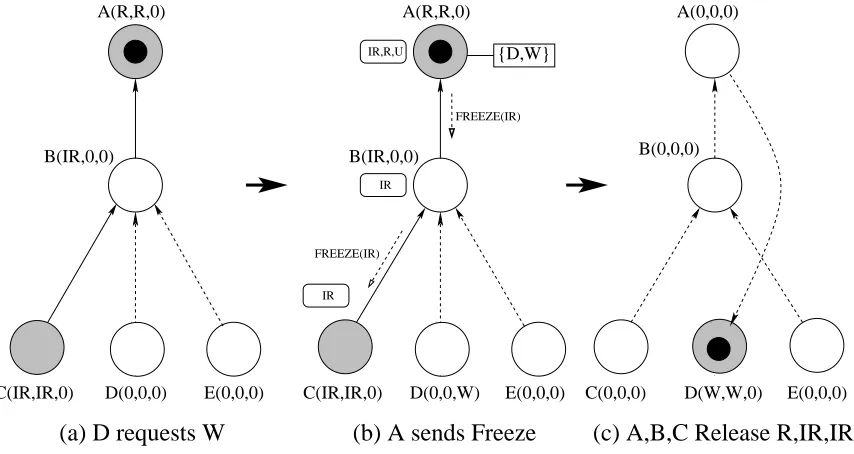
Consider a request by
for mode
in the state of Figure 2.8(a). (Ignore freeze messages and frozen modes for now).
will reach according to the rules described above, and will queue it according to Rule 4, as shown in (b). Once and
release their locks for and , respectively, the token will be forwarded to
due to Rule 3, as depicted in Figure 2.8(c). While
waits for
to advance, may grant other
Rule 3. As mentioned before, accepting
requests potentially violates the FIFO policy since
arrived first. After
is received, we should be waiting for release of
modes since they are not compatible with
. This prevents from granting the pending
request. If, however, subsequent
requests are granted, the
request may starve.
We ensure fairness in terms of FIFO queuing and, thereby, avoid starvation by freezing certain protocol states upon reception of incompatible requests. For example, the token node , after receiving
, will not grant any other requests compatible with the waiting request ( in this case). Other modes (
and in this case) are said to be frozen when certain requests (
in this case) are received, depending on the mode owned by the token node ( in this case). The rationale behind the freezing mechanism can be formalized by the following invariant:
Let be the set of modes to be frozen at token node when the token node owning lock
in mode receives a request for
in mode . Then, (2.2)
Token Node owning Requested Mode
Mode IR R U IW W
No lock –
Intention Read – IR IR, R, U, IW
Read – R R, U IR, R, U
Upgrade – U R IR, R
Intention Write – IW IW IW IR, IW Write – W
Table 2.4: Rules for Freezing Lock Modes at the Token Node
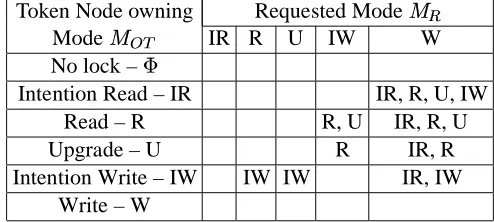
Table 2.4 depicts an enumeration of frozen modes for all combinations of and
. For instance, if the token node is owning a lock in and a
request is received and queued locally (as depicted in Figure 2.8(b)) then
, and are the modes to be frozen at the token node according to invariant 2.2.
In order to extend fairness beyond the token node, mode freezing is transitively extended to the copyset where required by modes. This ensures that potential granters of any mode incom-patible with the requested mode will no longer grant such requests. For instance, in Figure 2.8(b), hadnot notified its child about the frozen modes, would potentially grant any future requests for
. This will further delay the grant of the waiting
was received first. To avoid this version of FIFO violation, the token node notifies children about the frozen modes by sending a freeze message. The propagation of freeze messages can be formalized by the following invariant:
Let be the set of modes to be sent with the freeze message to a child owning
in . Then,
(2.3)
These invariants are effected by the following rule which supplements Rules 2 and 3:
Rule 6:
A node may grant a request only if the requested mode is not frozen.
! !
Frozen Modes Frozen Modes + Modes
Send Freeze to Children if required (")
Figure 2.9: Pseudocode for Freezing Mechanism
The pseudo-code of this freezing mechanism is augmented to almost all the other routines where requests are granted (Routines in Figure 2.4, 2.5 and Figure 2.11). Figure 2.9 depicts the pseudo-code for the freeze message handler. Through this freezing mechanism, ultimately, all children and grandchildren will release their modes, and a release message will arrive at the token node for each of its immediate children. Thus, the FIFO policy is preserved.
2.2.7 Upgrade Request
Upgrade locks facilitate the prevention of potential deadlocks by very simple means if the resulting reduction in the concurrency level is acceptable [18]. Upgrade locks conflict with each other (and lower strength modes), which ensures exclusive access rights for reading. This policy supports data consistency between a read in update (U) mode and a consecutive upgrade request for write (W) mode, which is commonly used when the written data depends on the prior read.This is reflected in the following rule.
Rule 7: Upon an attempt to upgrade to W, the token owner atomically changes its mode from U to
W (without releasing the lock in U).
Example: As depicted in Figure 2.10(a), owns and requests an upgrade to
. Note the pending mode ofreflecting this situation. As this request
sent to the children according to Rule 6. During this period,does not release (atomic upgrade) but waits for a release message to arrive from. Ultimately when
releases
, release messages are triggered. , according to Rule 5, changes its owned mode from to
and can now perform writes on the same data. Figure 2.11 is the pseudo-code of the RequestUpgrade() user API.
B(IR,0,0) IR
FREEZE(IR)
(a) A requests Upgrade
A(U,U,W) IR,R
FREEZE(IR)
IR
C(IR,IR,0) E(0,0,0)
B(0,0,0)
C(0,0,0) E(0,0,0) A(W,W,0)
(b) Upgrade complete
Figure 2.10: Request Upgrade Example
!
[Rule 7]
Copyset
Release U Acquire W
Update Frozen Modes [Table 2.4] Send Freeze to Children if required (")
Wait for grant
2.3
Summary
In summary, lock, unlock and upgrade operations provide the user API. The remaining operations are triggered by the protocol in response to messages, i.e., for receiving request, grant, token release, freeze and update messages. In each case, the protocol actions are directly derived from corresponding rules and tables, as indicated in the algorithm. This greatly facilitates the imple-mentation since it reduces a seemingly complex protocol to a small set of rules defined over lookup tables in practice.
Rules 2, 3 and 4 (the only rules governing the granting of requests) coupled with Rule 1 ensure correct mutual exclusion by enforcing compatibility. Rules 4 and 5 together ensure that each request is eventually served in the FIFO order, thus avoiding deadlocks and starvation.
Chapter 3
The Prioritized Protocol
In this chapter, we describe the prioritized version of our protocol. First, we motivate priority support for the hierarchical locking protocol described in the previous chapter along with a brief description of prior work to support priorities for distributed synchronization. Next, we describe the design of the prioritized protocol derived from our basic protocol. We also address the problem of bounding the priority inversion duration by employing inheritance protocols such as PCEP and PIP.
3.1
Motivation
In this section, we motivate priority support for our basic hierarchical locking protocol described in the previous chapter. We also describe in brief, a prior approach by Mueller [30] to support priorities of requests for distributed mutual exclusion and motivate supporting hierarchical locking along with request priorities.
3.1.1 Prior Work
priority information on intermediate nodes during request forwarding. Thus, if the request by passes along a node
, the probable owner for requests with priority is set to . (Higher priorities denote more important requests.)
The next list approach of Naimi’s protocol is replaced by a queue of locally stored requests to avoid race conditions. Each request seen by a node is stored in this local queue ordered first by decreasing priority, and then in FIFO order. When the token arrives at a requesting node, the requests are gradually removed from the queue of other nodes.
The example in Figure 3.1 depicts a sequence of token requests of A, B, C and D with priority 1, 2, 1 and 3, respectively. The token resides in node while the requests arrive. For the
T
B
C
D
A
T Q: (A,1)
B
C
D
A
T Q: (B,2),(A,1)
C
D
A
B
(A,1)
(B,2)
<= 1
<= 1
<= 1
> 1
<= τ
> 2
<= τ
<= τ
> 1
<= τ
<= τ
<= τ
> 1
<= τ
<= τ
<= 2
B Q: (C, 1)
(D,3)
Request
> 2
<= τ
T Q: (B,2),(A,1)
C
D
A
(C,1)
<= 1
<= 1
> 1
> 1
<= 2
B Q: (C, 1)
Request
Request
Request
> 2
> 3
T Q: (D,3),(B,2),(A,1)
C
D
A
<= 2
<= 3
<= 1
<= 1
> 1
> 1
Figure 3.1: Non-hierarchical Priority Support Example
priority are handled by. Other edges include , and . Any request is locally logged, then the probable owner is determined as the last node whose request was seen with greater or equal priority. The probable owners are updated so that edges with less or equal priority than the current request are replaced by the new request. If the token is not present locally, the request is added to the local queue and a message is sent to the probable owner. When a node issues a request at priority , this request propagates along the chain of probable owners until it reaches a node
with a pending request at priority . It is then locally queued at
. The basic idea is that node
has to be served before our request. Thus, ’s request may be stored locally until the token arrives. Once the token arrives, ’s request should be served after
’s if no other requests have arrived since then. This is also depicted in Figure 3.1, where local queues are associated with nodes and. Node stores
’s request at priority one since has an outstanding request at priority two that will be served first.
While this protocol supports priorities of requests with a simple and elegant solution, it does not differentiate between lock access modes. Also, it does not study the problem in the context of hierarchical locking scheme specified in [18]. Since hierarchical locking schemes constitute a solution to the problem of scalability, this protocol may not be suitable for large distributed environ-ments with focus on scalability. Our prioritized protocol described below borrows some of the basic mechanisms from this simple protocol and extends our basic hierarchical locking protocol described in the previous chapter to support request priorities.
3.1.2 Basic Protocol
Let us revisit Figure 2.8 of our basic protocol from the viewpoint of real-time applications. Possibly, timing requirements of node can be more stringent than those of node
. In that case, requests issued by should have higher priority than those issued by
. We should have granted
, overruling the frozen modes, thereby giving preference to over
. Enforcing FIFO vmay result in unbounded priority inversion, and the QoS of the upper layer applications will be compromised significantly. While the base protocol works best for non-realtime applications and ensures FIFO policy, it does not handle priorities adequately.
1. Freezing Mechanism: Overrule the frozen modes if the received request has higher priority than the request waiting in queue.
2. Queue Reordering: Order the local queue of requests first according to their priority and then according to FIFO.
3. Queue/Forward Policy: Change the local queuing policy to take into account the priority of received request Vs. the priority of pending self-requests in the case of Rule 4.1.
We describe each of these improvements and their motivations in the following subsections.
3.2
Freezing Mechanism
As illustrated in Figure 2.8, the current implementation of the freezing mechanism poten-tially results in unbounded priority inversion. Here, we examine the freezing mechanism outlined in the previous chapter and provide the extensions to overcome the shortcomings.
In the base protocol freezing mechanism, sets and calculated by invariants 2.2 and 2.3 were unified with a set recording the state for each of the six modes mentioned in inequation 2.1 at each node. The only values each of the elements in could take were and . Rule 6 used this information and approved a grant/token for requested mode
if the set had as the state
value of the element corresponding to
. This meant that any request, regardless of its priority, could cause a set of elements of to assume state if it were queued at the token node. Any request for any of those modes in the future, regardless of their priority, would be disapproved by Rule 6. This violates the strict priority policy according to which, higher priority requests should never block for lower priority requests. The solution to the problem is quite intuitive and elegant. Let threshold be the priority of the highest priority request causing the freeze of some modes in . The elements of the set can be made to record the threshold of the requests that caused the freeze. Table 3.1, the prioritized version of Table 2.4 outlines the improved mechanism.
Hence, Rule 6 can be replaced by its prioritized version as:
Rule 6
:
A request for mode
can only be granted if
Token Node owning Requested Mode
Mode IR R U IW W
No lock –
Intention Read – IR IR, R, U, IW
Read – R R, U IR, R, U
Upgrade – U R IR, R
Intention Write – IW IW IW IR, IW
Write – W
Table 3.1: Rules for Freezing Lock Modes at the Token Node (Prioritized)
3.3
Reordering Queue
The following rule gives preference to higher priority requests when requests are queued locally.
Rule 8:
1. While queuing a request with priority locally, it is queued first according to the non-increasing order of priority and then according to non-non-increasing order of usage times and finally increasing order of their receipt times (described in [29, 30]).
2. While receiving the token and merging the local queue with the queue received from the original token node, the queue is sorted according to the order described in Rule 8.1.
3.4
Queue/Forward Policy
The essence of the policy to queue requests locally is to enable path compression for requests, thereby reducing the message overhead without violating FIFO. Consider the initial state shown in Figure 3.2(a) and request
from followed by a request
from D. According to Rule 2, both will be forwarded to their respective parents. When A receives
, it cannot grant it due to Rule 3.2 and queues it locally according to Rule 4.2. While is waiting, it receives the request
and cannot grant it according to Rule 3.1 but queues it according to Rule 4.1 and Table 2.3. The rationale behind this table is as follows: Had
been forwarded to instead of queuing locally at,would not be able to grant it and
would never precede
the queue at due to FIFO policy. This means that
will always be granted before . By queuing
at, we reduce the amount of request propagation messages and promote the distribution of queued requests to multiple sites instead of a single large queue at the token node. Ultimately, when
is granted, is guaranteed to be able to grant the locally queued
due to Rule 3.1.
A(IW,IW,0)
{B,R}
{D,R}
D Requests R
B(0,0,R) D(0,0,R) C(IR,IR,0) A(IW,IW,0) C(IR,IR,0) B(0,0,R) {D,R} {B,R} D(0,0,R)
(a) B Requests R,
IW
(b) {D,R} Queued by B
Figure 3.2: Request Queuing/Forwarding Example (Prioritized)
Consider real-time applications with
. According to Rule 8.1, will precede
in the queue at. This means that queuing
locally at results in (poten-tially unbounded) priority inversion. This leads us to extend the Table 2.3 as shown in Table 3.2, bold faces indicating extensions. Essentially, to queue the request locally, should be met in conjunction to the conditional of Table 2.3.
3.5
Example
We describe an example here that illustrates the prioritized protocol and its policies we just described. To simplify the details (without restricting the generality), assume that
, , , and
, with larger values denoting higher priorities. Assume an initial state of the system as shown in Figure 3.3(a). is waiting for its request
to be served while has queued
Non-token Pending Requested Mode
Mode IR R U IW W
No pending –
F F F F F
Intention Read – IR CQ F F F F
Read – R F CQ F F F
Upgrade – U F F CQ CQ CQ
Intention Write – IW F F F CQ F
Write – W CQ CQ CQ CQ CQ
Conditional Queuing CQ = IF(
) THEN ’Q’ ELSE ’F’
Table 3.2: Queue / Forward Decision (Prioritized)
modes and frozen at thresholds according to invariant 2.2 and Table 3.1. has also sent a freeze message with
according to invariant 2.3. Next, consider a request
from
as shown in (b).
forwards the request to its parent . cannot grant it due to Rule 3.1 and also cannot queue it locally as the conditional of Table 3.2. Hence, Rule 4.1 is not satisfied ( ) and
is forwarded to . cannot grant it due to incompatibility and locally queues
ahead of
as per Rule 8.1. Queuing of
at causes the thresholds of and to be boosted to
as per Table 3.1. Notice that we have to notify
about this boost of thresholds to prevent
from granting requests with priority
. As a result,
has the threshold of boosted to
. Next, consider a request
from as depicted in (c). forwards it to its parent , cannot queue it or grant it and forwards it to. can grant a copy to the requester as Rule 3.2, and Rule 6
permits this action since holds at . Since is the higher priority node, it receives a grant immediately and becomes a child of (Rule 3, operational specification 2). Notice that needs to be sent the that satisfy invariant 2.3, which is
in this case.
3.6
Bounding Priority Inversion
The examples we have presented so far are in the context of a single lock
(c) Final state
D(0,0,0) E(0,0,0)
C(R,R,0) {B,IW}
(a) D Requests IW
A(R,R,0) B(0,0,IW) D(0,0,IW) E(0,0,0) B(0,0,IW) A(R,R,0) {D,IW} {D,IW} C(R,R,0) FREEZE (R,4)
(b) E Requests R
B(0,0,IW) D(0,0,IW) C(R,R,0) E(R,R,0) (R,4) (R,4) {D,IW}{B,IW} {D,IW}{B,IW} (R,2) (R,4) A(R,R,0)
(R,2)(U,2) (R,4)(U,4) (R,4)(U,4)
Figure 3.3: Prioritized Protocol Example
. The policies we described in the previous section allowed us to bound priority inversion local to one lock, such as
. But considering the scenarios in the global context with all such , still poses a potential for unbounded priority inversion.
Consider Figure 3.3(a) again. Queuing of
by may result in unbounded pri-ority inversion as
and is waiting for. A similar situation arises when queues
as depicted in Figure 3.3(b).
Obviously, cannot grant any of these requests straight away due to the conflict be-tween its owned mode and the requested modes
. To see how the current policies will lead to unbounded priority inversion in such situations, consider the logical tree for some other lock as shown in Figure 3.4(a).
is waiting for
to be granted, while
and are own-ing/holding
and
is queued due to incompatibility. As a result,
has
as per Invariant 2.2 and Table 3.1. has been notified about
as per Invari-ant 2.3. Let us assume
enters the state described in Figure 3.3(b) prior to entering the state described in Figure 3.4(b). As shown Figure 3.4(b),sends its request
to and
queues it locally as the Rule 6
disapproves the grant (even though Rule 3.1 allows it). Additionally,
is queued after
due to Rule 8.1. Once
and release their locks, the token will be transferred to
(according to Rule 5) and
will still be queued at
(c) Final state
E(0,0,0) D(IW,IW,0)
C(0,0,W) E(0,0,0) {C,W} (IR,3)(IW,3)
(IW,3) A(0,0,0)
(a) Initial State
B(IW,IW,0)
C(0,0,W) A(0,0,IR)
{C,W}{A,IR}
{A,IR}
(b) A Requests IR
D(IW,IW,0) (IR,3)(IW,3)
B(IW,IW,0) (IW,3)
D(0,0,0)
E(0,0,0)
B(0,0,0)
C(W,W,0)
{A,IR}
A(0,0,IR)
Figure 3.4: Priority Inversion Example
upper segments correspond to activity on
while lower segments sorrespond to activity on for each node.
A
B
C
D
E
R
R
W
I
W
I
R
I
W
W
I
W
I
R
W
RELEASE
RELEASE
ACQUIRE
WAIT
WAIT
WAIT
WAIT
TIME
3.3(a) 3.3(b)3.4(b) 3.4(c)
Figure 3.5: Time Line Representation of Priority Inversion Scenario
and
are waiting for in the context of
(as shown in Figure 3.6(a)) while is waiting for
in the context of (as shown in (b)). Hence, in a global context and
wait for transitively, as shown in (c). In general, an unlimited number of future requests from nodes such that
can be queued at
in the state of Figure 3.4(a). In summary, can potentially be waiting for an unbounded number of lower priority requests causing unbounded priority inversion as shown in Figure 3.6(d).
B B B
A
D A
C C
A
D D
A
C N1
(d) Worst Case (a) Context of Li (b) Context of Lj (c) Global Context
Figure 3.6: Wait-for Graphs
In the following section, we discuss various priority inheritance protocols as a solution to the problem of unbounded priority inversion. We also describe the implementation of two of the most prominent inheritance schemes, viz. PCEP and PIP, for our protocol.
3.7
Priority Inheritance
3.7.1 Priority Ceiling Emulation Protocol(PCEP)
Priority ceiling protocols in general require that a priority value, the ceiling
, be asso-ciated with a resource
and the corresponding lock
.
is defined as the priority of the highest priority node contending for
. The original priority ceiling protocol (PCP) determines the ceiling off-line for static priority scheduling [40]. The dynamic priority ceiling protocol (DPCP) deter-mines the ceiling online at the time of resource contention for dynamic priority scheduling [10]. Both PCP and DPCP only grant a resource to a requester if its priority is greater than the ceilings of all resources in use by other tasks. Should a requester block due to this rule, its priority is inherited by the node that holds the requested resource. While both protocols avoid chained blocking (such as induced by the transitivity property of PIP), they still require the following properties:
DPCP only: The state of all resources must be inspected to determine the maximum ceiling value
of held resources.
PCP and DPCP: A node’s priority may be changed during execution of a critical section.
The first property cannot be realized efficiently in the absence of shared memory. In a dis-tributed system a number of messages have to be exchanged to collect information about global state while any other activities potentially modifying this state have to be suspended. Thus, DPCP is not suitable for distributed environments. The second property may result in multiple priority changes while holding a resource. This property can be realized by extending the prioritized protocol for re-issuing requests, which will be discussed in the context of the priority inheritance protocol. Thus, PCP is suitable for distributed environments and can be realized by extensions of the prioritized protocol.
A third variant, the priority ceiling emulation protocol (PCEP), offers an even easier solu-tion. This protocol combines the general idea of the original PCP [40] with early priority boosting to the ceiling level immediately upon granting resource requests as proposed in the stack resource protocol [4]. It also requires that the ceilings be computed statically (as for PCP). When granting a resource
, PCEP boosts the priority of a requester node to
. When releasing a resource
by node , which still holds a subset of
resources, PCEP lowers the effective priority of to
of implementation. As a result, PCEP has been adopted by industry standards such as POSIX and Ada95 [21].
PCEP can be used with minimal changes to the prioritized protocol presented so far. It can be extended as (bold face extensions in Figure 3.7):
1. Boost the requester’s priority upon acquiring the resource in ReceiveToken or ReceiveGrant as described before.
2. Lower its priority upon releasing the resource in RequestUnlock as described before.
//All the other operations
//All the other operations
//All the other operations
Figure 3.7: Extensions for Ceiling Emulation
Implementing PCEP in the example of Figure 3.3(a) will boost
as
soon as acquires on
. Consequently, the request
is never queued in Figure 3.4(b). Instead, it is granted immediately due to Rule 3.1 and Rule 6
and, hence, priority inversion is bounded.
These modifications do not require any additional message overhead. The resulting proto-col provides the most efficient solution to bounding priority inversion in the protoproto-cols for real-time distributed concurrency control to our knowledge.
3.7.2 Priority Inheritance Protocol (PIP)
The PIP protocol requires that the priority of a node holding a resource be boosted to some value upon detection of a contention for this resource [40]. The protocol also requires transitive boosting when node requests resource
resource held by node
. This situation is commonly known as chained blocking. In this case,
will inherit ’s priority (if
) since node
causes node to be blocked indirectly through node . Transitive priority changes may cause a chain of priority boosts along the contention dependencies of resources.
Also, considering the global context of locks, a node may have its effective priority boosted due to a contention for multiple locks in that is holding. Hence, when releases one of its locks, its effective priority should be the highest of the effective priorities due to all the locks it is still holding. To calculate this new effective priority, we keep track of the highest boosted priority for each of the locks and call it the effective priority of a lock. We describe the extensions as follows (see bold-face extensions in Figure 3.8):
HandleRequest: If the request for
is being queued at the token node (a contention is detected) then
1. Send the freeze messages with frozen thresholds to its children. (This notifies the children holding conflicting modes for this lock for boosting their priority as stated in Lemma 1.) 2. If the request conflicts with token node’s (self) held mode, boost self’s effective priority to
= max( ,
and boost the effective priority of this lock to = max(,
. If self’s effective priority is changed, re-issue all the pending requests for all the locks
. (This boosts self’s effective priority in case of a conflict.)
HandleFreeze: If a child receives a freeze message from its parent and if the child is holding the
lock in any mode, a conflict between a child’s held mode and a recently queued requested mode at the token node is detected. The child boosts its effective priority to = max( , max(Frozen Modes.threshold)). If self’s effective priority is changed, the child reissues all the pending requests for all the locks
. The child also boosts the effective priority for this lock to= max(,max(Frozen Modes.threshold)).
RequestUnlock: When a lock is released, self’s effective priority is lowered to = max( (self), max(
IF(Held(
)) THEN
ELSE NIL))). Once the lock is released, the effective priority for this lock is lowered to the lowest priority
, i.e.,
.
HandleReissuedRequst: If a reissued request is received that is already present in our local queue,
!
IF Self
Token node THEN IF grantable( , ) [Rule 3.1] ELIF queuable( ,
) THEN [Rule 4.1, ]
ELSE [Rule 4.1] ELSE
IF tokenable
THEN [Rule 3.2] ELIF grantable
THEN [Rule 3.2] ELSE [Rule 4.2]
Queue Queue +
! ! ! ! ! ! ! ! ! ! ! ! ! ! ! ! ! ! ! ! ! ! !
locally (Table 3.2). Hence, the request is dequeued and forwarded to the parent. Also, updating the priority of the queued request may cause the frozen thresholds to be boosted and sent to the children according to Table 3.1 and Invariant 2.3.
Notice that while sending freeze messages to children with necessary thresholds (as given by Table 3.1 and Invariants 2.2 and 2.3), we assume that whenever there is a potential conflict between the request being queued and the held mode of the children, a freeze message will always be sent to those children. Lemma 1 explicitly states this requirement:
Lemma 1 If a child owns lock
in mode and a request for mode
is received by the
token node owning
in such that the modes are in conflict, then a freeze message will be
sent to the child.
Proof:
conflicts( ,
) conflicts(,
) [as
].
Let be a set of all modes to be frozen at the token node according to Invariant 2.2,
(3.1)
Let be a set of all modes that will be sent to the child according to Invariant 2.3,
(3.2) If the calculated in constraint 3.2 is non-empty, the token node will send a freeze to the child.
By substituting
in constraint 3.2, the constraint is satisfied as
[U and W mode owners cannot be children], conflicts( ,
) is true
and grantable(, ) is always true for a child of a token node.
Chapter 4
Experiments
Our experimental results not only serve the purpose of empirical evaluation and analysis, but they also demonstrate the feasibility and applicability of the protocol for different application areas. The performance and applicability of our protocol are elaborated in the respective contexts in the discussion below. The experimental setup and the protocol parameters are designed to match a unique set of applications in each case.