A DUPLICATION OF THE
H,
(FLAGELLAR ANTIGEN) LOCUS IN SALMONELLA’JOSHUA LEDERBERG
Department of Genetics, Stanford University School of Medicine, Palo Alto, California Received May 30, 1961
YPICAL Salmonella strains are “diphasic” with respect to their flagellar ‘antigens. That is, they manifest one of two genes, H I or H,, but not both in a given clone until a phase variation takes place and the alternative antigen is expressed.
The genetic analysis of this alternation by transductional methods ( LEDER- BERG and EDWARDS 1953; LEDERBERG and IINO 1956) has shown that the varia- tion depends on a “change of state” at the H , locus. The alternating factor has not been separated by recombination from the determinant for antigenic spec- ificity of H,. On the other hand, repeated cycles of alternation in state have occurred at H , without influencing its antigenic specificity. The H , gene, the determinant of the antigen of the alternative phase, is not linked to H,, but the expression of H I depends on the inactive state of H,. The present paper is part of a comprehensive study of the genetics of Salmonella phase variation ( IINO 1958, 1961 a,b)
.
Various anomalies, or exceptions to the simple pattern of diphasic variation have occurred, whose assimilation to the general scheme can throw light on the genic control of protein synthesis. The anomaly presented in this paper is repre- sented by CDC-157, a strain of Salmonella paratyphi B , now much used as a n antigen for the production of diagnostic anti-1.2 antiserum (EDWARDS and BRUNER 1942). The advantage of CDC-157 for this purpose is its apparent monophasic behavior; that is, large clones will consist nearly exclusively of cells whose flagellar antigen is 1.2. A genetic analysis of this strain has revealed two anomalies: (1) The 1.2 antigen is determined by a n allele at the H , locus instead of the H , usual for this antigen, and (2) the stock is carrying a duplicate H ,
locus. The genotypic formula of CDC-157 is thus H l b H l l . z , by contrast to the geno- type HlbHS1., for typical strains of S. paratyphi B . These genotypes accurately
summarize the genetic behavior of the respective strains.
MATERIALS, METHODS A N D RESULTS
The basic techniques of transductional analysis and background information on Salmonella immunogenetics have been detailed in a previous paper (LEDER-
1 These studies were mainly conducted at the Department of Genetics, University of Wis- consin in 1953. DR. TETSUO IINO’S association with them has done much to clarify the issues brought up here. The work was supported by research grants from the National Cancer Institute,
U.S. Public Health Service (C-2157) and the National Science Foundation.
1476 J O S H U A LEDERBERG
BERG and IINO 1956). To recapitulate, a phage grown on a strain A may carry individual markers, or a small cluster of closely linked markers, to strain B, an operation symbolized A-x B or its equivalent B X-A. The transduced markers replace their homologues in the recipient, an event usually detected by selection against the recipient marker. In this case specific antiserums are used to im- mobilize cells of the recipient flagellar serotype. The H , and H , loci are trans- duced independently, as if unlinked to one another, but H , is linked to certain Fla-
(flagellaless, nonmotile) factors. The frequency of transduction is so low, per marker per phage, that unlinked markers are never, in practice, found to- gether in the same transduction clone.
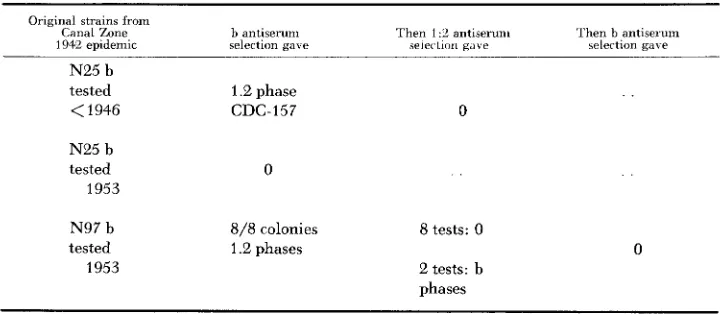
Strain CDC-157 was kindly furnished by DR. P. R. EDWARDS, of the Com- municable Disease Center, U.S. Public Health Service, Atlanta, Georgia, and he has also searched his archives for information on its history. A group of some 25 strains was isolated about 1942 from an outbreak of gastroenteritis in the Canal Zone, and identified as S. paratyphi B, var. jaua, i.e., monophasic b and d-tartrate- positive, phage type 3b. Attempts to select alternative phases by selection with b-antiserum met with sporadic success (EDWARDS and BRUNER 1946). CDC-157 itself was such a selection from a culture designated as N25. Further attempts by EDWARDS and BRUNER, and by us to repeat such a selection from this culture, have been unsuccessful, and the two cultures may be accurately designated as monophasic 2.2 and b respectively. Another culture, N97, had been isolated from the same outbreak, and also designated as b. After it was received from DR.
EDWARDS in 1953, however, this culture and single-colony reisolations sporadi- cally generated 2.2 phases after selection in b antiserums. The analysis reported here has therefore concentrated on N97 (see Table 1). The sluggishness of phase variation of N97 and its derivatives has undoubtedly been the chief obstacle to this work.
Other strains and techniques have been fully described in previous publications
TABLE 1
History of strains N25, N97 and CDC-157
Original strains from
Canal Zone b antisernni Then I :2 antiserum Then b antiserum 1942 epidemic selection g a l e seleclmn g.ive selection gave
N25 b
tested 1.2 phase
<
1946 CDC-I57N25 b
tested
1953
0
0
N97 b 8/8 colonies 8 tests: 0
tested 1.2 phases
1953 2 tests: b
phases
DUPLICATION O F LOCUS 1477
(STOCKER, ZINDER and LEDERBERG 1953; LEDERBERG and I I N O 1956; LEDERBERG
1956). Most of the cultures stem from the type collection in DR. EDWARDS' labora- tory (EDWARDS and BRUNER 1942). Many of the specific sera were kindly fur- nished from the same source and by the Standards Laboratory, Central Public Health Laboratory, Colindale, London. DR. EDWARDS has also confirmed the serotypes of the principal cultures described here.
Variation
in
strain N97: Upon selection in anti-b agar each of eight single colonies of N97 ( b ) gave 1.2 phases, though many of the tubes showed no swarms for several days. But only two of a total of ten isolated 1.2 phases, which may be abbreviated N97 ( b ; 1 . 2) , would revert to b ( b ; 1.2; b ).
The phases were refrac- tory to further attempts at demonstrating phase variation. Similar trials with N25 ( b ) gave no 1.2 phases, though CDC-157 had been isolated some years before as a stable 1.2 variant from N25 ( b ).
The following cultures are therefore avail- able for further study: the original N25 ( b ) and N97 ( b ),
presumably of com- mon origin; the N25 (1.2) secured in 1946 and N97 (1.2) recently obtained from N97 ( b ).
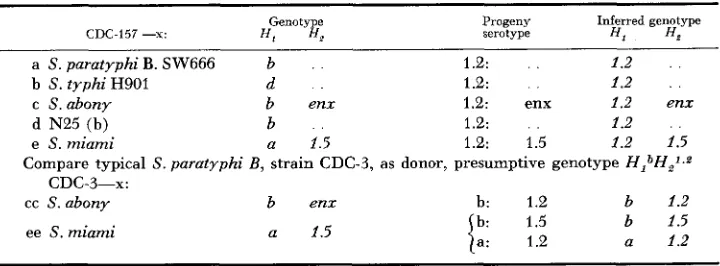
At the present time, the N25 cultures are stubbornly monophasic, while variation from b 1.2 can be demonstrated with some difficulty in N97 cultures.Transductions with N25 (1.2) = CDC-157: The present study of this strain stems from the findings of transduction experiments that its 1.2 antigen is con- sistently inherited and at the H , rather than at the H , locus (Table 2 ) . For ex- ample, in transductions from CDC-157 to S. abony H I b H e e n z (symbolized CDC-
157-xabony) the progeny was 1.2:enz, a serotype which does not occur naturally. This suggests that the 1.2 antigen of CDC-157 is homologous with the
b ( H I b ) rather than the enx (H,""") antigen of S. abony. By contrast, transduc- tions of the 1.2 antigen to S. abony from typical diphasic strains such as S.
typhimurium or S. paratyphi B have led to the serotype b:1.2, supporting the homology of the typical H Z 1 . , with HteQZ. These results are different but unam- biguous depending entirely on the specific strain used as donor. The other trans- ductions of Table 3 furnish additional support for the formulation of CDC-157
TABLE 2
Transductions from strain CDC-157, presumptive genotype H,1.2H2-
Genotype Progeny Inferred genotype
CDC-157 --x: HI H P serotype ff, H*
a S. paratyphi B. SW666 b 1.2: 1.2
b S. typhi H901 d 1.2: 1.2
d N25 (b) b 1.2: 1.2
c S.abony b enx 1.2: enx 1.2 enx
e S. miami a 1.5 1.2: 1.5 1.2 1.5
Compare typical S. paratyphi B , strain CDC-3, as donor, presumptive genotype HIbH,*."
cc S.abonv b enz b: 1.2 b 1.2
CDC-3-x:
ee S.miami a 1.5 b: 1.5
a: 1.2
b 1.5
1478 J O S H U A LEDERBERG
TABLE 3
Transductions to CDC-157 (1.2: -) as recipient
Genotype Progeny Inferred genotype CDC-I57 x-: FI, H , serotype H l H ,
a. b: . . b . .
b. b enx 1.2: enx 1.2 enx*
c. S. typhimurium i 1.2 1 : . . 1 . .
d. S. paratyphi B. SW666 b b: . . b
S. abony
* Further tests were made on this derivative:
3b H 1 ' . W 2 a n ~ x- S. typhimurium HIGII/.Z --f H , i H , e n s viz., H,'.% was again replaced by H , $ .
as The results of the preceding sections might be explained on the assump- tion that HIb had undergone mutation to H11.2 rather than phase variation. The recurrence of the change N97 b N97 (2.2) cast some doubt on the mutation hypothesis and provoked further study of these strains.
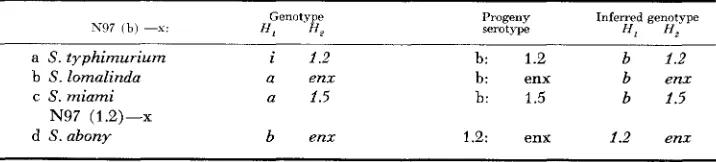
Transduction with N97 ( b ) and N97 (1.2) as donors (see Table 4): These experiments verify the results already shown with the corresponding strains of
N25 and support the assignment of HIb and H I I S to the two phases. N97 there- fore displays both HIb and an unusual in various clones. Two hypotheses might be considered, (1) an anomalous duplication of HI in the genotype
HlbHll.P or (2) a remarkable rate and direction of mutation at the HI locus in a euhaploid: HIb & HI1.,. These alternatives could be distinguished by experiments with N97 as recipient.
Transductions to N97 as recipient: These results (Table 5 ) disqualify the mutation hypothesis a n d support the duplication of H I . By a series of single substitutions, N97 ( b ) engenders the following homologous serotypes: b:2 .2 -+
b:i+ b:a+ c a . The last form now carries two standard HI alleles from type strain. The mutation hypothesis could not account for the transition of HIb to
HI1.$,
HIi, and H I u respectively in the first three cases. We may conclude thatN97 ( b ) and N97 (1.2) are respectivelyH;Hlj.z and HlbHi.2.
Table 6 also displays further tests of these genotypes in transductional con- frontations. The production of b:c as well as a:c from HIC-x HluHlb indicates the equivalence of the two HI loci in the recipient.
An H, locus
in
N97: No H, phase could be elicited from N97 by selection inb or 1.2-antiserum, nor did transductions from N97-x S. abony (H,""") or S.
TABLE 4
Transductions with N97 (b) and N97 (1.2) as donor
Genotype Progeny Inferred genotype
N97 ( b ) -x: HI H z serotype H* HZ
b: 1.2 b 1.2
a S. typhimurium i 1.2
b S. lomalinda a enx b: enx b e m
c S. miami a 1.5 b: 1.5 b 1.5
d S . abony b enx 1.2: enx 1.2 enx
D U P L I C A T I O N O F LOCUS 1479
typhimurium ( H Z 1 . , ) give any evidence of an H , factor in the donor. However,
H , factors can be transduced in a n active form only when the donor strain itself is expressing the H , factor (LEDERBERG and IINO 1956). Therefore, it cannot be excluded that N97 ( b ; 1.2) has the constitution, say, HlbH11.2H,1.z, the expres- sion of H , being subject to an usually sluggish alternation of phase by analogy with HlaH,enz in S. abortus-equi (IINO 1961a).
Explicit evidence for an H , locus in N97 comes from the introduction of H,"""
by transduction into N97 and its derivatives (Tables 5, 6 ) . Such isolates showed frequent alternation of phase between HZew" and one (only one) of the manifest
TABLE 5
Transductions with N97 ( b ) as recipient
Genotype Progeny Inferred genotype
N97 (b) x- H , H* serotype H l H , H*
a i: b i b .
b i : 1.2 i 1.2
S. typhimurium i 1.2
C
S. abony d
b: enx b (1.2) enz
1.2: enx 1.2 ( b ) enz b enz
TABLE 6
Transductions with N97 derivatives
Derivative
-X
or x- Salmonella :
Progeny
serotype HI Inferred genotype H l H*
a 5 a t H , i H l b X -
6a H,aH,b X -
b
C
d
e
f
g
6c H , a H I C X -
5 b H l i H l ' . * X -
h 5 a H , b H , i -X
6 a H l a H l b -X
i
1
sendai H 1 a H z l J a :
b: altendorf H,CH,l.7
a:
C:
1.2:
b: abony H,bH,enX
miami H,"H,1.5 1:
a:
b: t yphimurium H , H,'
.,
b
C
C
enx
enx
enx
1.2
1.5
1.2
1.2
a b . .
b c . .
a c . .
a ( c ) enz
( a ) c e m
1.2 ( i ) enz
1.2 b . .
i . . 1.5
a . . 1.2
b . . 1.2
1480 J O S H U A LEDERBERG
H , factors. If we assign the genotype HluHICHpenx, the phase variability of H,"""
would be expected to accord with that of its diphasic provenience. However, the control of phase between two H I loci, H I a and H I c is not now understood and is difficult to study when it occurs so rarely in the parental cultures as well as the progeny.
The alternative suggestion must be considered that H,""" has substituted for a n H," to give the diphasic c:enx, H l C H Z e n x (by analogy with the case reported by
IINO 1961b). This cannot be disputed except for the strict separation of recog- nized H I and H , factors in all other tests reported here. The c:enz type was tested -x H l ~ H H , l ~ a and in the face of some technical problems gave one successful trans- duction typed as i:enz as expected for a regular H,""" factor.
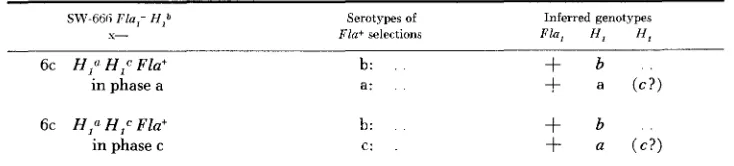
Are the duplicated factors linked? In a number of technically favorable trials, including several listed here, the H , factors of N97 derivatives were inherited independently. Further tests were made -x SW666 Fla,- (Table 7) that indi- cated linkage of each H I to Flu+. However, the Fla+ might also have been dupli- cated and we conclude nothing as to the mutual linkage of the duplicated
Hi's.
Indeed, there is nothing that would firmly contradict a model of complete dupli- cation of the genome, i.e., that N97 is diploid, though H , is the only locus known to be heterozygous.
TABLE 7
Linkage of HI factors to Fla,
Transductions of N97 derivatives (Tuble 6) to SW-666
SW-Gciti Flu; H I * Serotypes of Inferred genotypes
x- Flu+ selections Flu, H , H ,
6c H I u H I C Flu' b: . . + b
in phase a a:
+
a (c?)6c H l a H,C Fla' in phase c
b: C: + b
+
a ( c ? ) Pooled Flu+ swarms, selected for motility without antiserum, were streaked out, and also selected in b antiserum. The isolated clones were tested and typed as shown.DISCUSSION
The chief interest of these findings is that an unlikely anomaly still fits the predictions of the genetic model of phase variation with strict separation of H ,
and H , homologues. An exception to this rule has been found only by IINO (1961b) who has traced an allele that behaves as H Z b from an H I b parent. It seems most plausible that H , originally arose as a duplication of H I , and still retains snme fundamental homology with it, though this cannot usually be dem- onstrated. Indeed, synaptic homology should depend on the regional quality of a chromosome segment, beyond a single gene ( ZINDER 1960).
The phenotypic confusion of H l l . , and H , 1 . 2 is paralleled by the l w antigen. Salmonella wien must be typed as H l b H , l W , and S. dar-es-salaam as H11teHsen218 to interpret the findings of EDWARDS, DAVIS and CHERRY (1955). In contrast to
DUPLICATION O F LOCUS 1481 strains as a phase-I, in others as phase-2. The inference is suggested by the pat- tern of alternative phases and is given genetic meaning by the transduction tests. SPICER and DATTA (1959) have reported a clone of S. typhimurium as giving unstable transductional derivatives which show evidence of diploidy at both the
H , and H , loci. It differs from the present case in part in the irreproducibility of the effect and transduction of the duplicated H I locus or loci to other strains. I n typical diphasic strains, we can envisage that the H I gene is repressed by the action of the H , gene, or perhaps of a variable phase controller immediately adjacent to it. No evidence of a controller at the H , locus has been found in typical diphasic H,H, strains, only in the response of H I to H , control. This system has evidently broken down in the H , H , duplications; but we cannot say whether a residual H , controller is still coupled to one H , or whether another gene is pinch hitting for the evident regulation.
Apart from the troublesome obstinacy of N97 in undergoing phase variation, genetic analysis by selective transduction has evident disadvantages for the articulation of a complex system. We may look forward to constructive applica- tions of sexual breeding methods in Salmonella immunogenetics (BARON, CAREY and SPILMAN 1959).
SUMMARY
Salmonella paratyphi B strain CDC-157 has the genotype H l b H l l . s H , P ; typical strains of this serotype are H,bH,l.e. Two anomalies are thus evident, the duplica- tion of HI and the representation of the 1.2 antigen at the H I locus. The trans- ductional progeny of CDC-157 affirm the assigned genotype. They include such exceptional serotypes as 1.2:1.5, 1.2:enx7 b:i, b:c, and a:c.
LITERATURE CITED
BARON, L. S., W. F. CAREY, and W. M. SPILMAN, 1959
EDWARDS, P. R., and D. W. BRUNER, 1942
Genetic recombination between Escheri- chia coli and Salmonella typhimurium. Proc. Natl. Acad. Sci. U.S. 45: 976984.
Serological identification of Salmonella cultures. The
Notes on monophasic SalmonelZu cultures and their use in the production of diagnostic
Transfer of antigens by phage lysates University of Kentucky, Agricultural Experiment Station, Circular 54.
serums. J. Bacteriol. 52: 493-498. 1946
EDWARDS, P. R., B. R. DAVIS, and W. B. CHERRY, 1955
IINO, T., 1958
with particular reference to the 1,w antigens of Salmonella. J. Bacteriol. 70: 279-284.
Immunogenetics of Salmonella. Thesis. University of Wisconsin. 1961a
1961b
A stabilizer of antigenic phases in Salmonella abortus-equi. Genetics 46 : 1465-1469.
Anomalous homology of flagellar phases in Salmonella. Genetics 46 : 1471-1474.
LEDEXBERG, J., 1956
LEDERBERG, J., and P. R. EDWARDS, 1953
LEDERBERG, J., and T. IINO, 1956
SPICF~, C. C., and N. DATTA, 1959
STOCK=, B. A. D., N. D. ZINDER, and J. LEDERBERG, 1953
ZINDER, N. D., 1960
Linear inheritance in transductional clones. Genetics 41 : 845-871.
Serotypic recombination in Salmonella. J. Immunol.
71: 232-24Q.
Phase variation in Salmonella. Genetics 41: 743-757.
Reversion of transduced antigenic characters in Salmonella
Transduction of flagellar characters typhimurium. J. Gen. Microbiol. 20: 136-143.
in Salmonella. J. Gen. Microbiol. 9: 410433.