1028 | P a g e
A STUDY ON MEDICAL GRADE NETWORK
Thilagavathy R
1, Nalina H D
2, Spoorthy Y
3 1,2,3Assistant Professors, Department of Electronics and Communication Engineering
GSSSIETW, Mysuru, Karnataka
ABSTRACT
In computer networks, networked computing devices exchange data with each other using a data link. The
connections between nodes are established using either cable media or wireless media. The Open Systems
Interconnect (OSI) model has seven layers. Application Layer, Presentation Layer, Session Layer, Transport
Layer, Network Layer, Data Link Layer and Physical Layer. Medical-Grade Network (MGN) provides the
network foundation that enables reliable, seamless, and secure health data exchange and communications for
the healthcare community. It allows integration and interoperability at each functional area, optimizing
interactions among healthcare participants, processes, applications, and hardware components. The MGN
architecture is built on three layers: the networked infrastructure layer, the interactive services layer and the
applications layer. In this paper, the functions of both OSI layers and MGN layers are compared with its
architecture.
Keywords: OSI, MGN, Healthcare, Networked Infrastructure Layer, Interactive services layer,
Application layer
I. INTRODUCTION
A computer network is a set of computers connected together for the purpose of sharing resources. The most
common resource shared today is connection to the Internet. Other shared resources can include a printer or a
file server. Two such devices can be said to be networked together when one device is able to exchange
information with the other device, whether or not they have a direct connection to each other. Computer
networks differ in the transmission medium used to carry their signals, communications protocols to organize
network traffic, the network's size, topology and organizational intent. A communications protocol is a set of
rules for exchanging information over network links. In a protocol stack (also see the OSI model), each protocol
leverages the services of the protocol below it. An important example of a protocol stack is HTTP (the World
Wide Web protocol) running over TCP over IP (the Internet protocols) over IEEE 802.11 (the Wi-Fi protocol).
This stack is used between the wireless router and the home user's personal computer when the user is surfing
the web.
The Open Systems Interconnection model (OSI model)
[1] is a conceptual model that characterizes and standardizes the communication functions of a
telecommunication or computing system without regard to their underlying internal structure and technology. Its
1029 | P a g e
the model defined seven layers. The physical layer defines the electrical and physical specifications of the dataconnection. It defines the relationship between a device and a physical transmission medium. The data link layer
provides node-to-node data transfer—a link between two directly connected nodes. It detects and possibly corrects
errors that may occur in the physical layer. The network layer provides the functional and procedural means of
transferring variable length data sequences (called datagrams) from one node to another connected to the same
"network". The transport layer provides the functional and procedural means of transferring variable-length data
sequences from a source to a destination host via one or more networks. The session layer controls the dialogues
(connections) between computers. It establishes, manages and terminates the connections between the local and
remote application. The presentation layer defines the format and organization of the data, it includes Encryption. The
application layer is the OSI layer closest to the end user, which means both the OSI application layer and the user
interact directly with the software application.
The section II explain briefly need of MGN in medical field, section III gives the architecture of MGN with
brief explanation of its layers and sections IV gives the conclusion of this paper.
II. MEDICAL GRADE NETWORK
Healthcare organizations worldwide are turning to information technology to cope with mounting pressures to
reduce costs and improve quality and safety. They are using technology to create an integrated system of care
that connects patients, clinicians, payers, and support organizations so that all key stakeholders can exchange
information more effectively.
The Medical-Grade Network (MGN) [2] provides the industry-specific framework required to meet healthcare’s
unique needs for
interoperability, security, availability, productivity, and flexibility. It supports:
Efficient communications among clinicians, patients, administrators, and partners.
Regulatory requirements for patient privacy and data security.
The unique information, technology, bandwidth, and integration challenges of healthcare.
Anytime, anywhere information capture and access for wired and wireless applications and devices.
Converged data, voice, and video networks.
Identity and policy-based security from inside the network to beyond organizational walls.
Transfer and storage of the large amounts of data created by healthcare applications.
These characteristics are detailed within the MGN architecture, which is based on the best practices of a robust
healthcare environment. Medical-Grade Network provides an end-to-end framework for the healthcare industry.
It allows integration and interoperability at each functional area, optimizing interactions among healthcare
participants, processes, applications, and hardware components. This includes areas such as acute care campus
networks, ambulatory clinics, remote clinicians, and data centers.
A number of business challenges for the healthcare industry are service quality, safety, rising costs, and a
shortage of skilled staff to meet the needs of an ever-expanding number of patients with an increasingly
complex burden of illness. Meeting these challenges requires a shift from acute episodic care to preventive and
long-term chronic care management. This new care model must be supported by interoperable health
1030 | P a g e
In MGN model, [4] patients assume greater responsibility for their personal healthcare, advocating forthemselves as healthcare consumers. As a result, they need access to information about their own health and
clinicians. Through the Internet and other information sources, patients can access information about treatment
protocols and alternatives. In the competitive healthcare world, the transparency of patient and practitioner
information may influence practitioner selection and retention. As a result of the increased availability of
information, patients are demanding higher- quality services. Several decades ago, a single physician treated all
of a patient’s various illnesses. Today, a patient receives treatment from multiple physicians and clinics. This
creates the need for medical and clinical information to be shared securely among many healthcare entities. To
provide the framework for this new healthcare world, a connected healthcare ecosystem is needed—where
networked resources of medical information, knowledge support, and process optimization are all parts of the
system. The MGN meets today’s healthcare needs while laying the foundation for future requirements.
III. MGN ARCHITECTURE
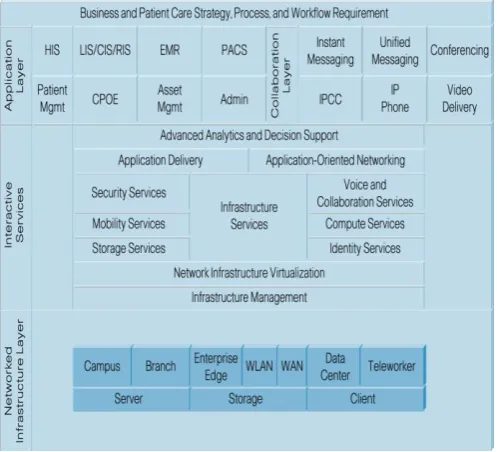
The MGN framework [3] is segmented into three layers: networked infrastructure layer, interactive services
layer, and application layer. Each layer enables system-wide communications, allowing the network to operate
efficiently and disseminate clinical and business information throughout the healthcare system.
Figure 1 MGN Architecture Elements
The MGN is an end-to-end solution that streamlines operations and supports a variety of medical applications.
The MGN architecture is built on three layers: the networked infrastructure layer, which provides a converged
network foundation that enables secure, reliable, and highly available connectivity to network-enabled devices;
the interactive services layer, which enables mobility, security, and more efficient utilization of resources; and
the applications layer, which contains the business, clinical, and collaborative applications that are used in the
1031 | P a g e
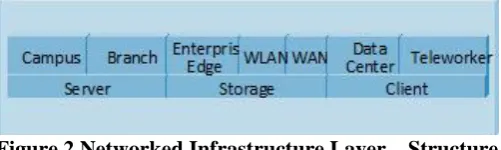
A. NETWORKED INFRASTRUCTURED LAYERThe Networked Infrastructure Layer [5] is the source of all IT resources that are connected over a single IP
network. This layer demonstrates how a fully integrated network enables quality of service (QoS), security, and
high availability even in the most demanding healthcare environment.
Figure 2 Networked Infrastructure Layer—Structure
This layer supports traditional functions, such as routing, switching, and transport technology. Locations in the
network include healthcare data centers and campuses, remote clinics, regional facilities, national partners and
suppliers, or any other organization that is part of the healthcare ecosystem.
Wide Area Networks (WANs) and Metropolitan Area Networks (MANs) provide connectivity between
distributed sites, campuses, and/or data centers. The specific transport technology usage is determined by
connectivity requirements, such as latency, distance, data replication, and path isolation Additional capabilities
are required to support healthcare’s high-bandwidth, mission critical applications across a WAN and MAN
network. Requirements for deploying voice over IP (VoIP) and videoconferencing include high availability, IP
Multicasting (IP MC), and QoS. Most healthcare enterprises rely on private WAN connections, such as Frame
Relay, ATM, or leased-line services, to connect their organizations. Enterprise WAN and MAN architectures
provide numerous options for connecting different locations of patient care, offering multiple technologies to
connect data centers, campuses, remote offices, supply chains, call centers, mobile workers, and more. This
connectivity promotes greater mobility and collaboration among affiliates. Centralized applications deliver new
capabilities, standardize support, and simplify information sharing over the MGN. MGN architecture employs a
number of MAN and WAN technologies engineered and optimized to interoperate as a contiguous system.
These technologies help connect the entire healthcare ecosystem, provide support for advanced applications
The data center is home to the servers, storage, and applications necessary to support a hospital’s clinical and
business operations. In a consolidated and centralized architecture, all data and computing resources are
supported by the data center’s infrastructure. Design considerations include MGN requirements for availability,
interactivity, security, and responsiveness. The flexibility to quickly deploy and support new services is another
important design aspect. The MGN data center design is based on a layered approach that provides support for
Web, application, and database services.
The campus network comprises the core, distribution, and access layers. This design model affords a hierarchical
structure and modularity, thereby improving the interaction between clients and applications with the use of campus
service functions. In an MGN hierarchical model, the individual building blocks are interconnected using the core
layer. The core serves as the network backbone and is designed for performance resiliency. Since the core is tuned for
efficiency, minimal feature configuration in the core reduces complexity, limiting the possibility for operational error.
The distribution layer creates a fault boundary that provides a logical isolation point in the event of a failure
originating in the access layer. The campus access layer is the first point of entry into the network for edge devices,
distribution-1032 | P a g e
layer switches for purposes of redundancy. The campus network provides a multiservice environment for current andemerging applications. A healthcare organization may have one or several campuses.
The enterprise edge is the entry point to the Internet and other networks that are external to the healthcare
system. Through the consolidation of Internet-facing application environments, the edge is the first line of
defense for enterprise networks connected to external networks. The two traditional environments in an
enterprise edge are the Internet edge and the extranet. The Internet edge provides enterprise gateway functions
in and out of the enterprise network to the Internet while the extranet provides connectivity to business partner
networks. The enterprise edge is defined as the area containing the network infrastructure required for a resilient
Internet connection. The scope of the area depends on how the enterprise is using the Internet connection.
Teleworkers constantly are at risk because they function outside the corporate security perimeter and often lack
the latest antivirus and operating system updates. Systems with exposure to the Internet are at risk for day-zero
outbreaks, such as newly released worms and viruses for which there are no known antivirus signatures. To
mitigate this risk, guest network services can be made available, allowing controlled access to business and
clinical resources. The MGN architecture provides robust support by allowing video, data, and voice to coexist
securely in a wired/wireless environment. Integrated voice services include extension mobility for a remote
office number dial tone, videoconferencing, and QoS for voice.
B. INTERACTIVE SERVICES LAYER
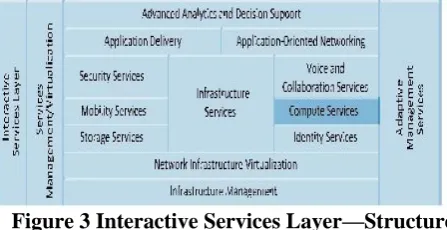
Centralized, network-based services promote unified administration and heightened performance. The
interactive services layer provides direct support for essential applications and the networked infrastructure
layer[6][7]. By using a standardized network foundation and virtualization, interactive services achieve optimal
performance and interoperate more effectively than if delivered using standalone devices or networks.
Figure 3 Interactive Services Layer—Structure
The infrastructure services provides a secure, interactive, and collaborative enterprise network environment. Storage
services, such as virtualization, write and tape acceleration, and network- accelerated server less backup, enhance
provisioning flexibility and business continuance capabilities. Other services, such as adaptive threat defense,
virtualized firewalls, and host-based intrusion detection, help secure infrastructure consolidation and virtualization
initiatives. Application-delivery services allow consolidation of the infrastructure to centralized locations,
making the effective delivery of applications to remote users even more critical.
Data security within the healthcare environment is critical for patient privacy and availability requirements.
Information security has a direct relationship with reliability and availability. Additionally, security is necessary
to assure data integrity. High availability requires strict security measures to ensure that accidental or intentional
1033 | P a g e
Mobility services enable efficiencies in clinical and business workflows in the healthcare environment. Clinicianmobility is critical to providing cost-effective and efficacious care. Secure mobile networking requires using
industry-standard security protocols, which control authentication, heighten data encryption, minimize latency,
and support roaming among access points. Mobility services are inherent in the MGN. Figure 25 identifies a list
of attributes afforded by the MGN’s mobility services. These are considered necessary when deploying a
wireless network in a medical environment.
To meet the healthcare environment’s storage requirements, the MGN uses a high performance, highly available
storage network architecture. Applications, such as electronic medical records (EMRs), Computerized Physician
Order Entry (CPOE) [8] systems, and imaging systems require consistent and accurate access to system data. In
support of these requirements, the MGN’s healthcare storage environment provides real-time, consistent access
to relevant patient and application information where and when it is needed. To facilitate business continuity
and disaster recovery planning, the MGN supports reliable backup and archiving of valuable patient
information, including digital images and EMRs. The MGN provides high-speed and reliable access to storage
over IP networks. Using this storage infrastructure, healthcare providers can transmit patient data across the
network to provide clinicians with rapid access to key patient information regardless of their physical location.
The MGN storage architecture takes advantage of best practices in storage design to enable cost-effective,
scalable storage architectures.
IPC represents the ultimate evolution of voice and video integration, encompassing IP telephony, video
telephony, unified messaging, IP video and audio conferencing, customer contact solutions, voice gateways and
applications, security solutions, and network management [9]. The MGN facilitates operational efficiencies by
converging multiple discrete networks into a single network. IPC creates opportunities for real-time, anywhere
collaboration by bringing advanced telephony services into the clinical and business environments. Through the
use of IPC’s integrated features and applications, clinicians at either remote or central locations obtain access to
enhanced voice and data collaboration. This technology creates the basic foundation for enhanced application
integration in the telephony environment. Figure 34 identifies the attributes that are associated with IPC.
The medical environment requires intense and highly available computing services. Virtualization and
communication across hardware platforms can minimize the hardware necessary to satisfy a healthcare systems’
computing requirements. In addition to minimizing the number of servers required, high-performance
computing can optimize the space, power, and cooling required to meet the medical data center’s needs.
The MGN provides a framework [10], along with technology standards, for the implementation of true
identity-based network access control down to the user and individual access port at the network edge. The system
provides user and device identification using strong, reliable authentication technologies. Identities of users or
devices are mapped to policies that grant or deny network access, set network parameters, and work with other
security features to enforce items such as posture assessments.
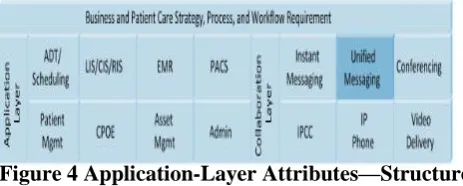
C. APPLICATION LAYER
The application layer facilitates collaboration and visibility between departments, facilities, and
organizations. It performs internal business functions, such as back-office systems for business intelligence and
1034 | P a g e
Figure 4 Application-Layer Attributes—Structure
The MGN has mission-critical [11] requirements for applications that support healthcare. In the future,
Application-Oriented Networking may be used to optimize message routing, improve information sharing, and assist in application
integration. Application-integration services could provide application delivery to the end user, as wellas
communication among application tiers and business services. Using these defined protocols and standards can
provide a way for public and private health institutions to transmit important patient record information
electronically.
Collaborative and conferencing services are critical to advancing patient care, training, and other information-sharing
initiatives. A Unified Communications system of voice and IP products and applications enables organizations to
communicate more effectively. Business processes are streamlined, giving clinicians and ancillary personnel the
ability to reach the right resource the first time. Unified Communications offer an integrated solution for a healthcare organization’s conferencing needs.
The MGN offers enterprise-class, rich-media conferencing, incorporating voice, Web, and video. These
real-time collaborative functions [12] are essential features of the healthcare communications landscape. Using
high-reliability components and component redundancies helps ensure high availability. Servers and software are
customizable and integrate with common enterprise communication software to fit easily into any corporate
infrastructure. In order to meet these mandates, the MGN has stringent conferencing requirements.
Unified messaging is a feature-rich solution that makes it easier for clinicians, staff, and caregivers to perform
their jobs. Unified messaging in the medical environment facilitates improved communication by merging
traditional and IP-based communications, allowing patients and clinicians to collaborate better.
E-mail messaging over IP enables subscribers to access e-mail messages from a telephone by using one access
device for all messages. Voice messages are played as streaming audio or .wav files.
Fax messaging over IP lets subscribers receive faxes anywhere by redirecting fax messages from their unified
messaging mailbox to a nearby fax machine. Fax messaging over IP also enables subscribers to determine, via
phone, which faxes have arrived, the arrival time, and the sender’s identity.
Collaboration / Internet Protocol Contact Center Services
In the medical environment, it is critical that calls are delivered to the appropriate clinician. Through the IP Contact
Center (IPCC)[13], using skills-based routing, calls are forwarded based upon personnel skill set or caller
requirements. Additionally, calls are prioritized and serviced in a manner that promotes the best quality care. This
technology can be used on healthcare’s business side to optimize both workflows and communication pathways.
The IP phone is designed to enhance the communication capabilities of both clinicians and support staff. IP phones,
by their very nature of merging telephony and computers, provide a platform for enhanced communications
applications.
The MGN augments collaboration in the healthcare environment. Possibly the most beneficial changes to
1035 | P a g e
reach to patients in other geographies. Videoconferencing enables a clinician to pick up cues regarding apatient’s condition from verbal and nonverbal findings. Additionally, videoconferencing facilitates on-demand
clinician-to-clinician conferencing.
IV. CONCLUSIONS
To address the growing challenges of providing healthcare, all members of the healthcare system— including
patients—must be part of the connected ecosystem. The MGN provides the foundation for this ecosystem by
supporting healthcare’s requirements for interoperability, security, availability, productivity, and flexibility. This
is accomplished while helping ensure the highest-quality outcomes and maximizing operational efficiencies.
Each layer provides the necessary collaborative capabilities to maximize communications efficiencies,
facilitating sharing of critical clinical, business, and collaborative information throughout an organization as it
evolves to a connected healthcare ecosystem. MGN and its layers are built on SONA (Service-Oriented
Network Architecture), they enable the adoption of new technologies and resolve how to apply these
technologies. The MGN’s end-to-end framework helps healthcare organizations and providers solve today’s
business and clinical issues while preparing for the future.
REFERENCES
[1] https://en.wikipedia.org/wiki/Computer_network
[2] www.cisco.com
[3] www.netcraftsmen.com
[4] www.dupont.com
[5] M. Gibbs and H. Quillen; "The Medical Grade Network: Helping Transform Healthcare," White paper.
Cisco Systems, Inc. Cisco IBSG, 2008.
[6] J. Barnes, "Wired Network Security: Hospital Best Practices," published online on 11/08/2006 -
www.ids-healthcare.com.
[7] Brocade Communication Systems Technical Report, "Dynamic Changes in Healthcare. Create Challenges
in Hospital Campus Networks," online [24.11.2011]: http://www.brocade.com/.
[8] E. Kershaw, "Wireless networking reshapes the face of patient monitoring systems", Biomed. Instrum. &
TechnoZ., May/June 2002.
[9] I. A. Gieras, "The proliferation of patient-worn wireless telemetry technologies within the U.S. healthcare
environment", Proc. IEEE Conf. Inf. Technol. Appl. Biomedicine, 2003.
[10]NIST Advanced Network Technologies Division. Healthcare goes wireless, [online] Available:
http://w3.antd.nist.gov/Health.shtml.
[11]M. K. Dempsey, ‘‘An overview of various wireless data links for medical applications,’’ presented at
AAMI, Baltimore, MD, 2001.
[12]R. Hampton, ‘‘Future challenges to clinical engineering,’’ presented at the AAMI Annu. Conf., Boston,
MA, June 4, 2004.
[13]Radio-Frequency Wireless Technology in Medical Devices. [Online]. Available:
http://www.fda/gov/cdrh/guidance/1618.pdf