The
Q
ew
V
pin
S
hysics
S
rogram
of
the
COMPASS
H
xperiment
Luís Silva1,a,b
1LIP - Laboratório de Instrumentação e Física Experimental de Partículas, Av. Elias Garcia 14, 1º 1000
Lisboa, Portugal.
Abstract.The COMPASS experiment, at CERN SPS, has been compiling for more than a decade successful and precise results on nucleon structure and hadron spectroscopy, leading to statistical errors much smaller than previously measured. The new COMPASS spin physics program, starting this year, aims to a rather complete nucleon structure de-scription; this new representation goes beyond the collinear approximation by including the quark intrinsic transverse momentum distributions. The theoretical framework, for this new picture of the nucleon, is given by the Transverse Momentum Dependent dis-tributions (TMDs) and by the Generalised Parton Disdis-tributions (GPDs). The TMDs, in particular Sivers, Boer-Mulders, pretzelosity and transversity functions will be obtained through the polarised Drell-Yan process, for the first time. The results will be comple-mentary to those already obtained via polarised Semi-Inclusive Deep Inelastic Scatter-ing (SIDIS). Also unpolarised SIDIS will be studied, allowScatter-ing the knowledge improve-ment of the strange quark PDF and the access to the kaon fragimprove-mentation functions (FFs). Deeply Virtual Compton Scattering (DVCS) offan unpolarised hydrogen target will be used to study the GPDs, in a kinematic region not yet covered by any existing experiment.
1 Introduction
The fixed target experiment COMPASS (COmmon Muon and Proton Apparatus for Structure and Spectroscopy) is located in the Super Proton Synchrotron (SPS) facility, at CERN. The experiment started in 2002 and since then regularly takes data every year, having had only two interruptions for upgrades (on 2005 and 2013). COMPASS uses polarised muons and hadrons on protons and deuterons. The experimental apparatus is a fifty meter long two–stage spectrometer, followed by a cryogenic polarised target system. The first spectrometer stage is designed for low momentum parti-cles having relatively large angles. The second spectrometer is focused to measure high momentum particles having small angles. More information about the COMPASS spectrometer can be found in Ref. [1].
The previous COMPASS program can be divided into two physics sub–programs: one, so-called muon program, for nucleon structure studies and another, so-called hadron program, for hadron spec-troscopy investigations. In the muon program, the beam is composed by naturally and longitudinally polarised positive muons (at energies of 160 and 200 GeV/c), which scatter offprotons and deuterons,
ae-mail: [email protected]
bOn behalf of the COMPASS Collaboration.
C
both longitudinal and transverse polarised. For the hadron program, unpolarised hadrons –pions, kaons and protons– (at energies of 160 and 190 GeV/c) scatter offunpolarised protons and deuterons. After a decade of precise and successful results, the COMPASS collaboration is performing a new spin physics program [2], approved in December 2010 and started in 2012. The new program aims to a more complete knowledge of the nucleon structure, going beyond the collinear approximation by taking into account the quark intrinsic transverse momentum distributions. This new approach allows to introduce a new theoretical frame: the Generalised Parton Distributions (GPDs), and in the same direction nevertheless with a different formulation, the Transverse Momentum Dependent Distributions (TMDs). Also two other subjects will be addressed, the unpolarised PDFs and TMD effects in Semi-Inclusive Deeply Inelastic Scattering (SIDIS).
2 Unpolarise Semi-Inclusive Deep Inelastic Scattering
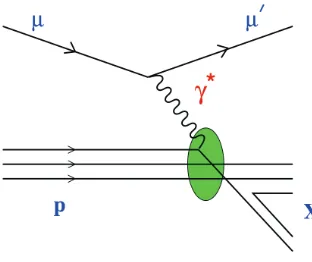
Semi-Inclusive Deep Inelastic Scattering is the standard tool used to investigate the inner structure of the nucleon and therefore to probe the nucleon contents. In figure 1. this process is illustrated by a schematic representation; a muon particle scatters offa nucleon, the interaction is done electro-magnetically via a virtual photon with one of the valence quarks, the nucleon absorbing the imparted energy by the photon breaks up producing the final state that afterwards fragments into hadrons. The purpose of SIDIS is to study these hadrons.
Figure 1: Schematic representation of the Semi-Inclusive Deep Inelastic Scattering.
constrain is depicted. In figure 2 (b). thes(x)+s(x) distribution determined by the HERMES col-¯ laboration [6] using SIDIS kaon data on deuteron is depicted, this result disagrees substantially with the existing parametrisations. Recently, HERMES published a new re-evaluation of the strange quark distribution [7], which has is more precise, yet still in disagreement with the theoretical parametrisa-tions. Also in figure 2 (b). the COMPASS projection of statistical error for one week of data taking with the liquid hydrogen target is shown.
(a)
x
-2
10 10-1
(x))
s
x(s(x)+
-0.1 0 0.1 0.2 0.3 0.4 0.5
COMPASS Proj.1 week HERMES MSTW08 LO CTEQ6L LO (x))
s x(s(x) +
(b)
Figure 2: (a) Strange quark distribution, atQ2 = 104 GeV2, obtained using QCD global analysis from CTEQ and MSTW groups [8]. On thex-axis the range of COMPASS contribution is shown. (b) Projected statistical error fors(x)+s¯(x) for one week of data taking with the liquid hydrogen target, also shown are the parametrisations of CTEQ and MSTW groups and the HERMES result [6].
3 Generalised Parton Distribution Functions
The Generalised Parton Distribution Functions (GPDs) are a conjugation of both nucleon electromag-netic form factors and PDFs. GPDs provide transverse spatial information of a parton as a function of the fraction it carries of the nucleon’s longitudinal momentum,i.e.they correlate (transverse) spatial and (longitudinal) momentum degrees of freedom of quarks and gluons. The study of the GPDs can be performed experimentally by the Deeply Virtual Compton Scattering (DVCS) and Deeply Vector Meson Production (DVMP) mechanisms.
There are four GPDs:Hf,Ef,Hf andEf , where f can be one of the quarksu,dorsand gluon
g. The GPDs attracted special attention after it was shown that the total angula momentum os a given parton species f is related to the 2nd moment of the sum of the two GPDs Hf and Ef, by the Ji
relation [9]:
Jf(Q2)= 1 2 limt→0
1
−1
dxx Hf(x, ξ,t,Q2)+Ef(x, ξ,t,Q2), (1)
from total quark angular momenta to the nucleon’s spin budget
1 2 =
q=u,d,s
Jq(Q2)+Jg(Q2), (2)
whereJg is the total gluon contribution to the nucleon spin. The Ji relation (1) can be also a way to constrain the quark total angular momentum contributions to the nucleon spin budget.
A particular simplification of the GPDs as probability density is done in the limiting caseξ =0 where the parton carries the same longitudinal momentum fraction x in initial and final state and hence the momentum transfert ≡ −Δ2 =−Δ2
L−Δ2⊥ is purely transverse,t =−Δ2⊥. In this case the
Fourier transform of the−Δ2⊥dependence of the GPDHf(x,0,−Δ2
⊥) for fixedxdescribes the spatial
distribution of partons of species f carrying the longitudinal momentum fractionx, with respect to their transverse distanceb⊥from the centre of momentum of the nucleon (impact-parameter
represen-tation) [10]
qf(x,b⊥)=
d2Δ ⊥
(2π)2e
−iΔ⊥·b⊥Hf(x,0,−Δ2
⊥). (3)
The 3-D impact-parameter-dependent parton distributionqf(x,Δ⊥) can be interpreted as providing a
set of “tomographic images” of the nucleon, as illustrated by the cartoon shown in figure 3. where depending on the slice ofxdifferent regions of the nucleon can be accessed.
Figure 3: Nucleon tomography: (a) The Fourier transform of the −Δ2
⊥ dependence of the GPD
Hf(x,0,−Δ2
⊥) for fixed xdescribes the distribution of the transverse distance b ≡ |bT|of partons
carrying the fraction xof the nucleon’s longitudinal momentum P, from the centre of momentum of the nucleon. (b) Sketch of tomographic views of the transverse spatial parton distribution in the nucleon at certain parton longitudinal momentum fractionsx.
Another interesting result comes from x = ξ. It has no probabilistic interpretation but nev-ertheless its Fourier transform is connected to the distancer⊥ between struck parton and spectator
system [11, 12]. At leading order inαs, the corresponding averager⊥2(x)can be directly obtained
from the imaginary part of the amplitudes of exclusive processes. At smallx, where amplitudes are predominantly imaginary, one has the relationr2
⊥(xB) ≈ 2·B(x) if the exclusive cross section is
parametrised as ddσt ∝exp(−B(x)|t|). Figure 4. shows the projected statistical and systematic uncer-tainties for a measurement of thexBdependence of the so-calledt-slope parameterB(x) for the range
-2 0 2 4 6 8
10-4 10-3 10-2 10-1
B (GeV
-2 )
COMPASS ZEUS H1-HERA I H1-HERA II
< Q2 >
< Q2> < Q2> < Q2>
= 2 GeV2 = 3.2 GeV2 = 4 GeV2 = 8 GeV2
280 days at 160 GeV
α' = 0.125
α' = 0.26
Figure 4: Projections for the xdependence of thet-slope parameterB(x) of the DVCS cross sec-tion, calculated for 1 < Q2 < 8 GeV2. For comparison some HERA results with similar
Q2are
shown [13–15], for which the horizontal dashed lines indicate theirxrange. The left vertical bar on each data point indicates the statistical error only while the right one includes also the quadratically added systematic uncertainty, using only ECAL1 and ECAL2 (first row) and also ECAL0 (second row). Two different parametrisations are shown usingα=0.125 GeV−2and 0.26 GeV−2.
4 Transverse Momentum Dependent Distributions
In the so-called leading twist regime, where the transverse intrinsic momentum distributions of the partons,kT, is neglected, the nucleon structure is described by three PDFs, namely: (1) the
unpo-larised distribution function f1(x), also known as the number density, describing the probability of
finding a quark with fractionxof longitudinal momentum of the parent nucleon, regardless its spin orientation, (2) the helicity distributiong1(x), representing the difference between the number
den-sities of quarks with spin parallel and anti-parallel to the spin of the longitudinally polarised parent nucleon, and (3) the transversity functionh1(x), analogous tog1(x) but for the transverse orientation
of the quark spins and nucleon polarisation. Several experimental observations on large azimuthal and spin asymmetries are not be explained in perturbative QCD at leading twist. The new approach are the Transverse Momentum dependent parton Distribution functions (or simply TMDs), which aim to describe the nucleon structure by including the transverse intrinsic momentum distributions of the partons. In the case wherekT is taken into account, there are eight TMDs, f1(x,kT2),g1L(x,k2T),
h1(x,k2T),g1T(x,k2T),h⊥1T(x,kT2),h⊥1L(x,k2T),h⊥1(x,k2T) andf1⊥T(x,kT2). In figure 5. they are organised and
categorised according to the quark and nucleon polarisation –unpolarised, longitudinal or transversely polarised– and also according to the quarkkT.
The TMDs can be accessed by two ways: using the Drell-Yan process [16] or SIDIS (discussed in Sect. 2). In the Drell-Yan process a quark and anti-quark annihilate into a pair of leptons, as represented in figure 6. COMPASS studies the following reaction involving an unpolarised beam (Ha) and a transversely polarised target (Hb):
Figure 5: The eight TMDs for unpolarised beam and transversely polarised target in SIDIS.
wherePa(b)is the momentum of the beam (target) hadron;l,landq=l+lare the momenta of the lepton, the anti-lepton and the four-vector of the virtual photon, respectively, andS is the four-vector of the target polarisation. Further, the following kinematical variables will be used:
s =(Pa+Pb)2, the total centre-of-mass energy squared,
xa(b) =q2/(2Pa(b)·q), the momentum fraction carried by a parton fromHa(b), xF =xa−xb, the Feynman variable,
M2
μμ =Q2=q2 =s xaxb, the invariant mass squared of the dimuon.
Ha(Pa)
X γ∗(q)
l−(l)
l+(l)
Hb(Pb, S)
¯
u(ka)
u(kb)
For this special case, where the beam is unpolarised and the target is transversely polarised, in the LO QCD parton model approximation, the Drell-Yan cross section expression simplifies to
dσ d4qdΩ =
α2 em
F q2σˆU
1+D[sin2θ]Acos 2φ U cos 2φ
+ |ST|
AsinφS
T sinφS +D[sin2θ]
Asin(2φ+φS)
T sin(2φ+φS) (5)
+ Asin(2φ−φS)
T sin(2φ−φS) .
The general form of the Drell-Yan cross section expression can be found in [17]. The solid angle
Ωspecifies the orientation of the lepton,F =4
(Pa·Pb)2−Ma2M2b represents the flux of incoming
hadrons. The anglesφandθare defined in the Collins-Soper frame, while the angle φS is defined
in the target rest frame. The part of the cross section ˆσU = F1
U(1+cos2θ) is factored out, after
integration over the azimuthal anglesφandφS, whereF1
Uis the unpolarised structure functionF1. The
depolarisation factorD[f(θ)]depends only on the lepton polar angleθ, asD[f(θ)]= f(θ)/(1+cos2θ).
The four azimuthal asymmetries,Af(φ,φS)
P , in equation (5), are obtained by the ratios of the
combi-nations of structure functionsFf(φ,φS)
P overF1U+F2U. In this particular casePstands forUorT for
the unpolarised and for the transversely polarised case, respectively. More precisely these azimuthal asymmetries:
• Acos 2U φgives access to the Boer–Mulders functions of the incoming hadrons and target nucleon, • AsinφS
T to the Sivers function of the target nucleon,
• Asin(2φ+φS)
T to the Boer–Mulders function of the beam hadron and toh⊥1T, the pretzelosity function of
the target nucleon, • Asin(2φ−φS)
T to the Boer–Mulders function of the beam hadron andh1, the transversity function of the
target nucleon.
Figure 7. shows the projected statistical errors for the azimuthal asymmetries, as a function of x-Feynman, of the Drell-Yan measurementπ−p→μ+μ−Xwith a 190 GeV/cpion beam, in the so-called high mass region, 4 GeV/c2<M
μμ<9 GeV/c2. For Boer-Mulders the statistical error is spread into 5 bins, while for the other three only one bin is used. These errors were calculated considering a 140 days run at the beam intensity of 108 pions/s. Thus, the rate of Drell-Yan events in the high mass
region expected per day is 2034, in total 285000 DrellYan events are expected in the mass region 4 -9 GeV/c2. More information about the calculation of this estimation can be found on Ref. [18].
In particular, within the context of this new program of the COMPASS experiment, the Sivers and the Boer-Mulders functions can be extracted from Drell-Yan processes and SIDIS events, as these functions areT-odd,i.e.both functions are process dependent, therefore the following relations should hold:
f1⊥TDY =−f1⊥TDIS and h⊥1DY =−h⊥1DIS, (6)
This represents a crucial test of non-perturbative QCD and of the TMD approach that COMPASS has proposed to perform.
Acknowledgements
Figure 7: The expected predictions on the statistical errors for the Sivers (top-left), Boer–Mulders (top-right), sin(2φ+φS) (bottom-left) and sin(2φ−φS) (bottom-right) azimuthal asymmetries for a DY measurementπ−p→μ+μ−Xwith a 190 GeV/cπ−beam in the high-mass region.
References
[1] P. Abbonet al. [COMPASS Collaboration], Nucl. Instrum. Meth. A577, 455 (2007) [2] F. Gautheronet al. [COMPASS Collaboration], CERN-SPSC, 014 (2010)
[3] C. Adolph [COMPASS Collaboration]et al., Phys. Lett. B736, 124 (2014) [4] C. Adolph [COMPASS Collaboration]et al., Eur. Phys. J.73, 2581 (2014)
[5] C. Adolph [COMPASS Collaboration]et al., Phys. Lett. B717, 376 (2012); Phys. Lett. B717, 383 (2012)
[6] A. Airapetianet al. [HERMES Collaboration], Phys. Lett. B666, 446 (2008) [7] A. Airapetianet al. [HERMES Collaboration], Phys. Rev. D89, 097101 (2014) [8] A.D. Martin, W.J. Stirling, R.S. Thorne, G. Watt, Eur. Phys. J. C63, 189 (2009) [9] X.-D. Ji, Phys. Rev. Lett.78, 610 (1997)
[10] M. Burkardt, Phys. Rev. D62, 071503 (2000), Erratum ibid. D66, 119903 (2002) [11] M. Diehl, Eur. Phys. J. C25, 223 (2002)
![Figure 2: (a) Strange quark distribution, at QProjected statistical error forfrom CTEQ and MSTW groups [8]](https://thumb-us.123doks.com/thumbv2/123dok_us/8174612.1365171/3.482.46.440.162.302/figure-strange-quark-distribution-qprojected-statistical-forfrom-groups.webp)

![Figure 4: Projections for the xtion, calculated for 1shown [13–15], for which the horizontal dashed lines indicate theireach data point indicates the statistical error only while the right one includes also the quadraticallyadded systematic uncertainty, us](https://thumb-us.123doks.com/thumbv2/123dok_us/8174612.1365171/5.482.101.384.70.243/projections-calculated-horizontal-indicates-statistical-quadraticallyadded-systematic-uncertainty.webp)