Determination of Angle of Repose of
Pharmaceutical Materials Based On Image
Processing Using Labview
Rinal Mistry1, Chirag Dalal2, Dr. Tejal Soni3
M.Tech. Scholar, Dept. of Instrumentation and Control Engineering, Faculty of Technology, Dharmsinh Desai
University, Nadiad, Gujarat, India1
Associate Professor, Dept. of Instrumentation and Control Engineering, Faculty of Technology, Dharmsinh Desai
University, Nadiad, Gujarat, India2
Professor and Head, Dept. of Pharmaceutics, Faculty of Pharmacy, Dharmsinh Desai University, Nadiad,
Gujarat, India3
ABSTRACT: Physical properties of pharmaceutical products are of great importance in handling, drying, heating, extraction and other relevant processing operations. Majorly these properties are affected by the particle size and shape of the material. Flow property and compressibility of the powdered materials used in the pharmaceutical industry can be measured in terms of various parameters like Hausner’s ratio, Carr’s index, angle of repose and particle size. Tapped density and Bulk density measurements are also required to determine some of these parameters. Most of the conventional methods used for measurement of these parameters are manual and hence prone to error. This paper presents an approach of image processing using Vision Assistant - LabVIEW for determination of the angle of repose of different pharmaceutical materials and the results are compared with those obtained using conventional methods.
KEYWORDS: Angle of repose, image processing, LabVIEW, Flow property, Vision Assistant.
I.INTRODUCTION
Pharmaceutical materials are available in various states and forms like slurries of varying viscosity as well as solid granular powders. Handling and processing of these granular powders is largely dependent on the flow ability and compressibility of the particles. Various processes like dry coating using hybridizer, Magnetic assisted impaction coater, wet and dry granulation methods are used to improve the flow property by evenly coating one material on the other. The resultant materials developed exhibit better physical properties than their original forms which are measured in form of different pre-formulation parameters using conventional methods. One of these parameters of utmost importance is the angle of repose which characterizes the flow capacity of the material.
ISSN (Print) : 2320 – 3765 ISSN (Online): 2278 – 8875
I
nternational
J
ournal of
A
dvanced
R
esearch in
E
lectrical,
E
lectronics and
I
nstrumentation
E
ngineering
(An ISO 3297: 2007 Certified Organization)
Website: www.ijareeie.com
Vol. 6, Issue 3, March 2017
morphology image processing is used to smooth the detected edges. Finally averaging function is used on two angle measurements (from left and right sides of the pile) to achieve the final repose angle. Section II describes the literature survey carried out in this context. In section III, the conventional methods for measurement of the repose angle have been discussed. Section IV presents the proposed image processing approach for angle measurement using LabVIEW. Finally section V and VI presents the comparison of results of measurement and conclusion.
II.LITERATURE SURVEY
Image processing has acquired most of the researcher’s attention in recent years. Many applications can be efficiently and effectively developed using machine vision as a result of availability of multiple software toolboxes for image processing. One of the most important advantages of using vision systems is that all the inspections are carried out under same conditions and the results produced are consistent [1],[5]. Image segmentation methods are now used for diversified applications. Segmentation accuracy determines the extent of success of the computerized procedure used for the application while image morphology helps to remove extraneous spurs on the edges of the region of interest [6]. As suggested by Rishi et. al in [2], choice of a segmentation method and the level of segmentation are dependent on the type of image and the problem under consideration. Specifically for an application where size and shape of the particles of material are of major importance, region growing method is more suitable [2][3]. Laplacian based filter efficiently helps to determine correct places of edges as well as it can test wide area around the pixels as suggested by Raman Maini et al in [4].
Various mechanical coating methods are used in the pharmaceutical industries for modification of the surface properties of the particles like impaction coating, mechanofusion and hybridization[7]. Effectiveness of the coating method is evident from the tests conducted to examine the physical properties of the materials. Angle of Repose is one of the parameters that represent the flowability of a material [8]. Angle of repose test is very sensitive to the method used to create the pile. Commonly used method is to suspend the granules of the material from a funnel on a flat surface. Classical method to calculate the repose angle using the relation tan (Ɵ) = 2h/r is subject to caution on account of formation of irregular shaped piles[9].
Optical evaluation methods have also been used by A. B. Spierings et. al in [10] to examine powder flow characteristics for AM –Additive manufacturing for metal powders. Kurkuri et. al in [11] also developed a new optical method for measuring static angle of repose of wheat grains. A novel apparatus was developed by A.P. Chaudhari et. al. as mentioned in [12] to measure the repose angle of five different agricultural materials. The method proposed in this paper uses the LabVIEW platform and the Vision Assistant from National instruments to determine the angle of repose of different pharmaceutical materials. Instead of measuring the repose angle from only one side (left or right), both angle measurements are taken and then using the average function, final angle is calculated.
III. MEASUREMENT BY CONVENTIONAL METHOD
Fig. 1 Angle of repose measurement of pile of iodized salt
Manual measurement of this angle is done by drawing a free hand circle making the boundary of pile of the powder material. The height of the pile is kept fixed as the distance between the flat platform and the tip of the funnel from which the powder is suspended onto the platform.
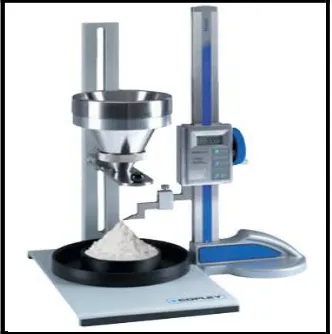
Many instruments have been commercially available to measure the angle of repose to check the flow property of the material. The methods involve formation of pile of the powdered material on a flat platform by suspending the powder through a funnel. The height of the pile is recorded or is kept fixed for convenience. The radius of the pile is then measured. Finally using equation (1), the angle is calculated.
Ɵ= (1)
ISSN (Print) : 2320 – 3765 ISSN (Online): 2278 – 8875
I
nternational
J
ournal of
A
dvanced
R
esearch in
E
lectrical,
E
lectronics and
I
nstrumentation
E
ngineering
(An ISO 3297: 2007 Certified Organization)
Website: www.ijareeie.com
Vol. 6, Issue 3, March 2017
Fig. 3 Repose angle testing machine (Gardco)
IV.PROPOSED METHOD OF MEASUREMENT
The image processing approach is carried out according to the flow diagram given in figure 4. Firstly, the images of the piles are acquired using the iBall Super-View C8.0 web camera interfaced to Vision Assistant. The experimental setup for measurement is shown in figure 5.
Fig. 4 Flow diagram of the image processing method for repose angle measurement
Image acquisition using Webcam
Color plane
extraction Thresholding
Binary Image Applying Filter
(Laplacian) For edge detection Morphology
modification
Measurement of AoR(Left)
Measurement of AoR(Right)
Fig. 5 Experimental setup to measure angle of repose using image processing
The blocks shown in Figure 4 represent various stages of the processes undergone by the acquired images. Once the images are acquired, their colorspace is changed to gray scale by extraction of one of the red, blue or green component. This is required to apply the thresholding process to convert the RGB image to binary. The resultant binary image is the segmented into different regions based on the threshold value selected. Next stage involves detection of the edges of the regions separated in order to emphasize the shape of the pile of the powdered material. Laplacian filter with appropriate Kernel size is chosen to clearly detect the edges.
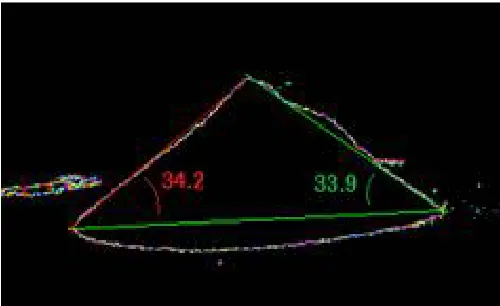
Fig. 6 Measurement of left and right angles of the pile
ISSN (Print) : 2320 – 3765 ISSN (Online): 2278 – 8875
I
nternational
J
ournal of
A
dvanced
R
esearch in
E
lectrical,
E
lectronics and
I
nstrumentation
E
ngineering
(An ISO 3297: 2007 Certified Organization)
Website: www.ijareeie.com
Vol. 6, Issue 3, March 2017
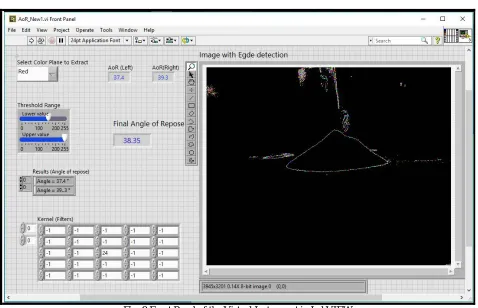
Fig. 8 Front Panel of the Virtual Instrument in LabVIEW
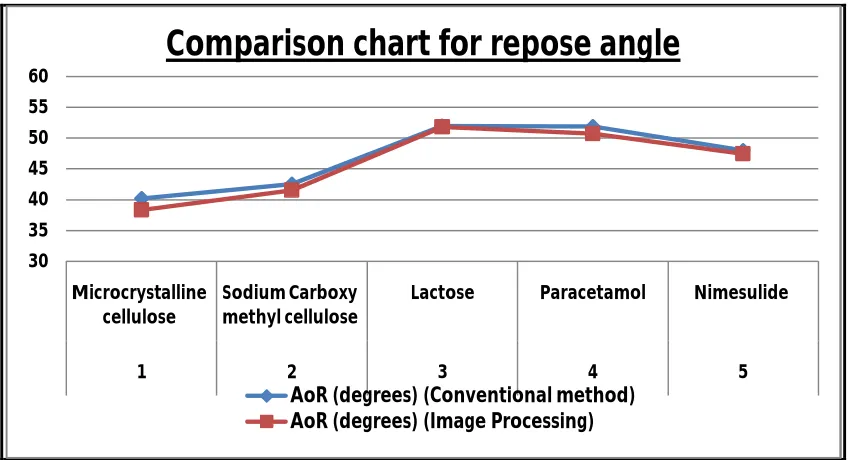
Table 1 given below shows the comparison between the measurements of the repose angle done manually and by using the image processing approach. Figure 9 shows the comparison chart of these measurements. The blue graph represents the angles measured using the conventional method and red represents those measured using the image processing approach. It is observed from these results that the measurements made using image processing methods are consistent with those obtained by conventional methods.
Sr. No.
Powder Material
AoR (degrees)
(Conventional method)
AoR (degrees)
(Image Processing)
1. Microcrystalline cellulose 40.2 38.35
2. Sodium Carboxymethyl cellulose 42.56 41.56
3. Lactose 52.0 51.84
4. Paracetamol 51.9 50.75
Fig. 9 Chart for comparing the AoR results
VI.CONCLUSION
Image processing using LabVIEW Vision Assistant proves to be an efficient tool for measurement of the repose angles. The same can be applied for measurements of large grain size particles like granular sugar or rice grains. The results obtained using the image processing approach, are consistent with those achieved by other conventional methods. Thus it allows effective measurement of the repose angle. Accurate results obtained so, provide significant aid in further processing and handling of the pharmaceutical materials.
REFERENCES
[1] Pinnamaneni Bhanu Prasad, “Machine Vision Systems and Image Processing With Applications”, Journal of Innovation in Computer Science and Engineering, Vol. 3, Issue 1, pp. 1-4, 2013
[2] Rishi, Narinder Rana, “Particle size and shape analysis using ImageJ with customized tools for Segmentation of particles”, International Journal of Computer Science and Communication Engineering, Vol. 4 issue 3, pp. 23-28, 2015
[3] Tadhg Brosnan, Da-Wen Sun, “Improving quality inspection of food products by computer vision––a review”, Journal of Food Engineering Vol. 61, Issue 1, pp. 3–16, 2004
[4] Raman Maini & Dr. Himanshu Aggarwal, “Study and Comparison of Various Image Edge Detection Techniques”, International Journal of Image Processing (IJIP), Vol. 3, Issue 1, pp. 1-12, 2011
[5] Xiao Yan Liu, Yao Yao Zhang, “Real-time Detection of the Repose Angle of Solids in Rotating Drum Based on Image Processing”, Advanced Materials Research Vols. 301-303, pp 748-751, 2011
[6] M. He, J. Zhang, X.Y. Liu, “Determination of the Repose Angle of Stuff in Rotary Kiln Based on Imaging Processing”, The Ninth International Conference on Electronic Measurement & Instruments ICEMI’ 2009
[7] Manoj Gera, Vikas A. Saharan, Mahesh Kataria and Vipin Kukkar, “Mechanical Methods for Dry Particle Coating Processes and Their Applications in Drug Delivery and Development”, Recent Patents on Drug Delivery & Formulation 2010, Vol. 4, Number 1, pp. 58-81, 2010
30 35 40 45 50 55 60
Microcrystalline cellulose
Sodium Carboxy methyl cellulose
Lactose Paracetamol Nimesulide
1 2 3 4 5