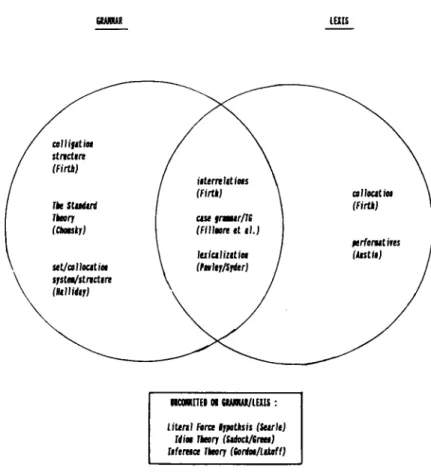
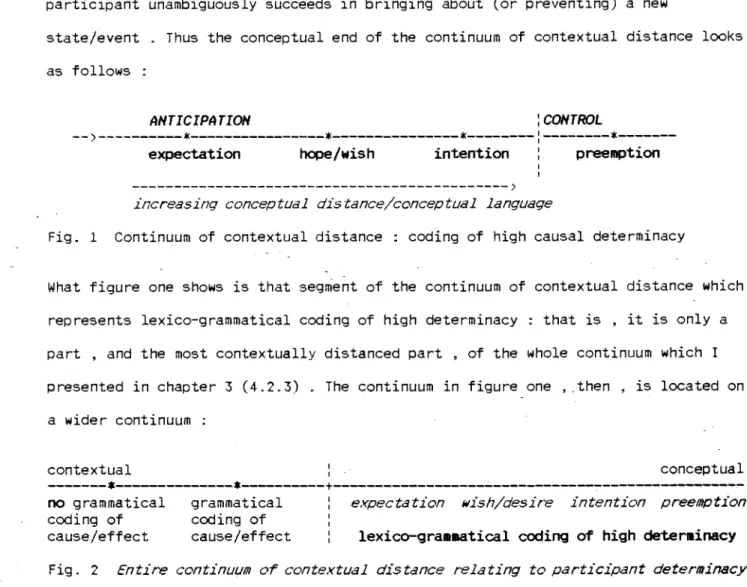
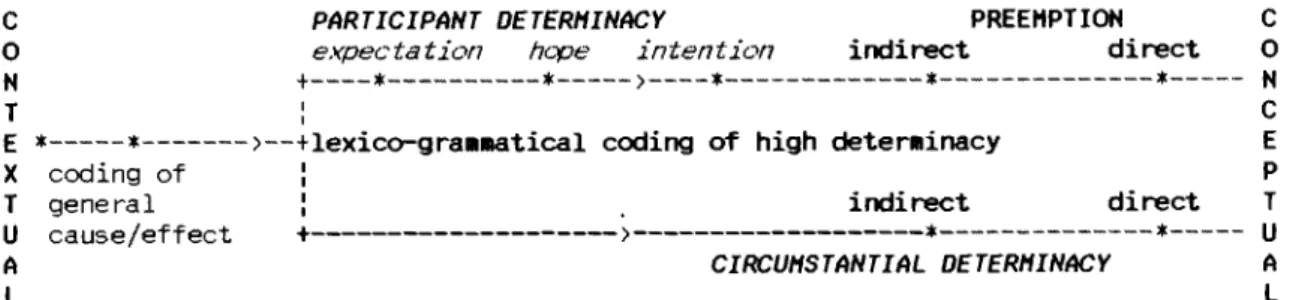
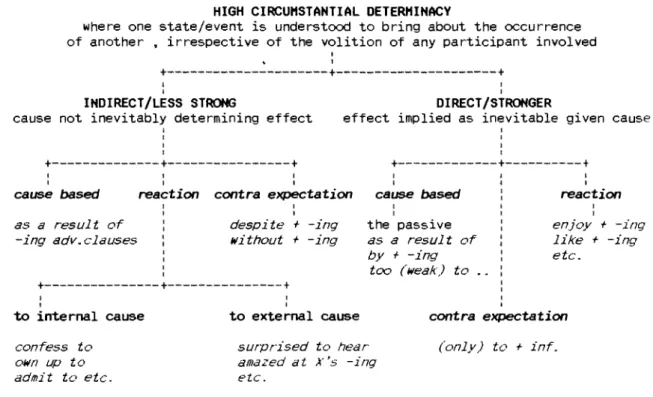
GRAMMAR , LEXIS AND CONTEXT
Rob Batstone
University of London , Institute of Education
1
Language teaching has been strongly influenced over recent years by talk of notions and functions , most notably through Wilkins' (1976) work on Notional Syllabuses . Yet the notional/functional syllabus has been criticized for failing to capture anything more than a superficial correspondence between form and meaning .
In this thesis I argue for a framework in which a deeper congruence between form and meaning is developed . I identify regularities in the lexico-syntactic structure of English which express recognizable notional relationships , which in turn reflect deeper conceptualizations of
relations between events and participants . These conceptualizations are represented on a semantic continuum of 'contextual distance' . By
reference to this continuum , I argue that we can identify a clear
congruence between increasing conceptual complexity and increasing lexico-syntactic complexity . This account gives considerable prominence to the role of lexis , and to the interdependence between grammar , lexis and context in the signalling of meaning , something which has not always been adequately considered within linguistics or within applied linguistics .
I then consider a possible application of these ideas to pedagogy . In many 'product' approaches to syllabus design and methodology , learners work with language forms whose meanings are to an extent already fixed , with grammar subsuming lexis and with cotext and context already clearly related by the materials designer . In such approaches the interdependence between grammar , lexis and context is sometimes lost sight of , and I argue for a revised approach in which this interdependence is made central . Thus learners are encouraged to fashion their own meanings by working with lexical items , and by learning to grammaticize these lexical items by reference to context . By separating out grammar and lexis in this way , learners are given direct access to the deeper congruence between form and meaning - between grammar , lexis and context .
CONTENTS
CHAPTER ONE: GRAMMAR AND LEXIS IN LINGUISTICS Page Section Title
11 Introduction
11 1 Chomsky: TG and role of the lexicon 11 1.1 The Standard Theory
13 1.2 The Revised Theory
13 1.2.1 The Revised Theory: derivational & inflectional morphology 15 1.2.2 Enriching the Lexicon : Case Grammar
17 1.2.3 Case Grammar : further implications & Applications
20 2 J.R.Firth
20 2.1 Interrelations & the context of situation 20 2.2 Firth's categorisation: a brief overview
23 2.3 Collocation & colligation: a relationship between grammar & lexis
27 3 Halliday
27 3.1 Grammar & lexis in the Hallidayan framework: brief overview 28 3.2 System & set: grammar and lexis
31 3.3 Structure & the relegation of lexis 33 3.4 Collocation & the limitation of lexis 35 4 Speech Act Theory
35 4.1 Grammar, lexis & context: introduction 35 4.2 Lexical signalling: performative verbs
37 4.3 Grammar , lexis and context : Searle & the Literal Force Hypothesis 42 4.4 Summary and synthesis
44 5 Formulaic Language 44 5.1 Introduction
44 5.2 The units of language acquisition 45 5.3 The units of adult language production 46 5.4 Grammar & lexis in formulaic language
48 6 Grammar & lexis in descriptive linguistics : synthesis
CHAPTER TWO: GRAMMAR AND LEXIS IN PEDAGOGY
51 Introduction
52 1 The rise & fall of the word based paradigm: Basic English 52 1.1 Outline
Page 54 54 55 57
Section 2 2.1 2.2 2.3
Title
The rise & fall of the word based paradigm: Michael West
Outline
Grammar & lexis in West's framework West in the wider context
58 3 Fries and the structural approach 51 3.1 Outline
52 3.2 Lexis, grammar & context: a pedagogic mismatch 61 4 Wilkins and the notional/functional syllabus 61 4.1 Introduction
61 4.2 Grammar & lexis: the semantico-grammatical category 63 4.3 Communicative function & modal meaning
65 4.4 Summary & synthesis
67 5 The organising framework of communicative syllabus design 67 5.1 Introduction
67 5.2 The organising principle & its' problems
69 5.3 Implications of the organising principle for grammar & lexis 72 6 The Relational Syllabus
72 6.1 Outline: informing the syllabus 73 6.2 Outline: the syllabus framework
74 6.3 Organisation & integration in the relational syllabus 75 6.4 Grammar & lexis in the relational syllabus
79 7 The Lexical Syllabus 79 7.1 Outline
81 7.2 Grammar & lexis in the lexical syllabus 85 8 Summary & synthesis
CHAPTER THREE : GRAMMAR , LEXIS & CONTEXT : OVERVIEW OF A HYPOTHESIS 87 1 BACKGROUND : GRAMMAR AND MEANING
87 1.1 GRAMMATICIZATION : GRAMMAR AS PROCESS 87 1.1.1 A continuum of grammaticization : over time
88 1.1.2 A continuum of grammaticization : at any one point in time 88 1.2 GRAMMATICIZATION AND MEANING
Page Section Title
90 1.3 GRAMMAR , MEANING AND NOTIONS 91 1.3.1 Surface form/meaning correlations
93 1.3.2 Form/meaning congruences: conceptual & linguistic independence 94 1.4 Synthesis
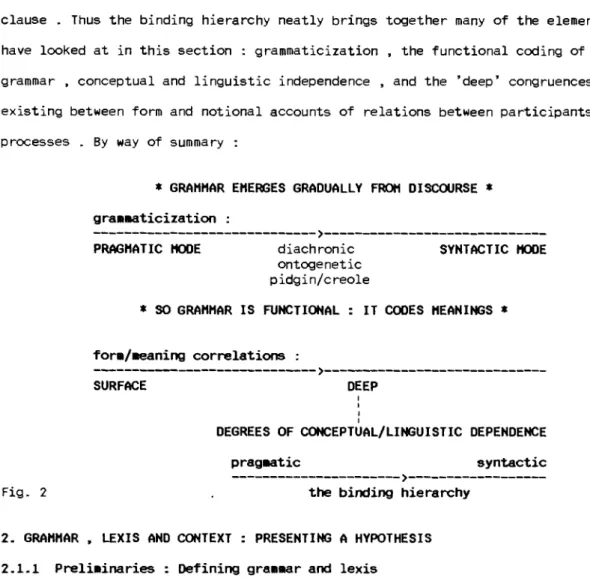
95 2. GRAMMAR , LEXIS AND CONTEXT : PRESENTING A HYPOTHESIS 95 2.1.1 Preliminaries : defining grammar & lexis
96 2.1.2 Preliminaries :a brief outline of the hypothesis 97 2.2 Overview
97 2.2.1 The continuum of contextual distance : a form/meaning congruence 101 2.2.2 Ideational language & the ideational context
103 3 CONTEXTUAL AND CONCEPTUAL LEXICO-GRAMMAR 103 3.1 Outline
105 3.2 Inflectional & lexical restriction 106 3.3 Transparency and opacity
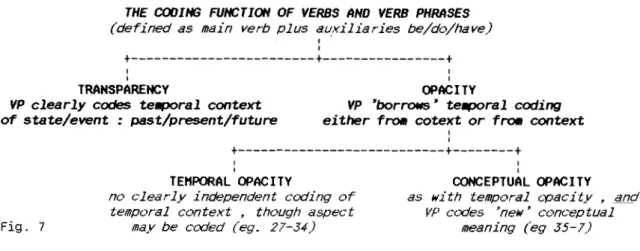
106 3.3.1 Opacity and temporal coding : introduction 107 3.3.2 Temporal opacity
108 3.3.3 Conceptual opacity 109 3.3.4 Summary
110 3.4 Synthesis
110 3.4.1 Conceptual form and independent clauses
111 3.4.2 Coding and the continuum of contextual distance 112 3.4.3 Contextual distance and its limitations
114 4 CAUSAL DETERMINACY
114 4.1 Overview : cause and contextual distance
114 4.2 The coding of determinacy and degrees of contextual distance 115 4.2.1 No coding of cause/effect
115 4.2.2 Lexico-grammatical coding of general cause/effect 116 4.2.3 Lexico-grammatical coding of high determinacy
117 4.2.4 Types of high determinacy : participant & circumstantial 119 5 HYPOTHETICAL MEANING
119 5.1 Hypothetical meaning & contextual distance : two categories 119 5.2 Participant & Circumstantial modality
123 5.2.1 Coding future probability 124 5.2.2 Coding Compulsion
126 5.3 Degrees of hypothetical distance 126 5.3.1 Introduction and overview
Page Section Title
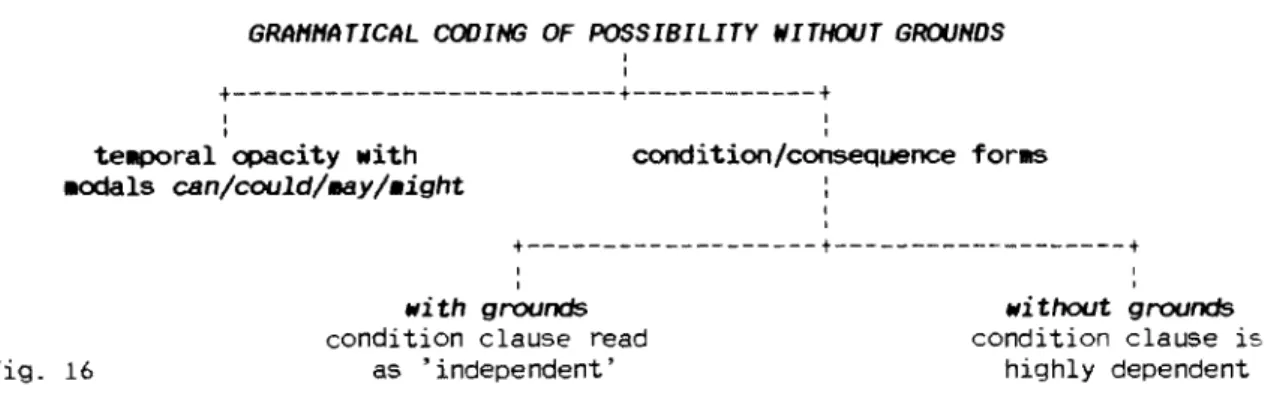
129 5.3.2.2 The grammatical coding of possibility without grounds 131 5.3.2.3 The grammatical coding of impossibility
131 5.3.2.4 Summary
132 6 REFERENTIAL ABSTRACTION & CONTEXTUAL DISTANCE : IDIOMS & PROVERBS 132 6.1 Overview
132 6.2 Introduction : defining idioms & proverbs
134 6.3 Contextual components and referential abstraction 136 6.4 The form/meaning congruence
137 6.4.1 Proverbs
138 6.4.2 One component idioms 139 6.4.3 Two component idioms 141 6.5 Summary
142 7 INTERPERSONAL MEANING AND CONTEXTUAL DISTANCE
142 7.1 World to words : contextual distance and interpersonal meaning 144 7.2 Contextual distance interpersonal coding & the congruence 144 7.2.1 Coding the interpersonal context : want and willing
145 7.2.2 Conceptual lexico-grammar & the form/meaning congruence 146 7.3 Summary
147 8 GRAMMAR , SYSTEM AND RULE : THE NATURE OF LINGUISTIC KNOWLEDGE 147 8.1 Introduction
148 8.2 Idioms , speech acts & grammaticization : a qrammar/lexis continuum 150 8.3 The mental lexicon & degrees of analysability
CHAPTER FOUR : CAUSAL DETERMINACY : A FORM/MEANING CONGRUENCE
153 1 154 2 154 2.1 156 2.2 156 2.2.1 157 2.2.2 158 2.2.3 159 2.3
Introduction and overview
PARTICIPANT DETERMINACY & THE FORM/MEANING CONGRUENCE Degrees of participant determinacy : anticipation & control Overview of the form/meaning congruence
Inflectional restriction
Opacity and that— complementation Lexical restriction
Expectation : the form/meaning congruence
160 2.4 Hope/wish : the form/meaning congruence 162 2.5 Intention : the form/meaning congruence 162 2.5.1 The semantic perspective
7
Page Section Title
165 2.5.2.2 Other action 167 2.5.2.3 Self action
169 2.6 Preemption : the form/meaning congruence 169 2.6.1 Overview
171 2.6.2 The form/meaning congruence 173 2.7 Summary and synthesis 174 3 CIRCUMSTANTIAL DETERMINACY 174 3.1 Introduction
175 3.2 The semantic perspective : overview 178 3.3 The linguistic perspective : overview 179 3.4 Indirect circumstantial determinacy 179 3.4.1 Introduction and overview
179 3.4.2 Indirect participant reaction 181 3.4.3 Indirect contra expectation
183 3.4.4 Cause as control : as a result of 184 3.5 Direct circumstantial determinacy 184 3.5.1 Introduction and overview
185 3.5.2 Direct cause as control : the passive
185 3.5.2.1 Conceptual independence : the semantic perspective
186 3.5.2.2 The passive & conceptual lexico-grammar : linguistic perspective 190 3.5.3 Direct participant reaction : like/enjoy + gerund
192 3.5.4 Direct contra-expectation : only to 193 3.6 Summary and synthesis
CHAPTER FIVE : INTERPERSONAL MEANING : A FORM/MEANING CONGRUENCE 196 1 INTRODUCTION AND OVERVIEW
196 1.1 World to words : contextual distance & interpersonal meaning 197 1.2 Contextual distance and the coding of suasion
199 1,3 Coding suasion : the form/meaning congruence 199 1.3.1 Lexical and inflectional restriction
200 1.3.2 Opacity
202 1.4 The on/off record continuum : inflectional and lexical restriction 205 2 INTERLOCUTOR DEPENDENCE
205 2.1 Overview
Page Section Title
207 2.3 The form/meaning congruence 207 2.3.1 Requests for hearer action 209 2.3.2 Requests for permission 210 2.3.3 Giving permission 210 2.3.4 Offers
211 2.3.5 Promising
212 3 SPEAKER DETERMINACY 212 3.1 Introduction
213 3.2 Speaker determinacy and contextual distance 214 3.2.1 Weak speaker determinacy
215 3.2.2 Strong speaker determinacy
215 3.3 Speaker determinacy and the on/off record continuum 217 4 CIRCUMSTANTIAL JUSTIFICATION
217 4.1 Defining circumstantial justification
218 4.2 Circumstantial justification and speech acts
220 4.3 Circumstantial justification & contextual distance : the congruence 220 4.3.1 Introduction and overview
223 4.3.2 Circumstantial determinacy and conceptual form
224 4.3.3 Circumstantial justification & ambiguity : advise/Warn/tnredt- 226 5 IMPLICATURES
228 6 EXPRESSION AND MEANING : SPEECH ACT CONDITIONS 228 6.1 Overview
228 6.2 Want . willing and the congruence 231 6.3 Speech act conditions
234 7 SUMMARY AND SYNTHESIS
CHAPTER SIX : APPLICATIONS FOR PEDAGOGY : TOWARDS A METHODOLOGY 236 1 THE CASE FOR A REVISED METHODOLOGY : OUTLINE
236 1.1 Grammar lexis and context : a pedagogic framework 238 1.2 Theoretical justifications for a revised pedagogy 241 1.3 Towards a process approach
244 2 EXPLOITING THE MEANING POTENTIAL OF LEXIS AND CONTEXT 244 2.1 Introduction
Page Section Title
246 2.2.3 The lexical signalling of ideational meanings & pedagogic exploitation
254 2.2.4 The lexical signalling of interpersonal meanings & pedagogic exploitation
256 2.2.5 Lexis , context and cultural knowledge : varying the cognitive load
258 3 BRINGING GRAMMAR INTO FOCUS : LEARNER CHOICE & GRAMMATICIZATION 258 3.1 Introduction and overview
262 3.2 Grammaticization and semi-focusing activities 262 3.2.1 New vs. old information
263 3.2.2 Tense , time and context gap
264 3.2.3 Participant vs. circumstantial modality
266 3.3 Grammaticization and focusing activities : an 'organic' approach 266 3.3.1 Consciousness raising , propositional clusters and lexical choice 269 3.3.2 Focusing activities and the ideational context
274 3.3.3 Focusing activities and the interpersonal context 275 4 SUMMARY AND SYNTHESIS
CHAPTER SEVEN : AN APPROACH TO SYLLABUS DESIGN
276 1 PROPOSALS FOR SYLLABUS DESIGN : INTRODUCTION AND OVERVIEW 276 1.1 Grammar , lexis and syllabus design : a perspective 277 1.2 Proposals for a revised syllabus design : an outline 277 1.2.1 Separating out grammar . lexis and context
280 1.2.2 Co-reference and co-occurrence
282 1.3 Syllabus design and the process/product dichotomy 282 1.3.1 Product syllabuses : the item-based approach 283 1.3.2 SyllabuS design and language learning
284 1.3.3 Process and product : dichotomy or continuum ? 287 2 NOTIONAL AND FUNCTIONAL ORGANIZATION
287 2.1 Product syllabuses : the problem of structural disorganization 288 2.2 Grammar as process : accommodating the grammar/lexis continuum 290 3 THE GRAMMAR CHECKLIST
290 3.1 Overview
290 3.2 Horizontal and vertical checklists
292 3.3 The grammar checklist : varying the control
Page Section Title
296 4 THE LEXICAL AND CONTEXTUAL COMPONENTS : GIST SPECIFICATION 296 4.1 Introduction
297 4.2.1 Lexical and contextual specification : interpersonal meanina
298 4.2.2 Lexical and contextual specification : valency & ideational meanina 301 4.3 THE MENTAL LEXICON AND LEXICAL SPECIFICATION
303 5 SUMMARY AND SYNTHESIS
304 APPENDIX A : A SEMANTIC CLASSIFICATION OF STATIVE VERBS 305 APPENDIX 8 : A CATEGORIZATION OF IDIOMS IN TERMS OF
CONTEXTUAL CONSTITUENCY
306 APPENDIX C : CONTINUUM OF CONTEXTUAL DISTANCE : OVERVIEW
11 - CHAPTER ONE -
GRAMMAR AND LEXIS IN LINGUISTICS INTRODUCTION
The purpose of this section is to look at a variety of approaches taken to the description of language, with the aim of establishing to what extent certain linguists have considered relationships between lexis and grammar.
It will be suggested that grammar and lexis have generally been regarded as quite distinct entities, and that consequently certain important generalizations about the 'meaning potential' of lexis with regard to grammar, and of grammar with regard to lexis , have not been fully appreciated.
1. CHONSKY : TG & THE ROLE OF THE LEXICON 1.1 THE STANDARD THEORY
In Chomsky's original conception of transformational grammar ( 1957) the relationship between grammar, lexis and meaning is expressed through his term `linguistic competence'. This in itself consists of a number of separate competences - grammatical, phonological and semantic . Chomsky kept these competences separate because well-formedness within one kind of competence does
not of itself entail well-formedness in another . So , for example , a sentence may be grammatically well formed , but semantically deviant , as with the sentence my wife is unmarried . As Chomsky put it:
Grammar is best formulated as a self-contained study independent of semantics. In particular, the notion of grammaticalness cannot be identified with meaningfulness...
( 1957:106)
However , while he kept his grammatical , semantic and phonological categories distinct from each other , lexis was not considered by Chomsky to constitute a separate competence . Rather , his 'lexicon' was made available to the
then have access to the lexicon so that words can be fitted into grammatical patterns . It is important to note the directionality of Chomsky's model: although each component of linguistic competence has access to the lexicon, the lexicon does not have access to the grammar. In other words, underlying Chomsky's classification is the belief that lexis is subsidiary to grammar. It does not in itself define or significantly contribute to any kind of competence. On the contrary it is, in effect, merely a means of illustrating syntactic structure.
According to the Standard Theory, structures generated from the syntactic component are sent to the semantic component for a semantic representation, and to the morphophonemic component for a phonological representation. Thus the syntactic component comprises the core of the system . The lexicon is not involved at all in these transformations, because in itself it consists of nothing more than a list of separate and unconnected lexical items. With such little importance attached to the lexicon, it is not surprising that with the Standard Theory (1957) , a great deal of work was left to be done by the syntactic component through transformations : language forms were generated entirely from the syntactic component , while the purpose of the lexicon was essentially to give substance to the final structure for purposes of
exemplification .
The primacy given to grammar meant that other components were interpretative of structures formulated entirely by the syntactic component. Chomsky was aware that this sharp delimitation of competences might create difficulties:
The syntactic and semantic structure of natural languages evidently offers many mysteries, both of fact and of principle, and any attempt to delimit the boundaries of these domains must certainly be quite tentative. (1965:163)
However, such caution was not clearly represented in the framework of the standard theory, although it has been argued (eg.Brown 1982:150) that if equal attention were given over to the semantic component and to the lexicon, it would
13
by any of the three, or have been divided up between them. Realizations such as
this soon led to the modification of the Standard Theory during the 1960's. As
well as giving increasing prominence to the semantic component, these years also
witnessed a growing interest in the role of the lexicon, thereby raising
fundamental questions concerning the relationship between grammar and lexis.
1.2 THE REVISED THEORY
1.2.1 Enriching the lexicon: derivational and inflectional morphology
With the development of the revised theory (1965) the lexicon was gradually
accorded greater prominence , both with respect to derivational morphology and
with respect to inflectional morphology .
Firstly , derivational morphology , previously considered a matter for the
syntactic component , was handed over to the lexicon , so that existing word
stock , together with rules for the analysis of existing words and the formation
of new words , were located in the same place . This shift , from the syntactic
component to the lexicon , took place in order to account for two distinct
processes. The first of these was conversion, which involved the simple transfer
of an item from one lexical class to another, such as the conversion from 'they
manned the ship' to 'they shipped the man'. The second process was compounding,
where two potentially free lexical forms may be juxtaposed to form a derived
compound form - 'wind' and 'mill' to form 'windmill', 'back' and 'chat' to form
`backchat', and so on.
It is important to underline the reason why this transfer took place . In
short , it became increasingly apparent that the applicability of derivation is
not systematically accessible to the same kind of principled rule-making as
syntax was held to be . So the lexicon became associated with procedures for
conversion and compounding whose relevance was restricted to particular lexical
items , leaving the syntactic component free to deal with general 'rules' which
could form the basis for the systematic generation of transformations ,
of lexical items marked for their particular patterns of derivation , each
pattern applying only to a certain group of words. The derivation 'rule', for
example, through which the noun 'length' can be derived from the adjective 'long'
applies to 'long' but not to other adjectives . A thoroughgoing derivational
approach referring indiscriminately to all lexical items of a particular class
would, ofcourse, have led to a situation where marked forms would be generated on
a large scale . This realisation led to the acceptance of a 'mixed lexicon', with
many items entered as single, unique units.
Although in one sense a solution , this process created a new set of problems,
because derivational morphology is not the only area with 'rules' of limited
applicability . If the lexicon was to concern itself with derivational
irregularities , what of inflectional morphology ? This is concerned in part
with aspects of word structure variations which have a direct bearing on
grammatical categories such as number and gender : inflectional morphology, that
is, accounts for the internal structure of words, and as such it makes no
categorical distinction between aspects of grammar and considerations of lexis.
How, then, should TG incorporate features of inflectional morphology ? - what
should be the responsibility of the syntactic component, and where should the
line be drawn between this and the lexicon ? .
Number had previously been seen as a grammatical category , while gender was
lexical (because gender is invariant - an arbitrary feature of individual lexical
items) . Number and gender, though, function in a similar way. Adjectives derive
their gender from the noun they modify, just as determiners must agree with the
noun with which they associate in number. Similarly, just as with gender , some
nouns are inherently plural (people, cattle) while others are inherently
singular/`mass' (wine/water). The only way to account for these relatively
arbitrary elements was to specify number as well as gender in the lexicon, using
a '+/- count' notation. In this way, number also entered the lexicon.
I have already noted that derivational morphology entered the lexicon on account
15
similar reasons: there is no systematic basis for the distinction between nouns
which are inherently plural and nouns which take the -s suffix. The -s suffix -
previously considered to be a matter for the grammar as part of the syntactic
component - now entered the lexicon , thereby maintaining the principle that
grammar is systematizable while lexis is not ; grammar exemplifies rules, lexis
is characterized by a web of restrictions . In this respect lexis got defined
more and more in terms of how it differed from grammar , even though this
involved 'glossing over' the fact that semantic notions such as number infact
made reference both to lexical and grammatical elements. However , not all
modifications to TG involved this kind of grammar/lexis polarization . In the
period following the development of the Standard Theory (Chomsky:1965) , the
lexicon also took on a more influential role in direct relation to the syntactic
and the semantic component , through the application of case grammar .
1.2.2 Enriching the lexicon : case grammar
The development of case grammar (cf. Fillmore 1968) was an early attempt to
accommodate additional dimensions of meaning within TG , by seeking to explain
deep structure through reference to the underlying similarity between such
syntactically contrasting sentences as 'John killed Bill' and 'Bill was killed by
John'. Using case grammar terminology, John is said to be the agent or direct
initiator of the action in both cases, and Bill the patient. This gave rise to
the notion that all the main verbs in a language can be defined semantically in
terms of 'frame features' or 'case frames'. The verb 'open', for example, can
occur in a variety of case frames:
1. The door opened ( 2. John opened the door ( 3. The wind opened the door ( 4. John opened the door with a chisel (
objective) object + agent) object + instrument)
object + instrument + agent)
All this can be expressed more economically by using bracketing to specify the
optional elements, so that 'open' can be specified as:
Open [- 0 (I) (A) ] (Fillmore 1968:27)
explicitly demonstrates how two structures (such as active/passive) are
semantically related one to the other . This had substantial repercussions for
TG, allowing for previously convoluted transformations to be simplified on the
basis of a lexical entry supplemented by syntactic specification through case
frames.
In the standard theory , the burden of accounting for systematic relationships
between sentences had fallen largely on the transformational component . The verb
GIVE , for example 7 was said to occur in two environments
NP1 (GIVE) NP2 to NP3 eg. B111 gave the glass to Jane
NP1 (GIVE) NP3 NP2 eg. Bill gave Mary the book
The second structure here would be derived from the first through a
transformation called 'dative movement' , involving preposition deletion and the
reordering of the verb arguments . The difficulty was that this kind of rule was
not universally applicable : it applies to verbs such as GIVE , OFFER and SEND ,
but not to BROADCAST or to TRANSMIT , neither of which takes the dative movement.
The standard theory solution was to state the transformation in general terms in
the syntactic component , and to mark exceptions to the rule in the lexicon . In
this way verbs like TRANSMIT would be entered lexically together with the feature
[-dative] . Rather as with number and gender , then , the lexicon was used as the
depository of exceptions to 'grammatical rule' .
But syntactic transformations of this kind are not the only way of treating
relationships of this kind , and in wake of Fillmore's work the lexicon assumed
much greater responsibility . The various possible environments for each verb
were now listed in the lexicon , so that the entry for GIVE would be as follows :
GIVE V , NP pp (to NP)
NP1 (AGENT) ---- NP2 (PATIENT) to NP3 (GOAL) NP1 (AGENT) ---- NP3 (GOAL) NP2 (PATIENT)
17
functional specification for each , allowing the formulation of a basic logical
representation which clearly shows how the two structures paraphrase each other.
The important point here is that the semantic and syntactic relations
which were handled previously through the syntactic component were now allocated
quite satisfactorily to the lexicon , including all those operations which
involve the rearrangement of the arguments of a lexical item within basic
structures . So , whereas the earliest transformational models (cf.Chomsky 1957)
involved a syntactic component which far outweighed the lexicon in terms of
importance , later models have involved a substantial re-allocation of
responsibilities (cf. Cook 1972;Brown 1986) .
Implicit within this shift in the 'balance of power' between the syntactic
component and the lexicon was a formalized recognition of the interdependence
between grammar and lexis . Certain lexical items (and particularly verbs) are
themselves marked for the various possible arguments with which they can co-occur
in syntactic structure , and the acceptability or otherwise of specific
grammatical operations (such as dative movement , discussed above) is clearly
constrained at the lexical level .
1.2.3 Case Grammar : some further implications and applications
The adoption of case grammar , then , led to the specification within the lexicon
of individual verbs in direct relation to the types of grammatical modification
and transformation which they would allow . But this did not mean that the
lexical realization of each related argument was similarly specified . For
example , the verb GIVE is specified in the lexicon together with its permissible
arguments (AGENT , PATIENT , GOAL) , but there are some lexical items which
cannot (in the vast majority of cases) occur as AGENT or as PATIENT . We can say
that 'cat', 'dog', 'man' and 'bone' all belong to the same nominal category, so
that the grammar does not in itself differentiate between them . Clearly ,
though , mutual substitution between these lexical items is not always possible
5. The man gave the dog a bone
6. The bone gave the dog a man
So only certain nouns can occur, depending on the verb selected. There is clearly
a need to establish sub-categories of nouns and verbs , but to avoid the extreme
of listing all possible subjects for 'give', it was decided to say simply that
'give' is a verb which requires a noun phrase subject, but to leave the selection
of the actual noun to be sorted out through the semantic component (Brown
1986:103-5) .
Given that it was one of the purposes of TG models to account for such matters as
derivation and transformation systematically and economically , this kind of
'delegation' to the semantic component made a lot of sense . Nevertheless , the
issue of the acceptability or unacceptability of specific combinations of lexical
items is a crucial one , for it raises further questions concerning the
relationship between grammar and lexis . For example , case grammar tells us that
with a lexical item such as OPEN , we have the option of selecting from agent and
instrument, and we must have an objective. Given the lexical items 'John','open'
and 'door', for example , it is clear that they are very likely to associate in
the following way :
7. John - open - door
(Agent) - (Process) -(Objective)
With these particular lexical items, then, we do not really need grammar to tell
us which word plays what semantic role , so that in this example, the
relationship between lexical item and semantic role can be inferred largely with
reference to lexis . If the lexical choice had been different - if , for example,
we had chosen the lexical association in 8 , then we would have to call on
grammar to sort out the role distribution for us , through word order :
8. John - strike - Bill
The connection between case grammar and the grammar/lexis relationship is
something which I will refer to in later sections of this chapter , and again in
this connection works out . According to Widdowson (1990) , the lexical
association in 8 serves to identify those component parts of context - a process and two related participants - whose precise relationship one to another is ambiguous : is John acting as agent , or as patient ? We need to call on grammatical devices such as word order to clarify the distribution of role relationships . In effect , what Widdowson is suggesting is that the balance of power between grammar and lexis as represented in TG can be reversed : first we lay down the bare lexical items in ungrammaticized association , and then we supplement them by the addition of grammatical elements which give the word a
more precise conceptual orientation . Grammatical inflection , for example , enables us to give semantic focus to bare lexical associations through giving them a location in time through tense and aspect :
9. farmer - kill - duckling 10. farmer is killing duckling
Markings for tense and aspect , says Widdowson , are "communicative devices for getting features of context into focus" and hence :
The greater the contribution of context in the sense of shared knowledge and experience , the less need there is for grammar to augment the association of words . The less effective the words are in identifying relevant features of context in that sense , the more dependent they become on grammatical modification of one sort or another .
(1990:86) Widdowson thus sketches a basic relationship between grammar and lexis whereby :
it is the function of grammar to reduce the range of meaning signalled by words so as to make them more effective in the identification of features of context ...
2. J.R.FIRTH
2.1 Interrelations and the context of situation
Firth's thinking is radically different from that of Chomsky. Wheras Chomsky's competence model consisted of discrete components, Firth emphasized the
importance of establishing and investigating the relationships between them. For Firth, the central concept of semantics is what he termed the context of
situation, made up of complex interactions between lexis, grammar and phonology. As Firth put it:
Even when the phonetician, grammarian and lexicographer have finished, there remains the bigger integration, making use of all their work in semantic study, and it is for this
situational and experiential study that I would reserve the term 'semantics'. (1951:193)
These various components, then, should be regarded as having interrelations, as well as interior relations - the latter being Firth's term for relationships contracted between terms within a single category . But we cannot properly talk of meaning, according to Firth , without taking into account both interior relations and interrelations. When we talk of meaning, then, we use:
...the whole complex of functions which a linguistic form may have. The principal components of this whole meaning are phonetic function, lexical, morphological and syntactical (to be the province of a reformed system of grammar), and the function of a complete locution in the context of situation, or typical context of situation. (1968:174)
In other words, meaning consists of a complex of relations between language and context, and each component of the language needs to be related to all other components .
2.2 Firth's categorization : a brief overview
grammatical. Structure, he says ,is " an interrelationship of elements within the text or part of the text" (1968:103). On other occasions Firth refers to such syntactic interrelations as colligation. When he does imply a distinction between structure and colligation, it seems to be that structure can be broken down into smaller, composite grammatical elements:
The terms structure and elements of structure are not used to refer to a whole language or even to what may be called portions of a language, but exclusively to categories abstracted from common word or textual form. (1968:186)
Colligation, on the other hand, is concerned with categories of structure which have a 'mutually expectant order', so that colligation is used exclusively to deal with relations contracted, syntagmatically, between elements of the grammar in text, or in portions of a text . Although sometimes used in a way very similar to this, it is only 'structure' which is used to refer to grammatical elements abstracted from their place within text.
Then there is a further distinction, one which is thankfully rather more transparent, between structure and system. System is strictly a paradigmatic concept:
A system such as a system of vowels or a system of grammatical forms is in the nature of a paradigm. (1968:103)
Thus the paradigm of the verbal inflections - ing/ed - would in isolation fall within the scope of system.
It is not entirely clear whether Firth had a paradigmatic lexical category. Perhaps the closest he came to this was in his use of the term exponent, which directs us to the phonological and orthographic 'shape' of a word or part of a
word (1968:183).
expectancy. We could start with the exponent 'keep', which can be used to demonstrate the tabulated verbal paradigm 'keep-keeps-keeping-kept'. Here,
perhaps, we have - at an abstracted level - an association between exponent/lexis (keep) and system/grammar (the paradigm of inflection which can be applied to
it). But Firth considered such a level of analysis to be of little value : what matters is how these grammatical and lexical isolates function at the syntagmatic level, beginning with clause or sentence level, for "the verbal characteristics of the sentence are rarely in parallel with what you find in tabulated
conjugations in the grammar books" (1968:103) . Firth then gives us the following example (ibid.) :
11. He kept popping in and out of my office all the afternoon
At the level of structure, we could abstract 'popping' in relation to the auxiliary of aspect 'kept': the relationship between the two, focussed on in isolation from the rest of the sentence, is a matter of structure . Then there is another verbal characteristic of the sentence which is of interest, associated with the adverbial phrase 'all the afternoon':
One could not very well say' he kept popping in and out of my office at ten o'clock' or' at once'(1968:103)
To the extent that such adverbial restrictions need to be read in conjunction both with 'kept' and with 'popping', we begin to see how the complexities of this sentence are a product of interrelations between grammatical elements, between elements of structure. However, as we focus more and more on the sentence as a unit, and on the way in which 'mutual expectancies' are set up between its component parts, we begin to see how the construction as a whole operates as a colligation . As Firth put it , 11 "is grammatically close-knit as a verbal
piece . The elements of structure are ... interdependent (1968:103/4) .
So far I have dealt principally with Firth's grammatical categories. For lexis,
category, refers us to the habitual company that words keep, one to another, within text. There is a clear parallel here between collocation
(lexical/syntagmatic) and colligation (grammatical/syntagmatic), and it is one which allows us to key in to Firth's treatment of grammar and lexis. In the above sentence, for example , could we not also make a collocational analysis,
focussing on the relationship between 'keep' and 'pop' and 'all the afternoon'? Whatever the answer to this query, it begs the question of the precise
relationship between colligation and collocation, and this requires that we first establish more clearly precisely how Firth defined each of these categories . Since he attached so much importance to interrelations between categories, we would expect Firth to have something to say about the grammar/lexis relationship in terms of a relationship between collocation and colligation.
2.3 Collocation and colligation : a relationship between grammar & lexis? Firth's concept of collocation , then , is concerned with habitual lexical associations :
(Collocation) is the study of key-words, pivotal words, leading words, by presenting them in the company they usually keep -that is to say, an element of their meaning is indicated when
their habitual word accompaniments are shown.(1968:106/7)
Thus the distribution in collocation of a word such as 'get' can be analysed once an exhaustive collection of collocations has been made, to indicate that 'get' assumes different meanings in different collocational environments - 'this music just gets me/get me one too/ that won't get you anywhere' (1968:20/21).
different collocations to illustrate each one, saying that each constitutes a "descriptive indication of the relationship of the collocations to generalized contexts of situation" (1968:20) . Thus some of his examples are highly
suggestive of interpersonal contexts ('that won't get you anywhere') while others - the majority - are not ('silly ass/British Way of Life') . Firth did not,
however, pursue the question of how different collocations may refer more or less clearly to particular contexts of situation, for his interest was primarily in the principles of collocation per se.
If Firth was not entirely clear about the relationship between collocations and contexts, he was less clear on the relationship between words in collocation and grammar in colligation . Colligation deals with the mutual expectancy between elements of structure in syntagmatic association, within text or within sentences. I have already mentioned one quite compleA example (9) , but colligation does not always presuppose such close-knit complexities. On a much simpler level, the 3rd person singular masculine pronoun 'he' may be in
colligation with a singular 3rd person verb such as 'smokes', as in
'he-smokes'.Colligation, however, makes no reference to words as lexical items but only as representations of grammatical classes. So, for example, 'I watched him' may be a collocation in so far as the 'key' word, watch , habitually associates with an agent and patient, but as a colligation it simply relates pronouns to a past tense verb form . As Firth put it:
The statement of meaning at the grammatical level is in terms of word and sentence classes ... and of the interrelation of those categories in colligation . Grammatical relations should not be regarded as relations between words as such - between watched and him in 'I watched him' - but between a personal pronoun , the past tense of a transitive verb ....
Firth's writing to support this notion in any detail. What, for example, should we make of collocations which involve grammatical elements, elements of
structure, whose word order and inflection is completely fixed ? . If we take an expression such as 'how are you?', it is clear that along with the mutual
dependency of the constituent lexical items comes a drainage of clear referential meaning. 'How are you?', in other words, operates as a single unit in its own right : its meaning can only be established through reference to the expression as a whole. It thus serves very well as an example of the Firthian notion that
word meaning is dependent on word company . However , there are difficulties which Firth's categorisation does not help to solve. Firstly, where is the key word here? Given that the expression is in effect a single meaning unit, it is questionable whether the idea of a key word -one word which we can single out as in a sense dominant or 'determining' - is at all applicable. Secondly , this expression is grammatically unique : 'How are you?' completely loses its illocutionary force as a greeting as soon as the verb is inflected in any way (*How were you?). This crucial distinction is lost when the expression is
presented as a colligation, where the change in structure gives us no clue as to the radical shift in meaning. Firth, as we have said, talks of colligations as
`mutually expectant orders'.(1968:186). Clearly this expression does indeed illustrate a mutually expectant order, but in lexical rather than in grammatical terms . It is difficult, then, to maintain that it is the grammar which generates this lexical sequence. We cannot capture the formulaic nature of expressions such as this by reference to colligation or to structure - it is clearly a form of collocation but it cannot , in Firth's terms, be usefully analyse( as a colligation .
Firth , I have said , emphasized the need to recognize that each of his
categories - including colligal'ion and collocation - bear interrelations one to another . To establish a relationship between grammar and lexis , it would be
have suggested above that some formulaic expressions are mutually expectant not between abstracted grammatical classes but between specific lexical items , so that they are collocations but not (in any useful sense of the term)
colligations
But there are other cases where both colligation and collocation are simultaneously in evidence :
12. Fred kicked the bucket
In 12 there is a clear element of collocation . Although there is - as with 'how are you?' - no obviously self-selecting 'key word' , the collocation of 'kick'
with 'bucket' is exceptional in that it gives a quite different meaning from , say , the collocation of 'kick' with almost every other inanimate noun . Thus the idiomatic reading of 'kick the bucket' (meaning 'die') is a product of the tight lexical interdependency between these particular lexical items . But at the same time 12 is extremely tight knit as a colligation : its word order , for example , is fixed so that we cannot say 'the bucket was kicked by Fred' and retain the idiomatic meaning . Unlike 'how are you?' , 12 cannot be regarded exclusively in collocational terms because , like regular colligations of the SVO pattern , it can be inflected : Fred has kicked/is kicking/kicks the bucket . In short , 12 has features both of collocation and colligation .
But although Firth allows for interrelations between the grammatical and lexical components of his framework , he has little to say by way of specific
27
3. HALLIDAY
3.1 Grammar & lexis in the Hallidayan framework : overview
Halliday follows, atleast superficially, in the tradition of Firth, adapting some
of Firth's categories and developing them into an overall framework (1964) .
Grammar and lexis are seen by Halliday, as by Firth, as falling into separate
categories. The first of these refers to paradigmatic relations , for which
Halliday used the term choice relationships . Broadly speaking there are two
types of choice category . One is grammatical, and is known as system.
Grammatical systems are closed, because they involve choices between a small and
finite number of possibilities, such as the choice between singular and plural,
or between 'this' and 'that'. Whenever we a have a choice between grammatical
elements which are commutable -grammar words, verbal inflections and so on - then
these are elements of system . The other chain category is set . This too is
paradigmatic, and it concerns lexical items abstracted from their context in
text. In contrast to system, set is an open choice, because it deals with
choices from a wide, and sometimes almost unlimited grouping of individual
lexical items.
Halliday's second main category concerns syntagmatic relations, which he calls
chain relationships . Again there is a subdivision between grammatical and
lexical components . The grammatical component is structure, which is roughly
akin to Firth's colligation. The lexical component is collocation, concerned with
the syntagmatic association between lexical item but, as we shall see, rather
different from Firth's category of the same name.
The distinction between grammar and lexis, says Halliday, is not always as stark
as this categorisation may make it seem. Frequently , for example, we are not
clearly dealing with system or with set - rather we are somewhere on a cline
between the two, and "languages all have choices in the middle of this cline"
In the Hallidayan approach, grammar is much more powerful than lexis. Grammar,
for example, deals both with choices between individual items (eg. this/that,
I/you) and between categories (eg singular/plural or past/future) while lexis
deals only with open set choices between discrete lexical items. Thus we can make
many more generalizations about grammar than we can about lexis, and "any
statement made in grammar can account for a larger number of events than a
statement made in lexis" (1964:23). He then goes on to argue that:
Since the purpose of the theory is to account for the largest number of events as simply as possible, this means that the theory of grammar is more powerful than the theory of lexis. So in making a description of language we try to bring in as much as we can within the framework of the grammar.(Ibid.)
Halliday's overall framework can be summarized thus:
CHOICE: SYSTEM (paradigmatic/grammar) SET (paradigmatic/lexis)
CHAIN : STRUCTURE (syntagmatic/grammar) COLLOCATION (syntagmatic/lexis)
Fig. 1
For the purposes of this enquiry, it is the horizontal links in figure two which
are the most important. What precisely is the relationship between system and
set, and between structure and collocation, and what are the implications of the
framework as a whole for the relationship between grammar and lexis?
It will be argued that there is a tendency within Halliday's approach to define
chain and choice categories so as to undermine Firth's insistence on the
importance of interrelations between component categories.
3.2 System and Set: grammar and lexis
Halliday's distinction between grammatical systems and lexical sets reflects,
quite clearly, a distinction between grammar and lexis . System involves choices
(singular/plural , past/present); set involves choices between content lexical items. Halliday gives little explicit consideration to the relationship between the two, but his overall framework, and particularly his distinction between chain and choice , make such a consideration essential.
How might this be? Halliday's framework can be regarded from two contrasting perspectives . Firstly, as a model with four fundamental components - set, structure, system and collocation - which interrelate primarily through grammar.
Thus, lexical items within set are chosen on the basis of and with reference to structure and to system, which in some way have already been formulated . The actual selection of lexical items occurs on a 'slot and filler' basis, as is made clear by Halliday's example:
he was sitting there on the (1964:21)
Here we have an illustration of how elements of system (the grammar words `he , was , on , the' together with the progressive inflection) are already 'in place' before a final content lexical item, such as 'bench', is chosen from set . So the choice of 'bench' to round off the sentence has the form of an independent 'slot filler'. "In lexis" says Halliday,"we make one choice at a time" (1964:34). But if the point about lexical choices is that they are made separately, one at a time , is there no sense in which a sequence of choices
might be made? In the case of the above example , it is clear that some choices, quite a few infact, have already been made. 'Sit' has been chosen (also from set) and all the grammar words are in place . Have these already been selected from system, which therefore has some kind of priority, associated
so , but there remains the larger issue , namely that the very concepts of chain and choice must , by definition , presuppose some notion of sequence -you cannot
have a choice in a void.
Let me reformulate this problem from a rather different perspective . It seems difficult to see how we could have a choice between items of system -between, say , 'the' and 'a' or between 'on' and 'under', without having already in mind some kind of tangible referent in the ideational context which is being referred to .•The choice, from system , of 'on' in the above example is likely to refer to an object, such as a chair or a fence, which would form part of Halliday's
ideational context. Surely, though, there must be cases where the kind of object referred to can influence our choice of grammar word in other ways. Thus 'he was sitting there on the fence/chair/bench' but:
13. ? he was sitting there on the grey sky
14. he was sitting there under/below the grey sky
With 13 and 14, we have a very clear example of how a choice from set influences and takes priority over prepositional choices from system. In this case, atleast, set is prior to system.
In principle Halliday does not rule out such interrelationships, because he accepts that grammar and lexis are not always clearly distinct:
It is not the case...that all choices in language are clearly of one type or the other, closed or open. What we find is really a gradient or `cline' : that it, there is a continuous gradation in the patterns of formal choice in language. At one end we have a large number of systems...with a small number of fixed possibilities in each: here we are clearly in grammar. At the other end we have open sets...whose limits are hard to define: here we are equally clearly in lexis. But every language has choices which are round about the middle of this cline...and the interaction of one choice
with others is still fairly complex. (1964:22)
Halliday's more specific categorizations and illustrations. It is not always very easy to visualize this cline in operation given the very broad distinction made between system and set, and between structure and collocation.
3.3 Structure and the relegation of lexis
Once we begin to look at Halliday's framework in terms of dynamic interrelations between components, we cannot restrict ourselves to a consideration of system and set. I have already suggested that case grammar (and particularly Widdowson's implicit application of it) shows how the selection of particular verbs creates expectations in terms of associated lexical items and their semantic roles. Referring back once again to Halliday's example, the choice of 'sit' itself implies both an agent and an optional locative in syntagmatic relation to it. This raises the more general question of the relationship between choice and chain, because the choice of 'sit' need not be seen purely as a paradigmatic
matter . 'Sit', in other words, itself implies an unfocussed relationship between agent, process and locative (eg. he-sit-chair). Consequently syntagmatic
relations such as [agent-process-patient] need not be formulated exclusively at the (grammatical) level of structure: we could strongly argue that certain lexical items can also be seen to play a sizeable role here . Thus the
syntagmatic implications of certain choices from set have a direct bearing on the relationship between set and structure.
Halliday refers to grammar as a 'natural system': both general kinds of grammatical patterning and specific manifestations of each bear a natural relation to the meanings they have evolved to express. When a child says 'man clean car'
the fact that this is separated into three segments reflects the
interpretation of composite experiences into their component parts: the different grammatical functions assigned to 'man' , 'clean' and 'car' express the different roles of these parts with respect to the
whole ; the distinction into word classes of verb and noun reflects the analysis of experiences into goings-on (expressed as verbs) and
But it is not necessary to view the man-clean-car association purely in terms of 'grammatical functions' . The very fact that we can so easily make sense of such an utterance is helped by the conceptual nature of these particular lexical items in association. Had the child said 'man car clean' we would still be able to make sense of it, partly because we recognize the noun/verb distinctions, but primarily because we know, from our knowledge of the world, that 'man' - being animate - must be the 'doer' of the action, the agent . We could argue , then , that the final 'grammaticized' sentence, eg. 'the man is cleaning the car', is conceptualized as much by lexis (set) as by syntagmatic grammar (structure) ,
with the latter very often refining and focussing the former (cf. Widdowson 1990) . So the agent/process/patient roles can be inferred from lexical items taken from set, which are then given further focus by the grammar of structure, as 'the man is cleaning the car' is a further focussing of 'man clean car'. Here we have the loose beginnings of a relationship between grammar/structure and lexis/set. Halliday, however, does not allow for any such integration, because for him set is strictly paradigmatic.
By way of summary, it is clear that 'the man is cleaning the car' could evolve from interrelations between set, system and structure. Ofcourse the syntagmatic framework of the sentence could, quite uncontroversially , be formulated in structure in terms of mutually expectant elements placed in order by the
grammar , with a subsequent 'filling in' of the slots from set. This seems to be more or less Halliday's perspective, and can be represented as follows:
1. STRUCTURE
> 3. SET
2. SYSTEM fig. 2
If, on the other hand, we allow that set has a wider role than this, implying
33
could be seen to inform lexical content both paradigmatically and
syntagmatically , in close association with structure. The choice of grammar
words and of inflections -the man, the car, clean ing, could then be made from
system. This reformulation , although highly generalized, might be represented
thus:
STRUCTURE
SET
> SYSTEM
fig. 3
Clearly this is much too crude and superficial to constitute a principled
reorientation of the Hallidayan framework, but it may atleast serve to
demonstrate how the set/system/structure distinctions beg a number of questions
about the relationship between grammar and lexis , a relationship which must take
into account the dynamic, sequential implications of chain and choice.
3.4 Collocation and the limitation of lexis
For Halliday collocation is the basic formal pattern into which lexical items
enter:
A lexical set is simply a grouping of items which have a similar range of collocation . 'Chair', 'seat' and 'settee' belong to the same lexical set because they have a number of highly probable
collocations in common: they collocate readily, for example , with 'comfortable' and 'sit' .
(1964:33)
So collocation is serviced from set , in terms of 'probable' associations.
Furthermore, such probabilities are a matter of degree:
Wheras in grammar we can say : 'at this place in structure, these terms are possible , and all others are impossible', in lexis we can never say : 'only these items are possible'. Lexical sets in act are bounded only by probabilities. Given the item 'chair' we are
more likely to find in the same utterance the items 'sit' or `comfortable' or 'high' than , say , 'haddock' or 'reap'...
(ibid.)
with reference to structure (because set is the 'filler' while structure provides
the 'slot'). He seems to be saying : 'just as we cannot make lexical choices from
set without a priori structure, so we cannot construct collocations without
reference to set'. The relationship would seem to be something like:
Fig. 4 STRUCTURE >SET >COLLOCATION
allows us to choose from to form a
This is a rather restrictive definition of collocation, because of its dependence
on grammar (structure). It is not clear, for example, how such a framework would
deal with relatively fixed expressions, where the grammar is marked (so that few,
if any inflections are possible), and where the collocation is more or less
invariable, as in 15 and 16 below:
15. a stitch in time saves nine (*saved)
16. sooner you than me! (*you are sooner than me)
The idea, which I have already suggested, that expressions can make more or less
clear reference to structure, and can be more or less the outcome of a free
lexical choice, involves us in-accepting that grammar and lexis have a
complementary but varying relationship . Halliday says that with lexis we can
never say 'only these items are possible' (ibid.). Surely, though, this is
exactly what we can say, atleast with regard to 15 above . Lexical fixity of this
kind and restrictions on the grammar may go hand in hand - as I argued earlier
with reference to the idiom in 12 . Halliday's collocation , though , cannot free
itself from the grammar, and being based on grammar, it does not help to account
4. SPEECH ACT THEORY
4.1 Grammer, lexis and context : Introduction
It has long been recognized that speech acts give the linguist particular problems in identifying and accounting for the variable meanings of language forms and their contexts of use. It is rare to find examples of a one-to-one
relationship between language and illocutionary meaning. Rather, such meanings are invariably the product of relationships between language and context . But how far has this relationship been investigated in terms of the roles played by grammar and by lexis ?
4.2 Lexical signalling : performative verbs
There is a class of speech act which draws its illocutionary force largely from features of its lexical realisation; where, in effect, the verb signals the illocutionary force of the proposition. J.L.Austin, who identified these performatives or performative verbs, pointed out that in certain cases, the uttering of the sentence is, or is part of, the doing of the action" (1962:5). He gave the following examples:
17. I name this ship the Queen Elizabeth 18. I bet you sixpence he'll win
19. I warn you not to spread gossip against him (Ibid.)
In each of these examples the performative verb - name, bet, warn - signals the act (of naming, betting, warning) which is performed by virtue of the utterance.
At first sight, it would seem that Austin is arguing for a relatively fixed, context-independent relationship between performative verbs and the acts they serve to express, and he is criticized for holding precisely this view (eg. Crombie 1985b:8). However, Austin was well aware of the ways in which linguistic configurations and contextual constraints can effect meaning, even with
performative verbs. Dealing first with context, he pointed out that the
already be married.
Austin went on to talk about grammar as a means by which lexically signalled performatives might be made invalid, or 'unhappy' as he put it . He said that while 'I bet' may be a performative," 'I betted' and 'he bets' are clearly not performatives, but describe actions on my and his part respectively" (1962:63). Thus, for the illocutionary act of 'betting' to be valid, particular grammatical as well as lexical configurations are required .
Austin then takes his argument a stage further. It is doubtful, he says, whether there is a precise 'grammatical' criterion whereby we can unambiguously identify a performative/non performative distinction. Even the first form (I bet) :
.... may be used to describe how I habitually behave: 'I bet him (every morning) sixpence that it will rain' or 'I promise only
when I intend to keep my word'. (1962:64)
Austin's argument does not stand still; he is constantly challenging his own assertions and thereby developing new lines of enquiry . However, the general point is clear enough . Lexis does not independently signal a performative illocutionary act. 'Bet' can be modified by grammar, by associated lexical items and by context, so that it is performative in some circumstances, but not in others. Furthermore, there is no independent, exact role which we can assign either to lexis or to grammar in this process, because grammar, lexis and context are closely inter-dependent.
Consequently, although lexis can play a crucial signalling role in speech act exponents, we can only go so far in talking of lexis in isolation from other linguistic and contextual factors.
4.3 Grammar , lexis and context : Searle and the Literal Force Hypothesis Searle (1969/79) is associated with what has become known as the Literal Force Hypothesis , namely the view that illocutionary force can , atleast with certain expressions , be built into sentence form . According to Searle certain syntactic forms -most notably some of the modal auxiliaries - are conventionally associated
with certain speech acts, as is illustrated in the following examples:
20. Could you dust the room ?
21. would you like to dust the room ? 22. You really ought to dust the room 23. You should dust the room
Searle, like Austin a speech act theorist with a background in philosophy, looked at examples such as these and commented on the relationship between their syntactic
regularity and their frequent use as suasive speech acts. Speech act theory, says Searle, provides us with a framework whereby , under certain conditions, 20 would be understood as a request, rather than simply as a hypothetical question about a past ability, as in 'were you able to dust the room?'. He goes on to argue that:
... within this framework certain forms will tend to become conventionally established as the standard idiomatic forms for indirect speech acts...I am suggesting that "can you", "could you", "I want you to", and numerous other forms are conventional ways of making requests.
(1979:49)
Condition Definition (for requests) Propositional
Content Preparatory
Sincerity
Future act A of the hearer
1. The hearer is able to do the action A, and speaker believes this.
2. It is not obvious to hearer and speaker that the hearer will perform the action in the normal course of events, and of his/her own accord.
The speaker wants the hearer to do the action
Essential Counts as an attempt to get the hearer to do the action in question.
(Adapted from Searle 1969:66)
Searle examines each of these conditions in detail, building them into his overall theory designed to address the relationship between 'expression' and 'meaning'. Exactly how do these 'conventionalized' forms for indirect requests draw on these general conditions? To answer this question, Searle listed four 'generalizations':
Generalisation 1 : S (speaker) can make an indirect request ...by either asking whether or stating that a preparatory condition concerning H's (hearer's) ability to do A (the action) obtains
Generalisation 2 : S can make an indirect directive by either asking whether or stating that the propositional content condition obtains. Generalisation 3 : S can make an indirect directive by stating that the sincerity condition obtains ....
Generalisation 4 : S can make an indirect directive by either stating that or asking whether there are good or overriding reasons for doing A.... (1979:45)
Searle listed example expressions which, at a 'pretheoretical level', illustrate these generalizations and the basis speech act conditions on which they are based:
24. Can you reach the salt ? 25. Can you pass the salt ?
26. Could you be a little more quiet ?
27. You could be a little more quiet (1979:36)
These examples relate to generalisation 1, because they ask whether (24-26) or state that (27) H is able to do the act - in other words, the preparatory
are good reasons for doing the act, is implied when we use the modal auxiliaries `should/ought'. Searle gives the following examples:
28. You ought to be more polite to your mother 29. You should leave immediately
30. Ought you to eat quite so much spaghetti ?
31. Should you be wearing John's tie ? (1979:37/38)
Clearly , though , there are self evident difficulties with this view when taken to extremes . For example, the preparatory condition, which involves reference to the hearer's ability to perform the action, can be made more explicit by using the conventionalized form 'if you can' , as with:
32. Would you pass me the salt, if you can ?
However, this form is syntactically 'stigmatized', ie. its distribution is marked so that it cannot occur with direct or with indirect requests for information:
*33. I want to know if you've got the spanner, if you can
So, because there are distributional restrictions which seriously delimit the systematicity of LFH, it has come in for considerable criticism (eg. Levinson 1983:266).
Searle's examples of conventionalized syntactic forms ( 24 to 31 above) are all structured around lexical items which clearly illustrate his hypothesis. However, it is possible to think of the same syntactic forms occurring with lexical items
which do not meet Searle's conditions for a valid request:
34. Could you help him ? 35. Could you hear him ?
difficult to regard 35 as a request for action , largely on account of the lexis .
So in 35 the directive force of the syntactic form is to some extent countered by the use of a stative verb in the predicate . Indeed , it is because many statives express 'actions' which are innate rather than consciously brought about that these expressions are so difficult to interpret as directives
-
understand , see , hear ,resemble , recognize etc. Logically , it is not possible to request or to advise someone to do something which they cannot do deliberately . So , while the syntax of these forms (34/5) does not in itself discriminate between directive and non directive meanings , the lexis quite clearly does . However , Searle's hypothesis does not distinguish in any clear way between grammar and lexis in its' statements about the relationship between 'form' and illocutionary force .
Thus a change of lexical item can create ambiguity between a directive force and what Searle calls the 'literal' force . This relates to Searle's propositional content condition for requests , which he says concerns the speaker referring to a 'future act' of the hearer . In essence , whether or not 'could you hear me ?'
denotes a request depend on whether 'hear me' can in certain circumstances be seen to refer to a future act , or only to a past ability (the literal force) .
There are other ways in which grammar and lexis can play distinct but mutually dependent roles in signalling particular illocutions . A change of performative verb , for example , can mark a shift from one kind of directive meaning to another :
36. I warn you not to spread gossip against him 37. I order you not to spread gossip against him
Here there is a quite unambiguous change to Searle's preparatory condition , from a situation in which speaker implies that a warning can be backed up with punitive action in the event of non compliance (36) , to a situation where the question of punitive action is simply not relevant (37) .