Simulation of physics background in Super c-tau factory
detector
LShekhtman1,2,∗,FIgnatov1,2, andVTayursky1,2
1Budker Institute of Nuclear Physics, 11 av.Lavrentiev, 630090, Novosibirsk, Russia 2Novosibirsk State University, 1 Pirogova str., 630090, Novosibirsk, Russia
Abstract. Simulation of background particle fluxes generated by colliding beams is performed with FLUKA package for the Super C-Tau factory De-tector (SCTD). Two processes are considered as main sources of luminosity generated background: two-photon production of electron-positron pairs and Bha-Bha scattering with bremsstrahlung photon emission (radiative Bha-Bha). The SCTD geometry is described corresponding to the last version of the Con-ceptual Design Report. The magnetic field based on the calculation in ANSYS is introduced in the model. Main results of the simulation for beam energy of 3 GeV, luminosity of 1035 cm−2s−1 and 1.5 T magnetic field are the
following: charged particle fluence in the region of the Inner Tracker (radius 5cm -20 cm, Z between -30cm and 30 cm) is between 105particles/(cm2s) and∼103
particles/(cm2s); 1-MeV neutron equivalent fluence for Si in the regions
cor-responding to electronics of the Inner Tracker and the Drift Chamber is below 1011n/(cm2y) and absorbed dose is below 100 Gy/y in the hottest regions of the
detector.
1 Introduction
Super C-τfactory is electron-positron collider with "Crab-Waist" collision scheme, that will operate in the energy range of 1.5 - 3 (3.5) GeV per beam, provide luminosity up to 1035 cm−2s−1and longitudinal polarization of electrons in the interaction point [1].
The physics program of experiments at the Super c-τfactory is dedicated to studies of rare decays of D mesons, τ lepton, D0D¯0 oscillations and searches for so-far unobserved lepton-flavor-violatingτdecays, in particularτ→µγdecay. The proposed program requires creation of a general purpose magnetic detector with a field of about 1.5 T. The detector should provide the following features:
• Good energy and momentum resolution
• High efficiency for soft hadrons
• Excellentπ/K andπ/µseparation
• Maximum output event rate up to 300 kHz
• Minimum CP-asymmetry of the detector
Detector for Super c-τfactory (SCTD) consists of the Inner Tracker (IT), the Drift cham-ber (DC), the Particle identification system (PID), the Calorimeter, the Superconductive coil and the iron yoke with the Muon system. Conceptual design of the SCTD is shown in Fig. 1.
Figure 1.Conceptual design of the Super C-τfactory detector.
Most of SCTD subsystems have several options. In particular the IT has three main op-tions: compact time projection chamber (TPC), cylindrical Gas Electron Multiplier tracker (CGEM) and silicon microstrip tracker (Si-strip). Besides that two wire options are also con-sidered: straw tube tracker (STT) and compact drift chamber (CDC). As the IT is the closest subsystem to the interaction point, the flux of background particles is an important issue that will affect the choice of IT technology. In the present work the simulations of physics back-ground generated by the colliding beams are performed and main consequences for all the listed options of the IT are analysed as well as distributions of particle flux, radiation dose and 1-MeV neutron equivalent fluence for the whole SCTD.
2 Simulations of background particle flux
Simulations of background particle fluxes were performed with FLUKA package [2, 3]. Main sources of background generated by colliding beams are two-photon interaction of electron and positrone+e− → γ∗γ∗ → e+e−e+e−and radiative Bha-Bha scatteringe+e− → e+e−γ(nγ). Particles for the first process were generated with "diag36" generator [4, 5] and for 3 GeV electron and positron beams total cross-section of this process was∼6 mb. Radia-tive Bha-Bha events were generated with "BHWIDE" generator [6]. Total cross-section with θ>5mrad and photon energy Eγ>3MeV was∼1.7 mb. Total cross-section for two background
processes is equal to 7.7 mb that for luminosity of 1035 cm−2s−1 gives∼8x10⁸background events per second or eight background particles per collision (5 ns between bunches, 2 parti-cles per event).
Schematic view of the SCTD model used for simulations is shown in Fig. 2. The model has axial symmetry, all dimensions and materials are realized according to the Conceptual Design Report [1].
Figure 2.SCTD model in FLUKA.
The vacuum pipe in the region of the IT is realized of two nested Be cylinders, the inner one having 30 mm inner diameter and 1.5 mm wall thickness and the outer one having 34 mm inner diameter and also 1.5 mm wall thickness. The gap of 0.5 mm between these cylinders is filled with paraffin. The rest of the vacuum pipe is realised of 30 mm diameter stainless steel pipe with 3 mm thick wall. The IT occupies volume from 30 mm to 200 mm in radius and from -300 mm to 300 mm in Z (along beam axis). In most of the simulations the TPC option of IT was realized with 1mm thick walls made of glass fiber (G10) coated with 15µm of copper and all the inner volume filled with argon gas at 1 atm pressure. At the right and the left sides of the IT the models of the final focus magnets were realised. They are built as copper cylinders with gradually increasing radius from 5 cm to 20 cm and with increasing thickness from 2 cm to 10 cm. These copper cylinders are enclosed in stainless steel containers with 10 mm thick walls with vacuum inside. All other parts of the model are filled with uniform materials (see Fig. 2). The whole model is surrounded with concrete walls at Z and R equal to±300 cm.
Magnetic field was calculated with ANSYS program [7] and incorporated into the sim-ulation. The absolute value of magnetic field within the whole tracking system is about 1.5 T.
2.1 Results of the simulations
difference was observed. Electron-positron fluence in the region of IT is changing from 105 particles/cm2s at the inner radius to 103particles/cm2s at the outer radius.
Figure 3.Fluence of electrons and positrons.
The R-Z map of 1-MeV neutron equivalent fluence for Si is shown in Fig. 4. Neutrons are generated by high energy photons through photo-nuclear reactions in a regions with high flux of high energy electrons and photons (final focus magnets, walls of vacuum pipe). In the regions of electronics of the IT and the DC (Z=±30 cm, 3 cm<R<20 cm and Z=±90 cm, 20 cm<R<100 cm) 1-MeV neutron equivalent fluence for Si does not exceed 1011n/cm2year and 1010n/cm2year respectively, assuming 107seconds per year of machine operation.
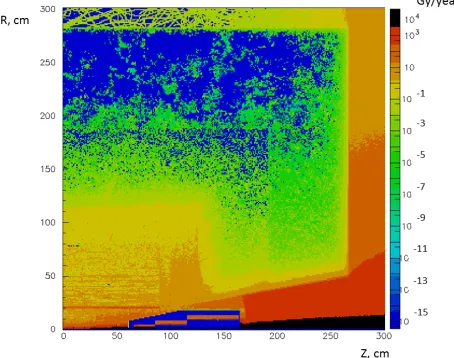
The map of absorbed dose is presented in Fig. 5. Dose is deposited mostly by secondary electrons, positrons and photons scattered from the walls of vacuum pipe and final focuse magnets. In very inner layers of the tracking system the dose is deposited by intense flux of electrons and positrons generated by two-photon interactions of primary beams. In the region of electronics of the IT absorbed dose does not exceed 100 Gy/year while in all other regions of the SCTD it does not exceed 10 Gy/year.
Figure 5.Absorbed dose in Gy/year.
Taking into account particle fluxes in the IT listed above, 103- 105particles/cm2s, channel area and dead time of each IT option, corresponding occupancy values were estimated (see Table 1). From the table one can see that occupancies of the wire options are too high while for the rest three options occupancies are quite acceptable.
Table 1.Occupancy (fraction of time, when system is busy) for different options of the Inner Tracker.
option Channel size Time of the measurement Occupancy
TPC 1x300 mm2 100 ns 3x10⁻²- 3x10⁻⁴
Si-strip 300x0.2 mm2 10 ns 10−3- 10−5
CGEM 300x0.4 mm2 100 ns 10−2- 10−4
Straw tubes 600x10 mm2 100 ns 1 - 0.01
Compact drift chamber 600x5 mm2 100 ns 0.5 - 0.005
3 Summary
respectively in the regions of electronics of the tracking system. Occupancies of different op-tions of the IT were estimated using the values of particle fluence, and it appeared that wire options, such as straw tubes and compact drift chamber can not be used in such environment.
References
[1] https://ctd.inp.nsk.su/c-tau/
[2] T.T Bohlen et al., The FLUKA Code: Developments and Challenges for High Energy and Medical Applications, Nuclear Data Sheets,120, 211-214 (2014).
[3] G. Battistoni et al., Overview of the FLUKA code, Annals of Nuclear Energy82, 10-18(2015).
[4] Frits A. Berends, P.H. Daverveldt, R. Kleiss, Monte Carlo Simulation of Two Photon Processes. 2. Complete Lowest Order Calculations for Four Lepton Production Processes in electron Positron Collisions, Comput.Phys.Commun.40(1986) 285-307
[5] Frits A. Berends, P.H. Daverveldt, R. Kleiss, Complete Lowest Order Calculations for Four Lepton Final States in electron-Positron Collisions, Nucl.Phys. B253 (1985) 441-463.
[6] S.Jadach et.al., in Physics at LEP2, edited by E.Altarelli, T.Sjostrand and F.Zwirner (CERN, Geneva, 1996), Vol.2, p.229, Yellow Report CERN 96-01, e-Print Archive: hep-ph/9602393.