
Recent results from CMD-3
F. V. Ignatov1,2∗, R. R. Akhmetshin1,2, A. N. Amirkhanov1,2, A. V. Anisenkov1,2, V. M. Aulchenko1,2, V. Sh. Banzarov1, N. S. Bashtovoy1, D. E. Berkaev1,2, A. E. Bondar1,2, A. V. Bragin1, S. I. Eidelman1,2,5, D. A. Epifanov1,2, L. B. Epshteyn1,2,3, A. L. Erofeev1,2, G. V. Fedotovich1,2, S. E. Gayazov1,2, A. A. Grebenuk1,2, S. S. Gribanov1,2, D. N. Grigoriev1,2,3, V. L. Ivanov1,2, S. V. Karpov1, V. F. Kazanin1,2, I. A. Koop1,2, A. N. Kirpotin1, A. A. Korobov1,2, A. N. Kozyrev1,3, E. A. Kozyrev1,2, P. P. Krokovny1,2, A. E. Kuzmenko1,2, A. S. Kuzmin1,2, I. B. Logashenko1,2, P. A. Lukin1,2, K. Yu. Mikhailov1, V. S. Okhapkin1, Yu. N. Pestov1, A. S. Popov1,2, G. P. Razuvaev1,2, Yu. A. Rogovsky1, A. A. Ruban1, N. M. Ryskulov1, A. E. Ryzhenenkov1,2, A. V. Semenov1,2, Yu. M. Shatunov1, P. Yu. Shatunov1, V. E. Shebalin1,2, D. N. Shemyakin1,2, B. A. Shwartz1,2, D. B. Shwartz1,2, A. L. Sibidanov4, E. P. Solodov1,2, V. M. Titov1, A. A. Talyshev1,2, A. I. Vorobiov1, I. M. Zemlyansky1, and Yu. V. Yudin1,2
1Budker Institute of Nuclear Physics, SB RAS, Novosibirsk, 630090, Russia 2Novosibirsk State University, Novosibirsk, 630090, Russia
3Novosibirsk State Technical University, Novosibirsk, 630092, Russia 4University of Victoria, Victoria, BC, Canada V8W 3P6
5Lebedev Physical Institute RAS, Moscow, 119333, Russia
Abstract.Regular data taking with the CMD-3 at the electron-positron collider VEPP-2000 is under way since 2010. The collected data sample corresponds to about 200 inverse picobarns of integrated luminosity per detector in the energy range from 0.32 up to 2 GeV, with a goal to collect about 1f b−1during next five
years. Some of the recent results from the CMD-3 detector are discussed.
1 Introduction
The electron-positron collider VEPP-2000 [1] has been operating at Budker Institute of Nu-clear Physics since 2010. The collider is designed to provide luminosity up to 1032cm−2s−1at the maximum center-of-mass energy √s=2 GeV. At present two detectors, CMD-3 [2, 3] and SND [4], are installed in the interaction regions of the collider. In 2010 both experiments started data taking. The current collected integrated luminosity is about 200 pb−1per detector. The physics program [5] includes high-precision measurements of thee+e−→hadronscross sections in the wide energy range up to 2 GeV, with rich intermediate dynamics involved, studies of known and searches for new vector mesons, studies ofnn¯andpp¯production cross sections near threshold and searches for exotic hadrons. It requires a detector with high effi -ciency for multiparticle events and good energy and angular resolutions for charged particles as well as for photons.
CMD-3 (Cryogenic Magnetic Detector) is a general-purpose detector, see Fig. 1. Coordi-nates, angles and momenta of charged particles are measured by the cylindrical drift chamber
Figure 1. CMD-3 detector: 1 – beam pipe, 2 – drift chamber, 3 – BGO calorimeter, 4 – Z-chamber, 5 – SC solenoid (0.13X0, 13 kGs),
6 – LXe calorimeter, 7 – TOF system, 8 – CsI electromagnetic calorimeter, 9 – yoke, not shown muon range system
400 600 800 1000 1200 1400 1600 1800 2000 2E, MeV 10
2
10
3
10
4
10
2E = 20 MeV, 1/nb/20MeV
∆
L per
CMD3 collected Luminosity as of 27.02.2019
-1
<2.4rad, L_BaBar=470 fb
ISR
θ
0.35<
--- BaBar effective Luminosity
Figure 2.Luminosity collected by CMD-3. The ef-fective ISR luminosity of BaBar (the last competitor experiment) is shown for comparison
with a hexagonal cell for uniform reconstruction of tracks, which is placed inside of the su-perconducting solenoid providing 1.3 T magnetic field.
The calorimetry is performed with the endcap BGO calorimeter and the barrel calorime-ter. The barrel calorimeter placed outside of the superconducting solenoid consists of two systems: the inner ionisation Liquid Xenon calorimeter and the the CsI scintillation calorime-ter. The total thickness of the barrel calorimeter is about 13.5X0. The LXe calorimeter has seven layers with strip readout which give information about a shower profile and are also able to measure coordinates of photons with about millimeter precision.
During 2013-2016 the VEPP-2000 collider and the detectors have been upgraded. Start-ing from 2017 the accelerator complex is runnStart-ing with a new injection facility, which helps to solve a problem of deficit of positrons. Also the “Beamshaking” technique was introduced in 2018, which suppresses beam instabilities by introducing controllable additional kicking of a beam. As a result of such improvements, a luminosity was increased by∼5 times at middle and high energies, but is still lower than the design value by a factor of two at top energies. The 4×1031cm−2s−1 luminosity was reached by the VEPP-2000 collider. The already col-lected integrated luminosity is 200 pb−1per detector, with about 135 pb−1above theφenergy and 65 pb−1from a scan below theφ(Fig. 2).
All major channels are under analysis with up to 7 pions or 2 kaons and 3 pions in the final state. The CMD-3 collaboration has already published many results such as: e+e− → pp¯, 2(π+π−), 3(π+π−), 3(π+π−)π0,ωη,ηπ+π−π0,ωπ+π−π0,K+K−,K
SKL,K+K−π+π−, search of e+e−→η0. Some more almost completed results will be soon ready for publication:K+K−η,
K+K−ω,ωπ+π−,ηπ+π−, search ofe+e− → D∗0. Many others analyses are in progress, some of them will be discussed below. Status of some of them is presented in dedicated papers for proceedings of the PhiPsi19 conference:
• “An amplitude analysis of the processe+e−→4π”,
• “Identification of thee+e−→nn¯events”,
• “The NNbar and multihadron production at the threshold”,
• “Current status of luminosity measurement with the CMD-3”,
• “Search for the processe+e−→D∗
0(2007)”,
• “Study of the processe+e−→π+π−γ”,
• “Study of the processe+e−→K+K−π0”,
• “Study of thee+e−→KSKLπ0process”.
2
e
+e
−→
π
+π
−channel
The dominant contribution to production of hadrons in the energy range √s<1 GeV comes from the e+e− → π+π− mode. This channel gives the main contribution to the hadronic term and overall theoretical precision of the anomalous magnetic moment of the muong−2. It is the most challenging channel because of a high-precision requirement, necessitating a systematic precision of 0.2% to fulfill requirements of new g-2 experiments and physics at future electron-positron colliders. The CMD-3 has plans to further reduce a systematic uncertainty achieved by CMD-2. Two energy scan below 1 GeV for theπ+π−measurement was performed at VEPP-2000 in 2013 and 2018. The collected data sample corresponds to about 63 pb−1of integrated luminosity with 18 pb−1during the first scan and 45 pb−1during the second one. It is already higher than in any other experiments like previous CMD-2, the BaBar[6] and the KLOE[7, 8] experiments (Fig. 3).
Figure 3. Statistical precision of |Fπ|2 from the CMD-3 data collected during the 2013 and 2018 seasons in comparison with the results from CMD-2, BaBar, KLOE and BESIII
Figure 4. Preliminary results onF2
πfrom CMD-3. Open crosses – separation done using the calorimeter information, filled squares – using particle momentum. Some additional corrections, common to two methods, are not applied
The crucial pieces of analysis to reach the claimed goal include stablee/µ/πseparation, precise fiducial volume determination, theoretical precision of radiative corrections, etc. An important point is that many systematic studies rely on high collected statistics.
Theπ+π−process has a simple event signature with two back-to-back charged particles. They can be selected by using the following criteria: two collinear well reconstructed charged tracks are detected, these tracks are close to the interaction point, both tracks are inside a good region of the drift chamber. The selected data sample includes events withe+e−, µ+µ−, π+π− pairs and cosmic muons, and it practically doesn’t contain any other physical background at energies √s<1 GeV. These final states can be separated using either the information about energy deposition in the calorimeter or that about particle momenta in the drift chamber. At low energies the momentum resolution of the drift chamber is sufficient to separate different types of particles. The pion momentum is well aside from the electron one up to energies
√
s .0.9 GeV, while theµ+µ−events are separated from others up to √s .0.66 GeV. At higher energies the peak of an electron shower in the calorimeter is far away from the peak of minimal ionization particles. Separation using energy deposition works better at higher energies and becomes less robust at lower energies.
A full energy deposition in combined LXe and CsI calorimeters is used at the moment. Further methods are under development to exploit full power of the layered barrel calorime-ter. Additional information from independent measurements of energy deposition in seven strip layers of the LXe and in the CsI calorimeter gives better discrimination power between different particles due to different interaction process involved (electromagnetic shower, ion-ization process, nuclear interaction).
Figure 5.Preliminary results of the measurement of muon pair production in comparison with the QED prediction
Figure 6.Ratio of the measured 2πcross-section to the common fit |Fπ|2 parametrization. Blue points - season 2013, red points - 2018.
The preliminary result on the pion formfactor measured by the CMD-3 is shown in Fig. 4 comparing two approaches using either momentum information or energy deposition. The additional corrections, common to two methods (e.g., the trigger efficiency), are not applied. These two methods overlap in the wide energy range and provide a cross-check of each other, allowing to reach in future a systematic error of event separation at the level of 0.2%.
The contribution to systematic precision frome/µ/πseparation at the peak of theρ res-onance is estimated now as 0.2% when using momentum information and up to 1.% in case of energy deposition, where in the second case work is still in progress and this number rep-resents a current level of studies. Comparison of both methods is an important step before publishing first results.
The current estimated systematic uncertainty is about 0.65% at theρ-peak and up to 0.9% at lowest points.
The comparison of results from two seasons of 2013 and 2018 is shown in Fig. 6 (from the analysis based on momentum information). Good agreement is seen at the level of 0.1%, while the condition of the DCH was very different, like a different level of correlated noise, one HV layer was offin 2013 and so on, which affect very stronlgy applied corrections.
One of the tests in this analysis is a measurement of the e+e− → µ+µ− cross section at low energy, where separation was performed using momentum information. Preliminary results of this test are consistent with the QED prediction with an overall precision of 0.25% as shown in Fig. 5.
For some sources of systematics there is a clear way of how to bring it down. e/µ/π
nuclear interactions and decays in flight will be improved with better understanding of the drift chamber (which includes a detailed description of per cell inefficiencies, noise level, etc) and possible dedicated study based on the 3π-channel.
Another important source of systematics is a theoretical precision of radiative correc-tions [9], which contribution is estimated as 0.45% in case of event separation based on momentum information and is mainly coming from the theoretical prediction of momentum spectra from differential cross sections. Additional studies like crosschecks of different calcu-lation approaches and further proof from comparison with experimental data are necessary in this field. As seen from effects of two-photon contributions to momentum spectra, it becomes very desirable to have an exact NNLOe+e−→e+e−(γγ) generator to reach precision.0.1%. Hopefully, growing up activity in such calculations for future high-precision experiments like MuOnE [10] and FCC-ee [11] will also help our experiment.
3
e
+e
−→
K
+K
−,
K
S
K
Lchannels
The largest contribution toR(s) at theφmeson comes from two kaon production channels. The recent CMD-3 result for thee+e−→KSKLcross section [12] is shown in Fig. 7. This is
the most precise measurement of this cross section with reached 1.8% systematic uncertainty. The data is very well consistent with previous experiments, and the obtained parameters of theφmeson are in good agreement with the PDG data.
1000 1010 1020 1030 1040 1050 1060
,nb
σ
10
2
10
3
10 SND
CMD-2 CMD-3 Fit CMD-3 2012 CMD-3 2013
a)
, MeV
c.m.
E
1000 1010 1020 1030 1040 1050 1060
(data - Fit)/Fit
-0.05 0
0.05 b)
Figure 7. (a)e+e− → K0
SK 0
Lcross section
mea-sured in the CMD-3 experiment. (b) Relative dif-ference between the data and fit.
Figure 8.e+e−→ K+K−
cross section measured by CMD-3 [14]
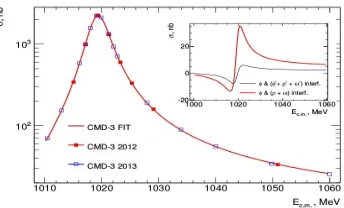
Results on thee+e− → K+K−channel were recently published by the CMD-3 [14] ex-periment below 1.06 GeV as shown in Fig. 8. This cross section was measured in the φ -meson energy range with 2% systematic accuracy. As shown in Figs. 9 and 10, the obtained results have comparable accuracy, but they are not consistent, in general, with the previ-ous data. In particular, an inconsistency between the old CMD-2 [15] result and more re-cent BaBar data [16] was confirmed. The new CMD-3 measurements ofe+e− → K+K− and e+e− → K
SKL mentioned above demonstrate good agreement with isospin
symme-try: the ratio of the coupling constants with the Coulomb factor taken into account is
gφK+K−/gφK
SKL/ q
Z(m2
φ)=0.990±0.017.
The lower CMD-2 e+e− → K+K− cross section is explained by overestimation of the value of the trigger efficiency for slow kaons in the previous experiment and a reanalysis of CMD-2 data is expected.
, MeV
C.M.
E 1020 1040 1060 1080 1100
(Data - Fit)/Fit
-0.2 -0.15 -0.1 -0.05 0 0.05 0.1
CMD-2 95
CMD-2
SND
CMD-3 2012
CMD-3 2013 a
Figure 9. Comparison of the CMD-3 measure-ment ofe+e− →
K+K−
to previous CMD-2 [15] and SND [13] measurements. The width of the band shows the systematic uncertainties in the CMD-3 study.
, MeV
C.M.
E
1020 1040 1060 1080 1100
(Data - Fit)/Fit
-0.2 -0.15 -0.1 -0.05 0 0.05
0.1 BaBar
CMD-3 2012 CMD-3 2013 b
Figure 10. Comparison of the CMD-3 measure-ment ofe+e− →
K+K−
to the BaBar measure-ment [16] using the ISR approach. The width of the band shows the systematic uncertainties in the CMD-3 study.
Figure 11. Thee+e− → 3(π+π−
)π0 cross
sec-tion measured with the CMD-3 detector at VEPP-2000 (dots). The contributions from thee+e−→ 2(π+π−
)ηand e+e− → 2(π+π−
)ω reactions are shown by triangles and open circles, respectively.
Figure 12. The e+e− → 2(π+π−
)ηcross sec-tion measured with the CMD-3 detector at VEPP-2000 (circles). The results of the BaBar measure-ment are shown by open circles.
4 Unaccounted modes
The total e+e− → hadron cross section below 2 GeV is calculated as a sum of exclusive cross sections for all possible hadronic modes. Some unmeasured channels are calculated using rough isospin relations, which can be very approximate. To fulfill a preciseR(s) mea-surement program, it is very important to take into account all possible channels and to do measurements of unaccounted modes or accounted by indirect isospin relations. Some of them were recently studied by the CMD-3 group.
The processe+e−→π+π−π0ηwas studied using theπ+π−4γfinal state [17]. This channel can go through several intermediate states. At least four mechanisms of this reaction:ωη,φη,
Another first time measurement ofe+e−→3(π+π−)π0has been published recently [18] by the CMD3. The measured cross section is shown in Fig. 11, where only thee+e−→2(π+π−)η subchannel was measured before by BaBar [19] as shown in Fig. 12.
5 Conclusions
The precise low-energye+e− → hadronscross sections are used in the SM prediction of various fundamental quantities. New precise data are desirable to fulfill requirements of new g-2 experiments and physics at future electron-positron colliders. The VEPP-2000 is now the only working collider capable of scanning energies below< 2 GeV for a measurement of exclusivee+e−→hadronschannels.
The two scans below 1 GeV for theπ+π−measurement were performed in 2013 and 2018. The already collected data sample for the cross section measurement has a few times better statistical precision than was achieved by other experiments. High statistics will allow to study and to control better different systematic contributions estimated now as 0.9÷0.6%, and the improvement here is also expected.
Several previously unmeasured processes likee+e−→π+π−π0ηand 3(π+π−)π0 contribut-ing to the total hadronic cross section below 2 GeV have been studied.
Many analyses are ongoing at CMD-3. The overall goal of the VEPP-2000 experiments is to collectO(1)1/f bduring next 5 years, which should provide new precise results on the hadron production.
This work is supported in part by Russian Foundation of Basic Research (17-02-00847, 17-02-00897, 18-32-01020).
References
[1] P. Y. Shatunovet al., Phys. Part. Nucl. Lett.13(2016) no.7, 995; D. Shwartzet al., PoS ICHEP2016(2016) 054; this proceedings [2] V. M. Aulchenkoet al., BUDKER-INP-2001-45
[3] B. Khazin,Nucl. Phys. Proc. Suppl.181-182(2008): 376 [4] M. N. Achasovet al., Nucl. Instrum. Meth. A598(2009) 31. [5] S. Eidelman,Nucl.Phys.Proc.Suppl.162(2006): 323
[6] J. P. Leeset al., Phys. Rev. D86(2012): 032013 [7] F. Ambrosinoet al., Phys. Lett. B670(2009): 285 [8] F. Ambrosinoet al., Phys. Lett. B700(2011): 102 [9] S. Actiset al., Eur. Phys. J. C66(2010): 585
[10] S. Di Vita, S. Laporta, P. Mastrolia, A. Primo and U. Schubert, JHEP1809(2018) 016 [11] FCC CDR , M. Mangano et al. CERN-ACC-2018-0056, Geneva, December 2018. [12] E. A. Kozyrevet al.,Phys. Lett. B760(2016) 314
[13] M. N. Achasovet al., Phys. Rev. D94(2016) no.11, 112006 [14] E. A. Kozyrevet al., arXiv:1710.02989 [hep-ex].
[15] R. R. Akhmetshinet al.,Phys. Lett. B669(2008) 217 [16] J. P. Leeset al.,Phys. Rev. D88(2013) no.3, 032013 [17] R. R. Akhmetshinet al.,Phys. Lett. B773(2017) 150
[18] R. R. Akhmetshinet al.[CMD-3 Collaboration], Phys. Lett. B792(2019) 419
[19] B. Aubertet al.[BaBar Collaboration], Phys. Rev. D76(2007) 092005, Erratum: [Phys. Rev. D77(2008) 119902]


![Figure 10. Comparison of the CMD-3 measure-ment of e+e− → K+K− to the BaBar measure-ment [16] using the ISR approach](https://thumb-us.123doks.com/thumbv2/123dok_us/8005388.1330144/6.482.57.220.278.381/figure-comparison-cmd-measure-babar-measure-using-approach.webp)
