Web Based Image Searching and Reranking
Using Saliencing Techniques
Mayuri H. Kawalkar1, Prof. Gangotri Nathaney2
M. Tech Scholar, Department of CSE, WCEM, Nagpur, India1
Assistant Professor, Department of CSE, WCEM, Nagpur, India2
ABSTRACT: The main aspect of the proposed system is use image click-through data, which can be viewed as the implicit feedback from users, to overcome the intention gap, and further improve the image search performance. The proposed system presents a novel re-ranking approach, named spectral clustering re-ranking with click-based similarity and typicality using saliencing technique. The saliencing technique can be used to estimate foreground and background
region according to saliency distribution. To achieve an appropriate similarity measurement, we propose click-based
multi-feature similarity learning algorithm. It conducts metric learning and integrates multiple features into a unified similarity space via multiple kernel learning. Then based on the learnt click-based image similarity measure, we conduct spectral clustering to group visually and semantically similar images into same clusters, and get the final re-rank list by calculating click-based clusters typicality and within- clusters click-based image typicality in descending order.. Our experimentimproves the initial search result.
KEYWORDS: Image search, search re-ranking, click-through data, multi-feature similarity, image typicality.
I. INTRODUCTON
Hundredsof thousands of images are uploaded to the internet with the explosive growth of online social media and the popularity of capture devices thus; building satisfying image retrieval system is the key to improve user search experience. In order to improve search performance, image search re-ranking, which adjusts the initial ranking orders by mining visual content or leveraging some auxiliary knowledge is proposed, and has been the focus of attention in both academia and industry in recent years. In order to learn appropriate image similarity and typicality measurements, meanwhile explore the effects of click-through data to reduce intent gap, we develop a novel image search re-ranking approach, named spectral clustering ranking with click-based similarity and typicality (SCCST). In image search re-ranking named spectral clustering re-re-ranking with clicked based similarity and typicality which use first use image click information to guide image similarity learning for multiple features, and then conduct spectral clustering to group visually and semantically similar images into clusters. Finally obtain the re-ranking results by calculating click-based clusters typicality and within-clusters click based image typicality in descending order. In clicked base multi feature similarity learning uses click through data and multiple modalities simultaneously to learn image similarity. It increases the image search performance.
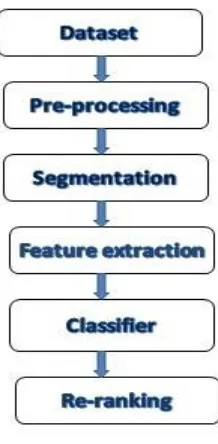
The following figure shows basic concept of image processing. The proposed system consist of some steps such as collecting dataset, pre-processing saliency map generation, feature extraction, and then classify images. Then apply re-ranking method. This paper is organized as follows: section II describes the related work; section III describes the proposed methodology, section IV describes experimental result and conclusion in section V.
Fig 1.1:BASIC STEP OF IMAGE PROCESSING
II.
RELATED WORKXiaopengYang,TaoMei,Jie Liu : Proposed novel re-ranking spectral clustering re-ranking with click base similarity and typicality. It use clicked through data to guide image similarity for click multiple feature and then conduct spectral clustering. And obtanined re-ranking calculating clicked base cluster typicality. For these feature extraction technique like edge,color feature extraction technique.
Xiaopeng Yang, yangdongzhang, Ting Yao, Tao Mei : Proposed new re-ranking algorithm name click boosting multymodility graph base re-ranking. The algorithm leverages click image to locate similar image that are not clicked. And re-rannked them in multimodality graph base scheme. The clicked through data can be viewed as footprint of search user behaviour. the feature extraction technique like color moment autocorologram gabber wavelet, texture wavelet are use for the feature extraction .to compare the feature of similar image.
JunieCai, Zheng,Junzha, Mengwang: proposed attribute assisted re-ranking. In these each image is represented by an attribute feature consisting the resonce from the classifier. A hyper graph is used to model the relationship between images by integrating low level feature and semantic feature. For visually similar images the feature are extracted. The edge distribution algorithm used for material attributes. K means is use for clustering. The svm classifier used for classification images.
Yan Liu, Tao Mei, Xian Sheng, Xiuqing Wu proposed novel approach to visual search re-ranking.Typicality defines on the basis of data distribution and theoreticallyformalizes example selection as an optimization problem and propose close form solution.
III. PROPOSED METHODOLOGY
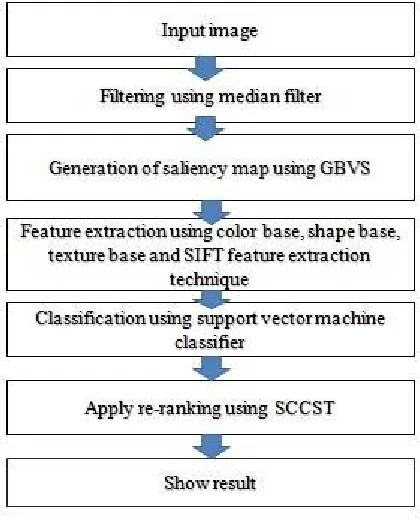
FOLLOWING FLOW EXPLAINS METHODOLOGY OF PROPOSED SYSTEM
Fig 2.1: PROPOSED TECHNIQUE
A. Image pre-processing
Image pre-processing is process which eliminates image distortion and enhances the image. For these we use following technique.
Median filter:
Median filter averages the intensity of neighbour’s pixel. It removes all type of noise. It provides excellent nose reduction capability with considerable less blurring than any other filter. Hence we use median filter.
B. Saliency map generation
Image saliency consists of three main steps: multi-level segmentation that decomposes an image into regions, region saliency computation that maps the features extracted from each region to a saliency score, and multi-level saliency fusion that combines the saliency maps over all the levels of segmentations to get the final saliency map. Saliency should be defined discriminative feature. It contains the information about where the interesting information can be found.
C. Feature extraction technique
Color:
HSV Histogram:
In HSV (or HSL, or HSB) space is widely used in computer graphics and is a more intuitive way of describing color. Hue, Saturation, Value or HSV is a color model that describes color (hue or tint) in terms of their shade (saturation or amount of gray) and their brightness (value or luminance). The hue is invariant to the changes in illumination and camera direction and hence more suited to object retrieval.
Auto correlogram:
The color auto correlogram only captures the spatial correlation between identical colors. The auto-correlogram integrates the color information and the space information. For each pixel in the image, the auto-correlogram method needs to go through all the neighbours of that pixel.
Color moment:
Color moments are used to differentiate images based on their features of color. This moment is used to measure the color similarity between images. The basis of color moments lays in the assumption that the distribution of color in an image can be interpreted as a probability distribution. If the color in an image follows a certain probability distribution, the moments of that distribution can then be used as features to identify that image based on color. Three central moments of an images color distribution. They are mean, standard deviation and Skewness.
Shape based features
Gabor wavelet
A Gabor wavelet is linear filter used for edge detection.. Gabor wavelet is widely adopted to extract texture from the images for retrieval and has been shown to be very efficient. Gabor wavelets can be generally considered as orientation- and scale tunable edge and line detectors, and the statistics of these micro features are often used to characterize texture information. Basically Gabor filters are a group of wavelets, with each wavelet capturing energy at a specific frequency and specific orientation. The scale and orientation tunable property of Gabor filter makes it especially useful for texture analysis. Among various wavelet bases, Gabor functions provide the optimal resolution in both the time and frequency domains, and the Gabor wavelet transform seems to be the optimal basis to extract local features for several reasons.
1. Biological motivation:
2. Mathematical and empirical motivation: Gabor wavelet transform has both the multi-resolution and multi-orientation properties and are optimal for measuring local spatial frequencies. Besides, it has been found to yield distortion tolerance space for pattern recognition tasks.
Wavelet Transform
Wavelet transforms are a mathematical means for performing signal analysis when signal frequency varies over time. For certain classes of signals and images, wavelet analysis provides more precise information about signal data than other signal analysis techniques. The wavelet transform uses functions that are localized in both the real and Fourier space.
SIFT feature:
SVM classifier:
SVM classifier is a supervised machine learning algorithm which can be used for classification or regression problems. It uses a technique called the kernel trick to transform your data and then based on these transformations it finds an optimal boundary between the possible outputs. In this SVM classifier used to classify images similar to the input image before re-ranking.
Apply Re-ranking using SCCST
In spectral clustering with click base similarity and typicality use image click through data to guide image similarity for multiple feature then conduct spectral clustering into group visually and semantically similar image and finally obtained re-ranking by calculating clicked base cluster typicality and within cluster click based image typicality.
IV. EXPERIMENTAL RESULT
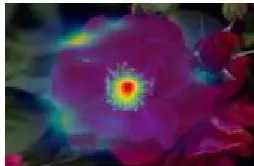
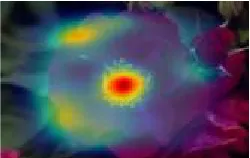
This experiment performs on search re-ranking scheme name spectral clustering re-ranking with click base similarity and typicality. We use color image as input. Then it pre-processes by some several technique of image processing and generate saliency map. The saliency map contain the interesting information can be found in image. The result show the various saliency map fig generated at various scale.
Fig4.1: is the original image which is given to the input.
Fig 4.2: shows the result after of pre-processing technique.
Fig 4.4: shows the saliency map after applying the blur ratio at scale 40%.
Fig 4.5: shows the saliency map after applying blur at scale 60%.
Fig 4.6: shows the saliency map after applying blur at scale 80%
Fig 3.7: shows the average result output.
V. CONCLUSION
The system is to design to improve the image search. We can use this system in any type of search engine and in smart phone. The silencing technique is used to get the better search result in similarity of the images. After applying silencing technique we get rescaled output. This output image from the proposed work can be used for further processing.
VI. ACKNOWLEDGMENT
REFERENCES
[1] Xiaopeng Yang, Tao Mei, Yongdong Zhang, Jie Liu, and Shin “Web Image Search Re-Ranking With Click-Based Similarity and Typicality” IEEE TRANSACTIONS ON IMAGE PROCESSING, VOL. 25, NO. 10, OCTOBER 2016
[2] B. Wu, T. Mei, W.-H. Cheng, and Y. Zhang, “Unfolding temporal dynamics: Predicting social media popularity using multi-scale temporal decomposition,” in Proc. 13th AAAI Conf. Artif. Intell., 2016,pp. 272–278.
[3]X. Yang, Y. Zhang, T. Yao, C.-W. Ngo, and T. Mei, “Click-boostingmulti-modality graph-based reranking for image search,” MultimediaSyst., vol. 21, no. 2, pp. 217–227, 2015.
[4] J. Cai, Z.-J. Zha, M. Wang, S. Zhang, and Q. Tian, “An attribute-assisted reranking model for Web image search,” IEEE Trans. Image Proces
[5] T. Mei, Y. Rui, S. Li, and Q. Tian, “Multimedia search reranking: A literature survey,” ACM Comput. Surv., vol. 46, no. 3, p. 38, 2014.
[6] Y. Zhang, X. Yang, and T. Mei, “Image search re-ranking with query dependentclick-based relevance feedback,” IEEE Trans. Image Process., vol. 23, no. 10, pp. 4448–4459, Oct. 2014.
[7] Y. Liu, T. Mei, M. Wang, X. Wu, and X.-S.Hua, “Typicality-based visual search reranking,” IEEE Trans. Circuits Syst. Video Technol., vol. 20,no. 5, pp. 749–755, May 2010.
[8] G.-R. Xueet al., “Optimizing Web search using Web click-through data,” in Proc. 13th ACM Int. Conf. Inf. Knowl. Manage., 2004, pp. 118–126. [9] V. Jain and M. Varma, “Learning to re-rank: Query-dependent image re-ranking using click data,” in Proc. 20th Int. Conf. World Wide Web, 2011, pp. 277–286.
[10] W. Hu, R. Hu, N. Xie, H. Ling, and S. Maybank, “Image classification using multiscale information fusion based on saliency driven nonlinear diffusion filtering,” IEEE Trans. Image Process., vol. 23, no. 4, pp. 1513–152
[11] Y. Rui, T. S. Huang, M. Ortega, and S. Mehrotra, “Relevance feedback: A power tool for interactive content-based image retrieval,” IEEE Trans.Circuits Syst. Video Technol., vol. 8, no. 5, pp. 644–655, Sep. 1998.
[12] X. Tian, D. Tao, X.-S.Hua, and X. Wu, “Active reranking for Web image search,” IEEE Trans. Image Process., vol. 19, no. 3, pp. 805–820, Mar. 2010.
[13] X. S. Zhou and T. S. Huang, “Relevance feedback in image retrieval: A comprehensive review,” Multimedia Syst., vol. 8, no. 6, pp. 536–544, Apr. 2003.
[14] B. Carterette and R. Jones, “Evaluating search engines by modeling the relationship between relevance and clicks,” in Proc. Adv. Neural Inf.Process. Syst., 2008, pp. 217–224.
[15] G. Dupret and C. Liao, “A model to estimate intrinsic document relevance from the clickthrough logs of a Web search engine,” in Proc.3rd ACM Int. Conf. Web Search Data Mining, 2010, pp. 181–190.
[16] G. E. Dupret and B. Piwowarski, “A user browsing model to predict search engine click data from past observations,” in Proc. 31st Annu.Int. ACM SIGIR Conf. Res. Develop. Inf. Retr., 2008, pp. 331–338.
[17] T. Joachims, L. Granka, B. Pan, H. Hembrooke, and G. Gay, “Accuratel interpreting clickthrough data as implicit feedback,” in Proc. 28th Annu.Int. ACM SIGIR Conf. Res. Develop. Inf. Retr., 2005, pp. 154–161.
[18] T. Mei, Y. Wang, X.-S. Hua, S. Gong, and S. Li, “Coherent image annotation by learning semantic distance,” in Proc. IEEE Conf. Comput.Vis. Pattern Recognit. (CVPR), Jun. 2008, pp. 1–8.6, Apr. 2014
[19] C. Yang, L. Zhang, H. Lu, X. Ruan, and M.-H.Yang, “Saliency detection via graph-based manifold ranking,” in Proc. IEEE Conf. Comput. Vis.Pattern Recognit., Jun. 2013, pp. 3166–3173.
[20]J. Harel, C. Koch, and P. Perona, “Graph-based visual saliency,” in Proc. Annu. Conf. Neural Inf. Process. Syst., 2007, pp. 545–552.
BIOGRAPHY
Mayuri Kawalkar has received her B.E. degree in Computer Engineering in 2014. She is pursuing Master in technology in computer Science and Engineering from Wainganga College of Engineering and Management, Nagpur-44013. Her area of interest includes digital image processing.