University of Windsor University of Windsor
Scholarship at UWindsor
Scholarship at UWindsor
Electronic Theses and Dissertations Theses, Dissertations, and Major Papers
2016
Comparative Mining of B2C Web Sites by Discovering Web
Comparative Mining of B2C Web Sites by Discovering Web
Database Schemas
Database Schemas
Bindu Peravali University of Windsor
Follow this and additional works at: https://scholar.uwindsor.ca/etd
Recommended Citation Recommended Citation
Peravali, Bindu, "Comparative Mining of B2C Web Sites by Discovering Web Database Schemas" (2016). Electronic Theses and Dissertations. 5861.
https://scholar.uwindsor.ca/etd/5861
This online database contains the full-text of PhD dissertations and Masters’ theses of University of Windsor students from 1954 forward. These documents are made available for personal study and research purposes only, in accordance with the Canadian Copyright Act and the Creative Commons license—CC BY-NC-ND (Attribution, Non-Commercial, No Derivative Works). Under this license, works must always be attributed to the copyright holder (original author), cannot be used for any commercial purposes, and may not be altered. Any other use would require the permission of the copyright holder. Students may inquire about withdrawing their dissertation and/or thesis from this database. For additional inquiries, please contact the repository administrator via email
Comparative Mining of B2C Web Sites by Discovering
Web Database Schemas
By
Bindu Peravali
A Thesis
Submitted to the Faculty of Graduate Studies through the School of
Computer Science in Partial Fulfillment of the Requirements for the Degree
of Master of Science at the
University of Windsor
Windsor, Ontario, Canada
2016
Comparative Mining of B2C Web Sites by Discovering
Web Database Schemas
By
Bindu Peravali
APPROVED BY:
Dr. Zhiguo Hu, External Reader
Department of Mathematics & Statistics
Dr. Subir Bandyopadhyay, Internal Reader
School of Computer Science
Dr. Christie I. Ezeife, Advisor
School of Computer Science
iii
DECLARATION OF ORIGINALITY
I hereby certify that I am the sole author of this thesis and that no part of this thesis has been published or submitted for publication. I certify that, to the best of my knowledge, my thesis does not infringe upon anyone’s copyright nor violate any proprietary rights and that any ideas, techniques, quotations, or any other material from the work of other people included in my thesis, published or otherwise, are fully acknowledged in accordance with the standard referencing practices. Furthermore, to the extent that I have included copyrighted material that surpasses the bounds of fair dealing within the meaning of the Canada Copyright Act, I certify that I have obtained a written permission from the copyright owner(s) to include such material(s) in my thesis and have included copies of such copyright clearances to my appendix.
iv
ABSTRACT
Discovering potentially useful and previously unknown historical knowledge from
heterogeneous E-Commerce (B2C) web site contents to answer comparative queries such
as “list all laptop prices from Walmart and Staples between 2013 and 2015 including make,
type, screen size, CPU power, year of make”, would require the difficult task of finding the
schema of web documents from different web pages, extracting target information and
performing web content data integration, building their virtual or physical data warehouse
and mining from it. Automatic data extractors (wrappers) such as the WebOMiner system
use data extraction techniques based on parsing the web page html source code into a
document object model (DOM) tree, traversing the DOM for pattern discovery to recognize
and extract different web data types (e.g., text, image, links, and lists). Some limitations of
the existing systems include using complicated matching techniques such as tree matching,
non-deterministic finite state automata (NFA), domain ontology and inability to answer
complex comparative historical and derived queries.
This thesis proposes building the WebOMiner_S which uses web structure and
content mining approaches on the DOM tree html code to simplify and make more easily
extendable the WebOMiner system data extraction process. We propose to replace the use
of NFA in the WebOMiner with a frequent structure finder algorithm which uses regular
expression matching in Java XPATH parser with its methods to dynamically discover the
most frequent structure (which is the most frequently repeated blocks in the html code
represented as tags < div class = “ ′′ >) in the Dom tree. This approach eliminates the need
for any supervised training or updating the wrapper for each new B2C web page making
the approach simpler, more easily extendable and automated. Experiments show that the
WebOMiner_S achieves a 100% precision and 100% recall in identifying the product
records, 95.55% precision and 100% recall in identifying the data columns.
v
DEDICATION
vi
ACKNOWLEDGEMENT
I would like to give my sincere appreciation to all of the people who have helped me throughout my education. I express my heartfelt gratitude to my parents and brother for their support throughout my graduate studies.
I am very grateful to my supervisor, Dr. Christie Ezeife for her continuous support throughout my graduate study. She always guided me and encouraged me throughout the process of this research work, taking time to read all my thesis updates and for providing financial support through research assistantship.
I would also like to thank my external reader, Dr. Zhinguo Hu, my internal reader, Dr. Subhir Bandhyopadhay, and my thesis committee chair, Dr. Dan Wu for making time to be in my thesis committee, reading the thesis and providing valuable input. I appreciate all your valuable suggestions and the time, which have helped improve the quality of this thesis.
vii
Table of Contents
DECLARATION OF ORIGINALITY ... iii
ABSTRACT ... iv
DEDICATION ... v
ACKNOWLEDGEMENT ... vi
LIST OF TABLES ... ix
LIST OF FIGURES ... x
CHAPTER 1: INTRODUCTION ... 1
1.1 Web Mining: ... 1
1.1.1 Web Structure Mining: ... 1
1.1.2 Web Usage Mining:... 2
1.1.3 Web content mining: ... 2
1.2 Types of Web Pages ... 3
1.2.1 The Unstructured Web Page: ... 3
1.2.2 Semi-structured/Structured Web Pages... 4
1.2.2.1 The List Web Page ... 5
1.2.2.2 The Detail web page ... 7
1.3 Why List Page ... 7
1.4 Understanding the html source code behind the webpage ... 7
1.5 Building DOM Tree: ... 8
1.5.1 Using Tags Alone: ... 8
1.5.2 Using Both Tags and visual cues: ... 9
1.6 Cascading style sheets: ... 9
1.7 Xml and Xpath Parser: ... 10
1.8 Thesis Contributions: ... 11
1.9 Outline Of Thesis: ... 11
CHAPTER 2: RELATED WORK ... 13
2.1 Grammar Based Approaches: ... 13
2.1.1 IEPAD: Information Extraction Based On Pattern Discovery ... 13
2.1.2 STALKER: A Hierarchical Approach to Wrapper Induction ... 17
2.1.3 The WebOMiner : Towards Comparitive Mining Of Web Documents Using NFA ... 20
viii
2.2 Comparison Based Approaches: ... 25
2.2.1 DEPTA: Data Extraction Based On Partial Tree Alignment... 25
2.2.2 DEBYE: Data Extraction By Example ... 28
2.2.3 Information Extraction From Web pages: ... 31
2.3 Vision Based Approaches: ... 33
2.3.1 LIXTO: Visual Web Info Extraction: ... 33
2.3.2 Simultaneous record detection and attribute labeling in web data extraction ... 35
CHAPTER 3 : PROPOSED SYSTEM THE WEBOMINER_S ... 38
3.1Problems Addressed ... 38
3.2 Problem Domain ... 39
3.3 Proposed WebOMiner_S Architecture and Algorithm: ... 41
3.3.1 The Crawler Module: ... 43
3.3.2 The Cleaner Module: ... 47
3.3.3: The Parser Module: ... 48
3.3.4: The Frequent Structure Finder Module ... 52
3.3.5 The Schema Extractor Module: ... 60
CHAPTER4: EVALUATION OF WEBOMINER_S SYSTEM ... 63
4.1. Empirical Evaluations ... 63
4.2 Experimental Results ... 66
4.3. Comparison with the WebOMiner ... 68
4.4 Limitations ... 69
CHAPTER 5: CONCLUSION AND FUTURE WORK ... 70
5.1 Future Work ... 70
REFERENCES ... 72
A P PE N D I X – A ... 75
ix
LIST OF TABLES
x
LIST OF FIGURES
Figure 1: Unstructured web page ... 4
Figure 2: Structured web page ... 5
Figure 3 : Detail Page... 6
Figure 4: Sample Html Source Code ... 8
Figure 5: Web page content for the sample html code ... 8
Figure 6: Refering css stylr using Class attribute ... 10
Figure 7: Sample css ... 10
Figure 8: A Pat Tree ... 15
Figure 9: Sample String Alignment ... 16
Figure 10:EC tree for LA weekly ... 18
Figure 11: Description of LA weekly ... 18
Figure 12: A slg for the start of area ... 19
Figure 13: Data block contents ... 21
Figure 14: matching two book web pages ... 23
Figure 15: complex mismatch ... 24
Figure 16: Vision tree ... 26
Figure 17: Sample HTML code and Coordinates rendered ... 26
Figure 18: Iterative tree alignment with two iterations ... 27
Figure 19: Snap shot of a web page and hierarchical structure for the object... 29
Figure 20: Extracted object in xml ... 30
Figure 21: The execution of bottom up ... 30
Figure 22: Sample DOM tree with 2 sub trees ... 32
Figure 23: Sample Dom tree ... 32
Figure 24: HTML parse tree for the page ... 35
Figure 25: A sample HTML page ... 35
Figure 26: Piece of data from sample web page ... 36
Figure 27: Junction tree for the subgraph starting from 0 ... 36
Figure 28: WebOMiner_S Architecture ... 41
Figure 29: WebOMiner_S Main Algorithm ... 42
Figure 30: Algorithm crawler ... 43
Figure 31: Input web page... 45
Figure 32: uncleaned.html ... 46
Figure 33: Clean Html File ... 47
Figure 34: Algorithm parser ... 49
Figure 35: Algortihm search_string ... 50
Figure 36: Temporary Xml file ... 51
Figure 37: Occurrence data file ... 51
Figure 38: Dom tree ... 52
Figure 39: Nodelist struct_List ... 53
Figure 40: Dom tree <div class=”supporting-info”> ... 54
Figure 41: Dom tree <div class="deal"> ... 55
Figure 42: Dom tree with <div class= "prodwrap"> ... 56
xi
Figure 44: Algorithm fs_finder ... 59
Figure 45: Frequent Structure ... 59
Figure 46: Schema Extractor ... 61
Figure 47: Discovered Schema ... 62
Figure 48: Dtabase table generated ... 62
Figure 49: noise extracted ... 67
Figure 50: Comparison on system runtime ... 68
Figure 51: Architecture of WebOminer_S ... 78
Figure 52: GUI for the user ... 79
1
CHAPTER 1: INTRODUCTION
The World Wide Web is the biggest and most widely used information source that is easily
accessible (Liu, 2007). It is essential to provide tools for effective knowledge discovery. It
has numerous amounts of web pages that keep on updating and some gets deleted as well.
Data is heterogeneous in nature, several types of data such as text, image, video, and audio
are within the web.
Web has emerged as one of the important medium for business. E-commerce has evolved
as the most potential business area. Huge volume of products are being sold online, where
each vendor has his own web site to show case his products. We have identified the
necessity of a comparative agent for such product web pages which not only compares
current data but also historical. Such agents already exist in the literature but none of them
are totally automatic even if some of them are automatic each has its own downside.
The main intuition of the thesis is to develop a scalable and robust approach for automatic
web data extraction and storage for further analysis.
1.1 Web Mining:
Web mining can be stated as the application of data mining techniques on the web (Cooley,
Mobasher, & Srivastava, 1997). It is performed to discover unknown knowledge existing
on web data. Also to provide some value added services to the users. Containing large
volumes of data and its versatility, interest’s lots of researchers on performing several
mining techniques for knowledge discovery.
Web mining is categorized into 3 areas as given below
1) Web Structure mining
2) Web usage mining
3) Web content mining
1.1.1 Web Structure Mining:
2
This area of research also involves study of World Wide Web structure as a whole like
social networks and citation analysis etc. Considering web as a directed graph, the analysis
of in-links and out-links to a page is the key to search engines. Traditional data mining
techniques does not perform the link analysis as they are stored as relational databases no
link structure exists. The structure of a web site can be obtained by analyzing the link
structure between pages (Kosala & Blockeel, 2000). It also involves web page
categorization and discovering communities on the web.
1.1.2 Web Usage Mining:
The web usage mining focuses on techniques that could present the user behavior while the
user interacts with the web (Srivastava, Cooley, Deshpande, & Tan, 2000). Such data is
stored on the webservers and log files this information can be mined for identifying the
user interests and further build recommendations accordingly. But the problem arises in
identifying individual user and their sessions.
There are 3 main tasks for performing the web usage mining, Preprocessing, Pattern
discovery, and Pattern analysis (Cooley, Mobasher, & Srivastava, 1997). Data can be
embedded into a web page by anybody there is no any restrictions, this flexibility gives
way to incomplete and in appropriate data which makes the task of pattern discovery
difficult. Hence preprocessing the web data before performing any task is must. Pattern
discovery is performed on web usage data by using several machine learning techniques
and statistical methods, pattern recognition along with data mining. Some of the major
approaches involves association rule mining, clustering, classification, sequential patterns
and dependency modeling (Srivastava, Cooley, Deshpande, & Tan, 2000). Such discovered
patterns can be analyzed for interesting patterns using some already existing forms such as
sql and olap depending up on the data.
1.1.3 Web content mining:
3
distributed in large scale over numerable servers all over the world. Task of performing
web content mining involves gathering relevant information from the World Wide Web.
General Challenges in web content mining:
1) Web data is heterogeneous in nature, several kinds of data such as text, image, audio and
video exist on web.
2) Web data is dynamic, whenever an expensive mining task is performed on web data now
or then the data on web gets updated and as a result the same task has to be performed
again. This scenario gets worse when the data gets updated frequently, unfortunately this
is a common scenario in web.
Introduction:1.2 Types of Web Pages
Data on the World Wide Web has been classified by many researchers into 3 types. The unstructured data, the semi structured and the Structured (Kosala & Blockeel, 2000). As the web is not strict anybody can represent their content in any way they wanted. However based on the domain the website / web page belongs to, it follows a similar structure with the other web pages belonging to the same domain. For example all the web pages that belong the news columns will project their content to the readers in a similar format. The type which the web page belong to matters, because wrappers generated to extract the content on the web page highly depends on the type of web page and its structure. Here, we discuss the different type of web pages.
1.2.1 The Unstructured Web Page:
4
place their content according to their desire and no structure is followed necessarily.
Figure 1: Unstructured web page
On such web pages no template based web data extraction can be applied and these pages
are usually represented as a bag of words or phrases which can be mined using several data
mining techniques.
1.2.2 Semi-structured/Structured Web Pages
5
Figure 2: Structured web page
two classifications, the List Page and the detail page. Which are formed due to the type of template used to generate them.
1.2.2.1 The List Web Page
6
may or may not be associated with. Figure highlights a web page from bestbuy.ca, it is a product web page which is a list type of page having 8 objects displayed with several attributes such as price, brand, size, color, processor, hard disk, ram and operating system. Also object 2, 8 have an attribute discount which none of the other objects in the page has. It is meta data of the product which can be stored into a data warehouse from historical querying and comparative analysis .This page also has other data such as header, navigational data, advertisements (Currently not visible) and footer (currently not visible), all this information has to be ignored and only the target objects has to be extracted by the wrapper. This Figure is an example of our input web page for our system WebOMiner_S performing the data extraction.
7
1.2.2.2 The Detail web page
Detail web page displays only one object with all of its attributes. The Figure 4 showcases a detail page from an e-commerce website chaptersindigo.ca. The object is a book and the detail page displays all the attributes of this object such as name of the book, price, format, dimensions, published on ,Published by , language etc. All this can be extracted to store into a data warehouse for value added services.
1.3 Why List Page
We have chosen to mine a list page instead of a detail page because of the following reasons: 1. List pages provide with the most important attributes of the object in the customers
perspective whereas the detail pages contains all the attributes of the object. As our main objective is to develop a system that can perform a comparative mining and historical querying as value added service for the customers.
2. Our observation is that the detail page contains more noise than the list page, on Considering the recommendations and advertisements. As we work towards eliminating noisy data in our data ware house we prefer to mine less noisy web pages.
3. It is very resource consuming to extract data of an object and its attributes from the web page then move to another page to extract another object and its attributes when all the objects belong to the same type and while we can extract multiple objects from single page in the list type.
1.4 Understanding the html source code behind the webpage
8
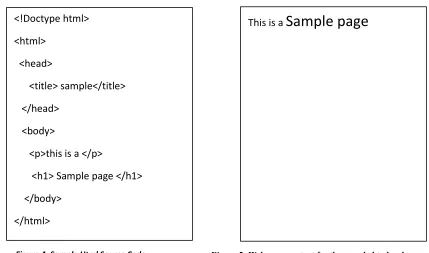
FONT>, <COLOR>, < H1>, <H2>, <IMG>, <A>, < BR> etc., these are called inline tags. Tags like <DIV>, <TABLE>, <OL>, <FORM>, <LI>, <TR>, <TD> helps in grouping, organizing and sectioning the web page also called block level tags according to w3consortium. Figure shows a sample html source code and how it will be rendered by the browser as a web page.
Figure 5: Web page content for the sample html code
1.5 Building DOM Tree:
Dom stands for document object model it has become a necessary step for many data
extraction algorithms. Dom tree is constructed using the html source code of the web page.
The tags and their hierarchies form the parent child relationship explaining how the content
is organized in the page. This insight allows the researchers to build wrappers for data
extraction. DOM trees can be built by using 2 methods.
1) Using tags alone 2) Using both tags and visual cues
1.5.1 Using Tags Alone:
Most of the html tags occur in pairs with an open tag and a closed tag. Within such pairs
there can be other pair of tags, giving rise to nested structure. A DOM tree for an html page
is built by considering each pair of tag as a node.
Html is not a strict language, missing or incomplete tags may be encountered so there a
necessity to properly embed the tags in order to derive a correct DOM tree. This gives rise
This is a
Sample page
<!Doctype html><html>
<head>
<title> sample</title>
</head>
<body>
<p>this is a </p>
<h1> Sample page </h1>
</body>
</html>
9
to the preprocessing task called data cleaning. Followed by building a DOM tree from the
clean html file.
1.5.2 Using Both Tags and visual cues:
Relying on the visual information (location of tags on the screen) to infer the structural
relationship among tags for constructing a DOM tree is another method. Nested rectangles
are used to interpret the tag structure. This is performed by finding the 4 boundaries of a
rectangle of each html element by calling the rendering engine of a browser. Containment
check is performed to see if one rectangle is contained in another, this interprets the nested
structure of html tags.
1.6 Cascading style sheets:
10
Figure 6: Refering css stylr using Class attribute
Figure 7: Sample css
1.7 Xml and Xpath Parser:
Similar to HTML, XML is also a markup language and is a w3c recommendation. While HTML has a predefined set of tags xml allows users to define their own self descriptive because of which it is not only machine readable but also human readable. XML is designed to store and transport data and exclusively used in IT systems. The major difference between the HTML and XML is that the former one is designed to display data while the later one is to carry data. XPath (the XML Path language) is a language for finding information in an XML document. XPath is used to navigate through elements and attributes in an XML document. It uses path expressions to navigate in XML documents. Also, it contains a library of standard functions. XPath uses path expressions to select nodes or node-sets in an XML document. These path expressions look very much like the expressions you see when you work with a traditional computer file system. Some of the sample expressions are /-> selects from the root node//-> Selects nodes in the document from the current node that match the selection no matter where they are. .-> Selects the current node , ..-> Selects the parent of the current node, @->Selects attributes. It also has wild cards, XPath wildcards can be used to select unknown XML nodes.* ->Matches any element node, @* -> Matches any attribute node and node()-Matches any node of any kind. It provides with some methods to retrieve information from the xml document such as, xpath evaluate() method to return specific data from xml file that matches the xpath expression. It can take as input an xml document and returns its nodes as a nodelist. getlength() method to get the count of no of matching nodes to the path expression in the xml.
We have made use of all these functional features in our system to make the data extraction much easier.
div.prodlook{
font-weight:bold;
margin-left:30px}
div.prodprice{
font: sans-serif;
color:red;
background:green}
<div class=”prodlook”>…….</div>
11
1.8 Thesis Contributions:
1) We propose to replace the use of the NFA in step 4 of the WebOMiner system with a frequent structure finder (FSfinder) algorithm using both web content and structure mining. The FSfinder uses the Java xpath parser to summarize the frequency of each tag occurrence in the web html code, retaining only tags that meet a certain minimum occurrence (e.g. 3), then for each tag, it uses the web page DOM tree to find the tag’s block and retrieve the most frequently used block. This most frequently used block is then marked as the data block and its data region/table name is retrieved with its schema.
2) Schema can be dynamically discovered for any given web page using our technique while with the WebOMiner, to add and learn about a new or re-structured B2C web page, the NFAs need to be refreshed so that it can recognize new features not previously in its structure. Our proposed system uses regular expression matching in the Java xpath parser through its methods such as compile(), evaluate() which will discover the most frequent structure block level tag (e.g.,< divclass = “ ′′ >) in the Dom tree.
3) Our algorithm does not follow any hard matching techniques like tree alignment (such as recognizing zones and blocks of the DOM tree with series 1 and 2 observations) or NFA as done in . Instead we summarize and observed the occurrence of tags that create similar block structure. 4) WebOMiner_Simple is extendable and has the potential to be scalable to large websites because of its simple and effective technique.
5) It is highly automated and no manual efforts (such as description of sample training B2C pages) are required in the extraction process. We only have to give the system a product page web page address and it will discover the database schema.
1.9 Outline Of Thesis:
The remainder of the thesis is organized as follows:
Chapter 2: Related literature in the area is presented. We have identified problems which are related to the problem studied in this thesis. We categorized these problems in three sections and each section explains the related work done in these problems and surveys the various solutions proposed. Different works are compared in this section and we tried to identify the advantages and disadvantages of the approaches.
12
Chapter 4: Explain performance analysis and the experiments conducted in detail.
13
CHAPTER 2: RELATED WORK
In this section we present the related work in the literature on web data extraction. There
have been several works conducted in this domain here we present most significant work
performed in the area of data extraction. Researchers had used several data mining
techniques on the web data to extract information, over the years web data extraction had
improved from manual to automatic using several data mining techniques. We have
categorized the existing work based on the scientific technique used and thus we have the
comparison based, vision based and the grammar based approaches in web data extraction.
The first category of systems build their wrappers based on the comparisons between the
new web page and the template. For comparing the web pages or the data blocks researchers
had used string matching, tree matching and multiple sequence alignment methods. In the
second group of systems unlike the other researchers the authors proposed to use the visual
information on the web page instead of underlying html code. Information like coordinates
of the data blocks on the web page and vision based Dom trees were used in the web data
extraction. In the third category of systems used grammar based approach for building their
wrappers. They observed patterns and used regular expressions to identify and further
extracted the data.
2.1 Grammar Based Approaches:
The data extraction systems that performed data extraction by inferring a grammar from the html code of the webpage. The common tag structure shared by the web page is uncovered by using regular expressions, string alignments which are further used to build rules for extraction.
2.1.1 IEPAD: Information Extraction Based On Pattern Discovery
(Chang & Lui, IEPAD: information extraction based on pattern discovery, 2001)
IEPAD is the semi-supervised learning system which extracts data from web without using
some manual methods such as labeling the Sample pages. It highlights the usage of
repetitive patterns occurred in web pages in order to present the target data as a structure
called PAT trees. And, multiple sequence alignment is used to comprehend all record
instances.
14
in a web document and data is pushed into web pages from underlying databases using a
common template. 2) Uses a data structure called PAT trees a Binary suffix tree, to discover
repetitive patterns as they only records exact match for suffixes. 3) Uses multiple sequence
alignment by the center star method which begins from each occurrence of a repeat and
ends before the beginning of next occurrence.
The Architecture of the system has 3 modules first is an Extraction rule generator, the
pattern viewer and the Extractor module. Where the first module analyses the html tag
structure and generates rules, the second module displays the rules to the uses to select one
rule among them to perform extraction and the third module extracts all the data records
that match with the rule selected. Their algorithm is explained with a running example as
follows
Example 1: For Instance consider this 2 lines of html code as input for the system in their
first step.
<B>Congo</B>< I>242</I><BR>
<B>Egypt</B><I>342</I><BR>$
The HTML page is given as an input to this component it then translates into a string of
abstract representations called tokens which is identified by a binary code. Here tokens are
divided into two types, tag tokens and text tokens where tag tokens are the html tags and
text tokens are the original text in between the tags denoted by Text(). Discovering patterns
based on tag tokens majorly block level tags excluding text tags will result in more abstract
patterns that represent the whole web page.
Example 2: Token string generated by the translator for the above example is as follows
Html(<B>)Text(_)Html(</B>)
Html(<I>)Text(_)Html(<BR>)
Html(<B>)Text(_)Html(</B>)Html(<I>)Text(_)Html(<BR>)$
These as encoded into binary strings as shown below
Html (<B>) 000, Html (</B>) 001, Html (<I>) 011 then the pattern would be 000001011$
15
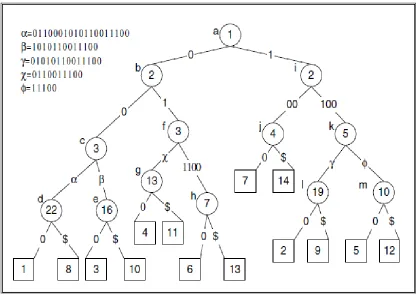
internal node is an indication of which bit is to be used for branching. Every sequence of bits starting from each of the encoded token extending it to the end of the token string. Each sistring is represented by a bit position. An important observation in pat tree is that, all suffix strings with the same prefix will be under the same subtree. Also, each edge is associated with a virtual edge label which is the sistring between those two nodes. We can uniquely identify a sistring by its prefix. The edges labelled with the $ sign indicates the end of the string as shown in figure 8
Figure 8: A Pat Tree
16
used to eliminate maximal repeats that are scattered apart beyond a given bond. Along with
these, Coverage measures the volume of content in the maximal repeats. IEPAD uses
multiple string alignment for pattern matching, it does not allow any partial or inappropriate
matching only strings exactly matched are considered. For Example, Suppose “kjl” is the
pattern discovered for token string, if we have multiple alignments kjlmn, kjlm, kjlmo the
extraction pattern can be generalized as “kjl[m\x]o[p\-]” where “ –“ represents missing
characters. Thus the problem is transformed to find the multiple alignment of the k strings.
The approximation algorithm is used to find the center string Sc
in K strings. Once the
center string is found, each string is iteratively aligned to the center string to construct
multiple alignment, which is in turn used to construct the extraction pattern.
The extraction process starts when the user selects one or more
patterns from the pattern viewer. The extractor searches the PAT
tree for maximum occurrences to find the target data but if the web
page cannot be expressed as PAT tree then a normal pattern
matching algorithm can be used for extraction. Their results
shows 97% accuracy in successfully identifying the target data.
However the major Short comings of the paper includes the following
1) The assumption that multiple data records will be homogenous fails as data records in
web pages can have different attributes because of the missing values.
2) Requires a trained user that can infer rules to extract actual data records.
3) Their assumption that target data will be under the same parent node fails for large
number of web pages as there is no necessity in HTML5 after using the block tags to section
web pages.
4) Does not propose any strategy to overcome noise or unnecessary data.
5) Their use of binary suffix trees only produces exact matches is a huge drawback because
of the missing attribute values in data records.
6) Did not discuss about the heterogeneity of the web data such as the Images and their
extraction process.
K J L M O P K J L X O P K J L X O -
17
2.1.2 STALKER: A Hierarchical Approach to Wrapper Induction
( Muslea, Minton, & Knoblock, A hierarchical approach to wrapper induction, 1999)
This is a supervised approach for data extraction, where the user labels some sample pages
from which the system generates the extraction rules. There by data in web pages having
similar structure can be extracted by matching those rules. It performs a hierarchical data
extraction by using embedded catalog formalism. The Major Contributions of the paper
includes 1) Introducing the concept of hierarchical data extraction using embedded
catalogue tree in which leaves are the attributes and internal node are the tuples.2) web
content can be extracted by some consecutive tokens called landmarks that enable the
wrapper to locate data x with in a data region p. 3) Multiple scans are performed to handle
missing values and multiple permutations. The Stalker proposed to represent a web page as
typical embedded catalogue tree where each leaf node contains the target data and the
internal nodes form the list of K tuples. Again the items in k tuples can be a leaf node l or
another list L. Each edge of the tree is associated with an extraction rule in order to extract
x from p.
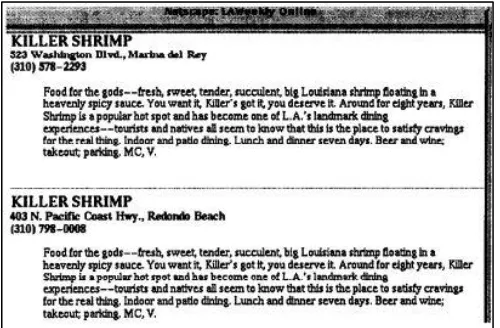
For example consider the Restaurant description as given below
1:<p> Name: <b> Yala </b><p> Cuisine: Thai <p><i>
2:4000 Colfax, Phoenix, AZ 85258 (602) 508-1570
18
Figure 10:EC tree for LA weekly
Data is extracted by using 2 rules the start rule and the End rule.For the above given
example in order to identify the name of restaurant the start rule is SkipTo(<b> and the end
rule would be SkipTo(</b>). Thus for each data item an extraction rule is associated and
the wrapper has to generate it automatically. The SkipUntil() and NextLand mark () rules
can also be used.
The Extraction rules can also be expressed as landmark automata where each transaction is
labelled by a transaction. Disjunct rules can be used in extraction process.
List (Restaurant)
Name Review Address List(credit cards)
Credit card
19
Example: 2
El: 513 Pica, <b>Venice</b>, Phone: I-<b>800/b>-555-1515
E2: 90 Colfax, <b> Palms </b>, Phone: (818) 508-22222
E3: 523 1st St., <b> LA </b>, Phone: l-<b>mk</b>-578-2293
Ed: 403 Vernon, <b> Watts </b>, Phone: (310) 798-0008
The stalker inductive algorithm generates extraction rules to capture each data item by
taking as input the set of sequence of prefix tokens. User identifies the start of x from the
sample page using the GUI. For instance consider that the user has marked the area codes
then the sequential covering algorithm starts by generating linear l, As it then covers all the
examples and generates disjuncts. In the fore mentioned example algorithm initially
generates SkipTo(() it matches E2 and E4 but does not match E1, E3. While in the second
iteration algorithm considers only uncovered examples and generates SkipTo(phone) and
SkipTo(<b>). The fig 1 represents the slg that accepts both the rules. Thus Stalker tries to
generate slg that accepts all the positive examples and reject all the negative ones. The
algorithm contains a function called learnDisjuncts() generates all the candidates repeatedly
selects and refines the best candidate until it finds a perfect disjunct which only accepts the
positive pages. In order to find best disjunct stalker searches for a disjunct that accepts the
largest number of positive examples. Another function Refine() obtains netter disjuncts()
by making its landmarks more specific or by adding new states to the automata. Followed
by the GetTokens() which gives out the tokens that have appeared at least once. Their
<b> Phone
S1
(
Figure 12: A slg for the start of area
20
experimentation proves that their methodology achieves 97% accuracy. But Short comings
of the paper are 1) Their algorithm requires Multiple passes over the input data to extract
the target data. 2) The performance of the algorithm entirely depends on the sample training
pages given, making the system dependent on a trained user. 3) Their Technique is
scientifically complex and time consuming that it cannot be used in real time applications.
4) Maintaining wrapper is another huge dis-advantage of this system, every time new
presentation structure arrives the wrapper has to be updated.
2.1.3 The WebOMiner : Towards Comparitive Mining Of Web Documents Using NFA
(Ezeife & Mutsuddy, 2012)
21
amNFA that can extract target data from all the porduct list pages author observes a
comprehensive list of schemas. Some of them are as follows,
Product (title:string, image:image-file,prodNum:string, brand:string, price:long);
Product (title:string, image:image-file,prodNum:string, price:long);
Thus, the NFA should be able to identify any of the scema and extract the data tuples and
send them to product content object class. The case is similar with list, form, text and image
contents as well.
Author proposed an architechture with 6 modules called sequentially by the main
algorithm and always output of the previous module is input to the next one. Each modul
is described as follows. They proposed a mini crawler algorithm that takes input as a url, it
crawl the web fetches the page nad stores it in a local directory. It discards the comments
from the document. Followed by the cleaner module. Their reason for using a cleaner is
that the web data is usaully dirty. Data cleaninig has to be performed to avoid any missing
tags or in approporiate ones because DOM tree is built based on these tags, ao it is importan
to have quality tags. After the cleaning is done content Etractor Module is called.The task
of this module is to take the clean html file to build a DOM tree and assign respective class
object class and push objects into content array list.Each data block is seperated by the
seperator object. Then the algorithm calls Mine contentObject.Identifytuple() which
extracts diffetent tuple types and places them in corresponding containers This algorithm
generates Seed NFA pattern for data blocks from positive pages. It extracts objects of all
tuples by matching them with the refined NFAs and storing identical tuples(e.g., product
22
record object tuples, list tuples) into appropriate TupleList. A count check is performed to
verify if all the tuples wre extracted. Tuple squeezing is used to generalize tuples of the
same data block. so that pattern of any tuple containing varying length pattern can be
represented in the same category.
In order toCreate Data base table the data ware house star
schema approach is used to form the fact and dimentional tables from the tuple array list
along with the company name. They have achieved an accuracy of 100% and recall of 96%.
Major Short Comings Of The paper includes 1) Matching each tuple in the ArrayList with
NFA sequentially is a hard matching technique, can not be applicable to large web sites
2)Wrapper Maintenance : has to be updated every time a new structure is encountered
2.1.4 RoundRunner: Towards Automatic Data Extraction From Large Websites
(Crescenzi, Mecca, & MerialdO, 2001)
23
A Matching algorithm called ACME, Align, Collapse under mismatch, and extract is
proposed the input to this algorithm are the list of prepared html tokens and two web pages
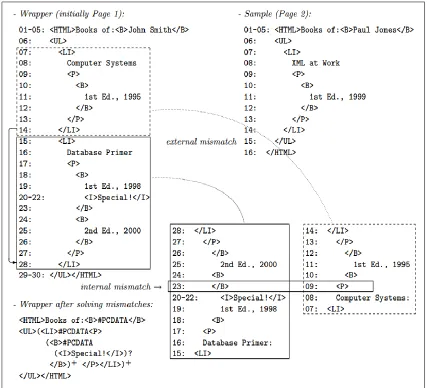
in which initially considered as a version of wrapper and progressively will be transformed
into a wrapper that extracts from similar pages. The wrapper is generalized whenever a
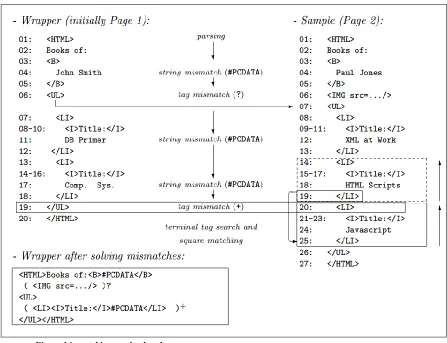
mismatch has occurred. According to this Paper, two mismatches can take place String
mismatch and the tag mismatch.String mismatches are nothing but the different values to
the attributes so they can be commonly generalized by replacing #PCDATA. In the
mentioned example strings “john smith” , “Paul jones” there is string mismatch which can
be overcome by replacing them with #PCDATA. However the tag mismatch is not as easy
Figure 14: matching two book web pages
24
finally finding the repeated pattern with the next <UL> tag.when a mismatch occurs due
to the cardinality of the data values it can be solved by identifying the squares and
generalizing the wrapper accordingly. Algorithm initially finds where the minimum
cardinality exists whether in the sample or in the wrapper, then finds the terminal tag. There
by explores the possibility of candidate square of form <UI>……</LI> in the wrapper
which is a fail and next in the sample <LI>……..</LI> it succeeds here. Therefore it
concludes that the sample contains candidate occurrence of tokens from 20 to 25.Now that
the algorithm found square s the wrapper has to be generalized as S
+by continuously
searching the wrapper for repeated occurrences.
25
But the problem arises when we try to resolve a mismatch and it results in more internal
mismatches. A variant of pages about author is showcased in example 2, parsing stops at
line 15 due to tag mismatch when the algorithm tries to find the candidate tokens by
matching upward from the terminal string it results in more and more mismatches. This
situation can be handled by considering each internal mismatch as another tag mismatch
try to solve it in the same way as external mismatch. In the example internal mismatch
involves tokens 23, 9 after solving it leads to the list of editors and the second mismatch is
treated as an optional pattern <I>Special!</I>. Hence from all the above cases the algorithm
Match can be summarized as follows, Input to the algorithm is a wrapper w and a sample
page s it tries to generalize the wrapper by finding the mismatches occurred. Therefore
finding a solution to the match (w,s) is a visit to AND-OR tree in fact the solution is finding
solution to every mismatch that has occurred in the process of parsing the tree and will
involve adding a node or searching for one. Short coming of the Paper are 1)
Manual
labelling the fields after extraction is necessary as they are anonymously named (like a,b,c,d
etc.,) 2) The algorithm has exponential time complexity with respect to input lengths so it
cannot be used in real time. 3) It requires more than one training page and is
semi-supervised approach.
2.2 Comparison Based Approaches:
These approaches find commonalities to identify data records by making comparisons
between the page fragments considering the web page as a tree and by performing tree edit
distance, string edit distance. These kind of systems are explained in detail as follows.
2.2.1 DEPTA: Data Extraction Based On Partial Tree Alignment
(Zhai & Liu, 2005)
26
Author argues that data records may not be contiguous and in a nested structure it can begin
from the middle of any other record as well. Also he states that trees based on tag
information does not always guarantee correctness so vision based tag trees are reliable.
Based on these observations he proposes a novel tree alignment method on vision based
trees.
Building a vision based HTML tag tree involves Each HTML element being represented
as a rectangle. A Tag tree is constructed based on the nested rectangles by finding the 4
boundaries of the rectangle and by detecting the containment Relationship between the
rectangles. Instead of immediately mining data records author proposes to mine data
regions first then followed by data records. A data region is found by performing the string
edit distance. A generalized node is used to indicate a subtree. Unlike the other methods
author says that data records may not be contiguous but generalized nodes are contiguous.
The data records are identified by the fact that the distance between the data records in a
data region are less than the distance between any gaps with in a data record. There can be
a case in which a data region can have more than one generalized node or even two or more
data regions from multiple generalized node such cases can be handled by the algorithm.
Data extraction is performed by creating a rooted tag tree for each data record, once all the
data records are identifies the subtrees of all the data records are re-arranged into a single
subtree. Then the tag trees of all the data records are in each data region are aligned using
partial alignment method based on tree matching. In this approach author aligns multiple
left right top bottom
100 300
200 400
100 300
200 300
100 200
200 300
200 200
200 400
100 300
300 300
200 300
300 400
100 300
300 400
Table <table> <tr> <td>….</td> <td>…….</td> <tr> <td>…..</td> <td>…</td> </tr> </table> td td tr tr td td
27
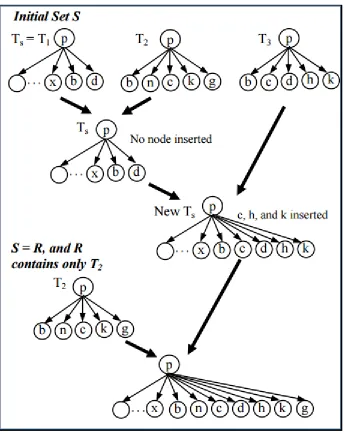
tag trees by progressively growing a seed tree Ts, here the seed tree is tree which has a
maximum child nodes. For each Ti
the algorithm tries to find out for each node in Ti
a
matching node in Ts . If a match is found then a link is created between those nodes if not,
a node is inserted into the seed tree. In that case where to insert a new node or a set of
unmatched sibling nodes uniquely is a question. In such case it is added to R set flag to
true, whenever a new alignments are found iteratively R is compared for matching. The
procedure is explained by using an example as follows
28
There are 3 trees T1, T2, T3 and consider T1 as the seed as it has more number of child nodes.
Algorithm assigns Ts to the seed tree which is T1 now. The rest of the two trees are compared
to the seed tree for alignments.
Ts and T2 produce one match, node b. Nodes n, c, k and g
are not matched to Ts. So, it attempts to insert them into Ts. However none of the nodes n,
c, k and g in T2 can be inserted into Ts because no unique location can be found. Then it
inserts T2 into R, which is a list of trees that may need to be further processed. In when
matching T3 with Ts, all unmatched nodes c, h and k can be inserted into Ts. Thus, T3 will
not be inserted into R set “flag = true” to indicate that some new alignments/matches are
found or some unmatched nodes are inserted into Ts. When the algorithm encounters S=
∅
and flag=”true” it understands that there are no more trees in S but there are some new
alignments and insertions took place. If there is any data still unprocessed it will be placed
into a single column in the database table. Thus all the data records are extracted and stored
in the database. The results showed that their approach has yielded 99% of recall and
accuracy. Short comings of the Paper includes 1) This approach does not work nor cannot
be extended with the pages having single data record such as the detail page 2) Nested data
records cannot be extracted using this approach.
2.2.2 DEBYE: Data Extraction By Example
(Laender, Ribeiro-Neto, & da Silva, DEByE–data extraction by example, 2002)
29
each piece of data is represented by an object. There exists multilevel objects they term
these as complex objects
Debye has 2 modules The Graphical interphase and The Extractor. An object is denoted as
a pair O= <T, V> such that V є domain (T) where V is a type of O. thus O is an instance of
T. domain(T)={a1,a1,a3….an}(n>=1).Instances of A-types are termed as atoms. The pair
<T, ai> is termed as attribute value pair User has to highlight the target data from the web
page using the GUI. This target data is treated as objects. Such assembled objects are used
to generate oe_patterns in xml. These patterns are used to extract data from the new web
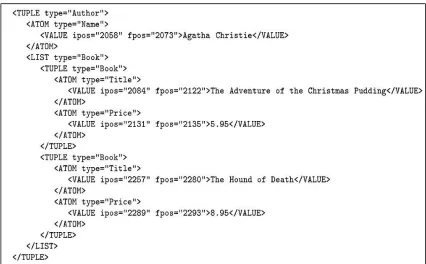
pages. The initial and final positions of occurrence of data are indicated by ipos, fpos
respectively. Attribute value pair patterns are described as <T,ai>, a local syntactic context
is associated to each avp it is the tokens surrounded by avp. Using this context information
avp patterns are built. In the given example in order to identify avp pattern for type price
would be as expressed in (a) that the value should be prefixed by Spre =“A deadly lie--$” in
particular and suffixed by
Ssuf = “;dead online”.so it strictly extracts only specific values. A more generalized pattern
is indicated by (b) it denotes that price value is prefixed by “$” and followed by “;” and
“*” indicates any value in that place.
Author
Name Book
Title Price
Agatha c
{(The Adventure of the
Christmas pudding, 5.95$),
(The hound of death, 8.95$)}
30
Figure 20: Extracted object in xml
31
OE patterns represent the structure of the data that the user needs to extract, its internal
nodes form another OE tree or type nodes (like price, book) and leaves are avp patterns.
There are two extraction strategies specified, the bottom up and the top down strategy. The
Top down strategy is a straight forward, the oe patterns are assembled for each example
object and using these patterns to discover new objects. This procedure is repeated based
on the number of example pages provided. Here the whole object is demolished into
components thus called a top down approach. This approach does not work well if the page
is variable structure.
In the Bottom up strategy the avp’s are priory recognized and extracted. For this approach
objects are represented as triple O = <T,V,L> where t is the type of the object, v is the value
and l is the index. The last row of circles indicate the avps. Each is avp is associated with a
label li. Contiguous pairs of title, price are formed as book instances. The values in L9 are
in reverse order and L11 does not have the price component, such cases can be handled by
the bottom up strategy. The list of objects assembled after the first step are indicated in 2
ndrow. Further the book instances are grouped up as list of book instances. From the example
l1 is combined with l2 and l8 is combined with l9. Thus the data can be extracted from similar
pages. Major Short Comings are 1) Extraction precision falls low in case of missing
attributes or multi-ordered attributes. 2) Multiple scan of input page is needed to extend
each atomic attribute.
2.2.3 Information Extraction From Web pages:
32
for example list of products in a e-commerce environment.When ever user clicks on a
particular product all the inforamtion appeers in a detail page. Most of all the techniques
proposed so far treat web page either as a list or as adetail page but it not the actual case.A
web page is crawled as a DOM tree and the nodes are classified by their weight, performing
prune operation on nodes with weight 0. Now that the web page is modelled as a dom tree,
the search for the data records is Breadth first search. Finds the repeated similar sub trees
by comparing the text similarity of nodes by string edit distance. In the tree text nodes are
tokenized by considering the html, special characters and conjunctions as seperators. In
order to Identifying attribute values from master page the attribute values are obtained from
ontology, They may be atomic or non-atomic sometimes even both. However we have to
match the tokens to the attribute values which is obtained with the help of the ontology.
The leverage of ontology allows us to detect the structure of data records, the cardinality of
extracted attribute values and possibly the relationships between them. The extraction
precision can be improved by the onyology extraction which can specify the attribute
labels, regular expression or key words. But certain data values can not be extracted from
domain, for example data record which has to be extracted a student name has an infinate
domain. To Identify attribute values from detail pages data extraction from detail page is
based on the observation that, web page is a template generated by embedded values form
the underlying databases. Thus they represent web page as a HTML page with variables.
These variables are in the process of template evaluation merged with the data model
having the attributes of products. Author believes that dissimilarity between web pages
<table>
<tr>
<td
> <td>
<tr> <td > <td> <table> <tr > <td> <td > <tr> <td>
33
occurs 3 places 1) Difference between the structure of DOM tree and the Structure of Sub
trees in the web page. Below given sample dom trees to represent the similar structure but
the sub strees are not similar as their number of child trees differ. 2)Difference between the
HTML attributes or values. Because, Not that every data record will have the same
attributes. 3)Differences in text nodes , representing different values to nodes. By
identifying the differences, author proposes extraction as, Initailly retrieving the HTML
source code of 2 detail pages is performed, then apply diff algorithm to retrieve all the
different spots. Followed by finding the nearest HTML element which contains different
spot in the sub tree. If the different spot is in the child node it s clear that the pages have
the same structure except variations in values, so declare the entire next node as candidate
to be extracted. But if the difference is in HTML atrribute simply ignore it. If it is the other
case then the web pages does not have the similar structure hence pass it to other extraction
process. Thus data can be extracted from detailed and list pages by identifying their
diffrences. Short comings of the Paper include 1)Ontology is largley a manual process and
expensive often not compatable. 2)certain attributes can be of infinite domain. Such as the
product names.
2.3 Vision Based Approaches:
2.3.1 LIXTO: Visual Web Info Extraction:
(Baumgartner, Flesca, & Gottlob, 2001)
34
35
Co(S, X, . . .)[a, b], where S is the parent instance variable, X is the pattern instance
variable, Ex (S, X) is an extraction definition atom, and the optional Co(S, X) are further
imposed conditions. A set of such rules form a pattern. All the rules in a pattern uses the
same information like the name of the pattern, its parent etc. Such patterns form an
extraction program which can be applied to similar pages. For Example, A wrapper for the
above quoted example every item is stored in its own table extracted by <record> , all such
patterns are defined in the same record. The price attribute uses concept attribute, namely
isCurrency which matches with the string like $ and the bids pattern uses a reference to
price. The final two patterns are strings.
2.3.2 Simultaneous record detection and attribute labeling in web data extraction
(Zhu, Nie, Wen, Zhang, & Ma, 2006)
This paper proposes a method called hierarchical conditional labeling, A novel graphical
approach to mutually optimize record recognition and attribute naming. Major
contributions of the paper involves 1)This approach extracts data from list web pages as
well as detail web pages. 2) Uses a vision based tree construction mechanism. 3) The
problem data record detection is viewed as assigning data record labels to the block in the
vision tree. Attributes labeling is considered as assigning labels to leaf blocks, and both the
tasks can be performed simultaneously. 4) Efficiently incorporates all useful features and
their importance weights. Web pages are represented as vision trees by using page layout
features such as font, color, size separators are the horizontal and vertical lines that do not
cross any node visually. A block in a web page is represented as a node in the vision tree
Conditional Random Fields are markov random fields, If x, y are 2 random variables then
G= (V, E) where x=label over observation
Figure 25: A sample HTML page
36
to be labelled and y is the variables over corresponding labels. Here, y could be a linear
chain.
Now the problem of web data extraction can be narrowed as finding the maximum
conditional probability of y over x, where x are the features of all blocks , y are the possible
label assignments.
Based on the hierarchical representation of data a model can be constructed by denoting
inner nodes as rectangles and leaf nodes as ellipses. A random variable Y is associated with
each label. Based on the model graph a junction tree is constructed by mapping ellipses a
clique nodes and rectangles as separators. Then the algorithm selects the arbitrary clique
node as a root node. The figure 2 represents the junction tree of the aforementioned
example. The value in each internal node are the values of that particular node along with
Figure 26: Piece of data from sample web page
37
its child nodes. The value in the root is thus {0,1,2}.This is followed by two phases. Using
HCRFmodel for web extraction it is necessary to define the leabel spaces followed by
seperation between the variables at leaf nodes and those at inner nodes, because we need
to extract the attribute value of the laf node where a for the inner node has to be identified
wether it is a data record or not. There is a necessity to explicitly define lef label space and
inner label space each for its own pupose. Forexample the leaf label space for the extraction
of products data can be {Product name, product id, prcice, description etc}.
38
CHAPTER 3 : PROPOSED SYSTEM THE WEBOMINER_S
Problem Definition :
Given any Business Customer website
W
of a domain
d
consists of several product list
pages that are generated by a common templae
T
from the underlying data bases with
Schema
S
with tuples α. Identifying S from the webpage there by extracting α to store in a
database and further in a datwarehouse for comparative mining.
As discussed in 2.1.4 (Ezeife & Mutsuddy, 2012) proposes object-oriented data model for extraction and mining of heterogeneous web contents. They gave the framework for extracting web data in a B2C webpage and an algorithm (called WebOMiner) for extraction of web objects. Though it achieved the purpose it was very complex and their wrapper have to be updated in case it encounters a new structure. We studied their work and propose two-level mining process for knowledge discovery. This thesis develops the architecture (we call it WebOMiner_S) for web content and structure mining using object-oriented model. It develops, extends and modifies necessary algorithms for WebOMiner_S system. It also discovers database schema and gives guidelines for data integration in the second phase. This thesis addresses the following problems in (Ezeife & Mutsuddy, 2012) work towards development of WebOminer_S System.
3.1
Problems Addressed
1. In the WebOMiner system they have divided the input web page into 3 zones the header, body and the footer zone using the series 1 and series 2 pointers created by their observation that a set of five or more sibling <a> tags mark the start of the body zone marked by series 1 while the last set of 5 or more <a> tags indicates the end of body zone recorded by series 2 pointer. This was done in order to eliminate the noise and narrow down the search for target data which is the product data to the body zone. This Assumption might not always work as expected since every web site has it’s own way of design and presentation. We have eliminated this whole process by identifying the repeated block level tags.
39
3. In their work (Ezeife & Mutsuddy, 2012) has used NFA’s to identify similar tuples, however the web data is very susceptible to change so with time many new structures of product data records might evolve and their NFA has to update the new structure every time. We have overcome this problem in chapter 3.
4. They have proposed the framework to extract and store in database but the discovery of schema has been pending, we have addressed this in our work in chapter 3.
3.2 Problem Domain
For the specific domain of B2C websites, we have selected to mine all the data rich web pages, i.e., the product list page. ). From the common B2C webpage structure shown in figures 05 and 06 (page 20 and 21), product list webpage is commonly a data rich page. We observed that, a product list page usually contains brief list of all or specific types of products. There is a set of product list pages in a B2C website. We define a product list page as follows:
Definition 1: If ‘w’ is a B2C website and ‘p’ is a webpage in ‘w’ such that
nj pj
w 1
, then a page pjw where j≥1, is a product list page iff ‘pj’ contains a set of tuples τ of type α, where
α ≥ 1, having distinct instance type.
Definition 2: The data block contains specific information about the specific product such
as product name, price, brand, size, etc.
If ‘p’ is a web page it consists of different sets of tuples ‘t’ of type α, where each α is a set of similar list of objects and each object having a finite set of attributes r, then each object with its corresponding attributes forms a data block.
Example : In the figure shows a web page p it consists of different sets of tuples of type product, advertisements, navigations, header etc., and each type has a similar list of objects like the product type has 8 objects with a set of attributes like price, color, brand, hard disk etc.,
These data blocks has to be stored into a database as a data tuple. In the html Dom tree a data block is a sub-tree of the Dom tree having the same or different parent node. The tags that are used to form a data block are <div>,<table>,<tr>,<td> etc., as per w3 consortium.
Definition 3: All the data bocks in the webpage together form the data regions and a
webpage can have a finite set of data regions depending on the type of data it presents.