MANESS, CHANDLER ROSS. Evaluation of Particulate-Blocking Materials for Use within Firefighting Turnout Ensembles. (Under the direction of R. Bryan Ormond, Ph.D.).
A variety of test methods were developed and employed for the purpose of evaluating
the nanoscopic particulate-capturing capabilities of assorted materials. These evaluations have pertinence to firefighting due to the similarity of particle sizes used in the testing efforts and
the sizes of particles released into the environment from material combustion. The relevance is sustained by the toxicity of those particles released during combustion and the overwhelming exposure to them experienced throughout the duration of a career in firefighting.
Simulated smoke from a theatrical fog machine was produced in a controlled environment and directed through diverse material types. It was discovered that certain
materials used in occupational firefighting gear provide better protection from particulate infiltration than others, and may even perform better than materials typically used in air
filtration applications. The simulated smoke was also used in combination with an adjustable manikin bearing a porous, smoke distribution tubing network to assess the vulnerability of various ensembles to particulate infiltration. The inclusion of properly-donned occupational
gear was found to decrease particulate infiltration at the waist, wrist, and ankle interfaces of traditional firefighting turnout systems. Furthermore, modifying the turnout system design
with integrated filtration materials was found to drastically improve particulate-blocking capabilities at the interfaces.
A benchtop wind tunnel was constructed and utilized with fluorescent aerosolized
microspheres to challenge material samples under wind conditions similar to those recorded at firegrounds. The aerosol used was polydisperse, with each different particle size corresponding
to particle size. The acquired results suggested acceptable aerosol distribution within the wind
tunnel, and were found to correlate well with the material evaluations performed using the simulated smoke methodology.
by
Chandler Ross Maness
A thesis submitted to the Graduate Faculty of North Carolina State University
in partial fulfillment of the requirements for the degree of
Master of Science
Textile Chemistry
Raleigh, North Carolina 2017
APPROVED BY:
_______________________________ _______________________________ R. Bryan Ormond, PhD Roger Barker, PhD
Committee Chair
_______________________________ Warren Jasper, PhD
DEDICATION
Above all, this work is dedicated to all the men and women of the fire service industry – past, present and future. There is no profession more honorable than one that serves humanity. The
courage, nobility, and self-sacrifice required to forsake a career of safety and comfort appropriately define a firefighter, and the willingness to wager life so that others may continue living positively defines heroism. The members belonging to this brotherhood of bravery will
forever be celebrated in the hearts and minds of those they protect. I am grateful to have had the opportunity to give back to those who have given so much of themselves.
Further dedication of this work is in honor of those who have made significant, positive impacts to my perspective, ideology, and well-being. Ceaseless thanks and appreciation to:
My parents, Carl and Lori, for demonstrating an unconditional love towards me that
has served to inspire, motivate, and educate me in ways that have contributed
immeasurably to my personal development.
My grandparents, Steve and Louise, for instilling the values of family, community, and
selflessness within me through hundreds upon hundreds of delicious home-cooked meals.
My brother, Jaxon, for lending an open ear, an eager mind, and a humbling admiration
throughout the years.
My Nanny, for showing me that everybody is deserving of compassion and patience.
My friend, Ervin, for encouraging me to live a life full of adventure, excitement, humor,
and wonder.
My best friend, Patrick, for providing unquestionable loyalty, sound advice, and some
of the craziest and most fun living I’ve had the pleasure of experiencing.
My friends, teammates, and colleagues over the past 7 years for supplying the
BIOGRAPHY
Chandler Ross Maness, arriving fittingly to his parents as an April Fool’s baby in 1992, spent his first 18 years living and learning in Albemarle, NC. Born to a small-business owner
and a finance officer, he quickly learned that staying active was the key to remaining undrafted to the ranks of menial office work or weekend landscaping efforts. As such, he found happiness in the outdoors, allocating his time between soccer balls, skateboards, trampolines, and
bicycles. He would eventually pass this wisdom to a brother 7 and ½ years his junior.
With a few years of high school under his belt, Chandler had a growing interest in the
sciences of the world, with a particular affinity for chemistry. He pursued his impulse to further his knowledge of the subject, enrolling in NC State University in 2010. The four years that followed coalesced into a mesmerizing blur, rife with late nights, academic rollercoasters, and
countless learning experiences, culminating with a B.S. in Polymer and Color Chemistry from NC State University’s College of Textiles in the spring of 2014.
In the fall immediately following the completion of his bachelor’s degree, Chandler re-enrolled at NC State to pursue a Master’s in Textile Chemistry. One year later, after occupying
the tiresome role of graduate student by day and adhesives chemist by night, he joined the
Textile Protection and Comfort Center under the supervision of Dr. Bryan Ormond. It was here where he found his passion for materials research, a calling that elicited direction, confidence,
ACKNOWLEDGMENTS
The work presented in the pages to follow would not have been possible without the support, advice, and encouragement imparted by my graduate advisor, Dr. Bryan Ormond. You
have been a mentor, teacher, friend, and constant source of motivation, and I am thankful to have known you in such capacities. Your tenacity, intelligence, and passion for your work have not only been the driving force behind my graduate research, but have served to improve my
research approaches, ignite career interests, and highlight my capabilities as a member of the scientific community. You have acted as such an influential role model on how to find success
within scientific disciplines, and I will carry my lessons learned for the rest of my career. Thank you, Bryan.
Furthermore, I would like to acknowledge the TPACC family for providing an
engaging and productive learning environment. I am grateful to Dr. Roger Barker for serving as the captain of such an industrious endeavor. I would also like to express my appreciation
for Dr. Cassandra Kwon and Dr. William Gabler, who both provided invaluable knowledge, feedback, and laughter along the way. Lastly, I would like to extend a thank you to the other TPACC students that have gone and are going through the graduate programs, followed by
TABLE OF CONTENTS
LIST OF TABLES ... ix
LIST OF FIGURES ... x
LIST OF EQUATIONS ... xiii
CHAPTER 1. Introduction ... 1
1.1 Purpose ... 1
1.2 Research Objectives ... 2
CHAPTER 2. Literature Review and Background ... 4
2.1 Firefighter Exposures and Associated Risks ... 4
2.1.1 Characterization of Smoke Produced from Structural Fires ... 4
2.1.1.1 Typical Compounds and Concentrations ... 4
2.1.1.2 Combustion By-products of Materials and Objects ... 9
2.1.1.3 Particulate Matter ... 12
2.1.1.4 Firefighter Susceptibility to Particulates ... 15
2.1.2 Firefighter Health Risks and Documented Malignant Occurrences ... 19
2.1.2.1 Physiological Effects of Toxic Combustion By-products ... 20
2.1.2.2 Correlation between Firefighting and Physiological Malignancies ... 23
2.2 Particulates and Filtration... 28
2.2.1 Classifications and Applications ... 30
2.2.2 Methods of Fibrous Media Particulate Collection ... 34
2.2.3 Evaluating Particulate Collection Efficiency ... 38
2.2.3.1 Defining and Measuring Filtration Efficiency ... 39
2.2.3.2 Effects of Material Properties and Filter Construction ... 42
2.3 Particulate Protection in Structural Firefighting Gear ... 46
2.3.1 Effects of Garment Usage on Material Functionality ... 46
2.3.2 Current Standards and Protection Factors... 49
2.3.2.1 Clothing ... 50
2.3.2.2 Protective Hoods ... 54
CHAPTER 3. Smoke Simulation for Evaluating Susceptibility of Ensembles and
Materials to Particulate Infiltration ... 61
3.1 Introduction and Background ... 61
3.2 Materials and Methods ... 61
3.2.1 Procedures ... 61
3.2.2 Materials ... 65
3.2.3 Data Analysis ... 69
3.3 Results and Discussion ... 73
3.3.1 Manikin Smoke Leakage Simulation Tests ... 73
3.3.2 Material-Level Smoke Penetration Tests ... 75
3.4 Conclusions ... 78
CHAPTER 4. Development of Dynamic Wind Tunnel Designed for Dispersed Aerosol Challenge of Materials ... 79
4.1 Introduction and Background ... 79
4.2 Materials and Methods ... 82
4.2.1 System Design ... 82
4.2.2 System Components... 84
4.3 Results and Discussion ... 88
4.3.1 System Parameters ... 88
4.3.2 Aerosol Size Distribution ... 91
4.4 Conclusions ... 98
CHAPTER 5. Use of Fluorimetric Analysis to Quantify Fluorescent Polystyrene-Latex Microsphere Aerosol Deposits on Fabrics ... 100
5.1 Introduction and Background ... 100
5.2 Materials and Methods ... 103
5.2.1 Microspheres ... 103
5.2.2 Fluorimeter Settings and Material Selections ... 114
5.2.3 Method Validation ... 121
5.3 Results and Discussion ... 126
5.3.1 Fluorescence of PSLs in Solution vs. Aerosolized PSLs ... 126
5.3.2 Quantification of Particle Penetration using Fluorescent Intensity Values .... 129
CHAPTER 6. Conclusions and Recommendations ... 139
6.1 Smoke Simulation ... 140
6.2 Benchtop Wind Tunnel ... 140
6.3 Fluorimetric Quantification of Microsphere Content in Solid Samples ... 142
6.4 Final Words ... 143
LIST OF TABLES
Table 1: Number of Fires with Gas Concentrations Exceeding Recommended Exposure
Limits ... 6
Table 2: Toxic Combustion By-products of Common Materials within a Structural Fire ... 10
Table 3: Possible Effects of Exposure to Various Toxic Compounds [10] ... 21
Table 4: Acute and Chronic Effects of Metal Toxicity [34] ... 22
Table 5: Prevalence of Chronic Respiratory Symptoms in Firefighters and Control Workers [38] ... 24
Table 6: Particulate Capture Mechanisms of Fibrous Media [57] ... 35
Table 7: NFPA 1971 Assessed Material Properties and Applicable Ensemble Elements [80] ... 51
Table 8: Comparison of NFPA 1994 PILT and DoD TOP 10-2-022A ... 54
Table 9: NFPA 1971 Performance Requirements for Protective Hoods [80] ... 55
Table 10: Common Fiber Types Used in Protective Hoods ... 56
Table 11: Cost of Particulate-Resistant Hoods vs. Traditional Nomex® Hoods [90-92]... 60
Table 12: Ensembles Evaluated for Outward Smoke Leakage ... 66
Table 13: Materials Evaluated for Smoke Penetration ... 68
Table 14: PSL Microsphere Solution Concentrations ... 90
Table 15: Average Particle Counts for Various Conditions ... 95
Table 16: Approximate Number of 0.5µm and 1.75 µm Particles Passed through Cross-Sectional Areas of the Wind Tunnel over Time ... 96
Table 17: Approximate Number of 0.1µm Particles Passed through Cross-Sectional Areas of the Wind Tunnel over Time ... 98
Table 18: Approximate Totals of 0.1 µm and 0.5 µm PSL Microspheres Captured by Material Samples during 30-minute Aerosol Challenges ... 136
LIST OF FIGURES
Figure 1: Mean VOC Air Concentrations Measured from Background Air, Used PPE
Ensembles, and New PPE Ensembles [12] ... 8
Figure 2: Total Career Fire Calls of Chicago and Philadelphia Firefighters [18] ... 11
Figure 3: Particle Number Density & Size Distribution after Ignition of an Attic [21] ... 13
Figure 4: Soot Samples Viewed under Scanning Electron Microscope [28] ... 14
Figure 5: Firefighter Turnout Ensemble Interface Locations ... 16
Figure 6: Aerosol Particle Size Distribution of IAFF Particle Exposure Test ... 17
Figure 7: Particle Exposure Test Results for Standard Firefighter Ensemble [29]... 18
Figure 8: Median Urinary Metabolite Levels by Collection Time [44]... 26
Figure 9: Different Shapes of Particulate Matter [51] ... 30
Figure 10: Particle Sizes of Contaminants in Air [53] ... 31
Figure 11: Mechanisms of Particle Capture – Flow Past a Single Fiber [53] ... 36
Figure 12: Mechanisms of Particle Capture – Flow Through a Pore [58] ... 37
Figure 13: Most Penetrating Particle Size Separation Mechanisms [58] ... 39
Figure 14: Schematic of ASTM F2299 [64] ... 40
Figure 15: MERV Ratings for Typical Air Filter Performances [67] ... 42
Figure 16: Felted Fabric Arrangement [51] ... 44
Figure 17: LION® MT-94™ (Left) [87] and Blauer® HZ9420 Multi-Threat Ensemble (Right) [88] ... 58
Figure 18: DuPont™ Tychem® TK Ensemble [89] ... 58
Figure 19: Smoke Production Machine within Modified Acrylic Chamber... 63
Figure 20: Perforated Tubing System Attached to Articulated Manikin ... 64
Figure 21: Ensembles Subjected to Smoke Leakage Simulation... 67
Figure 22: Subjective Grading Scale for Quantification of Smoke Observed in Manikin Leakage Tests... 70
Figure 23: Subjective Grading Scale for Quantification of Smoke Observed in Penetration Cell Tests ... 72
Figure 24: Ratings of Observed Outward Smoke Leakage from Manikin Ensembles ... 74
Figure 25: Ratings of Observed Smoke Penetration through Individual Materials ... 76
Figure 26: Ratings of Observed Smoke Penetration through Material Composites ... 76
Figure 27: Aerosol Wind Tunnel Chamber at Aerosol Concentrations of 0 mg/m3 (left) and 170 mg/m3 (right) ... 80
Figure 28: Swatch Test Setup in an Aerosol Wind Tunnel [97] ... 83
Figure 29: Schematic of Constructed Aerosol Wind Tunnel ... 86
Figure 30: Benchtop Aerosol Wind Tunnel System ... 87
Figure 31: Material Sample Holder Design ... 88
Figure 32: Fluorescent PSL Microsphere Solutions as Viewed in Ultraviolet Lighting Conditions (365 nm) ... 101
Figure 33: All Colors (0.5 µm) Monitored at Blue Parameters ... 106
Figure 34: All Colors (0.5 µm) Monitored at Yellow-Orange Parameters ... 106
Figure 36: All Colors (0.5 µm) in a Single Solution Monitored at their Respective Parameters ... 107 Figure 37: Blue, Yellow-Orange, and Red (0.1, 0.5, 1.75 µm) Monitored at Blue Parameters ... 110 Figure 38: Blue, Yellow-Orange, and Red (0.1, 0.5, 1.75 µm) Monitored at Yellow-Orange Parameters ... 110 Figure 39: Blue, Yellow-Orange, and Red (0.1, 0.5, 1.75 µm) Monitored at Red Parameters ... 111 Figure 40: Blue, Yellow-Orange, and Red (0.1, 0.5, 1.75 µm) in a Single Solution Monitored at their Respective Parameters ... 111 Figure 41: Green PSL Solutions of Incremental Particle Sizes as Viewed in 365 nm UV Light ... 112 Figure 42: Green PSL Solutions of Incremental Particle Sizes Monitored at Green Parameters ... 113 Figure 43: Materials and Blue Microspheres (0.1 µm) Monitored at Blue Parameters with 3 nm Slit Width ... 118 Figure 44: Materials and Blue Microspheres (0.1 µm) Monitored at Blue Parameters with 3.5 nm Slit Width ... 118 Figure 45: Materials and Blue Microspheres (0.1 µm) Monitored at Blue Parameters with 4 nm Slit Width ... 118 Figure 46: Materials and Blue Microspheres (0.1 µm) Monitored at Blue Parameters with 4.5 nm Slit Width ... 118 Figure 47: Materials and Orange Microspheres (0.5 µm) Monitored at Yellow-Orange Parameters with 3 nm Slit Width ... 119 Figure 48: Materials and Orange Microspheres (0.5 µm) Monitored at Yellow-Orange Parameters with 3.5 nm Slit Width ... 119 Figure 49: Materials and Orange Microspheres (0.5 µm) Monitored at Yellow-Orange Parameters with 4 nm Slit Width ... 119 Figure 50: Materials and Orange Microspheres (0.5 µm) Monitored at Yellow-Orange Parameters with 4.5 nm Slit Width ... 119 Figure 51: Fluorescence (Blue Parameters) of Backdrop Samples Directly Exposed to
Aerosol Challenge and Accompanying Blank ... 122 Figure 52: Fluorescence (Yellow-Orange Parameters) of Backdrop Samples Directly
Exposed to Aerosol Challenge and Accompanying Blank ... 122 Figure 53: Fluorescence (Blue Parameters) of Backdrop Samples Directly Exposed to
Aerosol Challenge with Fluorescence of Blank Backdrop Excluded ... 123 Figure 54: Fluorescence (Yellow-Orange Parameters) of Backdrop Samples Directly
Figure 56: Average Fluorescence (Yellow-Orange Parameters) of Backdrop Samples Directly Exposed to Assorted-Duration Aerosol Challenges with Fluorescence of Blank Backdrop Excluded ... 125 Figure 57: Measured Fluorescent Intensities (Blue Parameters) of Blue Microspheres (0.1 µm) in Solution vs. Total Capture from 30-minute Aerosolization ... 127 Figure 58: Measured Fluorescent Intensities (Yellow-Orange) of Yellow-Orange
Microspheres (0.5 µm) in Solution vs. Total Capture from 30-minute Aerosolization ... 128 Figure 59: Comparison of Fluorescence of Material Samples and Maximum Measureable Fluorescent Intensity (Blue Parameters) of Aerosolized Blue Microspheres (0.1 µm) ... 128 Figure 60: Comparison of Fluorescence of Material Samples and Maximum Measureable Fluorescent Intensity (Yellow-Orange Parameters) of Aerosolized Yellow-Orange
LIST OF EQUATIONS
CHAPTER 1. Introduction
1.1 Purpose
As willing participants in a dangerous and demanding occupation, firefighters are expected to engage in life-threatening situations wherein they are tasked with protecting civilians, property, and the environment. In structural firefighting specifically, there exists a
multitude of hazards that threaten the livelihoods of those suppressing the fire. Although heat strain, wind-whipped flames, and falling debris demand constant attention, these first
responders must also be cautious of the billowing smoke that typically engulfs structures during a fire. The constituents of typical structural fire smoke have been analyzed by a number of research efforts, many of which report high concentrations of toxic chemical compounds
produced as a result of decomposition via material combustion [1-3]. It has been shown that several of these toxic compounds are carcinogenic to humans given prolonged exposure at the
concentrations characteristic of firegrounds [4, 5].
The toxicant-saturated particulates produced from structural fire smoke present an immediate danger to firefighters by way of respiratory inhalation and dermal exposure.
Operating in close proximity to smoke yielded from a structural fire is unavoidable as a firefighter, therefore it is paramount that personal protective equipment (PPE) meets rigorous
performance thresholds to ensure the safety of the wearer. Self-contained breathing apparatuses (SCBA) are responsible for minimizing respiratory exposure to these particulates during firefighting activities in a fireground environment, providing clean air in a closed
components, designed to protect the wearer from physical burns, work together to provide full-body coverage and minimize the possibility of exposing skin to the particulate-laden
fireground air.
Unfortunately, this protection system cannot eliminate all dermal exposure, as high
smoke concentrations, increased wind speeds, and garment movements coalesce and permit smoke to penetrate inside the system through various interfaces, closures, and even fabrics. These exposures compromise the safety of the firefighter in a subtle manner that would likely
be ignored during treacherous occupational procedures. Therefore, this issue must be addressed via design improvements or material advances before the firefighter is subjected to those
conditions.
The purpose of this research is to establish a basic foundation for evaluating materials with particulate-resistant functionality with test methods that simulate usage conditions
characteristic of the structural firefighting occupation. These evaluations are inherently valuable, as they provide insight for increasing the particulate protection factor of structural
firefighting gear and offer data for comparison amongst those materials with potential for use within new ensemble and protective hood designs.
1.2 Research Objectives
The objectives for this research effort revolve around simulating structural fire smoke exposure and subjecting particulate resistant materials to these simulations, with a primary
investigative methods had to be developed for consistent, safe, and accurate material evaluations.
The development of an enclosed smoke production chamber provided the capability to distribute non-toxic smoke of known particle size at controlled rates. Combining this creation
with a material enclosure that permitted smoke passage through the test material allowed for general comparison across a selection of particulate-resistant materials and materials generally found in flash fire hoods. To better understand those particulate-blocking performances
relative to one another, reference materials were also included for testing procedures. Additionally, the smoke production chamber was used to fill the interiors of various iterations
of firefighting ensembles in order to gain an awareness of interface susceptibility to particulate infiltration, and how that susceptibility may change based on the addition or removal of occupational gear.
The development of a wind-driven aerosol challenge allowed for material challenges using multiple particle sizes typical of those found in the size range of particles produced from
fires. This involved the construction of a small-scale wind tunnel, which was extensively standardized to ensure consistent results. The polydisperse aerosol contained a fluorescent component, which was used to distinguish between particle sizes. This allowed for more
CHAPTER 2. Literature Review and Background
2.1Firefighter Exposures and Associated Risks
It is well understood that firefighting is perhaps one of the most hazardous occupations an individual can choose to pursue, given the high risk of burn injury and excessive physiological thermal stress. However, one of the more disconcerting aspects of the occupation
and one that had gone unrealized for far too long, is the repeated exposure of the firefighter to aerosolized combustion products, a number of which pose a carcinogenic threat to humans.
These toxic compounds have a prolific presence in fireground environments, as they easily embed themselves within smoke and soot particles produced from burning materials. The microscopic size of these particles makes them especially dangerous given that their presence
would go unnoticed if contact was made with the skin. The constituents of fireground smoke and the risks associated with repeated exposure to them are discussed further in Sections 2.1.1
and 2.1.2.
2.1.1 Characterization of Smoke Produced from Structural Fires
With the vast amount of synthetic materials used in the production of home furnishings
and building materials alike, it is not unreasonable to infer an inherent toxicity in the resulting fumes from the combustion of these materials. These, and similar assumptions, have been the
driving force behind numerous efforts to characterize the constituents of fireground smoke over the past several decades.
2.1.1.1Typical Compounds and Concentrations
steadily increasing in number in response to increased concern over this occupational hazard. An unfortunate commonality between the findings of many of these studies is the
overwhelming presence of airborne hazardous chemicals including: carbon monoxide, carbon dioxide, benzene, hydrogen cyanide, hydrogen chloride, hydrogen sulfide, sulfur dioxide,
acrolein, asbestos, formaldehyde, ammonia, certain heavy metals, polycyclic aromatic hydrocarbons, phthalates, and numerous other chemicals with potential for toxicity at elevated concentrations [6-9].
These hazardous compounds are not only present, but in some cases, exist in concentrations exceeding various recommended exposure limits. A research effort funded by
the Department of Homeland Security (DHS) AFG Fire Prevention and Safety Grants program, and conducted jointly by Underwriters Laboratories Inc. and the University of Cincinnati College of Medicine, investigated the concentrations of various gases at structure fires by
outfitting members of the Chicago Fire Department with microenvironment air sampling equipment [10]. Each personal gas analyzer sampled the respective environments of the
individual firefighters during their normal course of operations at fire scenes in the Chicago metropolitan area. With a sample size of 25 fires, the study compared the resulting concentrations of hydrogen cyanide (HCN), ammonia (NH3), sulfur dioxide (SO2), nitrogen
dioxide (NO2), hydrogen sulfide (H2S), and carbon monoxide (CO) to their respective recommended limits as given by the National Institute for Occupational Safety and Health
Table 1: Number of Fires with Gas Concentrations Exceeding Recommended Exposure Limits
It was reported that these excessive concentration instances for SO2 and CO happened at the same fires. However, there were also instances wherein gases other than carbon
monoxide exceeded recommended exposure limits, yet carbon monoxide did not. This observation can be explained by the general nature of the fire, as carbon monoxide is produced by the incomplete combustion of carbon-based materials. Furthermore, it is shown that HCN
and H2S also exceeded recommended exposure limits in some instances, adding to the already alarming amount of potential hazards. The lack of fires exhibiting an excess concentration of
NH3 and NO2 does not necessarily imply the absence of these compounds in structural fires. These results could be a function of both the role of the firefighter during fire suppression and
the chemical compositions of the materials being burned, a topic addressed in Section 2.1.1.2. In the same vein of smoke characterization, researchers from Finland simulated house fires in order to measure concentrations of polycyclic aromatic hydrocarbons (PAH) and toxic
chlorinated hydrocarbons, specifically, polychlorinated dioxins and furans (PCDD/F) [11]. Pieces of chipboards, old furniture, and various pieces of PVC plastic were used as fire loads,
albeit not amounting to as much cumulative interior material as what would be found in the
Gas NIOSH IDLH
(ppm)
No. of fires exceeding IDLH
NIOSH STEL (ppm)
No. of fires exceeding STEL
HCN 50 0 4.7 2
NH3 300 0 35 0
SO2 100 1 5 8
NO2 20 0 1 0
H2S 100 1 10 1
common household. Their sampling method differed from that of the DHS-sponsored study, whereas instead of sampling the air, multiple ceramic plates were placed throughout the fire
environments to collect soot for direct sampling. After the fires, samples were taken from the soot-laden ceramic tiles and analyzed using gas chromatography. One of the observed fires
resulted in a PAH concentration of 470 mg/m3 and PCDD/PCDF concentrations of 130 ng/m3 and 160 ng/m3, respectively. Each of these values exceeded the limit values for municipal solid waste incinerators in European countries by at least ten-fold. This study demonstrates that the
toxic chemicals produced during material combustion not only saturate the air independently, but that they also deposit in soot and other particulate matter produced from fires. The
mechanisms by which this interaction operates will be explained in Section 2.1.1.3.
Considering this interaction wherein toxic compounds affix themselves to soot and other carbon-based particulate matter, it becomes apparent that firefighters will unavoidably
be subjected to deposition of these particles on their PPE. Two studies have addressed this same topic, but with differing sampling approaches, much the same as the studies in the
previous two paragraphs. The first study, sponsored by NIOSH, employed air sampling to determine the concentrations of volatile organic compounds (VOC) off-gassing from used firefighter PPE [12]. Approximately 25 minutes after the overhaul phase, the firefighter turnout
ensembles (excluding SCBA) were placed in cases with gas-collecting canisters for a period of 15 minutes, as to comply with the typical short-term exposure limits. A visual comparison
much higher than the background and new gear concentrations (with the exception of the concentration of 1,4-dichlorobenzene on the new gear). It was reported that all background air
concentrations were well below any applicable short-term occupational exposure limits.
Figure 1: Mean VOC Air Concentrations Measured from Background Air, Used PPE Ensembles, and New PPE Ensembles [12]
The second of the two research efforts, a case study from the Department of
Environmental Health at the University of Cincinnati, sampled occupationally soiled firefighter personal protective clothing, including gloves, coats, and protective hoods [13].
fire suppression activities. Phthalate diesters are often found in plasticizers and upon material combustion, are released into the ambient environment. It was discovered that the levels of
phthalate diester contamination, especially DEHP, on soiled clothing samples subjected to the same conditions were much higher than those for PAHs [13]. Moreover, the sampled gloves
each contained three layers, and it was discovered that both PAHs and phthalates were able to penetrate into the inner layer, albeit the phthalates much moreso. This finding spotlights a very unsettling reality; wherein the firefighter is not as protected from these toxic compounds as
previously thought. Human exposure levels corresponding to dermal absorption cannot be deduced directly from measurements of contamination on clothing samples due to a number
of physiological and environmental factors that will be discussed in Section 2.1.1.4. 2.1.1.2Combustion By-products of Materials and Objects
Since it has been well-established that smoke produced from structural fires contains a
multitude of toxic compounds, the knowledge of what lies within the burning structure could be the difference between life and death. The contents of a burning building, both the materials
used in the building construction as well as any interior materials, will define not only the behavior of the fire, but also the concentration of toxicants to which firefighters will be exposed. Even the most common household items pose a serious hazard upon combustion to
the livelihood of individuals within range of the fire, due to the off-gassing of multiple compounds with established correlations to cancers and other malignancies in humans.
structures. Given the extensive range of applications for the materials subjected to combustion, it is not unreasonable to assume that every structural fire will emit smoke with abnormally high
concentrations of these and many other toxic compounds.
Table 2: Toxic Combustion By-products of Common Materials within a Structural Fire
Gas Responsible Materials Common Applications
Ammonia Polyurethane foams
Treated wood
Mattresses Hardwood flooring
Carbon
Monoxide Most natural and synthetic polymers Building construction
Hydrogen Cyanide Nylon Polyurethane Acrylonitrile Insulation Carpets Appliances Hydrogen Sulfide Cotton Wool Asphalt Clothing Furniture Roofing shingles Nitrogen Dioxide Wood Nylon
Acrylonitrile butadiene styrene
A fifty-year study detailing various firefighter exposure parameters surveyed nearly 20,000 firefighters serving in Chicago and Philadelphia fire departments. This exposure
assessment provided a cumulative metric, shown in Figure 2 [18], that listed the amount of fire calls to which the firefighters had responded during their careers. The mode of the
distribution was 2,000 calls, with nearly 1,500 firefighters contributing to that specific amount. In 2015 alone, United States firefighters responded to a total of 501,500 structural fires which accounted for nearly 40% of total fires reported [19]. These statistics translate to frequent
repeated exposures to these toxicants for many firefighters, especially those working in metropolitan settings, thus highlighting the imperative need for PPE that addresses this issue
in a sustainable manner.
2.1.1.3Particulate Matter
The composition of fireground smoke, in addition to retaining toxic compounds
existing in the gaseous phase, is also populated by particulate matter in the form of soot. The soot, produced as a by-product of burning organic material, is composed largely of carbon
particles, but can also contain silica, asbestos, and other minerals based on the material contents of the burning structure. It has been shown that firefighters experience a broad range of particulate exposure during fire suppression, as particle diameter sizes range from 0.01 µm to
10 µm with the predominant size range being 0.03 µm – 0.3 µm [10, 20, 21]. Baxter et al. measured particle number densities and size distributions during overhaul of various structural
burn scenarios including typical renditions of an attic, bedroom, kitchen, living room, and wooden deck [21]. The particle diameter sizes and distributions were found to agree with results from similar research efforts, but the prevalence of particles in the environment after
the fire, shown for the attic in Figure 3 [21], demonstrates a high cause for concern. The ultrafine particle densities (~ 0.03 – 0.3 µm) not only increase with the overhaul process, but
remain at elevated concentrations for over half an hour after the start of the overhaul stage. The overhaul stage, which involves opening walls, ceilings, and partitions to check for lingering fires, is a period wherein some firefighters will remove their SCBA and unzip their jacket in
Figure 3: Particle Number Density & Size Distribution after Ignition of an Attic [21]
Even without added threat of toxic chemical compounds, particulate matter is still a health concern for the general population. Fine particulate matter, specifically those with particle diameters of 2.5 µm and less, are considered to be air pollutants created from exhaust
fumes, power plants, and other processes involving burning or heating [22]. When a specific area is subjected to elevated concentrations of particulate matter, it is considered to be a health
risk to the local population. Particulates of this size have been shown to travel deeply into the respiratory tract and pulmonary vasculature, where they can become lodged or translocated to the cardiovascular systems, nervous system, and liver [23]. Short-term exposure to these
particles can worsen lung function, heart disease and asthmatic medical conditions. Studies also suggest that regular exposure is linked to increased rates of chronic bronchitis, lung
Given the inherently harmful nature of particulate matter with particle diameters likened to those of particles found in smoke, there is already an established necessity to limit
firefighter exposure to them. Unfortunately, since carbon particles make up the majority of particulate matter suspended in smoke, there is an added element of danger due to the ability
of carbon to adsorb volatile chemicals, of which there are plenty during the course of a structural fire [27]. These chemicals can become attached to the surface as well as ingrained within the particle, thus adding their malignant effects to the already extensive catalogue of
health risks imposed by particulate matter. Figure 4 [28] shows microscopic images of soot samples collected from a controlled burn, demonstrating the variability in particle sizes and
relative distributions in a small sample size. Such variability entails a high probability that the particle sizes small enough to enter the bloodstream will have harmful chemicals embedded in the microscopic structures.
2.1.1.4Firefighter Susceptibility to Particulates
As mentioned previously, a typical turnout ensemble for a structural firefighter will
contain an SCBA which allows the user to breathe clean air from a closed system, regardless of the air quality of the surrounding environment. This system, with the pressured mask
attached snuggly to the face, effectively eliminates the possibility of inhaling the abounding particulate matter characteristic of firegrounds, and protects the firefighter from potential long-term health risks in doing so. There are instances wherein a firefighter can still experience
respiratory exposure, such as soot seeping under the rubber lining of the mask due to excessive movement or the individual neglecting to wear the SCBA in a time when it is needed, such as
the overhaul phase. Aside from these occurrences, inhalation of soot particulate matter is limited, leaving dermal absorption as the primary concern in minimizing exposure. Although firefighter turnout ensembles appear to provide full-body skin coverage, there still exists a
significant possibility that occupational movements, elevated wind speeds, and high smoke concentrations will coalesce and permit smoke to penetrate inside the garment system through
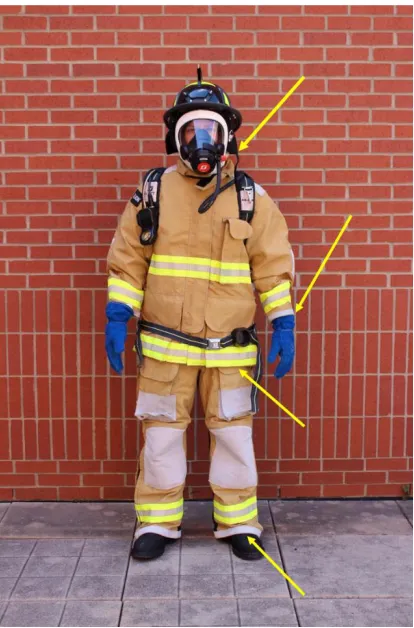
various interfaces, closures, and even fabrics. The traditional structural firefighting system has several interfaces that can serve as avenues for smoke infiltration, namely, the head and neck area, the wrists, and the ankles, all of which are designated in Figure 5. These interfaces, which
mark the end of one piece of PPE and the beginning of another, rely on the overlapping of the garments to provide adequate protection from flame and smoke exposure. However, they
Figure 5: Firefighter Turnout Ensemble Interface Locations
These claims were verified in 2015 when a full turnout ensemble particle exposure test
was commissioned by the International Association of Fire Fighters (IAFF) [29]. This evaluation involved a used turnout ensemble system, including boots, gloves, protective hood, helmet, and SCBA worn by a test subject who completed routine movements over a 30-minute
period within a particle-laden wind tunnel [29]. The test offers visualization of aerosol infiltration and deposition patterns as a means of detecting penetration points in protective
and size distributions similar to those of firegrounds, as shown in Figure 6. Further information outlining the test methodology can be found in Sections 2.3.2.1 and 4.1. After completion of
the exercise routine intended to simulate garment usage, the ensemble was removed and the subject was observed under ultraviolet light to determine the amount of fluorescent green
aerosol that may have leaked through and deposited on the skin. It was discovered that this standard issue turnout ensemble and protective hood permitted large amounts of the fluorescent aerosol to penetrate the garment system, illustrated by the post-test photographs given in Figure
7 [29] wherein the presence of the fluorescent green color represents infiltrating particulate matter. This was the first published instance of visualization for this issue, bringing attention
to a long-suspected point of worry regarding the actual safety of firefighters.
Figure 6: Aerosol Particle Size Distribution of IAFF Particle Exposure Test 0%
10% 20% 30% 40% 50% 60%
<0.47 0.47 - 0.66 0.67 - 1.46 1.5 - 2.5 2.5 - 5.5 5.5 - 8.7 >8.7
%
of
Mas
s
Figure 7: Particle Exposure Test Results for Standard Firefighter Ensemble [29]
Dermal exposure to soot particulates has long been believed to be a likely health risk for firefighters. However, recent studies have shown that it is a far more troublesome issue
than once suspected due to the combination of certain environmental and physiological factors. Irrespective of how or where smoke penetrates the garment system, it is unfavorable for the wearer due to the impending skin deposition and subsequent invasion of toxicants into the
body. However, the extreme environmental conditions characteristic of the firefighting occupation only serve to exacerbate this problem, as high temperatures and high humidity have
been shown to substantially increase skin absorption [30]. A report from the Firefighter Cancer Support Network indicates a 400% increase in skin absorption for every 5oF increase in skin temperature, a noteworthy statistic given the abnormally high body temperatures experienced
locations on the body is more porous and therefore more absorptive than other areas. It has been reported that the neck, ear, and groin areas are highly susceptible to absorption due to the
thin and porous nature of the skin [32]. This information, in conjunction with the results from the 2015 IAFF particle exposure test, emphasizes the severity of dermal exposure threats facing
firefighters and subsequently highlights the need not only for rigorously tested protective materials, but also for constructive turnout ensemble designs that serve to minimize smoke infiltration.
2.1.2 Firefighter Health Risks and Documented Malignant Occurrences
Although the occupational risks associated with firefighting are numerous and
frequently encountered, the hazard of chronic exposure to toxicants affixed to ubiquitous particulate matter looms long-term malignancies over the heads of firefighters. Fortunately for current and future firefighters, this topic has spread throughout the fire service industry very
quickly, and has resulted in several manufacturers taking steps to improve the particulate protection of their products. However, for those who have served as first responders for many
years, the comprehensive understanding now afforded by recent research efforts does little to aid in the prevention of health issues given the extent of prior service and the lack of awareness during those periods regarding the implications of such exposures. The following subsections
2.1.2.1Physiological Effects of Toxic Combustion By-products
It has been sufficiently demonstrated that smoke produced from structural fires is
composed of numerous toxic combustion products that exist in both gaseous and solid states at high concentrations, a composition that threatens the livelihood of firefighters through
respiratory inhalation and dermal exposure. A collective effort on behalf of Underwriters Laboratories Inc. and the University of Cincinnati College of Medicine studied exposures to common constituents of structural fire smoke and defined the potential health impacts resulting
from exposure to a number of the chemicals present on firegrounds [10]. These specific exposures, shown in Table 3 [10], include both acute and chronic effects that can vary
dependent upon the nature and severity of the exposure, as well as the medical history of the person exposed. When paired with the information given in Table 2 [13-16], it becomes apparent that nearly every structural fire call will put those tasked with controlling the burn at
Table 3: Possible Effects of Exposure to Various Toxic Compounds [10]
Ammonia
Irritant to skin, eyes, and upper and lower respiratory tract. Respiratory exposure can result in bronchitis with or without bronchospasm, cough, shortness of breath, wheezing, and chest pain
Carbon Monoxide
Asphyxiant interfering with oxygen-carrying capacity of blood.
Symptoms of acute poisoning include headache, dizziness, drowsiness, nausea, fainting, coma and death. Cardiac effects include enhancement of exercise-induced angina.
Hydrogen Cyanide
Asphyxiant affecting fundamental aspects of the cellular oxygen utilization. Lower exposures cause weakness, headache, confusion, nausea and vomiting. Higher exposures may cause loss of consciousness and death.
Hydrogen Sulfide
Irritant to eyes and upper and lower respiratory tract at low concentrations, and chemical asphyxiant properties at higher
concentrations. Neurological effects can vary from headache, fatigue, weakness, and nervousness to convulsion and death. Respiratory tract symptoms can vary from mucous membrane infection and bronchitis to chemical pneumonitis.
Nitrogen Dioxide
Irritant to eyes and upper and lower respiratory tract. Brief exposure at high concentrations can result in the rapid onset of cough and shortness of breath and subsequent chemical pneumonitis. In some circumstances, exposure can result in chronic pulmonary disease.
Sulfur Dioxide
Severe irritant to skin, eyes, and nasal and oral mucous membrane. At higher concentrations exposure can impact the lower respiratory tract resulting in cough, shortness of breath, and bronchospasm.
Polycyclic Aromatic Hydrocarbons
Chemical class of which benzo[a]pyrene is a common constituent and the most studied. Carcinogenic toward several tissues, including skin,
mammary glands and respiratory system in experimental animals.
Phthalate Esters
In addition to various irritants and asphyxiants, firefighters must also endure exposures to various heavy metals. Soot accumulations from structural fires can contain deposits of lead,
mercury, arsenic, cobalt, chromium, and phosphorous [33]. Much the same as the gaseous compounds, there have been documented instances of these metals exceeding the NIOSH
Short-Term Exposure Limits [33]. Table 4 [34] details some of the acute and chronic health effects of metal toxicity for metals frequently found in fireground environments.
Table 4: Acute and Chronic Effects of Metal Toxicity [34]
Metal Acute Effects Chronic Effects
Arsenic
Nausea and vomiting Encephalopathy Painful neuropathy
Diabetes Hyperkeratosis Cancer (lung, bladder, skin)
Chromium Hemolysis
Renal failure
Pulmonary fibrosis Cancer (lung)
Cobalt Cardiomyopathy Pneumoconiosis
Lead Nausea and vomiting
Encephalopathy Anemia Nephropathy Mercury Fever Vomiting Diarrhea Gingivostomatitis Neurasthenia Nephrotic syndrome
The prevalence of the combustion products listed in the preceding tables presents an
by-products, with numerous new commercial compounds being introduced annually. The knowledge of such perilous exposure combined with the review of firefighter health analyses
presented in Section 2.1.2.2 invokes an urgent need to mitigate these risks for the benefit of firefighters everywhere.
2.1.2.2Correlation between Firefighting and Physiological Malignancies
With the overwhelming amount of information detailing the toxicity of structural fire smoke towards humans, it should be inferred that an equal amount of recorded evidence
subsists that documents instances of these malignant effects in firefighters. A large number of these documented instances do exist, with the total number of findings growing exponentially
as more information becomes available. Short and long-term studies alike, all seeking to assess health hazards associated with the firefighting occupation, have reported elevated relative risks for respiratory disease, coronary heart disease, and various types of cancers among individuals
involved in structural firefighting.
One of the most common detrimental health effects to firefighters allegedly produced
by exposure to combustion by-products of burning materials is damage to the respiratory system. Numerous reports dating back to the 1970s have reported increased rates of acute and chronic respiratory effects in firefighters [35-37]. A 2001 study from the American Journal of
Industrial Medicine investigated health effects of firefighting function in a group of 128 active firefighters, with an additional 88 control works not exposed to known pollutants. In
Table 5 [38]. This research, along with similar efforts, suggest a very strong correlation between respiratory diseases and occupational firefighting tasks [39]. However, a direct link
cannot be made due the variances in exposures as well as individual health conditions. Despite the exposures in these studies being characterized strictly according to their contributions to
respiratory issues, it is clear that there is an overall apparent danger in the day-to-day routine of the average structural firefighter.
Table 5: Prevalence of Chronic Respiratory Symptoms in Firefighters and Control Workers [38]
Respiratory Symptom Firefighters Exhibiting
Symptom (%)
Control Workers Exhibiting Symptom (%)
Chronic Cough 47.1 29.3
Chronic Phlegm 33.8 26.8
Chronic Bronchitis 33.8 24.4
Dyspnea 72.1 5.4
Nasal Catarrh 39.7 5.4
Sinusitis 45.6 5.4
These exposures, while concurrently imposing risks on pulmonary functions, also present a threat to cardiovascular functions, as evidenced in numerous studies spanning the last 20 years [40-42]. The implications of such risks encompass heart attacks, cardiac arrest, and
coronary heart disease. The findings that report elevated prevalence of these conditions in firefighters is even more disconcerting when the screening process for the career is taken into
is expected to be healthier than the average member of the population, given the demanding nature of the occupation. A report from the Journal of Occupational and Environmental
Medicine reports fatal coronary heart events including heart attacks, arrhythmia, and sudden death are responsible for 45% of the approximate 100 annual United States on-duty firefighter
deaths [21]. This same study discussed the contribution of ultrafine particle (diameters < 0.1 µm) exposure to coronary heart disease in firefighters, as particles in this range have been suggested of being capable of inducing remote cardiovascular events after respiratory
deposition by several mechanisms [43]. They report the potential contributing properties of ultrafine particles as being their reactivity, large surface area-to-mass ratios, and ability to
transport toxicants to target organs. Their findings, in conjunction with those of previous studies, support the hypothesis that exposure to high levels of ultrafine particles may represent a higher risk for coronary heart disease events in firefighters during fire suppression duties.
Although these researchers designate respiratory inhalation as the likely bodily-entry method for these particles, these malignancies may also be a product of dermal exposure. Such
speculation is supported by reports such as the U.S. Department of Health and Human Services (DHHS) evaluation of dermal exposure to PAHs in firefighters. After subjecting five firefighters to three controlled structure burns, it was determined that PAH breakdown products
were present in elevated concentrations in both breath and urine samples from the firefighters [44]. The presence of the PAHs in the post-fire urine samples, illustrated in Figure 8 [44],
no immediately obvious physiological indications [45], further demonstrating the dangers of repeated exposures to structural fire smoke.
Figure 8: Median Urinary Metabolite Levels by Collection Time [44]
Although pulmonary and cardiovascular concerns abound within the fire service industry, the primary feelings of consternation are in response to the increased likelihood of
developing cancer as a result of the unavoidable toxic exposures. The recent findings from a study of cancer among United States firefighters, published jointly by DHHS, NIOSH, and the
60 years of research, consisted of two studies [46, 47] which surveyed nearly 30,000 fire fighters from major metropolitan areas across the country and compared them to the general
population as well as other firefighters. Statistical evidence from the effort showed that, when compared with U.S. cancer rates, firefighters had a greater number of cancer diagnoses and
cancer-related deaths [46]. Furthermore, it was discovered that the relative number of firefighters with malignant mesothelioma was more than twice that of the general population, likely due to the frequency of which asbestos is encountered during fire suppression.
Comparison of firefighters internally within the study revealed the chance of lung cancer diagnosis or death increased with the amount of time spent at fires, and that the chance of
leukemia death increased with the number of fires attended [47]. These findings are further supported by numerous research efforts regarding the topic, as reported in an analytical review of 32 studies involving cancer risk among firefighters. The quantitative and qualitative
assessment designated multiple myeloma, non-Hodgkin’s lymphoma, prostate, and testicular cancers as a probable risk for firefighters. Additionally, the review designated a host of other
cancers as possible risks, including: skin, malignant melanoma, brain, rectum, buccal cavity and pharynx, stomach, colon, and leukemia [48].
In summation, there exists a wide breadth of research that suggest strong linkages
between firefighting and the onset of cancer and other malignancies, however it cannot yet be concluded that definitive relationships exists, due to large variance in exposure occurrences,
the livelihoods of firefighters. As such, this is a threat best-neutralized before human contact, and one that may be addressed through the use of particulate-resistant materials within
firefighter turnout gear.
2.2Particulates and Filtration
Particulate matter, which can exist in both solid and liquid phases, is produced by a
substantial variety of natural and industrial processes such as smoke from power generation, re-suspension of soil, photochemical formation, and atmospheric condensation. These airborne particles are microscopic and can exist in concentrations high enough to affect not only
visibility and climate, but also health and quality of life. Given the microscopic nature of these substances, they are classified as aerosols, denoting a two-phase system wherein solid or liquid
particles are suspended in a gas [49]. There are many types of particulate suspensions, the majority of which require a comprehensive understanding of the associated physical and
chemical properties in order to predict their behaviors and manage their presence. Although the particulate phase of an aerosol represents only a very small fraction of its total mass and volume, less than 0.0001%, these microscopic bits of matter often have a substantial impact,
whether positive or negative [49].
As mentioned in Section 2.1.1.3, some types of particulate matter are inherently
hazardous to humans based on various physical and physiological factors. For instance, a fume is defined as a solid-particle aerosol produced by the condensation of vapors or gaseous combustion products, often existing in clusters or chains with the individual units having
prolonged exposure to fumes from any source is detrimental to the overall health of a human. Similarly, smoke is defined as an aerosol of solid or liquid particles usually resulting from
incomplete combustion, generally having small primary particles and large aggregated chains with extremely complex shapes [50]. Much the same as particulate matter in fumes, the
particulate suspensions in smoke have established negative health effects on individuals that experience sustained exposures. To counter these harmful effects, particulate barriers are implemented to capture the particles and minimize exposures altogether. These barriers, or
particulate filters, exist in a large assortment of sizes, functionalities, and physical constructions, and can be found in residential and industrial applications alike.
In order to properly capture these particulates from the surrounding environment, a fundamental knowledge of the designated aerosols must be applied. Particle size is the most important parameter in characterizing the behavior of aerosols and subsequently defining the
filtration constraints of the desired barrier. Not only do aerosol properties depend on particle size, but the nature of the laws governing these properties may also change with particle size
[49]. Another governing parameter is particle shape, as most solid aerosol particles usually have complex shapes. Figure 9 [51] presents a visual reference for the various shapes of particles. For most applications, mass equivalent diameters, are assigned to particles with
non-spherical shapes to provide a general comparison of how the aerosol should behave. These reference diameters are diameters of nonporous spheres composed of a bulk particle material
factors, particle concentration and particle size distribution, also define aerosol populations in manners that dictate their respective methods of capture. Particle concentrations, which can be
described using number, mass, surface area, and volume concentration, are typically used as measurement reference points when tracked over time. Particle size distributions are one of the
most important attributes of polydisperse aerosols, as they characterize the full gamut of behavioral properties afforded by varying particle sizes, allowing for exact determination of multiple particle modes over a wide size range [52]. Defining each of these aerosol parameters
prior to the onset of choosing a particulate filter will offer a holistic grasp on the expected particle behaviors, resulting in a barrier selection providing optimal performance in the capture
of particulate matter.
Figure 9: Different Shapes of Particulate Matter [51]
2.2.1 Classifications and Applications
Considering the myriad of sources for the production of particulate matter, it should be
information presented in Figure 10 [53] supports this assumption, as the extremely broad range of particle sizes contains numerous sources of suspended particles, both man-made and
environmental alike. Filters designed to capture particles of the size range typical of mold spores would permit carbon black particles to pass through, whereas filters designed to capture
particles of the size range typical of carbon black would capture all mold spore particles and effectively nullify the air permeability of the filter media. As such, various classification scales have been developed to aid in the differentiation of particulate filter types.
Figure 10: Particle Sizes of Contaminants in Air [53]
Air filtration enables the purification of workplace and living environments via
residential, commercial, and industrial applications include high efficiency particulate air (HEPA) filters, ionic filters, activated carbon filters, and ultraviolet-light air purifiers. HEPA
filters provide a wide range of capabilities given that the fiber diameter and filter thickness can be altered to accommodate different scenarios. These filters have the capacity to trap 99.97%
of all airborne particles that are as small as 0.3 µm and 95% of particles that are as small as 0.1 µm [54]. This particle size range encompasses contaminants such as pollen, mold, pet dander, smoke, and bacteria [55]. Ionic filters charge air molecules, typically producing anions, which
then attract particles in the air. Upon contact with the anions, particulate matter is deionized and removed from the air stream [54]. Ionic filters can capture ultra-fine particles as small as
0.01 µm, but need to be cleaned regularly [55]. Activated carbon filters have small adsorbent pores with a capacity to react chemically with pollutants as they pass through the filter. This type of filter excels at adsorbing and internally neutralizing odors, gases, and smoke, and are
often used in conjunction with other filter types [54, 55]. The functionality of a UV-light air purifier stems from the emitted electromagnetic radiation which serves to break molecular
bonds within bacteria and pathogens, nullifying their harmful effects [55]. This mechanism is not traditional filtration, but remains as an effective method for destroying micro-organisms with effectiveness contingent upon length of exposure and light intensity [54]. Similar to
activated carbon filters, optimal performance of UV-light purification is attained when used in unison with other types of air filters.
and contents from the effects of poor air quality. This translates to minimizing exposure to particulate matter that threatens human livelihood and providing protection to heat ventilation
and air conditioning (HVAC) systems from unnecessary maintenance and malfunction. Industries that require high degrees of air cleanliness will often be the target consumers for
particulate barriers that employ multiple filtration types. The medical industry is a chief pursuant of these air filters, as pharmaceutical applications, operating rooms, and general clinical healthcare all require the control of airborne particulate matter to protect patients and
staff alike. Food processing, photo processing, and electronics production also require a minimization of particulate exposure within their respective controlled climates. These
manufacturing processes rely on air filters in combination with specific temperature, humidity, and pressure parameters to ensure the integrity of their products with minimal defects. Particulate barriers are also used in specialty applications such as gas turbine air intakes,
respirators, and gas masks [53]. Their presence in the intakes of gas turbines is necessary due to the excessive erosion that occurs on the rapidly spinning rotor assemblies in response to
repeated particulate contact. The usage of filters within respirators and gas masks can range from simple fabric filters that cover the nose and mouth to complex devices that provide protection against dangerous dusts, microbes, fumes, and chemical vapors [53]. Although the
functionality, construction, and efficiency of particulate barriers can vary drastically, their value is inherent as they all offer a common semblance of protection within their designated
2.2.2 Methods of Fibrous Media Particulate Collection
Particulate filters are critical to creating and maintaining clean environments. The
expansive selection of air filtration options affords an appropriate solution for nearly all applications. Air filters with the largest amount of production specialization are those
composed of some type of fibrous media. Fiber types, diameters, and orientations all serve as contributing factors to the overall effectiveness in capturing designated particulate matter. In order to tailor these and other parameters to specifications ideal for success in a given
application, the mechanisms of interaction between particles and fibers must first be understood.
There are countless other nuances involved in particulate capture via fibrous media, but a succinct overview of established particle collection mechanisms will provide a worthy foundation for the topic. The non-classical behaviors that will not be discussed are associated
with particle re-entrainment and filter performance in response to loading. The classical collection mechanisms, speaking strictly to external fibrous collection, have been established
as gravity, inertial impaction, interception, diffusion, and electrostatic attraction [51, 56]. These five mechanisms, listed and defined in Table 6 [57] and illustrated in Figure 11 [53], are the major particle removal mechanisms over the entirety of the particle size spectrum at
Table 6: Particulate Capture Mechanisms of Fibrous Media [57]
Mechanism Description
Gravity
Large particles will settle out of the gas stream. This action occurs independently of the fiber and depends on the gas velocity and the particle mass.
Direct Interception
A particle following the upstream flow streamlines is collected when it collides with or touches a fiber. This mechanism depends on the ratio of the particle diameter to the fiber diameter (interception parameter).
Inertial Impaction
Occurs when the inertia of the particle causes it to deviate from its initial streamline and collide with a fiber. It depends on the gas viscosity and velocity, particle density, fiber diameter, and the square of the particle diameter.
Diffusion
Particles have a small enough mass that their trajectories are altered by collisions with gas molecules. This phenomena is called Brownian motion and can de described by a diffusion coefficient. Smaller particles have higher diffusion rates and the random deviation from streamline due to diffusion leads to an increased probability of collection by the fiber.
Electrostatic Attraction
Figure 11: Mechanisms of Particle Capture – Flow Past a Single Fiber [53]
Given the wide range of particle sizes in airborne particulate suspensions, there is a propensity for ultrafine particles to bypass these classical collection mechanisms as their
microscopic sizes allow them to make passage through gaps or pores. To demonstrate this, Hutten introduced similar effects, illustrated in Figure 12 [58], that define the passage of
particles through a cylindrical pore. The illustration is a series of decreasing particle sizes trying to penetrate a pore tunnel which is bent, contains obstructions, and is assumed to vary in diameter. The surface straining phenomenon occurs when the pore is too small to allow the
passage of the particle. Smaller particles may fit through the pore, but their momentum may result in contact and adherence with the wall of the pore, as the streamline follows the natural
or protrusions from the pore wall [53]. Figure 12 also shows a certain particle diameter, known as the most penetrating particle size (MPPS), that successfully passes through the pore and
emerges from the exit side. This particle size is too small to be captured by straining, impaction, or interception and yet too large to be captured by diffusion, the collection mechanism for very
small particles exhibiting Brownian motion. The MPPS is a crucial property when considering the construction of a particulate barrier, as the efficiency values used to rate HEPA filters rely heavily on the susceptibility to the MPPS. Further elaboration on the MPPS and the evaluation
of particulate collection efficiency is provided in Section 2.2.3.
![Figure 1: Mean VOC Air Concentrations Measured from Background Air, Used PPE Ensembles, and New PPE Ensembles [12]](https://thumb-us.123doks.com/thumbv2/123dok_us/1428407.1175334/24.612.145.515.186.458/figure-mean-concentrations-measured-background-used-ensembles-ensembles.webp)
![Figure 2: Total Career Fire Calls of Chicago and Philadelphia Firefighters [18]](https://thumb-us.123doks.com/thumbv2/123dok_us/1428407.1175334/27.612.155.479.371.600/figure-total-career-calls-chicago-philadelphia-firefighters.webp)
![Figure 3: Particle Number Density & Size Distribution after Ignition of an Attic [21]](https://thumb-us.123doks.com/thumbv2/123dok_us/1428407.1175334/29.612.106.537.86.309/figure-particle-number-density-size-distribution-ignition-attic.webp)
![Figure 4: Soot Samples Viewed under Scanning Electron Microscope [28]](https://thumb-us.123doks.com/thumbv2/123dok_us/1428407.1175334/30.612.217.414.429.650/figure-soot-samples-viewed-scanning-electron-microscope.webp)
![Figure 7: Particle Exposure Test Results for Standard Firefighter Ensemble [29]](https://thumb-us.123doks.com/thumbv2/123dok_us/1428407.1175334/34.612.101.538.72.311/figure-particle-exposure-test-results-standard-firefighter-ensemble.webp)
![Table 3: Possible Effects of Exposure to Various Toxic Compounds [10]](https://thumb-us.123doks.com/thumbv2/123dok_us/1428407.1175334/37.612.90.544.62.673/table-possible-effects-exposure-various-toxic-compounds.webp)
![Table 4: Acute and Chronic Effects of Metal Toxicity [34]](https://thumb-us.123doks.com/thumbv2/123dok_us/1428407.1175334/38.612.93.542.285.548/table-acute-chronic-effects-metal-toxicity.webp)
![Figure 16: Felted Fabric Arrangement [51]](https://thumb-us.123doks.com/thumbv2/123dok_us/1428407.1175334/60.612.183.448.78.344/figure-felted-fabric-arrangement.webp)