ISSN(Online): 2320-9801 ISSN (Print) : 2320-9798
I
nternational
J
ournal of
I
nnovative
R
esearch in
C
omputer
and
C
ommunication
E
ngineering
(An ISO 3297: 2007 Certified Organization)
Vol. 4, Issue 10, October 2016
Intelligent Image Acquisition of License Plate
Image Using Kernel Estimation Algorithm
Sudha. S1, Suganthi. K2, Deepika. R3
Student, Department of Computer Science and Engineering, Arasu Engineering College, Kumbakonam,
Tamilnadu, India1,3
Assistant Professor, Department of Computer Science and Engineering, Arasu Engineering College,
Kumbakonam, Tamilnadu, India2
ABSTRACT: As the unique recognizable proof of a vehicle, license plate is a key hint to unveil over-celerity vehicles
or the ones required in hit and run mishaps. Anyhow, the snapshot over-celerity vehicle caught by surveillance camera is much of the time quick movement, which is even unrecognizable by human. Those watched plate images are usually in low determination and suffer severe loss of edge data which cast awesome test to existing visually impaired deblurring techniques. For license plate image blurring brought about by quick movement, the blur kernel can be viewed as linear uniform convolution and parametrically modelled with angle and length. In this paper, we propose a novel plan in view of sparse representation to identify the blur kernel. By investigating the sparse representation coefficients of the recuperated image. We decide the angle of kernel view of the perception that the recuperated image has the most sparse representation when the kernel angle relates to the genuine movement angle. At that point, we evaluate the length of the movement kernel with Linear Interpolation. Our plan can well handle substantial movement kernel blur even when the license plate is unrecognizable by human. We assess our approach on genuine images and contrast and a few prevalent best in class blind image deblurring algorithms. Experimental result show the predominance of our proposed approach in terms of adequacy and strength.
KEYWORDS: Blur Kernel estimation, license plate deblurring, linear motion blur, linear interpolation sparse representation.
I. INTRODUCTION
ISSN(Online): 2320-9801 ISSN (Print) : 2320-9798
I
nternational
J
ournal of
I
nnovative
R
esearch in
C
omputer
and
C
ommunication
E
ngineering
(An ISO 3297: 2007 Certified Organization)
Vol. 4, Issue 10, October 2016
deblurring / deconvolution (BID) has picked up loads of consideration from the image handling group. Mathematically, the model of image blurring can be defined as:
B (a, b) = (M * S)(a, b) + N(a, b) eq. (1)
Where B,S and M mean the blurred image, the sharp image we expect to recoup, and the blur kernel, individually; N is the added substance clamour ( typically viewed as white Gaussian commotion); and * signifies convolution administrator. For BID, the kernel M and sharp image S are both unknown. As indicated by whether the kernel M is spatially – invariant or not, the BID issue can be isolated into two classifications: uniform BID and non-uniform BID. For non-uniform BID, the kernel M is frequently called angle spread capacity. Lately, numerous compelling BID algorithm have been proposed. The greater kernel of them all the while estimate kernel from the blurred image and apply a non-blind image deblurring (NBID) algorithm recursively to approach the true solution[6-10].The difficulties for license plate deblurring lie in three aspects.
1) The surveillance camera is normally intended for catching a major scene that include that incorporates an
entire vehicle, in this way, the license plate just involves a little area of the entire image. This prompts lacking angles of interest for kernel estimation.
2) The substance of license plate image is very simple, most of edges lie in even and vertical headings.
Hence, the techniques taking into account isotropy suspicion [12] may likewise not work well for license plate image.
3) To produce satisfactory results only one small number of selected images. The poor robustness has
severely hindered the applicability of the deblurring techniques to real-world applications[13]
In this paper, we elaborate on the above mentioned properties. In section II, we summarize some of the existing methods about BID and blur kernel estimation. In section III, we discuss how to derive the beneficial property of sparse representation coefficient and present our blur kernel estimation in detail. Deblurring results and comparing experiments with the best in class blind image deblurring algorithms are provided in section IV. Finally, conclusion is provided in section V.
II. RELATED WORK
A. HIGH-QUALITY MOTION DEBLURRING FROM A SINGLE IMAGE:
we present a new algorithm for removing movement blur from a single image. Our method computes a deblurred image using a unified probabilistic model of both blur kernel estimation and unblurred image restoration [7]. These terms include a model of the spatial randomness of noise in the blurred image, as well a new local smoothness and exhibits low contrast. In the most decades ago, but are still widely used in many image restoration tasks nowadays because they are simple and efficient. Most non-blind deconvolution methods require complex parameter settings and long computation times. A successful motion deblurring method, thus makes it possible to take advantage of information that is currently buried in blurred images, which may find 3D reconstruction and video editing. Our main contributions are an effective model for image noise that accounts for its spatial distribution and local prior to suppress ringing artifacts.
B. UNDERSTANDING AND EVALUATING BLIND DECONVOLUTION ALGORITHMS
Blind deconvolution is the recovery of a sharp version of a blurred image when the blur kernel is unknown. The goal of this paper is to analyze and evaluate recent blind deconvolution algorithms both theoretically and experimentally. We explain the previously reported failure of the naive MAP approach by demonstrating that it mostly favours no-blur explanations[11]. Blind deconvolution can be performed iteratively, whereby each iteration improves the estimation of the PSF and the scene or non iteratively, where one application of the algorithm, based on exterior information extracts the PSF.
C. TEXT IMAGE DEBLURRING USING TEXT-SPECIFIC PROPERTIES
ISSN(Online): 2320-9801 ISSN (Print) : 2320-9798
I
nternational
J
ournal of
I
nnovative
R
esearch in
C
omputer
and
C
ommunication
E
ngineering
(An ISO 3297: 2007 Certified Organization)
Vol. 4, Issue 10, October 2016
previous document image restoring systems and the recently proposed black-and white document image deblurring method are limited, and cannot handle large motion blurs and complex background. Our method extends the commonly used optimization framework for image deblurring to allow domain-specific properties to be incorporated in the optimization process. Novel text image deblurring approaches do work well on text images. Deblurring quality of text images is high. This method is used to enforce the domain-specific properties on the latent image[15].
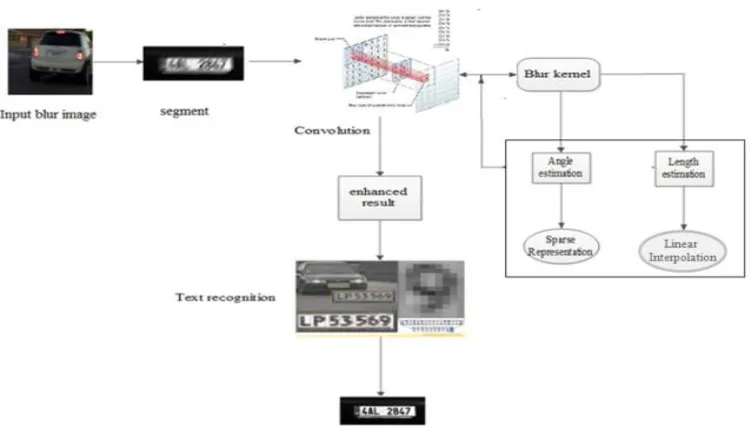
Fig .1: Text recognition architecture
III. METHODOLOGY
Blur kernel estimation
Generally, the blur kernel depends upon the relative motion involving the movement vehicle and fixed surveillance camera during the presentation time. In the event presentation time is very short and the vehicle is moving very quick, the movement can be regarded as step-wise and the speed can be considered as around constant. In such instances, the blur kernel of license plate image can be made as a linear of license uniform kernel with two variables: angle and length [14]. In the pursuing section III-A, we expose how to use sparse representation on over-complete book to evaluate the angle of kernel strength. Behind the angle estimation, in section III-B, linear interpolation method is proposed to estimate the length of kernel. At last, we summarize our algorithms in details in section III-C & III-D. A. Angle estimation
Sparse representation coefficients show great potential in the angle estimation of linear uniform kernel. A natural extension is to apply it to the length inference. The problem solved by the sparse representation is to search for the most compact representation of a signal in terms of linear combination of pixels in an over complete dictionary. Sparse representation works well in applications where the original signal needs to be reconstructed as accurately as possible, such as denoising, image in painting and coding.
(V, I) = {- p(I) + |Mϴ * S – B|i¹} (2)
Where B is the blurred image, I denotes the latent image to be recovered, Mϴ is the linear uniform movement kernel
determined by angle ϴ and p(I) is the prior of the sharp image.
V = argmin ∑ | βi |
s. t. Ψi Y = D βi
Y = {|I|TV + | Mϴ * S – B|i¹} (3)
Where D is pre-learned over-complete dictionary on the sharp license plate image, Ψi is the patch extraction operator,
ISSN(Online): 2320-9801 ISSN (Print) : 2320-9798
I
nternational
J
ournal of
I
nnovative
R
esearch in
C
omputer
and
C
ommunication
E
ngineering
(An ISO 3297: 2007 Certified Organization)
Vol. 4, Issue 10, October 2016
∑| |
. However, it is difficult to directly solve such a two-layer optimization problem. In order to investigate the
relation between ∑|αi|. We first solve the following optimization problem.
Y = {|I|TV + | Mϴ * S – B|i¹} (4)
Then the sparse representation coefficient ∑|αi| can be computed by solving:
min ∑ |αi|
s. t.Ψi Y = D αi (5)
Here, for simplicity, we define C = ∑ |αi|. C (n, m) can be regarded as a function of kernel parameters (n, m).
Chart . 1: Angle Estimation
B. LENGTH ESTIMATION
For BID, Linear interpolation is proposed to estimate the motion blur kernel, especially when the observed image is corrupted by noise. In our length estimation algorithm, we adopt the modified Linear interpolation which only considers the center area of blurred image.
Linear interpolation is used to estimate the blur kernel in spatial-temporal domain. The Linear interpolation represents an image as a collection of projections along various directions. The Linear interpolation is the projection of the image intensity along a radial line oriented at a specific angle.
C. CONVOLUTION
Convolution is an important operation in signal and image processing. Convolution operates on two images and the other called the kernel on the input image, producing an output image (so convolution takes two images as input and produces a third as output). The input blur is convoluted with the blur kernel to get the enhanced output. The blur kernel can be viewed as linear uniform convolution and parametrically modeled with angle and length. The angle is estimated using the sparse representation and the length using the Linear interpolation.
D. TEXT RECOGNITION
Blur kernel estimation can be regarded as searching the best solution in a large blur kernel space. The license plate blur should be considered as the linear blur. The text is recognized after deblurring the license plate. The angle is estimated using the sparse representation and length using linear interpolation. The angle and length of kernel is estimated and convoluted with an input blur image. The kernel is estimated to find the enhanced output image. The enhanced output image contains the semantic information.
IV. PSEUDO CODE
COARSE ANGLE ESTIMATION
Input: Blurred image B, step Δ, initial angle θ0, a moderate length m, s = 0
Step 1 : while not converged do
Step 2 : Generate uniform linear kernel M n ,ϴm, Mn , ϴm – Δ, Mn , ϴm + Δ
Step 3 : Solve eq. (5) with kernels M n, ϴm, Mn , ϴm – Δ, Mn , ϴm + Δ, getdeblurred imagesS n , ϴm, Sn ,
ISSN(Online): 2320-9801 ISSN (Print) : 2320-9798
I
nternational
J
ournal of
I
nnovative
R
esearch in
C
omputer
and
C
ommunication
E
ngineering
(An ISO 3297: 2007 Certified Organization)
Vol. 4, Issue 10, October 2016
Step 4 : solve eq. (6) withC n , ϴm, Cn , ϴm – Δ, Cn , ϴm + Δ, get C n , ϴm, Cn , ϴm – Δ, Cn , ϴm + Δ
Step 5 : if C n ,ϴm = = min(C n ,ϴm , C n , ϴm– Δ, C n ,ϴm+ Δ)
Step 6 : converged and return
Step 7 : else if C n ,ϴm – Δ == min (C n ,ϴm ,C n ,ϴm – Δ, C n ,ϴm +Δ)
Step 8 : θ m ← θ m – Δ
Step 9 : else
Step 10 : θ m ← θ m + Δ
Step 11 : end while
Output: θ m
FINE ANGLE ESTIMATION
Input: Blurred image B, the output of algorithm 1 ϴ, a moderate length n
Step 1 : Generate a series of pair (ϴi , ni) that center about (ϴ , n)
Step 2 : Solve eq. (4) with kernel Mi, get Si
Step 3 : Solve eq. (5) with Si, get Ci Step 4 : Sort Ci by increasing order
Step 5 : Get the top-M Ci and the corresponding ϴi
Output: The average of top-M ϴi
In both algorithms 1 and 2, it is critical to solve eq. (4) and (5).
V. SIMULATION AND RESULT
In this section, we compare the proposed method with several existing best in class blind image deblurring methods on real blurred plated images. The parameter settings and computational complexity are also discussed in detail.
For eq. (4), λ is set as 500. We find that λ can vary in a wide range without notable impact on the final deblurred results. In the coarse angle estimation stage, the step Δ is 5 considering the robustness and computing
complexity. Another parameter is the starting angle ϴ. For over-speed car license plate blur, the angle of motion
kernel is usually in the range [40, 140].
In the fine angle estimation stage, centering at the output ϴ of the last module, we generate a series of
parameter pairs (ϴi,li), where the length li lies in the range [25,49] with step size 3, and ϴi lies in the range [ϴ - 10, ϴ
+ 10] with step size 5. That means we have 45 images to apply NBID and sparse coding algorithm.
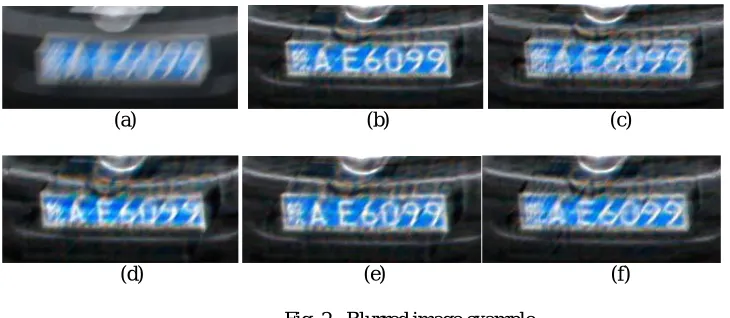
(a) (b) (c)
(d) (e) (f)
Fig. 2 . Blurred image example.
The image size is 224 × 140, and our estimated kernel parameters are (ϴ = 89.67, l = 30.87). Top-left is the
observed license plate image. Top-middle is our recovered result. The other four images are the results acquired by
modifying the kernel parameters with small bias on the estimated angle or length. (a) blurred image. (b) (ϴ = 89.67 ̊ ,
ISSN(Online): 2320-9801 ISSN (Print) : 2320-9798
I
nternational
J
ournal of
I
nnovative
R
esearch in
C
omputer
and
C
ommunication
E
ngineering
(An ISO 3297: 2007 Certified Organization)
Vol. 4, Issue 10, October 2016
(e) (ϴ = 89.67 ̊, l = 30.87). (f) (ϴ = 89.67 ̊, l = 30.87)
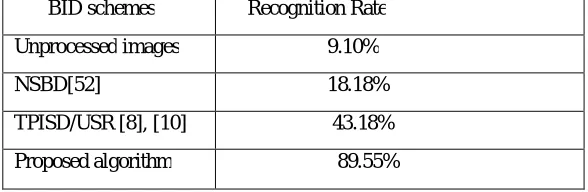
TABLE I:Recognition Rate Of Different BID Methods
BID schemes Recognition Rate
Unprocessed images 9.10%
NSBD[52] 18.18%
TPISD/USR [8], [10] 43.18%
Proposed algorithm 89.55%
TABLE II : Running Time Of Different Methods
The performance improvement on recognition rate is shown in Table I. Apparently, the recognition rate is notably improved after deconvolution and the proposed algorithm achieves the highest recognition rate.
In our scheme, the fine angle estimation stage is the most time consuming. Table II shows used linear interpolation. One advantage of our algorithm is that our model can handle very large blur kernel. As shown by experiments in section IV, for license plate can be recognized by the running time of the different blind image deblurring algorithms on a real blurred plate image with size of about 200 ×300.
VI. CONCLUSION
In this paper, we propose a text recognition of license plate image using kernel estimation has been implemented. The sparse representation coefficient with angle is uncovered and exploited. The length estimation is completed by exploring well-human, the deblurred result becomes is more robust. Experiments on a large set of images have shown that it produces high-quality results.
REFERENCES
1. Q. Lu, W. Zhou, L. Fang, and H. Li, “Robust Blur Kernel Estimation for License Plate Images From Fast Moving Vehicles,” IEEE Trans. Image process., vol. 25,no. 5, May 2016.
2. Y.-W. Tai, H. Du, M. S. Brown, and S. Lin, “Correction of spatially varying image and video motion blur using a hybrid camera,” IEEE Trans.
Pattern anal. Mach. Intell., Vol.32, no. 6, pp.1012-1028, Jun. 2010.
3. W. Zhou, H. Li, Y. Lu, and Q. Tian, “Principal Visual word discovery for automatic license plate detection, ” IEEE Trans. Image Process., vol.21, no. 9,pp. 4269-4279, Sep. 2012.
4. W. Zhou, Y. Lu, H. Li, Y. Song, and Q. Tian, “Spatial coding for large scale partial-duplicate Web image search,” in Proc. 18th ACM Int. Conf.
Multimedia, Oct. 2010, pp. 511-520.
5. W. Zhou, H. Li, R. Hong, Y. Lu, and Q.Tian, “BSIFT: Toward data independent codebook for large scale image search,” IEEE Trans. Image
process., vol. 24, no. 3, pp. 967-979, Mar. 2015.
BID schemes Running time(S)
TPISD/USR [8], [10] 45.68
NSBD [52] 11.84
FSR [17] 135.23
HQMD [7] 736.89
ISSN(Online): 2320-9801 ISSN (Print) : 2320-9798
I
nternational
J
ournal of
I
nnovative
R
esearch in
C
omputer
and
C
ommunication
E
ngineering
(An ISO 3297: 2007 Certified Organization)
Vol. 4, Issue 10, October 2016
6. W. Zhou, M. Yang, H. Li, X. Wang, Y. Lin, and Q. Tian, “Towards codebook-free: Scalable cascaded hashing for mobile image search,” IEEE
Trans. Multimedia, vol. 16, no.3, pp. 601-611, Apr.2014.
7. S. Cho and S. Lee, “Fast motion deblurring,” ACM Trans. Graph., vol. 28, no. 5, p. 145, 2009.
8. Q. Shan, J. Jia, and A.Agarwala, “High-quality motion deblurring from a single image,” ACM Trans. Graph., vol. 27, no. 3, pp. 73, 2008. 9. H. Cho, J. Wang, and S. Lee, “Text image deblurring using text-specific properties, ” in Proc. Eur. Conf. Comput. Vis. (ECCV), Oct. 2012, pp.
524-537.
10. L. X u and J. Jia, “Two-phase kernel estimation for robust motion deblurring,” in Proc. Eur. Conf. Comput. Vis. (ECCV), Sep. 2010, pp. 157-170.
11. A. Levin, Y. Weiss, F.Durand, and W. T. Freeman, “Understanding blind deconvolution algorithms,” IEEE Trans. Pattern Anal. Mach. Intell.,
vol. 33, no. 12,pp.2354-2367, Dec. 2011.
12. J. P. Oliveira, M. A. T. Figueiredo, and J. M. Bioucas-Dias, “Parametric blur estimation for blind restoration of natural images: Linear motion and out-of-focus,” IEEE Trans. Image Process., vol. 23, no.1, pp. 466-477, Jan.2014.
13. C. Wang et al., “Nonedge-specific adaptive scheme for highly robust blind motion deblurring of natural images,” IEEE Trans. Image Process., vol. 22, no. 3, pp. 884-897, Mar. 2013.
14. R. Hartley and A. Zisserman, Multiple View Geometry in Computer Vision, 2nd ed. Cambridge Univ. Press, 2004.
15. G. Liu, S. Chang, and Y. Ma, “Blind image deblurring using spectral properties of convolution operators,” IEEE Trans. Image Process., vol. 23, no. 12, pp. 5047-5056,Dec.2014.