Dynamic Traffic Grooming:
The Changing Role of Traffic Grooming
∗CSC Technical Report TR-2006-15
Shu Huang and Rudra Dutta
Computer Science Department, North Carolina State University Raleigh, NC
{[email protected], [email protected]}
Abstract
Traffic grooming refers to the techniques used to aggregate subwavelength traffic onto high speed lightpaths, while at the same time minimizing some measure of network cost, usually optoelectronic equipment cost. In the last few years, traffic grooming has come to be recognized as an important research area, and has produced extensive literature. Recently, the dynamic traffic grooming problem, where traffic carried in the network varies with the time, has gained in interest. This is because of the growing applicability of QoS concerns and associated network design methodologies in networks closer to the indivdual users than backbone networks, where the traffic cannot be well modeled as essentially static. A number of studies in this area have recently appeared in the literature, but there is as yet no good resource that introduces a reader to the problem in all its forms, and provides a review of the literature. In this paper, we fill this void by presenting a comprehensive survey of the literature in this emerging topic, and indicating some essential further directions of research in dynamic traffic grooming.
1
Introduction
Computer and communication networking have been maturing over the past several decades, and has moved beyond the age of survival to the age of sophistication. The expectations of the end user from the network have also changed, and the concept of Quality of Service (QoS) and Service Level Agreements (SLA) have become pervasive. Until recently, it was assumed that such concerns were operative primarily in transport networks, that is at the highest level of aggregation of traffic in the planetary network hierarchy. At lower levels of aggregation, the network was seen to be composed of traffic networks, where QoS was neither feasible nor desired.
In this context,traffic groomingbecame an active area of research starting from the late 1990s. The new generation optical networks utilizing Wavelength Division Multiplexing (WDM) are cur-rently in the process of being deployed to form the backbone networks of tomorrow. In WDM, multiple wavelength channels can be used over the same physical link of optical fiber using fre-quency multiplexing. Each wavelength channel can carry 10 Gbps with current technology, and higher rates are foreseen for the near future. Further,wavelength routingtechnology makes it possi-ble to forward an optical signal at an intermediate node entirely at the optical plane, forming clear end-to-end optical channels that are calledlightpaths. WDM networks utilizing wavelength routing
can be modeled as multi-layer networks that consist of a virtual layer formed by such lightpaths implemented over a physical topology of optical fiber, and customer traffic routed at a second level, over the lightpaths of the virtual topology. The customer traffic demands are expected to be gen-erally of much smaller bandwidth than the capacity of a single wavelength channel. Moreover, the traffic demands will be various different rates. For example, in generalized MPLS (GMPLS) [1, 2] networks, the traffic carried by this virtual layer are label switched paths, which can be of arbitrary bandwidth requirements. Because of the significant disparity between the the typical bandwidth request of a traffic component and the much higher capacity of a wavelength, it is well recognized that, to reduce the network cost, low speed traffic (referred to as subwavelength traffic) must be multiplexed (using Time Division Multiplexing) into lightpaths.
However, wavelength routing only allows the entire wavelength channel to be switched at the op-tical plane. If differentiated routing and forwarding of subwavelength traffic components contained in a wavelength channel is required, the optical signal must be terminated using Line Terminating Equipment (LTE), converted into digital eletronic signals, and input to an electronic logic device such as a traditional electronic router. At the end of the electonic routing operation, the packets must again be converted to optical signal and injected into outgoing lightpaths. This operations is called Opto-Electro-Optic (OEO) conversion, and is generally not desirable because it offsets the high speed and reliability of optical transport, and the OEO device is significantly more expensive than the optical switching equipment. Thus the subwavelength traffic must be packed into full wavelengths such that the cost of such OEO conversion may be optimized globally. This is the problem usually referred to as traffic grooming. The reader is referred to [3] for a survey.
In this literature, researchers have generally assumed that the magnitudes of traffic demands (given as a single traffic matrix) do not change with time. This assumption is reasonable for the following two reasons. First, in many core networks, low speed traffic requests are aggregated over several hierarchical levels of networks, and at many levels the bandwidth of the higher level network is sufficient to carry the aggregated flows from the tributary networks in terms of the average rates, but not the peak rates. Thus there is periodic buffer buildup and drainout, leading to some smoothing of traffic burstiness in such networks. Second, because of the importance of high speed traffic demands (in terms of the revenue the carrier will obtain), the network is designed such that the peak rates of traffic demands, which do not change drastically, are satisfied. Both reasons make the problem amenable to the static analysis.
However, recently the usefulness of the static approach has been seen as having clear limitations. As WDM optical networks are being deployed not only in Wide Area Networks (WAN) but also in Metropolitan Area Networks (MAN) and Local Area Networks (LAN), traffic demands have shown different dynamics. At the same time, the emergence of end-to-end QoS concerns has made it desirable to apply network design and resource provisioning techniques that were considered more suited to backbone networks to these lower level networks. In such networks, the magnitudes of traffic demands are more appropriately modeled as some functions of time. The traffic grooming problem has been generalized into this arena, giving rise todynamictraffic grooming.
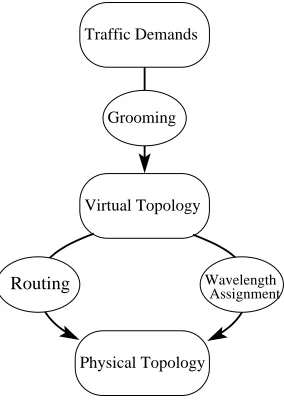
Traffic Demands
Physical Topology Virtual Topology
Routing
Assignment Grooming
Wavelength
Figure 1: Dynamic traffic grooming subproblems
each link, and the wavelength assigned to each lightpath is the same on all physical links. This is the Routing and Wavelenth Assignment (RWA) problem, which has been extensively discussed and studied in optical networking literature; see [3] and references thereof for a detailed discussion. Finally, the subwavelength traffic demands must be routed over the lightpaths formed, so that each traffic demand is carried by a sequence of lightpaths that form a path in the virtual topology which carries the traffic from its source to its destination. Traffic is transferred from one lightpath to the next in the sequence by OEO routing. Global minimization of OEO routing or OEO equipment required at network nodes is often the goal of static traffic grooming, as mentioned above.
The dynamic traffic grooming problem can be understood in terms of exactly the same subprob-lems. However, the objective of grooming must be seen in a new light. Unlike the static problem, in the dynamic traffic grooming problem the solutions to these subproblems need to satisfy time-varying traffic. Thus the solution itself must vary with time. At the least, the mapping of traffic demands to the virtual topology must change. Also, network designers can take the advantage offered by reconfigurable optical switches to dynamically adjust the virtual topology in response to traffic demand changes, in that case the RWA must also be readjusted to map the changed virtual topology onto the unchanging physical topology.
It is important to note that the focus of grooming traffic shifts as a consequence of the above. Reduction of OEO costs may continue to be an objective of traffic grooming. But the primary objective may now well be a minimization of the blocking behavior of the network; this is not particularly relevant in static traffic grooming because with good planning the entire traffic matrix is expected to be carried by the network, but making a similar 100% guarantee under statistically described dynamic traffic may be prohibitive in cost and not desirable. Similarly, the consideration of fairness is not relevant for the static problem, but may become an important one for the dynamic case.
in a distributed manner is likely to be of far more practical use in the dynamic context than one that requires a centralized approach; this distinction is less significant in the static case. Thus in various ways, the goal and priorities of grooming changes in the dynamic traffic context, and this is what we refer to as the changing role of traffic grooming. Finally, as the field evolves, it is likely to come to be perceived as a general class of network design problems where the cost component is largely concentrated into specialized network node equipment that will enter the mainstream in the future, such as optical drop-and-continue, wavelength converters, or OTDM switches.
The connection with the work in the Internet Engineering Task Force (IETF) in the GMPLS context is worth remarking upon. The original definition of Multi-Protocol Label Switching (MPLS) in the Networking Working Group of the IETF, building on earlier paradigms of tag switching and cut-through switching, was motivated by the need to reduce the forwarding burden on core routers. In label switching, an additional header is attached to Internet packets that carry information regarding flows to which each packet belongs. Once a flow, called a Label Switched Path (LSP) in MPLS, is set up, a Label Switching Router (LSR) in the path can forward packets bearing the label corresponding to the flow with much less processing than for a normal packet. In Generalized MPLS (GMPLS) [1, 2], time slot positions for TDM transport and wavelength channels for optical transport can also act as labels. It was soon realized by the networking community that label switch routing could also serve as an enabling mechanism for traffic engineering (TE), and flow-level QoS, because it allowed the identification of flows to routers. There has been significant recent work in defining extensions and signaling for the interaction of GMPLS and underlying networking layers, including SONET and other optical transports, and the communication of traffic engineering information between underlying networks and GMPLS [4, 5, 6].
However, these developments have focused (as appropriate for the role of the IETF) on enabling technology rather than design strategies. In keeping with the original guiding principles of the Internet, the network administrator is provided mechanisms to set up TE or QoS actions; but what actions are to be taken is left up to the administrator, who must look elsewhere for algorithms that provide policy or strategy decisions. To put it simply, all the mechanisms to set up LSPs is provided, but what LSPs to set up must be decided by the network administrator or operator. It is in this sense that research work such as traffic grooming provides a necessary complement to the development of enabling technology.
Because of the wide deployment of WDM networks, efficient operation under dynamic traffic is an area of practical interest to service providers. Efforts at different layers have already started in the arena of enabling technology to make the network friendly to dynamic traffic. At the lower layer, in the legacy Synchronous Optical Network (SONET) networks, the hierarchical rates defined for multiplexing/demultipexing make it inefficient to carry dynamic traffic requests. To overcome this intrinsic inefficiency, two mechanisms, Virtual Concatenation (VCAT) (as defined by the International Telecommunication Union in its recommendation [ITU-T G.707]) and the Link Capacity Adjustment Scheme (LCAS) (as defined in [ITU-T G.7042]) have been developed for Next Generation SONET. At the higher layer, part of the motivation to generalize MPLS to GMPLS has been to provide a uniform control plane to LSRs that operate at IP/MPLS level as well as network equipment that operate at fiber, wavelength and circuit level. Dynamic traffic grooming is thus a timely and emerging research area. Our focus in this survey is this research area, which is expected to provide algorithms that supply designs or policies for network operation.
The rest of the paper is organized as follows. In Section 2, we briefly discuss network node architectures for traffic grooming networks, because it is an important factor in dictating the goals of the network design problem. We provide discussion regarding the formulation of the dynamic traffic grooming problem either as a resource allocation problem or a policy design problem in Section 3. This also allows us to present a classification of the literature. Section 4 presents a detailed literature survey according to our classification. We conclude with a few remarks on future directions in Section 5.
2
Node Architectures
The extent to which subwavelength traffic components may be manipulated (and thus what groom-ing actions may be performed) is determined by the network equipment that are available at the nodes. Accordingly, in this section, we provide a brief overview of nodal capabilities. A more detailed discussion, with some discussion of future switch capabilities, may be found in [7].
Generally speaking, the traffic entering/leaving a node equipment can be described by a tuple (optical fiber, wavelength, time-slot). Thus, a “perfect” switching node would perform a complete permutation, i.e. the traffic from any fiber, any wavelength, and any time slot would be possible to switch to any other fiber, wavelength, time slot. However, due to considerations of cost and scalability, different node architectures are deployed in reality that have less than perfect switch-ing capability. These impose different constraints on the groomswitch-ing problem. We will show in Section 3.3.1 how a mathematical formulation for the dynamic traffic grooming problem requires careful examination of the node architectures. A generic modeling of the constraints that applies to different architectures is also an interesting problem.
The basic conceptual building blocks of such switches can be broadly divided into optical compo-nents, which manipulate optical signals, and thus operate at the level of entire wavelength channels, and electronic or digital components, which are capable of manipulating individual bytes and pack-ets as electronic signals, as in traditional routers and electronic computers. Optical networking switches will in general have some of each type of component, and can be characterized by the capabilities of each of these. When a number of signals are multiplexed into a carrier, multiplex-ers (MUX) and de-multiplexmultiplex-ers (DEMUX) are required at the sender and receiver respectively. If an equipment has the capability to de-multiplex signals, then selectively switch some of them to another switching equipment at the same node, while passing others through to a multiplexer for outgoing signals, it is called an Add-Drop-Multiplexer (ADM). Such an equipment performs only one decision for each de-multiplexed flow (whether to drop it or to pass it through). If, in addi-tion, the equipment has the capability to choose which of several outgoing ports a signal is passed through to, it is called aCross-connect (XC).
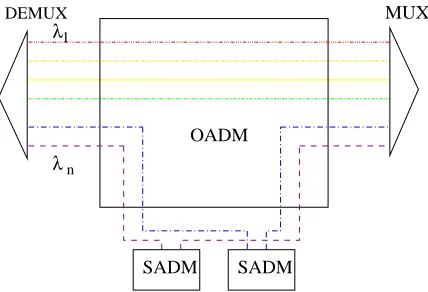
SADM OADM
MUX 1
DEMUX
λ λ
n
SADM
Figure 2: An OADM Architecture
For WDM networks, multiple wavelength channels are frequency multiplexed in each fiber links, and lower rate traffic streams are time division multiplexed in each wavelength channel. The digital equipment at the node can perform switching actions on the lower rate traffic streams by utilizing Synchronous Transport Signal (STS) in the optical signal. In WDM ring networks, an Add-Drop method as above can be used, but now Optical ADMs (OADMs) are used to selectively by-pass some wavelengths along the ring, while others are dropped into digital equipment, which may be SADMs. This forms the simplest node structure that can be used in optical grooming networks, and is shown in Fig. 2. The various wavelength channels frequency multiplexed in the fiber are represented by λ1. . . λn. The by-passing of wavelength channels creates lightpaths, channels that are optically continuous over multiple physical fiber links. In Fig. 2, the first four wavelengths are by-passed in this fashion, whereas the last two are dropped (and added, at the output). It is possible to re-generate a lightpath signal on a different wavelength entirely by optical hardware (without converting the signal into the digital electronic plane), this is called wavelength conversion. However, such equipment is quite costly, and in many cases practical node architectures may not include such converters. Without wavelength conversion capability, lightpaths must obey the
wavelength-continuity constraint, i.e. a lightpath must be assigned the same wavelength on the fiber links it traverses. For each added/dropped wavelength, an SADM is dedicated to process the traffic the wavelength carries electronically. The number of SADMs at a node determine the number of wavelength channels for which traffic can be switched at the timeslot level, thus this number characterizes in part the switching power of the node. It is well recognized that the cost of transceivers is the main contributor to the network cost, therefore the number of SADMs available at an OADM is usually either the objective to minimize, or a constraint to which the optimization problem is subject. This problem is referred to as ADM constrained grooming in [9]. Furthermore, if the SADMs on the different wavelengths are isolated (as shown in Fig.
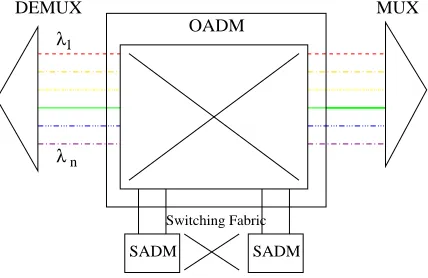
reffig:oadm), not only lightpaths but traffic components need to obey the wavelength-continuity constraint because the traffic dropped at a wavelength has to be sent onto the same wavelength in order to be forwarded to its destination, as in [9]. This constraint can be relaxed if a digital switching fabric is available such that the traffic added/dropped by SADMs can be reshuffled and re-injected into other SADMs, resulting in a more powerful switching node. Fig. 3 shows an example of such a node, with optical MUX/DEMUX and OADM, and SADMs on each dropped wavelength connected by a DXC.
n
MUX
1
OADM DEMUX
Switching Fabric
SADM SADM
λ
λ
Figure 3: An OADM architecture that allows cross-connect of local traffic
λ
DEMUX MUX
OADM
SADM SADM
Switching Fabric 1
λ
n
Figure 4: An ROADM architecture
switch in terms of how much traffic can be switched, but introduces more flexibility. The number of maximum wavelengths that can be dropped characterizes the power of the switch, as well as the digital switching capability (as before). For a comparison of different ROADM architectures, refer to [10]. An example is shown in Fig. 4.
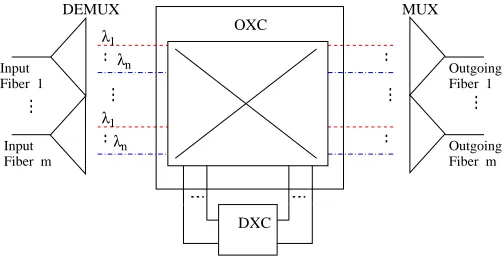
In all the above, the optical part of the switch is only an ADM, and the electronic part is an ADM or an XC. These can all be viewed as a special case of Optical Cross-Connects (OXCs), the most general class of grooming switches, which are widely expected to be deployed in realistic mesh topologies. In such switches, the optical ADM is replaced by an optical XC. Thus wavelength channels can not only be by-passed to form ligthpaths, but these lightpaths can be switched to specific output ports. An OXC is similar to an ROADM, but can accommodate incoming fibers from multiple nodes, similarly outgoing fibers to multiple nodes. Three broad classes of OXCs have been defined (refer to Telcordia’s Optical Cross-connect Generic Requirements GR-3009-CORE):
• Fiber switch cross-connect : the entire signal carried by an incoming fiber is switched to an outgoing fiber, cannot perform different actions for different wavelength channels of timeslots.
• Wavelength Selective Cross-connect : can switch a subset of the wavelengths from an input fiber to an output fiber, obeying wavelength continuity constraint.
• Wavelength Interchanging Cross-connect : WSXC with wavelength conversion capability.
Fiber m
DXC OXC
MUX
λ1
n λ
λ1
n λ
Input
Outgoing Fiber 1
Outgoing Fiber m Fiber 1
DEMUX
Input
Figure 5: An OXC architecture that has grooming capability
with m input and m output fiber ports. (Usually, the number of input fiber ports is equal to the number of output fiber ports; however, in [11], the design of strictly non-blocking OXCs with different numbers of input and output fibers has been studied.) An OXC usually has two separate switching fabrics, the wavelength switching fabric that switches traffic at the wavelength level, and the grooming fabric that switches traffic at the time-slot level [12]. Since the grooming fabric can be viewed as a DXC, to avoid confusion, the cost is usually modeled in terms of the number of transceivers, instead of SADMs as in SONET ring networks. Note that both the transceiver and the SADM can be seen as terminating a lightpath into digital equipment; thus this cost measure can be generalized as the number of LTEs required.
Other node capabilities related to the ones described above are possible. A node intermediate in power between an ROADM and an OXC called Optical Add-Drop Switch (OADX) has also been defined and is commercially available; however, we do not discuss it here because from the grooming point of view such as node is equivalent either to an ROADM or an OXC. In [13], a node is modeled as trunk-switched and a generalized framework for analyzing Trunk-Switched Networks
Switch architecture is introduced. Instead of using SaD switches, it has two stages of optical switching. Multicast traffic leaving the first stage optical switch is sent to a splitter bank and then switched by the second stage optical switch.
While different node designs afford different flexibilities in grooming solution design, some gen-eral conclusions regarding the cost points can be made. Clearly the distinction between OADM and OXC is dictated by considerations of the physical topology - an OADM is useful only in a ring. Other than that, the optical part of the switch is characterized by the number of wavelengths, which in turn is characterized by the transmission system being adopted. However, in the electronic part of the switch, there is room for more fine-grained design decisions. The DXC may typically have less capacity than that of every lightpath of every fiber port of the OXC. Thus the number of LTEs that form the ports of the DXC is often a good measure of the grooming capability, and also the cost, of the switch. For a ring node, the SADMs embody the LTEs, whereas for general topologies, the number of optical transceivers or transponders are the eqivalent quantity.
3
The Dynamic Traffic Grooming Problem
In this section, we make some general observations to indicate the scope of problems dealt with in literature that we consider as coming under the umbrella of dynamic traffic grooming. Broadly, we include both problems that take an essentially dynamic approach to changing traffic and problems that convert this changing nature into a static design problem. However, the underlying problem should be motivated by the changing nature of traffic. Also, we consider the study to come under grooming only if the multiplexing of subwavelength traffic is considered to contribute to the cost model or constraints in some manner. We exclude literature from our scope if the only consequence of subwavelength traffic is seen to be the required multiplexing, because such studies are more appropriately considered to fall under the more established research areas of routing design and resource allocation with multiplexing. These considerations prompt us to consider out of scope studies such as [19], which is in effect static grooming study; or [20], which is more appropriately considered a restoration strategy design at the lightpath level. Finally, we use the concepts devel-oped in this section to present a categorization of the literature on this topic, which we go on to survey in detail in Section 4.
3.1 Design and Analysis Problems
In [21], we classified the dynamic traffic grooming problem into two broad categories: the design problem and the analysis problem. The distinction, while not an absolute, is a practically useful one in understanding approaches to the problem and categorizing them.
• The networkdesign problem focuses on the state space; a time-varying one for the dynamic problem. Given a model of behavior of the network and some quantities of interest to optimize, the design problem attempts to find optimal settings of controllable parameters.
• The network analysis problem focuses on modeling the behavior. Given an a priori policy of network control under dynamic traffic events, such as arrival, departure, increment, decre-ment; the analysis problem attempts to develop a predictive model of some quantities of interest, under changing values of input parameters, such as arrival rates.
problem presupposes an existing policy and resource allocation under given traffic conditions. In the area of dynamic traffic grooming, analysis problems considered in literature generally address the blocking performance of the network under some given grooming policy, as experienced by arriving subwavelength traffic components. The design problems considered in literature show a larger variety both in the problems formulated as well as the approaches taken, and we discuss more of them in the rest of this section. At the end of this section, in Table 1, we use the distinction between design and analysis problems as our first categorization of literature on the dynamic traffic grooming problem. In Section 4, we include surveys of both categories of literature.
3.2 Quantities of Interest in Design
We briefly list the basic quantities in terms of which the design problem is defined, with accompa-nying notation.
• Let N be the set of nodes and A be the set of directed fiber links in the physical topology graph. We assume that the physical topology does not change with time.
• Let S be the set of traffic demands denoted by the source-to-destination node pairs in the network; S may consist of all distinct ordered pair of nodes, but may also be a subset of it because some node pairs do not have traffic between them.
• Let Λ|N|×|S|= [λns(t)] be the traffic matrix, whereλsn(t) is the time varying traffic flow for the node-flow pair (n, s). Specifically,λs
n(t) isλs, if at timet, the traffic demandsis sourced from node n, and has magnitude λs. Similarly, λsn(t) is −λs, if the traffic demand s is destined to node n, and 0 if n is neither the source not the destination of the traffic demand s. We suppose λs for every s is in units of a basic rate, and the capacity of a wavelength is C, in the same units.
• Let the number of wavelength channels available on each physical fiber link byW, wavelengths are numbered from 1 to W on each fiber.
• Let the matrix of the physical topology beP|N|×|A| = [pn(a)], where p(na) is 1 if the fiber a is sourced from noden,−1 if it is destined ton, 0 otherwise.
• Let L be the set of lightpaths, and let V|N|×|L|×W = [v (l)
n,w(t)] be the matrix of wavelength layered virtual topology, where vn,w(l) (t) is 1 if at time t, lightpath l is sourced from node n and uses wavelength w,−1 if it is destined tonand uses wavelength w, 0 otherwise.
• LetR|A|×|L|×W = [r( l)
a,w(t)] represent how the virtual topology is routed on the physical topol-ogy and assigned wavelengths, wherera,w((l) t) is 1 if lightpathluses the wavelength won fiber linkaat time t, 0 otherwise.
• LetG|L|×|S|= [gl(s)(t)] represent how the traffic demands are routed on the virtual topology, whereg(ls)(t) isλsif the traffic demandstraverses lightpathlat timet, 0 otherwise. This rep-resents the case that traffic bifurcation is not allowed; additional variables can be introduced to represent bifurcated or diverse routing of traffic demands.
In general terms, the inputto the dynamic traffic grooming problem are:
(ii) the resource availability (includes physical topology P, number of wavelength channels W, etc.), generally not varying with time, and
(iii) the node architecture (limits to grooming capability, etc.), also generally not varying with time.
The output of the dynamic traffic grooming problem are:
(i) the virtual topology V,
(ii) the routing and wavelength assignment V for the virtual topology on the physical topology
P, and
(iii) the routingG of the traffic demands on the lightpaths of the virtual topology.
In general, all of the outputs are functions of time.
3.3 Basic Constraints
3.3.1 Constraints on the node architecture
• As we observed in Section 2, the total OEO processing capability of a node is directly con-strained by the finite number of LTEs at the node. This is expressed as:
max
X
l:v(n,wl) >0 X
w
vn,w(l) (t), X
l:v(n,wl) <0 X
w
−v(n,wl) (t)
≤LTEn ∀n (1)
where LTEn is the number of LTEs available at noden.
• In Section 2, we have shown that different node architectures may also result in different constraints on the feasible grooming solutions. For instance, the unavailability of wavelength converters imposes the wavelength continuity constraint in the RWA problem. Because the wavelength converters are expensive, most researchers assume that they are absent in the network. Consequently, lightpaths must obey the wavelength continuity constraint. That is;
v(n,w(l) t) is 1 if at time t lightpath l is sourced from node n, −1 if at time t lightpath l is destined to noden, 0 otherwise.
Depending on the node architecture, there may be further constraints on the set of wave-lengths a local transmitter can be tuned to. For example, practically, transmitters may be equipped with lasers with limited tunability (e.g., a recent OADM card provided by a major vendor can only be tuned to a band that has two predetermined wavelengths). However, if the wavelengths that are dropped/added are reconfigurable and completely selective, such a constraint is not required.
3.3.2 Constraints on the RWA problem
To ensure correct RWA, we can use the following constraint or similar:
P|N|×|A|R|A|×|L|×W =V|N|×|L|×W (2) To ensure one wavelength on a fiber is assigned to at most one lightpath, we can use:
X
l
3.3.3 Constraints on the traffic routing
We use V|N|×|L|= [v( l)
n (t)] to denote the virtual topology at time t. vn(l)(t) is 1 if the lightpath l is sourced from node nat time t,−1 if the lightpathl is destined to noden, 0 otherwise. Note that the virtual topology is the sum of the wavelength layered virtual topology, that is:
V|N|×|L|=
X
w
V|N|×|L|×W (4)
The following constraint ensures the traffic demands are properly routed on the virtual topology.
V|N|×|L|G|L|×|S|= Λ|N|×|S| (5)
To ensure the capacity of a lightpath is obeyed, we have:
X
s
g(ls)(t)≤C ∀l (6)
3.4 Static and Dynamic Formulations of Design
3.4.1 Static Formulation - Resource Allocation
While traffic demands change with time, the change may be partly or wholly predictable. As an extreme case, the nature of variation of traffic with time may be completely deterministic. If the value of the traffic demands at all times (over a period of interest) is known with certainty beforehand, the problem can be seen as some variation of a general resource allocation problem, and a static formulation of the problem is most appropriate.
In this model, the traffic is deterministically given over some period of interest, possibly as a sequence of traffic matrices, Λ(t0), . . . ,Λ(tn). The period may be infinite, by specifying that the pattern of traffic matrices repeats; this is essentially a scheduling problem. This model is amenable to an ILP formulation [56]. One obvious approach to such a problem is to eliminate the effects of time-variation altogether by simply designing for the peak values each traffic component assumes in the entire set of matrices. However, as shown in [23, 24], using the traffic matrix formed by the peak rates may result in requiring an unnecessarily large amount of resources. The reason is the space-time nature of the dynamic traffic grooming problem, which is left out of consideration in this approach. The traffic matrix of peak rates is an overestimation of the traffic demands, because the dynamic nature of traffic spreads peak rates out along the time dimension. Thus this problem, while a static problem, is distinct from the static grooming problem.
3.4.2 Dynamic Formulation - Policy Design
On the other hand, unpredictability or uncertainty may be seen as an essential characteristic of the traffic model. In such cases, the dynamic nature of the problem needs to be explicit in the problem formulation. The problem must be seen as one of supplying a policy design for the network, that is an algorithm that the network control plane can employ to make decisions in response to traffic change events, with state and action space defined as follows:
traffic routing Gi. The tuple{Vi, Ri, Gi} is referred to as the grooming solution at time ti. Then, the network state at time ti can be described by the tuple {Λi, Vi, Ri, Gi}.
Action space: According to the layer it will affect, the actions taken by the network control algorithm can be classified as follows:
• Call Admission Control (CAC) actions, where two possible actions are reject and accept. If a traffic change is accepted, actions on other layers may follow. Note that while we use the term “call”, the events may be more general ones than arrivals of entire subwavelength traffic demands; for example it may be an increment or decrement to the magnitude of a traffic connection already established. However, the network action must still start with a decision regarding whether to accept or reject the increment.
• Network layer routing actions. Once a change is accepted, the changed traffic will be either routed on the existing virtual topology, or it will trigger virtual layer actions. The actual route of the subwavelength call on the virtual topology must also be determined according to some policy. When the change is in the nature of a traffic decrease, network layer action may also be triggered to rearrange the routing of remaining traffic, see below.
• Virtual layer setup, teardown, or routing actions. To route the changed traffic component, new lightpaths may be set up. These may be either a direct lightpath, or a combination of new lightpaths, which may be further utilized in conjunction with existing lightpaths to route the changed traffic component. For new lightpaths, routing and wavelength assignment is performed. Similarly when traffic decreases, lightpaths may be also torn down in response.
• Re-routing Actions. Furthermore, if disruption of existing traffic is allowed, the actions may include rerouting (or even terminating) some existing traffic. Existing subwavelength traffic may be rerouted on the virtual topology, or existing lightpaths may be rerouted on the physical topology.
For each action,{Vi, Ri, Gi}will change to{Vj, Rj, Gj}. The goal of the policy will be always to maximize some reward function, akin to the objective function for a static formulation; we discuss some possible goals later in this section.
Referring back to our discussion regarding Fig. 1, we see that the physical topology at the lowest layer does not change with time, and the highest layer, the traffic demands to be carried, do change with time. Thus dynamic traffic grooming strategies can be seen as the algorithms executed by the network to perform a time-varying mapping of the traffic onto the network resources, using the routing, wavelength assignment, and grooming, to satisfy the demands and satisfy some goal of network operation such as operating cost minimization or maximization of utilization.
3.5 Models of Non-deterministic Traffic Variation
For the dynamic formulation, traffic variations are not wholly predictable, but the time-variation of traffic may nevertheless be modeled or characterized to some extent. Different models can be designed to reflect realistic network conditions, we list a few below.
• Traffic demands are preferred to be serviced within time windows [25]. This is a generalization of the simple arrival-departure model. Instead of each traffic component requiring to be serviced at the instant (or as soon after as possible) that it arrives, every traffic component specifies a window of time within which the traffic component must be carried. The arrival process may again be Poisson, or some other process.
• Traffic demands are restricted by specified bounds. Such bounds may be provided by the traffic components themselves, or they may be imposed by the available resources. For ex-ample, the number of SADMs available at the node (referred to ast-allowable traffic in [23]). Let SADMn be the number of SADMs at noden, then the traffic matrices must satisfy:
max
X
s:λ(ns)>0
λ(ns)(t), X
s:λ(ns)<0
−λ(ns)(t)
≤SADMn·C ∀n
• Traffic components change in magnitude over time inincrementsanddecrements. The process by which increments and decrements occur may be Poisson or some other.
• Entire traffic matrices are specified as in the deterministic model, but the time epochsti are not deterministic, and varies according to some random process.
3.6 Design Goals
The goal of either resource allocation or policy design is to minimize some measure of cost in provisioning and operating the network, and/or to maximize the benefit from the network. This can be embedded as cost function(s) in a static formulation, and reward function(s) in a decision formulation. In the literature, different goals have been articulated, some representative ones include:
• Minimize the network cost; these are more suitable for the static, resource allocation, view:
– Number of ports at network nodes (converters, LTEs, wavelengths).
– Amount of OEO processing.
• Maximize the revenue by providing better service or better utilization of the network resource; more appropriate for the dynamic, policy design, view:
– Minimize the blocking probability.
– Minimize the provisioning time (time to setup a connection for an arrival, traffic delay, etc.)
– Minimize the disruption to traffic already being carried.
– Minimize the unfairness (e.g., traffic demands having different bandwidth requests should have approximately the same blocking probability).
connection admission control mechanism that provides good fairness without over-penalizing the overall blocking probability. In [23, 28], the objective is to design networks with the minimal SADM costs while keeping the existing traffic undisrupted (non-blocking in the strict sense).
3.7 Literature Classification
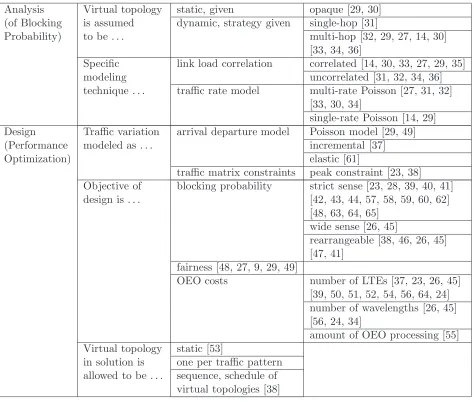
Based on the observations we have made in this section, we present an organized view of the literature on the dynamic traffic grooming problem in Table 1. Because all the categories are not orthogonal, several papers appear in multiple places in this table. Thus this table should be thought of as an organization rather than a categorization.
Moreover, some studies address more than one category of problem. For example, consider the variants of blocking probability that are considered in the literature. The blocking characteristic of a network can be classified as strict-sense non-blocking, wide-sense non-blocking and rearrangeable non-blocking (e.g. in [23]). If the network resources can guarantee strict-sense non-blocking, then all the new arrivals will be satisfied, and the policy design problem may not be addressed since it is trivial. However, if network cost considerations dictate accepting lesser blocking performances, to design a wide-sense non-blocking or rearrangeable non-blocking network, both the problems of resource design and policy design (to route new arrivals) are likely to be addressed.
4
Literature organization
In this section, we present detailed surveys of the literature. Table 2 provides a quick summary of most of the papers making up the dynamic grooming literature we survey.
4.1 Analysis
As we have discussed in the previous sections, the resource and policy design problems are in essence optimization problems. In order to evaluate the performance (usually, the blocking probability) of a design, practitioners often resort to massive simulations. As simulation results are generally specific to the input (arrival and departure rates, etc.) and time consuming, analytical models are not only interesting in its own right but practically meaningful. In literature, the metric of greatest interest is the blocking probability, i.e., the ratio of the number of accepted arrivals to the total number of arrivals. In order to accept an arrival, the subproblems described in Fig. 1 should be solved. We distinguish two cases, the single-hop case and the multi-hop case (referred to as dedicated-wavelength TDM and shared-dedicated-wavelength TDM in [13]). In the former case, a new arrival is accepted if it can be routed on a single lightpath (either an existing one or a new one to be established) from source to destination. In the latter case, the arrival is allowed to traverse multiple lightpaths, which could be a combination of existing lightpaths and newly established lightpaths. In addition, some routing and wavelength assignment algorithms should be assumed, e.g., the shortest path routing and random wavelength assignment algorithms considered in [13, 14]. In queuing networks, we also distinguish single-rate and multi-rate requests. In the single-rate model, all traffic demands have the same magnitude. The model simplifies the analysis significantly. However, in grooming networks, the multi-rate model may be more realistic because traffic demands are usually subwavelength, thus in units of some basic rates (say, OC-3).
Analysis Virtual topology static, given opaque [29, 30] (of Blocking is assumed dynamic, strategy given single-hop [31]
Probability) to be . . . multi-hop [32, 29, 27, 14, 30]
[33, 34, 36]
Specific link load correlation correlated [14, 30, 33, 27, 29, 35]
modeling uncorrelated [31, 32, 34, 36]
technique . . . traffic rate model multi-rate Poisson [27, 31, 32] [33, 30, 34]
single-rate Poisson [14, 29] Design Traffic variation arrival departure model Poisson model [29, 49]
(Performance modeled as . . . incremental [37]
Optimization) elastic [61]
traffic matrix constraints peak constraint [23, 38] Objective of blocking probability strict sense [23, 28, 39, 40, 41]
design is . . . [42, 43, 44, 57, 58, 59, 60, 62]
[48, 63, 64, 65] wide sense [26, 45]
rearrangeable [38, 46, 26, 45] [47, 41]
fairness [48, 27, 9, 29, 49]
OEO costs number of LTEs [37, 23, 26, 45]
[39, 50, 51, 52, 54, 56, 64, 24] number of wavelengths [26, 45] [56, 24, 34]
amount of OEO processing [55] Virtual topology static [53]
in solution is one per traffic pattern allowed to be . . . sequence, schedule of
virtual topologies [38]
Table 1: Variants of the Dynamic Grooming Problem
All these challenges and difficulites make the exact queuing analysis intractable. Accordingly, researchers have made different assumptions and simplifications. In the following section, we survey related works in this field.
4.1.1 Multihop model with correlation
at the two nodes. Two mappings, namely independent mapping and architecture-dependent mapping, are proposed to find the conditional probability. In [33], the authors extend the work to the multi-rate case.
Washington et al. study the blocking probability on tandem networks, i.e., a unidirectional path virtual topology [30]. The authors consider the multi-rate arrival model on existing lightpaths. A path network is first decomposed into subsystems consisting of two adjacent nodes and analyzed exactly by a modification of Courtois’ method. The first step of the Courtois’ method that requires solving a system of equations is replaced by solving a multi-rate model for the exact conditional steady-state probabilities. After that, the link load correlation is considered by proposing an iterative method.
The authors of [35] study the performance of traffic grooming networks. Two types of grooming networks are distinguished, the constrained grooming networks where each node of the network is a wavelength-selective crossconnect (WSXC), and the sparse grooming networks where some nodes are wavelength-grooming crossconnect (WGXC). WSXCs are equipped with both OXCs, which perform switching at the wavelength level, and OADMs, which groom traffic streams onto the added/dropped wavelength. The authors start with a simple two-hop single-wavelength system. Ar-rivals are multi-rate traffic requests. Then the network state is described by (n1, n2, . . . , nj, . . . , ng,
m1, m2, . . . , mj, . . . , mg, l1, l2, . . . , lj, . . . , lg), where nj is the number of traffic demands that tra-verse the first link only and ask for j capacity, mj is the number of traffic demands that traverse the second link only and ask forj capacity, lj is the number of traffic demands that traverse both the first and the second link and ask for j capacity. Then the steady state distribution can be obtained. Using the two-hop single wavelength capacity correlated model, a more complex and realistic multi-hop single wavelength model is solved. The application of this model in performance analysis in general networks is also demonstrated. The main novelty of the paper is taking the multi-rate requests and capacity correlation into account. However, routing and wavelength as-signment is not addressed because the capacity correlation model is specified for single wavelength systems.
4.1.2 Uncorrelated models
In [31], Xin et al. study the blocking performance analysis problem on traffic grooming in single hop mesh networks. A closed-form formula is derived by some simplifications. For example, a single-wavelength link (SWL) blocking model is introduced and the multi-rate arrivals are converted into bulk arrivals and approximated departures. The authors also assume that overflow traffic is Poisson. Then a reduced load model is used to compute the end-to-end blocking probability.
By the same authors, the work in [32] is an extension of [31] that takes multi-hop routing into consideration. The authors propose a simple admission algorithm at a source node for each incoming traffic demand. A routing strategy is given such that the SWL model introduced in [31] can be extended to include multi-hop traffic arrivals. Instead of the sequential overflow model, a random selection of two-hop paths for the overflow multi-hop traffic demand is performed.
nodes) first and randomly select a candidate route if the direct one fails. Accordingly a path is blocked if all candidate routes are unable to satisfy it and respectively, a route is blocked if any of the lightpaths it consists are unable to satisfy it. Assuming the wavelength conversion capability is absent, a lightpath can be carried if there is an available single wavelength path (i.e., an available wavelength on all the links along the lightpath). The availability of a single wavelength path is in turn decided by the availability of the set of single wavelength links it consists, i. e., the existence of a set of common channels (time slots) that can satisfy the amount of capacity the s-d pair requires. It should be noticed that, using this model, some important assumptions have been made. First, the single wavelength links consisted in a single wavelength path are assumed to be independent. Similarly, the lightpaths consisted in a route are assumed to be independent. Meanwhile, the overflow traffic is assumed to be Poisson.
4.1.3 Other models
The study in [61] deals with the traffic models in traffic grooming networks. The aim of the paper is to investigate how traffic elasticity, the reactivity of traffic with respect to the changing environment (load, e.g.), impacts grooming. The authors argue that even in core networks, the traffic is elastic in nature. Therefore, it is inappropriate to model them as the traditional circuit switched traffic. Specifically, two traffic grooming policies, virtual-topology first (V irtF irst) that prefers using existing lightpaths and optical-level first (OptF irst) that prefers setting up new lightpaths, are studied under two traffic models that have some feature of elastic traffic. The first model, referred to as time-based (TB), which is less complex, captures the decrease of throughput of traffic when there is a congestion. The more complex model, referred to as data-based (DB), captures the nature that the more congested the network, the longer flows remain in the network. Different combinations of the traffic models and the grooming policies are simulated using the simulator named GANCLES and the average throughput per flow, the starvation probability, the ratio between the opening rate of optical paths and the arrival rate of flows at the IP level, and, the average number of links per optical path are compared. The simulation results show that the interaction between the IP and optical layer gives rise to some complex behaviors, which suggests that neither the OptF irst nor V irtF irst are suited for the management of an IP over WDM grooming network, because they do not take the interaction between the IP and optical layer into consideration.
As we have mentioned in 3.5, [25] studies the ‘sliding scheduled traffic model’. Specifically, a traffic demand is given by a tuple {s, t, n, l, r, τ, p}, wheres and t are the source and destination respectively,nis the bandwidth requirement,land rare the starting and ending time respectively,
The space-time traffic grooming algorithm is compared with a tabu search algorithm that uses fixed alternate routing and the authors claim that the former algorithm outperforms the latter one in terms of the number of lightpaths.
4.2 Design
As a design problem, it usually consists of two phases: build a model and solve it. Therefore, two major concerns are how accurate the model is and how difficult this model can be solved. In dynamic traffic grooming networks, one important challenge that impacts the accuracy of the model is how to model traffic variations. As we have seen in Table 1, different traffic models have been proposed. As we described above, the problem can be formulated as an ILP when the traffic model is deterministic, or is treated as the traffic changing entirely to a new traffic matrix while the network is running [46].
As another concern, solving the model is also challenging. Since the general static traffic grooming problem is NP-Complete [54, 55], obviously the general dynamic traffic grooming problem with the static formulation, which has significantly more time dependant variables is also NP-Hard. In [55], we show that the static problem may be even inapproximable. Because of this, most research focuses on heuristic approaches.
4.2.1 Objective is blocking performance
As we have discussed in section 4.1, it is generally very hard (if not impossible) to find a closed-form solution to the blocking probability in grooming networks. Therefore, many researchers propose heursitic traffic grooming algorithms and compare their performance in terms of blocking proba-bility.
4.2.1.1 Strict sense
should have lower blocking probability than the low priority requests. Again, the PII is calculated for an LSP request. As in the previous paper, a request will be routed on a new lightpath if the route on the IP/MPLS layer is too long. For low priority requests, if no lightpath can be set up due to the wavelength or transceiver limit, they will be blocked. In contrast to low priority requests, high priority requests are routed on the IP/MPLS layer. The algorithm proposed (referred to as algorithm A in the paper) is further modified by introducing the Average Path Inflation Index (APII), which takes the holding time of LSP requests into account. This algorithm (referred to as algorithm B in the paper) gives those LSP requests that are blocked by algorithm A a chance to be routed if the APII is not too large. The authors claim that algorithm B can be extended to handle more than two priority classes, however, numerical results are provided only for two classes.
Sabella et al. propose a strategy for dynamic routing in GMPLS networks [53]. A GMPLS network is modeled as a multi-layer network consisting of an IP/MPLS layer and a logical layer. Assuming that the logical layer is given, the authors study the problem of how to route a new LSP request. The proposed strategy has two phases. First, an IP/MPLS topology is considered, where there is an MPLS link between two nodes if and only if there is at least one lightpath interconnecting them. Based on this topology, a proposed routing algorithm extends the least resistance routing weight method [44] to the multi-layer GMPLS paradigm, where subwavelength LSPs are routed. The second phase is the grooming phase, where the LSP is groomed into lightpaths. Two policies, the packing policy that prefers the most loaded lightpath and the spreading policy that prefers the least loaded lightpath, are addressed. Extensive simulation results show that the strategy named Multi Layer -Least Resistance Packing (ML-LRP) outperforms other variants.
In [28], the authors use a genetic algorithm to find a grooming solution in a strictly non-blocking manner for all-to-all traffic demands. New traffic demands are satisfied without re-routing and reconfiguration. To realize the strictly non-blocking property, the chromosome is decoded by a first fit approach incorporated with a local greedy improvement algorithm.
To enable a traffic grooming network, some kind of grooming algorithm must be implemented. Practically, we expect that the algorithms are some on-line algorithms that have a short pro-cessing time and small memory usage. Accordingly, some authors propose auxiliary graph based approaches, which can be adapted to satisfy various objectives. Based on the auxiliary graph, different grooming algorithms are proposed. This approach takes the advantage of the flexibility of an auxiliary graph and routing algorithms such that some simple algorithms can be constructed taking cross-layer information and heterogeneous node architectures into consideration. Different studies propose different auxiliary graph constructions.
Zhu et al. study the dynamic traffic grooming problem in mesh networks using a novel graph model [57]. This model creates an auxiliary graph that has an access layer, a lightpath layer andW
layer and the wavelength layer. Also note that by splitting the lightpath layer in [57] into the mux and grooming layers, the model is able to support different types of lightpaths distinguished by the source and/or destination node grooming capabilities. Using this model, the authors illustrate how different traffic engineering optimization goals can be achieved through different grooming policies. As in [57], auxiliary graphs are constructed in [40] to solve the dynamic traffic grooming problem. The graph has two layers, the virtual topology layer and the physical topology layer. An improve-ment to the previous work is the introduction of the link bundling (or more accurately wavelength bundling). In particular, following constraints are taken into consideration: the transceiver con-straint and the generalized wavelength continuity concon-straint, which allows nodes equipped with different kinds of conversion capability. The link bundled auxiliary graph (LBAG) simplifies the previous auxiliary graph representation by aggregating at mostW, the number of wavelengths avail-able on a link, wavelengths into one arc in the LBAG. Based on the graph, an algorithm (SAG-LB) is proposed to find a feasible path and a feasible wavelength assignment. As multiple feasible paths may exist, grooming polices, namely least resource path first (LR) and self-adaptive least resource path first (SALR), are introduced to select the preferred one. To prefer paths that consume less scarce resources, the LR and SALR policies explicitly take the wavelength and transceiver resources into consideration. The simulation results show that in some cases LR and SALR outperform the least physical hop path first and least virtual hop path first policies, in terms of the blocking probabilities (however, no conversion is assumed).
In [58], Farahmand et al. propose the Drop-and-Continue Node architecture, which, in addition to setting up some new lightpaths and/or utilizing existing lightpaths, allows two other operations, namely, drop-and-continue and lightpath extension. These two operations can reduce the network cost. If a lightpath is terminated at an intermediate node and part of the traffic goes to the local port before traversing another lightpath that will reach the destination node, two pairs of transceivers are necessary. However, if a splitter is used, one transmitter can be saved because the intermediate node can drop the local traffic without disturbing the optically bypassed signal, except for the power loss. This is a general scenario in multi-cast networks where we have one source node and many receiving nodes. Considering the node architecture and operations, the auxiliary graph method is used to solve the dynamic traffic grooming problem. The graph has a dedicated layer for each wavelength and different edges describing existing lightpaths, potential lightpaths, potential extended lightpath and sub-lightpath. By assigning them different weights using different grooming policies that are essentially the same as those in [57], a shortest path algorithm is used to find the best solution. Note that without the intermediate dropping and extension capability, this algorithm becomes identical to that of [57].
In [17], the same authors propose an auxiliary graph based tree grooming algorithm dealing with dynamic unicast traffic on mesh networks. Based on a node architecture that supports light-trees, auxiliary graphs are constructed. A difference of the constructions between this paper and [58] is the introduction of the grooming layer. Four kinds of edges are distinguished, namely, the AddEdge, the DropEdge, the pass-through edge (PTEdge) and the wavelength link edge (WLKEdge). Based on the auxiliary graph, a dynamic tree grooming algorithm (DTGA) is proposed. The DTGA has the weight assignment strategy (referred to as routing polices) as a sub-routine. As in [58], the edges are assigned weights by different policies. Accordingly, the shortest path algorithm is used by the DTGA to setup a connection for an arrival. Specifically, the connection is set up either by establishing a new light-tree along the vertices on the optical hop or extending an existing light-tree to cover the remaining vertices.
in a layered graph, which consists of wavelength planes, are fully available (FAL) edges. The significance of these two types of edges is as follows. If a traffic demand is routed on the virtual graph, i.e., routed by PAL edges, no new lightpaths will be setup, hence it will not use additional transceivers. On the other hand, if a traffic demand is routed on the layered graph, it may result in a route with less number of hops with additional transceivers. Upon these two graphs, a two-layered routing algorithm (TLRA) is proposed, which tries to route a traffic demand on the virtual graph first, then tries the layered graph if the first step fails. Obviously, the TLRA may fail to route some traffic demand that requires a route consisting of both existing lightpaths and new lightpaths. Then, a single layered routing algorithm (SLRA) based on an integrated graph is proposed. The shortcoming of SLRA, as claimed by the authors, is that using the shortest path algorithm on an integrated graph may result in a route that uses more new transceivers. The reason is that, in the integrated graph, the PAL edges and FAL edges are not distinguished. In view of the pros and cons of TLRA and SLRA, the authors propose the third algorithm, the joint routing algorithm, that combines the TLRA and SLRA. Finally, the algorithms are compared in terms of the blocking probability and it shows JRA, incurring a slight increase in complexity over TLRA, outperforms the others irrespective of whether the number of transceivers is small or large.
Although the auxiliary graph approach takes the advantage of its simplicity, because of the heuristic nature, in [59], Ho and Lee argue that, the algorithms proposed in [57] can be time-consuming in large scale mesh networks. A remedy is proposed by considering only part of the whole network when auxiliary graphs are constructed. Specifically, when a traffic demand arrives, instead of constructing an auxiliary graph with n nodes, where n is the number of nodes in the network, m candidates that are in the physical shortest path of the traffic demand are evaluated. If no lightpath can be found, neighbor nodes of the candidates are included into the consideration. This procedure can be repeated until a lightpath is found or resources are exhausted. In [60], based on the same idea, the authors propose a dynamic traffic grooming algorithm. In the first phase, to reduce the complexity of constructing an auxiliary graph of the entire network, a reachability graph that includes all the possible logical paths between the source and the destination is constructed. Based on the graph, the second phase is to find the optimal route by a cost-constraint algorithm, where the cost of interest is the sum of the cost of grooming fabrics and the penalty paid for wasted wavelength bandwidth.
4.2.1.2 Rearrangable
Traffic grooming algorithms are also studied in the context of reconfiguration, where one main concern is when and how the network should be reconfigured.
Kandula and Sasaki study the dynamic traffic grooming problem with rearrangement on ring networks [38]. The authors provide a reconfiguration algorithm, called bridge-and-roll (BR), such that the number of LTEs is reduced while keeping the network as bandwidth efficient as a fully opaque network. Putting different constraints on the resources, some interesting traffic models are introduced to illustrate the algorithm. In addition, to reduce the cost of traffic disruption, bounds are provided in terms of the number of BRs.
in the observation period. If some links are underutilized (i.e., the load on the link is lower than
WH), one lightpath is torn down. The authors first formulate the problem as an MILP problem, with a goal to minimize the maximum load, with constraints that ensure the correct action is triggered and the virtual topology changes correspondingly. Then, the authors propose a heuristic adaptation algorithm. If some links are congested, the algorithm simply picks the link that has the maximum load and the maximum traffic component that traverses the link, then sets up a new lightpath for the selected traffic component.
As we have mentioned in section 3.3.1, different node architectures may raise different problems. In addition to the Drop-and-Continue node architecture in [58], and the splitter-and-delivery switch architecture in [17], the authors of [15] study a two-layer groomer architecture. Based on this archi-tecture, a dynamic traffic grooming algorithm that combines both rerouting and segmented backup employing backup-backup multiplexing is proposed. Traffic requests are multi-rate requests, and may or may not require protection. Therefore, to satisfy a new arrival with protection requirement, both the primary and backup routes need to be set up. In case that rerouting existing traffic is necessary to accommodate a new arrival, end-to-end backup routes of existing traffic are consid-ered first, in order to avoid disrupting the existing traffic. If no route that is link-disjoint with the current primary and backup routes is found, all backup routes (end-to-end or segmented) are considered. The “best” route for a backup route is found if rerouting the backup on this route can satisfy the new arrival. Finally, existing traffic without protection requirements or with end-to-end backups are considered, either a traffic without backup is rerouted on a link-disjoint new route or an end-to-end backup route is rerouted on a route that is link-disjoint with the backup (not necessarily the primary).
[41] studies the rerouting algorithms and operations for dynamic traffic requests. When a traffic request arrives, rerouting is performed only if the existing routing fails to accommodate the request. Two approaches are proposed for the rerouting, namely, rerouting at lightpath level (RRAL) and rerouting at connection level (RRAC). RRAL can be viewed as a special case of reconfiguration because the rerouting of lightpaths suggests a way to change the virtual topology. The RRAC, on the contrary, keeps the virtual topology unchanged while changing the traffic routing on the virtual topology. Both approaches have pros and cons. The RRAL may be simpler in terms of the time complexity because the input is the set of lightpaths, which are much fewer in number than the traffic requests. However, it is subject to a longer time of disruption because of the laser re-tuning time involved. The RRAC, although more complicated, provides a finer granularity of adjustment. Practically, a combination of both approaches may be more appropriate. Based on these two approaches at different layers, two algorithms, called critical-wavelength-avoiding one-lightpath limited and critical-one-lightpath-avoiding one-connection-limited, are proposed. The first approach initially finds the set of critical wavelength of a path (the set of wavelengths that are used on only one link alone the path), then the lightpath using this critical wavelength is rerouted such that a traffic request can traverse the path. Similarly, the latter approach finds the set of critical connections for a path and a connection request and reroutes the critical connection so that the new request can be satisfied.
4.2.2 Objective is fairness
of QOS, which is generally implemented by the Call Admission Control. While CAC comes under the general area of grooming policy design, it is a distinct area which has received significant at-tention and it is worth mentioning separately. As one of the major functionalities that the control plane needs to implement, CAC has been extensively studied in signaling-based networks (e.g., ATM), where a call is accepted or rejected with respect to a pre-established agreement between the user and the service provider or the resource availability. In the context of optical grooming networks, we expect that some “old” concepts (e.g., QOS) will be re-examined by taking the virtual layer into consideration. As we have mentioned, when a new call arrives, the basic actions to take are accept and reject. Without CAC, a call will be rejected only if the available resources are unable to accommodate it. However, in a network with service differentiations, this simple strategy may not lead to an optimal overall utilization/revenue.
In [27], a CAC algorithm is proposed to deal with the capacity fairness, which is achieved when the blocking probability ofm calls of line-speedn is equal to the blocking probability ofncalls of line-speed m, and this is true for every pairm, n of line-speed. The overall blocking probability is defined as the blocking probability per unit line-speed of the call requests. The fairness ratioFr is defined as the ratio of the estimated blocking probabilities of calls of lowest and highest line-speeds. Therefore, the goal of the CAC algorithm is to makeFr as close to 1 as possible while keeping the overall blocking probability acceptable.
Mosharaf et al. address the wavelength provisioning problem in [29]. A simple 2-hop tandem network with three classes of traffic, traffic traversing the first hop only, traffic traversing the second hop only and traffic traversing both hops, is studied. The authors propose a dynamic partitioning approach. That is, the number of wavelengths allocated to each class of traffic is some function of the current state. This problem is formulated as a Markov Decision Process (MDP) problem. When a wavelength request terminates, the network decides for which class this wavelength is reserved. The best policy (the set of best actions for each possible state) is achieved by the Policy Iteration algorithm which maximizes the overall weighted utilization, using the discount cost model with infinite horizon. In [49], the same authors extend the work of [29] to grooming networks where traffic demands are usually subwavelength, with the goal to minimize the unfairness. Considering a single-hop single wavelength network, traffic is classified according to the bandwidth it requires. Thus, the network state is described by the number of existing calls of each class. Using this simple model, the optimal policy is examined. The authors also propose a heuristic to decompose tandem and ring networks using the idea of pre-allocating wavelengths for traffic with different o−dpairs such that overlapping o−dpairs do not share wavelengths (note that this is possible because the routing for all o−d pairs are predetermined in the ring and tandem topologies). The numerical results show that substantial improvement in terms of fairness and utilization can be achieved compared to that of complete sharing policy and complete partitioning policy.
demands in a manner as fair as possible.
4.2.3 Objective is OEO
Since the all-optical network is still unrealistic, optical signals need to be electronically processed. Therefore, a specific objective to be optimized is the OEO cost. The OEO cost may consist of different metrics of interest, such as the number of LTEs (or SADMs, electronic ports, etc.), the number of wavelengths, and the amount of OEO processing.
In [26], Sasaki and Gerstel study the dynamic traffic grooming problem for some typical WDM SONET ring architectures that guarantee no blocking. The primary network cost is the number of SADMs while the secondary concern is the number of wavelengths. For WDM unidirectional path switched ring (UPSR) and two-fiber bidirectional line switched ring (BLSR/2) networks, both the cases of limited and unlimited number of wavelengths are studied. For UPSR networks with limited number of wavelengths, a lower bound is derived by assuming the traffic is allowed to be cross-connected at every node. Given this lower bound, a single-hub architecture that guarantees wide-sense non-blocking, as well as a node grouped architecture designed for static traffic, are compared. For the UPSR wavelength limited case, the single-hub architecture and an incremental architecture are compared. The incremental architecture is a simplified version of the incremental network described in [45], where around the ring, nodes alternate between having the maximum and minimum number of ADMs (i.e., the trivial upper and lower bounds of the number of ADMs at a node). It shows that the incremental architecture is rearrangeably non-blocking and also wide-sense non-blocking for incremental traffic [45]. For BLSR/2 networks with unlimited number of wavelengths, the single-hub architecture is wide-sense non-blocking and it leads to a lowering of the bandwidth requirements because traffic may be routed on either direction of the ring. For the BLSR/2 wavelength limited case, the double-hub network is rearrangeably non-blocking [45], and the SADM cost is close to that of the single-hub network.
In [23], Berry and Modiano also address the dynamic traffic problems in SONET ring networks. The problem is defined as minimizing the number of ADMs while being able to satisfy a set of allowable traffic requests. The authors first lower bound the number of ADMs, which corresponds to the no grooming solution. A bipartite matching approach is then proposed to combine two solutions such that any one of the traffic requests can be satisfied while keeping the number of ADMs minimized. To study a specific and realistic dynamic traffic model, the t-allowable traffic model is introduced (see Section 3.5). The authors lower bound the number of ADMs and model it as a bipartite matching problem. Using Hall’s theorem, a necessary and sufficient condition to support the t-allowable traffic is developed, and an algorithm to remove unnecessary ADMs is proposed. The authors extend the work to support dynamic traffic in a strictly non-blocking manner and show how hub nodes and tunability can further reduce the number of ADMs.
Hu study the deterministic traffic model and present an ILP formulation with the goal to minimize the number of ADMs. The authors study both unidirectional and bidirectional rings and their corresponding ILP formulations. A nice observation for unidirectional rings proved in [56] is that the integer constraint for the variable xr
ijl, the number of traffic circuits from node i to