ISSN(Online): 2320-9801
ISSN (Print) : 2320-9798
I
nternational
J
ournal of
I
nnovative
R
esearch in
C
omputer
and
C
ommunication
E
ngineering
(An ISO 3297: 2007 Certified Organization)
Vol. 4, Issue 3, March 2016
Electronic Poll Counter of Crowd Using
Image Processing
Anish M.Nair, Rutvi R. Saraf, Anurag S. Patil, Vijayalakshmi Puliyadi,. Shashikant Dugad
Student, Dept. of Computer Engineering, Fr.C.Rodrigues Institute of Technology, Vashi, India
Student, Dept. of Computer Engineering, Fr.C.Rodrigues Institute of Technology, Vashi, India
Student, Dept. of Computer Engineering, Fr.C.Rodrigues Institute of Technology, Vashi, India
Assistant Professor, Dept. of Computer, Fr.C.Rodrigues Institute of Technology, Vashi, India
Professor, Department of High Energy Physics, Tata Institute of Fundamental Research, Mumbai, India
ABSTRACT: Image Processing has become a major part of industry whether it is Gaming Industry, IT industry, Day to Day lives etc. Everywhere there has been thousands of applications of Image Processing. It’s very amusing that just playing with certain images and performing some operations gives you tons of information about them. Image processing technology is used in various medical field, remote sensing, and robot vision, tracking movements and Gestures, Surveillance etc. With such applications we are proposing an idea as an Image Processing Application for counting the number of people helpful during rush hours in Railways or Shopping centres etc. Our system, by capturing real life videos and images make appropriate detection and provide an accurate count of people present at any instant of time. We have implemented two methods to count. Firstly based on an image and then based on video. In image based counting method, pre-processing operations like grey scaling ,frame differencing, morphology operations are performed on single image, whereas in video based counting method pre-processing operations are performed similar to that of image based method. Since we are working with video we have implemented object tracking and data association algorithms to count people.
KEYWORDS: Image processing, grey scaling, frame difference, morphology operations, object tracking, data association algorthim, image based counting, video based counting.
I. INTRODUCTION
In imaging science, image processing is any form of signal processing for which the input is an image, such as a photograph or video frame; the output of image processing may be either an image or a set of characteristics or parameters related to the image. The image is processed by adjusting hue, saturation, brightness etc. People counting has been an important component in video surveillance systems. For example, different levels of attention could be based on crowd of different density. To track and count moving people is considered important for the security or the marketing research. Many of such information are extracted manually. Therefore it is necessary to develop the automated system which will count the number people. There are different approaches for counting the number of people from acrowded scene. One of the approaches is to detect humans using Image Processing techniques from an image or videos. There has been a vast amount of work done in the area of human detection and it usually performs well in scenes that are not very crowded.
ISSN(Online): 2320-9801
ISSN (Print) : 2320-9798
I
nternational
J
ournal of
I
nnovative
R
esearch in
C
omputer
and
C
ommunication
E
ngineering
(An ISO 3297: 2007 Certified Organization)
Vol. 4, Issue 3, March 2016
identity to the detected object. This identity act as our counter.To track people, we have used Kalmanfilter[4] and for data association we have executed Hungarian algorithm[3].
We have implemented our project using java as our frontend language and MySQL as our backend database. To perform image processing we have used OpenCV 3.1.0.
II. RELATED WORK
Authors like Lin SF, Chao HX[7], T. Zhao, and R. Nevatia[8] addressed issue of people counting. They proposed methods such as fitting method, object detection method. Fitting method is easy to use method, but as it has skipped single object tracking process, it results into difficulty to acquire correct counting information. Objecttracking method has high precision because it detects directly object. This method acquires people counting information by tracking moving point, then applying analysis for point tracking. But though this method is insusceptible of camera angle, but has lower accuracy.
Duan-Yu Chen, Chih-Wen Su, Yi-Chong Zeng, Hong –Yuan Mark Liao[9] proposed a system “An Online People Counting System for Electronic Advertising Machine” for counting the number of people watching a TV-wall advertisement or electronic billboard without counting repetitions by using stationary camera. In this firstly detect face and filtering of face is done, in which, SVM based face detector is used. Filtering is used to filter out false positive face. Then an online classifier trained by Fisher’s Linear discriminate strategy is developed. Several attempts have been made to track pedestrians.
III. PROPOSED SYSTEM
In this paper, we are introducing a method for counting the number of people at any instant.Our system as two different methods for people counting
1) Image based counting. 2) Video based counting. 3.1 Image Based Counting
Image based counting modules are as follows:
a)Image Acquisition Module:
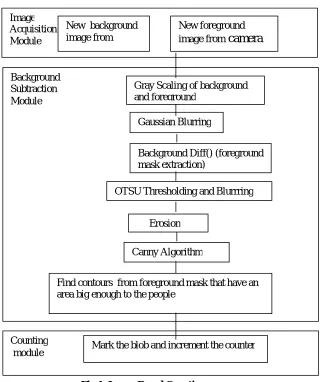
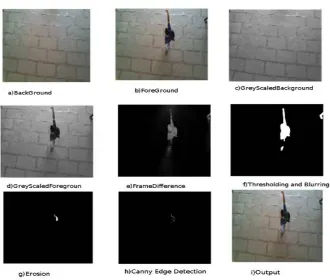
Image are first required in RGB and it is resized to 640x480 pixels. Firstly, background image needs to be captured and then foreground image which consists of people (objects).Fig2.a shows the acquired background and fig2.b shows foreground.
b)Background subtraction and segmentation module:
In this module we have sub-modules as follows:
i)Grey scaling& Frame Difference:
In this module, both images are pre-processed by converting it to a grey-scaled image to remove noise. The resulting image after grey scaling of both background and foreground is shown in fig2.c and fig.2.d.Frame Difference step is very important and consists of Pixel by Pixel absolute difference between two consecutive frames(in our case background and foreground). The result of this operation is a new image that shows all the differences between this 2frames. Fig.2.d shows the frame difference output.
ii)OTSU Thresholding and Blurring:
ISSN(Online): 2320-9801
ISSN (Print) : 2320-9798
I
nternational
J
ournal of
I
nnovative
R
esearch in
C
omputer
and
C
ommunication
E
ngineering
(An ISO 3297: 2007 Certified Organization)
Vol. 4, Issue 3, March 2016
Fig 1: Image Based Counting
iii)Erosion:
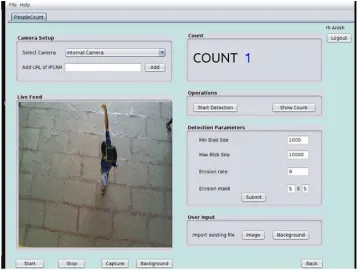
Threshold will not eliminate all the “wrong” Pixels (Pixels which are in the background of the scene). The second step of this algorithm, is to make a morphology erosion in the binary image.We have given an option to set the mask and rate of erosion in application interface as shown in fig 3.Fig2.g shows the output after applying erosion.
iv)Canny Edge Detection
We have used Canny Edge algorithm in the beginning of the project while we were testing to get correct count on a handmade image of circles. We tested Canny Edge[1][2], Laplacian[2], and Sobel[2] operator on our test image out of which canny Edge algorithm gave us the best result.Fig2.h is the resulting image after canny edge detection.
v)Blob Analysis and Counting:
The step to identify all the objects on the scene and calculate all their features is called a Blob Analysis . We have set a condition to detect and mark good blobs.
If(Size_of_blob> min and Size_of_blob<= max) mark that blob Image
Acquisition Module
New background image from
New foreground image from
camera
Background Subtraction Module
Gray Scaling of background and foreground
Gaussian Blurring
Background Diff() (foreground mask extraction)
OTSU Thresholding and Blurrring
Erosion
Canny Algorithm
Find contours from foreground mask that have an area big enough to the people
Counting
ISSN(Online): 2320-9801
ISSN (Print) : 2320-9798
I
nternational
J
ournal of
I
nnovative
R
esearch in
C
omputer
and
C
ommunication
E
ngineering
(An ISO 3297: 2007 Certified Organization)
Vol. 4, Issue 3, March 2016
Fig 2:Output at each step ofimage based counting method
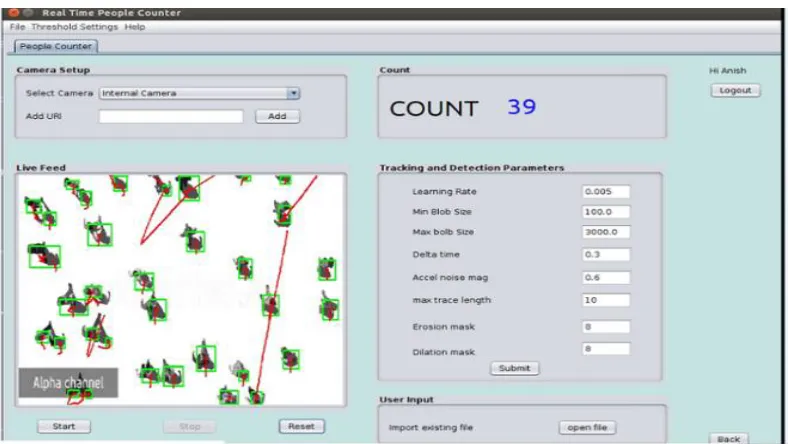
We have provided an option to change maximum and minimum blob size at application interface as shown in fig 3.Counting module counts the number of marked good blobs. Count value is displayed on application interface as shown in fig 3.
2.2) Video based counting
Video based counting modules are as follows:
a)Frame acquisition:
Images (frames) are continuously fed from camera or the video sequence.Fig5.a shows input video. We have provided an option to select existing video file at application interface shown in fig 6.
b)Background subtraction module:
ISSN(Online): 2320-9801
ISSN (Print) : 2320-9798
I
nternational
J
ournal of
I
nnovative
R
esearch in
C
omputer
and
C
ommunication
E
ngineering
(An ISO 3297: 2007 Certified Organization)
Vol. 4, Issue 3, March 2016
Fig 3: Image Based Counting GUI
c)Background Segmentation module:
Sub-modules are as follows:
i)Morphological operations:
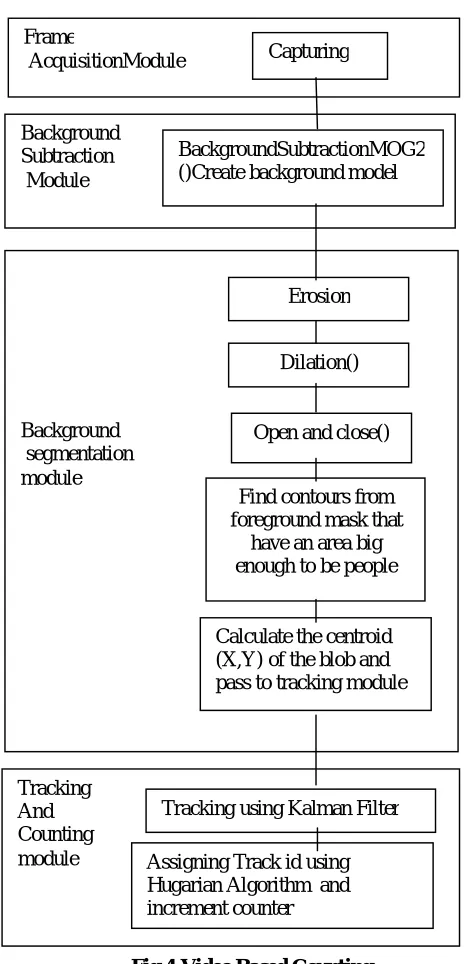
We have used erosion ,dilation, open, close morphological operation. This operation performed on the binary output which is obtained after background subtraction mog2. Fig 5.b shows the output after morphological operation. We have also provided as option to set the parameters of this operation at application interface as shown in fig 6.
ii)Blob Detection
Blob analysis plays an important role in both image based counting and video based counting. The blobs which satisfies the blob area constraint are considered and the centroid of the detected blob is obtained. This centroid co-ordinates are passed to the kalman filter[4] tracking algorithm.
d)Tracking and counting module: i)Kalman Filter:
ISSN(Online): 2320-9801
ISSN (Print) : 2320-9798
I
nternational
J
ournal of
I
nnovative
R
esearch in
C
omputer
and
C
ommunication
E
ngineering
(An ISO 3297: 2007 Certified Organization)
Vol. 4, Issue 3, March 2016
Fig 4:Video Based Counting
ii)Counting:
When the blobs are tracked, for each tracked blob we assign a track identity to each tracks using the Hungarian algorithm[3]. This track id gives the real time count. We have displayed count value at application interface as shown in fig 6 which gets incremented each time a track id is incremented.
iii)Hungarian Algorithm:
Hungarian algorithm[3] is used for solving an assignment problem[3]. Consider an example where we have four jobs say J1, J2, J3, and J4which is need to be carried out by four workers say W1, W2, W3, and W4, one job per
Frame
AcquisitionModule Capturing
Background Subtraction Module
BackgroundSubtractionMOG2 ()Create background model
Background segmentation module
Erosion
Dilation()
Open and close()
Find contours from foreground mask that
have an area big enough to be people
Calculate the centroid (X,Y) of the blob and pass to tracking module
Tracking And Counting module
Tracking using Kalman Filter
ISSN(Online): 2320-9801
ISSN (Print) : 2320-9798
I
nternational
J
ournal of
I
nnovative
R
esearch in
C
omputer
and
C
ommunication
E
ngineering
(An ISO 3297: 2007 Certified Organization)
Vol. 4, Issue 3, March 2016
worker.The algorithm will assign a worker to job which will result into minimum cost. Cost matrix shows the cost of assigning a certain worker to a certain job. In our project we are considering tracks as workers and jobs as the detections. The objective is to minimize the total cost of the assignment.
Fig 5: Video Based Counting Output
ISSN(Online): 2320-9801
ISSN (Print) : 2320-9798
I
nternational
J
ournal of
I
nnovative
R
esearch in
C
omputer
and
C
ommunication
E
ngineering
(An ISO 3297: 2007 Certified Organization)
Vol. 4, Issue 3, March 2016
IV.PERFORMANCE ANALYSIS
We observe the performance of the algorithms under various conditions on image and video dataset which was captured in both outdoor and indoor environment. In the context of tracking, the accuracy can be defined as
Accuracy= (actual count/resulting count).
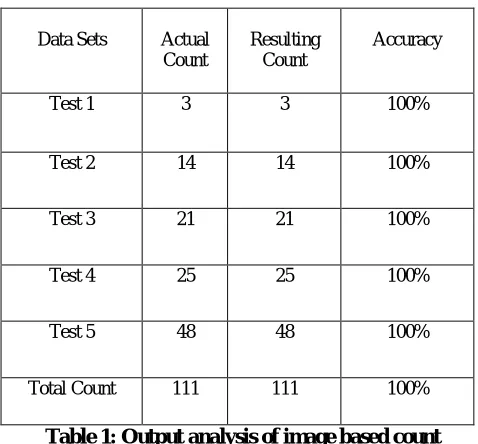
Performance analysis of image based counting method and video based counting methods shown in Fig: 7 and Fig: 8
Data Sets Actual
Count
Resulting Count
Accuracy
Test 1 3 3 100%
Test 2 14 14 100%
Test 3 21 21 100%
Test 4 25 25 100%
Test 5 48 48 100%
Total Count 111 111 100%
Table 1: Output analysis of image based count
Figure 3 shows image based system user interface. We need to click the start button to start live feed, then we need to capture background and foreground either by exporting the existing file or by taking it in real time.Figure 6 shows video based system interface. We can start live feed by clicking start button or we can export video file. Table 1 shows the results that we obtained for image based counting. We have performed various test cases at different environment to test our system. Test cases like test 1,test2 and test3 was performed in real time, by capturing images from live feed while test 4 and test 5 were existing image. Figure 2 shows the output at each stage of test case1.In this figure we can observer that the person is marked properly.We got 100% accuracy for all test cases respectively.
ISSN(Online): 2320-9801
ISSN (Print) : 2320-9798
I
nternational
J
ournal of
I
nnovative
R
esearch in
C
omputer
and
C
ommunication
E
ngineering
(An ISO 3297: 2007 Certified Organization)
Vol. 4, Issue 3, March 2016
Table2 : Output analysis of video based count
V. CONCLUSION
Thus we have presented a method for counting the number of people in a crowd using Image processing. The People counting system has several applications such as:
i)Security applications.
ii)Economic purposes like crowd Management.
In case of Shopping centres this poll can give us a bright scenario,when the trading hours are high andthe shopkeepers may have the sales in those hours. Our system can be also used as security application such as, if there is scenario of an evacuation, it is very important and useful to know how many people have been evacuated.We can count the number of people in a crowd with reports for further analysis. Thus introducing this new method we can reduce the error rate for the counting purpose.
REFERENCES
1. J. Canny, "A Computational Approach to Edge Detection," in IEEE Transactions on Pattern Analysis and Machine Intelligence, vol.
PAMI-8, no. 6, pp. 679-698, Nov. 1986.
doi: 10.1109/TPAMI.1986.4767851
2. R Maini, H Aggarwal . Study and comparison of various image edge detection techniques, International journal of image processing (IJIP) vol 3 issue1,pp 1-11,Feb 2009.
3. H. W. Kuhn , Bryn Yaw,’ The Hungarian method for the assignment problem’,Journal Naval Res. Logist. Quart,pp(83-97),1955. 4. R.E. Kalman, A New Approach to Linear Filtering and Prediction Problems Transactions of the ASME – Journal of Basic Engineering,
No. 82 (Series D). pp. 35-45 (1960).
5. Z.Zivkovic, ‘Improved adaptive Gausian mixture model for background subtraction"
International Conference Pattern Recognition, Vol.2, pages: 28-31 , 2004
6. Otsu, Nobuyuki, "A Threshold Selection Method from Gray-Level Histograms," in IEEE Transactions on Systems, Man, and Cybernetics, vol.9,no.1,pp.62-66,Jan.1979.
doi: 10.1109/TSMC.1979.4310076
7. Lin SF, Chen Y, Chao HX, “Estimation of number of people in crowded scenes using perspective transformation," IEEE Transactions on Systems, Man and Cybernetics- Part A : Systems and Humans, vol.3l,no 6, pp. 645- 653,2001.
8. T.zhao,R.Nevatia, 'Tracking multiple humans in complex situation," IEEE Transactions on Pattern Analysis and Machine Intelligence , vol .26,no 9,pp.l208-1221,2004.
Data Sets Actual Count
Resulting Count
Accuracy
Test 1 10 10 100%
Test 2 33 31 93.93%
Test 3 40 39 97.5%
Test 4 80 76 95%
Test 5 150 146 97.33%
Test 6 180 173 96.11%
ISSN(Online): 2320-9801
ISSN (Print) : 2320-9798
I
nternational
J
ournal of
I
nnovative
R
esearch in
C
omputer
and
C
ommunication
E
ngineering
(An ISO 3297: 2007 Certified Organization)
Vol. 4, Issue 3, March 2016
BIOGRAPHY
Anish Nair is a final year BE Computer Engineering student,Fr.C.Rodrigues Institute Of Technology, Vashi,Navi-mumbai,India,Mumbai University. He has completed Diploma in Compter Technology in 2013 from ShreeRam polythecnic,Airoli,Navi-mumbai,India and he is an Oracle Certified java 6 programmar. His area of interests are Java application development, Database management system, Big data Analysis.
Rutvi Saraf is a final year BE Computer Engineering student,Fr.C.Rodrigues Institute Of Technology, Vashi,Navi-mumbai,India,Mumbai University. She has completed Diploma in Compter Engineering in 2013 from K.J.Somaiya,VidyaVihar,Mumbai,India. She has worked with database management systems and GUI Designing.