--,
'Estimation of Ratios of Variance Components
in the Unbalanced One Way Random Effects Model
by
Jang Taek Lee and F.G. Giesbrecht
Institute of Statistics Mimeograh Series No. 2267
July 1994
MSll 2267
July 1'194
Estimation of Ratios of Variance
Components in the Unbalanced One Way Random Effects Model
by
Jang Taek Lee &F. G. Giesbrecht
-,
~
i,
,
-i
Name Date
Estimation of Ratios of Variance
Components in the Unbalanced One
Way Random Effects Model
Jang Taek Lee'
Dept. of Computer Science and Statistics,
Dankook University, Seoul, Korea
and
F. G. Giesbrecht
Dept. of Statistics,
North Carolina State University, Raleigh, U.S.A.
July 15, 1994
Abstract
The point estimation of the ratio of variance components and the intraclass correlation coefficient for the unbalanced one way random ef-fects model are considered. ANOVA, REML, ML, MIVQUE, MINQE type, and MU (median unbiased) estimators are compared with re-spect to their absolute biases and mean squared errors through a sim-ulation study. Explicit, computable expressions with no matrix in-version necessary are given for these estimators. Our results indicate that the two types of MIN QE estimators are excellent for estimating the ratio of variance components for all around performance and good for the intraclass correlation coefficient when the value of true ratio of variance components is thought to be low.
Key Words: Ratios of variance component; Mean squared error.
"'->Ilmellt
01
S'lttSfl~The libl'lll'/ of:ttIe._
y" • •
North Can)liria'State University
1
Introduction
• l .
, : . ,
, "
...
..'"
The model for the one-way classification for the jth observation in the ith group IS
Yij = J1.
+
a;+
Cij, (1.1)where J1. is an unknown parameter,ai and Cij are mutually independent
nor-mal random variables with zero means and variance 17~ and
17;,
respectively,i = 1, ... ,k with k ::: 2, j = 1, ... ,ni and ~V = L~ni. When this model is analyzed, the ratio of the variance .components 0 = 17~/
17;
and the intraclass correlation coefficient p=
17~/(17~+17~) are often parameters of interest in ap-plied work such as genetics, breeding, and certain industrial work (Graybill, 1966).The problem of estimating 0 in the balanced one way random effects
model was considered by Loh (1986). Chaloner (1987) provided a simulation
study for the estimation of 0 in the unbalanced one way random effects
model with a Bayesian approach. Lee and Lee (1990) gave a more extended
study for the problem of estimating0in the balanced one way random effects
model. They recommended that the MSE of a MINQE type and an improved estimator have smaller than the those of other estimators that have been developed during the past 20 years. Also, an·unified solution to the problem
of estimating0 in the balanced one way random effects model can be found
in Das (1992).
Point estimation of the intraclass correlation coefficient under the one way random effects model was investigated by Donner (1980). He recommended that maximum likelihood estimator be used if no prior knowledge concerning
the value of p exists, or if the value of p is thought to be high. Palmer
and Broemeling (1990) presented a simulation study of estimation of the intraclass correlation coefficient p under the one way random effects models. Their results showed that the Bayes median estimator would be preferred
over the maximum likelihood estimator unless p was small or when one or
more classes consisted of only one observation. Confidence intervals for
0
and p in the unbalanced one-way random effects model are well examined by Donner and Wells (1986) using approximate methods, and Burdick et al. (1986) using exact methods.
..
REML estimator, two of MINQE's, and MU (median unbiased) estimator. For a review on this subject one may be refer to the recent book by Roo and Kleffe (1988). In Section 2, explicit, computable expressions with no matrix inversion necessary for these estimators are investigated. Section 3 describes the simulation study performed in this article to compare eight estimators. Also, the absolute biases and mean squared errors of the estimates of () and p
for eight estimators are provided. Section4gives some comparisons of other
procedures. Finally, Section 5presents some remarks and conclusions.
2
Model and Estimators
The model (1.1) may be written in matrix notation as
where a' = (at, ... , ak), e' = (en, e12, ... ,ekn,,), IN an N-vector with all
ele-ments unity, the N x k matrix Zl
=
~+lni' Z2=
IN, and ~+ denotes a directsum of matrices.
Thus y is a vector of multivariate normal random variables with mean INJ.l
and variance matrix
V = cr;IN
+
cr~ZlZ~. (2.1)When cr; and cr; are replaced in (2.1) by "estimates"
0-;
and0-;,
we have(2.2)
Let
(2.3)
Q
=
{qij}=
tr(V-1ZiZ:V-1 ZjZj), i, j=
1,2, (2.5) andu
=
{ud
=
y'PZiZ:Py , i=
1,2. Also, we use the following notations throughout this section.mi
=
niJ(1+
niT), m= 1/
L
mi,k k
iii.
=I:
Yij/ni andY..
=(I: miyd/(I:
mi),j ~1 ~
(2.7)
where r is a prior chosen values of ().
The main variance component function to be estimated in this paper is
() =
u~/u;. Note that the intraclass correlation coefficient p=
()/(l+ ())
can be regarded as a nonlinear function of (). In order to provide desirable point estimators of (), we consider natural estimators, the ratio of the readilyavailable estimators of u~ and
u;.
Six methods of estimating the variancecomponents are considered as follows.
2.1
Analysis of Variance (ANOVA) Estimator
The ANOVA estimators are obtained by equating the among and within groups mean squares from an analysis of variance to their expectation, and solving the resulting equations for o-~ and 0-;. This gives
where
Yi.
andY..
are the ith group mean and grand mean, respectively. Theyare uniformly minimum variance unbiased estimates for balanced data. How-ever, this property is lost in unbalanced cases. Since ANOVA estimators of
u;
and u~ are given in (2.8), respectively, it is natural to define the ANOVA estimator of () as iJ = o-~/0-;.
2.2
Restricted Maximum Likelihood (REML)
Esti-mator
The REML estimators 0-2(r)
=
(o-~,0-;)' obtained as the solution of REMLequations solved iteratively are given by
(2.9)
Simplifying the elements of matrix expressions (2.9), we use the following expressions which are a modified version of a result proved in Swallow and Searle (1978).
s u4
= '"
m~- 2m '"
m~+
m 2('"m~)2..
S120':
=E (mUni) - 2m E (mr!ni)
+
m
2E
m~E (mUni),
S220':
=
N - k
+
E
(m~/nn-
2mE (mr/nn
+
m
2(E
(m~/nd?,4
~2[-
~-]2
U10'e
=
LJmi Yi. - m
LJmiYi. ,
and
U20':
=
[E E Y;j - E nillr]
+
E
(m~/ ni)
[:iii. -
m E milli.]2 .
For the simplicity of notation, define
Srj
=
SijO':
andur
=
UiO':
for i, j=
1, 2. Then, the first step REML of () is(2.10)
Thereafter, r for each iteration is () from the previous iteration, and we continue iteration procedure until the convergence criterion is satisfied.
2.3
Maximum Likelihood (ML) Estimator
The ML estimators
u
2(m)=
(u~,u;)' can be obtained by iterative solutionsof ML equations given by
a-
2(m) =Q-1 U . (2.11)
The expressions needed in (2.11) for computing ML estimators are:
q;1
= Em~,q;2
=E(mUni),
q;2
= N -2rEmi
+
r2E m
i2,
ur
= Em~(jh- mE milli)2,
and
u
2
=(E E Y;j - E niyl)
+
E(mUni)(Yi. -
mE miYiY·
Then, the first step MLE of () is
(2.12)
The relationships among
qij' qij, ur,
andUi
areqij
=qijO':
andui
=UiO':
fori, j = 1, 2, respectively.
The procedure then iterates until the convergence criterion is satisfied. Note
that the ML estimator of () is a direct function of the ML estimators of O'~
and
0';.
2.4
MIVQUE
The one is the MIVQUE(A) that uses equation (2.8) without iteration,
in-serting the ANOVA estimates of
u;
andu;
in a prior value r foro.
TheMIVQUE(A),s are the first iterates of the REML estimators of section 2.2. The other is MIVQUE(O) by virtue of their inclusion as the default estima-tors in SAS's procedure VARCOMP. MIVQUE(O) estimaestima-tors are defined as
those obtained from equation (2.10) without iteration using r = O. However,
MIVQUE(O) is poor for estimating
0";
and very poor for0";,
even for just mildly unbalanced data (Swallow and Monahan, 1984).2.5
MINQE
The MINQE are the minimum norm quadratic estimators without the condi-tion of unbiasedness. The explicit forms of MINQE for
0";
and0";
were given Ahrens et al. (1981) asand
k
u;
= r2L
mi2(jk -fl.Y
/k
i=l
(2.13)
k ~ k
u;
= (L L(Yij -fk?
+
L(m~/ni)(tli. -fl.
.?)/,
(2.14)j i=l
where r is a prior guess of
o.
Since MINQE of0";
and0";
are given in (2.13)and (2.14), respectively, we define MINQE of 0 as {}
=
u;/u;.
Anothermodification of MINQE for estimating0 is using the equation (2.7) instead
of (2.13) as estimator of
u;,
which we shall denote by MINQE(A). We notethat ANOVA estimator of
0";
are one of the best estimators.From the point of view of a smaller MSE, Conerly and Webster (1987) pointed out that the MSE of MINQE is smaller than that of the MLE when
o
>
1. Moreover, the MINQE is a better estimator of0";
than any unbiasedquadratic estimator ()
>
0.5. Lee and Lee (1990) also recommended thatthe MINQE type estimator could provide useful estimator of ratio () for the balanced one-way random model.
2.6
MU Estimator
possi-bility of using this for the point estimator of (J. Median unbiased estimates of (J is the solution of Wald's (1940) equation
k
Z((J) =
L
mi(]ii. -
Y..
?
/[(k - l)MSE] = F(0.5; k - 1,N - k),i=1
(2.15)
where MSE is the usual within groups mean squares and
F(t5;VI,V2)
rep-resents the upper t5 probability point of an F-distribution with
VI
andV2
degrees of freedom. But MU estimator has the disadvantages, in comparison to other methods, of requiring an iterative solution of non - linear equations.
3
Simulation Study
A simlliation study involving several unbalanced designs was conducted to compare the MSE and the bias of several estimators described in section 2. The procedures of a simulation were conducted as being similar to those used
in Burdick et al. (1986). For any particular estimator, the MSE and bias of
estimator depends on the value of (J. The value of (J selected in the study
were 0.1, 0.2, 0.5, 1.0, 2.0 and 5.0. The comparison of estimators of the
parameter (Jfor unbalanced data required a variety of patterns of imbalance, numbers of classes, and a full range of the values of(J. To overcome this prob-lem, the concept of N-patterns used in previous researach, such as Swallow
and Monahan (1978), Burdick and Graybill (1984) and Chaloner (1987), is
introduced. These N-patterns are listed in the first column of Table 1.
For all data sets, each value was calculated using 10000 replications of
each of the 13 model N -pattern and six values of(J. Therefore,780,000 distinct data sets were created. Without loss of generality, the value O'~
+
0';
=
1 wasassigned and It was set at
o.
Also, we generate simulated data sets usingRANNOR and RANGAM function of SAS.
ML and REML procedures iterates until their log-likelihood objective
function converge. Both ML and REML were allowed up to 50 iterations to
converge. Convergence was said to have occurred when the estimates at the kth and
(k
+
1)th iterations satisfiedA A 8
l(Jk+1 - (Jkl
<
10- .We use the ANOVA estimates as the starting point when ML and REML
MINQE's. As we know, this is the common choice of prior weigt in MINQUE theory.
3.1
Estimation of ()
The MSE and absolute Bias of eight estimators of () are shown in Table 1 and Table 2. These are ratios of MSE and absolute biases to the MIVQUE(A) estimators. The efficiency of MIVQUE(O) is not reported because they give the worst efficiency among eight estimators. The results of our investigation for estimating () are as follows:
1. Two types of MINQE estimators consistently have the smallest MSE
and absolute Bias. The MINQE(A) has considerably smaller MSE and absolute Bias than other estimators, an the MINQE comes next when () is small. When () is large, the MINQE is best and the MINQE(A) comes next. The absolute bias behavior of two MINQE's repoted is surprising. We know that the MINQE have nontrivial bias generally (Conerly and Webster 1987).
2. The MSE advantage of ANOVA over MIVQUE(A) estimators depends on the value of (), the number of classes, and unbalance of design. The MSE superiority of ANOVA esitmator increases when () is very small, the number of classes is small and the data are severly unbalanced. The
size of absolute bias for ANOVA is similar to that of MIVQUE(A). It
decreases as () increases generally.
3. MIVQUE(O) performs well when () is nearly
o.
MIVQUE(O) has noadvantage and should be used only when () is sufficiently small. When
() ~ 0.2, MIVQUE(O) performs very poorly, even in mildly unbalanced
designs and it may have a tremendous MSE and absolute bias as () becomes large. This is similar to the results of Swallow and Mona-han (1984) but the degree of poor efficiency for estimating ratio of variance components are higher than those of estimating individual variance components.
4. There is no apparent advantage of REML over MIVQUE(A), the first iterate of REML. For all around performance, MIVQUE(A) should be
Table 1. Ratios of MSE of Estimators of0 to the MIVQUE(A).
8
Name Estimators 0.1 0.2 0.5 1.0 2.0 5.0
PI = (3,5,7) ANOVA 0.947 0.943 1.026 1.005 1.024 1.032 REML 1.018 1.015 1.010 1.006 1.004 1.001
ML 0.357 0.389 0.430 0.443 0.451 0.456
MINQE 0.364 0.290 0.242 0.219* 0.215* 0.206* MINQE(A) 0.244* 0.209· 0.213· 0.230 0.256 0.285
MU 7.516 5.511 3.543 2.792 2.377 2.150
P2= (1,5,9) ANOVA 0.646 0.651 0.969 1.027 1.150 1.242 REML 1.264 1.221 1.132 1.102 1.066 0.997
ML 0.365 0.405 0.442 0.464 0.471 0.468
MINQE 0.202 0.145 0.145 0.150* 0.179* 0.216* MINQE(A) 0.156* 0.123* 0.143* 0.170 0.214 0.263 MU 8.534 6.349 4.068 3.144 2.580 2.222
P3= (1,7,7) ANOVA 0.635 0.644 0.978 1.041 1.167 1.262 REML 1.298 1.250 1.143 1.110 1.071 0.998
ML 0.372 0.414 0.446 0.466 0.473 0.465
MINQE 0.283 0.284 0.354 0.383 0.427 0.474 MINQE(A) 0.215* 0.220· 0.272* 0.302· 0.340* 0.383* MU 8.919 6.589 4.113 3.168 2.591 2.226
P4= (3,3,5,5,7,7) ANOVA 0.950 0.977 1.001 1.037 1.077 1.059 REML 1.022 1.023 1.018 1.011 1.004 1.001
ML 0.595 0.647 0.688 0.697 0.700 0.698
MINQE 0.894 0.608 0.430 0.394 0.390* 0.386* MINQE(A) 0.539* 0.375* 0.329* 0.377* 0.441 0.495
MU 7.056 4.219 2.055 1.487 1.336 1.309
P5 = (1,1,5,5,9,9) ANOVA 0.810 0.865 0.979 1.116 1.242 1.254 REML 1.260 1.214 1.162 1.113 1.061 1.025 ML 0.630 0.682 0.733 0.747 0.736 0.715 MINQE 0.721 0.434 0.295 0.312* 0.372* 0.447* MINQE(A) 0.480* 0.297* 0.257* 0.330 0.426 0.510
MU 10.34 6.152 2.923 1.856 1.459 1.347
P6 = (1,1,7,7,7,7) ANOVA 0.907 0.886 1.021 1.090 1.172 1.171 REML 1.198 1.201 1.143 1.113 1.067 1.030 ML 0.583 0.668 0.731 0.751 0.740 0.725 MINQE 0.523 0.499 0.555 0.606 0.671 0.725 MINQE(A) 0.385* 0.378* 0.441* 0.498* 0.561* 0.616*
MU 11.50 6.505 2.904 1.856 1.482 1.349
P7= (1,1,1,1,13,13) ANOVA 0.586 0.741 1.013 1.392 1.708 1.914 REML 1.566 1.489 1.369 1.222 1.108 1.028 ML 0.695 0.736 0.794 0.798 0.769 0.722 MINQE 0.427 0.249 0.167* 0.233* 0.357* 0.540* MINQE(A) 0.312* 0.189* 0.170 0.266 0.401 0.552 MU 7.701 5.399 3.044 2.003 1.540 1.363
Table 1. (Continued)
8
Name Estimators 0.1 0.2 0.5 1.0 2.0 5.0
P8
=
(3,3,3,5,5,5,7,7,7) ANOVA 0.979 0.995 1.023 1.034 1.052 1.070 REML 1.015 1.023 1.017 1.010 1.004 1.001 ML 0.702* 0.755 0.796 0.795 0.798 0.793 MINQE 1.376 0.849 0.510 0.457 0.472* 0.514* MINQE(A) 0.785 0.476* 0.374* 0.445* 0.556 0.642MU 8.186 4.307 1.768 1.257 1.179 1.180
P9
=
(1,1,1,5,5,5,9,9,9) ANOVA 0.929 0.963 1.028 1.100 1.175 1.262 REML 1.080 1.104 1.097 1.087 1.049 1.018 ML 0.673* 0.753 0.825 0.841 0.831 0.807 MINQE 1.260 0.680 0.358 0.373* 0.475* 0.636* MINQE(A) 0.782 0.417* 0.305* 0.409 0.565 0.710MU 14.44 8.356 3.031 1.679 1.295 1.206
P10
=
(1,1,1,7,7,7,7,7,7) ANOVA 0.952 0.965 1.013 1.064 1.125 1.198 REML 1.067 1.087 1.094 1.084 1.050 1.019ML 0.669 0.743 0.821 0.838 0.831 0.807
MINQE 0.626 0.593 0.618 0.676 0.757 0.831 MINQE(A) 0.458* 0.449* 0.512* 0.586* 0.671* 0.723*
MU 15.25 8.586 3.107 1.686 1.299 1.207
P11
=
(1,1,1,1,1,1,1,19,19) ANOVA 0.623 0.815 1.185 1.672 1.949 2.673 REML 1.632 1.577 1.374 1.213 1.080 1.010 ML 0.837 0.903 0.952 0.933 0.865 0.806* MINQE 0.672 0.333 0.168* 0.285* 0.522* 0.915 MINQE(A) 0.470* 0.234* 0.182 0.340 0.581 0.890MU 7.295 5.107 2.662 1.723 1.317 1.208
P12
=
(2,10,18) ANOVA 0.810 0.889 1.156 1.197 1.243 1.340 REML 1.250 1.207 1.113 1.066 1.036 1.011 ML 0.383 0.448 0.508 0.518 0.512 0.503 MINQE 0.405 0.314 0.302 0.320 0.334* 0.337* MINQE(A) 0.331* 0.267* 0.282* 0.315* 0.345 0.376 MU 13.23 8.261 4.353 3.160 2.621 2.313P13
=
(3,15,27) ANOVA 0.913 0.997 1.250 1.236 1.256 1.395 REML 1.232 1.169 1.083 1.044 1.021 1.006 ML 0.429 0.491 0.530 0.536 0.525 0.520 MINQE 0.472 0.372 0.365 0.384 0.394* 0.405* MINQE(A) 0.409* 0.333* 0.346* 0.377* 0.397 0.427 MU 16.17 8.735 4.237 3.092 2.593 2.334Table 2. Ratios of Absolute Bias of Estimators of () to the MIVQUE(A).
8
Name Estimators 0.1 0.2 0.5 1.0 2.0 5.0
PI
=
(3,5,7) ANOVA 0.991 0.991 1.007 0.998 1.000 1.007REML 1.011 1.013 1.008 1.004 1.001 1.000
ML 0.660 0.721 0.773 0.789 0.792 0.796
MINQE 0.805 0.519* 0.315* 0.193* 0.119* 0.055*
MINQE(A) 0.551* 0.521 0.574 0.630 0.677 0.721
MU 6.347 6.374 6.726 8.973 12.67 25.15
P2
=
(1,5,9) ANOVA 0.919 0.931 1.011 1.001 1.023 1.049REML 1.086 1.101 1.084 1.058 1.033 1.002
ML 0.613 0.705 0.799 0.821 0.816 0.804
MINQE 0.438* 0.282* 0.219* 0.154* 0.107* 0.056*
MINQE(A) 0.503 0.460 0.522 0.588 0.654 0.718
MU 11.68 11.49 9.724 11.49 14.78 26.62
P3
=
(1,7,7) ANOVA 0.917 0.930 1.014 1.003 1.028 1.054REML 1.097 1.112 1.090 1.062 1.035 1.003
ML 0.620 0.711 0.802 0.822 0.817 0.804
MINQE 0.469* 0.361* 0.301* 0.205* 0.136· 0.067*
MINQE(A) 0.549 0.581 0.662 0.703 0.741 0.774
MU 11.77 11.68 9.688 11.46 14.75 26.58
P4
=
(3,3,5,5,7,7) ANOVA 0.997 1.003 1.001 1.007 1.019 1.023REML 1.012 1.016 1.011 1.005 1.001 1.000
ML 0.824 0.877 0.894 0.898 0.897 0.894
MINQE 2.775 1.602 0.830 0.503* 0.293* 0.129*
MINQE(A) 0.769* 0.616* 0.631* 0.712 0.793 0.850
MU 2.604 2.043 1.685 2.061 3.331 7.673
P5
=
(1,1,5,5,9,9) ANOVA 0.972 0.988 1.004 1.028 1.065 1.090REML 1.036 1.062 1.068 1.051 1.023 1.006
ML 0.796 0.877 0.925 0.933 0.919 0.900
MINQE 2.207 1.221 0.655 0.438* 0.283* 0.140·
MINQE(A) 0.775* 0.583* 0.589* 0.692 0.800 0.889
MU 4.667 3.566 2.685 2.760 3.800 8.070
P6
=
(1,1,7,7,7,7) ANOVA 0.991 0.990 1.013 1.030 1.049 1.065REML 1.023 1.055 1.064 1.048 1.026 1.006
ML 0.788 0.872 0.932 0.938 0.920 0.910
MINQE 2.004 1.398 0.898 0.565* 0.347* 0.155*
MINQE(A) 0.691* 0.703* 0.771* 0.828 0.862 0.908
MU 4.501 3.600 2.632 2.815 3.803 8.099
P7
=
(1,1,1,1,13,13) ANOVA 0.891 0.949 1.005 1.066 1.149 1.236REML 1.155 1.208 1.183 1.096 1.031 1.001
ML 0.781 0.908 0.992 0.972 0.934 0.900
MINQE 1.239 0.721 0.435* 0.355* 0.268* 0.155*
MINQE(A) 0.711· 0.511* 0.517 0.654 0.799 0.951
MU 5.481 4.483 3.478 3.383 4.299 8.422
Table 2. (Continued)
(J
Name Estimators 0.1 0.2 0.5 1.0 2.0 5.0
P8
=
(3,3,3,5,5,5,7,7,7) ANOVA 1.000 1.003 1.005 1.010 1.020 1.022 REML 1.010 1.015 1.009 1.004 1.001 1.000 ML 0.884 0.921 0.938 0.934 0.935 0.931 MINQE 5.101 2.705 1.229 0.723* 0.426* 0.196* MINQE(A) 0.925* 0.668* 0.652* 0.754 0.865 0.938 MU 2.048 1.433 1.026 1.262 2.144 5.022P9
=
(1,1,1,5,5,5,9,9,9) ANOVA 0.995 1.007 1.012 1.032 1.059 1.088 REML 1.011 1.039 1.044 1.035 1.018 1.003 ML 0.859* 0.921 0.961 0.962 0.950 0.935 MINQE 4.607 2.281 0.986 0.641* 0.422* 0.220* MINQE(A) 0.953 0.646* 0.613* 0.746 0.894 1.008 MU 3.980 3.064 1.923 1.798 2.463 5.252PlO
=
(1,1,1,7,7,7,7,7,7) ANOVA 1.001 1.006 1.010 1.027 1.045 1.069 REML 1.004 1.027 1.041 1.036 1.018 1.004ML 0.855 0.911 0.957 0.962 0.951 0.936
MINQE 3.123 2.265 1.342 0.835* 0.492* 0.222* MINQE(A) 0.733* 0.737* 0.809* 0.873 0.928 0.952
MU 4.081 3.081 1.949 1.796 2.460 5.246
P11
=
(1,1,1,1,1,1,1,19,19) ANOVA 0.904 0.968 1.029 1.128 1.231 1.389 REML 1.187 1.260 1.176 1.074 1.014 0.994 ML 0.866* 1.013 1.056 1.008 0.956 0.928 MINQE 2.242 1.142 0.570 0.500* 0.417* 0.265* MINQE(A) 0.883 0.540* 0.508* 0.702 0.939 1.176 MU 3.628 2.973 2.191 2.169 2.796 5.532P12
=
(2,10,18) ANOVA 0.969 0.989 1.041 1.036 1.051 1.085 REML 1.097 1.095 1.056 1.026 1.009 1.000 ML 0.732 0.816 0.854 0.849 0.836 0.828 MINQE 1.386 0.936 0.577* 0.349* 0.196* 0.084* MINQE(A) 0.642* 0.601* 0.653 0.701 0.742 0.787 MU 6.734 5.604 4.974 6.298 9.728 20.95P13
=
(3,15,27) ANOVA 0.996 1.009 1.057 1.058 1.061 1.091 REML 1.098 1.080 1.037 1.014 1.003 0.999ML 0.799 0.852 0.860 0.853 0.843 0.838
MINQE 2.146 1.326 0.719 0.427* 0.228* 0.097* MINQE(A) 0.688* 0.656* 0.700* 0.744 0.775 0.806
MU 5.489 4.462 4.158 5.373 8.712 18.92
..
Table 3. Estimated MSE of Estimators ofp
9
Name Estima.tors 0.1 0.2 0.5 1.0 2.0 5.0
Ph=(3,5,7) ANOVA 0.0309 0.0414 0.0655 0.0905 0.1046 0.0908
MIVQUE(A) 0.0312 0.0416 0.0651 0.0902 0.1044 0.0904
MIVQUE(O) 0.0313 0.0425 0.0705 0.0985 0.1178 0.1090
REML 0.0316 0.0423 0.0659 0.0909 0.1046 0.0903
ML 0.0173 0.0305 0.0671 0.1094 0.1386 0.1273
MINQE 0.0188 0.0214 0.0380* 0.0690 0.1001 0.1069
MINQE(A) 0.0138* 0.0178* 0.0399 0.0780 0.1154 0.1234
MU 0.1563 0.1307 0.0781 0.0493* 0.0379* 0.0327*
P2=(1,5,9) ANOVA 0.0353 0.0452 0.0713 0.1010 0.1220 0.1095
MIVQUE(A) 0.0377 0.0468 0.0699 0.1001 0.1217 0.1079
MIVQUE(O) 0.0331 0.0457 0.0820 0.1228 0.1629 0.1758
REML 0.0411 0.0516 0.0761 0.1064 0.1258 0.1087
ML 0.0200 0.0346 0.0778 0.1322 0.1729 0.1616
MINQE 0.0205 0.0209 0.0378* 0.0743* 0.1156 0.1311
MINQE(A) 0.0160* 0.0183* 0.0407 0.0840 0.1309 0.1464
MU 0.2892 0.2757 0.1955 0.1549 0.1056* 0.0720*
P3=(1,7,7) ANOVA 0.0337 0.0439 0.0705 0.1001 0.1212 0.1091
MIVQUE(A) 0.0362 0.0455 0.0688 0.0993* 0.1209 0.1074
MIVQUE(O) 0.0319 0.0448 0.0815 0.1225 0.1634 0.1780
REML 0.0400 0.0507 0.0753 0.1055 0.1248 0.1079
ML 0.0193 0.0338 0.0763 0.1300 0.1699 0.1591
MINQE 0.0199 0.0294 0.0608 0.1046 0.1420 0.1390
MINQE(A) 0.0167* 0.0264* 0.0604* 0.1091 0.1521 0.1523
MU 0.2977 0.2777 0.2085 0.1453 0.1043* 0.0701*
P4=(3,3,5,5,7,7) ANOVA 0.0172 0.0247 0.0394 0.0459 0.0436 0.0258
MIVQUE(A) 0.0173 0.0245 0.0392 0.0458 0.0432 0.0252
MIVQUE(O) 0.0178 0.0266 0.0447 0.0565 0.0608 0.0475
REML 0.0176 0.0251 0.0399 0.0461 0.0431 0.0250
ML 0.0126 0.0215 0.0417 0.0538 0.0542 0.0333
MINQE 0.0174 0.0155 0.0200* 0.0303* 0.0399 0.0340
MINQE(A) 0.0115* 0.0111* 0.0209 0.0376 0.0518 0.0433
MU 0.1090 0.0874 0.0536 0.0378 0.0295* 0.0181 *
P5=(1,1,5,5,9,9) ANOVA 0.0184 0.0263 0.0430 0.0527 0.0535 0.0337
MIVQUE(A) 0.0191 0.0265 0.0422 0.0522 0.0530 0.0319
MIVQUE(O) 0.0182 0.0286 0.0521 0.0723 0.0859 0.0781
REML 0.0201 0.0286 0.0457 0.0552 0.0538 0.0309*
ML 0.0134 0.0235 0.0480 0.0659 0.0697 0.0427
MINQE 0.0184 0.0147 0.0195* 0.0344* 0.0512* 0.0484
MINQE(A) 0.0129* 0.0111* 0.0216 0.0429 0.0637 0.0572
MU 107.70 32.286 26.687 10.332 5.5942 0.1540
P6=(1,1,7,7,7,7) ANOVA 0.0176 0.0259 0.0412 0.0531 0.0527 0.0331
MIVQUE(A) 0.0179 0.0261 0.0403 0.0523* 0.0525* 0.0317
MIVQUE(O) 0.0169 0.0267 0.0464 0.0639 0.0725 0.0619
REML 0.0186 0.0280 0.0436 0.0552 0.0536 0.0310*
ML 0.0123 0.0230 0.0460 0.0658 0.0692 0.0426
MINQE 0.0122 0.0190 0.0365* 0.0561 0.0637 0.0437
MINQE(A) 0.0100* 0.0169* 0.0372 0.0616 0.0732 0.0527
MU 40.027 151.61 79.728 255.58 4.7196 0.5201
P7=(1,1,1,1,13,13) ANOVA 0.0223 0.0307 0.0515 0.0678 0.0753 0.0501
MIVQUE(A) 0.0258 0.0323 0.0504 0.0672 0.0731 0.0438
MIVQUE(O) 0.0212 0.0360 0.0741 0.1164 0.1599 0.1816
REML 0.0312 0.0406 0.0606 0.0727 0.0719 0.0400*
ML 0.0183 0.0305 0.0643 0.0929 0.1022 0.0602
MINQE 0.0208 0.0145 0.0193* 0.0415* 0.0703* 0.0747
MINQE(A) 0.0155* 0.0116* 0.0226 0.0510 0.0832 0.0817
MU 1.4652 2.3543 2.9181 1.2688 0.9073 0.1671
..
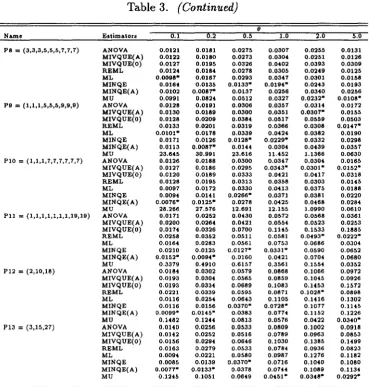
Table 3. (Continued)
9
Na.me EI&ima&ofl5 0.1 0.2 0.5 1.0 2.0 5.0
pa=(3,3,3,5,5,5,7,7,7) ANOVA 0.0121 0.0181 0.0275 0.0307 0.0255 0.0131
MIVQUE(A) 0.0122 0.0180 0.0273 0.0304 0.0251 0.0126
MIVQUE(O) 0.0127 0.0195 0.0326 0.0402 0.0393 0.0309
REML 0.0124 0.0184 0.0278 0.0305 0.0249 0.0125
ML 0.0098* 0.0167 0.0293 0.0347 0.0301 0.0158
MINQE 0.0164 0.0135 0.0133* 0.0194* 0.0243 0.0193
MINQE(A) 0.0102 0.0087* 0.0137 0.0256 0.0340 0.0256
MU 0.0991 0.0824 0.0512 0.0327 0.0232* 0.0108*
P9=(1,1,1,5,5,5,9,9,9) ANOVA 0.0128 0.0191 0.0306 0.0357 0.0314 0.0172
MIVQUE(A) 0.0130 0.0189 0.0300 0.0351 0.0307* 0.0155
MIVQUE(O) 0.0128 0.0209 0.0384 0.0517 0.0559 0.0503
REML 0.0133 0.0201 0.0319 0.0366 0.0308 0.0147*
ML 0.0101* 0.0178 0.0339 0.0424 0.0382 0.0190
MINQE 0.0171 0.0126 0.0128* 0.0229* 0.0332 0.0298
MINQE(A) 0.0113 0.0087* 0.0144 0.0304 0.0439 0.0357
MU 23.645 30.991 23.616 11.452 1.1366 0.0630
P10=(1,1,1,7,7,7,7,7,7) ANOVA 0.0126 0.0188 0.0300 0.0347 0.0304 0.0165
MIVQUE(A) 0.0127 0.0186 0.0295 0.0343* 0.0301* 0.0152*
MIVQUE(O) 0.0120 0.0189 0.0333 0.0421 0.0417 0.0318
REML 0.0128 0.0195 0.0313 0.0358 0.0303 0.0145
ML 0.0097 0.0172 0.0330 0.0413 0.0375 0.0188
MINQE 0.0094 0.0141 0.0266* 0.0371 0.0381 0.0220
MINQE(A) 0.0076* 0.0125* 0.0278 0.0425 0.0468 0.0284
MU 28.266 27.576 12.691 12.155 1.0990 0.0610
PI1= (1,1,1,1,1,1,1,19,19) ANOVA 0.0171 0.0252 0.0430 0.0572 0.0568 0.0361
MIVQUE(A) 0.0200 0.0264 0.0421 0.0554 0.0523 0.0253
MIVQUE(O) 0.0174 0.0326 0.0700 0.1145 0.1533 0.1885
REML 0.0258 0.0352 0.0511 0.0581 0.0493* 0.0222*
ML 0.0164 0.0283 0.0561 0.0753 0.0686 0.0304
MINQE 0.0210 0.0125 0.0127* 0.0331* 0.0590 0.0652
MINQE(A) 0.0152* 0.0094* 0.0160 0.0421 0.0704 0.0680
MU 0.3379 0.4910 0.6157 0.3561 0.1554 0.0352
P12=(2,10,18) ANOVA 0.0184 0.0302 0.0579 0.0868 0.1066 0.0972
MIVQUE(A) 0.0193 0.0304 0.0565 0.0859 0.1045 0.0926
MIVQUE(O) 0.0193 0.0334 0.0689 0.1083 0.1453 0.1572
REML 0.0221 0.0339 0.0595 0.0871 0.1028* 0.0898
ML 0.0116 0.0254 0.0643 0.1105 0.1416 0.1302
MINQE 0.0116 0.0156 0.0370* 0.0728* 0.1077 0.1145
MINQE(A) 0.0099* 0.0145* 0.0383 0.0774 0.1152 0.1226
MU 0.1482 0.1244 0.0813 0.0576 0.0422 0.0340*
P13=(3,15,27) ANOVA 0.0140 0.0256 0.0533 0.0809 0.1002 0.0918
MIVQUE(A) 0.0142 0.0252 0.0516 0.0789 0.0963 0.0853
MIVQUE(O) 0.0156 0.0294 0.0646 0.1030 0.1385 0.1499
REML 0.0163 0.0279 0.0533 0.0784 0.0936 0.0823
ML 0.0094 0.0221 0.0580 0.0987 0.1276 0.1182
MINQE 0.0085 0.0139 0.0370* 0.0716 0.1040 0.1080
MINQE(A) 0.0077* 0.0133* 0.0378 0.0744 0.1089 0.1134
MU 0.1245 0.1051 0.0649 0.0451* 0.0348* 0.0292*
..
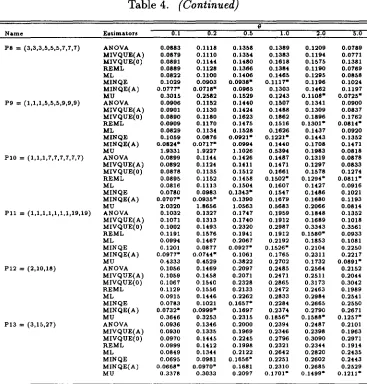
Table 4. Estimated Absolute Bias Estimators of p
8
Na.me Es\ima.t.ors 0.1 0.2 0.5 1.0 2.0 5.0
P1=(3,5,1) ANOVA 0.1314 0.1696 0.22(6 0.2535 0.2509 0.2019
MIVQUE(A) 0.1314 0.1693 0.22(0 0.253( 0.2501 0.2008
MIVQUE(O) 0.1303 0.1100 0.2315 0.2661 0.2158 0.2H5
REML 0.1326 0.1114 0.2251 0.25(0 0.2505 0.2003
ML 0.1058 0.15U 0.2311 0.2825 0.2955 0.2511
MINQE 0.0916 0.1141 0.1613· 0.2211 0.2535 0.2(21
MINQE(A) 0.0837· 0.1071· 0.173( 0.2388 0.2196 0.2681
MU 0.3136 0.3311 0.2290 0.1806· 0.1591· 0.1212·
P2 = (1,5,9) ANOVA 0.139( 0.1119 0.2366 0.2712 0.2150 0.2267
MIVQUE(A) 0.1416 0.1111 0.2330 0.2103 0.2H1 0.222(
MIVQUE(O) 0.1321 0.1110 0.2565 0.3088 0.3319 0.3211
REML 0.1457 0.1880 0.2(61 0.2793 0.2162 0.2181
ML 0.1099 0.16(5 0.2558 0.3183 0.335( 0.28U
MINQE 0.1026 O.l1U 0.1612· 0.2314· 0.2191 0.28(6
MINQE(A) 0.0895· 0.1083· 0.1757 0.2506 0.30(5 0.3031
MU 0.(613 0.(225 0.3091 0.U51 0.1975· 0.H59·
P3 = (1,7,7) ANOVA 0.1365 0.1151 0.23H 0.2699 0.2H5 0.2210
MIVQUE(A) 0.1388 0.1750 0.2310 0.2691 0.21M 0.2222
MIVQUE(O) 0.1301 0.1152 0.2553 0.3082 0.3381 0.32(0
REML 0.1435 0.1860 0.2(50 0.2119 0.2H9 0.2180
ML 0.1079 0.1619 0.2526 0.3153 0.3325 0.282'
MINQE 0.1071 0.lU9 0.2181· 0.21U 0.3059 0.2721
MINQE(A) 0.0993· 0.1390· 0.2181 0.2866 0.3216 0.2922
MU 0.(6(8 0.(236 0.31U 0.2UO· 0.1969· 0.1453·
P. = (3,3,5,5,7,7) ANOVA 0.1032 0.1314 0.166' 0.1720 0.1566 0.1070
MIVQUE(A) 0.1028 0.1303 0.1659 0.1716 0.15M 0.1051
MIVQUE(O) 0.1032 0.13(0 0.1766 0.1939 0.1951 0.1681
REML 0.10U 0.1325 0.1675 0.1719 0.lM9 0.10H
ML 0.092( 0.12H 0.1719 0.1852 0.113' 0.1217
MINQE 0.1001 0.095( 0.1166· O.HO.· 0.1538 0.1329
MINQE(A) 0.0788· 0.0816· 0.1202 0.1587 0.1806 0.1532
MU 0.3161 0.2109 0.1713 0.H17 0.1285· 0.092(·
P5 = (1,1,5,5,9,9) ANOVA 0.1062 0.1351 0.1151 0.1856 0.lH1 0.1225
MIVQUE(A) 0.1065 0.13U 0.1729 0.18U 0.1716 0.116(
MIVQUE(O) 0.1032 0.138( 0.1928 0.2225 0.2355 0.215'
REML 0.1080 0.140( 0.1814 0.1896 0.1711· 0.1131·
ML 0.093( 0.1331 0.1812 0.2012 0.1956 0.1338
MINQE 0.1036 0.093( 0.1151· 0.1506· 0.1796 0.1686
MINQE(A) 0.0831· 0.0819· 0.1226 0.1717 0.2056 0.1831
MU 1. 7565 1.3908 0.9003 0.5050 0.2857 0.lH1
P6 = (1,1,7,7,1,7) ANOVA 0.10(6 0.13'6 0.1709 0.1863 0.1736 0.1215
MIVQUE(A) 0.10(0 0.1333 0.1685 0.18U· 0.1716· 0.1163
MIVQUE(O) 0.1013 0.1361 0.1821 0.2081 0.2099 0.1110
REML 0.10H 0.1381 0.1166 0.1891 0.1716· 0.1131·
ML 0.0905 0.1301 0.1836 0.2075 0.1955 0.13(5
MINQE 0.0883 0.1151 0.1608· 0.1930 0.1937 0.H36
MINQE(A) 0.0806· 0.1099· 0.1639 0.20(9 0.2116 0.1621
MU 1.6783 1. 7167 1.0851 0.730' 0.2891 0.1193
P7 = (1,1,1,1,13,13) ANOVA 0.1155 0.H68 0.19(2 0.2135 0.2120 0.15(2
MIVQUE(A) 0.1201 0.H67 0.19H 0.2131 0.203( 0.13U
MIVQUE(O) 0.1091 0.1561 0.2(01 0.2999 0.3(16 0.3(36
REML 0.1291 0.1683 0.2141 0.2191 0.195(· 0.12(2·
ML 0.10(0 0.1531 0.2253 0.2511 0.2363 0.1535
MINQE 0.1122 0.0931 0.lH9· 0.1692· 0.2221 0.2282
MINQE(A) 0.0929· 0.083(· 0.1265 0.1922 0.2U1 0.2325
MU 0.6(65 0.6M6 0.5317 0.3655 0.2(99 0.1211
Table 4. (Continued)
(J
Na.me E.,imatollJ 0.1 0.2 0.5 1.0 2.0 5.0
P8=(3,3,3,5,5,5,7,7,7) ANOVA 0.0883 0.1118 0.1358 0.1389 0.1209 0.0789
MIVQUE(A) 0.0879 0.1110 0.13M 0.1383 0.1194 0.0771
MIVQUE(O) 0.0891 0.1144 0.1480 0.1618 0.1575 0.1381
REML 0.0889 0.1128 0.1366 0.1384 0.1190 0.0769
ML 0.0822 0.1100 0.1406 0.1465 0.1295 0.0858
MINQE 0.1029 0.0903 0.0938· 0.1117· 0.1196 0.1024
MINQE(A) 0.0777· 0.0718· 0.0965 0.1303 0.1462 0.1197
MU 0.3015 0.2582 0.1529 0.1243 0.1108· 0.0725·
P9=(1,1,1,5,5,5,9,9,9) ANOVA 0.0906 0.1152 0.1440 0.1507 0.1341 0.0900
MIVQUE(A) 0.0901 0.1130 0.1424 0.1488 0.1309 0.0837
MIVQUE(O) 0.0890 0.1180 0.1623 0.1862 0.1896 0.1762
REML 0.0909 0.1170 0.1475 0.1516 0.1301· 0.0814·
ML 0.0829 0.1134 0.1528 0.1626 0.1437 0.0920
MINQE 0.1059 0.0876 0.0921· 0.1221· 0.1443 0.1352
MINQE(A) 0.0824· 0.0717· 0.0994 0.1440 0.1708 0.1471
MU 1.9331 1.9227 1.1026 0.5394 0.1983 0.0818 PI0=(1.1.1.7.7.7.7.7.7) ANOVA 0.0899 0.1144 0.1426 0.1487 0.1319 0.0878
MIVQUE(A) 0.0892 0.1124 0.1411 0.1471 0.1297 0.0833
MIVQUE(O) 0.0878 0.1135 0.1512 0.1661 0.1578 0.1274
REML 0.0895 0.1152 0.1458 0.1502· 0.1294· 0.0811·
ML 0.0816 0.1113 0.1504 0.1607 0.1427 0.0916
MINQE 0.0780 0.0983 0.1343· 0.1547 0.1486 0.1021
MINQE(A) 0.0707· 0.0935· 0.1390 0.1679 0.1680 0.1193
MU 2.0320 1.8656 1.0563 0.5683 0.2066 0.0814 Pll =(1.1.1.1.1.1.1.19.19) ANOVA 0.1032 0.1327 0.1747 0.1959 0.1848 0.1352
MIVQUE(A) 0.1071 0.1313 0.1740 0.1912 0.1689 0.1018
MIVQUE(O) 0.1002 0.1493 0.2320 0.2987 0.3343 0.3561
REML 0.1191 0.1576 0.1941 0.1912 0.1580· 0.0933
ML 0.0994 0.1467 0.2067 0.2192 0.1853 0.1081
MINQE 0.1201 0.0877 0.0927· 0.1526· 0.2104 0.2250
MINQE(A) 0.0977· 0.0744· 0.1061 0.1765 0.2311 0.2217
MU 0.4333 0.4529 0.3822 0.2702 0.1732 0.0891· P12=(2.10.18) ANOVA 0.1056 0.1469 0.2097 0.2485 0.2564 0.2152
MIVQUE(A) 0.1059 0.1458 0.2071 0.2471 0.2511 0.2044
MIVQUE(O) 0.1067 0.1540 0.2328 0.2865 0.3173 0.3042
REML 0.1129 0.1556 0.2133 0.2472 0.2463 0.1989
ML 0.0915 0.1446 0.2262 0.2833 0.2984 0.2541
MINQE 0.0783 0.1021 0.1657· 0.2284 0.2665 0.2550
MINQE(A) 0.0732· 0.0999· 0.1697 0.2374 0.2790 0.2671
MU 0.3646 0.3253 0.2315 0.1856· 0.1588· 0.1257· P13=(3.15.27) ANOVA 0.0936 0.1346 0.2000 0.2394 0.2487 0.2101
MIVQUE(A) 0.0930 0.1335 0.1969 0.2346 0.2398 0.1963
MIVQUE(O) 0.0970 0.1445 0.2245 0.2796 0.3090 0.2971
REML 0.0999 0.1412 0.1998 0.2321 0.2344 0.1914
ML 0.0849 0.1344 0.2122 0.2642 0.2820 0.2435
MINQE 0.0695 0.0981 0.1656· 0.2251 0.2602 0.2443
MINQE(A) 0.0668· 0.0970· 0.1681 0.2310 0.2685 0.2529
MU 0.3378 0.3033 0.2097 0.1701· 0.1499· 0.1211·
Table 5. MSE of Four Estimators of ()
e
Name Estimators 0.1 0.5 1.0 5.0
PB
=
(5,5,5,5,5,5,5,5,5) ML 0.02 0.14 0.42 7.95 MINQE 0.02 0.13 0.45 9.46 MINQE(A) 0.01· 0.01· 0.24· 6.35·PM 0.01· 0.10 0.30 6.38
P8
=
(3,3,3,5,5,5,7,7,7) ML 0.02 0.14 0.45 7.95 MINQE 0.02 0.13 0.45 9.34 MINQE(A) 0.01· 0.10· 0.35 1.33 PM 0.01· 0.10· 0.30· 6.13· PH=
(1,1,1,1,1,1,1,19,19) ML 0.06 0.35 0.88 9.60 MINQE 0.02 0.14 0.48 9.18 MINQE(A) 0.01· 0.13· 0.44· 9.03PM 0.02 0.15 0.48 8.49·
• means the best choice.
Table 6. Bias of Four Estimators of ()
e
Name Estimators 0.1 0.5 1.0 5.0
PB
=
(5,5,5,5,5,5,5,5,5) ML -0.01· -0.04 -0.01 -0.30 MINQE 0.03 0.00· -0.02· -0.01· MINQE(A) 0.09 -0.04 -0.21 -1.60PM -0.02 -0.14 -0.39 -1.70
P8
=
(3,3,3,5,5,5,7,1,7) ML 0.00· -0.04 -0.01 -0.31MINQE 0.03 -0.01· -0.05· -0.08· MINQE(A) 0.01 -0.09 -0.21 -0.89
PM -0.02 -0.14 -0.30 -1.72
Pll
=
(1,1,1,1,1,1,1,19,19) ML 0.00· -0.04· -0.05· -0.30· MINQE 0.00· -0.16 -0.36 -1.67 MINQE(A) 0.00· -0.20 -0.44 -2.00PM -0.03 -0.24 -0.46 -2.00
..
Table 7. MSE of Four Estimators of p
8
Name Estimators 0.1 0.2 0.5 1.0 2.0 5.0
Pl-(3,5,7) ML 0.0173 0.0305 0.0671 0.1094 0.1386 0.1273
MINQE 0.0188 0.0214 0.0380* 0.0690 0.1001 0.1069
MINQE(A) 0.0138* 0.0178* 0.0399 0.0780 0.1154 0.1234
MEDIAN 0.0263 0.0271 0.0416 0.0655* 0.0970* 0.0914*
P2
=
(1,5,9) ML 0.0200 0.0346 0.0778 0.1322 0.1729 0.1616MINQE 0.0205 0.0209 0.0378* 0.0743 0.1156 0.1311
MINQE(A) 0.0160* 0.0183* 0.0407 0.0840 0.1309 0.1464
MEDIAN 0.0665 0.0571 0.0495 0.0622* 0.0778* 0.0830*
P3
=
(1,7,7) ML 0.0193 0.0338 0.0763 0.1300 0.1699 0.1591MINQE 0.0199 0.0294 0.0608 0.1046 0.1420 0.1390
MINQE(A) 0.0167* 0.0264* 0.0604 0.1091 0.1521 0.1523
MEDIAN 0.0611 0.0584 0.0530* 0.0597* 0.0831* 0.0853* P4
=
(3,3,5,5,7,7) ML 0.0126 0.0215 0.0417 0.0538 0.0542 0.0333MINQE 0.0174 0.0155 0.0200* 0.0303 0.0399 0.0340
MINQE(A) 0.0115* 0.0111* 0.0209 0.0376 0.0518 0.0433
MEDIAN 0.0298 0.0258 0.0234 0.0284* 0.0300* 0.0223* P5
=
(1,1,5,5,9,9) ML 0.0134 0.0235 0.0480 0.0659 0.0697 0.0427MINQE 0.0184 0.0147 0.0195* 0.0344 0.0512 0.0484
MINQE(A) 0.0129* 0.0111* 0.0216 0.0429 0.0637 0.0572
MEDIAN 0.0722 0.0576 0.0375 0.0296* 0.0273* 0.0180* P6
=
(1,1,7,7,7,7) ML 0.0123 0.0230 0.0460 0.0658 0.0692 0.0426MINQE 0.0122 0.0190 0.0365 0.0561 0.0637 0.0437
MINQE(A) 0.0100* 0.0169* 0.0372 0.0616 0.0732 0.0527
MEDIAN 0.0720 0.0608 0.0341* 0.0303* 0.0259* 0.0218* P7
=
(1,1,1,1,13,13) ML 0.0183 0.0305 0.0643 0.0929 0.1022 0.0602MINQE 0.0208 0.0145 0.0193* 0.0415 0.0703 0.0747
MINQE(A) 0.0155* 0.0116* 0.0226 0.0510 0.0832 0.0817
MEDIAN 0.1282 0.0995 0.0558 0.0366* 0.0240* 0.0156* P8
=
(3,3,3,5,5,5,7,7,7) ML 0.0098* 0.0167 0.0293 0.0347 0.0301 0.0158MINQE 0.0164 0.0135 0.0133* 0.0194 0.0243 0.0193
MINQE(A) 0.0102 0.0087* 0.0137 0.0256 0.0340 0.0256
MEDIAN 0.0272 0.0269 0.0191 0.0184* 0.0172* 0.0096* P9
=
(1,1,1,5,5,5,9,9,9) ML 0.0101* 0.0178 0.0339 0.0424 0.0382 0.0190MINQE 0.0171 0.0126 0.0128* 0.0229 0.0332 0.0298
MINQE(A) 0.0113 0.0087* 0.0144 0.0304 0.0439 0.0357
MEDIAN 0.0774 0.0616 0.0351 0.0220* 0.0168* 0.0086* PI0
=
(1,1,1,7,7,7,7,7,7) ML 0.0097 0.0172 0.0330 0.0413 0.0375 0.0188MINQE 0.0094 0.0141 0.0266* 0.0371 0.0381 0.0220
MINQE(A) 0.0076* 0.0125* 0.0278 0.0425 0.0468 0.0284
MEDIAN 0.0723 0.0569 0.0329 0.0215* 0.0159* 0.0083* P11
=
(1,1,1,1,1,1,1,19,19) ML 0.0164 0.0283 0.0561 0.0753 0.0686 0.0304MINQE 0.0210 0.0125 0.0127* 0.0331* 0.0590 0.0652
MINQE(A) 0.0152* 0.0094* 0.0160 0.0421 0.0704 0.0680
MEDIAN 0.1593 0.1214 0.0674 0.0369 0.0172* 0.0061* P12
=
(2,10,18) ML 0.0116 0.0254 0.0643 0.1105 0.1416 0.1302MINQE 0.0116 0.0156 0.0370* 0.0728 0.1077 0.1145
MINQE(A) 0.0099* 0.0145* 0.0383 0.0774 0.1152 0.1226
MEDIAN 0.0253 0.0274 0.0401 0.0634* 0.0829* 0.0843* P13
=
(3,15,27) ML 0.0094 0.0221 0.0580 0.0987 0.1276 0.1182MINQE 0.0085 0.0139 0.0370 0.0716 0.1040 0.1080
MINQE(A) 0.0077* 0.0133* 0.0378 0.0744 0.1089 0.1134
•
P2 and 0
=
5.0 under P3 in the sense of MSE criterion. Similarly,MIVQUE(A) has smaller absolute bias than REML estimators except
o=
5.0 under PH and 0=
5.0 under P13.5. The MU estimator has poor efficiency for any values ofkandO.MU has
highest absolute bias and smallest MSE efficiency except MIVQUE(O).
3.2
Estimation of
p
It is difficult to obtain good estimator of intraclass correlation coefficient p under MSE and absolute bias criterion. However, one possibility is to find
the approximation for MSE ofg(X), whereg(X) means that the estimator of
intraclass correlation coefficientg(O)
=
0/(1+
0). Ifwe expand9 in a Taylor series, keeping only to one term, then E(g(X) - g(O))2":'[g'(O)]2E(X _ 0)2.This means that good estimator of 0 is also desirable estimator of
g(
0),approximately. But it is not easy to improve this approximation by using
higher-order moments ofX.
To draw general conclusions for the estimation of intraclass correlation coefficient p,a simulation study was performed using the procedure described in section 3. The results of the simulations are shown in Table 3 and Table 4. The following conclusions are drawn from all the computed values.
1. For all around performance except P8 and P9 designs, the MINQE(A)
estimator of the p may have smaller MSE than any other estimator if
o::;
0.2. In the case of absolute bias, MINQE(A) is the best estimatorwhen 0 ::; 0.2. MINQE performs very well if 0
=
0.5 and 0=
1.0. However, the best winner in the sense of MSE and absolute bias is not clear. Because the difference of efficiency to their performances is very small.2. The MU estimator of p performs well if the value of k is small and 0
is thought to be large. However when 0 ::; 0.5, the MU estimators is a
terrible estimator ofp.
3. The ANOVA, MIVQUE(A) and REML estimators of p have similar efficiency. Further iteration to the REML estimates is unnecessary for the estimation ofp.
5. The MIVQUE(O) is a poor estimator for p when
e
is large. The MIVQUE(O) is a desirable estimator only when one is confident thate
~ O.4
Comparisons of Other Procedures
4.1
Attention on Point estimation of
e.
Several other estimators of
e
have also been cited in the literature. Chaloner(1987) used the bayesian posterior mode estimator of
e
in the considerationof estimation of
e.
In his paper, the posterior mode estimator (PME) issuperior to MLE. We reproduced a table regarding the efficiencies of MLE, PME, and two types of MINQE. Table 5 illustrates MSE and average bias of
four estimators of
e.
The values of MSE and bias for ML and PM estimatorswere duplicated in Chaloner (1987) except the case of design PB. MSE and average bias of ML and MINQE(A), respectively, can be calculated exactly when the data is balanced. By this reason, we used the exact values of MSE and bias at Table 5 and Table 6. Table 5 illustrates the following points:
1. The MSE of the MINQE(A) is less than the MSE of any other estimator
for
e :::;
0.5.2. Irrespective of small MSE of MINQE(A) and PME, they may have a nontrivial bias. Moreover, the absolute value of bias for PM is large
than that of MINQE(A) except
e
= 0.1 undere PB.3. Every estimators are generally biased downward for
e:::;
0.5.4. PME is not generally much more efficient than the MINQE(A). Of course, the expense of computation for PME is very high, although the MINQE(A) can be easily computed by hand.
4.2
Attention on Point estimation of
p.Palmer and Broemeling (1990) pointed out the possibility of using the Bayes estimator used the median of a conditional posterior density as its estimator
of p. We reproduced a table regarding to the efficiencies of MLE, PME,
estimators of O. Again the values for the Bayes estimators are taken from the Monte Carlo study of Palmer and Broemeling (1990). Table 7 gives the MSE and bias for four estimators. The MSE of the Bayes estimator is less
than the MSE of any other estimators for p ~ 1.0. Ifp :::; 0.2 then MSE of
MINQE(A) is the smallest except Pl1. MINQE is the best around p
=
0.5approximately.
5
Summary and Conclusions
To sum up, we recommend the followings:
1. For estimating of 0, two types of MINQE estimators seem to be the best or nearly best estimators unless the value of () is thought to be
high. For low values of0it is recommended that MINQE(A) be used.
2. For estimating ofp, the MINQE(A) estimators seems to be the overall
best choice in the case of p :::; 0.2. When the value of p ~ 1.0, the Bayes median estimates of p is recommended.
References
[1] Ahrens, H., Kleffe,
J.,
and Tenzler, R. (1981). "Mean Square Error Com-parison for MINQUE, ANOVA and Two Alternative Estimators Under the Unbalanced One-Way Random Model," Biomedical Journal, Vol. 23, 323 - 342.[2] Burdick, R. K., Maqsood, F., and Graybill, F. A. (1986). "Confidence Intervals on the Intraclass Correlation in the Unbalanced One-Way Clas-sification," Commun. Statist.- Theor. Meth., Vol. 15, 3353 - 3378.
[3] Chaloner, K. (1987). "A Bayesian Approach to the Estimation of Vari-ance Components for the UnbalVari-anced One Way Random Model,"
Tech-nometrics, Vol. 29(3), 323 - 337.
[4] Conerly, M. D., and Webster, J. T. (1987). "MINQE for the One-Way
•
[5] Das, K. (1992). "Improved Estimation of the Ratio of Variance
Com-ponents for a Balanced One-Way Random Effects Model," Statistics (3
Probability Letters, Vol. 13, 99 - 108.
[6] Donner, A., and Koval, J. J. (1986). "The Estimation of Intraclass Cor-relation in the Analysis of Family Data," Biometrics, Vol. 36, 19 - 25.
[7] Donner, A., and Wells, G. (1986). "A Comparison of Confidence Interval Methods for the Intraclass Correlation Coefficient," Biometrics, Vol. 42, 401 - 412.
[8] Loh, Wei-Yin. (1986). "Improved Estimators for Ratios of Variance Components;" Journal of the American Statistical Association, Vol. 81, 699 - 702.
[9] Lee, J. T., and Lee, K. S. (1990). "A Comparison on Non-Negative Estimators for Ratios of Variance Components," Proc. COMSTAT'90, 303 - 308.
[10] Palmer, J. 1., and Broemeling, 1. D. (1990). "A Comparison of Bayes
and Maximum Likelihood Estimation of the Intraclass Correlation Co-efficient," Commun. Statist.- Theor. Meth., Vol. 19(3), 953 - 975.
[11] Rao, P. S. R. S., and Chaubey, Y. P. (1978). "Three Modifications of the principle of MINQUE," Commun. Statist.- Theor. Meth., Vol. A7(8),
767 - 778.
[12] Rao, C. R. (1971). "Minimum Variance Quadratic Unbiased Estimation of Variance Components," Journal of Multivariate Analysis, Vol. 1, 445 - 456.
[13] Rao, C. R., and Kleffe, J. (1988). Estimation of Variance Components
and Applications, North-Holland, Amsterdam.
[14] Searle, S. R. (1971). Linear Models, New York: John Wiley.
•
•
[16] Swallow, W. H., and Searle, S. R. (1978). "Minimum Variance Quadratic Unbiased Estimation (MIVQUE) of Variance Components,"
Technomet-rics, Vol. 20, 265 - 272.
[17] Wald, A. (1940). "A Note on the Analysis of Variance With Unequal Class Frequencies," Annals of Mathematical Statistics, Vol. 11, 96 -100.