ISSN(Online): 2320-9801
ISSN (Print): 2320-9798
I
nternational
J
ournal of
I
nnovative
R
esearch in
C
omputer
and
C
ommunication
E
ngineering
(An ISO 3297: 2007 Certified Organization)
Vol. 4, Issue 11, November 2016
Brain Drain: Boon or Curse for the Economic
Development
Ajmi Noushad, Maria Kurian
M.Tech Student, Dept. of CSE, Ilahia College of Engineering and Technology Muvattupuzha, Kerala, India
Assistant Professor, Dept. of CSE, Ilahia College of Engineering and Technology Muvattupuzha, Kerala, India
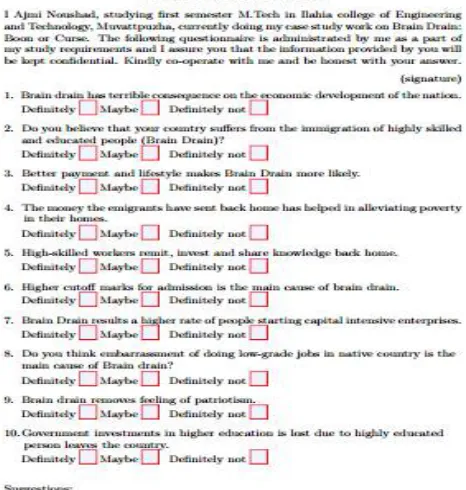
ABSTRACT: Brain drain as it clearly means migration of educated or talented people from one country to another. In this case study the importance is given to understand the effect of Brain Drain on the development of the nation. The developed countries, by attracting scarce skilled labour, were widely held to be pursuing policies that were costly to developing countries, both in the short and longer run. It is one of the most relevant topic ever to analyse the effect of brain drain in the development. For that the hypothesis raised is Brain rain has terrible consequences on the development of the nation. Data collection is done from the emigrants. The collected data is analysed and used for hypothesis testing. According to the hypothesis testing conclusion is obtained.
KEYWORDS: Brain drain.
I. INTRODUCTION
Brain drain is all about losing the Indian talent for global market. It is about Indians leaving for abroad for greener pastures and career prospects. The tendency to go abroad is strong among Indian youth presently. We find many Indian youth leaving for developed countries especially for US, UK, Australia and other advanced countries currently.
There are several reasons why Indian youth leave for developed countries. They leave India due to lack of opportunities at home. They also leave for leading better and comfortable life there. There is also feeling that there is no recognition at home. In addition, developed countries need Indian talent as Indians are good at technical knowledge and skills. Developed countries also prefer Indian talent due to low cost as it helps them bring their cost of production and enhance their competitiveness. We find innumerable reasons for brain drain. But when we look at Indian perspective, government spends lot of money to educate students and if these students go abroad their education and expertise is not useful to our country.
Brain drain is both a boon and bane for country. It is not only in India but we find youth from several developing countries settling down in developed countries for leading better life. Since Indian population is high and Indian youth population is higher the number the issue appears to be exaggerated presently. When we look at from other perspective, the Indian youth send lot of foreign exchange to India and that helps our country immensely. In addition, if these youth come back to India after acquiring knowledge, skills and abilities they can add value to India. This process is known as reverse brain drain. The need of the hour is to encourage reverse brain drain so that India can make use of their tremendous potential, experience and expertise for building a stronger nation. This helps India becoming a developed country very soon and also a global Super Power in the long run.
II. RELATED WORK
ISSN(Online): 2320-9801
ISSN (Print): 2320-9798
I
nternational
J
ournal of
I
nnovative
R
esearch in
C
omputer
and
C
ommunication
E
ngineering
(An ISO 3297: 2007 Certified Organization)
Vol. 4, Issue 11, November 2016
explained below.
[1] Survey reviews the theoretical and empirical literature on the Brain Drain. This literature starts in the 1950s and focuses on different economic and social topics: International Migration, Human Capital, Population, International Commerce, Growth, Low Developing Countries, etc. Furthermore, these brain drain's studies recall often to national and international debates: the role of the International Institutions and Organizations, the illegal migrations, the Human Rights, the Ethnical discrimination, the different USA's migration policies, the post war problems, the illegal migration from Mexico to the USA, the specific tax reforms in USA, the Gorbachev's Age, the collapse of the Soviet block the Chinese policies, etc.
[2] Migration of people as a phenomenon differs from country to country and from time to time It is misleading to generalize about the possible effects of migration from developing countries. The phenomenon of migration of high quality manpower can justify the use of the expression on the term "brain drain", but one has to be cautious in using the expression drain indiscriminately. The developed nations concerned saves her pounds and dollars on professional education and training and in the process obtains the services of trained doctors/ engineers who/earn very much more than their native counter parts and have more comfortable styles of living.
III. METHODOLOGY
Research is an academic activity and as such the term should be used in a technical sense. The research design refers to the overall strategy that you choose to integrate the different components of the study in a coherent and logical way, thereby, ensuring you will effectively address the research problem.
ISSN(Online): 2320-9801
ISSN (Print): 2320-9798
I
nternational
J
ournal of
I
nnovative
R
esearch in
C
omputer
and
C
ommunication
E
ngineering
(An ISO 3297: 2007 Certified Organization)
Vol. 4, Issue 11, November 2016
IV.ANALYSIS AND RESULTS
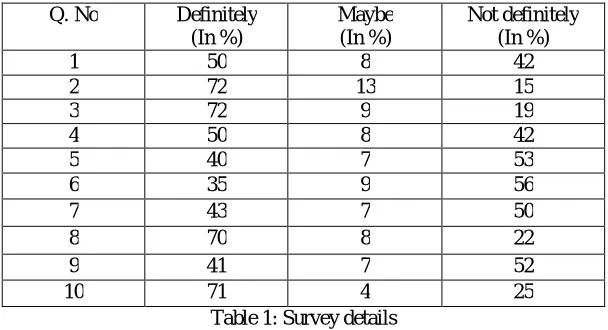
After collection, the data has to be processed and analysed in accordance with the outline laid down for the purpose at the time of developing the research plan. Data processing includes editing, coding, classification and tabulation of data. Analysis, particularly in case of survey or experimental data, involves estimating the values of unknown parameters of the population and testing of hypotheses for drawing inferences. Analysis of data collected by the questionnaire shows that the respondents were happy to participate in the case study and almost all of them answered all the questions. The survey details are shown in the Table 1 as percentage. In below table contain a Column Q.No to represent the question number given in questionnaire.
Q. No Definitely (In %)
Maybe (In %)
Not definitely (In %)
1 50 8 42
2 72 13 15
3 72 9 19
4 50 8 42
5 40 7 53
6 35 9 56
7 43 7 50
8 70 8 22
9 41 7 52
10 71 4 25
Table 1: Survey details
Here Chi- square test is used for hypothesis testing.A chi-squared test can be used to attempt rejection of the null hypothesis that the data are independent. The chi- square test is always testing what scientists call the null hypothesis, which states that there is no significant difference between the expected and observed result.
The equation for Chi- square testing is given below:
Where,
Oij =observed frequency of the cell in ith row and jth column.
Eij =Expected frequency of the cell in ith row and jth column.
Here, testing of my hypothesis is going to be conducted.
H0: Brain Drain has good impact on the development of the nation.
H1: Brain drain has terrible consequences on the development of the nation.
The questions 1 and 2 are used for Chi- square test. Contingency table prepared for Chi- square testing is show in below as Table 2.
Sample Agree Disagree Neutral Total Q.No 1 O11=50
E11=61
O12=8
E12=10.5
O13=42
E13=28.5
100
Q.No 2 O21=72
E21=61
O22=13
E22=10.5
O23=15
E23=28.5
100
Total 122 21 57 200
Table 2: Test Data
ISSN(Online): 2320-9801
ISSN (Print): 2320-9798
I
nternational
J
ournal of
I
nnovative
R
esearch in
C
omputer
and
C
ommunication
E
ngineering
(An ISO 3297: 2007 Certified Organization)
Vol. 4, Issue 11, November 2016
And Chi- square values are calculated from this Table 2 is also given below:
Here degree of freedom = (3-1)(2-1) =2
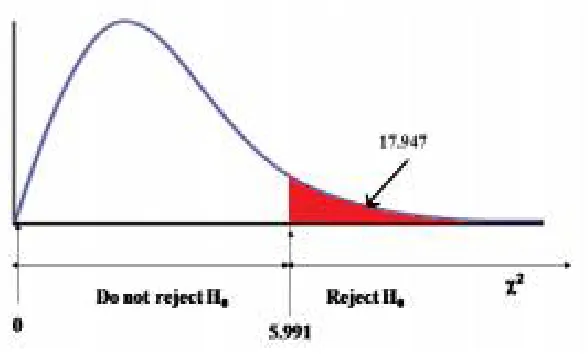
At 2 degree of freedom and 5 percentage level of significance, the critical value is 5.991 and calculated value is 17.947. The calculated value 17.947 much greater than critical value, so I am rejecting the H0 hypothesis, it states that Brain
drain has good impact on the development of the nation. Therefore Accepting the H1 (alternative hypothesis):Brain
drain has terrible consequences on the development of the nation.
Figure 2: χ 2test with degree of freedom 2
V. CONCLUSION AND FUTURE WORK
In this case study it is found that Brain drain has terrible consequences on the development of the nation. Brain drain is all about losing the Indian talent for global market. It is about Indians leaving for abroad for greener pastures and career prospects. They leave India due to lack of opportunities at home. They also leave for leading better and comfortable life there.
Brain drain is both a boon and bane for country. It is not only in India but we find youth from several developing countries settling down in developed countries for leading better life. Since Indian population is high and Indian youth population is higher the number the issue appears to be exaggerated presently.
ISSN(Online): 2320-9801
ISSN (Print): 2320-9798
I
nternational
J
ournal of
I
nnovative
R
esearch in
C
omputer
and
C
ommunication
E
ngineering
(An ISO 3297: 2007 Certified Organization)
Vol. 4, Issue 11, November 2016
consider different people works in our own country and other developing countries. The data may collect also through the online questionnaire. To increase the sampling area the online questionnaires can be send to the students and teachers all over to know their opinion.
REFERENCES
1. Abrokwaa C. K ., “ Africa 2000: What Development Strategy?”, Journal of Black Studies, Vol. 29, pp.646-668, 2000.
2. Abu-Rashed, J and Slottje, D.J., “A Theoretical Analysis of the Beneficial Effects of the Brain Drain Phenomenon “, Cambridge Journal of Economics, Vol. 15 No.3, 1991.
3. Agarwal, V. B. and D. R. Winkler., “United States immigration policy and indirect immigration of professionals”, Economics of Education Review, Volume 4, pp. 1-16 , 1985.
4. Acemoglu, D., “A Micro foundation for Social Increasing Returns in Human Capital Accumulation”, The Quarterly Journal of Economics, Vol. 111, No. 3, pp. 779-804, 1996.
5. Allen, H. L., “The Mobility of Black Collegiate Faculty Revisited: Whatever Happened to the Brain Drain?”, Journal of Negro Education, Vol. 60, No. 1, pp. 97-109,1991.
6. Ayres R. L., ” Development Policy and the Possibility of a Liveable Future for Latin America”, The American Political Science Review, Vol. 69, No. 2, pp. 507-525, 1975.
7. Bachner S.,“Black Literature: The Junior Novel in the Classroom-Harlem Summer”, Negro American Literature Forum, Vol. 7, pp. 26-27, 1973.
8. Bardhan, P., “Efficiency, Equity and Poverty Alleviation: Policy Issues in Less Developed Countries (in Policy Forum: Poverty and Development)”, The Economic Journal, Vol. 106, pp. 1344-1356, 1996.
9. Berelson B ., “The World Population Plan of Action: Where Now? “, Population and Development Review, Vol.1, pp. 115-146, 1975. 10. Bucovetsky, S. ,”Efficient migration and redistribution “, Journal of Public Economics, Volume 87, pp. 2459-2474, 2003.
11. Dr. Mohammad Reza Iravani . , “Brain drain Problem: A Review”, International Journal of Business and Social Science,Vol. 2 No. 15, August 2011.
12. Lien, D. D., “Appropriate scientific research and brain drain : A simple model”, Journal of Development Economics, Volume 29, pp. 77-87, 1988.
13. Penaloza, L. , “Atravesando Fronteras/Border Crossings: A Critical Ethnographic Exploration of the Consumer Acculturation of Mexican Immigrants “, The Journal of Consumer Research, Vol.21, pp. 32-54, 1994.
BIOGRAPHY