A Study on Neural Network in Image
Processing
Sudhir Kumar
1, Davender Singh
21M. Tech. Scholar, Dept. of ECE, Manav Institute of Technology and Management, Jevra, Hisar, Haryana, India
2Assistant Professor, Dept. of ECE, Manav Institute of Technology and Management, Jevra, Hisar, Haryana, India
ABSTRACT
:
This paper deals with the neural networks in image processing. Image Processing system includes treating images as two dimensional signals while applying already set signal processing methods to them. In previous years a significant progress in both the theoretical aspects and the applications of neural networks on the image analysis, and processing, has been made. An image can be represented as a matrix, each element of the matrix containing colour information for a pixel. The matrix is used as input data into the neural network. A type of neural network, Kohonen that provide an elegant solution to many arduous problems with large or difficult to interpret data sets. Through their intrinsic properties, such as preserving topological relationships between input data, they allow the visualization of complex data. The Kohonen rule allows the weights of a neuron to learn an input vector, and because of this it is useful in recognition applications. A Kohonen is employed to classify DCT-based vectors into groups to identify if the subject in the input image is “present” or “not present” in the image database. This paper describe about use of neural network in image processing and feature extraction of image using Kohonen neural network .KEYWORDS: SOM, ANN, DIP, CR, OCR
I. INTRODUCTION
Image processing is a method to convert an image into digital form and perform some operations on it, in order to get an enhanced image or to extract some useful information from it. It is a type of signal dispensation in which input is image, like video frame or photograph and output may be image or characteristics associated with that image. Usually Image Processing system includes treating images as two dimensional signals while applying already set signal processing methods to them.
It is among rapidly growing technologies today, with its applications in various aspects of a business. Image Processing forms core research area within engineering and computer science disciplines too.
Image processing basically includes the following three steps.
Importing the image with optical scanner or by digital photography.
Analyzing and manipulating the image which includes data compression and image enhancement and spotting
patterns that are not to human eyes like satellite photographs.
Output is the last stage in which result can be altered image or report that is based on image analysis.
II. WHY IMAGE PROCESSING
The need of image processing is divided into 5 groups. They are:
Visualization
Observe the objects that are not visible.
Image sharpening and restoration
ISSN(Online): 2320-9801
ISSN (Print): 2320-9798
I
nternational
J
ournal of
I
nnovative
R
esearch in
C
omputer
and
C
ommunication
E
ngineering
(An ISO 3297: 2007 Certified Organization) Website: www.ijircce.com
Vol. 5, Issue 5, May 2017
Seek for the image of interest.
Measurement of pattern
Measures various objects in an image.
Image Recognition
Distinguish the objects in an image.
III. TYPES OF IMAGE PROCESSING
The two types of methods used for Image Processing are
Analog Image Processing
Digital Image Processing
Analog Image Processing
Analog or visual techniques of image processing can be used for the hard copies like printouts and photographs. Image analysts use various fundamentals of interpretation while using these visual techniques. The image processing is not just confined to area that has to be studied but on knowledge of analyst. Association is another important tool in image processing through visual techniques. So analysts apply a combination of personal knowledge and collateral data to image processing.
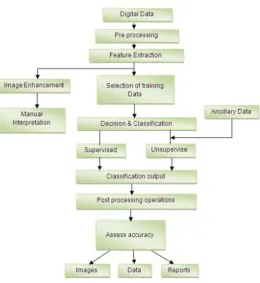
Digital Image Processing
Fig 1: Processing of image processing
IV. NEURAL NETWORK
Neural networks perform one of the six tasks in the image processing :
Fig 2: Neural network in image processing
Pre-processing
ISSN(Online): 2320-9801
ISSN (Print): 2320-9798
I
nternational
J
ournal of
I
nnovative
R
esearch in
C
omputer
and
C
ommunication
E
ngineering
(An ISO 3297: 2007 Certified Organization) Website: www.ijircce.com
Vol. 5, Issue 5, May 2017
Data reduction and feature extraction
an image compression algorithm, used for storing and transmitting images, contains two steps: encoding and decoding. For both these steps, ANNs have been used. Feature extraction is used for subsequent segmentation or object recognition. The kind of features one wants to extract often correspond to particular geometric or perceptual characteristics in an image (edges, corners and junctions), or application dependent ones, e.g., facial features.
Image segmentation
Segmentation is the partitioning of an image into parts that are coherent according to some criterion. When considered as a classi1cation task, the purpose of segmentation is to assign labels to individual pixels or voxels. Some neural-based approaches perform segmentation directly on the pixel data, obtained either from a convolution window (occasionally from more bands as present in, e.g., remote sensing and MR images), or the information is provided to a neural classi1er in the form of local features.
Object recognition
Object recognition consists of locating the positions and possibly orientations and scales of instances of objects in an image. The purpose may also be to assign a class label to a detected object. Our survey of the literature on object recognition using ANNs indicates that in most applications, ANNs have been trained to locate individual objects based directly on pixel data. Another less frequently used approach is to map the contents of a window onto a feature space that is provided as input to a neural classi1er.
Image understanding
Image understanding is a complicated area in image processing. It couples techniques from segmentation or object recognition with knowledge of the expected image content. In two applications, ANNs were used in combination with background knowledge to classify objects such as chromosomes from extracted and to classify ships, which were recognised from pixel data by an advanced modular approach. In another application, ANNs were used to analyse camera images for robot control from local features.
Optimisation
Some image processing tasks such as graphand stereo-matching can best be formulated as optimisation problems, which may be solved by Hop1eld ANNs. In some applications, the Hop1eld network obtained pixel-based input, in other applications the input consisted of local features or detected structures.
V. KOHONEN NETWORK
Kohonen Self-Organizing Maps (or just Self-Organizing Maps, or SOMs for short), are a type of neural network. They were developed in 1982 by Tuevo Kohonen, a professor emeritus of the Academy of Finland. Self-Organizing Maps are aptly named. “Self-Organizing” is because no supervision is required. SOMs learn on their own through unsupervised competitive learning. “Maps” is because they attempt to map their weights to conform to the given input data. The nodes in a SOM network attempt to become like the inputs presented to them. In this sense, this is how they learn. They can also be called “Feature Maps”, as in Self-Organizing Feature Maps. Retaining principle 'features' of the input data is a fundamental principle of SOMs, and one of the things that makes them so valuable. Specifically, the topological relationships between input data are preserved when mapped to a SOM network. This has a pragmatic value of representing complex data.
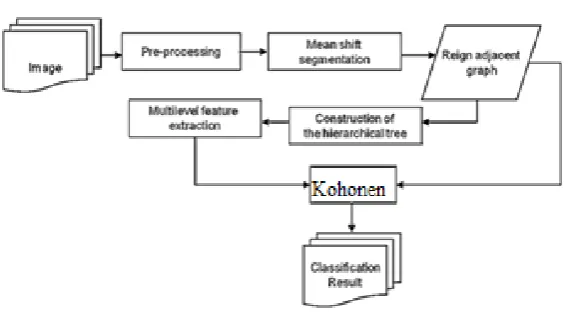
Figure 3: Feature Extraction
A Kohonen network identifies a winning neuron using the same procedure as employed by a competitive layer. However, instead of updating only the winning neuron, all neurons within a certain neighborhood of the winning neuron are updated using the Kohonen Rule. The Kohonen rule allows the weights of a neuron to learn an input vector, and because of this it is useful in recognition applications. A Kohonen is employed to classify DCT-based vectors into groups to identify if the subject in the input image is “present” or “not present” in the image database.
VI. APPLICATION OF KOHONEN NETWORK
The first, Colour Classification helps demonstrate the concept of Kohonen Network. It is not very practical on its own. However, the framework presented can be used for other extremely pragmatic applications. One of these such useful applications is described in the second section, Image Classification. To go from the Colour to Image Classification, all one needs to really change is the weight vector calculation, as the algorithms used are exactly the same.
VII. LITERATURE REVIEW
Using image stitching and image steganography security can be provided to any image which has to be sent over the network or transferred using any electronic mode. There is a message and a secret image that has to be sent. The secret image is divided into parts. The first phase is the Encrypting Phase, which deals with the process of converting the actual secret message into cipher text using the AES algorithm. In the
second phase which is the Embedding Phase, the cipher text is embedded into any part of the secret image that is to be sent. Third phase is the Hiding Phase, where steganography is performed on the output image of Embedding Phase and other parts of the image where the parts are camouflaged by another image using least significant bit replacement. These individual parts are sent to the concerned receiver. At the receivers end decryption of Hiding phase and Embedding Phase takes place respectively. The parts obtained are stitched together using k nearest method. Using SIFT features the quality of the image is improved[1].
The digital image processing (DIP) has been employed in a number of areas, particularly for feature extraction and to obtain patterns of digital images. Recognition of characters is a novel problem, and although, currently there are widely-available digital image processing algorithms and implementations that are able to detect characters from images, selection of an appropriate technique that can straightforwardly acclimatize to diverse types of images, that are very specific or complex is very important. This paper presents a brief overview of digital image processing techniques such as image restoration, image enhancements, and feature extraction, a framework for processing images and aims at presenting an adaptable digital image processing method for recognition of characters in digital images[2].
ISSN(Online): 2320-9801
ISSN (Print): 2320-9798
I
nternational
J
ournal of
I
nnovative
R
esearch in
C
omputer
and
C
ommunication
E
ngineering
(An ISO 3297: 2007 Certified Organization) Website: www.ijircce.com
Vol. 5, Issue 5, May 2017
algorithms have been discussed, to design high performance character reorganisation software for Indian Language Hindi based on Devanagari script. In this paper it is discussed that how to generate data for input of neural network, how it will work. This neural network is under development but as per my knowledge and previous record kohonen neural network with self organising map will surely give better result than other neural network. There will be increment in percentage of recognition rate compare to other neural network [3].
This report discusses the theory and implementation of an Optical Character Recognition (OCR) for Bangla. The principal idea is to convert images of text documents such as those obtained from scanning a document into editable texts. This report does not address the pre-processing steps such as skew correction and noise reduction (which is handled in a previous report), so the documents are assumed to pre-processed by another tool in the pipeline. For training and recognition, the input is then first converted to a binary image, and then into to a 25x25 pixel2 image; the only feature extracted from the images is a 625-bit long vector, which is then trained or classified using a Kohonen neural network. The OCR shows excellent performance for documents with single typeface. The work in progress is extending it to handle multiple typefaces [4].
This paper presents a simple learning rule for recognition of mouse dragged character on our computer screen using artificialneural network. We use Kohonen self-organization map for pattern classification which employs unsupervised learning algorithm. The results are quite encouraging in terms of percentage of characters being successfully recognized. One advantage of proposed scheme is that the system is quite tolerant to changing conditions and inputs. The system consistently learns. Moreover the recognition ratio is excellent in the proposed system [5].
Biometric recognition became an integral part of our living. This paper deals with machine learning methods for recognition of humans based on face and iris biometrics. The main intention of machine learning area is to reach a state when machines (computers) are able to respond without humans explicitly programming them. This area is closely related to artificial intelligence, knowledge discovery, data mining and neuro computing. We present relevant machine learning methods with main focus on neural networks. Some aspects of theory of neural networks are addressed such as visualization of processes in neural networks, internal representations of input data as a basis for new feature extraction methods and their applications to image compression and classification. Machine learning methods can be efficiently used for feature extraction and classification and therefore are directly applicable to biometric systems. Iris recognition is analysed from the point of view of state-of-the art in iris recognition, 2D Gabor wavelets, use of convolution kernels and possibilities for the design of new kernels. Software and hardware implementations of face and iris recognition systems are discussed and an implementation of a multimodal interface (face and iris part of a system) is presented. Also a contribution of Machine Learning Group working at FEI SUT Bratislava to this research area is shown [6].
The image of a face varies with the illumination, pose, and facial expression, thus we say that a single face image is of high uncertainty for representing the face. However, in a real world face recognition system, a subject usually has only a limited number of available face images and thus there is high uncertainty. In this paper, we attempt to improve the face recognition accuracy by reducing the uncertainty. First, we reduce the uncertainty of the face representation by synthesizing the virtual training samples. Then, we select useful training samples that are similar to the test sample from the set of all the original and synthesized virtual training samples. Moreover, we state a theorem that determines the upper bound of the number of useful training samples. Finally, we devise a representation approach based on the selected useful training samples to perform face recognition. Experimental results on five widely used face databases demonstrate that our proposed approach can not only obtain a high face recognition accuracy, but also has a lower computational complexity than the other state-of-the-art approaches [7].
histograms were projected to lower dimensions by applying PCA which represents local features to characterize the face of a subject. The global face representation of a subject was derived by projecting several images of the subject into lower dimensions applying PCA. Face Recognition was performed with different similarity metrics on ORL, JAFFE and INDIAN face databases and compared with other works. It was found that the local features (MB-LBP) are better than the global features (PCA) for face recognition [8].
Human-computer interaction system for an automatic face recognition or facial expression recognition has attracted increasing attention from researchers in psychology, computer science, linguistics, neuroscience, and related disciplines. In this paper, an Automatic Facial Expression Recognition System (AFERS) has been proposed. The proposed method has three stages: (a) face detection, (b) feature extraction and (c) facial expression recognition. The first phase of face detection involves skin colour detection using YCbCrcolor model, lighting compensation for getting uniformity on face and morphological operations for retaining the required face portion. The output of the first phase is used for extracting facial features like eyes, nose, and mouth using AAM (Active Appearance Model) method. The third stage, automatic facial expression recognition, involves simple Euclidean Distance method. In this method, the Euclidean distance between the feature points of the training images and that of the query image is compared. Based on minimum Euclidean distance, output image expression is decided. True recognition rate for this method is around 90% - 95%. Further modification of this method is done using Artificial Neuro-Fuzzy Inference System (ANFIS). This non-linear recognition system gives recognition rate of around 100% which is acceptable compared to other methods [9].
VIII. CONCLUSION
This paper has just begin to touch on the possibilities of image processing, neural network and Kohonen Neural Network. Image processing is very important area of research in today's life and neural network is the technique of image processing. A type of neural network, Kohonen that provide an elegant solution to many arduous problems with large or difficult to interpret data sets. Through their intrinsic properties, such as preserving topological relationships between input data, they allow the visualization of complex data.
REFERENCES
1. Jyotika Kapur and Akshay. J. Baregar, “Security using image processing,” International Journal of Managing Information Technology (IJMIT) Vol.5, No.2, May 2013
2. M. S. Alkoffash, M. J. Bawaneh, H. Muaidi, S. Alqrainy, and M. Alzghool, “A Survey of Digital Image Processing Techniques in Character Recognition,” Int. J. Comput. Sci. Netw. Secur., vol. 14, no. 3, pp. 65–71, 2014.
3. P. S. A. Nirve and U. B. Shinde, “HINDI CHARECTER RECOGNITION USING,” vol. 4, no. 5, pp. 1786–1790, 2013. 4. A. S. Shatil, “Research Report on Bangla Optical Character Recognition Using Kohonen network.”
5. C. Sc and I. M. S. E. College, “Hand-Written Character Recognition Using Kohonen Network,” vol. 4333, pp. 112–115, 2011. 6. Oravec, M., “Feature extraction and classification by machine learning methods for biometric recognition of face and iris”, Publication
Year: 2014 , Page(s): 1 – 4
7. Yong Xu, “Data Uncertainty in Face Recognition”, Cybernetics, IEEE,Volume: 44 , Issue: 10 Publication Year: 2014, Page(s): 1950 – 1961
8. Girish, G.N. ;ShrinivasaNaika, C.L. ; Das, P.K., “Face recognition using MB-LBP and PCA: A comparative study”, Computer Communication and Informatics (ICCCI), 2014 Publication Year: 2014 , Page(s): 1 – 6.
9. Dhavalikar, A.S. ; Kulkarni, R.K., “Face detection and facial expression recognition system”, Electronics and Communication Systems (ICECS), 2014, Publication Year: 2014 , Page(s): 1 – 7