
1
1Center for Nuclear Waste Regulatory Analyses, Southwest Research Institute®, San Antonio, Texas, USA 2University of Utah, Department of Civil Engineering, Salt Lake City, Utah, USA
E-mail of corresponding author: [email protected]
ABSTRACT
The structural performance of reinforced concrete components is affected by aging because changes in mechanical material properties affect structural resistance. One of the few material property parameters that does not decrease with time is the concrete compressive strength. Depending on the concrete mix, the peak compressive strength after several years can be 50-100 percent larger than the strength at 28 days. The increase in concrete compressive strength takes place for practically all concrete mixes commonly used in nuclear facilities, as long as the component is exposed to relatively low temperatures. The maximum temperature for nuclear facilities is limited in the United States at 65 °C [149 °F] [1].
This study evaluates the effects of temperatures close to the boiling point of water on the compressive strength of concrete mixes that include admixtures to accelerate strength development. These admixtures are commonly used to reduce construction schedules but their effect on the compressive strength of concrete permanently exposed to moderate temperatures has not been evaluated. For this study, normal strength concrete cylinders were cured in a standard moisture environment and tested at different times to obtain the evolution of the concrete compressive strength with time and temperature. After 90 days, some of the concrete cylinders were moved to a laboratory oven to be cured at temperatures ranging from 90 to 95 °C [194 to 203 °F]. The cylinders compressive strength was tested at 28 days and then at regular 90-day intervals over one and half years. In addition, petrographic analysis was carried out to understand the mechanism for accelerated strength reduction at elevated temperatures. The results indicated that long-term compressive strength is not significantly affected by the presence of water admixtures. The effect of continuous exposure to temperatures of 90 to 95 °C [194 to 203 °F] resulted in a loss of compressive strength of less than 10 percent. Petrographic analyses suggest that deterioration of concrete compressive strength at high temperatures 90 to 95 °C [194 to 203 °F] was mainly due to physicochemical changes in cement paste.
INTRODUCTION
The concrete compressive strength ( ′) has a significant influence on the system structural capacity, and
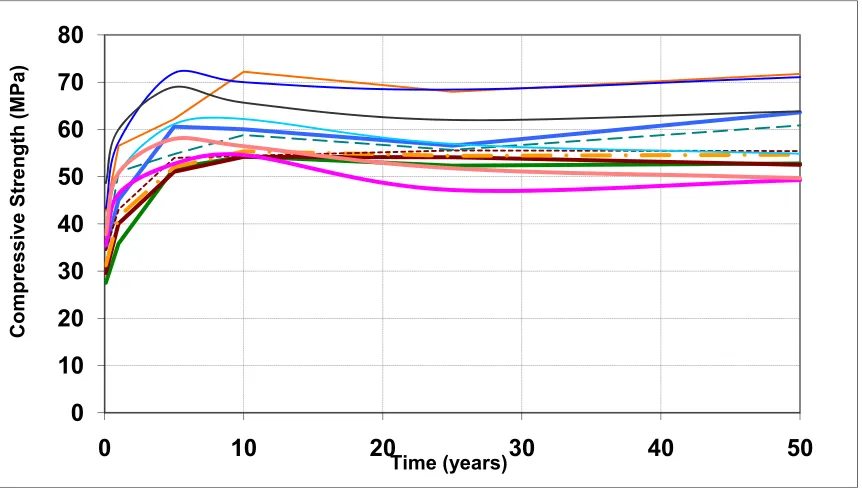
this strength increases with age because the hydration process continues for years after the concrete is cast. Washa, et al., [2] showed that compressive strength reaches a peak after a 5–10 year interval, and then decreases slightly with time (Fig. 1). Depending on the concrete mix, the peak strength can be 50–100 percent larger than the compressive strength at 28 days. Ibarra [3] tested several concrete samples from 50 year-old buildings, obtaining an average compressive strength of 39.3 MPa [5,700 psi] for a concrete with a compressive design strength at 28 days of 17.2 MPa [2,500 psi] (i.e., a strength increase of more than 100 percent). The results for in-situ concrete were obtained by Ibarra et al. [4] for concrete cores extracted from four slabs with ages ranging from 1 to 7 years, in which the measured ′ was 40 to 60 percent larger than the strength reported at 28 days. Because of this behavior,
probabilistic seismic performance evaluations of nuclear facilities can consider part of this increase in compressive strength when predicting the structural response of nuclear facilities [5]. Concrete mixes commonly used in nuclear facilities exhibit an increase in ′ with time, as long as the structural component is exposed to relatively low
temperatures. The increase in ′, however, may be affected by continuous exposure to moderate high temperatures.
Concrete components in nuclear facilities can be exposed to temperatures up to 65 ºC [149 °F] [1].
Previous investigations of exposure to moderate temperatures (i.e., from several hours to several days) have shown that the residual ′ (i.e., strength of cooled specimens) can actually increase. For example, Khoury [6]
2
Fig. 1. Compressive Strength Trend with Age for 12 Different Mix Proportions {after Washa et al. [1]}
These results are in agreement with Zoldners [7] study on the of cylinders exposed to temperatures ranging from 100 to 800 °C [212 to 1,472 °F]. Zoldners concluded that the residual (cold testing) increased up to 10 percent when the specimens were heated up to 300 °C [572 °F]for a couple of hours. For cold testing, specimens are initially exposed to high temperatures that were cooled to room temperature prior to testing. At temperatures over 500 °C [932 °F], the residual strength of the evaluated concretes decreased sharply due to dehydration of chemical constituents in the cement paste. Zoldners also concluded that flexural strength is more seriously affected by high temperatures than compressive strength. Nevertheless, different experimental tests did not report an increase on for moderate temperatures. For example, Freskakis [8] compiled residual compressive strength results of reinforced concrete sections exposed to elevated temperatures. The results showed a decrease in the residual for concrete exposed to temperatures lower than 300 °C [572°F], which largely depends on interactions between cement paste and aggregate. Freskakis also set upper and lower limits for the variation of when exposed to high temperatures. For the upper limit, he considered that the concrete mix retains the room temperature strength until the exposure temperature exceeds 240 °C [464 °F].
Naus [9] compiled data on the effect of elevated temperature on residual (i.e., unsealed, cold testing) for Portland cement concretes with <60 MPa [8,700 psi]. Naus [9] found that residual is generally lower than relative concrete compressive strength (hot testing). Also, as shown in Fig. 3, tends to decrease at temperatures below 100 to 120 °C [212 to 248 °F], followed by an increase in , as temperature increases to 200 to 250 °C [392 to 482 °F], and finally decreases as the temperature exceeds above 300 °C [572 °F]. For temperatures below 120 °C [248 °F], the concrete compressive strength decrease is attributable to thermal swelling of the physically-bound water that causes disjoint pressures. For temperatures above 300 °C [572 °F], compressive strength losses are likely due to differences in thermal expansion coefficients between aggregate, cement paste, and decomposition of calcium hydroxide. At temperatures above 450 °C [842 °F], concrete compressive strength drops significantly due to loss of bond between aggregate and cement paste. Data also showed that aggregate type influences ′ at elevated temperatures, more than 600–800 °C [1,112-1,472 °F], in that quartz and basalt aggregates
are less sensitive to temperature effects than the limestone aggregate concrete.
0
10
20
30
40
50
60
70
80
0
10
20
30
40
50
Compressiv
e Strength (MPa)
3
Fig. 2. Residual Compressive Strength at Different Temperatures {after Khoury [6]}
Carette et al., [10] evaluated the effect of sustained temperatures ranging from 75 to 600 °C [167 to 1,112 °F] on concrete compressive strength. At a temperature of 150 °C [302 °F], the decrease in compressive strength of concrete made with normal Portland cement over 1 month was 10 percent. The decrease in tensile strength was about the same order. Davis [11] concluded that ′ decreased less than 10 percent when subjected to
temperatures lower than 200 °C [392 °F].
Kasami et al., [12] evaluated the drying effect of elevated-temperature exposure on concrete properties. Specimens made from Portland cement were tested to investigate compressive, tensile, and bond strengths; elastic moduli; and weight loss after a 90-day exposure to temperatures of 35, 50, 65, 80, 110, 200, and 300 °C [95, 122, 149, 176, 230, 392, 572 °F]. Exposure to sustained elevated temperatures higher than 35 °C [95 °F] showed deteriorating effects on the physical properties of concrete when the moisture in concrete was allowed to evaporate. Greater reduction of strengths and weights after exposure were associated with the mixes having higher mix water contents. Strengths did not decline linearly for higher temperatures and showed a local minimum with a decrease in ranging from 10 to 25 percent at around 50 °C [122 °F]. The strength partially recovered at temperatures around 100 °C [302 °F], followed by a monotonic decrease in strength for higher temperatures. Reductions in tensile and bond strengths and elastic modulus of heated concretes were greater than the reduction in compressive strengths.
Kanazu et al., [13] evaluated concrete behavior on spent fuel storage facilities exposed to elevated temperatures for both sealed and unsealed specimens. The sealed specimens were placed into metal containers, which were sealed. At an age of about 3 months, heating of the specimens was initiated at temperatures of 65, 85, and 110 °C [149, 185, and 230 °F]. The specimens were tested after thermal exposures of 1 month, 1 year, 1.5 years, 2 years, 3 years, and 8 years. Compressive strength, modulus of elasticity, weight change, and splitting-tensile strength data were compared to reference 3-month strength results. Kanazu et al., concluded that the decrease in compressive strength at temperatures of 65 and 110 °C [149 and 230 °F] ceased after 3 months under unsealed conditions, as the moisture condition stabilized. Note that this conclusion is based on a comparison to
0 20 40 60 80 100 120 140
0 100 200 300 400 500 600
R
esidual Compr
essiv
e
Str
eng
th N/mm2
Temparature (° C )
4
Fig. 3 Compilation of Data on Temperature Relationship for Ordinary Portland Cement concretes, <60 MPa {courtesy of Oak Ridge National Laboratory and U.S. Nuclear Regulatory
Commission, after Naus [9]}
3-month strength results, and that concrete strength at room temperature should have significantly increased from 3 months to 8 years. The weight loss increased as temperature increased, but stabilized after 1 month exposure loss for unsealed specimens. The study recommended to increase the current temperature limit of 65 °C [149°F] for concrete utilized in facilities for storage of spent nuclear fuel to 85 °C [185°F].
As previously discussed, a large number of studies have evaluated the effect of high temperatures on concrete, but data regarding concrete performance under long-term high temperature exposure is limited, and does not take into account the strength gain that concrete may have experienced at room temperature. Moreover, previous data do not consider widespread use of admixtures, such as plasticizers. For these reasons, cylinders were tested to evaluate the effects on of sustained temperatures close to the boiling point of water. For normal strength concrete, prior studies indicate that initial concrete strength, cement type, aggregate size, heating rate, and water-cement ratio have little effect on relative strength for these temperatures.
Experimental Tests
Concrete cylinders of 15.2 cm [6-in] diameter × 30.5 cm [12-in] length and 10.2 cm [4-in] diameter × 10.2 cm [8-in] length were tested at different times to obtain the evolution of the concrete compressive strength. To mimic the process followed by industry, a target ′ of 27.5 MPa [4,000 psi] at 28 days was requested to
a ready-mix company, without specifying an acceptable maximum strength. The concrete cylinders were fabricated using the same lot of concrete mix and were cured in a standard moisture environment at 23 ± 2 °C [73.4 ± 35.6°F] and 95 percent relative humidity. The concrete was made with Portland Cement Type I, a water-to-cement ratio of 0.5, the coarse aggregate consisted of 1-inch crushed limestone, and the fine aggregate was well graded quartz and limestone sand. After 90 days, some of the 10.2 × 20.3 cm [4 × 8 in] cylinders were moved to a laboratory oven to be cured at a temperature ranging from 90 to 95 °C [194 to 203 °F]. Samples were not immediately moved to the oven because several months are expected to separate concrete pouring from the beginning of operational activities [11]. The cylinders compressive strength was tested at 28, 90, 180, 270, 365, 450, and 540 days. In addition, petrographic analysis of the exposed specimens was carried out.
5
′ ′ 1.34 (Eq. 1)
or
f f 2.33s 500 (Eq. 2)
Where is the sample standard deviation. Assuming a coefficient of variation (CV) of 0.16 for [18], the above equations render ′ values of 33.5 and 34.4 MPa [4,858 and 4,991 psi]. Because of the plasticizers,
however, the average at 28 days was 41.7 MPa [6,050 psi] (i.e., an increase of 26 percent). Thus, the water-reducing admixtures accelerated the rates of cement hydration leading to an early strength development. Based on the results presented below, it appears that the concrete has already reached the maximum compressive strength after 1.5 years, which in concrete with no plasticizers only occurs after a 5–10 year period. It does not seem that the long-term compressive strength of the mix was significantly affected by the use of plasticizers.
A plot of average compressive strength versus time of 15.2 × 30.5 cm [6 × 12-in] cylinders cured at room temperature is shown in Fig. 4(a) where the compressive strength is expressed as percentage increase with respect to the average compressive strength at 28 days. The data show the average compressive strength increased from 28 days to 90, 180, 270, 365, and 450 days. At 540 days, average compressive strength of the 15.2 × 30.5 cm [6 × 12-in] cylinders decreased 5.4 percent. A plot of average compressive strength versus time of 10.2 × 20.3 cm [4 × 8-in] cylinders cured in a laboratory oven at 90 to 95 °C [194 to 203 °F] is shown in Fig. 4(b). From 180 to 365 days, the average compressive strength of the oven-cured specimens decreased 5.8 percent, but increased 4.2 percent from 365 to 540 days. The results indicate that initial compressive strength loss due to oven-drying after 180 days was stabilized. Although more data are needed to detect conclusive trends, results indicate the effect of permanent exposure to high temperatures has a marginal effect on compressive strength (i.e., a decrease of about 5–10 percent).
Test results show an increase of compressive strength of concrete cylinders at room temperature, which is consistent with the trends reported in the literature [2]. However, the strength increase with time is relatively small (about 10 percent after 1.5 years) because the use of water admixtures leads to an early strength development. For concrete cylinders cured in the laboratory oven at temperatures of 90 to 95 °C [194 to 203 °F], compressive strength showed a strength decrease after the cylinders started to be heated. The trend appears to have stabilized after 1 to 1.5 years.
Petrographic Analysis of Concrete Cylinders in Moisture-Cure and Oven-Dry Conditions
To understand lower compressive strength for cylinders exposed to high temperatures, a petrographic analysis was conducted on a 10.2 × 20.3-cm [4 × 8-in] cylinder cured in a moist environment for 540 days, and on a 10.2 × 20.3-cm [4 × 8-in] cylinder cured in a moist environment for 90 days, followed by oven-drying at 90 to 95 °C [194 to 203 °F] for 450 days. To prepare the petrographic analysis specimens, cylinders were saw-cut parallel to the end surfaces to a length of 6 in. The lower portion of each cylinder was used for the examination. The 15.2-cm [6-in] portion was then saw cut perpendicular to the end surfaces. Two parallel saw cuts were made to obtain a 1.9-cm [0.75-in] thick section from each cylinder portion. Saw-cut sections were prepared for microscopic examination by lapping on a steel wheel with progressively-finer silicon carbide grit. Lapped sections were examined under a stereomicroscope at magnifications of 7X to 100X. Examinations were performed following guidelines outlined in ASTM C586, “Standard Practice for Petrographic Examination of Hardened Concrete” [19].
6
(a) (b) Fig. 4. Average Compressive Strength Versus Time (a) Cylinders Cured at Room Temperature, and
(b) Cylinders Cured in Laboratory Oven at 90 to 95 °C [194 to 203 °F]
(a) (b) Fig. 5. Photomicrographs of the Lapped Sections Taken Under the Stereomicroscope.
(a) Oven-Dried Specimen, (b) Moisture-Cured Specimen. The Arrows Indicate Residual Portland Cement Particles. (63X Magnification)
Hydration of Portland cement is responsible for the ultimate strength of the concrete, and a continued strength gain of moisture cured specimen over time is expected. Hydration of cement is greatly reduced when the relative humidity of capillary pores in concrete is less than 80 percent [20]. For this reason, a lower compressive strength of oven-dried specimens relative to continuously moist-cured specimens is expected.
Studies investigating effects on sustained high temperatures on concrete indicate that damage to concrete at temperatures of 100 °C [212 °F] or less is low, and that a loss of compressive strength of up to 10 percent can be expected [7,10,11]. The continuously moist cured concrete exhibited very well hydrated Portland cement. Oven-dried concrete showed a high number (relative to moist cured concrete) of partially hydrated cement particles, indicating that the hydration process had greatly reduced.
Petrographic data do not suggest differences in concrete properties for heated and unheated specimens, except lower compressive strength for the oven-dried cylinder. It is likely the temperature at which the oven-dried cylinders were held, 90 to 95 °C [194 to 203 °F], resulted in a loss of pore/capillary water. By placing concrete in such a high temperature environment for an extended period, this water would have been removed, resulting in air-filled capillaries, which lead to slightly lower compressive strengths.
85% 90% 95% 100% 105% 110% 115% 120%
28 90 180 270 360 450 540
Str e n gth In cr e as e ( % ) Time (days)
Increase on Avg. Compressive Strength, Room Temperature 85% 90% 95% 100% 105% 110% 115%
28 90 180 270 360 450 540
Str e n gth In cr e as e ( % ) Time (days)
7 incorporated to the mix.
The main findings of the investigation are as follows: (i) The water-reducing admixture in the concrete contributed to early strength development because it accelerated the cement hydration; however, the long-term compressive strength has not been significantly affected after 1.5 years, and the concrete strength has stabilized with a gain of 10–15 percent with respect to compressive strength at 28 days; (ii) The effect of extended exposure to temperatures of 90 to 95 °C [194 to 203 °F] resulted in a small loss of compressive strength of less than 10 percent, as compared to those continuously moist cured specimens; and (iii) Petrographic analysis of the test specimens revealed that the oven-dried specimen contains significantly more residual (partially hydrated) cement and less relict (fully hydrated) relative to the moist-cured specimen, indicating the deterioration of concrete compressive after exposure to sustained temperatures of 90 to 95 °C [194 to 203 °F] was mainly due to physicochemical changes in cement paste. The conclusions of this study should provide guidelines for probabilistic assessment of the seismic performance of concrete components permanently exposed to relatively high temperatures.
ACKNOWLEDGMENTS
This work was supported by Southwest Research Institute Internal Research and Development Project 20.R8090. The authors gratefully acknowledge the technical review of Dr. T. Wilt, the programmatic review of Dr. G. Wittmeyer, and the assistance of L. Neill in the preparation of this manuscript.
REFERENCES
[1] ACI. “Code Requirements for Nuclear Safety Related Concrete Structures.” ACI 349-06. Detroit, Michigan: American Concrete Institute. 2006.
[2] Washa, G.W., Saemann, J.C., and Cramer, S.M. “Fifty-Year Properties of Concrete Made in 1937.” ACI Materials Journal. Vol. 86, No. 4. 1989. pp. 367–371.
[3] Ibarra, L. “Comportamiento Dinámico de un Edificio con Sistema de Losa Plana, Abacos y Capiteles”, Master Thesis, UNAM, Mexico, in Spanish. 1999.
[4] Ibarra, L.F., Dasgupta, B., Chiang, K. “Third IR&D Quarterly Progress Report on Effect of Aging Concrete on Seismic Performance of Shear Wall Structures.” Southwest Research Institute, San Antonio, Texas. 2010.
[5] EPRI. “Methodology for Developing Seismic Fragilities.” Report EPRI TR–103959. Palo Alto, California: Electric Power Research Institute. 1994.
[6] Khoury G.A. “Performance of Heated ConcreteMechanical Properties.” Contract NUC/56/3604A with Nuclear Installations Inspectorate, Imperial College, London. August 1996.
[7] Zoldners, N.G. “Effect of High Temperatures on Concretes Incorporating Different Aggregates.” Sixty-third Annual Meeting of the Society, June 27–July 1, 1960, pp. 1,087–1,108.
[8] Freskakis G.M. “Strength Properties of Concrete at Elevated Temperature.” Civil Engineering Nuclear Power, Vol. 1, ASCE National Convention, American Society of Civil Engineers, Boston, Massachusetts, April 1979.
[9] Naus, D.J. NUREG/CR–7031, “A Compilation of Elevated Temperature Concrete Material Property Data and Information for Use in Assessments of Nuclear Power Plant Reinforced Concrete Structures.” Washington, DC: U.S. Nuclear Regulatory Commission. 2010.
[10] Carette, G.G., Painter, K.E., and Malhorta, V.M. “Sustained High Temperature Effect of Concretes Made of Normal Portland Cement, Normal Portland Cement and Slag, Or Normal Portland Cement and Fly Ash.” Concrete International, Vol. 4, No.7, 1982, pp. 41–51.
[11] Davis, H.S. “Effects of High-Temperature Exposure on Concrete.” Materials Research and Standards, Vol. 7, No. 10, 1967, pp. 452–499.
8
[13] Kanazu T., Matsumura, T., and Nishiuchi, T. “Changes in the Mechanical Properties of Concrete Subjected to Long-Term Exposure to High Temperatures,” Report No. U95037, Abiko Research Laboratory, Central Research Institute of Electric Power Industry, Japan, March 1996.
[14] ACI. Standard 211.1. “Standard Practice for Selecting Proportions for Normal, Heavyweight, and Mass Concrete.” ACI Manual of Concrete Practice, Part 1. Farmington Hills, Michigan: American Concrete Institute, 2005.
[15] Mehta P.K. and Monteiro P.J.M. “Concrete: Microstructure, Properties, and Materials.” Ed. McGraw-Hill, Third Edition. Columbus, Ohio: McGraw-Hill. 2006.
[16] Li, Z. “Advanced Concrete Technology.” Hoboken, New Jersey: John Wiley & Sons, Inc. 2011.
[17] ACI. Standard 318.08. “Building Code Requirements for Structural Concrete.” Farmington Hills, Michigan: American Concrete Institute. 2008.
[18] Braverman, J.I., Miller, C.A., Ellingwood, B.R., Naus, D.J., Hofmnayer, C.H., Shteyngart, S., and Bezler, P. NUREG/CR_6715. “Probability-Based Evaluation of Degraded Reinforced Concrete Components in Nuclear Power Plant.” Long Island, New York: Brookhaven National Laboratory. 2001. [19] ASTM International. “Standard Practice for Petrographic Examination of Hardened Concrete.” ASTM
C85604, West Conshohocken, Pennsylvania: ASTM International. 2004.
![Fig. 2. Residual Compressive Strength at Different Temperatures {after Khoury [6]}](https://thumb-us.123doks.com/thumbv2/123dok_us/1383854.1171063/3.612.100.512.94.391/fig-residual-compressive-strength-different-temperatures-khoury.webp)

![Fig. 4. Average Compressive Strength Versus Time (a) Cylinders Cured at Room Temperature, and (b) Cylinders Cured in Laboratory Oven at 90 to 95 °C [194 to 203 °F]](https://thumb-us.123doks.com/thumbv2/123dok_us/1383854.1171063/6.612.115.552.266.446/average-compressive-strength-versus-cylinders-temperature-cylinders-laboratory.webp)