Scholarship at UWindsor
Scholarship at UWindsor
Electronic Theses and Dissertations Theses, Dissertations, and Major Papers
2011
The Effects of Goal Management Training in Undergraduate
The Effects of Goal Management Training in Undergraduate
Students with Problems in Attention Functioning
Students with Problems in Attention Functioning
Jenny Carstens
University of Windsor
Follow this and additional works at: https://scholar.uwindsor.ca/etd
Recommended Citation Recommended Citation
Carstens, Jenny, "The Effects of Goal Management Training in Undergraduate Students with Problems in Attention Functioning" (2011). Electronic Theses and Dissertations. 222.
https://scholar.uwindsor.ca/etd/222
This online database contains the full-text of PhD dissertations and Masters’ theses of University of Windsor students from 1954 forward. These documents are made available for personal study and research purposes only, in accordance with the Canadian Copyright Act and the Creative Commons license—CC BY-NC-ND (Attribution, Non-Commercial, No Derivative Works). Under this license, works must always be attributed to the copyright holder (original author), cannot be used for any commercial purposes, and may not be altered. Any other use would require the permission of the copyright holder. Students may inquire about withdrawing their dissertation and/or thesis from this database. For additional inquiries, please contact the repository administrator via email
by
Jenny Carstens
A Thesis
Submitted to the Faculty of Graduate Studies through Psychology
in Partial Fulfillment of the Requirements for the Degree of Master of Arts at the
University of Windsor
Windsor, Ontario, Canada
2011
Attention Functioning
by
Jenny Carstens
APPROVED BY:
______________________________________________ Dr. Lorna de Witt
Faculty of Nursing
______________________________________________ Dr. Joseph Casey
Department of Psychology
______________________________________________ Dr. Anne Baird, Advisor
Department of Psychology
______________________________________________ Dr. Carlin Miller, Chair of Defense
Department of Psychology
iii
DECLARATION OF ORIGINALITY
I hereby certify that I am the sole author of this thesis and that no part of this
thesis has been published or submitted for publication.
I certify that, to the best of my knowledge, my thesis does not infringe upon anyone’s copyright nor violate any proprietary rights and that any ideas, techniques,
quotations, or any other material from the work of other people included in my thesis, published or otherwise, are fully acknowledged in accordance with the standard
referencing practices. Furthermore, to the extent that I have included copyrighted material that surpasses the bounds of fair dealing within the meaning of the Canada
Copyright Act, I certify that I have obtained a written permission from the copyright owner(s) to include such material(s) in my thesis and have included copies of such copyright clearances to my appendix.
I declare that this is a true copy of my thesis, including any final revisions, as approved by my thesis committee and the Graduate Studies office, and that this thesis has
iv ABSTRACT
Most research on training of executive functions involves older adults or individuals with
brain injury. The present study was conducted with 122 undergraduates who reported some difficulties with attention and executive functions. Students either received a
fourty-five minute session of Goal Management Training (GMT) or performed a distraction task. Tasks requiring goal management (GM) skills were given before and after this session. There was a significant decrease in completion time of the tasks overall
(p < .05), as well as a significantly greater decrease in the experimental group (p < .05). There was a non-significant decrease in errors across both groups with no significant
group difference in change. In addition to demonstrating a robust practice effect on GM tasks, the results suggest that brief GMT may be helpful to undergraduates who
experience attentional difficulties. Further work is needed to understand the value and
v DEDICATION
To Mum and Dad. Thank you for your unconditional support and love throughout
vi
ACKNOWLEDGEMENTS
I would like to thank my supervisor, Dr. Anne Baird, for her support throughout
this project. Her feedback, guidance, and patience were greatly appreciated. Further, I thank my committee members Dr. Joseph Casey and Dr. Lorna de Witt who have made
an otherwise stressful experience much less so through their kindness, while providing constructive criticism.
I also thank my fellow graduate students in my lab who allowed me to test my
materials on them, provided thoughtful suggestions, and supported me emotionally as well. On a more personal note, I would like to thank my family. Without their support, I
would not have been able to pursue and finish my Master’s degree. Finally, I thank my roommate Ashley for always being there for me and calming me down on those
vii
TABLE OF CONTENTS
DECLARATION OF ORIGINALITY ... iii
ABSTRACT ... iv
DEDICATION ...v
ACKNOWLEDGEMENTS ... vi
LIST OF TABLES ... ix
LIST OF FIGURES ...x
CHAPTER I. INTRODUCTION II. REVIEW OF LITERATURE Executive Functioning ...2
Executive Functioning and Attention . Error! Bookmark not defined. Interventions for Executive Functions ...5
The Present Study ...17
Hypothesis 1 ...18
Hypothesis 2 ...18
III. DESIGN AND METHODOLOGY Participants ...19
Procedure and Design ...19
Experimental Group ...19
Control Group ...20
Materials ...22
Both Groups ...22
Experimental Group ...25
Control Group ...25
Statistical Design ...27
IV. ANALYSIS OF RESULTS Preliminary Analyses ...28
Outliers ...28
Background Variables ...28
viii
Hypothesis 1 ...32
Hypothesis 2 ...39
Additional Analyses ...40
V. CONCLUSIONS AND RECOMMENDATIONS Overview ...42
Effectiveness of GMT ...42
Subjective Measures and Pre-Assessment Performance ...48
Qualitatice Analysis ...49
Methodological Limitations ...50
Future Research and Practical Implications ...51
APPENDICES Appendix A: Participant Pool Advertisement ...54
Appendix B: Everyday Paper-andPencil Task - Proofreading ...55
Appendix C: Everyday Paper-andPencil Task - Grouping Instructions and Grid ...57
Appendix D: Everyday Paper-andPencil Task - Room Layout Task ...60
Appendix E: Robert-Morris Attention Scale ...63
Appendix F: Background Questionnaire ...64
Appendix G: Goal Management Training - Script ...65
Appendix H: Goal Management Training - Handout ...70
Appendix I: Qualitative Feedback Questionnaire ...71
Appendix J: Picture Recognition Task ...72
Appendix K: Word Recall Task ...73
Appendix L: Word Recognition Task ...74
REFERENCES ...75
ix
LIST OF TABLES
Table 1: The Five Stages of GMT ...9 Table 2: Procedure of the Study for the Experimental and Control Group ...21 Table 3: Descriptive Statistics of Each Group’s GEC T-scores, RMAS, and Amount
of Problems Reported on the Background Questionnaire ...31 Table 4: Descriptive Statistics of Each Group’s Completion Time ...33
Table 5: Descriptive Statistics for Errors ...34 Table 6: Results of the Repeated Measure ANOVAs of Each Goal Management
x
LIST OF FIGURES
Figure 1: Average completion time of both groups during the GMT pre- and post-assessment ...33 Figure 2: Average number of errors of both groups during the GMT pre- and
post-assessment ...35 Figure 3: Average completion time of both groups during the room-layout task
1 CHAPTER I INTRODUCTION
Undergraduate students often report some degree of problems while focusing their
attention, getting distracted, or working towards a desired goal. The degree of these problems varies and is oftentimes not severe enough to require them to seek professional
help. Cognitive interventions that exist are not targeted for this population, but rather focus on people who have more severe impairments. This study was conducted in order to develop a program that will be helpful for the more general undergraduate population
with a lesser degree of attentional problems than those who have been diagnosed with an attentional disorder.
Before describing the current research study in more detail, the relevant literature will be reviewed. More specifically, the review will include a description of executive functions (EFs) and concerns that are associated with the term itself, as well as research
involving these functions. As attention is a fundamental part of executive functioning, there will be a more thorough review of this feature. That is, disorders that involve
attention, as well as the relation between attention and executive functioning will be discussed in more detail. Research on different approaches to interventions that focus on executive functions will be reviewed. This is followed by a discussion of goal
management training, specifically an exploration of its development and previous
applications. Finally, the present research will be introduced and described, including the
2 CHAPTER II
REVIEW OF LITERATURE
Executive Functioning
It is generally agreed upon that the brain develops hierarchically, with “lower” cognitive functions developing earlier than “higher” cognitive functions, which develop
later in life. More specifically, Stuss (1992) reported that several studies of the brain’s metabolic activity, electroencephalography measures, and neural myelination support this view. Puberty typically marks the maturation of the prefrontal structures of the brain, but
subsequent development continues to occur until one’s middle age (Alvarez & Emory, 2006; Dennis & Cabeza, 2008).
Although it is difficult to define executive functions (EFs), they are generally considered to be “higher-level” functions that organize and control goal-oriented thoughts
and behaviours. They are especially important in tasks that are new or challenging and
those that are important to success in everyday life. Examples of EFs include attention, reasoning, working memory, the ability to inhibit initial responses, planning,
decision-making, monitoring of ongoing tasks, and shifting between tasks (Alvarez & Emory, 2006; Biederman et al., 2004). Inhibition, working memory, and planning or strategic processing specifically have been identified as the three main components of
EFs (Connor & Maeir, 2011). EFs are essential for planning and management of daily activities (for example, taking medication, going grocery shopping, and so forth).
Miyake et al. (2000) examined three components of executive functioning (namely, shifting one’s mental set, updating and monitoring information, and inhibiting
3
other. Furthermore, it was found that different tests of EFs tap each of these components to a different degree. For example, successful performance on the Wisconsin Card
Sorting Test was most strongly related to mental set shifting, whereas successful
performance on the Tower of Hanoi task was most strongly related to response inhibition.
These findings illustrate the complexity of EFs.
Executive Functioning and Attention
Attention-deficit/hyperactivity disorder (ADHD) is often associated with deficits
in EFs. ADHD is defined in the Diagnostic and Statistical Manual of Mental Disorders, 4th Edition, Text Revision (DSM-IV-TR; American Psychiatric Association [APA], 2000)
as a disorder with attention, impulsivity and hyperactivity, or a combination of these as the key symptoms. The symptoms of inattention can include, for example, the failure to pay attention to details, difficulty sustaining attention, or difficulties organizing tasks and
activities. The symptoms of hyperactivity, on the other hand, can include fidgeting with one’s hands, leaving one’s seat in the classroom, or talking excessively. These symptoms
must be present for at least six months and must be maladaptive and cause impairment in either social, academic, or occupational functioning. In addition, some of these
impairments must have been present before the age of seven, and the symptoms must be present in more than two settings (for example, at school, at home, and so forth). Finally, the symptoms must not be better accounted for by another mental disorder, such as
Anxiety Disorder or Personality Disorder.
Willcutt et al. (2005) conducted a meta-analysis of 83 studies that looked at EFs
4
and Quinlan (2009) found that 73% of adults with ADHD who have an IQ higher than 120 show an impairment in five or more out of eight EF measures.
Studies have shown that children with ADHD often experience problems in their academic functioning (for example, Biederman, Faraone, Milberger, & Guite, 1996).
Biederman et al. (2004) investigated whether these difficulties stem from ADHD alone, or whether EF deficits play a separate role. They compared, among other things, the academic impairments in children with ADHD and EF deficits, children with ADHD
without EF deficits, and children in a control group. EF deficits were defined as impairment in at least two out of eight measures of executive functioning. After
controlling for the participants’ medication status and clinical symptoms of ADHD, as well as IQ, socioeconomic status, and learning disorders, their results confirmed the notion that EF deficits are more prevalent in children with ADHD than in a control group.
It was also shown that children with both ADHD and EF deficits were at greater risk for grade retention, learning disorders, and lower academic achievement than children with
ADHD alone or the control group. This suggests that EF deficits contributed to the participants’ academic difficulties over and beyond the difficulty attributable directly to
ADHD.
While this body of research demonstrates how a certain population of children and younger adults may experience EF deficits, research at the other end of the age
spectrum has also shown that EFs may be affected by the cognitive decline that occurs with aging or because of damages to the brain due to various diseases, such as strokes
5
relative to other brain areas, but are also thought to show some early degeneration due to the normal aging process (Raz, 2000). Normal aging is associated with a decline in a
variety of cognitive functions, such as attention, verbal fluency, mental imagery, and memory (Hofer & Alwin, 2008). Some theories have been suggested as to what
underlying mechanisms are responsible for this. Among these are, for example, general declines in sensory functions, speed of processing, or inhibitory control. It is generally agreed upon that no single mechanism is responsible for the cognitive decline, but rather
that several are a factor in the cognitive aging process (Birren & Schaie, 2006). Although a decline in these functions is the norm, it is important to keep in mind that there are
considerable individual differences in terms of the severity (Birren & Schaie, 2006; Hofer & Alwin, 2008).
Interventions for Executive Functions
Over the past decades, more studies have been published that focus on EF deficits and possible intervention strategies. In general, there are four different approaches to
improving EFs, namely re-training EFs, using internal or external strategies to
counterbalance the deficits, encouraging modifications in the environment (for example,
working with friends and co-workers), and implementing drug treatments (Miotto, Evans, Souza de Lucia, & Scaff, 2009). However, there is still a great need for empirical studies that investigate EFs and potential interventions.
Von Cramon, Matthes-von Cramon, and Mai (1991) developed a problem-solving therapy (PST) to help individuals with brain injuries. Thirty-seven participants with
6
including a general intelligence test, the Tower of Hanoi test, a planning test, and a problem-solving rating. The PST consisted of exercises that focused on different
problem-solving processes, such as breaking the problem down into smaller problems, and using a controlled and stepwise approach to solving them, instead of an impulsive
one. Although the PST group performed better on problem-solving tasks compared to the control group, no generalizations of these improvements were observed in the
participants’ everyday functioning.
Manly, Hawkins, Evans, Woldt, and Robertson (2002) conducted a study with ten participants who suffered from brain injury and who had difficulties with their EFs. They
presented the participants with five tasks that typically take over 60 minutes to finish, but told them to attempt to do some of each of these tasks within a 15 minute time limit. Participants with brain injuries initially performed significantly worse than a matched
control group (participants were matched on age and IQ), thus not succeeding in monitoring their time or intentions, or switching between the tasks. However, once
auditory cues were periodically presented, the brain injured participants improved to the extent that the difference between them and the control group was no longer significant.
The authors concluded that the initial difficulties of the brain injured participants were attributable to their neglect of goals, rather than memory difficulties or lack of task comprehension.
In an attempt to improve EF deficits in cognitively impaired individuals and to address the lack of cognitive rehabilitation programs that emphasize EFs, Levine et al.
7
an example of memory deficits that may be present in simulated situations (that is, in laboratory experiments), such as remembering word lists. According to Levine et al. (2000), goal management, or “maintaining intentions in goal-directed behavior” (p. 299),
is an EF, as it relies on higher-level functions. The findings of Manly et al. (2002) in a
brain-injured sample known to have executive dysfunction also provide support for the argument that goal management is an EF. Specifically, Manly’s participants experienced an improvement in goal management tasks when provided with cues to assist in
monitoring task performance, even though they received no assistance in meeting the memory and other cognitive demands of the task.
Goals in general are thought to “impose a structure on behavior by controlling the activation or inhibition of behavior that facilitate or prevent task completion” (Chan,
Shum, Toulopoulou, & Chen, 2008, p. 206). Duncan, Emslie, Williams, Johnson, and
Freer (1996) state that in order to do a task successfully, one needs a list of goals and their relevant requirements, which in turn impose a structure on one’s thoughts and
actions. In successful goal management, while performing a certain action, one’s current state is repeatedly being compared with the desired state and, in case of a discrepancy
between the two, a more suitable course of action or cognitive strategy is selected until there is no more such discrepancy. Another important purpose of the goal list is to ensure consistency in one’s behaviour by inhibiting actions that do not contribute to the goal
state. That is, any behaviour that is distracting and irrelevant to the goal is restrained through this process. According to Duncan (1986), patients whose frontal lobe functions
goal-8
relevant behaviour, has focused on having a single goal. As mentioned before, having one goal directs a person’s attention toward environmental stimuli, cognitive processes,
and behaviour that will facilitate reaching the goal. In real life, however, individuals often have multiple goals that are either incompatible or require competing attentional
resources. In these situations, individuals need to prioritize their goals (Vogt, Houwer, & Crombez, 2011). Vogt et al. (2011) found that prioritizing goals, based on either their value or the participants’ expectancy of success, directed participants’ spatial attention.
They used a dot-probe paradigm, which involves showing two words simultaneously at different locations on the screen that are immediately followed by a probe. Participants’
reactions were faster to probes that appeared at the location of a prioritized word category.
GMT is one specific approach that focuses on the rehabilitation of EFs by
teaching participants to organize their behaviour. According to Levine et al. (2000), GMT addresses several aspects of goal management, such as “attention, problem
definition, problem-solving, encoding and retrieval strategies, and monitoring” (p. 310). Initially developed by Robertson (1996, as cited by Levine et al., 2000), Levine et al.
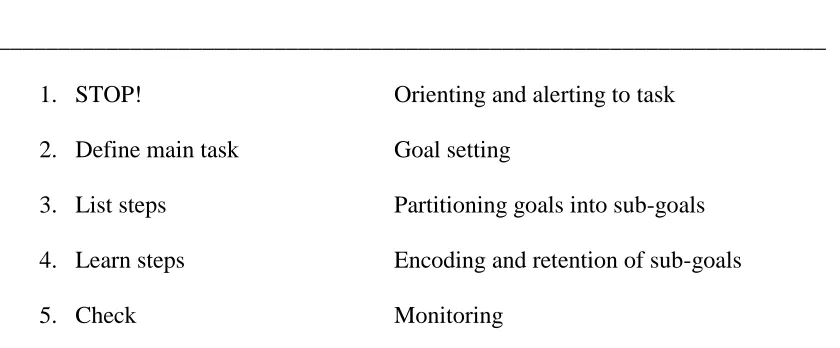
9 Table 1
The Five Stages ofGMT
_____________________________________________________________________
1. STOP! Orienting and alerting to task
2. Define main task Goal setting
3. List steps Partitioning goals into sub-goals 4. Learn steps Encoding and retention of sub-goals
5. Check Monitoring
_____________________________________________________________________
Note: Robertson, 1996, as cited in Levine et al. (2000, p. 302)
Each of these stages is an integral part of successful goal management. In the first stage, individuals orient themselves and become aware of their present state. The current
activity of the individual needs to be suspended and his or her attention directed towards assessing the existing situation and the intended goal. Oftentimes, participants use a
catchphrase that assists them in this task. Then, in stage two, they set appropriate goals for themselves. In stage three, their set goals are divided into subgoals, which is especially important when the goal itself is very complex. They learn the subgoals
through encoding and retention in stage four to make sure they know them well before they act. In the final stage, they need to check if the outcome of their chosen action
matches the intended goal state. If this is not the case, they return to stage one again and repeat the subsequent stages (Levine et al., 2000).
Attentional control is an important component of GMT. According to Diehl,
10
focus his or her attention on a given task, to control and regulate external and internal distractions, and to work toward a desired goal or outcome” (p. 306). Further,
Luszczynska et al. (2004) describe the relation between attention and the pursuit of one’s
goals through the common factor of self-regulation. Namely, “self-regulation processes
are based on feedback loops . . . that can be enhanced by means of attention. All self-regulatory processes involve attention . . . . Attentional selectivity facilitates the
processing of goal-supporting information and inhibits processing of information related to competing aims” (p. 556). Thus, attentional control does not only include attention
itself, but also related aspects such as, for example, self-regulation and goal completion.
Although training in attentional control plays an important role throughout GMT, there are certain stages in which it appears to be even more critical than in others. GMT may be especially relevant to attentional control in the first stage (that is, “Stop,”
orienting and alerting to task) as it may assist the participants to remember their catchphrase, task, or goal, and thus it may assist in the initiation of the goal-setting
strategies. Practicing stage four (that is “Learn steps”, encoding and retention of subgoals), may also be beneficial in maintaining attention. Additionally, stage five
(“Check,” monitoring) utilizes one’s skill to maintain attention. That is, once an action has been finished it is necessary to compare the outcome to the desired goal state and forgetting to pay attention may result in forgetting this comparison, and thus the goal will
not be reached. Monitoring and checking this assumption is a vital step on the path to reaching the intended goal, and paying attention to the monitoring of the goal, the main
11
GMT that focus on attention. Through practice, participants may increase the utilization of goal setting strategies, which will, in turn, increase their overall effectiveness.
Levine et al. (2000) used the GMT approach with 30 patients who suffered from traumatic brain injury (study one), as well as with one post-encephalitic patient (study
two). Results of their first study indicated that GMT improved the patients’ executive functions, as measured by everyday paper-and-pencil tasks that represented these functions. Although participants’ performances on these tasks were slower than before
the intervention, they included fewer errors after the intervention. It was suggested that the training program triggered the participants to act more carefully and to become more
aware of their tasks. As Levine et al. (2000) pointed out, their previous clinical experience indicated that to simply instruct participants to slow down and be more cautious when doing a task is not an effective strategy to improve performance, which
demonstrates the value of GMT.
The second study by Levine et al. (2000) also showed positive results. In this case
study, the emphasis of the GMT was on enabling the patient to prepare her own meals. Here, the individual practiced GMT with paper-and-pencil tasks, but once she had
mastered these tasks successfully, the goal-management skills were transferred to that specific real-life situation (that is, meal preparation).
There have been several studies that are based on this approach. Stuss et al.
(2007), Craik et al. (2007), Levine et al. (2007), Winocur, Palmer et al. (2007), and Winocur, Craik et al. (2007) all reported different aspects of one experimental trial that
12
Levine et al. (2000) was used, in which the GMT time was lengthened to four weekly meetings of three hours, instead of one one-hour session, and the effects of GMT on
real-life situations were emphasized. Memory skills training and psychosocial training were the foci of two other added four-week modules. The participants were assigned to an
Early Training Group, in which they received the training directly after pre-assessments, or to a Late Training Group, in which the training took place three months after the pre-assessments.
One of the assumptions regarding this study was that older adults, in general, tend to underutilize their organizing and planning abilities and thus they may benefit
from help in the acquisition and implementation of certain strategies. The aim of their approach was to rehabilitate cognitive functions, but especially to improve the
participants’ strategic functioning (Stuss et al., 2007).
Levine et al. (2007) focused on the GMT intervention. The purpose of the GMT method was to facilitate the organization of complex tasks into subtasks so that the
participants became more capable in their execution, and thus were more successful. They focused particularly on the real-life difficulties in EFs that arise due to the aging
process. More specifically, they mentioned problem-solving, disorganization, and forgetting things as examples of such. In the approach of Levine et al. (2007),
participants were trained to consciously think about the problem at hand and the goal that
is sought before they implemented the task, as well as keeping the problem and goal in mind throughout execution. Additionally, participants were trained in defining the task,
splitting a complex task up into sub-tasks, and in monitoring their execution. The
13
exercises and homework assignments throughout the four weeks of GMT. They also had one-on-one meetings with the group leader to establish individual goals and address
individual difficulties encountered throughout the program.
Levine et al. (2007) measured the success of their rehabilitation program with
simulated real-life tasks (SRLTs) in which the assessment was based on raters’
observation of target behaviours. These SRLTs were paper-and-pencil tasks designed to represent everyday activities that demand executive functioning and are thus difficult for
individuals with executive functioning deficits. Each consisted of one main goal and several subgoals. An example of one such task is setting up a carpool schedule to drive
to school. Additionally, a self-report measure of strategic difficulties was included as an assessment measure. It was shown that this rehabilitation training was successful in improving the participants’ EFs. These benefits were maintained at a long-term
follow-up after six months.
Van Hooren et al. (2007) examined the effects of a different rehabilitation
program with the focus on EFs in older adults. Their program consisted of 12 sessions (two per week) and was based on the GMT of Levine et al. (2000), but also included a
psycho-educational component. Sixty-nine participants were randomly assigned to an experimental or a control group. It was found that participants who received the
intervention improved their structuring abilities. More specifically, they were better able
to plan activities and to follow this plan, they increased their time-estimation skills, and they showed less distractibility than participants in the control group. Furthermore,
14
concluded that their intervention is most suitable for individuals who are intellectually capable of processing the information that is provided in the program but who have
executive problems.
Miotto et al. (2009) used an attention and problem-solving (APS) treatment to
improve EFs in individuals with frontal lobe injury. Their approach resembles a combination of GMT and PST. It consisted of a ten week program where participants were required to attend once a week for a 90 minutes session. Thirty participants were
separated into three groups: one group received the APS treatment, one received
“treatment as usual”, and the last underwent an educational/informational training. The
two groups that initially did not receive the APS did so at a later point in time.
Attention was the focus of the first four weeks of the intervention (including an educational component, as well as strategies that participants may use to manage their
attention) and problem-solving of the last six weeks. During this time, they were also introduced to the goal management strategies of the GMT. The aim of this strategy was
to teach the participants to take a systematic approach to problems they encountered in their lives, and thus to inhibit impulsive responses. More specifically, their training
included teaching them to be aware, to monitor, and to evaluate problems. Furthermore, their intervention taught the participants to develop and plan, as well as to initiate and implement that plan. Lastly, participants were trained to monitor and evaluate their
progress. Initially their practice involved theoretical problems, which were later on replaced by real-life problems from participants’ own experiences. The measures of
15
(DEX), Verbal Fluency (FAS), and the Virtual Planning Test. Results only partially supported the effectiveness of APS. That is, there was an improvement in the
performance on the executive functioning measures across groups, but the APS group improved significantly more on only the MMET and DEX.
The U.S. Department of Veterans Affairs (U.S. National Institute of Health, 2011) is currently conducting a study that is also using a version of GMT with veterans with mild traumatic brain injury. Their GMT consists of seven two-hour sessions in which the
participants are presented with the five steps of goal management. The steps are
practiced during several paper-and-pencil tasks within the group environment, as well as
individually at home. Their family members are being incorporated through involvement in homework assignments and feedback about the participants’ experiences and progress.
Results have not been published yet, as the proposed completion date of the study is
December 2011.
The previous findings of the effects of GMT support the view that it potentially
provides a new avenue to improve achievement and efficiency in undergraduate students with attentional difficulties. This is likely to be a sizeable group of students for whom
improved executive function could boost both emotional well-being and academic performance.
While there is no study that has investigated the number of university students
who experience inattention but do not meet criteria for ADHD, it is probable that there is a high number of such students. ADHD affects approximately 3 to 7% of school-aged
16
fairly common with estimates ranging from 4% (as in Weyandt, Linterman, & Rice, 1995) to 11% (as in Heilingenstein, Conyers, Berns, & Smith, 1998), depending on the
criteria used. Thus, it is assumed that the number of students with problems in attention not severe enough for an ADHD diagnosis is even higher than this.
In a study by Rabiner et al. (2008), college students with ADHD showed more depressive symptoms and academic concerns than a control group. According to them, inattentive symptoms served as an explanation for these findings. Even after controlling
for personality traits (that is the Big Five personality traits: agreeableness, extraversion, conscientiousness, emotional stability, and openness to experiences), inattention
continued to be a significant contributor to academic concerns and depressive symptoms. Hyperactive-impulsive symptoms, on the other hand, were not related to these outcomes. Because EF deficits occur at a higher rate in individuals with ADHD and because
attention is considered to be an important component in EFs, the assumption can be made that deficits in attention alone (without hyperactivity) contribute to EF deficits. This
further demonstrates the potential value of GMT for students with attention difficulties. Other aspects of GMT, specifically the motivational value, also may be helpful to
undergraduate students who report problems with attention. A study by Morisano et al. (2010) reported that approximately 25% of university students in a four year program never graduate and the majority of students who do graduate take longer than expected.
There are several reasons associated with this, including motivation, a lack of clear goals, and poor academic progress. Morisano et al. (2010) investigated whether an online
goal-setting program would be beneficial for undergraduate students and found that
17
lower negative affect than a control group. Goal-setting has previously been reported to increase an individual’s level of performance. The reason for this is that goals are thought
to be strong motivators for people, especially ones that are specific, proximal, and challenging. Such goals are associated with a higher level of task completion (Locke &
Latham, 2006). It is therefore likely that GMT will equip the students with new skills to successfully set goals and reach them, and thus to succeed in their academic careers.
There are many students struggling in and adjusting to the academic setting and it
is therefore important to find ways to support them in their endeavor. Because undergraduate students are assumed to have the necessary intellectual capabilities to
process the information of the intervention, it is easy to see that the conclusion of van Hooren et al. (2007) that GMT is suitable for such populations applies here, especially if problems with study skills and self-regulation are reported.
The Present Study
As of yet, there have been no systematic investigations of cognitive intervention
programs with younger adults that focus on GMT. Thus, this study will examine the effects of the GMT protocol of Levine et al. (2000), originally used with cognitively
impaired patients, on undergraduate students who report difficulties in attention, timely task completion, and self-regulation.
In addition to testing a new intervention for undergraduate students, who were
young adults mostly, this study may serve as the basis for a future study that will involve older, cognitively healthy adults. It assessed the measures used and test-retest practice
18
Hypothesis 1
Since the current literature shows that GMT has been effective in improving
performance on tasks that are related to goal management and executive functioning, it was hypothesized that here as well GMT would improve participants’ performance on
goal management tasks relative to a comparison group who had not received such training. This increase was measured in terms of the number of errors made on the GM assessment tasks, as well as on completion time.
Hypothesis 2
As attention is one component of EFs, and because GM measures were developed
to assess these functions, it was hypothesized that there would be a negative correlation between the participants’ severity of attentional problems and their performance on the
19 CHAPTER III
DESIGN AND METHODOLOGY
Participants
The participants in this study were undergraduate students attending a psychology course at the University of Windsor. They were recruited through the Participant Pool
website of this University. Students were asked to sign up for this study only if they had never been diagnosed with a learning disorder. Furthermore, they were asked only to participate if they had problems focusing their attention on a given task, controlling and
regulating distractions, or working toward a desired goal (see Appendix A). The Background Questionnaire served as a verification measure that both of these
requirements were met. One hundred and forty-one students participated in this study. At the beginning of the study, the students were asked to give written informed consent. The participation in this study was voluntary but participants were given an
incentive of two bonus points to be used for a psychology course of their choice. This study received approval by the University’s Research Ethics Board.
Procedure and Design
This study had within- and between-subjects components. The assessments and intervention occurred during one session that took approximately one and a half hours.
Participants were tested in groups of no more than four to enable the researcher to keep track of their response times. The specific order in which measures were administered
for the experimental and control groups can be seen in Table 2.
20
measures of GM and attention. The GM measures included a proofreading task (Appendix B), a grouping task (Appendix C), and a room layout task (Appendix D).
Furthermore, the attention measure consisted of the Robert Morris Attention Scale (RMAS; Appendix E). In addition, they filled out the Behavioral Rating Inventory of
Executive Functions for Adults (BRIEF-A) and the Background Questionnaire
(Appendix F) to assess the level of their EF difficulties. Participants then underwent the GMT (see Appendix G and H), after which they were tested on post-assessment measures
of GM. This assessment consisted of the same tasks as the pre-assessment measures described above, but for the GM post-measures a different version was presented (see
Appendix B, C, and D). In addition, the participants were asked to fill out the Feedback Questionnaire (Appendix I) that was designed to assess the overall quality of the training and assessment procedure. This information will be useful in further development of the
intervention for undergraduate students and future interventions for cognitively healthy, older adults.
Control group. The control group completed the same pre-assessment measures of GM and attention as the experimental group, as well as the BRIEF-A, the RMAS, and the Background Questionnaire. This was followed by a distractor task, which required
the participants to view several pictures, to fill out the Dissociative Experiences Scale (DES), and to complete a picture recognition task (Appendix J). In addition, they
21 Table 2
Procedure of the Study for the Experimental and Control Group
Experimental Group Control Group
Pre-assessment of GM
o Proofreading, Grouping, and
Room Layout task
Pre-assessment of GM
o Proofreading, Grouping, and
Room Layout task
Assessment of attention functioning o RMAS
BRIEF-A
Background Questionnaire
Assessment of attention functioning o RMAS
BRIEF-A
Background Questionnaire
GMT Distractor task
o Picture observation task, DES,
Picture recognition task, Word
recall task, and Word Recognition task.
Post-assessment of GM
o Proofreading, Grouping, and
Room Layout task (different version)
Post-assessment of GM
o Proofreading, Grouping, and
Room Layout task (different version)
22
At the end of the study, both groups were debriefed. At that time they were advised that they were randomly assigned to one of the two groups. Each participant in
the control group was then given the option of signing up for a future GMT session.
Materials
Both groups. Experimental and control groups completed the same measures of GM skills at the beginning and end of the study. They also completed other indices of attention and executive problems as well as a background questionnaire.
Goal-management skills assessment.The participants’ GM skills were assessed
two times in total. The assessment instruments for this were based on the everyday
paper-and-pencil tasks developed by Levine et al. (2000), but the difficulty level in the present version was greater. More specifically, the proofreading and grouping tasks contained additional criteria that the participants had to keep in mind and they were
instructed to complete the tasks as quickly as possible. The assessment was designed to measure the GMT effects and took approximately 15 minutes to administer. It consisted
of three tasks (that is, proofreading, grouping, and room layout) that required the
retention of goals, analysis of subgoals, and monitoring of one’s performance. In order to counterbalance any possible order-effects of the two versions of these three tasks (version
A and version B), they were switched halfway through the data collection process so that one half of the participants received version A of the instruments followed by version B,
and the other half of the participants received version B of the instruments followed by version A.
Proofreading. Participants were asked to proofread a short paragraph following
23
or boxed). They had one minute to study the instructions after which they were removed from sight. The assessment entailed the number of errors they committed (omission and
commission errors), as well as completion time (see Appendix B)
Grouping. Here, the participants were given a piece of paper that showed two
columns, each with the gender (“F” for female and “M” for male) and age (for example, “29 F”) for 23 hypothetical individuals. They were given instructions that were removed
from sight after one minute. These instructions included different tasks that needed to be
carried out, depending on the listed individual’s age and gender (for example placing a check mark next to male persons). The assessment again entailed the number of errors
they committed (omission and commission errors), as well as completion time. (See Appendix C)
Room layout. A seating scheme was presented in form of a 5x5 grid, where the
rows were numbered. A letter from “A” to “E” was in each of these 25 cells, identifying an employee from one of five companies (company A, B, C, D, and E). Five questions of
increasing difficulty were asked about the relative positions of certain company employees. The assessment of this task entailed the time it took them to answer the questions and the number of errors they committed. Timing commenced when the
participant was first presented with the seating scheme and questions. (See Appendix D)
Robert Morris Attention Scale (RMAS). This scale is a brief self-report measure
of general attention. It consists of five items and shows good internal consistency, retest reliability, and criterion validity. More specifically, Kelly (2009) reported a test-retest reliability of .81. The criterion was established through correlations with other
24
Regulation Scale, and the Digit Span Forward subtest of the Wechsler Adult Intelligence Scale–Revised. There is no significant relationship between the RMAS and social
desirability, and it is considered a potential viable alternative to performance-based measures of attention (Kelly, 2009; see Appendix E).
Behavioral Rating Inventory of Executive Functions – Adult Version
(BRIEF-A). The BRIEF-A is a standardized behaviour self-rating inventory that consists of several scales. Those scales include Inhibit, Shift, Emotional Control, Initiate,
Working Memory, Plan/Organize, Organization of Materials, Self-Monitor and Task-Monitor (Roth, Isquith, & Gioia, 2005). The Global Executive Composite (GEC)
represents the summary score of the BRIEF-A, and was thus used in this study. According to Roth et al. (2005), the GEC has high internal consistency (with alpha coefficients ranging from .93 to .98) and high test-retest reliability (with a correlation
value of .94). Convergent and discriminant validities were tested with several measures, including the Dysexecutive Questionnaire and the Frontal Systems Behavior Scale. The
results of these studies were overall supportive of the applicability of the BRIEF-A for testing EFs. In addition, an item analysis conducted by professionals in the field resulted in agreement of item membership among the nine indexes ranging from 35%
(self-monitor) to 98% (emotional control). . This measure was added to examine the EFs of the participants in depth.
Background questionnaire. Participants were asked to fill out a short background questionnaire developed for the purpose of this study to determine some of their
background information. The purpose of this questionnaire was to assess whether the
25
was to validate that they had never been diagnosed with a learning disorder and that they experienced problems focusing their attention on a given task, controlling and regulating
distractions, or working toward a desired goal. If a participant admitted to trouble with attentional functioning, the participant was asked to elaborate on their specific
difficulties. (See Appendix F)
Experimental group only. Certain parts of the study were only completed by the experimental group. This included the GMT and a Feedback Questionnaire.
Goal-management training. The GMT was also based on Levine et al. (2000). This intervention took approximately 45 minutes and covered the five steps of GM
described earlier (that is, 1: stop, 2: define main task, 3: list steps, 4: learn steps, and 5: check; see Appendix G). The participants received a handout to follow along with the presentation, which they were allowed to use to make notes and keep after the study was
completed. (See Appendix H)
Feedback questionnaire. This questionnaire was designed specifically for the
purpose of this study to address the qualitative changes in the participants’ GM skills. It consisted of five rating questions and three questions in which participants were asked to provide written feedback about the effectiveness of the study (see Appendix I).
Control group only. Certain parts of the study were only completed by the control group. This included the distractor task that in itself included five different
measures.
The distractor task included five types of activities (namely, a picture observation task, the Dissociative Experiences Scale, a picture recognition task, a word recall task,
26
tasks were chosen because they do not provide elements of the GMT and were of interest as part of another research question.
Picture observation task. Participants were shown 12 pictures of stereotypical scenes (such as a wedding or a beach scene) on a computer screen for ten seconds each,
with the task of remembering as many things as possible. The pictures are identical to those used by Miller and Gazzaniga (1998) and Carstens and Webster (2008).
Dissociative Experiences Scale (DES). This scale is a 28-item self-report
measure ofdissociation and took approximately ten minutes to complete. Dissociation can be conceptualized as an experience of de-realization or de-personalization. The
participants were asked to indicate the frequency of their dissociative experiences on a scale from 0 to 100 with intervals of 10. The reliability and validity (that is, internal validity, test-retest reliability, and construct validity) of the DES to measure dissociation
has been reported by several authors (for example, see Carlson & Putnam, 1993).
Picture recognition task. The participants were shown a second set of 12
pictures. This set included five original and seven altered pictures of the same
stereotypical scenes as in the previous set. The altered pictures contained two additional items and had two items removed. The subjects were asked to indicate whether each
picture was identical to one from the Picture Observation Task and also to rate their level of confidence in their decision on a likert-scale from 0 (not confident) to 3 (very
27
Word recall and recognition task. The participants completed three word recall tasks that were based on an experiment by Roediger and McDermott (1995). They were
presented with three lists, one after another, that consisted of 15 words each with the task to remember as many words as possible (with the lure words sleep, chair, and sweet; see
Appendix K). After each list, they were asked to recall as many words of the previous list as possible. Each list was strongly associated with one specific lure. Their recall of the lure was the measure of false memory creation.
After the word recall tasks, each participant was presented with a word
recognition task. Here, they were shown 21 words of which six had been presented on the
word lists, six had not been presented but were related to the presented words, six had not been presented and were not related to the presented words, and three lure words. They were asked to indicate whether each word had previously been presented and rate their
certainty of that decision on a likert scale from 0 to 3 (0 = not certain at all, 3= very certain). Their responses on this recognition task served as a measure of false memory
creation, as well as the magnitude of those memories. (See Appendix L)
Statistical Design
For the major analyses concerning Hypothesis 1 I conducted a repeated measure
analysis of variance (ANOVA) with one between-subjects factor. The independent variables were Prepost (whether the score was from the pre-assessment or the
28 CHAPTER IV ANALYSIS OF RESULTS
Preliminary Analyses
The sample size was 141. Among this sample, 14 participants were excluded because they did not meet the previously mentioned criteria. In addition, three
participants were excluded because they did not properly follow the instructions that were given to them. The remaining sample consisted of 124 participants. Both the
experimental and control group consisted of 62 participants. After 31 participants
completed the study in each group, the order of the two versions was switched, so that the first 31 participants received version A of the goal management skills tasks followed by
version B and the last 31 participants received version B followed by version A.
Outliers. Two participants had an error rate and completion time greater than three standard deviations from the mean, and were thus identified as outliers. Testing the
assumptions of the ANOVA with and without the outliers resulted in an increase in violations when including them, which warranted the removal of the outliers for the
subsequent analyses. Both outliers were part of the control group. The final data file consisted of 122 participants in total (N = 62 in the experimental group and N = 60 in the control group).
Background variables. Participants were between 18 to 65 years old with a mean age of 23 (SD= 7.21). The majority of students were Psychology majors (46.7%;
29
Assumptions. The first assumption, that of independence of observations, is violated if any scores of participants in the data set are not independent of the other
participants in the same set. Because the participants were tested in small groups, it is possible that there is some dependence among each group. For example, the completion
time of one participant may have influenced another participant to perform in a different manner in order to be more similar to the other group members. However, because the data were collected on several occasions, in these instances it is assumed that those
effects are counterbalanced.
Following this, the assumption that the distributions of scores within groups is
normal was tested. An analysis of the skewness and kurtosis values was performed where skewness values above -2 and below 2 and kurtosis values above -3 and below 3 indicated no violation of this assumption. The analysis of the total amount of time and
errors of the pre- and post-assessment measures yielded no violation of this assumption. The assumption of sphericity is met when the variances of the differences
between treatment levels are equal. Because measurements have only been taken on two occasions, sphericity is not of concern. The next assumption is that of homogeneity of variance, which assumes that the variances of the samples are equivalent or not
excessively different. The Levene’s Test was significant (p < .05) for the total time of the goal management skills measures at the post-assessment. This means that this
assumption was partly violated, suggesting that the variances within the groups was significantly different. However, an ANOVA is assumed to be robust against such a violation if the sample sizes are relatively equal (that is, the ratio of the sample sizes is
30
homogeneity of covariance, which assumes equality of the sample treatments variances. The Box’s M test was used to test this assumption. It showed that none of the values was
significant, indicating that the covariances of the groups were not significantly different from each other.
The analyses necessary to investigate the hypotheses are based on the assumption that the samples of both groups (experimental and control) are similar in their reports of executive functioning and attention difficulties. To establish this, independent sample
t-tests were used to compare the participants’ self-ratings on the BRIEF-A (the GEC) and on the RMAS, and the amount of problems they reported on the Background
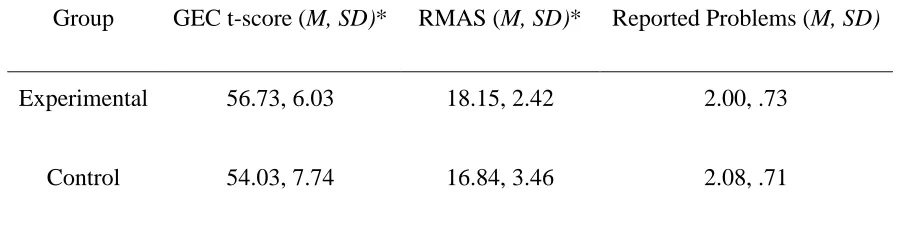
Questionnaire. The GEC raw scores were converted into t-scores using the BRIEF-A Manual. The t-tests of the GEC t-scores and the RMAS yielded a significant group difference (t(119) = 2.14, p ≤ .05 and t(120) = 2.28, p ≤ .05, respectively), whereas the
number of problems reported on the Background Questionnaire did not differ
significantly between the groups. One can see in Table 3 that the experimental groups
scored higher on both the GEC and RMAS, which means that they overall, according to their self-report, experienced more difficulties with their executive and attentional
functioning. As an additional analysis, it was established whether the experimental group
and control group differed in their number of participants who received a GEC t-score of 65 or higher. Five participants in each group fell into this category, and thus the chi
squared analysis revealed no significant difference between the experimental and control group (with a chi-square value of .003; df = 1; p > .05).
Even though the experimental and control groups statistically differed
31
both groups were in the average range. More specifically, the difference between the groups was only 2.7 on the GEC t-scores and 1.3 on the RMAS, and thus further
investigation was warranted. Subsequent analysis did not show a difference between the two groups on the pre-assessment of the GM skills measures. Therefore, it does not
appear that the experimental and control groups experienced clinically significant differences in their level of attentional problems before the intervention for the experimental group.
Table 3
Descriptive Statistics of Each Group’s GEC T-scores, RMAS, and Amount of Problems Reported on the Background Questionnaire
________________________________________________________________________
Group GEC t-score (M, SD)* RMAS (M, SD)* Reported Problems (M, SD)
Experimental 56.73, 6.03 18.15, 2.42 2.00, .73
Control 54.03, 7.74 16.84, 3.46 2.08, .71
* significant difference between the two groups at p ≤ .05
It was further established that there were no significant differences between version A and version B of the goal management tasks. More specifically, two
independent-sample t-tests were conducted to compare the two versions (that is, which
version of each task they completed first) on the total number of errors and completion time of the pre-assessment. No significant results were found (p > .05), indicating that the
32
tasks they were given at pre-assessment. More specifically, the results for errors and completion time on the pre-assessment were t(120) = -1.62 and t(120) = .62, respectively.
Hypothesis 1
The first hypothesis stated that GMT would improve the participants’
performance on goal management tasks relative to a control group in which participants performed memory tasks and thus did not receive GMT. The total number of errors and the total time it took them to complete the tasks were used as measures of their
performance. It should be noted that the two groups did not differ significantly on the total errors and completion time on the pre-assessment measures, which was established
by using two independent-sample t-tests. This analysis showed no significant differences between the groups on the pre-assessment despite their differences in self-report on the GEC and RMAS (that is, t(120) = -.85 for errors and t(120) = .62 for completion time,
with p > .05 for both). A repeated measure two by two ANOVA with one between-group factor was used to compare the number of errors and completion time of both groups on
their pre- and post-measures. This analysis revealed a significant Prepost main effect for completion time, indicating that both experimental and control groups significantly improved on completion time from the pre- to the post-measure with a Wilks’ Lambda
value of .45 (F(1, 120) = 147.62, p ≤ .01, partial = .55 ). According to Cohen (1988), a
partial η² of .1 is a small effect size, a partial η²of .25 is a medium effect size, and a
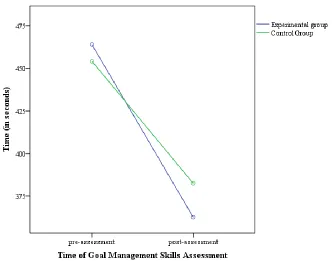
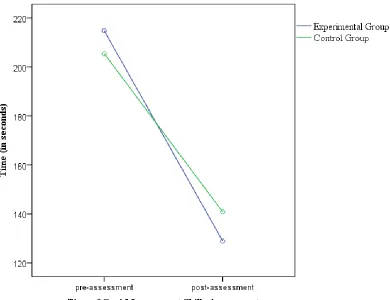
partial η²of .4 is a large effect size. Thus this effect is large. In addition, there was a significant Group X Prepost interaction effect of completion time between the groups with a Wilks’ Lambda value of .97 (F(1, 120) = 4.35, p ≤ .05, partial = .04). That is, the
33
group (see Table 4 and Figure 1). No significant main effect for Group was observed (p > .05), indicating that the average completion time across the pre- and post-assessment
was not significantly different in the experimental and control group. Table 4
Descriptive Statistics of Each Group’s Completion Time
________________________________________________________________________
N M (in sec.) SD (in sec.) Pre-assessment
Experimental Group Control Group
62 60
463.92 454.19
82.54 92.56
Post-assessment Experimental Group Control Group
62 60
362.61 382.52
73.91 98.71
34
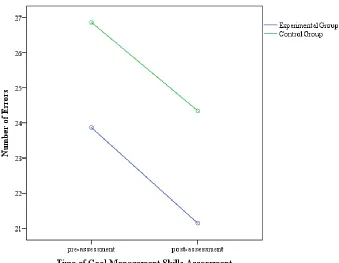
No significant reduction in the numbers of errors was observed in the
experimental or control group (p > .05, partial η² = .02), as well as no significant Group X
Prepost interaction effect (p > .05, partial η² = .00; see Table 5 and Figure 2).
Furthermore, no significant main effect for Group was observed in terms of error rate
(p > .05).
Thus, the first hypothesis was partially supported. That is, participants who received GMT improved significantly more in their completion time than participants
who did not receive GMT. However, although both groups reduced their total number of errors, the experimental group did not significantly differ in this regard from the control
group.
Table 5
Descriptive Statistics for Errors
________________________________________________________________________
N M SD
Pre-assessment
Experimental Group Control Group
62 60
23.87 26.87
17.80 20.97 Post-assessment
Experimental Group Control Group
62 60
21.15 24.35
35
Figure 2. Average number of errors of both groups during the GMT pre- and
post-assessment.
Because the GM skills tasks vary in terms of complexity, a more in-depth analysis was performed of the errors and completion time of each measure (that is, proofreading, grouping, and room layout task). For this, six additional repeated-measure ANOVAs
with one between-group factor were performed that included the completion time and total errors for each of the three tasks separately. The Bonferroni correction was used to
control for Type-1 error and was based on grouping the time and errors of each task together. Thus, the α-level of .05 (for time) was divided by three (as there were three
36
significant main effect for Prepost across the groups on the room layout task in terms of total errors, and completion time (p ≤ .016, partial of .11 and .71, respectively).
Table 6
Results of the Repeated Measure ANOVAs of Each Goal Management Skill Task
___________________________________________________________________
Total Errors Time
p partial η² p partial η²
Proofreading
Pre-post difference .49 .00 .30 .01
Pre-post difference*Group
.64 .00 .79 .00
Grouping
Pre-post difference .28 .01 .03* .04
Pre-post difference*Group
.94 .00 .05* .03
Room Layout
Pre-post difference .00** .11 .00** .71
Pre-post difference*Group
.36 .01 .02* .05
* significant at p ≤ .05 ** significant at p ≤ .016
These analyses further indicated only one main effect for Group, more
specifically for the error rate on the room layout task (p ≤ .016, partial = .10). This
37
Although not significant with the newly established α-level of .016, the Group X
Prepost interaction for the room layout task approached significance (p = .02, partial =
.05). As there was an overall difference between the groups in completion time, this result supports the previous findings, also indicating that the two groups may have shown
a difference in the degree of improvement in their response times on this task. Figure 3 illustrates this trend.
Figure 3. Average completion time of both groups during the room-layout task pre- and
post-assessment.
As there was a significant main effect for Prepost in the total number of errors on
38
factor were conducted to investigate the omission and commission rates of errors on this specific task. These analyses yielded a significant main effect for Prepost for overall
commission errors (p ≤ .016, partial η² = .08), but no significant results for omission errors (p > .016). As the participants were able to guess the answer during this task, and
thus were less likely to leave an answer blank, this finding is not surprising, given the significant difference in total errors on the room layout task that was previously found. There was no significant Group X Prepost interaction effect for either commission or
omission error rate (p > .016). Furthermore, there was a significant main effect for Group in terms of commission errors, indicating that, overall, the experimental group committed
fewer errors (p ≤ .016, partial η² = .09). No significant main effect for Group was found for omission errors (p > .05).
For completion time on the grouping task, the main effect for Prepost (p = .03,
partial η² = .04) and the Group X Prepost interaction (p = .05, partial η² = .03) approached significance. Thus, the grouping task also revealed some differences in the change of
completion time between those who received GMT and those who did not, which again supports the overall conclusion. As mentioned before, there was no significant main effect for Group on this task (p > .05).
To further analyze the data, another two repeated-measure ANOVAs with one between group factor were conducted (for total errors and time), which only included
39
errors and completion time among participants who reported relatively high scores of attentional and executive functioning difficulties.
First, the participants were split according to their GEC t-scores where participants with a value of 55 or lower were excluded. This resulted in a total of 60
participants (35 in the experimental group and 25 in the control group). For errors, there was no significant Prepost main effect, Group main effect, or Group X Prepost
interaction effect (p > .05). However, there was a significant Prepost main effect for
completion time (p ≤ .05, partial η2 = .59), but no significant Group main effect or Group X Prepost interaction effect for completion time (p > .05).
After splitting the participants according to their RMAS scores and excluding participants with a value of 17 or lower, the total number of participants was 72 (42 in the experimental group and 30 in the control group). The results were in accordance with the
previous analysis as there was no significant Prepost main effect, Group main effect, or Group X Prepost interaction effect for errors found (p > .05) but a significant Prepost
main effect for completion time between the pre- and post-measures overall (p ≤ .05, partial η2 = .58). Consistent with the previous analysis, no significant Group main effect or Group X Prepost interaction effect was found for completion time (p > .05).
Hypothesis 2
The second hypothesis stated that there would be a negative correlation between the severity of the participants’ self-reported executive functioning and attentional
difficulties, and their speed and accuracy on the pre-assessment measures of their GM skills. A one-tailed Pearson r correlational analysis was performed, which showed that