University of Windsor University of Windsor
Scholarship at UWindsor
Scholarship at UWindsor
Electronic Theses and Dissertations Theses, Dissertations, and Major Papers
2012
Evaluating Premise Relations
Evaluating Premise Relations
Matthew Alexander Stevens
University of Windsor
Follow this and additional works at: https://scholar.uwindsor.ca/etd
Recommended Citation Recommended Citation
Stevens, Matthew Alexander, "Evaluating Premise Relations" (2012). Electronic Theses and Dissertations. 5528.
https://scholar.uwindsor.ca/etd/5528
This online database contains the full-text of PhD dissertations and Masters’ theses of University of Windsor students from 1954 forward. These documents are made available for personal study and research purposes only, in accordance with the Canadian Copyright Act and the Creative Commons license—CC BY-NC-ND (Attribution, Non-Commercial, No Derivative Works). Under this license, works must always be attributed to the copyright holder (original author), cannot be used for any commercial purposes, and may not be altered. Any other use would require the permission of the copyright holder. Students may inquire about withdrawing their dissertation and/or thesis from this database. For additional inquiries, please contact the repository administrator via email
Evaluating Premise Relations
By
Matthew Stevens
A Thesis
Submitted to the Faculty of Graduate Studies through the Philosophy Department in Partial Fulfillment of the Requirements for
the Degree of Master of Arts at the University of Windsor
Windsor, Ontario, Canada
2012
Evaluating Premise Relations
By
Matthew Stevens
APPROVED BY:
______________________________________________ Douglas Walton, Philosophy
______________________________________________ Lori Buchanan, Psychology
______________________________________________ Hans Hansen, Advisor
______________________________________________ Connie Kvarfordt, Chair of Defense
iii
Declaration of Originality
I hereby certify that I am the sole author of this thesis and that no part of this
thesis has been published or submitted for publication.
I certify that, to the best of my knowledge, my thesis does not infringe upon
anyone’s copyright nor violate any proprietary rights and that any ideas, techniques,
quotations, or any other material from the work of other people included in my thesis,
published or otherwise, are fully acknowledged in accordance with the standard
referencing practices. Furthermore, to the extent that I have included copyrighted
material that surpasses the bounds of fair dealing within the meaning of the Canada
Copyright Act, I certify that I have obtained a written permission from the copyright
owner(s) to include such material(s) in my thesis and have included copies of such
copyright clearances to my appendix.
I declare that this is a true copy of my thesis, including any final revisions, as
approved by my thesis committee and the Graduate Studies office, and that this thesis has
iv
Abstract
An essential step to evaluating arguments is moving from the weight of individual
premises to the weight of the conclusion. In order to perform this step, one must
understand the relationship between the premises in the argument.
In the past, analyzing premise relations in informal logic has been limited
primarily to the linked-convergent distinction. This distinction has failed to resolve some
of the basic problems in finding a definition because it has underestimated the degree to
which premises interact with each other in some complicated way.
Embracing concepts from holistic epistemology, I argue that evaluating a premise
involves considering a wide set of presuppositions and implications that that premise, if
accepted, carries. I call this wide set the premise/world. The relationship between
v
Table of Contents
Declaration of Originality ... iii
Abstract ... iv
Introduction ... 1
Chapter 1 - Methods for Argumentation Evaluation ... 4
1.1 Acceptable-Relevant-Sufficient (ARS) Theories ... 5
1.2 Schemes or Fallacy Theories... 7
1.3 The Folly of Deductivism ... 9
1.4 Weight based Evaluations ... 13
1.5 Tier Based Weight Schemes ... 14
1.6 Numerical Weight Assignments... 23
1.7 Conclusion ... 27
Chapter 2 - Linked vs. Convergent Tests... 28
2.1 Irrelevancy Test ... 30
2.2 Insufficient Evidence Test ... 34
2.3 Degrees of Support Test ... 37
2.4 Introduction to Disjunction ... 47
2.5 Walton's Hybrid Test ... 49
2.6 Motivation for the Linked/Convergent Distinction and the First Sufficient Condition... 51
vi
Chapter 3 - The World of Implications and Premise Relations ... 69
3.1 Epistemic Responsibility and the World of Implications... 69
3.2 The Line between Disjunctive and Contrary Premises ... 81
3.3 Identifying Disjunctive Premises ... 85
3.4 Are Contrary Premises Really Different than Disjunction? ... 89
3.5 Identifying Contrary Premises ... 93
3.6 One-Directional Acceptability Conflict ... 94
3.7 Evaluating Disjunctive Premises ... 97
3.8 Evaluating Contrary Premises ... 97
3.9 Strongest Support Theory... 99
3.10 Pool of Evidence Theory ... 102
3.11 Resolution to Evaluating Contrary Premises ... 105
3.12 Standard Supportive ... 111
3.13 Coincidental Premises ... 122
3.14 Weak Standard Supportive Synergy ... 123
Chapter 4 - Conclusion ... 128
Bibliography ... 133
Appendix ... 136
1
Introduction
This paper will focus primarily on a detailed analysis of the effects of premise
relationships on argument evaluations. In a simple argument from a single premise to a
conclusion, an evaluation can rest on questions exclusive to the single premise such as
acceptability, relevancy, and sufficiency. An evaluation becomes much more complicated
in situations where there are multiple premises because we must then have some sense of
how the premises are inter-related with one another in an evaluation. This is a serious and
complicated question which has been largely ignored in argumentation literature except
for the simple distinction between linkage and convergence.
Even the linked and convergent distinction has run into an impasse over the
difficulty in finding a test which isn't riddled with problematic cases. In essence the
linked convergent distinction hopes to draw a line between those premises which interact
with one another and those which are independently relevant to the conclusion. The main
problem that is behind some of the unsuccessful tests is the undeveloped concept of
"interaction" between premises. One of the approaches that will be analyzed in the
second chapter, Yanal's Degrees of Support Test, suggests that any interaction between
two premises in an evaluation is grounds to label the premises linked. According to this
theory, "convergence" then is the term given to two premises which are entirely
independent. This is a perfect example to highlight the lack of research and understanding
in premise relations for there are many ways in which premises may be related with one
another, almost all of which feature some sort of interaction with one another. While I
2
convergence is an extremely broad category with many relationship types, only one of
which is the model of complete independence.
When I say the "relationship between premises" I am talking about the method by
which the weight of two premises is combined. If I take premise A to hold weight X and
premise B to hold weight Y when considering each premise individually towards the
conclusion, the relationship between the premises dictates the method for combining X
and Y into an overall sense of the strength Z of the conclusion given the premises. Of
course it is not always possible to weigh a premise individually towards a conclusion,
which is one of the reasons for declaring a pair of premises linked, but in convergence
this is usually an appropriate question. The simple view on convergence is that the
premises are independent and should be taken 'additively'. One of the major conclusions I
argue for in this paper is that the usual case of convergence, what I call standard
supportive premises, are not in a position of complete independence. They usually carry a
degree of synergy between the premises so that Z is greater than X and Y combined
additively. In my third chapter I present a theory to account for this synergetic
relationship along with the other relationships I outline. I call this the World of
Hypothetical Implications and base this theory on the epistemic responsibilities involved
in evaluating premises. These responsibilities I derive from Brandom's epistemic
responsibilities for making judgements in the context of holistic epistemology.
This thesis contains three chapters. The first chapter outlines evaluation methods
that are common in the literature and defends an approach of weight evaluations for the
purposes and remainder of the paper. The second chapter examines problems surrounding
3
where the distinction ought to lie and how one could develop a test for linkage. The third
chapter begins by outlining the Hypothetical World of Implications. The remainder of the
chapter is dedicated to using this theory to identify and evaluate new premise
relationships within the relationship of convergence. Four such relationships will be
identified; Contrary, Disjunctive, Standard Supportive, and Coincidental.
A valuable and necessary step in argumentation evaluation is recognizing the
great range of relationships premises may hold with one another. The conclusion of this
essay employs these newly identified relationships in evaluating an extended argument to
show how useful these distinctions are in further analyzing arguments. In general this
paper is an incomplete exploration into some new concepts I think important to
argumentation theory. Although I try to give a fairly detailed account of the relationships,
I recommend much more work on these prototypes and on identifying others. There are
many concepts that will be used in the third chapter which are not sufficiently developed
and some conclusions I draw I assume can be improved. Nevertheless, I believe I have
made substantial developments in this paper on the topic of premise relations in argument
4
Chapter 1 - Methods for Argumentation Evaluation
The focus of this paper as a whole will be the effects of premise relationships on
the evaluation of arguments. By evaluation I mean an epistemic evaluation of an
argument, an evaluation by an audience member as to how strongly the conclusion is
supported and what epistemic stance1 they are justified in taking on the issue in question.
This is opposed to other forms of evaluation such as logical evaluation; evaluating the
strength of the connection between the premises and conclusion independently of other
concerns. A necessary first step before jumping into this exploration is to settle on some
basic language and methodology that will be used to conduct our evaluations. In
particular, we need to have a useful way to evaluate the strength that a premise carries
towards a conclusion in an argument so that we may begin to talk about how two
premises interact with one another, how to combine these strengths. This chapter will
explore some of the language and theories that have been used to evaluate premises and
arguments, to the end of resolving what language is best suited to proceed with this study.
A thing to keep at the front of our minds throughout this chapter is that there are
two very different motivations possible behind choosing a method of evaluation. The first
and more common method is to find a method that is practical for teaching and everyday
use in evaluating arguments. The second is to find a method of evaluation that is a good
tool to pry deeper into questions of argumentation theory. Our motivation is only
concerned with the latter and so, even though a method of evaluation may have very
strong qualities for the first motivation, it may be easily dismissed under the second.
1
5
1.1 Acceptable-Relevant-Sufficient (ARS) Theories
Many books on the subject offer some variation of conditions that an argument
must satisfy to be considered a good or strong argument, centred on the notions of
acceptability, relevance and sufficiency. Groarke and Tindale (2008) describe a strong
argument as, "an argument with 1) acceptable premises and 2) a conclusion that follows
from them."2 The second conditions combines relevance and sufficiency into one as is
later noted in the textbook.3 One way of evaluating an argument according to this theory
is to question if both of these conditions are satisfied or not. If an argument is found not
to have acceptable premises OR a conclusion that does not follow from the premises then
we have good grounds for considering it a weak or bad argument, while if both
conditions do hold then it is a strong argument.
A cogent argument, according to Trudy Govier, is one which satisfies the ARG
conditions, Acceptability, Relevance and Adequacy of Grounds.4 Adequacy of Grounds
is whether the premises provide enough support ground (make the case for) the
conclusion. This is the same thing as asking if they are sufficient to ground (support) the
conclusion (Sufficiency). Mark Vorobej (2006) defines a cogent argument as satisfying
these same three conditions but adds one more; the compactness condition. Compactness
asks whether the argument in question could give rise to a proper subset of premises
which do not give less support than the original set. If such a subset is possible then the
original set is not a cogent argument, and the proper subset is the cogent argument
2
Groarke, Leo and Tindale, Chris (2008). Good Reasoning Matters, Fourth Edition. Ontario: Oxford University Press. p. 140.
3
Groarke and Tindale (2008), p. 147. 4
6
instead. This means removing any redundant or irrelevant premises.5All of these
variations on ARSare inspired by Johnson and Blair's very influential first edition of
Logical Self Defence in which ARS was initially proposed.6
There is much discussion in the field of informal logic about how properly to
define and apply each of these necessary conditions. For the most part these questions are
beyond the scope of this chapter and the answers can vary between theorists. What is
important is the general perspective that these approaches take to be the method of
evaluation. They ask an audience member to consider premises and ask themselves if
they are persuaded that the premises are acceptable, relevant and sufficient for the given
conclusion.
Let us assume for now what will be shown in later chapters; that premises interact
with one another in complicated ways which affect the amount of support carried from
premises to conclusion independently of concerns of relevance and sufficiency. If this is
the case, then it would be difficult to even approach this topic within the ARS method.
These questions would have to be classified as a further subcategory under the
grounding/sufficiency condition, asking first how strong the premises are individually
then how strong they are taken together. Even if we went in this direction we would not
have the language to progress any further without introducing it ourselves. ARS therefore
seems too simple a theory to be of use. Blair openly accepts this lack of complexity of the
theory, arguing that it is a virtue of the theory that it is simple and easily learned stating
clearly that ARS is more concerned with the first motivation above, teaching and
5
Vorobej, Mark (2008). A Theory of Argument. Cambridge University Press, NY. p. 51-52. 6
7
applying the theory to real world application.7 There is little reason going forward for our
purposes to consider adopting this method.
1.2 Schemes or Fallacy Theories
Another approach to argument evaluation asks the audience to recognize
arguments as instances of common prototypes. These scheme-recognition approaches are
not usually meant as a definitive evaluative test, but rather an indicator tool with which to
help the practical understanding and evaluating of arguments.8 Fallacies have a very long
history in informal logic and there has been a great deal of work done enumerating and
grounding the field. Identifying an argument or part of an argument as matching a
recognized fallacy (e.g., argument from authority) used to be grounds for dismissing the
argument as bad reasoning. More recent work has shown that supposed fallacies can
sometimes be perfectly fine instances of neutral reasoning schemes. There can be both
good and bad arguments that are instances of the same neutral argument scheme. A
particular instance of this scheme is only bad (fallacious) if it does not appropriately
answer certain critical questions such as, 'is the authority an expert in the field to which
the proposition they are asserting belongs'. Douglas Walton takes this stance and asserts
that fallacies are often just instances of defeasible reasoning schemes, thereby translating
fallacies into improper uses of an argument scheme.9 In his book, Fallacies and
Argument Appraisal, Christopher Tindale doesn't adopt the same method for analyzing
fallacies as Walton but still recognizes fallacies as characterizing their own schemes or
7
Blair, J. Anthony (2011). p. 12. 8
There are other approaches to schemes that would disagree with this statement, but this is the one we will be considering, endorsed by Robert Pinto; Pinto, Robert (2001). Argument Inference and Dialectic. NL: Kluwer Academic Publishers. P. 98-111. And Douglas Walton; Walton, Douglas (2011). "Defeasible Reasoning and Informal Fallacies." Available at SSRN:http://ssrn.com/abstract=1775825.
9
8
patterns of reasoning.10 Evaluating a fallacious argument under either approach first
involves recognizing the relevant scheme.
Schemes theory asks audience members to recognize arguments as specific cases
of some common argument scheme when appropriate. In doing so, a method for
evaluating the premises specific to the context can be established and the important
critical questions for a particular argument brought forward. An argument is a good one
when it resembles a recognizable scheme and satisfies the conditions of that scheme for
the most part.11
Fallacies and schemes are a part of many important textbooks in informal logic,
even those that support another more explicit method for evaluating an argument, like
ARS. They are well structured and practical to use in many cases making them handier
then the abstract questions of relevance and sufficiency. One might argue that schemes
are not different from ARS as a method of evaluation; schemes are only easily
recognizable specific cases where relevance-sufficiency can be better defined. Indeed
Johnson and Blair analyze fallacy schemes as following from an error in applying one of
the ARS conditions.12 For instance, the straw man fallacy is a fallacy because it makes
premises irrelevant. Argumentations schemes may not be obviously or even commonly
recognized as a form of argument evaluation, but it is a method by which a set of
premises and conclusion can be interpreted as being strong or weak and is thereby
appropriately seen as one. A challenge for the scheme theorists is separating descriptive
10
Tindale, Chris (2007). Fallacies and Argument Appraisal. Cambridge University Press. NY, p. 6. 11
Schemes are usually discussed in connection with sets of critical questions that should be asked of the context to determine the quality of the appeal to the scheme, above simply being recognized as following the scheme.
12
9
from normative functioning schemes. The normative and hence evaluative aspect of
schemes is properly left to the critical questions involved with each scheme13 and taking
the schemes themselves to be merely descriptive (this distinction is not always so easy to
maintain).
There may be some advantages to adopting a scheme based approach for our
purposes. If the relationships between premises can be categorized into recognizable
forms with characteristics, then arguments could be seen exhibiting these characteristics
and an appropriate method of evaluation could be applied. This is to say that a
scheme-based method of evaluation could possibly handle incorporating premise relationships14
as identifiable schemes or part of the identity of schemes. The problem is that this method
only works for already identified or identifiable common schemes and we intend to
approach a topic about which there is not much already known. This theory does not help
us to investigate what these relationships are, and so it will not be useful for the purposes
of this paper, although I reserve that it may be a useful medium with which to deal with
the consequences of this study.
1.3 The Folly of Deductivism
In the past, a good deal of effort had been paid to the attempt to ground rational
argumentation around formal logical validity. Natural language deductivism asserts that
all informal arguments should be interpreted as attempts to create deductively valid
13
A stance Walton adopts. 14
10
arguments.15 The conclusions of such an argument become as certain as the premises are
taken to be. Obviously most natural language arguments do not take a valid form16 but
often they can be translated into one by filling in assumed missing gaps in the argument,
or reconstructing the argument into such a form. Take for example; Tom was not
involved with the break in last weekend, he was with me the whole time. This could be
rewritten; P1 - Tom was with me all of last weekend, P2 - It cannot be the case that Tom
was both with me and involved in the break-in, C - Tom was not involved in the break-in.
This argument is reconstructed to be valid and therefore its evaluative strength follows
simply from the acceptability of the premises.
The appeal of deductivism is felt by many who seek to unify the difficult field of
informal logic under the more established and productive heading of logic. However,
since around the 1970’s this has become almost unanimously accepted as a bad idea.17
The methods with which a person naturally reasons cannot be reduced to deductive
reasoning schemes. A very common example is the following; P1- Crow 1 is black, P2 -
Crow 2 is black... PN - Crow N is black, C - All crows are black. A deductivist would try
to add a premise something like; PN+1 - All crows are similar to the ones seen.18 This
however changes the nature of the argument being presented. The original argument was
never meant to support the conclusion as following deductively from its premises, neither
15
Stanford Encyclopaedia of Philosophy. "Informal Logic, NLD and Beyond." http://plato.stanford.edu/entries/logic-informal/#Ded. 2011 - This does not reflect the position of all deductivists, it is more specifically an ontological deductivist perspective.
16
I am taking validity here to be the more general informal validity. Informal validity asks that it not be logically possible for the conclusion to be false given the premises. Groarke, Leo (1992). "In Defence of Deductivism: Replying to Govier.” In; Eemeren et al., eds. Argumentation Illuminated. Amsterdam: SICSAT. p. 113.
17
Korb, Kevin (2004). "Bayesian Informal Logic and Fallacy." In: Informal Logic. Vol. 24 No. 1. p. 49. 18
11
would the author necessarily endorse PN+1. The argument is an induction, moving from
certain premises to an uncertain conclusion. This 'reconstruction' changes the very
essence of the argument, pulling it back into deduction. The problems this type of fraud
raises are serious, especially as more difficult cases are discussed.It thereby undermines
attempts to generate a well rounded theory of argument. Deductivism simply can't handle
the complexities found in natural language arguments, or account for the degrees of
strength premises usually hold.19 Reconstructing arguments into deductively valid ones
ignores the responsibility rhetoricians push for, that the structure of arguments ought to
rest on psychological considerations.20 The faults of deductivism are therefore a
cautionary tale for those in the field.
The argument above is a criticism of the ontological perspective of deductivism,
that deductivism does not reflect the way people actually reason. Some people argue that
reconstructive deductivism can still be a useful logical device for evaluating the
connection between premise and conclusion.21 Deductivists argue that the theorist is not
obliged to inquire after the arguer’s intentions.22
The reconstruction remains correct
because it supplies as a premise only what is the implicit basis of the inference being
made,23 a premise that must be endorsed by the arguer to save attributing some
contradictory belief (the opposite of the implicit premise).24 Even this non-ontological
19
Korb, Kevin (2004). p. 49. 20
Vorobej, Mark (1992). "Defining Deduction". In: Informal Logic. Vol. 14, No. 2-3. p. 105. 21
Primarily defended by Leo Groarke in a number of papers from 1992-2002. 22
Godden, David M. (2005). "Deductivism as an Interpretive Strategy: A Reply to Groarke's Recent Defence of Reconstructive Deductivism". In: Argumentation and Advocacy. Vol. 41, No. 3. p. 16.
23
Groarke, Leo (1995). "What Pragma-Dialectics Can Learn from Deductivism and what Deductivism can Learn from Pragma-Dialectics". Proceedings of the third ISSA Conference on Argumentation. Vol. 2 Analysis and Evaluation. p. 141.
24
12
defence of deductivism then has justification through the epistemic position of the arguer
and here again we run into the problem. Godden explains;
"Consistency does not commit an arguer to acceptance of the associated
conditional... While an arguer might not believe its negation, he or she might not
believe the conditional either. The arguer might be agnostic with respect to the
associated conditional, or might not have considered it at all... Indeed, there is a
larger point hidden beneath the possibility of an arguer's consistent agnosticism
regarding the associated conditional. Arguers are only committed to accepting the
associated conditional if they are already committed to the deductive standard of
evidence."25
Deductive reconstructivism is simply indefensible as an evaluative method for our
epistemic purposes. The last defence of deductivism would be to argue that it might still
be useful for one to ask whether the conclusion deductively follows from the premises, or
what it would take to be deductively valid, even if this is a removal from the arguer’s
beliefs/intentions. This does not save the approach from obvious criticism though. If the
argument is actually an attempt at deductive reasoning then it is useful to evaluate it in
that way, which other theories would also recommend doing.26 The question becomes
whether it is useful to analyze arguments that are attempts at inductive reasoning in this
way. While it is one way of evaluating such arguments, I cannot see any purpose to the
evaluation given that it does not reflect the reasoning involved. Changing the argument
into a deductively valid one creates a new trivial case which is then evaluated, but there is
25
Godden, David (2005). p. 18. 26
13
no applicability of this case and hence the evaluation is only interesting as some thought
exercise.
1.4 Weight based Evaluations
ARS and Scheme based evaluations were dismissed because of a lack of ability to
give a detailed analysis of arguments. Instead, a method is needed that can give more
detail as to how strong connections are between premises and conclusions. A fairly
common expression in informal logic is that of "weight" or "weighing". Weighing a
premise asks for a value to be given to the argumentative force27 of the premise in
relation to its conclusion. Any approach to evaluation that hopes to examine closely the
forces at work in arguments needs a theory that is sensitive to weight concerns. There are
two different ways to make a weight evaluation that will be considered. The first is a
breakdown of weights into tiered categories. The second, and what will be argued for, is a
numerical assignment of weights.Unfortunately there are few theories that attempt to
apply the concept of weight to evaluations and so the review below will attempt to build
an approach out of tangent enterprises. One field which has started to accept the value of
turning to a weight based evaluation is conductive argumentation.
A conductive argument is one which has the following; 1) there are one or more
reasons supporting a conclusion, none of which provide conclusive support for it. 2)
There are one or more counter-considerations that actually or apparently count against the
conclusion.28 Conductive arguments are then arguments which contain within them both
pro and con considerations before reaching some conclusion, despite the contrary
27
Some people might use the terms logical force or rational persuasion but each of these shows bias towards some means of evaluation, while argumentative force remains more neutral in this regard.
28
14
evidence. Arguments of this type raise a difficult question for argument evaluation. As
Robert Pinto points out, no method of evaluation is possible unless one is prepared to
asses the relative strengths of the pro and con considerations.29 For example, if one were
to attempt to judge the argument using an ARS theory they may simply find that both the
pro and con considerations are acceptable and relevant. If we defined sufficiency here as
a question of whether the pros outweigh the cons or vice versa, then sufficiency can not
be judged until one can already conclude that one side is stronger than the other.
The same sort of rationality applies to our situation. If we are to compare the
relationships between premises, evaluate the effect that one premise has over another
then we must be able to come to a sense of how much weight each premise holds
individually and then together. In order to develop a tier based weight strategy let us look
at an approach developed by Robert Pinto to deal with conductive arguments and attempt
to translate the basic idea to apply to non-conductive arguments. This translation is a little
forced but necessary since no good method of tier based weight evaluation already
exists.30
1.5 Tier Based Weight Schemes
An interesting introduction to weight based evaluations comes from Michael
Scriven in his paper, The 'Weight and Sum' Methodology. Scriven begins by recognizes a
tactic that is used in everyday decision making; for a given decision one often breaks
29
Pinto, Robert (2011). "Weighing Evidence in the Context of Conductive Reasoning". In: Blair, J. Anthony and Johnson, Ralph, eds. Conductive Argument: An Overlooked Type of Defeasible Reasoning and Argument. London: College Publications.p. 116.
30
15
down each candidate by different categories relevant to the decision. For example, if I
were trying to reach a decision on what TV to buy, I may draw the following chart:
Cost Picture Quality Reliability
Sony 3 8 9
Samsung 6 7 8
Sharp 9 5 5
Table 1.1
In this situation, each value is considered as a score out of 10 where the higher the
number is, the better it is. A difficult question then becomes how to combine these scores
into some conclusion that accounts for the variable importance each category might hold,
which categories I take to be the most important. The easiest way is likely to change the
range of values for each category. If I take quality to be the most important factor in my
decision to buy a TV then I should change the range of value for that column to be out of
20, or whatever seems appropriate. There are other difficulties and concerns that are
involved in using such a method, one particularly interesting one is how to account for
new conditions being introduced. If I wanted to introduce a new condition into the set
above, any value given to that category diminishes the value of the other categories. This
may be an unfavourable consequence but it is one that is difficult to avoid. In order to
16
set of categories.31 This gives rise to scepticism that applying numbers will never be
accurate since we can never have solid epistemic footing on which to apply values.
Pinto takes up a form of this approach as a method for evaluating conductive
arguments. He takes a two dimensional tiered approach which turns on the concepts of
risk and weight. Motivated by Scriven, Pinto hopes to see all premises as members of
larger categories, called features. For instance, arguing that speeding is dangerous falls
under the feature of safety for the topic in concern, 'should I speed?’ Once the features
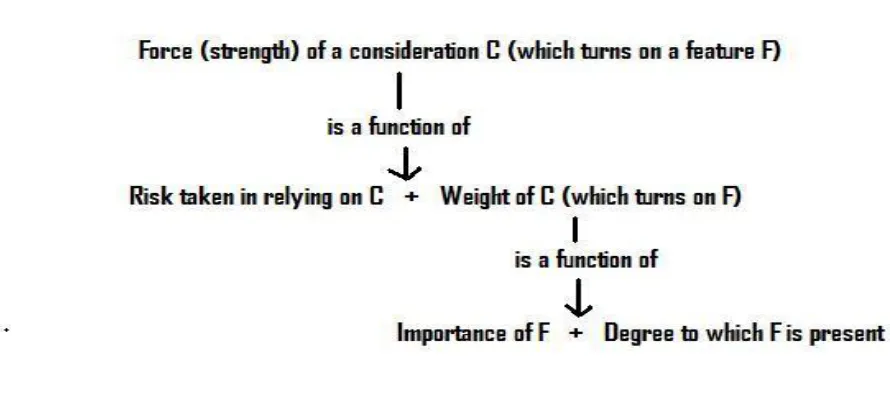
are all exposed, the weight of a premise becomes a product of the importance of the
feature F on which it turns and the degree to which the premise makes F present.32 This
mimics the methods suggested in Scriven, where the degree to which the premise makes
F present is the value out of 10 given for the category and the importance dictates what
that value ought to be multiplied by, to set the importance of the category relative to the
others. The weight of the premise is only half the story though as it must then be
combined with the risk taken in assuming the premise.
The dimension of risk is not well explained by Pinto, but it seems to be a question
about the strength of the inference between the premise/feature and the conclusion to be
reached. This is in many ways redundant with the importance and degree-of-satisfaction
questions except that it is not asking the normative question (if you take importance to be
that) of how important the feature is, rather the logical question of how likely the
conclusion would be given the premise and feature on which it turns. It seems that it only
makes sense to ask either the risk or importance question but not both, depending on the
31
Scriven, Michael (1981). "Weight and Sum Methodology." In: American Journal of Evaluation. Vol. 85, No. 2. p. 88.
32
17
example. It is not clear why Pinto holds both questions to be relevant, rather than
combining them into one question, I believe this is merely an unfortunate consequence of
the freshness of the study. The combination of the weight and the risk, Pinto calls the
Force or strength of consideration C (which turns on a feature F).33
Figure 1.134
The language this theory uses is difficult to process since Pinto recommends
reinterpreting premises away from their original text towards considering primarily the
features on which premises turn. This was designed to help categorize pro and con
considerations which speak directly against each other from those that speak indirectly
against each other. Premises speak directly against each other if they disagree within a
particular feature on the topic, and indirectly if they disagree across different features.
For instance, two premises that argue for and against speeding being dangerous could be
easily analyzed as arguing directly against each other within a single feature, while
premises that state speeding is dangerous and speeding is time efficient speak indirectly
33
Pinto, Robert (2011), p. 120. 34
18
against each other towards the decision of whether or not to speed. Let us work through
an example of how to apply this theory.
Ex. 1.1 P1 Speeding leads to a higher chance of fatalities in accidents. C P2 Speeders do not get in more accidents than non speeders. P
P3 Speeding is less fuel efficient. C
P4 Speeding will save a significant amount of time. P C I should/should not speed.35
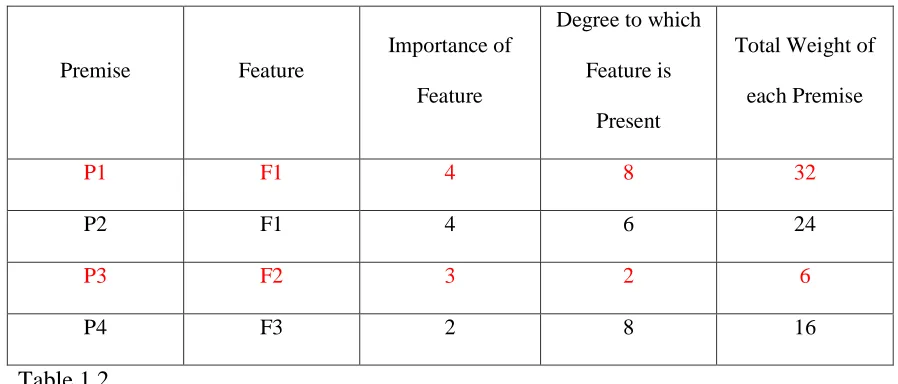
This argument would break down into features; F1 - Safety Concerns, F2 -
Financial Concerns, F3 - Time Concerns. Evaluating these premises is obviously subject
and context sensitive. Let us suppose someone evaluates them in the following way:
Premise Feature
Importance of
Feature
Degree to which
Feature is
Present
Total Weight of
each Premise
P1 F1 4 8 32
P2 F1 4 6 24
P3 F2 3 2 6
P4 F3 2 8 16
Table 1.2
The measures of importance and degrees to which each feature is present are
made relative to each other. The total weight of each premise or consideration is the
product of the importance of the feature on which it turns and the degree to which this
feature is present.36 Instead of using numbers as above, Pinto suggests that evaluations
35
All examples in this paper will be listed in the Appendix. 36
19
should be one of comparative degrees.37One should calculate the weight of each
consideration against the weight of some other consideration. These are evaluated on a
tiered scale including values, 'significantly more', 'more', 'slightly more' 'relatively
equal'.38 In this example we see how risk becomes redundant, there is no sense to asking
how strong the inference is between the premises or features and supposed conclusion
since it is merely a preferential question. The strength of the inference is essentially the
same as the strength of the weight of each consideration.
Pinto proceeds to give suggestions for how to combine differences in degrees of
risk and weight. The rules behind combining the two dimensions are all similar to the
following, "A marked difference in risk in favour of a less weighty consideration gives
slightly more force to the less weighty consideration, but only if the latter had only
slightly less weight than the weightier consideration."39 The other combinations explore
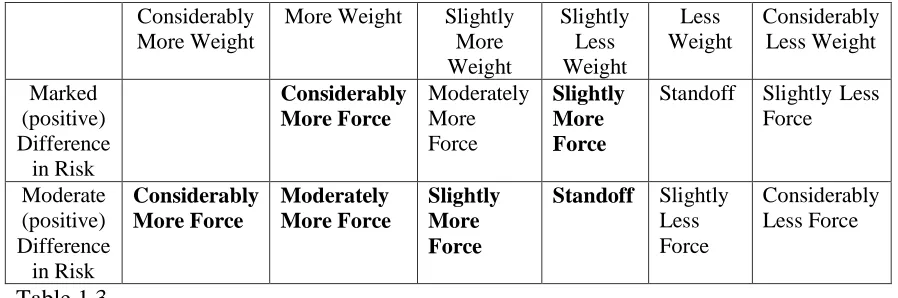
the other degrees to which the dimensions may be present. The chart below outlines how
to compare two considerations for and against an issue. Let the categories indicate the
amount of risk and weight that feature 1 holds relative to feature 2 which it speaks
against. Those in bold are stated explicitly by Pinto, I have taken the liberty to fill in
relationships that were not mentioned, following his intended relationship:
37
Relational evaluations he argues are far more coherent and defensible than applying some numerical evaluation. We often have the ability to accurately order considerations even though specific evaluations are arbitrary and erroneous. Pinto (2011), p. 121 (among other places)
38
Pinto (2011), p. 123. 39
20
Considerably More Weight
More Weight Slightly More Weight Slightly Less Weight Less Weight Considerably Less Weight Marked (positive) Difference in Risk Considerably More Force Moderately More Force Slightly More Force
Standoff Slightly Less Force Moderate (positive) Difference in Risk Considerably More Force Moderately More Force Slightly More Force
Standoff Slightly Less Force
Considerably Less Force
Table 1.3
The above chart takes the two dimensions as being roughly equally relevant to the
overall force of the argument. If we take example 1.1 again, to reach the conclusion let us
take the collection of considerations that support speeding against those that do not. It
seems we should say either that the considerations implying that we should speed are
slightly weightier or equally weighty to considerations that we should not speed.40 If we
say that the risk is equal between the two considerations then the conclusion as to the
force is the same as the weight.
This method was only developed to deal with conductive arguments but it gives
an interesting suggestion for a method that may be translatable into more standard
argumentation evaluation. If, instead of battling against each other, we were developing a
method for combining the weights and risks of premises that work with each other then
we may have a method to evaluate the relationships between premises. Of course the
table above does not give answers relevant to these new questions; the table would have
40
21
to be reconstructed to suit the new pursuit. What we would be able to preserve is the
general methodology for combining multiple tier based scales and the language of risk,
weight, and force.
There are however good reasons to resist using this language to develop a theory
around. Aside from the problems with the separation of risk from weight, difficulties
arise from the language shift from premises to features. This shift merely adds another
layer of difficult questions. It is not at all easy in many arguments to break down
premises into the features on which they turn.This can only hurt argument analysis by
pushing the content of the analysis further from the actual argument. It is not at all
obvious how to apply features to many arguments.
A better foundation for a tiered system is partially suggested by Robert Yanal. He
describes two parameters of evaluation as the strength of evidential support and the
accuracy of the evidence. This involves a two question process: First, how well does the
evidence (the premise) support the conclusion? Secondly, is the premise true?41 Yanal
breaks down the first question into a scale of responses that allow for the conclusion to be
deductively valid, strong medium or weakly supported by the premise.42 This he labels
the degree of validity. The second question is called the truth of the premise(s), and is
unfortunately restricted in Yanal's theory to rendering only yes or no responses.43
It is interesting that theorists have often restricted premise acceptability to this
duality, even when the inference strength admits of degrees. In argumentation, an
epistemic evaluation as to the acceptability of a premise is not a question of whether it is
41
Yanal, Robert (1988). Basic Logic. Thomas Learning. p. 72. 42
Yanal, Robert (1988), p. 76. 43
22
actually true or false, it is instead a measurement of the audience’s willingness to accept
it as true. It seems reasonable to say that an audience judges an argument both on the
acceptability of the premises and the strength of the inference to the conclusion and that
these two parameters admit of varying quantities.
The tiered evaluation would then ask the two questions; 1) To what degree is the
premise acceptable, and 2) To what degree does the premise, if true, support the
conclusion. The degrees for question two were discussed above, question one could be
answered in terms of 'very likely', 'moderately likely', and 'slightly likely'. Whether these
responses are made independently for each premise or, like with Pinto's strategy, merely
an ordining between the premises can remain an open question.
A method for working with a tiered system of evaluation would then mimic the
one explored by Pinto above. To find the overall strength of a premise, a piecewise
formula or chart would have to be given, stating the overall weight of a premise given
each combination of degrees available between these two parameters. In theory one could
then use these degrees of weight to develop ways of combining multiple premises
together.
The short-comings of this theory are almost identical to its supposed strengths.
This lies in the intersection between ARS theories and a numerical assessment of weight
hoping to borrow the strengths from both perspectives. A tiered system hopes to provide
a more detailed approach and accessible tools for argument analysis over the standard
ARS theory while still avoiding running into overwhelming accuracy problems by
23
effective at deeper argument analysis while still attempting to preserve its everyday
argument analysis merits. Breaking down the strengths of premises into a limited number
of degrees will do little but provide rough pokes and sweeping statements about the
relationships between premises, the number of options for combining weights would
force details to be overlooked. Even with the evaluation of example 2.1 it seemed
necessary to revert back to the numerical assignments made originally.
1.6 Numerical Weight Assignments
The last of the approaches we will look at is one which evaluates arguments from
a numerical/probabilistic approach. Probability theory in mathematics is largely based on
Bayesian theories, and there have been multiple attempts to translate some of these
principles into argumentation analysis with limited success. Other alternatives to the strict
Bayesian theory have also been suggested. A first step to any of these approaches is the
ascribing of numerical values to the premises involved in an argument. This is obviously
difficult to do.
The reasons to be resistant to an approach along these lines are numerous. First, it
is right to be sceptical that a numerical evaluation of the probability of a premise in
natural language is possible, outside of perhaps some special cases. This stance has been
held by many theorists including Govier (2001), Wellman (1971), and Pinto (2011).
Almost no premises naturally carry probabilities and so in order to apply a probabilistic
approach to natural language arguments, a method must be adopted to ascribe values to
situations. Any theory that attempts this will have a difficult time justifying itself. What
makes a premise 80% probable towards the conclusion rather than 85%? If the method
24
chance of the conclusion given the premise' as it appears it must, then the criticism
becomes that such intuitive notions are never as specific as a number implies. Using
numbers creates a false sense of absoluteness and can allow erroneous consequences to
be reached by relying on them.
A second problem is that formulas that work with numbers do not naturally
translate from probability theory or fuzzy logic into natural language reasoning. There is
no coherent system that could be put in place to talk about how to combine probabilities
of premises towards a conclusion. If two premises hold probabilities P1 and P2 and
support the same conclusion, how do we reach the probability of the conclusion? This
cannot be simply added since each individual probability may be over 50% and yet
together still not prove the conclusion. No matter how this issue is resolved, there is no
hope of developing a universal system that could act as more than a metaphor for
combining these epistemic numbers.
One last concern is whether attempting this approach is falling into the same
errors as deductivism. Kevin Korb asks, "If the methods of deductive logic are relatively
useless for understanding natural language arguments or scientific reasoning, why should
we believe that the formal methods of probability calculus can do any better?"44 After all,
probability calculus is formal as well, while human reasoning is not. Korb defends a
probabilistic analysis of natural language arguments in the face of all these criticisms by
arguing that such formal quantitative tools can shed some light on semi-formal reasoning
even if it is not a complete method for evaluation.45
44
Korb, Kevin (2004). p. 49. 45
25
The criticisms above do perhaps give good reason to avoid a numerical approach
to evaluation as an everyday approach that is to be applied and taught. It may however
remain a very useful tool for our purposes of prying deeper into the study of the field, so
long as we remember its limitations.46 If, for example, we were to assume explicit
probabilities for premises in an argument then it may be possible to reach a formula for
the appropriate way the premises affect one another in a given situation. Such a formula
would be wonderfully detailed for the discussion, even though it likely would hold no
practical purpose, since no justification for the formula or way of universalizing the
theory is possible. Moving forward we will hold that such formulas are to be considered
metaphorical for the relationships being described and are useful to that capacity - that
they suggest a non-literal resemblance in the actual relationship.
In some situations we may simply assume explicit probabilities in connection
with the premises. In other situations it may be useful to develop some way of assigning a
numeric value to the weight of a premise. In this pursuit we may employ the same
terminology we developed for Yanal's tiered weight section; that a premise is to be
evaluated first in terms of its acceptability, secondly on the strength of the inference to
the conclusion. Each question should be evaluated numerically between 0 (weakest) and
1 (strongest). Let us formalize this language. Weight of Acceptability of premise X (Wax)
is the degree to which an audience member is willing to accept a premise [0≤x≤1].
Weight of Relevance47 of premise X (Wrx) is the degree to which the premise supports
46
The evaluation is meant to reflect the subjective position of the audience member relative to his or her epistemic state. The closer these evaluations can be kept to this subjective concern the safer it will be from misuse.
47
26
the conclusion if the premise is accepted [0≤x≤1]. The Weight of the premise X48 (Wx)
then is the product: Wx= Wax*Wrx.
This should fit with our intuitions on this question. If Jimmy told me that it is
snowing outside, in support of the conclusion that there is snow outside; Wrx=1,
Wax=0.9, Wx=0.9. The premise is as strong in support of the conclusion as it is believed
to be true. If I see Jimmy's wet boots after he comes inside; Wrx=0.6, Wax=1, Wx=0.6.
The premise is as strong to the conclusion as it is relevant to the conclusion. If I hear the
squishy sound of Jimmy tracking water into the house; Wrx=0.6, Wax=0.7, Wx=0.42. Of
course the weight isn't exactly 0.42, whatever that means, it implies the weight is lower
than the weight of the individual questions, and roughly proportional to the factor of
them. If we held a single premise argument then the weight for the conclusion would be
the same as the weight of that premise.
The next question is obviously, how do we reach the Weight of the Conclusion
(Wc) in arguments with more than one premise? Even though premises only hold weight
in relation to a conclusion, the conclusion itself carries a weight of its own which is the
combination of the weights of all the premises in the argument. As I have been asserting,
this is not just a question of the respective weights of the premises involved but also the
relationship that the premises share in a given situation. Illuminating these metaphorical
formulas is then the overall focus of the rest of this investigation.
48
27
1.7 Conclusion
It is interesting to note that the two different motivations behind finding a theory
of evaluation seem almost negatively relevant to one another. That is, the better a theory
is for everyday argument evaluation, the worse the theory seems to be for investigating
the deeper questions of argument analysis.
It is useful and very likely necessary for the rest of this discussion to adopt a
weight based method of evaluation. Further, I have argued that actual numbers as weights
being assigned to premises may help highlight relationships that exist between premises.
Using numbers can be helpful so long as it remains understood that these are tools used to
uncover metaphorical formulas for what the actual relationship being describedis. A
difficult question to discuss later will be how to translate these discoveries out of
28
Chapter 2 - Linked vs. Convergent Tests
The linked convergent distinction is the main distinction that is commonly made
about the relationship between premises in relation to a conclusion. This distinction is so
widespread that it can be found in almost all modern textbooks on argumentation theory.
Despite its place as a cornerstone of argumentation theory it is very underdeveloped and
problematic. Most of the academic debate on the subject is stuck resolving the difficulties
behind defining this distinction. Although it has often been said that whether two
premises are linked or convergent can be intuitively understood, even if a particular
definition fails to perfectly draw the line, through investigating difficult cases we see that
different theorists differ greatly even in their intuitions about straight forward cases.
This chapter will investigate the different definitions that have been proposed and
the numerous counter examples that have been brought forward to cast doubt about each
of them. Furthermore, it will highlight how the different definitions reflect different ways
of interpreting the distinction. Some people have begun to question the legitimacy of the
distinction, arguing that it is merely arbitrary and inherently problematic and should
therefore be abandoned. I will evaluate these claims and decide if this popular distinction
is salvageable. This investigation will continue to be one designed around epistemic
argument evaluation, how an individual audience member should come to decide how
persuasive they find the argument.
There have been many common things said to describe the linked-convergent
distinction in the past: ‘two premises fill in/do not fill in each other's logical gaps’, ‘two
premises are in the same line of reasoning/separate lines of reasoning’, ‘two premises are
29
conclusion’. The problem with any of these common sayings is that they do not give any
hints on how to handle difficult cases. There is no way to know explicitly what is meant
in each definition. For example, here is one common type of argument49 which cannot be
clearly said to be linked or convergent using the previous characterizations of the
distinction:
Ex. 2.1 P1 Crow 1 is black. P2 Crow 2 is black. .
. .
PN Crow N is black. C All crows are black.
The premises here build off of each other to develop the conclusion and yet any
single observed crow could be disregarded and the conclusion still supported. It is
therefore difficult to decide whether this should be linked or convergent. This shows the
need to find an explicit definition or test in order to properly apply the linked/convergent
distinction, to know if two premises in a particular argument are to be identified as
convergent or linked. No matter how or where this distinction is to actually be, if it is a
real distinction to be made then there must be some sort of reliable line on which to draw
it. So far there have been three main candidates for such a test. We shall call these; the
irrelevancy test, the insufficiency test, and the degrees of support test.Within these tests
there are different variations, and a few more rogue attempts. Let us go through each of
these tests in turn, examining the different expressions of the test and problematic cases
that arise.
49
30
2.1 Irrelevancy Test
The first test is the irrelevancy test. This is the most popular test in argumentation
text books likely because it is the simplest in its formulation. Copi, Cohen and McMahon
endorse such a test in Introduction to Logic.50 Douglas Walton summarizes this test as;
"Assume the first premise is true and the second premise is false, and ask: `Does
theconclusion have any support at all?' Assume the second premise is true and the
first premise is false and ask: `Does the conclusion have any support at all?'"51
Here the test centreson the question of whether both premises are required to form
a reason to accept the conclusion. If the answer to either of these earlier questions is yes,
if one of the premises is capable of supporting the conclusion, then the premises are
convergent.52 If neither of these give a positive response then the premises need each
other and are linked, assuming thattogether they do provide some support. Walton calls
this the falsity/no support test.53 Copi et al. ask for a strong version of this test, that
neither premise be capable of standing on its own. Alternatively one may argue for a
weak interpretation, where only one of these premises must fail the test to be considered
linked. These particular tests ask that one premise be considered false in considering its
effect on the other premise, a slight variation of this test is to ask instead if one premise
were suspended or simply not known to be true, does the other still lend any support?
This alternative was once supported by James Freeman who asks, "If we knew that just
one of the premises were true, and had no knowledge of the other, would we see why that
50
Copi et al. (1990). Introduction to Logic,EighthEdition. NY: Macmillan. p. 20. 51
Walton, Douglas (1996). Argument Structure A Pragmatic Theory. Toronto: University of Toronto Press. p. 110.
52
Walton, Douglas (1996) p. 110. 53
31
premise was relevant to the conclusion? If we blocked the other premise completely out
of our mind, would we see why the first still gave a reason for the conclusion?"54
Relevant here means only that a premise gives some justification towards the conclusion.
This test is called the suspension/no support test and is usually taken to be a weak version
of the test, if either one of the premises can give any support towards the conclusion
under the suspension of the other then it comes out as convergent. Let me summarize the
definition for these four tests:
Suspension/No Support Test (Weak)
Two premises, P1 and P2, of an argument, {P1, P2} -> C, are linked with one another iff suspending P1, P2 is no longer positively relevant to C OR suspending P2, P1 is no longer positively relevant to C. P1 and P2 are convergent iff suspending P1, P2 is still positively relevant to C AND suspending P2, P1 is still positively relevant to C.
Suspension/No Support Test (Strong)
Two premises, P1 and P2, of an argument, {P1, P2} -> C, are linked with one another iff suspending P1, P2 is no longer positively relevant to C AND suspending P2, P1 is no longer positively relevant to C. P1 and P2 are convergent iff suspending P1, P2 is still positively relevant to C OR suspending P2, P1 is still positively relevant to C.
Falsity/No Support Test (Weak)
Two premises, P1 and P2, of an argument, {P1, P2} -> C, are linked with one another iff asserting P1 is false, P2 is no longer positively relevant to C OR asserting P2 is false, P1 is no longer positively relevant to C. P1 and P2 are convergent iff asserting P1 is false, P2 is still positively relevant to C AND asserting P2 is false, P1 is still positively relevant to C.
Falsity/No Support Test (Strong)
Two premises, P1 and P2, of an argument, {P1, P2} -> C, are linked with one another iff asserting P1 is false, P2 is no longer positively relevant to C AND asserting P2 is false, P1 is no longer positively relevant to C. P1 and P2 are convergent iff asserting P1 is false, P2 is still positively relevant to C OR asserting P2 is false, P1 is still positively relevant to C.
54
32
These four tests are very similar and shall all be put under the heading of 'no
support tests'. Some theorists take the privilege of employing either test, depending on
which seems more appropriate in a given situation. In particular Trudy Govier has been
seen arguing in some instances in favour of the falsity version55 while in other places
defends a suspension/no support test or states the test in such a way that either test may
be endorsed.56 In Groarke and Tindale's text book, Good Reasoning Matters!, the
suspension/no support test is employed in practice yet it is not explicitly endorsed,
leaving room for the falsity/no support test to be adopted should it be needed.57
There are some small differences between these two tests. In situations where one
premise acts as an explanation of the relevancy of the other premise, the falsity test will
show the argument to be linked while the suspension test will usually call it convergent:
Ex. 2.2 P1 Jim used someone else's work without citation. P2 This event violated the school's plagiarism policy. C Jim should be punished.
This example gives different results from these two tests. If the second premise is
suspended, it is still reasonable to accept that the first premise supports the conclusion
independently. In this situation there is a background belief available that usually when a
person uses other people's work without citation they are breaking the school's plagiarism
policy and therefore should be punished. If, on the other hand, the second premise is
considered false, if this use of others' work were not for some reason a violation of the
school's plagiarism policy, then the conclusion would no longer be supported. The
audience would reason that this use of another's work was some legitimate exception to
55
Govier, Trudy (1985). A Practical Study of Argument. Belmont, CA: Wadsworth. p. 131. 56
Govier, Trudy (1985), p. 126. 57
33
the background belief. Examples of this type are usually assumed to be linked and
therefore the falsity test fares better in these cases. The falsity test functions as a slightly
more rigorous test before labelling two premises convergent and it generally seems to
give the better results of the two across the wide set of challenge cases. However, the
suspension/no support test is still used often since it is easier to conceptualize blocking a
premise out of one's mind than drawing the implications of negating that premise and it is
usually sufficient in labelling premises as properly linked.
There are examples that can still be found to reject either of these no support tests.
These tests ask whether each premise is absolutely necessary for the other to be
considered relevant. Counter examples are numerous as there are many situations which
intuitively seem to be linked and yet, even when one of the premises is assumed to be
false, the other can still be argued to give some support to the conclusion:
Ex. 2.3 P1 This book is on Physics. P2 This book is on Chemistry.
C Neither of these books is on philosophy.
Ex. 2.4 P1 Pigs are mammals. P2 No mammals lay eggs. C Pigs don't lay eggs.
These are just a couple examples where the two premises work together to reach
the conclusion although having both premises is not completely necessary to reach the
conclusion. In Ex. 2.3, even if the first book were not on physics, there is small reason to
believe that it is therefore on philosophy, and so the conclusion remains supported. In 2.4
we see that P2 is in fact false, there are some known mammals that lay eggs. Nevertheless
the vast majority of mammals do not lay eggs and so P1 is still a strong reason to accept
34
The important thing to realize is that we are considering these examples under the
no support tests, which ask if any support at all remains if one of the premises is
considered false. Obviously the amount of support for the conclusion is diminished if one
premise is taken away but that is not the nature of the test here. In response to these
problems a new line of tests were proposed. Rather than asking, after removing a
premise, if the remaining premise provides any support at all, perhaps the question of
linkage is whether the amount of support is significantly affected.
2.2 Insufficient Evidence Test
What it means for the support to be significantly affected is a difficult question.
One solution is that it is the difference between a conclusion being adequately supported
or not. Let us call these tests the 'insufficient evidence' tests. They ask if one of the
premises were suspended or assumed false, would the other premise still provide
sufficient support. This test has been especially endorsed in dialectical theories,
specifically Van Eemeren and Grootendorst.58 Convergent arguments, or as they call it
'multiple argumentation' is when there are several premises present and each is sufficient
to reach the conclusion:59
Ex. 2.5 P1 Jake didn't have a ride to the theatre. P2 The movie wasn't playing.
C Jake did not see the movie.
58
Van Eemeren, F. H. and Grootendorst, Rob (1984). Speech Acts in Argumentative Discussions. Dordrecht and Cinnaminson: Foris.
59