Robust Visual Moving Object Detection,
Tracking and Speed Estimation of
Progressively Denoised Video in Real Time
Madhuri R.Jadhav, Prof.Shamala R.Shewale
Student II Year M.E, Dept. of E & Tc, J.J.M.C.O.E., Jaysingpur, India
Associate Professor, Dept. of E & Tc, J.J.M.C.O.E., Jaysingpur, India
ABSTRACT: Image denoising continues to be an active research topic in the field of image processing.The denoising methods approach is numerically impressive but they suffer from visible artifacts. The current methods which are used are more complex for analysis, and implementation is also difficult.Theproposed image denoising method which progressively reduces noise by deterministic annealing. The results of implementation are numerically and visually excellent. The new perspective of Robust Estimator is also implemented.The focus of this paper is to alsodesign an algorithm to track a moving object and its speed estimation.
KEYWORDS: Image denoising, robust estimation, deterministicannealing, bilateral filtering, short-time Fourier transform
I. INTRODUCTION
Modern digital technology has made it possible to analyse multi-dimensional signals with systems that range from simple digital circuits to advanced parallel computers. Image processing is processing of images using mathematical operations by using signal processing which is having the input is an image, such as a photograph or video frame and the output of image processing may be either an image or a set of characteristics or parameters related to the image.
During acquisition and transmission, images are is the most severe one.Image denoising is the process of reconstruction of the original image from a noisy image. The noise may be produced by definitely contaminated by noise. As an essential and important step to improve the accuracy of the possible subsequent processing, image denoising is highly desirable for numerous applications, such as visual enhancement, feature extraction and object recognition [1] [2]. In image processing, the image denoisingproblem noise contamination through an analog process during acquisition or transport over analog media. Image has been contaminated with additive white Gaussian noise (AWGN) is the most common simplifying assumption. It is assumed that the noise is stationary and uncorrelated among pixels and the variance of the noise is known. There are different approaches for quantitative and qualitative analysis of algorithms for different types of noises like AWGN, Salt & pepper noise, Poisson noise.
After denoising the data in image processing, moving object detection in real time is a challenging task in visualsurveillance systems. It often acts as an initial step for further processing such as classification of the detected moving object. Object tracking plays an important role in many applications, such as video surveillance, human– computer interface, vehicle navigation, and robot control. It is generally defined as a problem of estimating the positionof an object over a sequence of images. In practical applications, however, there are many factors that make the problem complex, such as illumination variation, appearance change, shape deformation, partial occlusion, and camera motion. In order to accomplish such a challenging task of detection, a number of tracking algorithms [3]–[8] and real-time working systems [9]–[14] have been developed in recent years.
II. RELATED WORK
S. M. M. Rahman, M. O. Ahmad, and M. N. S. Swamy presented the paper “Video denoising based on inter-frame statistical modeling of wavelet coefficients” [1] in which it was proposed that a joint probability density function to model the video wavelet coefficients of any two neighbouring frames and then apply this statistical model for denoising. The joint density function was employed for spatial filtering of the noisy wavelet coefficients by developing a bivariate maximuma posterior estimator. Simulation results on test video sequences show an improved performance both in terms of the peak signal-to-noise ratio and the perceptual quality compared to that of the other denoising algorithms.
F. Luisier, T. Blu, and M. Unser presented in the paper “SURE-LET for orthonormal wavlet domain video denoising” [2] anefficient orthonormal wavelet-domain video denoising algorithm based on an appropriate integration of motion compensation. The simulations made onstandard grayscale video sequences for variousnoise levels demonstrate the efficiency of the proposed solution in reducing additive white Gaussian noise. By using a cycle-spinning strategy, this algorithm was in fact able to outperform above methods.
The goal of the article “Object tracking: A survey” [3] by A. Yilmaz, O. Javed, and M. Shahwas to review the state-of-the-art tracking methods, classify them into different categories, and identify new trends.In this survey, the tracking methodswere categorized on the basis oftheobject and motion representations used, provided detaileddescriptions of representative methods in each category, and examined their pros and cons, also discussed important issues related to tracking including the use of appropriate image features, selection of motion models, and detection of objects.
The proposed work was based on a spatial-colour mixture of Gaussians (SMOG) appearance model for particle filters. This improved on the popular similarity measure based on colour histograms because it considered not only the colours in a region but also the spatial layout of the colours. Hence, the SMOG-based similarity measure was more discriminative.H. Wang, D. Suter, K. Schindler, and C. Shen in the paper “Adaptive object trackingbased on an effective appearance filter” [4] proposed a new technique to efficiently compute the parameters for SMOG, with which the computational time was greatly reduced.
This paper “Online selection of tracking features using AdaBoost” [6] by Y.-J. Yeh and C.T. Hsu presented an online feature selection algorithm for video object tracking. Using the object and background pixels from the previous frame as training samples, the feature selection problem was modelled as finding a good subset of features to better classify object from background in current frame. The main aim was to improve existing methods by taking correlation between features into consideration. Experimental results demonstrated that the proposed algorithm combined with mean-shift based tracking algorithm achieved very promising results.
Particle filters maintain multiple hypotheses simultaneously and use a probabilistic motion model to predict the position of the moving object, and this constitutes a bottleneck to the use of particle filtering in real-time systems.J. U. Cho, S. H. Jin, X. D. Pham, J. W. Jeon, J. E. Byun, and H. Kang, proposed in “A real-time object tracking system using a particle filter” [9] that, to track moving objects in real-time without delay and loss of image sequences, a particle filter algorithm specifically designed for a circuit and the circuit of the object tracking algorithm using the particle filter are proposed.
a new optical flow technique in the paper “Adaptive Optical Flow for Person Tracking” [15] that was based upon an adaptive background segmentation technique, which only determines optical flow in regions of motion.
In the paper “Moving objects segmentation using optical flow estimation” [16] by Ranchin, and F. Dibos, presented a new method for the segmentation of moving objects. One of the most powerful variational methods as used for computing the optical flow and we exploit this information in the segmentation. This segmentation lied on well-known techniques of active contours. The gray level was also taken into account to improve the quality of the segmentation.
L. Li, W. Huang, I.Y.H. Gu, and Q. Tian proposed in the paper “Foreground object detection in changingbackground based on colour co-occurrence statistics” [17] a novel method for detecting foreground objects in nonstationary complex environments containing moving background objects. A Bayes decision rule was derived for classification of background and foreground changes based on inter-frame colour co-occurrence statistics. An approach to store and fast retrieve colour co-occurrence statistics is also established.
III.PROPOSED WORK
A. Scope:
The main aim of the proposed workis to develop a method that can reconstruct the original image from noisy image with excellent results and to build a robust and novel moving object detection algorithm that can detect object in a varietyof challenging real world scenarios.The Progressive Image Denoising (PID) has very short algorithm. Despite its simplicity, the algorithm delivers high-quality results, outperforming other methods in denoising synthetic images [18]. PID algorithm has successfully fulfilled the need to denoise the synthetic images along with natural images.
There are various algorithms used for detecting moving objects.The proposed work having subtraction algorithm after performing noise removal for edge detection and calculating centroid, velocity and distance of moving object in the scene. Background subtraction is particularly a commonly used technique for motion segmentation in static scenes. This background subtraction model reacts quickly to changes in background and adapts itself to accommodate changes occurring in the background. It also has a good foreground detection rate and the processing time for background subtraction is real time.
B. Motivation:
To fulfil the requirement of natural as well as synthetic image denoising with good quality of results, Dual Domain Image Denoising (DDID) method is explored to PID and offers opportunities. PID method is a methodinspired by deterministic annealing and based on robust noise estimation to solve the complex optimization problems.
The Background subtraction technique attempts to detect moving regions by subtracting the current image pixel-by-pixel from a reference background image. Acommon approach is toperform background subtraction, which identifies moving objects from theportion of video frame that differs from the background [19].
C. Methodology:
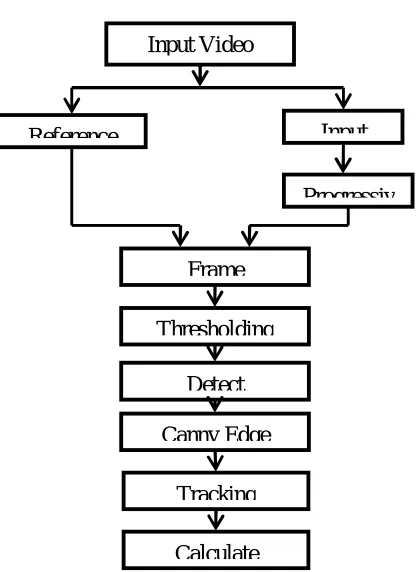
1. Working flow chart:
Fig No1.System Overview
2. Progressive Noise Removal
A signal has been contaminated with additive white Gaussian noise n and variance σ . This task decomposes the noise contaminated signal y into its original signal x and noise instance n.
y = x + n(1)
Many estimation problems are formulated as energy minimization problems. Thus, the denoising can be formulated as gradient descent as follows,
x = x−λ∇E(x) (2)
The gradient descent can be reinterpreted as a progressive removal of noise differentials, which can be Input Video
Reference Input
Progressiv
Frame
Thresholding
Detect
Canny Edge
Tracking
d, , =x, −x, (3)
The discrete Fourier transforms to obtain the masked signal in the frequency domainf , yielding the Fourier coefficients D, ,for frequency f as,
D, , = ∑ d, , k | , , | * k (
| |
)*e ( )(4)
4. Shape Shifting Estimator
The range parameter of the bilateral kernel exponentially decays over time like deterministic annealing. The exponential decay of the temperature works best.
The scale parameters Tand S as functions of time i:
T=σ ɤ α (5)
S = σ ɤ α(6)
5. Edge Detection
Edge detection is the first step to recover informationfrom images. A typical edge detector has the following steps: (a) it suppresses noiseas much as possible, without destroying the true edges, (b) it applies a filter to enhance the quality of the edges in the image, (c) it determines which edge pixels should be discarded as noise and which should be retained, (d) it determines the exact location of an edge.
6. Canny Edge Detector
The Canny edge detector is one of the most commonly used image processing tool to detect edges from image. It has the following steps:
Gray Scale Conversion
A gray scale digital image which carries only intensity information. To convert any colour to a grayscale representation of its luminance, the values of its red, green, and blue (RGB) primaries in linear intensity encoding, by gamma expansion are calculated.
Noise Reduction
The Canny edge detector uses a filter based on the first derivative of a Gaussian, because it is susceptible to noise exists in raw unprocessed image data.
Gradient Computation
The edge may point to different directions .The edge detection first derivative is obtained and the point ofmaxima is calculated.
D. Facilities Available :
Names of Hardware: Computer system. Names of Software: MATLAB
IV.SIMULATION RESULTS
Fig. 2, 3, 4 and 5 displaythe original image and denoised image after progressive image denoising process.The evolution starting with the noisy image. We used 10 iterations. Normally, a denoising output of an iteration step cannot be used as input for another step, as the output pixels are correlated an estimating the variance which would require expensive covariance tracking. But in this case, however, correlated noise in the spatial domain is decorrelated in the frequency domain and therefore no covariance tracking is needed.The PSNR increases fast in the beginning, and slows down as the noise becomes smaller. Fig. No. 5 shows thatnoisier image with PSNR 20.23dB. Fig. No. 4 shows better image with improved PSNR 20.42dB.And the fig. No. 3 shows approximately original image with PSNR 20.57dB after last iterationswhich shows PID works better for image denoising.
Original ImageNoisy Image (20.57dB) Noisy Image (20.42dB) Noisy Image (20.23 dB) Fig.No.2 Fig. No. 3Fig. No. 4 Fig. No. 5
V. CONCLUSION
We presented image denoising as a physical process, which includes a gradient descent performed by progressively estimating noise differentials and subtracting them iteratively from the noisy image. The second is robust kernels in two spatial domains. And third, the kernel scale parameters modifications. We also connected image denoising to statistical mechanics like deterministic annealing which gives near-optimal solutions. This algorithm is short and simple and delivers high-quality results for natural as well as synthetic images.
Our denoising approach impacts related problems like artifact removal, superresolution, and hole filling. Our denoising formulation is agnostic of dimensionality of the signal.
REFERENCES
[1] S. M. M. Rahman, M. O. Ahmad, and M. N. S. Swamy, “Video denoising based on inter-frame statistical modeling of wavelet coefficients,”
IEEE Trans. Circuits Syst. VideoTechnol.,vol. 17, no. 2, pp. 187–198, Feb. 2007.
[10] H. Medeiros, J. Park, and A. Kak, “A parallel colour-based particle filter for object tracking,” in Proc. IEEE Comput. Soc. Conf. CVPRW, pp. 1–8,Jun.2008.
[11] Z. Kim, “Real time object tracking based on dynamic feature grouping with background subtraction,” in Proc. IEEE Conf. CVPR,pp. 1–8,Jun.
2008.
[12] T. Ishiguro and R. Miyamoto, “An efficient prediction scheme for pedestrian tracking with cascade particle filter and its implementationon
Cell/B.E.,” in Proc. Int. Symp. ISPACS, pp. 29–32,Jan. 2009.
[13] E. Norouznezhad, A. Bigdeli, A. Postula, and B. Lovell, “Robust object tracking using local oriented energy features and its
hardware/softwareimplementation,” in Proc. 11th Int. Conf. Contr. Automat. Robot. Vision (ICARCV), pp. 2060–2066,Dec. 2010.
[14] S.-A. Li, C.-C. Hsu, W.-L. Lin and J.-P. Wang, “Hardware/software code sign of particle filter and its application in object tracking,” in
Proc.ICSSE, pp. 87–91,Jun. 2011.
[15] S. Denman, V. Chandran, and S. Sridharan,“Adaptive Optical Flow for Person Tracking”, inProc. Digital Image Computing: Techniques
andApplications, Cairns, Australia, pp.44-50,Dec. 2005.
[16] Ranchin, and F. Dibos, “Moving objects segmentation using optical flow estimation”, in Proc. Workshop on Mathematics and Image Analysis,
Paris, France, Sep. 2004.
[17] L. Li, W. Huang, I.Y.H. Gu, and Q. Tian, “Foreground object detection in changingbackground based on color co-occurrence statistics”, in
Proc. IEEE 6th Workshop Applications of Computer Vision, Florida, USA, pp. 269-274,Dec. 2002.
[18] Claude Knaus, Member, IEEE, and Matthias Zwicker, Member, IEEE, “Progressive Image Denoising”, IEEE Transactions On Image
Processing, Vol. 23, No. 7, July 2014.
[19] T. Malavika and M. Poornima, “Moving object detection and velocity estimation usingMATLAB”, in International Journal of Engineering