NONLINEAR FEEDBACK FOR VEHICLE YAW STABILITY SYSTEM
MOHD HANIF BIN CHE HASAN
iii
NONLINEAR FEEDBACK FOR VEHICLE YAW STABILITY SYSTEM
MOHD HANIF BIN CHE HASAN
A project report submitted in partial fulfilment of the requirements for the award of the degree of
Master of Engineering (Electrical-Mechatronics and Automatic Control)
iv
ACKNOWLEDGEMENT
First of all, thanks to Allah, god and creator of this universe for His blessing in accomplishment of this research project. I would like to express my gratitude to my supervisor, Associate Professor Dr Yahaya bin Md. Sam for his guidance and support. Also special thanks to Universiti Teknikal Malaysia Melaka as my employer for funding my study.
ABSTRACT
Vehicle stability control (VSC) is one of important topics in vehicle dynamics and active automotive control. This research is focusing on vehicle stability control by active steering system that utilizes steering control method to improve stability of the vehicle. This stability control system is solely based on kinematic and dynamics motion of vehicle. The development of mathematical model of vehicle dynamic that includes body and tyre dynamics is one of the most important steps to make sure the result obtain is close as possible to actual system. In the other hand, an analysis of transient state is very crucial in control system performance where one of the objectives is to track reference signal as fast as possible with minimum overshoot, fast settling time, and without exceed nature of actuator saturation limit. Hence, in order to achieve this target, a robust and high performance of control algorithm is essential for vehicle stability control. In this research project report, a Composite Nonlinear Feedback (CNF) strategy is used to control yaw rate of vehicle through active steering. Extensive computer simulation is performed with considering a various profile of cornering manoeuvres with external disturbance to evaluate its performance in different scenarios. The performance of the proposed controller is compared to conventional Proportional Integration and Derivative (PID) for
vi
ABSTRAK
Kawalan kestabilan kenderaan adalah salah satu topik penting dalam dinamik kenderaan dan kawalan aktif kerangka. Kajian yang dijalankan ini akan difokuskan pada kawalan kestabilan melalui sistem stering aktif yang menggunakan kaedah kawalan stering bagi memperbaiki kestabilan sesebuah kenderaan. Sistem kawalan kestabilan ini berasakan sepenuhnya kepada gerakan kinamatik dan dinamik sesebuah kenderaan. Pembinaan model matematik bagi dinamik kenderaan yang melibatkan dinamik keranka dan tayar adalah salah satu langkah penting untuk memastikan keputusan yang diperolehi adalah sehampir yang mungkin dengan sistem yang sebenar. Selain itu, analisis keadaan fana adalah sangat penting dalam prestasi sistem kawalan dimana salah satu objektif adalah menjejaki isyarat rujukan secepat mungkin dengan penghasilan telajak yang minimum, masa reda yang cepat, dan tanpa melepasi tahap tepu yang normal bagi sesebuah penggerak. Oleh itu, dalam mencapai sasaran ini algoritma pengawal yang mantap dan berprestasi tinggi adalah menjadi satu kemestian dalam kawalan kestabilan kenderaan. Dalam laporan kajian ini, strategi Komposit Suapbalik Tak linear (CNF) digunakan untuk mengawal kadar rewang kenderaan melalui kaedah stering aktif. Simulasi komputer yang ekstensif digunakan dengan mengambil kira pelbagai gerakan dan profil selekoh dan
juga gangguan luaran untuk menilai tahap kecekapan kawalan yang dibina dalam situasi-situasi berbeza. Kebolehan pengawal yang disyorkan akan dibandingkan
TABLE OF CONTENTS
CHAPTER TITLE PAGE
DECLARATION ii
DEDICATION iii
ACKNOWLEDGEMENTS iv
ABSTRACT v
ABSTRAK vi
TABLE OF CONTENTS vii
LIST OF TABLES ix
LIST OF FIGURES x
LIST OF ABBREVIATIONS xii
LIST OF SYMBOLS xiv
1 INTRODUCTION 1
1.1 Vehicle Stability 1
1.2 Project Overview 3
1.3 Objective of Study 4
1.4 Scope of Project 5
1.5 Research Methodology 5
1.6 Literature Review 8
2 SYSTEM MODEL 15
2.1 Introduction 15
viii
2.5 Reference Model 28
2.6 Type of Performance Test 30
2.7 Conclusion 32
3 CONTROLLER DESIGN 33
3.1 Introduction 33
3.2 Control Scheme and Objective 34 3.3 Composite Nonlinear Feedback 35
3.3.1 Basic CNF 36
3.3.2 Enhance CNF 39
3.4 Stability Analysis 44
3.4.1 Basic CNF Stability 45 3.4.2 Enhance CNF Stability 46
3.5 Conclusion 48
4 SIMULATION 49
4.1 Introduction 49
4.2 CNF Based Active Front Steering 49
4.3 Result and Discussion 52
4.3.1 J-Turn Manoeuvre with Disturbance 53 4.3.2 Single Sine Manoeuvres with Disturbance 57
4.4 Conclusion 66
5 CONCLUSION AND RECOMENDATION 68
5.1 Conclusion 68
5.2 Recommendation 69
LIST OF TABLES
TABLE NO. TITLE PAGE
2.1 Numerical data used for the vehicle (He 2005) 20 2.2 Numerical data used for the Pacejka tyre model 25 4.1 Numerical parameters for Basic and Enhance CNF
Controllers
51
x
LIST OF FIGURES
FIGURE NO. TITLE PAGE
1.1 Understeering and oversteering situations 3 1.2 Research methodology flow chart 6 2.1 Nonlinear two track yaw plane vehicle model 17 2.2 Wheel rotation motion on top and side view 19 2.3 Lateral Tyre Force versus tyre slip angle 23 2.4 Lateral Tyre Force in combined slip condition 24 2.5 Longitudinal Tyre Force in combined slip condition 24 2.6 Yaw rate response for three different approaches 29
2.7 J-Turn manoeuvre 31
2.8 Various amplitude of single sine steering manoeuvres 31 2.9 Side wind external disturbance 32
3.1 AFC steering actuation 34
3.2 AFC block diagram configuration 35 4.1 Actual and estimate value of disturbance 52 4.2 J-Turn input steer with disturbance 54
4.3 Side slip during J-Turn input with disturbance 54 4.4 Yaw rate during J-Turn input with disturbance 55
4.5 Tracking error of yaw rate during J-Turn input with
disturbance 55
4.6 Active steer (controller output) during J-Turn input with
disturbance 56
4.9 Yaw rate during 2° single sine amplitude with
disturbance 59
4.10 Tracking error of yaw rate during 2° single sine
amplitude with disturbance 59
4.11 Active steer (controller output) during 2° single sine
amplitude with disturbance 60 4.12 Input for 3.1° single sine amplitude with disturbance 60 4.13 Side slip during 3.1° single sine amplitude with
disturbance 61
4.14 Yaw rate during 3.1° single sine amplitude with
disturbance 61
4.15 Tracking error of yaw rate during 3.1° single sine
amplitude with disturbance 62 4.16 Active steer (controller output) during 3.1° single sine
amplitude with disturbance 62 4.17 Input for 7.1° single sine amplitude with disturbance 63 4.18 Side slip during 7.1° single sine amplitude with
disturbance 64
4.19 Yaw rate during 7.1° single sine amplitude with
disturbance 64
4.20 Tracking error of yaw rate during 7.1° single sine
amplitude with disturbance 65 4.21 Active steer (controller output) during 7.1° single sine
amplitude with disturbance 65 4.22 Yaw rate during 7.1° single sine amplitude with
xii
LIST OF SYMBOLS
- Wheel steering angle - Braking torque at ith wheel
- Vehicle velocity at centre of gravity - Vehicle side slip angle
- Vehicle yaw rate
- Desired vehicle yaw rate - Sideslip angle at ith wheel
- Tyre longitudinal slip ratio at ith wheel
- Tyre ground contact point velocity at ith wheel - Tyre rotational speed at ith wheel
- Longitudinal tyre force at ith wheel
- Lateral tyre force at ith Wheel
- Tyre normal load at ith Wheel
- Nominal tyre cornering stiffness at front wheel
- Nominal tyre cornering stiffness at front wheel
- Distance from the vehicle center of gravity to the front axle
- Distance from the vehicle center of gravity to the rear axle
- Wheel base of vehicle T - Track of vehicle
h - Vertical distance from CG of sprung mass to roll axis - Moment of inertia of car body
- Wheel moment of inertia
R - Tyre radius
m - Total mass of the vehicle
- Steering wheel ratio - Gravity = 9.81 m/s-2
- Nonlinear locally Lipschitz function - Linear state feedback of CNF
- Nonlinear state feedback of CNF
- 1st nonlinear parameter gain of CNF - 2nd nonlinear parameter gain of CNF
! - State equilibrium point
" - Reference signal of control system
xiv
LIST OF ABBREAVIATIONS
VSC - Vehicle Stability Control ASC - Active Steering Control AFS - Active Front Steering ESP - Electronic Stability Program DYC - Direct Yaw Moment Control FWS - Front Wheels Steering 4WS - Four Wheels Steering
CNF - Composite Nonlinear Feedback PID - Proportional Integration Derivative SMC - Sliding Mode Control
ISM - Integral Sliding Mode LQR - Linear Quadratic Regulator MPC - Model Predictive Control
LMI - Linear Matrix Inequalities QFT - Quantitative Feedback Theory DOF - Degree of Freedom
CG - Center of Gravity
SISO - Single Input Single Output MIMO - Multi Input Multi Output
IAE - Integral of Absolute Error
CHAPTER 1
INTRODUCTION
1.1 Vehicle Stability
Safety factor is very important issue in vehicle design and handling. Vehicle safety system can be divided into two parts, which are passive and active safety system. Passive safety technologies can be seen such as belts, safety glass, and air bags. The systems are designed to prevent or reduce the damage to the pedestrians, passengers, and the vehicles involved after the accident has occurred. Meanwhile, in driver assistance and active safety system have received much attention from researcher because it can prevent vehicle from accident. Their development is continuously conducted to meet current demand that always keep increasing on the safety of vehicles. For example, vehicle stability control (VSC), collision avoidance
(CW/CA), smart cruise control (SCC), lane keeping support, lane change assistance and collision warning, and automated parking assistance have been extensively
studied with many developments that have been explored since the 1990s (Yu et al. 2008).
2
so that a ground vehicle will have a better stability and handling quality which can provide safety and comfort driving for the driver. Vehicle stability control (VSC) is one of the important topics in vehicle dynamics and active chassis control and purposely to maintain the vehicle keep on the road or desired track/path where lateral
force that exists in vehicle dynamic motion has great influence to the vehicle stability.
Yaw stability control system that purely based on kinematic and dynamics motion of vehicle is one of lateral control system that has been developed by researchers. The main objectives of vehicle yaw stability control are to control the yaw rate, vehicle sideslip or combination of them. Two major approaches of yaw stability control are using active steering control (ASC) and direct yaw moment control (DYC) that based on braking system such as active differential or active braking. A dynamic motion of vehicle is very nonlinear due to its robustness of uncertainties characteristics and disturbance that have great influences to vehicle stability. Hence, in order to cater this problem, a robust control algorithm is essential for vehicle stability control. These systems are believed to reduce the risk of accidents, improve safety, and enhance comfort and performance for drivers. The introduction of these new advanced driver assistance and active safety systems open new possibilities in accident prevention.
Active steering is an effective tool and most popular to control vehicle handling in where active front steering type has attracted more and more attention.
Originally, this technology developed by German BMW Company and ZF Lenksysteme GmbH Company in 2003 as optional equipment for BMW vehicle from
1.2 Project Overview
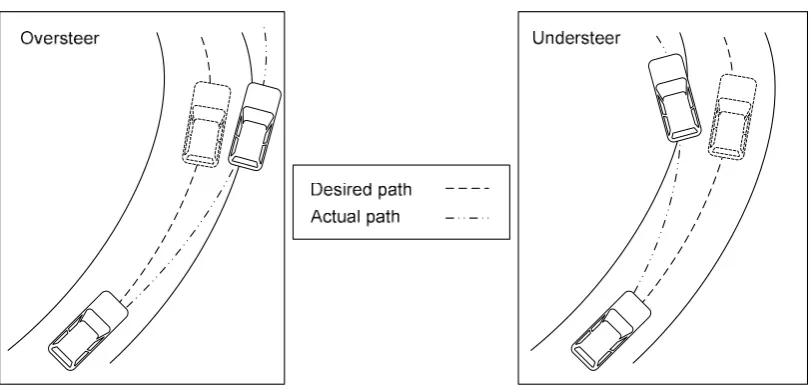
In vehicle stability control, there are two common situations of vehicle dynamic during unstable condition that called understeering and oversteering as shown in Figure 1.1. Others possible situation occurred when vehicle disturbed by side wind and split road coefficient. All these conditions can be controlled by using Active Steering, Differential Braking, Traction Control, Active Suspension, or combination of these strategies.
Figure 1.1 Understeering and oversteering situations
4
this will force the driver to an evasive action. The inexperienced driver who caught in this kind of situation will easily overreact and destabilizes the car.
The aim of this study is to use CNF based active front steering control for vehicle yaw stability control of typical passenger cars for general some cornering manoeuvres with external disturbance. A vehicle control system using a 2 DOF controller that based on Composite Non-Linear Feedback (CNF) algorithm, will be proposed to enhance vehicle stability and improve system response especially during transient state.
1.3 Objective of Study
This research embarks on the following objectives: I. To establish the dynamics modelling of vehicle.
II. To propose an Active Front Steering (AFS) based on Composite Nonlinear feedback (CNF) for Vehicle Stability Control (VSC).
III. To enhance performance of Vehicle Yaw Stability by using the proposed controller.
To achieve these objectives, various parameters involved such as vehicle construction parameters, tyre coefficient, and velocity will be considered. The
extensive computer simulation that will be performed using MATLAB software and SIMULINK Toolbox subjected to various types of test manoeuvres and disturbance.
1.4 Scope of Project
The research work carry out in this project are concentrated to the following aspects: I. Mathematical modelling of vehicle body and tyre dynamic vehicle using
Matlab Simulink.
II. Implementation of Composite Nonlinear Feedback (CNF) control scheme for Active Front Steering (AFS) control in vehicle yaw stability system.
III. Simulation, validation and analysis of the Composite Nonlinear Feedback (CNF) performance based Active Front Steering (AFS) method.
IV. Evaluation of Composite Nonlinear Feedback (CNF) based Active Front Steering (AFS) control performance with Proportional Integral Derivative (PID) control strategy.
Research in vehicle stability is very wide to be explore, so some parameter need to be ignored without scarifies important factors involved in this CNF based active front steering research.
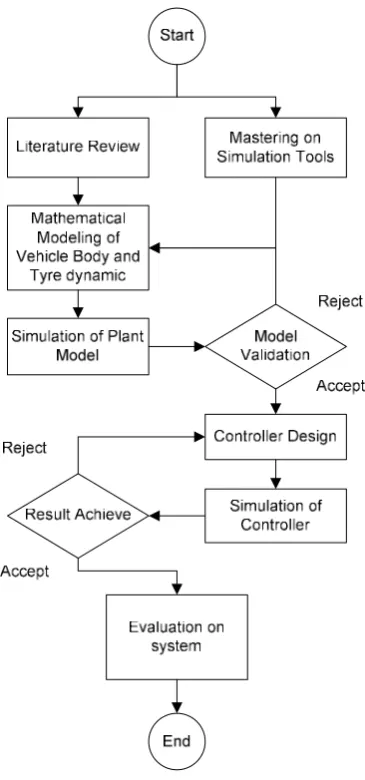
1.5 Research Methodology
6
Figure 1.2 Research methodology flow chart
The next step for this research is development of plant model. On this stage, car model based on two-track yaw plane have been carried out. Vehicle modelling contains body and tyre dynamics. A car body dynamic with 7 Degree of Freedom
(DOF) will be constructed to model a vehicle as closed as actual one. Tyre dynamic model also is considered and in this research, Magic Formula is used in tyre modelling due to it is widely used by researchers. This research will be stressed on a dynamic mathematical modelling of vehicle and CNF control algorithm. The performance of proposed controller then will be evaluated by different types and level of car manoeuvres on nominal road adhesion coefficient, speed and disturbance as well. The task is to ensure stability, prevent skidding of vehicle, and remain the car at the desired path. This will be considered of the dynamics relationship of a car and take into account the yaw movement and lateral motion that make the car unstable.
The Active Front Steering system control strategy is required to minimize the yaw rate and side slip angle errors of vehicle during cornering manoeuvre. Various parameters will be observed such as relationship between slip angles and lateral forces on tire and uncertainties on the friction of the road surface and vehicle speed. Relationship on vehicle inputs, which is front wheel steering angle applied effect on vehicle side slip and yaw rate without controller have been evaluate by Matlab simulation software as preliminary result. Even though active steering control can overcome some of the vehicle handling problem, it only capable to drive the vehicle at moderate cornering level only. To overcome this limitation, controller with
integration of active breaking is more effective method especially during high vehicle speed where tyre vehicle dynamic start to react in nonlinear regime. This
automatic feedback system can assist the driver to overcome such dangerous situations. Robustness of the control system with respect to the various cornering manoeuvres and disturbance are very important.
8
famous conventional Proportional Integration and Derivative (PID) method is used. Then, new control strategy for active front steering car system will be proposed based on the Composite Nonlinear Feedback Control (CNF) approach. A CNF technique is proposed to improve the performance of the vehicle stability and road
handling characteristic of the car especially at transient stage. To ensure the robustness of the proposed controller, various cornering manoeuvres together with disturbance will be applied to the system.
Finally, the proposed controller will be evaluated with extensive simulation work to determine the performance. Then, the performance of the system using CNF will be compared with PID technique, which is performed in previous work. The results will be then verified and analysed in time domain as typical linear analysis.
1.6 Literature Review
Vehicle stability implementation by active steering control can be seen in many research papers, mostly by Active Front Steering (AFS) (Q. Li et al. 2009; Ohara & Murakami 2008; Ma et al. 2010; Zhang et al. 2008; Mammar & Koenig 2002; Nam et al. 2009; Zheng & Anwar 2009; Kawaguchi et al. 2007; Guo & Feng 2011; Falcone, Borrelli, et al. 2008; Y. C. Chen et al. 2010; Marino et al. 2011;
Kunsoo Huh 1999; Nor Maniha 2006; Fujimoto & Yamauchi 2010; Wanzhong et al. 2011; Namuduri et al. 2009; Wen et al. 2009; Q. Li et al. 2010; Solmaz, Corless & R
(4WS) is another type of active steering system and can be found in some papers (B. Li & Yu 2009; F. Du et al. 2010; Nor Maniha 2006; Ghani & Sam 2007; Wen et al. 2009) and even though this method seems more complicated but it is more efficient way to control vehicle stability. This can be seen during high level of speed
cornering, the steady yaw rate of vehicle for 4WS is less than AFS that means at same cornering, driver workload can be reduced drastically.
Direct Yaw Moment Control (DYC) method also widely used by researchers (Mirzaei 2010; B. L. Boada et al. 2005; Canale et al. 2008) until today. It is an effective solution for high tyre slip angles, where tyre region is not linear anymore. To extend performance of a stability system in wider range, ASC and DYC Integration (He 2005; Ding & Taheri 2010; Falcone, Eric Tseng, et al. 2008; Tjønnås & Johansen 2010; Baslamisli et al. 2011) was made. Besides, others methods are such as controlling vehicle stability by Integration of ASC and Active Suspension (Lai & Deng 2009) and ASC and DYC with Active stabilizer also available (D. Li et al. 2008). These methods proposed by researchers to improve vehicle limit performance and mainly to enhance ride comfort.
From all these papers that have been read, maximum degree of freedom (DOF) for nonlinear vehicle model used is 27 which use CarSim vehicle dynamic modelling software from Mechanical Dynamics Corporation (MSC) (B. Li & Yu 2009; Marino et al. 2011; Nam et al. 2009; Solmaz, Corless & R Shorten 2007; Solmaz, Corless & Robert Shorten 2007). Reduce order version of 14 DOF vehicle
model also been used (Canale & Fagiano 2010; Kunsoo Huh 1999). The 8 DOF vehicle model as in F. Du et al. (2010) and He (2005) is a simplify version which
10
basic modelling to present vehicle motion. Other than that, the ADAMS/CAR software also is used for simulation result validation (Zhang et al. 2008; Guo & Feng 2011). This software is highly dependable and it used to simulate the real vehicle before the prototype is built (Westborm and Frejinger, 2006).
In the research of active steering, most of researcher did not mention about type of tyre dynamic equation used in their controlled plant. This is because of in this control system, tyres still in linear regime so it is not relevant to discuss about tyre dynamic where only become important when active braking controller is used. However, when they use CarSim software to present vehicle plant model automatically we know that the Magic formula is used. However, without consider tyre dynamic that may tend to enter nonlinear region we cannot see limitation of active steering realistically. There is several method to represent tyre model and most famous one is Pacejka tyre model so called Magic Formula (Ma et al. 2010; Mammar & Koenig 2002; Kawaguchi et al. 2007; Kunsoo Huh 1999). Other than that, is such as Dugoff tyre model which use in paperwork of F. Du et al. (2010). Linearize version of Magic formula also can be used when assuming tyre lateral slip angle is almost zero (Canale & Fagiano 2010). Even though above mention tyre modelling is use to formulate a tyre behaviour accurately, but by assuming tyre in linear region is still relevant to present overall plant behaviour in low level cornering manoeuvres as in some papers (Ghani & Sam 2007; Fujimoto & Yamauchi 2010).
Various control strategies have been proposed by researchers to improve
vehicle stability by active steering method. As highly demand on electric vehicle nowadays, research area for typical vehicle now expending into electric vehicle as
well (Nam et al. 2009; Fujimoto & Yamauchi 2010; Yamauchi & Fujimoto 2008; Wanzhong et al. 2011) and thus open a new field and more opportunities to be explore.
structure based on 2 DOF single track model is designed to follow desired yaw rate and side slip angle of vehicle. Optimal control theory was used in this research and reported that this method has better handling performance compare with conventional one if disturbance is not considered. To cater uncertain parameter that
very complex in vehicle system with external disturbance and perturbation, Sliding Mode Controller is used by F. Du et al. (2010), for 4WS vehicle model. This robust controller can overcome greatly influence of uncertain factor on the manoeuvrability of 4WS car and effectively prevent the loss of vehicle stability. Besides, it also can ensure the car steering quality by prevent steering from making significant change.
Ohara & Murakami (2008), proposed a Proportional Derivative (PD) controller for active front steering vehicle. Strength of this research was they use side slip observer in controlling the yaw rate of vehicle. Side slip angle value, which is very important for stabilizing a vehicle in real world, cannot obtain directly from typical sensor. The novel linear observer that has minimum estimation error then was compared with conventional linear observer.
Controlling of vehicle yaw stability by Fuzzy logic based AFS also can be seen (Ma et al. 2010). In this method, the yaw rate error and its derivative are applied to the controller inputs. The performance of designed controller then has been implementing on 8 DOF nonlinear vehicle model and verified trough simulation and it is proved that this method capable to control yaw stability of car effectively.
Development of an AFS by Quantitative Feedback Theory (QFT) presented
12
Mammar & Koenig (2002) proposed Linear Fractional Transformation (LTF)
based feedfoward and feedback H$control to improve vehicle handling after investigate stability aspects of vehicle lateral motion. The control action is applied as a summation of user input and corrective angle produced by controller. The synthesis method simply allows time domain direct specification objectives such in reference model matching. By obtain both feedback from both yaw rate and front steering angle, we can achieves the decoupling of lateral and yaw motion and yaw damping of vehicle simultaneously (Zheng & Anwar 2009). Trade-off between robust decoupling and yaw rate damping through adjustment of feedback gain respected to
vehicle velocity can be used for gain schedule steering controller to provide the desired yaw rate damping while maintain the yaw lateral motion decoupled.
Other than that, there are many others control method proposed in active front steering such as Adaptive Nonlinear Control (Kawaguchi et al. 2007), Model Predictive Control (MPC) (Falcone, Borrelli, et al. 2008), Mu Control Theory (Y. C. Chen et al. 2010), Fuzzy logic (Q. Li et al. 2010) and PID (Namuduri et al. 2009).
As reviewed in previous paragraph, so far there are no research works for Composite Nonlinear Feedback so called CNF technique applied in vehicle stability. This is a nonlinear control technique, where consists of a linear feedback law and a nonlinear feedback law without any switching element. The purpose of linear feedback is to yield a closed-loop system with a small damping ratio for a quick response, but not exceeding the actuator limits. The nonlinear feedback then is used to increase the damping ratio as the system output approaches the target reference, so that overshoot phenomena can be avoided.
on modern flight control application. Their works extend later by Turner et al. (2000) for high order multivariable linear system, and successfully demonstrate at Helicopter pitch control and MIMO missile control and then applied CNF in hard disk and prove that CNF can beat Time Optimal Control in asymptotic tracking
situation. His group also had expend CNF to more general technique by introduce 3 different cases in control feedback method, i.e. the state feedback, the full order measurement feedback and reduced order measurement feedback.
Selection of nonlinear gain in CNF is very important to ensure controller can track smoothly and not sensitive to variation of amplitude of target reference. In that means Lan & B. M. Chen (2007) review some of nonlinear function and introduce new function with solution to find suitable value of nonlinear function parameter by solving minimization problem. They investigate two performance criteria, the Integral of Absolute Error (IAE) and the Integral of Time multiplied Absolute value Error (ITAE) where both can be used to tuned nonlinear parameter. This research work also has been carry out for some researchers (Lan et al. 2010).
Classical CNF control method cannot be implementing directly on singular system. The study on this matter has be carried out by introduce pre-linear feedback law to singular system and this guarantee the impulsive freeness (D. Lin et al. 2010). The CNF solution for system with disturbance proposed by Peng et al. (2005) during considering friction and nonlinearities in hard disk drive (HDD) servo system. The enhance CNF control technique has a feature to composite disturbance without
scarifying overall tracking performance. Similar study has been carried out then by some researcher for a system with unknown constant disturbance (Schmid & Lan
2007; Guoyang & Wenguang 2006).
14
of disturbance can be eliminate, with at the same time retain the performance of initial CNF control.
To track general target reference , CNF can be developed by introducing reference generator, which able to produce more general reference such as sinusoidal and others wave profile (Cheng et al. 2007). This method comprises the modified CNF control law and reference generator to tracking a target reference with fast settling time without overshoot and proven in XY-table trajectory tracking control.
REFERENCES
Baslamisli, S.Ç., Köse, Đ.E. & Anlaç, G., 2011. Handling stability improvement through robust active front steering and active differential control. Vehicle System Dynamics, 49(5), pp.657–683. Available at:
http://www.tandfonline.com/doi/abs/10.1080/00423111003671900 [Accessed April 27, 2012].
Boada, B.L., Boada, M.J.L. & Díaz, V., 2005. Vehicle System Dynamics : International Journal of Vehicle Mechanics and Fuzzy-logic applied to yaw moment control for vehicle stability. Vehicle System Dynamics, 43(February 2012), pp.37–41.
Canale, M. et al., 2008. Vehicle Yaw Control via Second-Order Sliding-Mode Technique. IEEE Transactions on Industrial Electronics, 55(11), pp.3908– 3916.
Canale, M. & Fagiano, L., 2010. Comparing rear wheel steering and rear active differential approaches to vehicle yaw control. Vehicle System Dynamics, 48(May 2010), pp.529–546.
Chen, B.M. et al., 2003. Composite Nonlinear Feedback Control for Linear Systems With Input Saturation : Theory and an Application. IEEE Transactions on Automatic Control, 48(3), pp.427–439.
Chen, Y.C. et al., 2010. Robust Active Front Steering Control Based on the Mu Control Theory. International Conference on Electrical and Control Engineering, (1), pp.1827–1829.
Cheng, G. et al., 2007. Improving Transient Performance in Tracking General
References Using Composite Nonlinear Feedback Control and Its Application to High-Speed XY -Table Positioning Mechanism. IEEE Transactions on
Industrial Electronics, 54(2), pp.1039–1051.
71
Ding, N. & Taheri, S., 2010. An adaptive integrated algorithm for active front steering and direct yaw moment control based on direct Lyapunov method. Vehicle System Dynamics, 48(10), pp.1193–1213. Available at:
http://www.tandfonline.com/doi/abs/10.1080/00423110903377360 [Accessed April 27, 2012].
Du, F. et al., 2010. Robust Control Study for Four-Wheel Active Steering Vehicle. International Conference on Electrical and Control Engineering, pp.1830– 1833.
Falcone, P., Borrelli, F., et al., 2008. Linear time-varying model predictive control and its application to active steering systems : Stability analysis and
experimental validation. Int. J. of Robust Nonlinear Control, 18(July 2007), pp.862–875.
Falcone, P., Eric Tseng, H., et al., 2008. MPC-based yaw and lateral stabilisation via active front steering and braking. Vehicle System Dynamics, 46(sup1), pp.611– 628. Available at:
http://www.tandfonline.com/doi/abs/10.1080/00423110802018297 [Accessed April 20, 2012].
Fujimoto, H. & Yamauchi, Y., 2010. Advanced Motion Control of Electric Vehicle Based on Lateral Force Observer with Active Steering. IEEE, pp.3627–3632.
Ghani, N.. & Sam, Y., 2007. Sliding Mode control of Active car Steering with various Boundry layer Thickness and Disturbance. In IEEE Conference on Industrial Electronics and Applications. pp. 2494–2499.
Guo, Y. & Feng, Y., 2011. Modeling and Simulation of Active Front Steering System Based on ADAMS. ICHCC, pp.500–507.
Guoyang, C. & Wenguang, J., 2006. Parameterized design of nonlinear feedback controllers for servo positioning systems. Journal of System Engineering and Electronics, 17(3), pp.593–599.
He, J., 2005. Integrated Vehicle Dynamics Control using Active Steering, Driveline and Braking. The University of Leeds.
Kawaguchi, Y. et al., 2007. Passivity-based Adaptive Nonlinear Control for Active Steering. IEEE International Conference on Control Applications, (October), pp.214–219.
Kiencke, U. & Nielsen, L., 2010. Automotive Control Systems For Engine, Driveline, and Vehicle 2nd ed., Springer.
Lai, F. & Deng, Z., 2009. Integrated Control Of Automotive Four Wheel Steering And Active Suspension Systems Based On Unifrom Model. In International Conference on Electronic Measurement & Instruments. pp. 551–556.
Lan, W. & Chen, B.M., 2007. On Selection of Nonlinear Gain in Composite
Nonlinear Feedback Control for a Class of Linear Systems. In IEEE Conference on Decision and Control. pp. 1198–1203.
Lan, W., Thum, C.K. & Chen, B.M., 2010. A Hard-Disk-Drive Servo System Design Using Composite Nonlinear-Feedback Control With Optimal Nonlinear Gain Tuning Methods. IEEE Transactions on Industrial Electronics, 57(5), pp.1735– 1745.
Li, B. & Yu, F., 2009. Optimal Model Following Control of Four-wheel Active Steering Vehicle. In IEEE International Conference on Information and Automation. pp. 881–886.
Li, D., Du, S. & Yu, F., 2008. Integrated vehicle chassis control based on direct yaw moment, active steering and active stabiliser. Vehicle System Dynamics,
46(sup1), pp.341–351. Available at:
http://www.tandfonline.com/doi/abs/10.1080/00423110801939204 [Accessed April 27, 2012].
Li, Q. et al., 2010. Yaw Rate Control of Active Front Steering Based on Fuzzy-logic Controller. In International Workshop on Education Technology and Computer Science. pp. 125–128.
Li, Q. et al., 2009. Yaw Stability Control of Active Front Steering with Fractional-Order PID Controller. IEEE, pp.1–4. Available at:
http://ieeexplore.ieee.org/lpdocs/epic03/wrapper.htm?arnumber=5366433.
Lin, D. et al., 2010. Composite Nonlinear Feedback Control for SISO Singular Systems with Input Saturation. In IEEE International Conference on Control and Automation. pp. 1961–1966.
Lin, Z. et al., 1998. Toward improvement of tracking performance nonlinear feedback for linear systems. International Journal of Control, 70(1998), pp.1– 11.
Ma, J., Liu, G. & Wang, J., 2010. An AFS control based on fuzzy logic for vehicle yaw stability. In International Conference on Computer Application and System Modeling. pp. 503–506.
Mammar, S. & Koenig, D., 2002. Vehicle Handling Improvement by Active Steering. Vehicle System Dynamics, 38(3).
73
Mirzaei, M., 2010. A new strategy for minimum usage of external yaw moment in vehicle dynamic control system. Transportation Research Part C, 18(2), pp.213–224. Available at: http://dx.doi.org/10.1016/j.trc.2009.06.002.
Mondal, S. & Mahanta, C., 2011. Composite nonlinear feedback based discrete integral sliding mode controller for uncertain systems. Communications in Nonlinear Science and Numerical Simulation, pp.1–12. Available at: http://dx.doi.org/10.1016/j.cnsns.2011.08.010.
Nam, K., Oh, S. & Hori, Y., 2009. Robust Yaw Stability Control for Electric Vehicles Based on Active Steering Control.
Namuduri, C.S. et al., 2009. Robust Control of Low-Cost Actuator for Automotive Active Front Steering Application. IEEE, pp.2108–2114.
Nor Maniha, A.G., 2006. Active Steering for Vehicle System using Sliding Mode Control. UTM.
Ohara, H. & Murakami, T., 2008. A Stability Control by Active Angle Control of Front-Wheel in a Vehicle System. IEEE Transactions on Industrial Electronics, 55(3), pp.1277–1285.
Pacejka, H.B., 2006. Tyre and Vehicle Dynamics 2nd ed., Elsevier.
Peng, K., Cheng, G. & Lee, T.H., 2005. Modeling and Compensation of
Nonlinearities and Friction in a Micro Hard Disk Drive Servo System With Nonlinear Feedback Control. IEEE Transactions on Control System
Technology, 13(5), pp.708–721.
Schmid, R. & Lan, W., 2007. Composite Nonlinear Feedback Control for Multivariable Systems with Disturbance Input. In IEEE International Conference on Control and Automation. pp. 3009–3014.
Solmaz, S., Corless, M. & Shorten, R, 2007. A methodology for the design of robust rollover prevention controllers for automotive vehicles with active steering. Int. J. of Control, 80(November 2007), pp.1763–1779.
Solmaz, S., Corless, M. & Shorten, Robert, 2007. A methodology for the design of robust rollover prevention controllers for automotive vehicles : Part 2-Active steering. In Proceedings of the American Control Conference. pp. 1606–1611.
Tjønnås, J. & Johansen, T.A., 2010. Stabilization of Automotive Vehicles Using Active Steering and Adaptive Brake Control Allocation. IEEE Transactions on Control System Technology, 18(3), pp.545–558.
Turner, M.C., Postlethwaite, I. & Walker, D.J., 2000. Non-linear tracking control for multivariable constrained input linear systems. Int. J. of Control, 73(12),
pp.1160–1172.
Wanzhong, Z. et al., 2011. Control strategy of a novel electric power steering system integrated with active front steering function. Science China, 54(6), pp.1515– 1520.
Wen, C., Zhulin, Z. & Changfeng, Z., 2009. Simulation for The Handling and Stability of Four-wheel SteeringVehicle Based on Matlab/Simulink. In International Conference on Transportation Engineering. pp. 1908–1913.
Yamauchi, Y. & Fujimoto, H., 2008. Proposal of Lateral Force Observer with Active Steering for Electric Vehicle. SICE Annual Conference, (1), pp.788–793.
Yu, F., Li, D.-F. & D.A.Crolla, 2008. Integrated Vehicle Dynamics Control – State-of-the Art Review. IEEE Vehicle Power and Propulsion Conference (VPPC), pp.3–8.
Zhang, J.-Y. et al., 2008. Development of an Active Front Steering ( AFC ) System with QFT Control. Int. J. of Automotive Technology, 9(6), pp.695–702.