Identification and Classification of Grain
Using Image Processing
Yugashree Bhadane1, Pooja Kadam2
Assistant Professor, Department of Information Technology, Dhole Patil College of Engineering, Pune,
Maharashtra, India
ABSTRACT: In the food industry, there are various food stuff in the form of grains. Of particular importance of rice, being a commodity crop. The knack to make out defining characteristics for classification is desirable as deceptive mislabeling of rice grain varieties is a growing problem. Deceitful labeling of one variety as another is a mainanxiety in the food industry. In order to measure the grain size rapidly and objectively, a measurement method based on digital image processing technology was proposed. The grain images acquired by a scanner were preprocessed by using the methods of image enrichment and morphological reconstruction. Through image scrutiny technology the grain size parameters were deliberate, grain number, area, and size. When the database of this work can be acquainted with the rice, which has been trained the data in number of time; and hence it is been identified. The experiment results show that the image measurement method has advantages of correctness and high efficiency.The main objective of paper is to identify and classify the riceusing image processing.
KEYWORDS:Image Processing, Morphology, Preprocessing.
I.INTRODUCTION
At the present time quality of grains is an imperative prerequisite to protect trade from sub-standard products. Acquiesce is the most conspicuous uniqueness to farmers while the crops is in the ground, but when the product of the crop, the minced rice, reaches the market, quality becomes the key determinant of its sale-ability. Though, the government imposes price manageopponent vital possessions in order to protect the consumers from black marketing and exaggerated prices. As aend result some traders unprofessionally liberate sub-standard products to the consumer market. Because of such experiments there are so many lower quality grains arriving to the market day by day. To evade such deceit with the customers a system is premeditated which will help the customers to get the correct type of rice.
Cereal grain size is an imperativeassessment index for food quality which has great importance in cereal products classifying, pricing and processing .With the expansion of computer image processing technology, by combining the image acquirement devices, the grain size amount based on the image processing technology is of viability and virtually [1].Rice is the seed of the monocot plants Oryza sativa (Asian rice) [2]. Rice is obligatory food to life in India and it is developed on a mainstream of the rural farms.In Southeast Asia alone, rice is staple food for 80% of the population [11]. It concludes the aspect ratio diffusion which is very significant for elongation. The rice has remained used as a sample. The samples experiential were from offered standards for rice length, area and aspect ratio features [3].
Basmati rice means the “queen of fragrance” which is a long grain scented rice grown for many centuries in the specific geological area [4]. Basmati rice fascinated the highest finest because it very long grained rice, with of an aroma of its own which enhances the flavors. Grain size is an important evaluation index for food quality, it has great significance in product classification, pricing and processing [9].
type of rice. The experiment can be extended for other grains. The saleable product of this research will be a handheld device to recognize the excellence of the grains. There are methods like morphological methods which are used for well-organized segmentation of images where corporal parameters like length, width, perimeter, area etc. are key features.
The rest of the paper is organized as follows: section II and III deal with related work and proposed scheme. Section IV and V present the performance analysis and implementation, finally, section VI presents the conclusion.
II.RELATEDWORK
In the food industry there are a range of foodstuffs in the form of grains. Of particular consequence of rice, being a commodity crop. The ability to make out defining characteristics for identification is desirable as deceptive mislabeling of rice grain varieties is a growing problem. Deceptive labeling of one variety as another is a mainanxiety in the food industry. The features of grain quality are frequent to every market, but the metric of the characteristic is not common for all markets. Thus, quality appraisal programs should go hand- in- hand with breeding programs, and all quality estimate programs should have the capability to measure at least the crucial features. At present, grain superiority handling process is assessed using illustrationscrutiny methods It is a very monotonous and time overwhelming approach. Especially the precision of quality glance by using human inspection method is varied from person to person such as working stress, wiles and loyalty for traders. Also, the acquaintance and experiences of superintendent are required to accurately perform this assessment process [2].
Most image processing programs are premeditated to start by loading an image from disk. They are the different type of file formats that are worn in image acquisition. This competence means that you can omit the steps implicated in using two separated programs: first to organize the attainment and the second for data scrutiny. Rice grains are sitedunderneath the focal point of a camera against a contrasting matte background. This repeatable, consistent and easy to use setup minimizes the pre-processing operations requisite but maximizing the disparity between the intention grains and the background [6]. Using digital image processing techniques as a resource of cereal grain research make it more instinctive and easier to evaluate the grain size so that we can make anenhancedprecisereview for the cereal grain quality.The quality of rice has discrete effect on the yield of rice, so the appropriate inspection of rice quality is significant [10]
Regarding the superiority assessment of rice, a new technique has been developed to estimate the breakage and fissures ratio [7]. It provides all pertinent parameters about rice grains by image scrutiny. For stifling Asians it is the affix food and is the foremost source of nutritional energy and protein. The superiority of rice has discreteoutcome on the yield of rice, so the proper scrutiny of rice eminence is very important. During grain management operations, information on grain type and grain excellence is required at several stages before the next course of operation can be resolute and performed. The varietals transparency is one of the factors whose scrutiny is more difficult and more intricate than that of the other factors [8].
Image segmentation has aimperative role to play in image processing. There are methods like morphological methods which are used for proficient segmentation of images where physical parameters like length, width, perimeter are key features. The digital images were developed and morphological features were taken out from an individual grain. The grain features extracted were: length, width, area. The images were pre-processed before take out the above features. The measurements in each dataset were then saved in Microsoft excel and later retrieved for scrutiny. From the literature it is obvious that the reasonable amount of work is visible is found to be on identification of diverse types of food grains but very less quantity of work has been reported on the grading of rice. Hence it is necessary that a automated process is crucial to replace manual process with an automation. In this context number of author proposed their work and is what follows. Kaur and Verma, [1] have proposed computer apparition techniques for grading of rice kernels based on their sizes (full, medium, half). The images are acquired using a digital camera having elevated pixel resolution. The camera is situated at a site normal to the object. This algorithm is experienced on images placed under dissimilar illumination &localecolordistinctiveness.
Based on the objects features, stem graphs were plotted and the grain kernels which have slighter values than a threshold were superfluous. Finally they calculate the percentage of full length grains in the sample image to grade the eminence.
Harpreet Kaur and Baljit Singh have anticipated a technique for categorization and grading of rice grains using multi-class SVM. He collect the images of sample by scattering the grains on glass of scanner and using black sheet of paper as background [6]. Maheshwari [8] proposed image processing techniques for identifying two varieties of rice based on their shape and size. Image of a sample grains spread on the black or butter paper were captured using a digital camera, the edge detection process were performed to calculate the Geometric parameters. Based on these parameters, classified rice seeds into three parts namely normal, long and small rice seeds and displayed the count of normal, long and small rice seeds on screen.
We used MATLAB asPCI; MATLAB is powerful & relatively easy to use. Its Image processing toolkit can employa variety of mathematical equations of diverse filters & other processes. It is a pretty high-level scripting language, meaning so as to user don’t have to worry about libraries, declaring variables, memory management or other lower-level programming issues. MATLAB comes with its own development surroundings. Moreover, MATLAB is capable of image processing as well as numerical investigation. This gives MATLAB an rim over other software’s.
III.PROPOSEDARCHITECTURE
The Morphological process is used for classifying rice grains by detecting its shape parameters. Morphology is the revise of shape and form of objects. Morphological image scrutiny can be used to perform operations like:
i. Object extraction.
ii. Image filtering operations. iii. Image segmentation operations.
iv. Measurement procedures such as texture analysis and shape description.
In this Morphological processing first we ‘Read image’ from the database. Then we carry out morphological opening process to guesstimate the background illumination. To create a more consistent background, subtract the background image, background from the original image. After subtraction, the image has a standardized background.
Create a binary report of the image so we can use functions to count the number of rice grains. Use the im2bw function to renovate the gray scale image into a binary image by using thresholding. The function gray thresh automatically calculates an appropriate threshold to use to convert gray scale image to binary. The function bacon discovers all the connected objects in thebinary image. The exactness of results depends on the size of objects, the connectivity parameter whether or not any objects are touching. Then here we execute a sophisticated operation that computes physical parameters of individual grain.
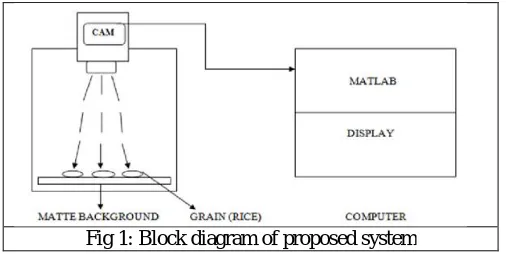
Fig 1: Block diagram of proposed system
The block diagram consists of: • Camera;
• Matte background; • Personal Computer.
the camera, matte background, the computer. This high-performance camera, with least noise and good gain control, was cheap and commonly available in the market. Camera will confine the image which is used for post processing. Camera is linked to the computer through USB port. When the grain image scrutiny system was prepared, some samples of cereal grain (rice) were sited on the matte background. In order to lessen the impediment of image segmentation and improve the measurement correctness, the grain sample should not contact with each other [2]. The light strength should also be taken into account as the readings should not be erratic which acts as avital parameter from the accuracy point of view.
On above of the platform a camera will be set which acquire the grain images, preprocessed by means of the methods of image enrichment and sends it to the computer. A computer is used to procedure the grain image and calculates related data using MATLAB software. MATLAB software system developed with logic algorithm provides direct consideration of quality of rice grains. It provides all pertinent parameters about rice grains by image analysis [3].
Morphological features are the most representative features to portray the shape of the object in the image. Algorithms were developed in windows environment using MATLAB software to extract morphological features (area) of individual rice grain. And the consequent result will be compared with the stored database and thus the classification will be processed.
A. Algorithm
An input for the algorithm is the rice sample whereas the output is classified rice grain type (basmati, kolam, rice tukada)
Begin
Step 1: Pre-process the images of rice to remove the background noise.
Step 2: Convert the pre-processed image to more precise image using “double” function. Step 3: Region label the binary image.
Step 4: Segment the individual grains present in the image.
Step 5: Remove the geometric features major axis, minor axis and area of all the individual grains. Step 6: Perform analysis on the quality using the average values of the feature extracted.
Step 7: Classify the sample for the type based on the analysis. Stop.
B. Working
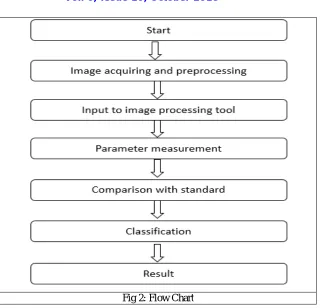
Image of rice sample is acquired by camera and processed by digital image processing tool. Image processing tool measures required parameters of rice samples and then compares with the existing standard through digital image processing techniques as shown in fig 2.
Fig 2: Flow Chart
IV.PERFORMANCEANALYSIS
A. IMAGE ACQUISITION
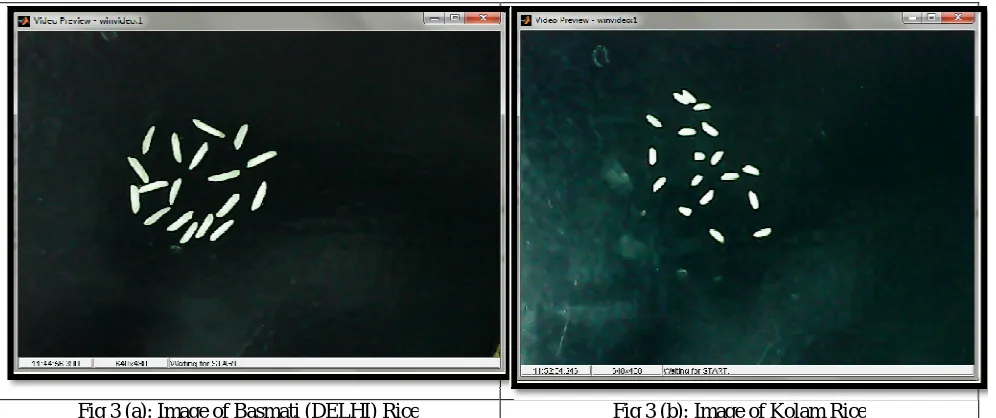
Fig 3 (a): Image of Basmati (DELHI) Rice Fig 3 (b): Image of Kolam Rice
Fig 3 (c): Image of Tukada Rice
B. IMAGE PRE-PROCESSING AND SMOOTHING
Image processing is used to scrutinize the grain images acquired. The aim of pre-processing is an improvement of image data that suppresses unwanted misrepresentation or enhances some image features for supplementary processing. For human viewing, Image Enhancement improves the superiority and clarity of images. Removing noise and blur, rising contrast and enlightening details from images are example of enhancement operation. Noise tends to molest images when picture are taken in low light setting. The proscribed lighting conditions minimize the number of irregular objects such as badly threshold grains. Another issue may be spots on the inside of grains due to camera generated noise. By recognizing these qualities, minor artifacts can be easily removed by using a combination of morphological operations, then filtering remaining objects.
it protect the edges of the image during noise removal and is mostly used in digital imaging and effective with salt and pepper noise .The noise in the input gray color image is detached using median filter.
C. IMAGE SEGMENTATION
After image enhancement, the subsequent process in image processing is the image segmentation and the very first step in image analysis is image segmentation where the image is subdivided into different parts or object. Essentially the image is subdivided until we isolate the interested object from their background. Generally there are two approaches for segmentation algorithms. individual is based on the discontinuity of gray level values and the other on the similarity of gray level values and for this different approaches like thresholding, region growing ,region splitting and merging can be used [1] [6] .Image segmentation is used to locate objects and boundaries in images. Segmentation can also be done using edge detection. Edge detector identify the discontinuities in color, gray level, texture etc. canny, sobel are edge detection operator which are basically used for detecting an edge [3]. One of the simplesttechniques of image segmentation is called the thresholding method. By using threshold value, image binarization is performed. Threshold is used to split the region in an image with respect to the object, which is to be analyzed and this is based on the variation of intensity between the object pixel and background pixel. The other approach is a region growing method used for segmentation.
In the present research work after enhancement our Rice classification based on size consists of morphological processing and thresholding. We can detect the rice grains by subtracting the background from the original image which is done using thresholding of image; the region of each rice grain in an image is detected using region growing. Particularly, image segmentation is the procedure of assigning a label to every pixel in an image such that pixels with the same label share certain visual characteristics.
D. FEATURE EXTRACTION
Morphological Feature Extraction:Extraction of quantitative information from image is deal with feature extraction. The work of categorization and recognizition of object based on various feature such as morphological feature, color feature extraction and textural feature [5]. In the present research work morphological feature are extracted. Algorithms were developed in windows environment using MATLAB 10. Programming language to extract morphological features of individual rice grains. The following morphological features were extracted from images of individual basmati, tukadaetc rice grains [6].
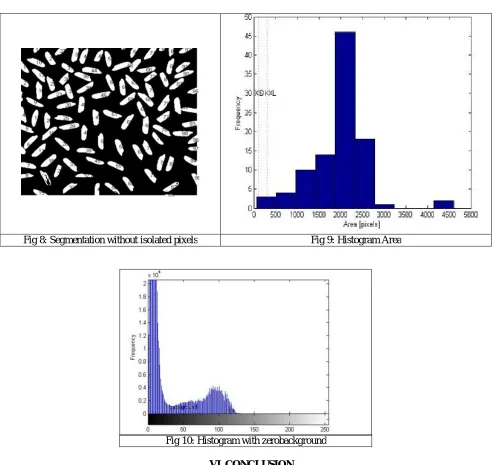
Area: The function sectionprop in MATLAB were used to determine the rice area of a selected region of an image in pixel count. Before applying the function province props, the actual image is transformed into a binary image. The area is the actual number of pixel in the selected region. The pixel counts of the process image rely on the distance among the camera and the object when the picture is taken, smallest distance and larger pixel counts. A reference object is an object with known region, desired to translate the pixel count area.
E.FEATURE MATCHING
The feature matching is referred that it can depend on the rice length and area changes in the induced non-rigid deformation between the two structures, the metric on two varieties of rice grains is accuratelyintegrated into the formulation matching.
V.RESULTSANDDISCUSSION
Image of rice sample is acquired by color Digital Started Camera and processed by Digital Image Processing techniques such as Scaling, Enhancement and Segmentation. Then morphological features are extracted using MATLAB tool and histogram Fig 9 for the extracted parameters are drawn. Based on the comparisons, rice samples can be classified among different categories. From the Fig 10, we can calculate threshold values and thus by comparing the calculated parameter values with threshold values, we can easily classify the rice grains as Normal (Kolam), Long (Basmati) and short (tukada) rice grains.
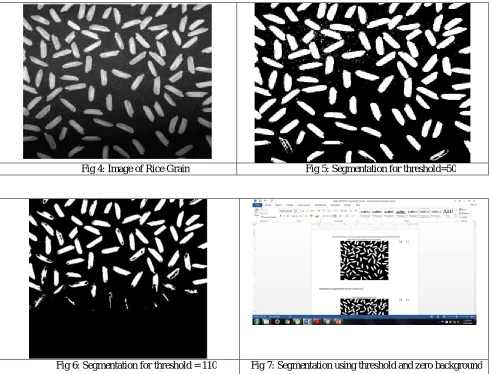
the customer to buy best quality stuff. Fig 7 demonstrates the result of segmentation using threshold and zero background.
Fig 4: Image of Rice Grain Fig 5: Segmentation for threshold=50
Fig 8: Segmentation without isolated pixels Fig 9: Histogram Area
VI.CONCLUSION
The results presented here demonstrates that the classification of rice grain as kolam, rice tukada, basmati using a parameter like area. It is concluded that quality grading of rice samples can be done effectively with the use of Image Processing Technique. With the method discussed, we can grade the rice samples. The setup used is MATLAB which is very common and easily available. This is more accurate than the human visual inspection which leads to better grading of the quality of the rice.
REFERENCES
[1] Yong Wu and Yi Pan, “Cereal Grain Size measurement Based on Image Processing Technology”, International Conference on Intelligent Control and Information Processing August 13-15, 2010 - Dalian, China.
[2] L.A.I.Pabamalie, H.L.Premaratne,“A Grain Quality Classification System,” University of Colombo School of Computing, Sri Lanka, 2010 IEEE.
[3] R.Kiruthika1, S.Muruganand, Azha Periasamy, “Matching Of Different Rice Grains Using Digital Image Processing,” International Journal of Advanced Research in Electrical, Electronics and Instrumentation Engineering, Vol. 2, Issue 7, July 2013
[4] Rubi Kambo, Amit Yerpude, “Classification of basmati rice grain variety using image processing and principal component analysis(2014),” International Journal of Computer trends and technology (IJCTT), Issue May, 2014.
[5] Bhavesh B. Prajapati1, Sachin Patel,” Classification of Indian Basmati rice using digital image processing as per Indian export rules”, Information Technology Department, Patel College of Science and Technology, Indore.
[6] Daljeet Kaur “Classification of rice based on morphological and colour analysis using IP”, Assistant Professor ECE, UIET Punjab University, Chandigarh, India.
[7] Vidya Patil, V.S. Malemath, “Quality Analysis and Grading of Rice Grain Images”, Dept. of CSE, KLE Dr M S Sheshgiri COE, Udyambag, Karnataka.
[8] Prof. A. H. Kulkarni, “Classification and Quality Analysis of Food Grains”, IOSR Journal of Computer Engineering (IOSR-JCE), Volume 16, Issue 4, Ver. III (Jul – Aug. 2014), PP 01-10
[9] Z.B. Sun, J.R. Cai, S. Jiang, "Application and research on the measurement of grain size of food using image processing", Food Research and Development, vol. 26, no. 6, pp. 164-166, Aug. 2005.
[10] SanjivaniShantaiya, Mrs.Uzma Ansari. Identification of Food Grains and Its Quality Using Patten Classification. Special Issue of IJCCT Vol. 2 Issue 2, 3, 4; 2010 for International, December 2010
[11] Harpreet Kaur, Baljit Singh,” Classification and Grading Rice Using Multi-Class SVM”, International Journal of Scientific and Research Publications, Volume 3, Issue 4, April 2013.